
Radisson RED Twickenham, UK
Designed by DLSM Studio, with lighting from Into Lighting, the newly opened Radisson RED at Twickenham’s Allianz Stadium celebrates the heritage, energy, and community spirit of rugby culture, with an additional vibrant flair.
At the home of English rugby, a new hospitality destination has opened up that fuses vibrancy and tradition, in an effort to encapsulate the aesthetic of the modern game.
Radisson RED London Twickenham is situated within the iconic Allianz Stadium (Twickenham) – owned by the Rugby Football Union (RFU), and operated by Aimbridge Hospitality EMEA, the property has been fully reimagined with the bold, dynamic personality of the Radisson RED brand, underpinned by a design narrative that celebrates the heritage, energy, and community spirit of both the RFU and rugby culture.
Spearheading the design of this new hotel was DLSM Studio, whose work spanned across the property’s 150 guest rooms, reception, lounge, co-working areas, event spaces, and washrooms – as well as two newly formed social concepts: The Loft, and The Huddle.
The Loft, situated on the mezzanine floor, consists of a bar, gaming area, and premium lounge space; while The Huddle, on the ground floor, is the main bar and restaurant for the property, appealing to both locals and hotel guests alike.
With this in mind, DLSM Studio approached the studio not only as a design exercise, but as a chance to reposition the hotel’s role within Twickenham.
Guided by extensive strategic insight, the team undertook a detailed study of the hotel’s operations, guest profiles, community needs and wider market potential, identifying the importance of creating a destination that would resonate beyond matchdays, when the stadium welcomes up to 82,000 spectators.
The result is a concept that actively appeals to local residents as well as guests, with co-working spaces, all-day lounge zones and art-infused social areas offering a warm, everyday backdrop to work, relax, dine, and gather.
Alongside the community-centred approach, DLSM Studio hoped that the interiors could match both the identity of Radisson RED as a brand, and also of RFU – a process that Emma Caballero, Interior Designer at DLSM Studio describes as “surprisingly smooth”.
“We found the sweet spot in between RFU’s brand identity, and that of Radisson RED. By selecting materials such as black metal, which can feel harsher and more urban, and coupling with reeded glass, which feels a bit softer and more elegant, there was a marriage of materiality, tactility, and different levels of energy across the various zones that works really well. There were high expectations, as both RFU and Radisson RED were really excited about how the future of the hotel could look – they both saw the potential of what we could bring, especially to the new spaces.”
DLSM Studio therefore understood that lighting would be integral to achieving this urban, yet elevated aesthetic. To that end, Into Lighting was invited to tender for the role of lighting designers by the RFU, project managers NBM, and DLSM Studio, based on its portfolio of completed hospitality projects.
“We knew that lighting was going to be key from the get-go, and it is something that we considered from the beginning of the concept stage,” Caballero adds. “Into was appointed when we were still doing the mock-up room. We had already developed the visuals for the whole hotel and had them approved by the RFU, so we knew what we wanted to achieve, but we didn’t know exactly how. Hosting a workshop with Into and talking through our vision, their team broke it down and proposed a very layered scheme with various approaches to the architectural, feature, and integrated lighting.They advised on where exactly to position LEDs, on the finishes to the artwork, and so on – they were really helpful.”
Darren Orrow, Director at Into Lighting, adds: “DLSM Studio had a strong vision for the interior design concept and the ambience. They wanted to push the boundaries creatively while also aligning with Radisson’s brand guidelines. Some bespoke, high-impact lighting concepts featured in their vision, and we had a series of design workshop sessions where we explored, challenged and developed a number of ideas – reviewing working samples and mock-ups.”
The lighting concept for the hotel was developed in conjunction with DLSM Studio as an integral part of the interior architecture – supporting further the bold brand identity of Radisson RED, while responding sensitively to the building’s unique context within such a renowned sporting location.
The approach, Orrow explains, was therefore centred on creating an atmosphere that feels “energetic, yet refined”, blending moments of drama with warmth and intimacy.
“Lighting was used not simply to illuminate, but to shape perception, guide movement, and create emotional resonance throughout the guest journey – from arrival and public spaces through to more intimate areas of retreat,” he says.
A carefully layered strategy combines architectural lighting, decorative elements, and accent illumination to establish depth and contrast. In public areas, controlled highlights draw attention to textures, materials, and key design features, while darker interstitial zones allow the illuminated elements to stand out, creating a sense of rhythm and visual intrigue. The lighting also aims to respond to the bold forms and colour palette set out by DLSM Studio, enhancing materiality without overpowering the interior narrative.
Orrow continues: “Dynamic contrasts between light and shadow were intentionally employed to reflect the vibrant, playful character of the Radisson RED brand, while warmer tones and softer transitions ensure the spaces remain welcoming and comfortable for guests. Throughout the project, glare control and visual comfort were prioritised, particularly in lounge and social areas, ensuring the lighting supports both social interaction and relaxation.”
Working closely with DLSM Studio, Into homed in on a palette of architectural light fixtures, integrated fixtures for use in joinery, and decorative and bespoke options. The decorative solutions primarily came from DLSM Studio, who Orrow says “had a strong narrative and aesthetic for the decorative lighting”.
From here, Into assessed through lux calculations how much light these would contribute to the overall ambience. Using this data, Into then considered if and where any additional architectural lighting was needed – resulting in the specification of additional integrated lighting, downlighting, and track spotlights.
“We also assessed the required dim protocols for the decorative lights, and their compatibility with the lighting control system. In some cases, this meant some fixtures were not suitable and had to be reselected,” Orrow adds.
“Into provided guidance on a number of large scale bespoke light features, which were a crossover between architectural and decorative features.”
Elaborating further on the narrative and aesthetic for the decorative lighting, particularly in the public-facing hospitality spaces, Caballero says that DLSM Studio had two different strategies.
“For the ground floor, we took a calmer and more welcoming approach, easing guests into the space, while still having that bold, fun aesthetic associated with Radisson RED – but it was about creating an approachable entrance to the hotel.
“Decorative lighting, such as table and floor lamps, was therefore used to soften the space, creating cosy nooks to compliment the layered interiors that are brought to life with curated dressing items and quirky artefacts, reflecting the rugby culture and Radisson RED personality.”
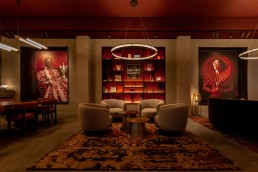
Indeed, the lobby of the hotel has been transformed into a vibrant, multifunctional space where dramatic colour contrasts, layered textures and curated artwork create a sense of energy and connection – a sense that Orrow feels is further strengthened through a combination of “high impact and unique statement lighting pieces”, while ensuring that all textures, graphics, and displays were theatrically lit.
Taking centre stage in the lobby space is a bespoke, sculptural installation of a female rugby player integrated into a structural column, symbolising the RFU’s commitment to its “Every Rose” five-year action plan to elevate women’s rugby. This statement piece serves to reinforce the hotel’s connection to its setting, while amplifying the inclusive values at the heart of the RFU’s vision.
Connection was also key to the design of The Huddle, the hotel’s standalone restaurant, where DLSM Studio looked to create a stronger link with the local community.
Influenced by the crafted materiality of historic rugby equipment, such as stitched leather and rugby shirt-inspired stripes alongside warm timber detailing and tactile finishes, the restaurant presents a playful, artisan-led environment that shifts between casual dining, weekend socialising, and the high-energy atmosphere of match days.
Lighting here emphasises the warm materiality of the space. Into wanted to create a warmer, cosier environment in The Huddle, so they specified 2700K for all architectural lighting and 2200K for all integrated lighting to architectural details, joinery and decorative lighting. In all other areas the colour temperature of the decorative lighting was adjusted between 2200K and 2700K to suit the use of each space and what CCT worked best visually with a particular light fixture.
In the first-floor event space Into specified tuneable lighting for the bespoke light rings. The lighting in the event space is DALI addressable, which gives the Client maximum flexibility on the use of the space and zoning of the lights.
Through careful circuit grouping of light fixture types, Into could also transition from higher ambient light levels during the day, to low-level, intimate, and theatrical lighting post-dusk and into the evening.
On the first floor, in The Loft, everything was designed to be bolder, and more fun and playful, with a focus on having key, feature ceiling lights.
“We had the idea of bringing the feeling of motion and movement, inspired by the players on a rugby pitch,” Caballero adds. “We wanted to add a neon-style light running across the whole floor, like a long exposure of film. Into was really helpful in terms of specifying this lighting. They had done this before, so they were mindful with the key suspension elements, so that we didn’t have too many, but enough to make it a flowing piece. The lighting really brings energy to this social space.”
An experience that was not without its challenges though. On the key difficulties that were faced during this project, Orrow recalls that, due to the fact that the site was a preexisting hotel under another brand, there were elements of the ceiling, wiring and services that were initially considered to be retained due to cost. “This meant that we had to design ceiling recessed and mounted lighting with this in mind to avoid any existing architectural construction and services,” he says.
“It was a challenge to balance use of existing locations and void depth with the new interior design layouts. But, as the project progressed, it was decided that the ceilings would be replaced, and we then had to rework the detailed design to accommodate this, while not undoing the detailed lighting design and circuiting approach.”
Caballero concurs, adding: “Transforming this property into a Radisson RED brand with various stakeholders involved required a strategic approach to design. Meeting the needs of the RFU, Aimbridge and Radisson, the property required a bold re-design to signify change and extend its appeal to the wider community, which included a review of the hotel’s offering. Delivering spaces that welcomed hotel guests and the public to rest, gather, dine and socialise within, from morning through to night.”
Indeed, this focus and emphasis on transitioning the spaces through the day with the lighting has paid off, as the dramatic, atmospheric light installations help to shape the hotel’s overall identity, intensifying the bold visual language that is at the heart of the Radisson RED experience.
Reflecting on the project, Orrow concludes: “The lighting enhances the architectural language of the hotel, and amplifies the interior concept, delivering a distinctive atmosphere that is rooted in both place and brand.
“We have worked with DLSM Studio on many projects over the years – they understand the value a lighting designer brings to a project. They listen and learn, but still challenge to ensure their vision is realised. Through this close collaboration with both DLSM Studio and the client team, we feel that we have delivered a cohesive, immersive environment that balances bold expression with subtlety – creating a memorable experience for guests at this landmark location.”
Client: RFU, Aimbridge Hospitality EMEA
Lighting Design: Darren Orrow, Anthony Stead; Into Lighting, UK
Interior Design: DLSM Studio, UK
Lighting Specified: Aromas, Astro, Atea, Bomma, Chantelle, Demo Lights, Dyke & Dean, Eicholtz, Enigma, Encapsulite, Flos, Frandsen, Illumination, Insight, Kemps, Lamp Twist, Light Box, Made In Design, Marset, Mode Lighting, New Works, Nocturne Studio, Optelma, Philips Kazzar, Polpo Products, Pooky, Royal Design, Segula
Photography: Stevie Campbell Creative