
Milan Design Week 2026
Returning this April, Milan Design Week once again saw the Italian city awash with visitors eager to see the latest trends and innovations in design. Ellie Walton, reports back on her findings in an exclusive from Milan.
Milan Design Week is on everyone’s lips come Spring. For me, it’s my favourite event of the year. Ever since experiencing my first show last year, I’ve been counting down the days until my return to the capital of design. My colleagues have spent years singing its praises, and now I completely understand why. The city brims with energy, ideas and creativity; add glorious sunshine and a few well-earned aperitifs, and it hardly feels like work at all.
With Euroluce not taking place this year, I’d imagined a more leisurely pace this edition, wandering between exhibitions, perhaps even squeezing in a little sightseeing. But I couldn’t have been more mistaken. My schedule quickly filled up, back-to-back with exhibitions, interviews, product launches and installations. Factor in a few missteps navigating Milan’s streets with Google Maps, and time seemed to vanish entirely. No rest for the wicked, as they say.
This year, I saw Milan revealed not in brightness, but in glow. I dislike using the word “trends” because I think it carries connotations of being a momentary phase, and, from what I saw in Milan, I believe we are beyond fleeting trends, and focused instead on innovation and creating design that is symbiotic with our evolving lifestyles.
Moving through Milan this year, it became clear that the larger consensus on light is that it is no longer just something to look at or see with; it is an active force in shaping atmosphere, a spatial tool, and a material that can be bent and shaped, taking on a role that extends far beyond simple illumination.
Lighting as Atmosphere
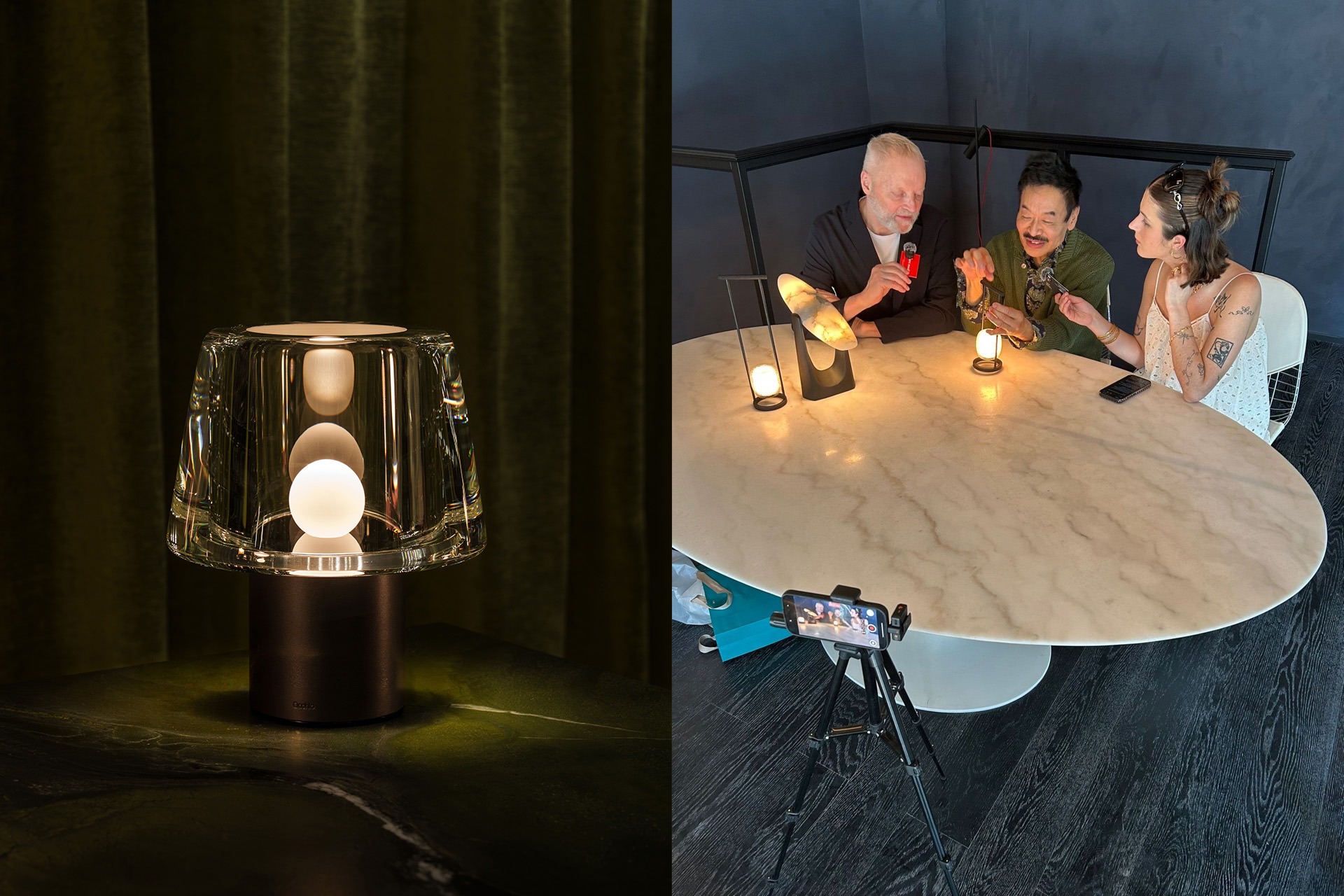
First on my list is that light shouldn’t be framed primarily as a functional tool, but as an atmospheric presence – something ambient, possibly mobile, and often sculptural. In the decorative lighting sphere, an influx of portable and freestanding luminaires has surged in the last year. A demand has clearly been heard from hospitality spaces wanting portable pieces for their tables, as well as residential homes, which now see the benefit of having a mobile source of light to take anywhere with them. Both Occhio’s Era and Moorgen’s latest collaboration with renowned interior design studio, Yabu Pushelberg, released less conventional lamps and more luminous artefacts.
Occhio’s Era premiered in their showroom in the infamous Corso Monteforte area (a hot spot for lighting design) under the title The Art of Reflection. Crafted from a solid block of polished glass and controlled through subtle gesture via motion sensors, Era relies on reflection to produce a warm, enveloping glow. Presented in the showroom on a velvet table, Era was displayed like a jewel – almost like a metaphor for light being something precious and atmospheric, not just simply functional.
A more restrained but equally evocative approach appeared in Yabu Pushelberg’s latest collaboration with the Chinese brand, Moorgen, on Moonbeam. Drawing on the form of the traditional lantern, the table map diffuses light evenly from within, avoiding directional performance altogether. Portable and sculptural, it continues the emotional and poetic idea of light.
“There’s something romantic about how light was understood centuries ago, a sensibility in China and across Asia that, with the invention of electricity and artificial illumination, lost a certain quality. When the light bulb was invented, I’d say it was almost an intrusion into our lives because it wasn’t focused; it simply answered a practical need to help us find our way,” says George Yabu, Co-Founder of Yabu Pushelberg, talking about Moonbeam’s inspiration.
Fellow Co-Founder Glenn Pushelberg adds: “With this piece, there is of course a feeling of being Chinese, but it also feels worldly, which is lovely. As George says, there’s a friendliness and happiness to this lamp, the colour, the glow and the simple form. It’s essentially a double-sided cast glass disc with an LED light source at its core. But when you look at it, it’s like looking at the full moon: not just a perfect flat disc, but something with craters and terrain.”
Meanwhile, further down Corso Monteforte, Flos transformed its professional space into an enigmatic, sci-fi environment to introduce Nocturne, Konstantin Grcic’s latest modular system. Referencing the quiet vastness of 2001: A Space Odyssey, luminous grid panels displaying iconic design pieces extended through space, situating the lamps within an abstract and cinematic landscape. An evolution of Grcic’s Noctambule, Nocturne offered a refined, discreet presence: controlled emission, no glare, and light that travelled through glass to produce calibrated reflections and transparencies.
Together, these projects suggest an importance for sculptural art in the lighting world, rather than ostentatious pieces that demand your attention; these objects allow themselves to be in a space with presence but with softness, rather than a deliberate beam of light.
Lighting as a Spatial Tool
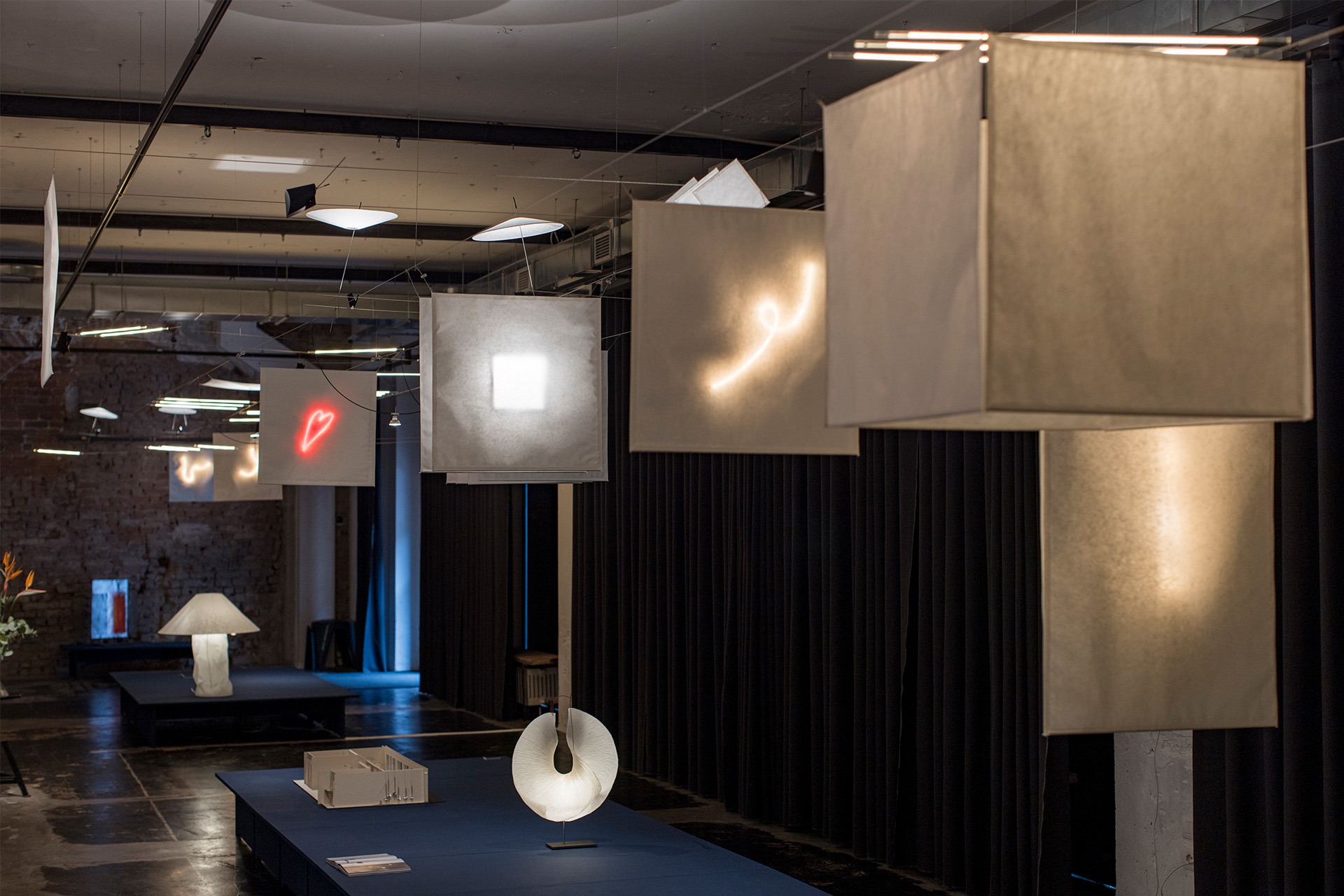
If lighting as atmosphere was about softness and presence, Ingo Maurer’s Here We YaYaHo Again demonstrated lighting as structure and fundamentally spatial. Installed at Via Varese 13, the project revisited the iconic YaYaHo system, which was first introduced in 1984, updating it for contemporary use without losing its original spirit.
The original YaHoHo was designed as a framework rather than a fixed object. Its tension wires allow luminaires to be positioned freely across the space, allowing the user to shape light freely.
Axel Schmid, Head of Design, presented the installation and explained the aim of the new interaction was never to separate the old and the new, but to allow them to coexist by keeping the former structure and updating it with new technologies such as discreet LED lines encased in glass to create a softer, more architectural light. The system can also move further than horizontal, enabling elements to rise and fall, or even use Japanese paper elements that can double up as room dividers. Japanese paper elements also transform light, introducing a diffused look or even ‘draw’ neon signs.
Crucially, the installation encouraged interaction and play, which guests experienced during the Ingo Maurer party while a DJ spun tunes and served YaHoHo-themed cocktails to boot. What’s interesting about the YaHoHo is that components can be refigured, adjusted, and mixed over time – reinforcing the idea that light is something to live with, mould, and reshape rather than a fixed place.
Experimental Materials and Research
Alongside new products and systems, I have always had a keen interest in materials research, ever since starting the materials feature in the magazine. Several presentations moved away from finished products, favouring more open-ended investigations in which process and testing took precedence over immediate commercial outcomes.
The HYLETech installation, Light in Matter: Architectural Variations bridges the ideas of both light as a spatial tool and experimental materials; however, more technologically driven. Appearing at the Triennale Milano, the installation framed light and technology as active components of architecture. Exploring the concept of the “active wall”, the installation proposed architectural surfaces that integrate illumination, energy, and sensory functions into a single plane. Across its wider Milan presence, HYLETech Lab positioned itself less of a supplier and more as a design partner, operating between material research, spatial atmosphere and technical innovation. In contrast to the openness and play of Ingo Maurer’s YaHoHo, HYLEtech Lab suggests a future where light is increasingly absorbed into the architecture as embedded and continuous.
Moreover, Foscarini’s exhibition at the Spazio Monforte, which explored the interaction between light and 3D knitting. Rather than presenting a resolved collection, the showcase framed lighting as an experimental discipline, and examined how textile structures can diffuse light in new ways. The project was led by designers Jozeph Forakis and Lorenzo Palmeri, who worked on two different approaches to the territory of 3D knitting. Forakis, who collaborated with TexTech to generate unusual volumes through adaptations of machines and unconventional yarns, says:
“Traditional diffusers act like walls; they are barriers that light must either fight through or bounce off. A three-dimensional knit creates an entirely different dialogue. Because the material possesses genuine structural depth, varying densities, and deliberate voids, light doesn’t just hit a surface; it inhabits it. The light is gently caught, filtered, and sculpted by the micro-architecture of the stitches. The entire object transforms into a breathing volume, shifting the experience from a functional illumination source into a living, sensory atmosphere that softly redefines the space it occupies.”
Palmeri, meanwhile, worked with MAS Knit Factory and Arman Avetikyan, adapting techniques rooted in fashion craftsmanship. His investigation centred on the ability of flat textile surfaces to generate volume, using traditional tailoring strategies and carefully calibrated cuts to convert fabric into a kind of textile kirigami.
Speaking to Palmeri on his discoveries, he says: “I realised we were not simply creating decorative effects, but an entirely new behaviour of light.
At that point, the project began to open up broader scenarios, not only connected to these specific pieces but also to a possible design language. The interesting aspect was that every variation in yarn, density or structure deeply transformed the luminous atmosphere, almost like working with a living material.
A quieter but equally material-led exploration appeared in Preciosa’s Drifting Lights, presented in an immersive installation at Tempesta Gallery in Brera. Composed of suspended panels of bubbled glass, the work explored how light and colour interact through texture and depth rather than form alone. Using the brand’s 3D patch light effect, the installation transformed the gallery into a slow-moving field of reflections, where light appeared to drift across and within the glass surfaces. Less concerned with spectacle, Drifting Lights reinforced the idea of lighting as a craft-driven and atmospheric medium, one rooted in material behaviour and emotional resonance rather than technological display. (Read more on page 52)
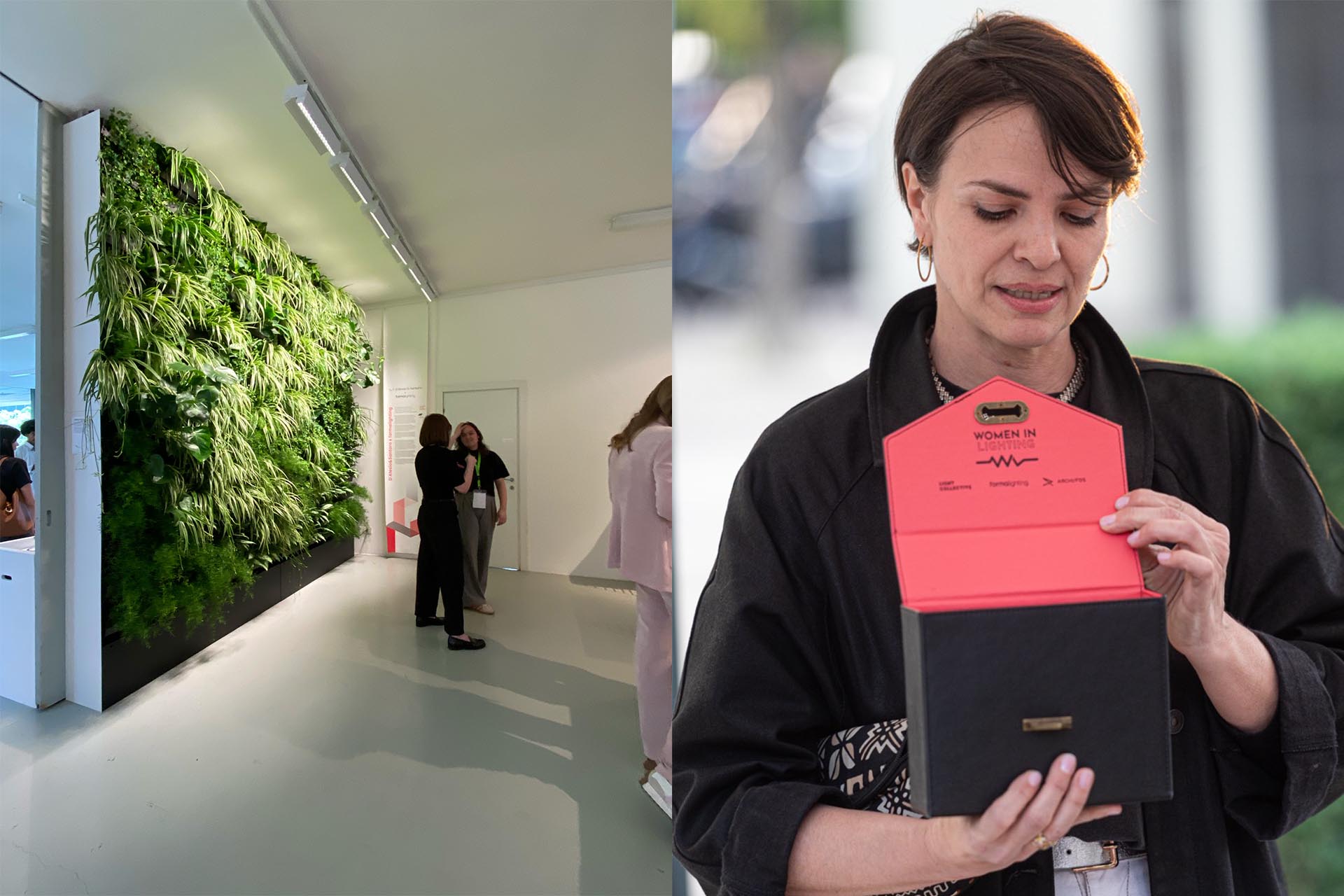
Continuing the exploration of innovation, a notable mention would be formalighting’s installation, ORNAMENTALE, with design studio D’Alesio&Santoro. I encountered the installation during the Women in Lighting event hosted by formalighting’s Director of Operations, Sharon Maghnagi and Giorgia Brusemini, Women in Lighting Amassador for Italy. Designed around the real needs of indoor plants, ORNAMENTALE combined phytostimulating LED spectra with a high colour rendering index, allowing greenery to thrive without compromising the chromatic quality of the surrounding space. Rather than treating plant lighting as a technical add-on, the system positioned it as an integrated architectural layer, adaptable across walls, flowerbeds and vertical installations. Seen alongside the conversations unfolding during the evening, the project underscored how material research and technology were key in Milan’s wider lighting discourse.
Community
Beyond the installation itself, the Women in Lighting (WIL) gathering foregrounded the social and professional networks that continue to shape the lighting industry. Hosted by Maghnagi and lighting designer and WIL ambassador, Giorgia Brusemini, the event at Ratanà offered a more informal yet meaningful counterpoint to Milan’s dense exhibition schedule. Conversations unfolded around long tables of delicious food and aperitifs rather than display plinths, reinforcing the sense that lighting culture is sustained as much through mentorship and shared experience as through objects and installations. In a week often dominated by spectacle, the evening served as a reminder that progress in lighting design also needs to happen within the social sphere through community and gender equality.
Wrapping up my experience during Milan Design Week 2026, I would suggest there is a move of priorities from designers within the lighting world, one that shifted from atmosphere over assertion, systems over standalone products, and research over immediate solution. To me, interiors are starting to focus on comfort and innovation over spectacle; however, the design isn’t compromised in the process. Whether through nostalgic references, experimental craftsmanship, or sustainable innovations, this year’s Salone del Mobile suggested the future in lighting design lies in balancing technology with warmth and meaning. Milan doesn’t simply present trends, it offers a vision into a more thoughtful experience vision that will exceed 2025.