
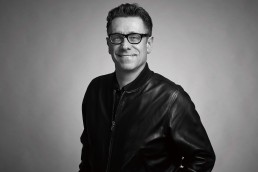
Hervé Descottes
In May of this year, Hervé Descottes, Founder of L’Observatoire International, was awarded the Architecture Prize by the American Academy of Arts and Letters – the first time a lighting designer has received this honour. arc editor Matt Waring visted Descottes at L’Observatoire International’s New York studio to talk about this recognition, his approach to lighting design, and how his career has seen him collaborate with a whos-who of the world’s leading architects.
If you were to come up with a “Bucket List” of star architects that you had to work with at some point in your career, there is a very real chance that L’Observatoire International founder Hervé Descottes has already worked with them.
With a list of collaborators that includes the likes of Frank Gehry, Jean Nouvel, Bjarke Ingels, Shigeru Ban, Diller Scofido + Renfro, Steven Holl, and Thomas Heatherwick, among many others, Descottes has, for more than 30 years, built a staggering portfolio of incredible projects from around the world, where light is combined with architecture to create unparalleled, immersive atmospheres.
From art and cultural institutions, museums, and performing arts centres, to public spaces, hospitality, luxury commercial and infrastructure projects, L’Observatoire International uses light to reveal both the aesthetic qualities of a space, and accentuate the experience of an environment, regardless of its application, to create a bespoke ambience.
For Descottes, this has been a core tenet for the studio since its inception in 1993; speaking to arc magazine at L’Observatoire International’s New York studio, he says that, from the offset, he has been very focused on sending the right message and retaining the “integrity” of light.
“It is so important that we are not just lighting a space or an object or a room, but rather that the lighting comes from it. We need to understand extremely well the intention behind creating an experience – whether it is a landscape, a room, an interior design, or a piece of architecture – and ask what we want people to feel. Once we understand the feeling that we want to express, and hear the architect’s vision for the lighting, we can start to integrate lighting.
“I have been extremely fortunate to work with the greatest architects of their generation. By understanding the meaning of the experience that they want to create for their visitors, and understanding our position as lighting designers, I am not looking to take too much space in their creation. Instead, I create just what they need so that they can express what they have to express.”
Born in Dijon, Burgundy in France, Descottes recalls playing with coloured lighting in his bedroom during his teenage years, experimenting with red, green and blue sources to “create magical shadows on a ceiling”.
However, it wasn’t until he moved to California to study English that he really “discovered” lighting design as a profession.
“I worked for a little bit in an engineering studio at an electrical company in France, but when I came to America to study, I found a job in a lighting design office. I was helping out, more to practice my English than anything else, and I discovered that lighting was talking to me, and it was an easy conversation. Reading the architecture plans, understanding what lighting could do, looking at the effects, the materials, it started to excite me.
“It started a relationship with lighting that I never left. Whatever I was doing, I would always connect it back to lighting design. I kept that dialogue going and never changed path.”
Descottes’ time learning English in America proved useful almost immediately on returning to France, when he met a fellow lighting designer, Georges Berne, who was at the time working with I.M Pei on the renovation of the Louvre Museum and its Richelieu Wing. Kickstarting his career-long habit of working with the best architectural minds in the world, Descottes was brought on board to assist.
While working with Berne, even at this relatively early stage in his career, Descottes had grand ambitions for something bigger. “I started working as an employee, but very rapidly I thought ‘I don’t feel myself to be an employee’. Sometimes you feel something calling from inside you and I thought ‘I really want to create my own studio’. So, I asked Georges if we should partner, and together we created L’Observatoire One.”
While the lighting design profession was still in its infancy in France, through L’Observatoire One, Descottes and Berne worked on a number of high-profile institutional projects across the country; from the aforementioned Richelieu Wing at Le Louvre, to the Musee des Beaux-Arts de Nancy and the Musee des Beaux-Arts de Lyon.
After eight years of design practice in France, Descottes returned to America in 1993. While working with I.M. Pei, Descottes met his first wife – an architect who was from the USA. She had been accepted into Columbia University, and so, he followed. “I was young, I was hungry, I was happy to discover the world, and I love America, so I thought ‘let’s do it’.” This was how L’Observatoire One became L’Observatoire International.
Once established in New York with L’Observatoire International, Descottes built the firm around a philosophy that is centred on the “interdependence between form and intangible atmospheres” that define our interpretation of the environments that we inhabit. Meaning that our visual understanding of the world is defined through both material and light – two phenomena that, while seemingly opposite in nature, are inextricably linked; light is revealed to the human eye through interactions with surfaces and objects, while these elements only visually exist in the presence of light.
The goal for Descottes and his team, therefore, is to harmonise the role of natural and artificial lighting in revealing the drama and nuance of the built environment through a conscious play between light and shadow.
All of this, Descottes explains, comes back to a primary understanding of the ‘why’ behind each project. “The name is L’Observatoire International, because you have to observe first. You have to express, and really understand the meaning,” he says. “Some architects have their own signature; some are constantly creating. So, how do we fit? Whether a vision is very artistic, or all about the function, how can we create that dimension and build that bridge between the experience of a space and its function?”
This task is made no easier with the wide variety of architects that Descottes and his team collaborates with – each with their own distinct style and approach. While, over the years, Descottes says this has become easier, he explains that, especially in the early days, it took a lot of research.
“I always studied the architecture. I wanted to make sure that I knew with whom I was working,” he says. “Now, it is different because we have such a long relationship and know each other extremely well, but in the beginning, we had to understand the meaning: Stephen Holl hiding every source of light; Frank Gehry really expressing volumetry, compressing or expanding space. How do you create a dark bright, or a dynamic, extremely dramatic, very strong rhythm? You are not going against his drama, but with his drama. Or working with Jean Nouvel, who is constantly changing everything.
“It’s a constant process of creativity, and we have to keep that creativity ongoing because we are responsible for delivering a project on time and on budget. So, we are always listening. It’s a lot of manoeuvring. Sometimes there will be a very different opinion on what the space should be. This is part of our challenge, but sometimes life is full of contradictions, and spaces can be too.”
This collaborative approach between L’Observatoire International and its laundry list of “starchitect” design partners has resulted in a plethora of stunning projects that beautifully fuse architecture and lighting into memorable landmarks.
However, rather than reflecting on these landmark destinations, when looking back on career highlights, Descottes prefers to remember the creative journeys.
“It is more about how we collaborate,” he explains. “A landmark exists as a feature, but we would remember more the process. There are beautiful projects, of course, like the collaboration on the High Line in New York, it’s definitely very prestigious. Or the Fondation Louis Vuitton or Fondation Cartier in Paris, the Guthrie Theatre in Minneapolis with Jean Nouvel, Kiasma was one of the first projects that we did with Steven Holl. There’s definitely a long list, but the fact that every one of these architects returned and asked us to collaborate on more projects, and that we are still working with all of them, means more.
“Frank Gehry unfortunately left us last year, but the studio is calling us, and we have some new projects coming up with them. It’s all about finding your place in the tribe. We all belong to tribes, and while I think architects are very tribal, I am pleased to be a part of their tribe.”
Within this “tribe” Descottes and L’Observatoire International collaborate with architects on a broad array of projects, ranging from large scale masterplans and cultural institutional projects, to residential, workspace, and boutique hospitality venues. And while Descottes says he cannot pick a favourite project from across his body of work, there are certain sectors that he enjoys working on more than others.
“There are two main groups – there are the great institutional projects like museums, theatres, performing arts centres, auditoriums, etc. We have done a lot of work there. But also, hospitality – hotels and restaurants. I love chefs. I love food. I love good wine. And we have had some good collaborations with many great brands, hotels, hoteliers and chefs.
“Jean-Georges Vongerichten has been my best friend for more than 25 years, and we have worked on many projects with them. I met Andre Balazs for the Mercer Hotel about 25 years ago and we’re still working on these properties. Again, it’s all about finding the people that you are comfortable with, that are comfortable with you, and understanding and listening to them.”
As the studio name might suggest, with such a vast array of projects around the world, L’Observatoire International has over the years expanded globally with the opening of studios in Paris, Seoul, and, most recently, in London. Descottes says that this worldwide expansion is something that he “never thought about”, but rather, something that occurred organically.
“We are always looking for great collaborators,” he says. “And when you find someone that you work with very closely for many years, and their private life takes them somewhere, you think ‘OK, maybe this is a good opportunity to expand’. Jessica Tchah, our Project Director in Seoul, has been working with me for nearly two decades, and having a presence in Asia is great. It makes it easier – we don’t have to travel so much, she knows how we work here, we collaborate and she uses some of the team based in New York.
“It is the same with London – Leah Xandora was here in New York for more than eight years, but she is from London and wanted to go home. And to have these people on the ground is hugely beneficial. It gives us a presence in these regions, and allows us to understand the culture and the way of working better.”
Across his career, Descottes has been recognised several times by the lighting design and architectural communities, picking up awards from the IALD, IES and American Institute of Architects. Most recently, in May of 2026 he was awarded the Architecture Prize from the American Academy of Arts and Letters – the first time that a lighting designer has received this accolade.
Reflecting on this award, Descottes says: “My parents would be very proud. I never thought that I would be recognised and to receive an award as prestigious as this one, I am honoured, it is really touching.”
He also hopes that the award serves as a demonstration of the growing appreciation that the wider design community has for lighting design, and the integral role that light plays in bringing architecture to life.
“Today, everybody knows everything, everybody is everything. Everyone is a journalist, an architect, a fashion designer, a lighting designer. There is so much exposure that what we do is a little bit more acknowledged and understood by people.
“I often compare our work to the movie industry, when I say that we are like the Director of Photography for a movie. Yes, you know a few of them, but rarely over the Director of the movie, but as a role it is so key.
“It’s good also for more people to know that lighting design is a profession that is there, that is inspiring for people. If you are interested in architecture, there is so much more to it than just architecture; you have different disciplines like landscape, lighting, acoustics. You can enter a whole new world.”
But as the lighting design profession gains more recognition, and particularly as technology continues to advance within the field, Descottes believes that the core principles, the philosophy behind each studio, should remain the same.
“It is so important. The philosophy is why it is going to make a difference – it is the reason that we are doing what we do. Every project should start with that ‘why’.
“I think that we will reach a hiccup at some point, and the meaningful will win. Sometimes we see things passing through and think ‘what is that? “Why does everything have the same value? It makes no sense’. Learning about technology is great, but understanding the philosophy is very important.”
As for Descottes’ ‘why’, while he jokes that he does what he does because he is “pretty good at it”, there is a passion and a privilege that he feels through the work that he is doing.
“When I wake up in the morning, I am very happy to do what I do. I am still extremely passionate about what I do. And I am so fortunate to feel the light the way that I feel the light – to see what I see and to be able to articulate a space or a room and bring a warmth or create an incredible emotion within that space. Just last night, we were setting up a new project, which is going to be in the beautiful Breuer Building, which was previously the Whitney Museum, and it was great. The emotion, the way we warmed up this brutalist architecture and brought some love in there, it was fabulous.”
Looking to the future, Descottes is keen to continue building on the “passionate relationships” that he has built with the world’s best and brightest architects, while also hoping to carve out connections with new design partners.
“Recently, we have been working on a few projects with Francis Kéré, who is based in Berlin but originally from Burkina Faso. With his African background, he brings a very different culture and a different approach – the way that he sees and wants to control the light, the relationship between daylight and artificial light, it is great.”
And as for the work he is doing with L’Observatoire International, Descottes has just one word: “more”.
“We want more. No compromises, just great projects with real stories and real integration, and great, meaningful design.”
Based on the work that Descottes has done with L’Observatoire International over the past 33 years, “more” can only be a good thing.
www.lobsintl.com