
Architect Frank Gehry dies aged 96
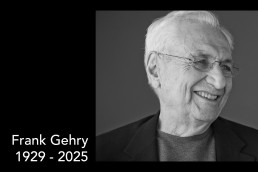
(USA) – One of the most influential architects of our time, Frank Gehry passed away on 5 December aged 96 after a course of respiratory illness.
His death was confirmed by his chief of staff Meaghan Lloyd. He is survived by two daughters from his first marriage, Leslie and Brina, as well as his wife, Berta Isabel Aguilera, and their two sons, Alejandro and Samuel.
Born in Toronto in 1929, Gehry moved to Los Angeles as a teenager to study architecture at the University of Southern California, before completing further study at the Harvard Graduate School of Design in 1956 and 1957.
After starting his own firm, Gehry & Associates, in Los Angeles in 1962, he began exploring unconventional architectural principles, stepping away from the traditional approaches of symmetry. Instead, he used irregular geometric shapes and unfinished materials in a style now known as deconstructivism.
Befriending a number of artists throughout the 70s and 80s gave Gehry the confidence to keep exploring new angles within architecture, despite the lack of enthusiasm from the people of LA.
A series of postmodern metaphors dominated his work of the middle 1980s: the California Aerospace Museum (1984) announced its use with a Lockheed F104 Starfighter hovering over a giant door; a restaurant, Rebecca’s, in Venice, California (1986), dramatised a night out with giant trees, an octopus, alligator and several fish hanging about its interior. Significantly, the overlarge animals and fish were explored multiple times across different media influencing his work for the coming decades.
It was at this point that his architecture began gaining international accolade. In 1989 he received the Pritzker prize, the so-called Nobel of architecture, and in 1992 the Japanese Imperiale award in architecture. Later, he held academic appointments at Harvard and received the Harvard arts medal in 2016. In 2000 he received the RIBA gold medal, and in 2016, from the US president, Barack Obama, the presidential medal of freedom.
Some claim his first breakthrough was a small furniture museum for Vitra held in Weil am Rhein in Germany in 1989. Following this he completed a series of projects, notably a fish sculpture in Barcelona in 1992 and a large mansion for Peter Lewis, an influential insurance man, in Cleveland Ohio. The $82 million Lewis House unfortunately was never built. However, it did allow Gehry the opportunity to flex his creativity, producing designs with wiggly glass, fabric-like roofs, horse-headed rooms and abstract fish.
His style was very divisive, some claiming him to have gone mad, while other religious bodies delighted at his symbolism of fish. The Lewis House project, which lasted 11-years before it was cancelled, provided Gehry’s studio with a $6 million revenue in fees. This funded the studio’s development of Catia; a software programme that aided in 3D interactive application, which was initially intended for the development of aircraft design. This software enabled Gehry to create his complex forms that could be linked directly with the manufacturing process. At the time, this was a breakthrough for the building industry and spawned a separate branch of the studio, Gehry Technologies, which was later sold to tech giant, Trimble.
His first digital experimentation with Catia was the design for the Guggenheim in Bilbao in 1991, arguably one of his most-recognised projects to date. The building was a culmination of abstract fish curves in jarring forms, much like the Lewis House, and created using what would become his hallmark material, titanium.
In subsequent years, large commission came rolling in and the creation of numerous buildings began popping up around the world. Notably, the 76-storey skyscraper in Manhattan branded New York by Gehry, university buildings across Massachusetts and Cincinnati, the Museum of Pop Culture in Seattle, Washington, a building for Sydney’s University of Technology, a gallery for the Foundation Louis Vuitton in Paris, the Jay Pritzker Pavilion in Chicago’s Millennium Park, the Gehry Tower in Germany, and an apartment complex close to Battersea Power Station in London.
Gehry’s celebrity status continued to grow into a household name, even awarding him an appearance in an episode of The Simpsons.
Paul Goldberger, author of Building Art: The Life and Work of Frank Gehry, came to know Gehry closely, and said he wanted to work “until the day he died”.
“He was one of the very few architects of our time to engage people emotionally,” Goldberger told BBC Radio 4’s The World Tonight. “He was all about pushing the envelope… wanting to use the most advanced technology to do the most adventurous things.”
In a statement, Canadian Prime Minister Mark Carney extended his “deepest condolences” to Gehry’s family and the “many admirers of his work. His unmistakable vision lives on in iconic buildings around the world.”