
Cologne Cathedral
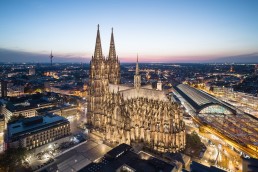
Through a respectful new lighting scheme, Licht Kunst Licht has redefined the nighttime identity of Cologne’s UNESCO World Heritage Cathedral, emphasising its striking Gothic architecture.
One of the most significant examples of Gothic architecture in the world, the UNESCO World Heritage site of Cologne Cathedral has been given a unique new lighting design that seeks to redefine its nighttime presence.
Created by Licht Kunst Licht, in collaboration with RheinNetz, the new lighting scheme replaces the former, outdated, floodlighting setup with a refined, energy-efficient LED system that emphasises the building’s architectural integrity, visual clarity, ecological responsibility, and conservation sensitivity.
“The previous lighting installation at Cologne Cathedral primarily relied on floodlights mounted on surrounding rooftops,” says Philipp Schmitz, Lighting Designer and Senior Team Lead at Licht Kunst Licht. “These 1,000W discharge lamps consumed more than 53,000W and emitted neutral white light (4200K), generating significant light spill and increasing concerns over light pollution.”
Recognising the need for change, Licht Kunst Licht was invited in 2017 to carry out a comprehensive site analysis, and propose a new, sensitive lighting concept tailored to the Cathedral’s architectural significance.
As original drawings were scarce, the lighting designers worked in close coordination with the Cathedral’s maintenance body, Dombauhütte, and the client, to develop a detailed lighting plan. The result of which is a system comprising more than 700 discreet luminaires, carefully placed to emphasise architectural features, while remaining largely invisible to the observer. The vast majority of which are installed directly on or near the structure, using compact, low-glare units; only 10% of the light now comes from remote positions – down from 80% – drastically reducing unwanted light spill and improving overall precision.
This approach was integral to Licht Kunst Licht’s central concept of “light follows architecture”, whereby instead of flooding the building, the new lighting emphasises the depth and verticality of the design through directional light, grazing, and shadow play.
“Our vision was to craft a lighting scheme that honours the architectural essence and spiritual significance of the Cologne Cathedral, while redefining its presence at night,” Schmitz continues. “The aim was not only to enhance legibility and spatial clarity, but to instil a sense of reverence and stillness appropriate to this UNESCO World Heritage site. At the same time, the design embraces ecological responsibility, with focused warm-spectrum LED lighting that reduces energy consumption by 80% and limits impact on local fauna. The result is a lighting scheme that supports conservation, enhances architectural identity, and creates a more meaningful experience for visitors, both near and far.
“The concept honours the spiritual and historic significance of the Cathedral, embraces the craftsmanship of the Dombauhütte, and supports its ongoing restoration. A deeply respectful, context-sensitive lighting strategy was essential.”
Through the “light follows architecture” approach, specific focus was given to some of the cathedral’s key architectural details. These included the flying buttresses, pinnacles, pointed arches and traceries, which now appear more three dimensional, as well as the twin towers and spires – these have been softly backlit and accentuated to reinforce their symbolic prominence.
“The towers are central to Cologne’s skyline identity. We combined soft backlighting with vertical grazing to highlight their soaring tracey and pointed arches,” adds Stephan Thiele, Lighting Designer and Design Lead at Licht Kunst Licht. “We also illuminated the upper tower interiors – showcasing their openwork Gothic geometry and creating a vivid nighttime beacon that reinforces the Cathedral’s symbolic presence across the city, particularly from the far side of the Rhine.”
Elsewhere, portals and sculptural ornamentation has been made legible through new ground-recessed uplights and vertical lighting columns.
By shaping the light around key features, rather than applying it uniformly, Thiele says the new scheme “enhances depth and structure, visually reinforcing the building’s inherent rhythm and volume in a way that is both respectful and visually compelling”.
Given the Cathedral’s status as a historic monument, any new lighting interventions had to be completely reversible and non-invasive. To that end, Licht Kunst Licht developed custom, reversible clamp systems that require no drilling. Instead, the systems use pressure-distributing brackets with lead padding to protect the stonework.
Schmitz explains in more detail: “These methods were developed in direct collaboration with the Dombauhütte, ensuring full compliance with conservation principles. The lighting is designed to be virtually invisible by day – an architecture-first philosophy where the only trace of lighting is the enhanced perception of the building itself.
“A key innovation within this sensitive framework was the development of bespoke, multifunctional lighting poles. These were conceived in close cooperation with Rhein Netz, the Dombauhütte, and luminaire manufacturers to address both functional and heritage requirements. Each pole integrates a glare-free light module to illuminate circulation zones directly in front of the Cathedral entrances, ensuring optimal visibility without disturbing the architectural view. Additional integrated spotlights highlight specific façade features, sculpting light with precision, while remaining visually discreet.”
To preserve the integrity of the key sightlines, all spotlight apertures were carefully oriented and shielded to prevent direct view of the light source from prominent vista points – creating an uninterrupted, respectful viewing experience. The slim, minimal appearance of the poles and their fully integrated components allow them to recede into the urban fabric, while playing a critical role in the lighting composition.
Their custom design, Schmitz adds, is a “cornerstone of the project’s success, enabling architectural expression, without compromising heritage values”.
Throughout, lighting is fully dimmable and tunable in colour temperature, down to 2700K warm white, supporting seasonal adjustments, special events, and evolving ecological guidelines. Light colour has been calibrated to match the warm tones of the sandstone, avoiding harsh contrast and enhancing material perception. The luminaires have also been designed to disappear visually, while producing maximum architectural effect – expressing the idea that “lighting should leave no trace, except in perception”.
As well as preservation, a core objective of the new lighting concept for Cologne Cathedral was to minimise ecological impact, while enhancing architectural expression. All luminaires are therefore equipped with highly efficient LED technology, and tuned to a very warm, long-wave spectrum. This careful selection significantly reduces disruption to local wildlife – particularly nocturnal species such as insects, birds, and bats, which are highly sensitive to short-wave, blue-rich light.
The lighting is precisely targeted, ensuring illumination is focused on architectural surfaces, without spilling into the surrounding environment or the night sky, while glare and light trespass have been substantially reduced. To further preserve the natural nocturnal rhythm, a night-time curfew has been implemented: luminaires dim to a minimal output in the second half of the night, supporting both ecological balance and visual calm.
Compared to the previous system, the new scheme is also markedly more energy-efficient. By introducing LED luminaires, advanced optical systems, and dynamic dimming controls, energy consumption has been reduced to just one fifth of the original installation – operating at just 11,000W on average, as opposed to the previous 54,000W system, while delivering higher visual quality. This, the lighting designers feel, demonstrates that sustainable lighting can go hand in hand with cultural and architectural reverence.
While the new lighting design treats the building with the cultural and architectural respect that it deserves, Schmitz explained that achieving the desired solution was not without its challenges – the primary one being the lack of access to original plans or drawings.
“The lack of detailed architectural documentation required a prolonged analytical study of the façade and Gothic elements,” he says. “Since digital simulation was insufficient for such a complex, heterogeneous structure, we conducted extensive on-site lighting tests over several years – testing various optics, angles, and positions to achieve the desired effects through empirical observation.”
Schmitz also adds that the collaboration with the project’s other stakeholders also proved beneficial in overcoming any issues that arose. He continues: “Once the concept was approved by both ecclesiastical and municipal authorities, implementation was carried out in close partnership with the client, Rhein Netz, and the Dombauhütte. The project benefitted from years of committed interdisciplinary teamwork and mutual trust – ultimately achieving a refined outcome that honours the vision from design to execution.
“Designing for heritage buildings is inherently time-consuming, but entirely worthwhile. This project demonstrates how architectural lighting can simultaneously reduce energy consumption, minimise light pollution, and elevate the perception of historic architecture.”
Indeed, by taking a nuanced approach, the team at Licht Kunst Licht has created a lighting scheme that balances the religious significance of the site with a more secular experience for general visitors, with a reverent, architectural expression of light that underscores both the Gothic structure itself, and its spiritual meaning, without becoming too theatrical.
It is an approach that has been received well, as Thiele reflects: “The Cologne Cathedral is a civic icon and deeply embedded in the city’s identity. Our aim was to maintain its visual presence after dusk and render its architectural richness legible across distance. We’re proud that the finished result now reveals the Cathedral’s form and detail even from across the Rhine – offering a sculptural, dignified nighttime appearance befitting its stature.
“Public and professional feedback has been overwhelmingly positive. Parishioners, tourists, and the media have all responded warmly. During a final commissioning session, an elderly woman paused nearby, photographing the Cathedral. She turned to her husband and said: ‘It looks better now than during the day’. That simple remark captured exactly what we hoped to achieve.”
Client: RheinNetz
Lighting Design: Philipp Schmitz, Stephan Thiele, Andreas Schulz; Licht Kunst Licht, Germany
Lighting Specified: We-ef
Photography: HGEsch