
David Morgan Review: Fagerhult Wrapped
As luminaire manufacturers seek to implement more sustainable approaches, Fagerhult has launched its new Wrapped range – the world’s first cardboard pendant luminaire. Product expert David Morgan takes a closer look.
Most luminaire design projects start with some questions that eventually lead to the solution of a problem.
When the solution to the problem is a luminaire that looks like a question mark and was the first step in building a company with a turnover of £600 million it takes this process to another level.
The problem that the founder of Fagerhult, Bertil Svensson, solved in 1943 in rural Sweden was to create a luminaire for his mother Elisabeth, who struggled to do needlework in poor light during dark Swedish winters. He made a floor-mounted work lamp as a Christmas present for her, enabling her work to continue in the darkest months of the year. The lamp had a distinctive curved “question mark” shape and became known locally as ‘Lampen’ (‘The Lamp’). When he saw how much easier it made her work, he realised there could be wider demand for all kinds of mass-produced practical task lighting.
His practical experience as an electrician led him to focus on functional lighting, which is still at the core of all Fagerhult lighting brands.
From these small beginnings, the company has grown through a strategy of buying technical lighting companies, starting in the 1970s with the acquisition of Ateljé Lyktan and, most recently, with iGuzzini in 2019, resulting in the creation of a major global group with more than 4,000 employees and 13 brands operating in 27 countries.
Fagerhult is committed to operating sustainably and made a formal commitment in 2022 to meeting net-zero goals by 2045, although the company was a pioneer in 1998 by creating a third-party reviewed environmental report.
In practical terms this means more focus on local manufacturing, reducing luminaire energy consumption, adopting a circular product design approach, designing for repairability and longer product life cycles, while also reducing embodied carbon.
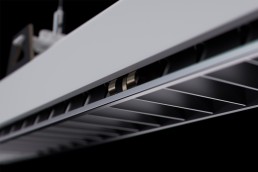
The ‘Wrapped’ pendant is a recent product development by Fagerhult, and a great expression of its sustainable approach. It is understood to be the world’s first cardboard pendant luminaire, and achieves the lowest climate impact of any Fagerhult pendant produced so far at 11.7 kg CO₂e.
The Wrapped range incorporates a variety of material, construction and control details to reduce both embodied carbon, and also the energy consumption in use where 75% of the carbon impact is created.
The use of cardboard instead of aluminium for the body achieves 89% lower climate impact per kilogram than virgin aluminium, so this is the most significant contribution to reducing embodied carbon.
The organic solid board used for the Wrapped body is sourced locally in Sweden and includes 65% recycled material. The outer layers of the 2.25mm thick board are laminated with high quality white material, while the middle layer in the sandwich is made of lower density material. The board supplier stamps the material to the required profile and routs the V shaped grooves, which allows the board to be neatly folded into a 3D shape. At the end of life, the board can be fully recycled as part of the existing waste stream.
With a pleasing neutral appearance, the Wrapped range provides both up- and down-light distributions for use in a wide variety of education, commercial and general lighting applications.
The first Wrapped product to be launched in 2025 was the 900mm size with a 50:50 up/down output ratio. The lighting performance of the 900mm size was designed to match a 1200mm length luminaire, but being smaller, it has a 25% lower embodied carbon rating. The downlight incorporates a nicely detailed double parabolic aluminium louvre combined with an optical diffuser over the light engine to produce a comfortable low glare output. The uplight incorporates a moulded textured lens to achieve a very wide soft output. A PIR sensor module is included as standard: either the Fagerhult wireless Organic Response system or the wired e-Sense BrightSwitch system.
The 1200mm size was introduced this year in response to market demand for a more standard luminaire length, and is available with both aluminium louvre and micro prismatic panel versions, with four distributions: 30/70, 50/50, 70/30 and 100/0.
The driver used is a CLO DALI / phase pulse control type configured to produce a constant lumen output over 100,000 hours of life. A starting wattage of 30W rises to 33W to compensate for the lumen depreciation of the LEDs over time. The 4000K, 80CRI version produces a lumen output of 4800K, an impressive 160lm/W. To achieve the high efficiency, Wrapped light engines incorporate Cree J series flip chip LEDs, which offer improved performance for 90CRI versions in all colour temperatures and a longer working life. Wrapped is available with 3000K and 4000K LEDs in both 80 and 90CRI.
When I first saw the Wrapped sample, my first thought was that layers of cardboard would act as an excellent insulator and that the driver and light engines would run hotter than with an aluminium body luminaire. Based on test figures provided by Fagerhult, it looks as though the temperature levels are within typical operating levels and that life expectancy is not compromised by using cardboard. As LED efficiency rises and the power consumption of luminaires falls, thermal management considerations are likely to become less of an issue.
In a video produced by Fagerhult, two members of the Wrapped design team, Fredrik Beckius and Martin Gustafsson, discuss the challenges of designing with a material that was unfamiliar to them and where traditional screw fixings could not be used. The range incorporates an ingenious series of components made from 100% recycled aluminium and recycled plastic components to hold the components into the two-part cardboard construction. The 100% recycled Polypropylene end caps snap into cut outs in the cardboard body, and the reflector assembly snaps into the inner housing with spring clips. The junction box and driver holding mouldings also snap into details in the cardboard housing. I could only spot three screws in the whole luminaire and, since no adhesives are used, all the components can easily be dissembled at the end of life.
The Wrapped range is an impressive piece of cardboard and sustainable engineering, and while it does need slightly more careful on-site handing than an aluminium luminaire to avoid damage, I think we can look forward to seeing this becoming a more common material in the lighting world.