
David Morgan Review – Magnetic Force
Following a collaboration with Luc Bernard of Licht Kunst Licht, German manufacturer ADO Lights developed the LED Luc – a spotlight whose clever use of magnets allows for enhanced flexibility. David Morgan takes a closer look at this innovative product.
Permanent magnets have the almost magical quality of providing force over distance without needing any power source. The magnetic force falls away quickly with an inverse cube or fourth power law, which makes it an ideal way to hold together those components that also need, from time to time, to be easily separated or moved. Examples are track adapters and adjustable spotlights.
Using one magnetic detail in a luminaire design might be considered a standard approach but it is unusual to discover magnets being used to achieve two different functions in the same product. The LED Luc miniature spotlight range from ADO Lights does exactly that, so I thought we should investigate the product range in more detail.
The third-generation family company who developed the LED Luc system was founded in Germany and originally manufactured roller grilles for heating and cooling convectors under the ADO Roste brand. The next generation was keen for the company to work with architects and moved into the high-end architectural metalwork market, and also diversified into custom architectural lighting with a new company called TTC Timmler Technology. The company is now run by Patrick Timmler, the grandson of the founder, and now uses the ADO by TTC Timmler Technology brand to market their lighting products around the world.
The original business model was based on creating custom lighting systems for specific projects based on the requirements of architects and lighting designers. These designs were then developed and refined and marketed as standard ranges. We use a similar approach at Radiant Architectural Lighting and know that it can be successful as all of our most successful product ranges started life as custom solutions.
The LED Luc spotlight was originally developed for use in a project with lighting design by Luc Bernard from Licht Kunst Licht, who worked frequently with ADO lights at that time. He was working on the lighting design for the St. Petri Church in Dortmund, where a miniature adjustable spotlight was required to light the restored 1531 Antwerp high altar; and so the LED Luc projector was developed as a custom solution for the project.
One hundred and fifty LED Luc projectors were mounted in vertical steel channels to light both sides of the altar. In the first design iteration for the project, screws rather than magnets were used to fix the spotlights in place. Once it became clear that the projectors would need to be easy to reposition to achieve the optimum lit effect, the idea of using a magnet to hold the spotlights to the channels was introduced. The projector was named after Luc Bernard in recognition of the effective collaboration between ADO Lights and the lighting designer.
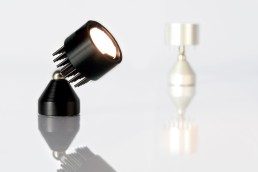
The LED Luc adjustable LED IP44-rated spotlight uses magnets twice in the design firstly to fix the luminaire base in place on a steel surface, and secondly as the force that holds the adjustable ball joint onto the base. The miniature magnets used are powerful and ensure that the projector head does not droop in use while allowing easy aiming, adjustment and repositioning. A soft flexible cable runs from the body to a remote driver with a jack plug connection.
The sample I was given to test has a high-quality machined aluminium construction with an effective pin type heat sink. A single 3W LED is bonded to the heat sink and the 20mm TIR lenses can be quite easily removed from the injection moulded holder on site with a tool. The light engine produces a nice beam quality with a range of beam angles including 10, 25 and 50°. The LED colour temperature options include 2,600, 3,000, 3,500 and 4,000K, all rated at 90 + CRI. Standard metal work colours are satin silver anodised aluminium, black anodised and powder coated satin white RAL 9010. Accessories include a screw-in honeycomb louvre and a screw-in cut angle anti-glare snoot. It is not possible to combine both snoot and honeycomb. An IP65 glass window accessory is also available to allow the projectors to be used for exterior applications.
In addition to the original 30mm diameter size, a 40mm diameter version has been developed by Patrick Timmler. With this larger design, the LED can be replaced to extend the working life of the luminaire and all the components can be disassembled, using a screwdriver, for ease of recycling at the end of life or for remanufacturing. A zoom optic is available for the 40mm version in addition to the various anti-glare and IP65 accessories.
The LED Luc range has been used on a wide variety of projects, often in combination with custom housings, where the ease of adjustability and miniature size is required. Notable projects where the LED Luc has been used so far include Castle Hohenschwangau, Museum Marseille, and the Richard-Wagner-Museum in Bayreuth.
It is always good to review lighting products that incorporate simple innovations which are used to offer tangible benefits and differentiate products in a crowded market. The LED Luc range meets those criteria extremely well.