
David Morgan Review: Super Nova
Launched at LiGHT 25, the Nova is the latest development in remote controlled, motorised luminaires from Luminii brand RCL. Keen to find out how the technology has developed since he last reviewed an RCL product, David Morgan puts the Nova under the microscope.
It has been more than five years since I last reviewed an RCL motorised recessed downlight so I was intrigued to see and test its new miniaturised Nova luminaire that was launched at LiGHT 25.
In the intervening period between the two reviews, RCL has been acquired by Luminii Lighting, based in Niles, Illinois with operations across the United States, Canada, the UK and the Middle East.
RCL product development and engineering is still based in Wimbledon, south London. Final assembly of all RCL luminaires is also undertaken in the UK at the RCL HQ, with components and sub-assembly sourced globally. RCL shares facilities and staff with sister company, Precision Lighting, and both firms focus on the specification lighting market. RCL grew out of a custom product request to Precision Lighting in 2001 for a remote controllable motorised lighting system for use in ballroom illumination. Since then, the two companies have grown from two to 25 employees in the UK, with approximately 40,000 RCL motorised luminaires installed worldwide. Luminii employs around 200 people across the world.
The benefits of being able to aim and focus projector luminaires without the need to use cherry-pickers, scaffolds or ladders are as relevant today as they were when RCL started. The costs of manually aiming multiple luminaires continues to rise while conversely the production costs of remote-controlled luminaires have fallen as the various enabling digital technologies develop, factors that have widened the market opportunity.
Although the first recorded example of remote-controlled, motorised lighting dates back to the 1920s, RCL has developed the concept into a recognised luminaire category. The Nova takes the development to the next level.
It is understood that the development of the Nova was triggered by requests from specifiers over recent years for smaller luminaires both in diameter and depth. Although the original application for RCL motorised downlights was for use in ballrooms with very high mounting height, the requests indicated that a wider market exists, including difficult to reach spaces and multi-use spaces where the lighting needs to be adjusted on a frequent basis. High-end residential homes, galleries, fashion retailing, restaurants and multi-use spaces in cruise ships are among the target applications for the Nova.
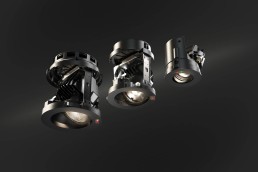
The cut out required for the Nova is only 100mm in diameter, with an aperture size of 50mm. The recess depth required is just 130mm. The Nova is approximately 30% smaller than the previously smallest RCL luminaire, the DRX5, while still delivering up to 85% of the lumen output. With a full 360° rotation and 35° tilt, it can be used in a wide range of lighting applications. The Nova is available with either a trimless housing or with a moulded bezel. For the US market, an IC rated enclosure is also available. A clear moulded window is integrated into the flange, which allows communication with the hand controller and is a tell-tale sign that this is not a standard downlight.
The Nova incorporates a variety of technical innovations that both reduce the size of the luminaire but also improve the aiming accuracy and extend the working life. The use of a flexible PCB, typically used in cameras, has helped to reduce the overall size. Digital stepper motors have been used, which also reduce the luminaire size, provide more accurate aiming and scene recall, while also giving a longer working life than previous motor types. A new flat flexible ‘clock-spring’ cable system overcomes the most common failure mode caused by broken wires. It is understood that during development the Nova undertook 30,000 movement cycles without failure, believed to be three times more than any other RCL luminaire.
The Nova range includes three different light engine options. The standard fixed white 18W light engine is available in narrow, medium and wide distributions with a delivered output of 1200lm. The 15.6W Intense fixed white light engine provides a narrow 6° distribution, delivering up to 35,000 Candela of peak intensity from a lumen output of 646lm. The three standard light engine colour temperatures are 2700, 3000 and 4000K, all with minimum 90 CRI. The Nova range also includes two tuneable white light engines 1800-4000K and 2700-6500K. The 7W TW narrow distribution version delivers 555lm and the medium and wide distributions deliver 1,200lm. A digital zoom based on the Lens Vector system is also available with a range that spans from 6° to 55° depending on the light engine used.
The usual beam control and glare control accessories including honeycomb louvre, and three different strengths of micro softening filter can all be added on site and are retained with a spring clip.
The Nova is controlled by all the existing RCL control options. The RCL handheld controller is required during set up and can then be used to control all the Nova functions. The Nova can also be configured to work with a variety of other control systems.
RCL Control is an iPad based wireless system that can be used to regulate up to 200 luminaires. DMX can be used to control dimming, pan and tilt. DALI can control dimming and colour temperature. Up to 10 saved scenes can be recalled with DALI, including aiming and zoom. Movement control is via the hand controller if the scene has not been pre-saved.
RCL founder and inventor-in-chief Joe Ruston, with his early Royal Navy weapons engineering background, is no longer involved with the company following the acquisition by Luminii. However, the innovative engineering culture, based at the RCL HQ, continues with a multi-disciplinary development team for the Nova project including George Ridley (project lead), Peter McClelland (design director), and Richard Jarvis (engineering manager), with electrical engineering contributions from Ed Cooper and Bart Jozwicki.
I was impressed with the lighting and mechanical performance of the Nova sample that was demonstrated to me by sales manager, Matthew Norse. It will be interesting to see if the Nova is able to widen the market for motorised downlights with its smaller size and lower price point than previous RCL products.