
Desert Rock, Saudi Arabia
Carved into the rocks of the Red Sea desert lies a unique hospitality destination. Delta Lighting Design explain how light helps to bring Desert Rock to life.
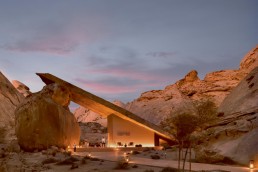
Emerging from the rugged terrain of the Saudi Arabian desert, Desert Rock is a resort like no other. Tucked away in a secluded valley within The Red Sea destination, the resort has been literally carved into the terrain itself, merging seamlessly with the surrounding mountains to form a truly unique masterclass in contextual architecture.
Designed by Oppenheim Architecture, with interior design by Paolo Ferrari, Desert Rock sets a new benchmark in hospitality and design; architecture and geology converge where rock formations and sophisticated structures blend effortlessly, creating a breathtaking sanctuary where nature and innovation co-exist in perfect harmony.
Across the resort’s 54 private villas and 10 elegant suites, each embedded within the dramatic plateau – whether high up on the rocky outcrops of the Massif mountain, or low down on the Wadi valley – guests are treated to a setting that is completely at one with the raw, natural environment, with each room offering uninterrupted views that stretch toward the horizon.
Elevating the retreat further are state-of-the-art amenities, including a world-class spa and fitness centre, remote destination dining, and a signature lagoon oasis. Guests can engage with the dramatic surroundings through guided hikes and dune buggy adventures, or take in the stunning views to the night sky through celestial stargazing – all part of a curated programme designed to celebrate the majesty of the land.
Integral to bringing this one-of-a-kind destination to life was a lighting scheme that would further champion the unique location. Delta Lighting Design developed the lighting concept for Desert Rock, joining forces with Oppenheim Architecture in the early concept design stages of the project.
Mohamed Medani, Partner and Design Director at Delta Lighting Design, reflects on the initial design conversations with the architects: “Since the early studies of the concept design, we were a part of the discussion, and our role was to shape the nighttime experience and create a narrative that responds to the exact envelope of the project.
“The character and the natural landscape of Desert Rock’s surroundings is clearly the champion and the focal point, so as much as possible we wanted to preserve and enhance this with lighting.
“The main drive for us was to maintain this existing nighttime surrounding with as minimal interruption as possible, while trying to create a place within this amazing space where you can really enjoy your time, enjoy your privacy and your own surroundings. It’s not just a trip into the wild, it’s also a place where you can, within these interesting surroundings, have your own private, high-end, luxury experience as well. It became a delicate balance between maintaining the landscape and making this one of the main parts of the design and the story, but also providing this luxury look and feel.”
To that end, the intent for the lighting design was to reveal, not dominate, with a focus on exposing the raw beauty of the rock’s textures and forms where the architecture meets the mountain through carefully positioned, low-level lighting.
Building cores are softly animated through controlled contrast, adding depth and maintaining a sense of liveliness, enhancing the contrast between the interiors and exteriors, and magnifying the depth of perception within the façades. Interior lighting glows from within, turning buildings into large-scale lanterns, nestled among the elevated, contoured natural structures.
“You want to bring some of the outside into the interior spaces. At the same time, you also want to retain the functional aspects of maintaining a luxurious hospitality environment. It was a very strong contrast that we tried as much as possible to make visible. We wanted to embrace it.
“We wanted to highlight and make a focal point of the rocks and the texture of the walls within the interior space, so that you are always reminded of the surroundings and where you are in the interesting landscape.
“We wanted to avoid creating an environment where you are completely detached from your surroundings, where you go to your room and forget where you are; there is always a highlight to the elements to give you a reminder of where you are within the hotel.
“That balance adds to the unique hospitality experience. You do not very often stay in a resort where you have a wall from a natural mountain behind your bed, or you walk through a cave that is actually the guest room corridor. These experiences are striking for the users, and we amplified that impact at night.
“We also tried to focus on what could be natural in a cave, and how this would be illuminated. That’s why lighting is kept to the walls or on the floor, as much as possible; we tried to avoid overhead lighting, because it doesn’t give any interesting value to the vertical surfaces, which are quite rich in this project. Where possible, everything was mounted on the floor, with in-ground uplighting within the rooms themselves highlighting the walls. What is bringing the functional lighting to the space is indirect lighting from the vertical surfaces, and also indirect lighting coming from the floor. So, when you look at this from outside, you almost feel like there is a torch or a natural fire source within the balconies and guest rooms – it gives you a natural impression.”
Across the resort, enhancing this more authentic, low-level lit environment, Delta Lighting Design developed a bespoke, multi-functional lantern that would meet both aesthetic and sustainability requirements, while aligning with the overall hotel design vision.
The bespoke design draws inspiration from the traditional lantern form, with a sleek, minimalist frame and a decorative candle to create a warm, inviting ambience. Crafted from slim-profile aluminium with a matte, dark brown finish, the lanterns have no glass enclosures, reducing dust build-up and allowing light to diffuse softly across the ground.
The lantern top houses an integrated, diffused light source that shines downwards, providing suitable light levels for circulation areas, while an electric candle is added to the core of the lantern for decorative purposes. The two light sources are controlled separately, enabling multiple lighting scenes, and allowing the fixture’s appearance to evolve throughout the evening.
Installed in hardwired clusters, these lanterns create a poetic, immersive atmosphere that enhances the guest experience, serving both as practical luminaires and narrative-driven design elements that echo the raw, sculptural elegance of the desert landscape.
Medani explains the design of these luminaires further: “We wanted a minimalist fitting that would not really stand out as an element competing with the surrounding environment, but would blend in with the architecture.
“At the same time, it’s a hospitality environment, so we wanted an element that would give the luxury and warmth. The third aspect is the functionality that needs to be accomplished by the design of this specific lantern. So, we came up with a minimalist form, but with the different lighting elements inside, the lanterns can be used across the site, and although they all look the same at daytime, at night, they bring a different character, depending on their location and how they are being used.”
When visiting Desert Rock, guests begin their journey at a small arrivals hub nestled into the foothills – lighting here is seamlessly integrated into the bespoke millwork, with linear fittings providing subtle, directional accents that frame the space without imposing on it.
From here, guests take a buggy up the valley and to the mountain, where the main hotel building emerges. As they travel through the valley, lighting was purposefully kept at a low level, preserving the views to the night sky, while building drama and suspense as the resort comes into view.
“As you approach the mountain in front of you, you start to see the sparkle of the rooms, the illumination of the caves, you get a taster of what is waiting for you, which adds to this experience as you travel from the wilderness into this luxurious, cosy place,” Medani adds.
Central to the design though, was an “intentional restraint” that focuses on the uninterrupted views towards open landscapes. Every light source is soft, shielded, and purposeful; stone becomes luminous, and stars shine freely, inviting guests to embrace an authentic dark sky experience.
This is something that was of paramount importance to all parties. Andrew Bates, Associate Director of Lighting at Red Sea Global, explains further: “Desert Rock has an in-house lead astronomer that, on a regular basis, is running astronomy sessions for guests at the resort on top of the restaurant. So, it is critical – not just because of our Dark Sky policy, but also from a guest experience, so that they can understand the culture and the history of the area – that we maintain a low level of lighting around the whole destination.
“There was a big conversation in the planning stages about how we as a developer have a Dark Sky Initiative, where we’re trying to maintain the pristine skies and the visibility of the stars, and how we safely illuminate the project while doing this. There is a lot of rough terrain, with steep hills, etc; how do we make sure our guests can safely navigate the space at nighttime without floodlighting the whole site, while retaining the authenticity of this candlelit, cave-like environment.
“We have to be mindful that every light that we add in to an exterior space is taking us a step away from the purity of the dark sky. So, we always have to question why we are adding the lights. It becomes a balance between safety, the guest experience, and seeing the night sky. There were some decisions that were made during the design stages that were then refined once we did some assessments on site, which were linked to safety.”
Even with the Dark Sky aims for the project, Bates explains that, as the project was drawing to a close, some additional lighting was added to the mountain itself to frame the hotel and provide some further context, particularly for those dining in the restaurant area after dark, where there would have been little visual clarity as to their location.
“We did a lot of testing with various fixtures, accessories, beam angles, colour temperatures, locations, etc, to ensure that the mountains were lit as delicately as we could. As we extended the coverage and added a narrative of when to light the mountain and to what intensity, we did a number of light pollution readings around the site to check what impact it was having. We got to a point where, with the mountain lighting at 40% intensity, it had a negligible impact on the sky quality readings that we did, but it really brings a sense of depth that adds to the guest experience.”
Alongside the Dark Sky goals for Desert Rock, Bates explained some of the more strenuous logistical challenges that came in bringing this awe-inspiring project to life.
“Getting materials up the mountain was a very physical challenge; we have an observation deck, which you access via a rope bridge, and then several hundred steps to the top, and getting material up there was all done by people power, we had no cranes, so that was very intense as well.”
Because of the very essence of the resort being carved into the mountain itself, Bates adds that, once each of the rooms had been excavated, further on-site alterations had to be made when it came to installing the lighting.
“On the drawings for the cave rooms, we had a number of uplights accenting the walls left and right – in the drawing, there is a planned layout, with an outline of what the room would look like. But, when they did the carving, it’s not like putting up a timber stud wall, where you know what the offsets are going to be. There were a number of rooms where we had to assess the location of the uplights depending on the actual finishes of the wall. Some of the walls are steeper than we thought, some are shallower, some were bigger or smaller – there were a lot of tolerances that we had to work around. So, we ended up adjusting the lights to meet those on-site surprises.”
Similarly, on the outdoor paths that weave between large rocks, Bates and his team relocated a number of the bespoke floor lanterns to fit better with the natural landscape. “We shifted the location of fixtures to suit the site, for example, at the main entry to the resort, there is a passage where the path meanders through these large rocks. By luck more than judgement, there were some nice little nooks where we could place the lanterns, but we wouldn’t have been able to do this from the drawings.
“After multiple lighting mock-ups and testing, we also adjusted the colour temperature of the exterior lighting from 2700K to 2200K, as, once on site, we felt that the warmth added an extra ambience to the colour of the stone and the texture on these pathways.
“A lot of the work that we were doing was responding to the site conditions, taking the design principle and then tweaking it to suit things that you can’t know during the design stage.”
However, these challenges and on-site tweaks notwithstanding, Bates says that he is “super proud” of the result that has been achieved, and of having the opportunity to create such a unique, one-of-a-kind destination.
“I very much had a connection with this project from the start because it is so unique,” he says. “It’s not been done before, especially at this scale – it is a very James Bond, Mission: Impossible-esque setting, so I was incredibly proud of following this through to completion.
“When you’re working on a project most days, in the heat and late into the night, you don’t really feel like it is such a special project, but when you see guests arrive, and you see their reaction when they see it for the first time, and when they look up and see the stars, it feels like you’re in a different world – it’s like a movie scene.”
Similarly, Medani looks back on the project with satisfaction, knowing that the lighting design greatly contributes to the creation of such a unique environment.
“We knew that our approach to this one had to be different, it had to be unique. We had to make sure that we flush everything conventional off the table and figure out a solution that would maintain this interesting experience for the users, achieve the necessary functionality, and give an interesting vision from outside. At times it was challenging, but also enjoyable to go through this and come up with the result that we see in the end.
“What is quite striking is that a lot of the comments that we have seen on the internet are saying that this is AI, it can’t be real. But with that, you feel that the project is really great – people thinking that this is not a reality means that you have offered a totally new experience to users.
“It is exciting to see a place that is outstanding by itself, manage to host a cosy, luxurious space within it, where people can really enjoy the experience. Otherwise, you would pass by in a car and not see it. We have brought a very remote, untouchable place to a lot of people now. It can give you a lot of joy to work on these projects, where you bring the human experience to a new place, to new areas, and new experiences.”
Rising from the ground, Desert Rock is a truly unique hospitality offering, with a sensitive and beautifully restrained lighting scheme to match. As many new developments around the world look to create stunning pieces of architecture that stretch high above the ground, sometimes it is important to remember that connection with the earth itself, and Desert Rock shows that in doing so, one can create truly remarkable experiences to savour and remember.
Client: Red Sea Global
Lighting Design: Ziad Fattouh, Mohamed Medani, Dimitris Theocharoudis, Daniela Meneghelli, Raluca Dascalita; Delta Lighting Design, UK
Architect: Oppenheim Architecture, USA
Interior Design: Studio Paolo Ferrari, Canada
Lighting Specified: IBL, iGuzzini, KKDC, L&L Luce&Light, LEDFlex, LED Linear, Linea Light Group, Louis Poulsen, Lucent, MP Lighting, Orluna, Unonovesette
Photography: Alex Jeffries; John Athimaritis