

History of Darkness: Values of Darkness Throughout Time
 Roxana Rakhshani, Senior Lighting Designer at Cundall, breaks down humanity’s relationship with darkness throughout history, and how lighting designers can factor darkness into their work.
I’ve borrowed this title from an intriguing artwork by the Scottish artist Katie Paterson, which includes hundreds of slides of the darkest parts of the night sky.
Darkness is a quiet treasure, too often overlooked and too easily feared. As Robert Hensey notes in The Archaeology of Darkness, “[Darkness] it is too big to see, too fundamental, too pervasive.”
As a lighting designer, I recognise that darkness holds as much value as light. They are deeply intertwined, forming a harmonious whole. Darkness has often been unjustly associated with evil and threat. In our efforts to escape this perception, we have flooded our evenings with electric lights. We are led to believe that darkness breeds crime and danger, prompting us to illuminate every corner of our towns in the name of “secure by design.” Yet we cannot study darkness as we study light. We cannot hold it, photograph it, or capture it. We can only sense it, embrace it, and live it. I believe darkness is not the absence of light. It exists.
Birth of Darkness
Our relationship with darkness begins with the Big Bang, around 13.8 billion years ago. At first, the cosmos was not dark at all – it blazed with high-energy photons, a searing plasma of matter and light intertwined. Yet this light was trapped, scattered endlessly by a fog of free electrons that kept the universe in radiant opacity, a brilliance locked within the newborn cosmos.
Only after 380,000 years did true darkness emerge. As the universe expanded and cooled, electrons joined protons to form neutral hydrogen atoms. After hydrogen formed, photons continued their journey, interacting only slightly with matter. Initially in the ultraviolet range, these photons stretched into microwaves as the universe expanded. This is why the Cosmic Microwave Background (CMB) offers a “snapshot” of the universe shortly after hydrogen formed. Yet though light now travelled, the visible universe remained dark to any hypothetical human eyes.
The CMB’s glow, was far from the bright starlight we know. Thus began the Cosmic Dark Ages, a vast stretch of time without a single star. For hundreds of millions of years, the universe lay in shadow. Darkness was the dominant state.
Between 100 and 200 million years after the Big Bang, gravity coaxed the first stars into being. Their nuclear fires pierced the darkness, flooding the cosmos with visible light for the first time. Darkness lost its monopoly but never disappeared, always retreating just beyond the edge of light.
Nine billion years after the Big Bang, our Sun ignited, and Earth began to form. In its oceans, single-celled life stirred – emerging 500 million to a billion years later.
For three billion long years, the planet waited before the first eyes to open and gaze upon the world. Until that moment, darkness and light were without witness, and thus without meaning.
Early Humans and the Fear of the Dark
For early humans, darkness was no passive backdrop – it pulsed with danger, beyond the reach of firelight. Predators prowled and vision faltered; fear of the dark became a survival instinct etched into our bones.
Even now, night stirs ancient anxieties, its shadows echoing the primal dread of our ancestors. During the Jurassic, mammals evolved rod cells for low-light vision to evade daytime predators like dinosaurs. Yet humans remain diurnal, lacking the tapetum lucidum that boosts night vision in nocturnal animals.
The subconscious brain also contributes to darkness. Our amygdala – the centre of fear – is activated, triggering heightened vigilance. Without sight, our imagination conjures shadows into threats – the proverbial “monsters under the bed.”
Yet early humans also sought the darkness of caves for shelter. This motherlike darkness was a womb protecting the child. Darkness became a canvas for human art and rituals. When early humans tamed fire, cave walls flickered with living shadows, their art animated by flame.
In darkness, stories of the daily hunt came alive – fire and shadow weaving myth from stone. Darkness was an essence to bring these stories to life.
Darkness Across Ancient Cultures
Prior to the science of how light and darkness emerged, different cultures and beliefs had a variety of interpretations of how this world has come to live. Most of these beliefs involved the dual existence of darkness and light. Some had them both at the same time, while other cultures believed it was darkness and then light.
For the Greeks, the cosmos emerged from Chaos: a dark, formless realm of potential. From it came Erebus and Nyx, birthing light and day, showing darkness as the womb of creation.
Creation in Egyptian myth begins in Nun, a dark ocean of chaos, where the Ogdoad – eight deities including Kek and Kauket – embody obscurity. From this void, Atum-Re emerges, shaping light and order from the depths of darkness.
In Manichaean dualism, light and darkness are eternal forces whose mingling births the material world. The battle between these forces creates the balance of day and night.
The Biological Necessity of Darkness
Darkness is an active, soft-spoken force that shapes our biology and restores balance. As evening falls, it whispers to the pineal gland, coaxing the release of melatonin, the quiet architect of sleep and guardian of our circadian rhythm. We close our eyes and walk into darkness to find peace and comfort. For the fortunate, sleep becomes an escape from life’s stresses.
When night is fractured by screens or streetlamps, this rhythm falters, bringing restlessness, mood disorders, and diminished vitality. Darkness offers more than sleep, it shelters our eyes from the strain of unbroken brightness, allows the retina to recover, and grants the mind rare stillness.
Darkness shields the immune system, calms the nervous system, and for children, lays the foundations for growth and learning.
The Design of Darkness
Darkness is the cradle of our history, the silent force shaping our beliefs, our bodies, and the way we see the world. Without darkness, there is no contrast, mystery, or wonder. Without darkness, light loses its poetry. In the realm of lighting design, the interplay between light and darkness becomes an art form, a dance that shapes our experiences and perceptions.
We need time and space to experience darkness. By embracing darkness, we can create environments that invite exploration and contemplation. We can enhance the texture of materials, highlight architectural forms, and foster a sense of intimacy, allowing us to connect more deeply with our surroundings.
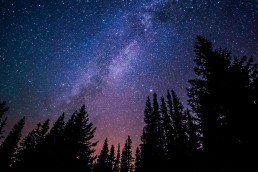
In the era of electrical light dominating our world, we must advocate for designs that respect the natural rhythms of darkness. Working on Dark Sky projects allowed me to learn how to consider how a well-placed lamp can illuminate a gathering without overwhelming the night, and its precious gift of peace, allowing the stars to shimmer above and the moon to cast its gentle glow.
As lighting designers, we must honour this truth with reverence and courage. Darkness is not absence, it is presence, the depth giving life to illumination. We must design our projects with shadow, celebrate it, worship it, and invite it into our spaces. Shadows don’t have to be obvious, grazing a rough textured wall, creating thousands of little shadows that make the texture visible. Imagine using a tree clamped luminaire in a park, that gives us dancing shadows of the leaves and brings the darkness to life.
We must see the yin in yang, and avoid a “blanket of light”. Darkness can frame the beauty of the light shining on an object or an artwork. Pockets of darkness can create a pathway and guide us through our journey.
To truly shape light, we must also shape darkness.
Let us become “darkness designers”.