
Lights in Alingsås 2025 – Movies in Lights
Lights, camera, action. Walk through Lights in Alingsås with junior journalist, Ellie Walton, as she returns to Sweden to uncover the Movie in Lights edition, as well as speaking to the workshop heads and students of 2025.
Alingsås is a little-known town in Sweden that few people outside the country – or the lighting community – would be familiar with. Yet, when September arrives, the lighting industry’s ears invariably prick up as news of the latest edition of Lights in Alingsås emerges. Last year’s festival marked its 25th anniversary, presenting tales of mythology, monsters, and moral meanings told through light. The milestone edition also introduced a series of community installations, including a window-display competition for local shops and the addition of video mapping, all of which have continued into the 2025 event.
Building on its legacy, this year’s festival’s theme was announced as Movies in Lights. The idea was conceived between the festival’s events manager , Camilla Boström; workshop manager, Frida Almqvist; and Shecko Amoor, communicator, inspired by the moments that make us laugh, cry, and dream. The workshop heads and their teams of young designers then transformed familiar scenes into luminous installations that guide visitors along a 2.5km route and into an immersive world of light.
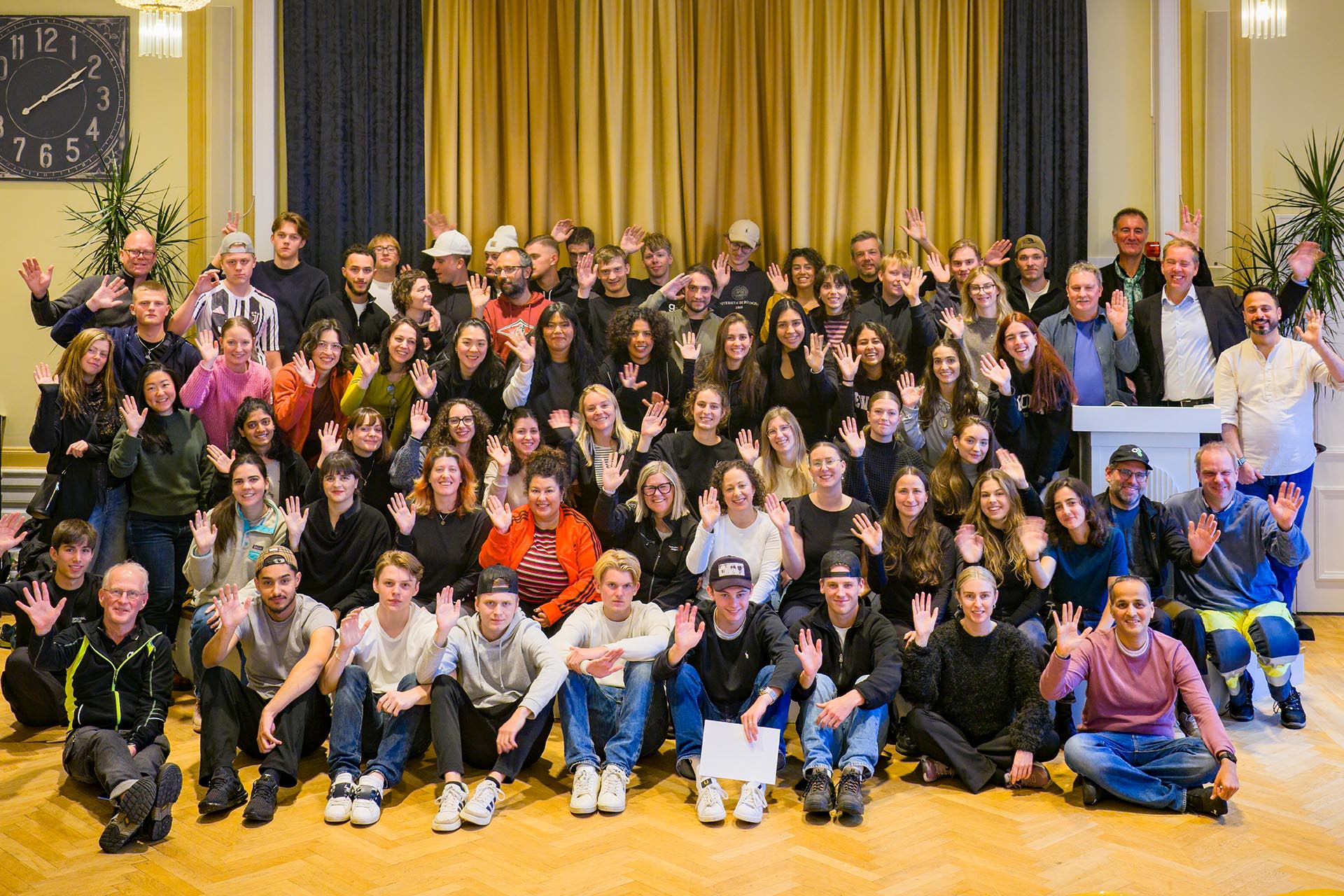
This year’s workshop heads brought together a balance of returning talent and fresh perspectives. Notable newcomers included Phillip Rose of Speirs Major Light Architecture and lighting researcher Amardeep Dugar. Joining them were experienced contributors such as Christina Mordeglia and Sjoerd van Beers of Beersnielsen, along with long-time participant Roberto Corradini, returning for his third year. They were complemented by three former students stepping into leadership roles: Meta Romanens of Hochschule Luzern, Niken Wulandri Sutanto, and Senior Lighting Designer Isabel Villar of White Arkitekter. Together, they have led 40 international students into a whirlwind experience of workshopping, prototyping, constructing, testing, and presenting their site installation.
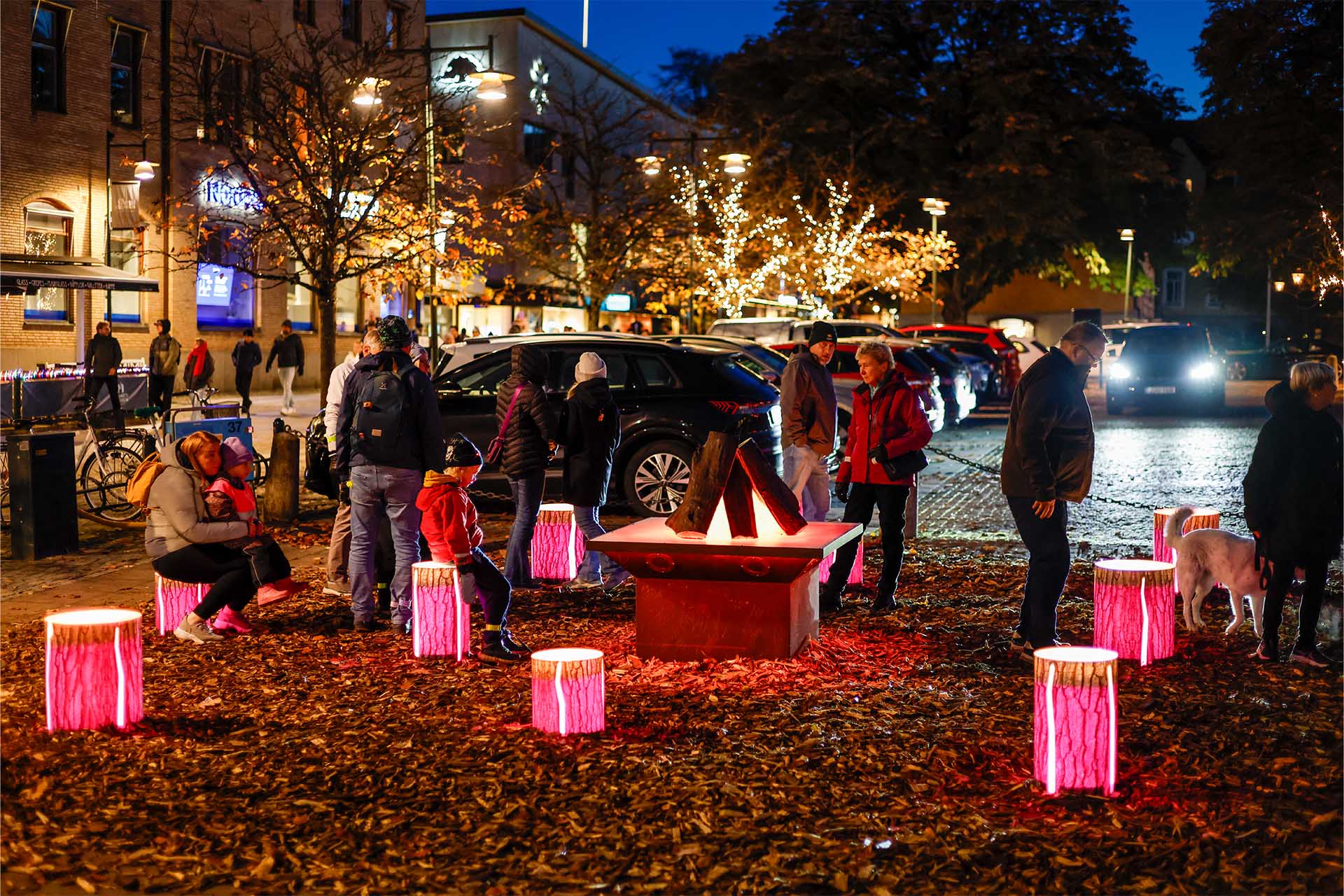
On the night of the opening, the people of Alingsås came out in their droves, wrapped up for a chilly autumn night at the ‘movies’. As visitors set off from Åmanska Parken by the Grand Hotel, the familiar route from Lillån takes on a distinctly cinematic rhythm. Each installation functions almost like a scene change: moments of darkness used as intentional pauses, bright reveals timed with the natural bends in the river or the narrowing of a pathway. The designers’ interpretations of Movies in Lights unfold gradually, with familiar cinematic devices – framing, contrast, colour codes, and controlled movement – guiding the eye as though through a film reel.
Before visitors even reach the first official site, the festival sets its tone with a compact highlight installation that acts as a prelude or a cinematic “cold open” if you will. Positioned just beyond Åmanska Parken, a video mapping installation functions almost like an establishing shot – a brief but deliberate moment that primes visitors for the visual language of the trail. Displayed on the façade of Alingsås Museum, the mapping acts as a blend of motion, light, and geometry into a dynamic sequence that nods to iconic production companies and cult films that the whole family recognises. Further down is the first installation highlighting the ‘Wood Fire’, rented from lighting designer and the festival’s programmer, Bertil Göransson of Luxera, using LEDs to create a wood fire where families and friends can gather around and tell their own stories or take a moment of quality time.
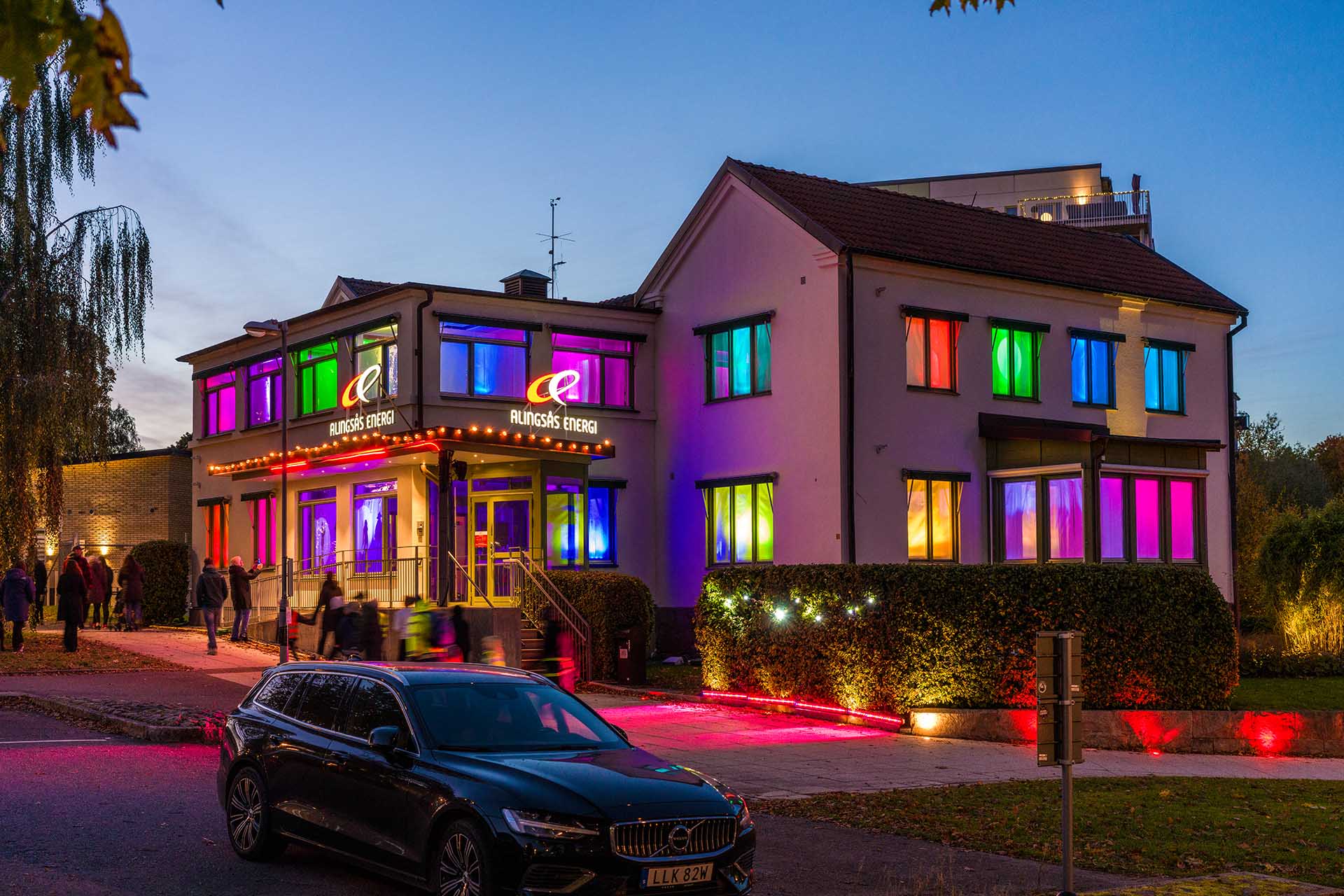
Arriving at site one, the trail shifts from prelude to full narrative as Dugar and his student team transform the Alingsås Energi building temporarily into an old-fashioned cinema. Inspired by vintage theatres and the ritual of stepping into the dark to be transported elsewhere, the group built their concept around the emotional palette of film itself – magic, adrenaline, mystery, nostalgia and, above all, fun.
The building’s grid of windows becomes their “silver screen”, each pane acting as a frame in a larger cinematic sequence. Five films anchor the composition – The Lion King, Kill Bill, James Bond, The Good, the Bad and the Ugly, and the Bollywood film Dhoom 2 – each contributing its own colour world and rhythm. The façade cycles from a slow Serengeti sunrise to sharp, katana-like slashes of light, from western desert tones to Bond-style pulses, before ending in dramatic red. A neon-inspired entrance, complete with a red-carpet wash created through gelled fixtures, sets the mood before visitors even look up. The students spoke of extensive hands-on testing, diffusing light with paper in the windows to achieve their desired softness, and iterating scene by scene to create a cohesive visual story.
Moving through to Udden, passing through the children’s installation (Childrens Lights), which depicts a shadow puppet scene from Jurassic Park. However, the dinosaurs are mechanical monsters in the shape of excavators and cranes. After the excitement and terror, squealing children and their guardians find themselves in a slightly more serene landscape where site two’s magical realist world comes to life.
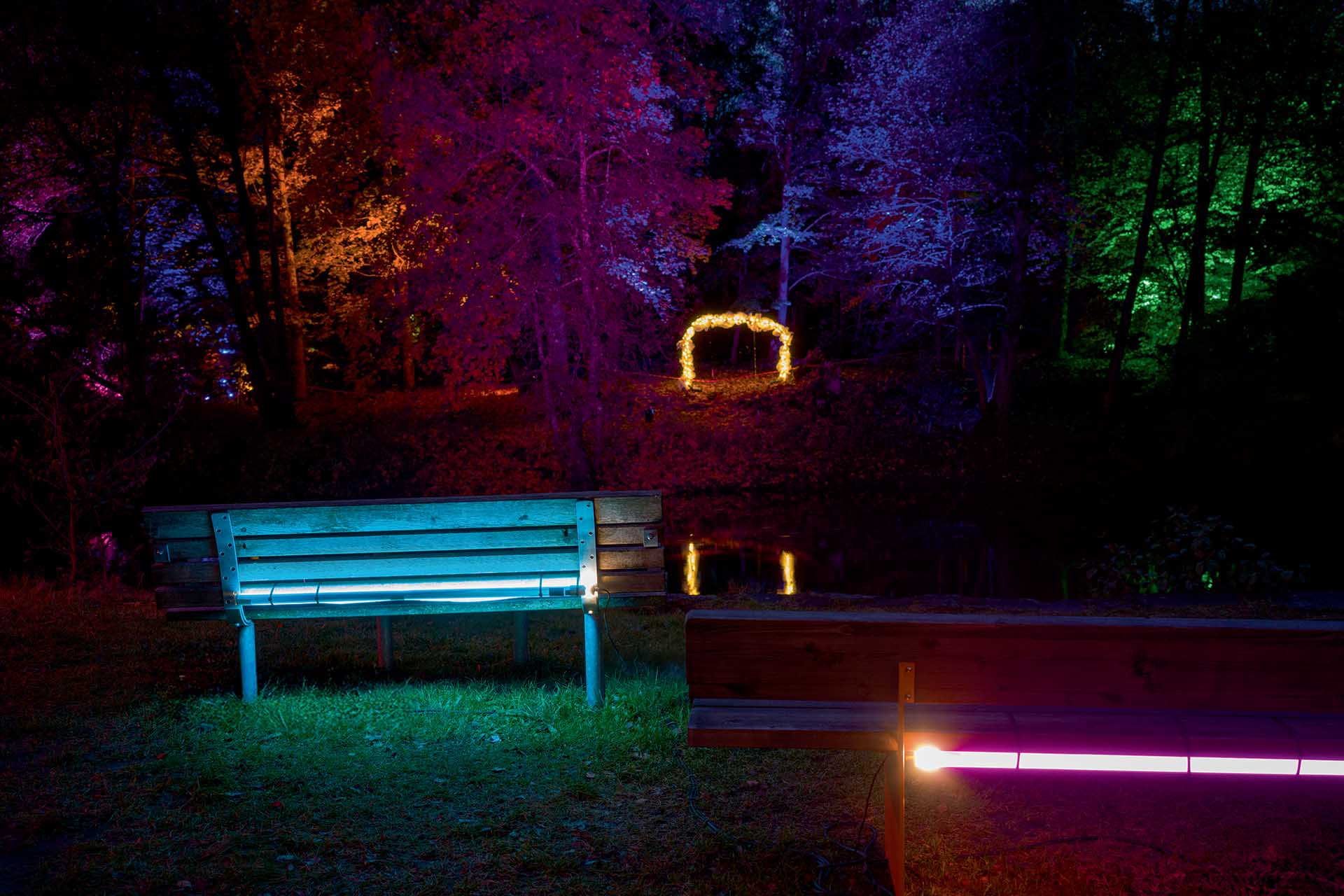
Site two, led by Italian designer Roberto Corradini, is inspired by Dreams by Akira Kurosawa. The film’s interplay between imagination and landscape became the foundation for the team’s design, and the site itself – framed by a coursing river, pockets of woodland, open grass, and park furniture – offered a setting ready-made for the quiet, uncanny atmosphere in which they hoped to evoke the idea of an “enchanted stroll”.
The installation was equally rooted in Corradini’s approach to mentorship. Corradini placed huge importance on fostering a family-like working environment; he encouraged the students to “just use your imagination”, with small nudges towards exploring soft, almost watercolour-like lighting gestures reminiscent of traditional analogue techniques. The result was an installation that blended technical experimentation with poetic restraint, creating a drifting, contemplative sequence of scenes that felt as if they might have been lifted straight from Kurosawa’s dreamworld.
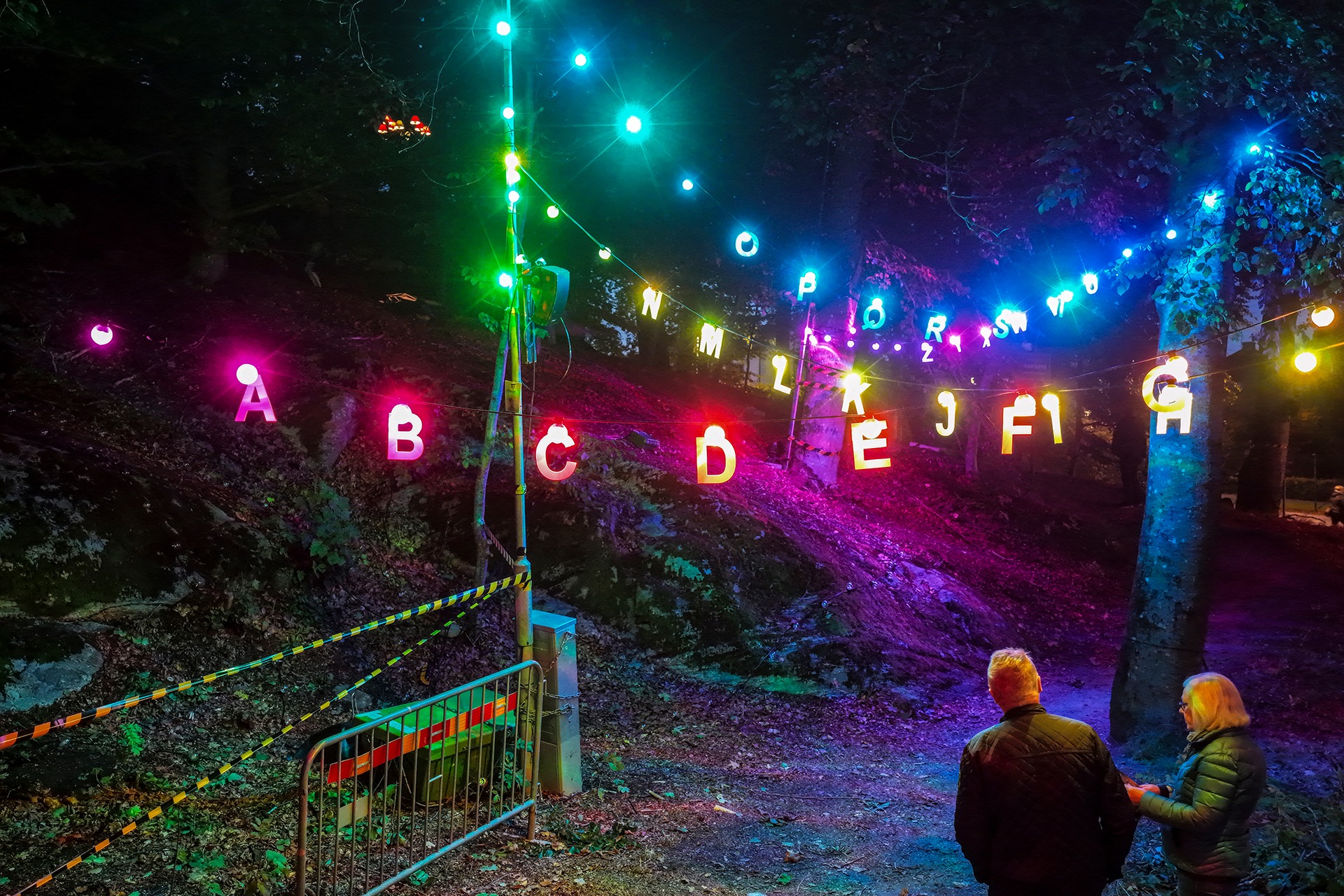
Moving along the trail, passing apartment windows emitting a warm, cosy glow from the lamps added to combat the darkness during the cold season. Once arriving at site three, where the installation is themed on the TV show Stranger Things, focusing on its 1980s science-fiction and horror aesthetic. The core design concept was to represent the show’s Upside Down, a dark parallel universe world, using a distinct red and blue colour palette, and programmed lighting sequences to create a moody, mysterious, and spooky atmosphere.
The site’s hilly terrain became the key source of inspiration, returning workshop head, Sjoerd Van Beers and Cristina Mordeglia, of the season four soundtrack Running Up That Hill by Kate Bush. The installation was designed as a “stage” to be viewed from a distance, leveraging the site’s natural depth rather than creating an immersive walk-through experience.
Key elements from the show were recreated, including a chandelier and an alphabet wall used for communication via lights, monsters like the Mind Flayer and the Demogorgon built from cardboard and mesh, and props like abandoned bicycles. Despite being the beating heart of the installation, the steep hill caused significant logistical challenges, which made cabling, positioning fixtures, and using equipment like a sky lift very difficult. However, through creative problem-solving and dedication, such as using a moving head light in a custom-built protective cage and integrating existing streetlights into their design with colour filters. In turn, the team created a masterpiece lightshow, cohesively timed with the angelic howls of Bush’s vocals.
A Dialogue in Lights (site four) took its cue from Dead Poets Society, adopting the film’s reverence for poetry as a springboard for a quiet, metaphorical narrative told entirely through light. Led by lighting designer Isabel Villar, the team developed a three-act structure centred on two entities attempting to communicate across the site’s narrow stream, with the final moment of connection enacted on the bridge that visitors themselves stood upon. Their process was notably thorough, with early site visits shaping their understanding of the landscape’s natural “pages”. Collaborative brainstorming between the team crystallised the idea of two sides calling out across water; and mood boards anchored their autumnal palette and soft-focus composition. On-site experimentation followed, with reflections in the water and the surrounding trees becoming integral to how each so-called “entity” expressed itself. Technical challenges, mostly cabling and DMX logistics, were handled collectively, contributing to the lively, late-night camaraderie the group recalled with evident fondness.
“Despite the late nights and long hours, we actually just had a lot of delirious fun while we were there at all hours. We learned a lot from each other in the process,” James McGowan, site four student from Ireland.
In their presentations, they explained that they ultimately resisted tying the story to a single meaning. Instead, the installation opened and closed like a book, inviting visitors to interpret the exchange for themselves, an approach consistent with the team’s belief that poetic light works best when it leaves space for the imagination.
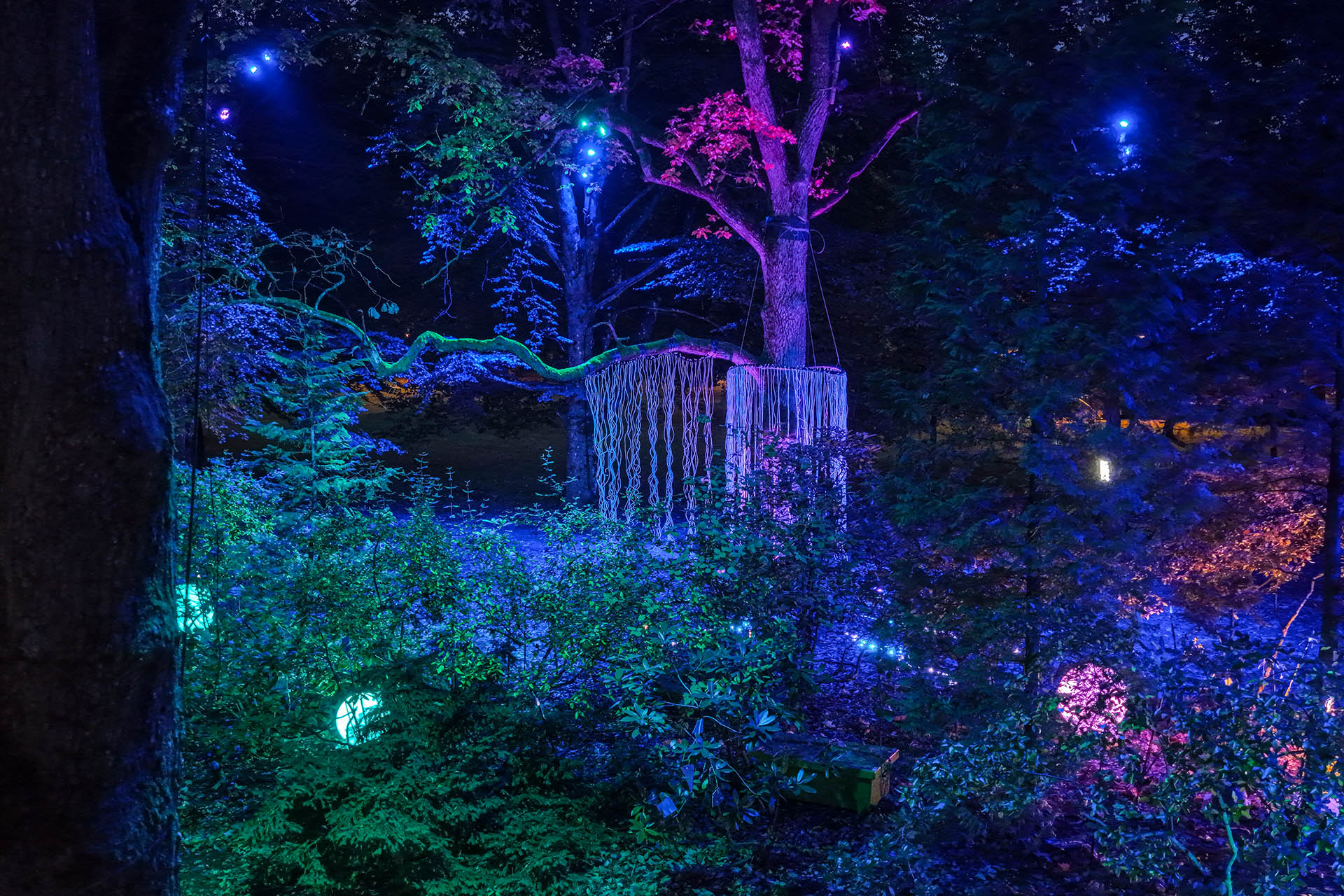
Phillip Roses’ team, site five, transported the visitors into a vivid bioluminescent world inspired by the film Avatar. The team set out to create an installation on the world Pandora, one that felt “alive” and “breathing”. This was achieved through dynamic lighting movements, shifting shadows cast from high trees, and a series of handmade features, including delicate flying seeds and glowing fireflies. At the heart of the installation stood the “Tree of Life”, an intricately woven structure requiring nearly a kilometre of thread, an emblem of both the project’s ambition and its intensely hands-on nature.
“Why Avatar? Well, they wouldn’t let me do E.T. because they wouldn’t give me a giant spaceship. Then I suggested Lord of the Rings, but they wouldn’t let me disappear off to Lothlórien in the forest or build all the houses up in the trees – apparently that was too much work”, laughs Rose. “So, I started looking at other forest-based ideas, and because some of the earlier concepts were quite heavy on white light, I became interested in doing something much more colourful. Those rich blues and magentas you see at night are so vivid, and I thought that could be really interesting to explore.”
The installation demanded formidable physical effort. It took long hours using sky lifts, crawling deep into dense bushes to secure fifty lights, and negotiating a site that was as demanding as it was beautiful. Yet, the team spoke warmly of the process and were pleased to trust Rose with their experience.
“I’ve seen Philip’s work before, so what initially drew me to this site was wanting to work with him. That was part of the reason, but I also really liked the team, and the site is fantastic because it’s the only site people can walk through and get close to,” says Deepa Mohare, who studies at the University College of London.
After walking through the town centre and admiring the local window display competition, the final stop on the tour arrived at site six, by the river, close to our starting point. This site was led by Meta Romanens and Niken Wulandri, who took a different approach to the site pitch.
“From the start, we knew we didn’t want to limit the students by choosing specific films for them. We wanted them to explore both the concept and any film they might eventually select. Because of that, we always felt as though we were a step behind the other groups, since we didn’t have a film to present early on. But the students handled it very well and progressed quickly. In the end, our site has a Star Wars theme, which I’m personally very pleased about,” says Romanens.
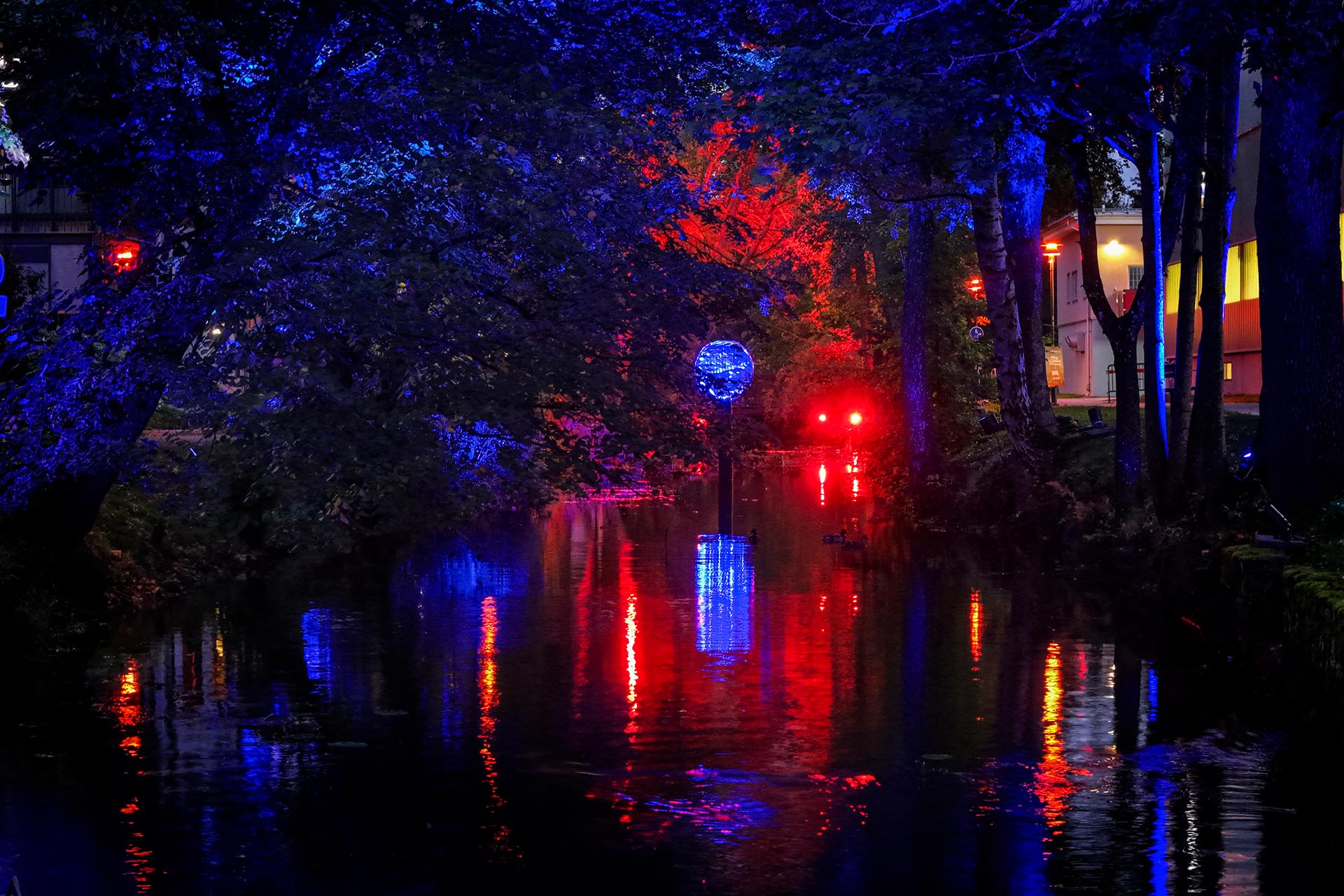
Titled Your Side, the installation explored the themes of dichotomy and good vs evil. Drawing on the natural duality of their site – two distinct riverbanks linked by bridges – they used blue light to represent the “good” side and red light to signify the “evil” side. At the centre of the installation stood a reflective structure, stretched across the river to symbolise the twin suns of Tatooine. This served as both a symbolic meeting point and a visual device, creating striking reflections on the water. Witnessing the installation in person truly emphasised the ambitious work created in just a week, framing it as a “yin and yang” experience, exploring the coexistence of opposites.
As the final glow of site six fades back into darkness and the trail loops once again towards the town centre, it becomes clear that this year’s Lights in Alingsås was not simply a celebration of cinema, but a celebration of how talented designers can bring stories to life. Together, they managed to create world-building, emotion, colour, language, symbolism, all translated through the medium of light. It was the student and the mentorship of their workshop heads who stitched these ideas together in a tireless commitment and sense of play to lighting design.
Commenting on the success of the whole light festival, event manager Camilla Bostöm concludes: “Over 70.000 people visited us this year, and many visitors have reached out to us and said that this was the best edition ever, with the theme Movies in Lights. The theme was personal and easy to connect to. The whole town, with the window-shopping competition, was involved in the theme. We are very happy for all participants and workshop heads as well as sponsors, and partners who made this edition possible with persistence, strength, joy and teamwork.”
Client: Alingsås Energi
Lighting Specified: Colorkinetiks, EWO, Fergin, Formenta, Gantom, iGuzzini, LedFLex, Martin, Meyer, Stockholm Lighting ,181, Annell BeersNielsen, Flux, Fox belsyning, Griven, iGuzzini Netherlands, Industire Licht, Jönköping Tekniska Högskola, KP Skylt, Louis Poulsen, Lumenpulse, LedLab, Lumenradio, MK Illumination, MaxiLed, Philip Hue, Signify, Wireless Solution, Zero, Zumtobel
Photography: Patrik Gunnar Helin