
LinkedIn Experience Centre London, UK
Merging architectural and decorative elements seamlessly, Ström has crafted a lighting scheme that perfectly complements the interior design of LinkedIn’s all new Experience Centre.
The largest online professional network, LinkedIn has recently unveiled a new, in-person meeting ground that can transform its digital experience into a real-world environment. Situated in its London offices and dubbed the LinkedIn Experience Centre, the space has been created with the goal of bringing together customers, social impact organisations, and industry experts across hiring, B2B sales, and marketing, inviting members, customers, and employees to collaborate, innovate, and connect in person.
This dynamic hub was designed by Ab Rogers Design (ARD), and has been broken down into three core areas – The Arcade, The Theatre, and The Executive Suite – each bursting with their own unique character.
Formerly an empty, underused space at the base of LinkedIn’s London offices, the Experience Centre presented a new opportunity, not just for ARD, but also for LinkedIn, to present itself in a whole new way.
Mara Irsara, Senior Associate at ARD, explains: “When LinkedIn approached us and we won the design competition, they were so excited to start on the project.
“As they had never created a space like this before, we had some deep conversations with the stakeholders to understand the business, the priorities, and how to translate that onto the floorplan.
“It was really interesting getting this knowledge from the stakeholders, because every market has different priorities. In London, it was more important to have an executive suite that acts as a ‘show off’ space, as well as a theatre to create events or host people. And then, as we expanded the concept, to reflect the building’s footprint, we developed the front-facing ‘Arcade’ space. This faces onto the road, and is very extroverted; and as you go further into the building, it becomes more introverted.”
This, Irsara says, is reflected in the choice of elements that are used in each space. The Executive Suite, for example, is more private, intended for VIP guests and boardroom meetings, while the outward-facing Arcade is designed more as an “internal street”, inviting visitors to linger and spend some time. In between these two areas is a theatre space, and production facilities for activities like podcasting.
Through each of these distinct spaces, lighting plays a central role in creating the desired ambience and defining the unique character and identity of each space – from creating pockets of interest and setting the right scene for a meeting to highlighting textures, working with interactive elements, and adding drama.
To that end, ARD invited lighting design studio Ström to tender for the project, as the interior designers felt that they had reached a point in the concept design where the input of a specialist lighting design consultant was needed in order for the unique space to meet its myriad needs.
Expanding on the design brief for the lighting, Anna Clara Sandgren, Co-Founder of Ström, tells arc: “The brief was focussed around creating an environment that promotes human ‘face-to-face’ connections and a sense of a public-facing space, more than an office. There were a number of interconnecting zones with their own functions (meeting booths, interactive learning zones, an auditorium, coffee bar), as well as the separate Executive Suite with a more premium/chic residential look and feel. But overall, the character of the spaces needed to work visually together.”
“It was important to provide breathing space for the interactive experiential designs by Deep Local, which are largely internally illuminated, while also providing suitable lighting to the artwork, supplied by Acrylicize, which included traditionally wall-hung prints and tapestries, as well as being integrated within the timber and glazed wall panels,” adds Emilio Hernandez, Co-Founder of Ström.
“The space is vibrant and full of visual interest, so we felt that it was important that the architectural lighting scheme didn’t try too hard, and instead brought a sense of calm through soft lighting to walls, with fixtures that were concealed or blended into the ceiling services.”
With a building profile that was not very deep plan, and a lot of north-facing glazing along one wall, Hernandez adds that the space felt like “quite a controlled environment”, which allowed for a gentler approach to the lighting that could add depth, without dominating the eye.
On entering the building, a glowing timber backdrop, illuminated by track-mounted wallwashers, frames the reception desk, alongside a large Santa & Cole Cirio circular pendant, that anchors the space and creates an inviting arrival experience.
“ARD asked us to propose something for the reception lobby, as it is the interface between the entrance, the lifts, the security gates and the reception desk, and the ceiling was just exposed concrete,” Hernandez says. “The Cirio pendant was a very simple intervention, but it works really well. Luckily, Santa & Cole provide really good Revit information and models of its range, and we were able to work with ARD to understand the drop of it, the size of each element, whether we use frosted glass or porcelain, to get the balance right so that the space was bright enough for a reception, elegant enough, and that the piece didn’t get lost in the exposed services ceiling.”
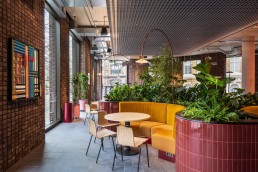
Leading from the reception, the lively, internal ‘street’ of The Arcade features meeting spots, lush planting, and playful design elements. Track-mounted wall washers and spotlights accentuate textured brickwork, featured artwork, and the bright, bold exterior of The Theatre. A Hunter Douglas perforated raft ceiling houses strategically placed recessed downlights that punch light onto the tables and enhance the planting below. An integrated line of light frames the feature ceiling and supplements ambient light levels, while illuminating the soffit above for an elevated effect. Muller Van Severen lamps droop over circular tables, casting an intimate glow, and are complemented by lighting integrated within banquette joinery to create visual interest.
“When you already have the space set out with such a strong concept, when we came on board, we wanted to understand the elements. For us, the track system gave a lot of flexibility to both light the artwork elements on the wall and in between the glazing, while also highlighting the tables and workspaces within the space,” Hernandez says.
Sandgren adds: “ARD uses a lot of colour, patterns and artwork, so we knew that we needed to have really good lighting onto the vertical surfaces to pick up the richness of the colours that they would be using. We also added little details such as the lighting underneath the seating, as we knew that it had to be something a little bit more, as the space is going to be used for evening events as well. During the day, there is so much daylight that the only thing that needs to be lit really well is the elevation; but at night, this space really comes to life with lots of evening events, so it was important that it felt like an inviting place to come to.”
“There are only a few places where people are actually going to be sat with a computer for a while,” Hernandez continues. “Most places, it’s going to be interactive, face-to-face meetings and discussions. We have picked a few key areas that are more ‘traditional’ meeting spaces, where we have used an acoustic hood pendant, so that people can zone out a little bit more from the rest of the space, but if you wanted to have a more informal meeting, there are tables with downlights, light bouncing off the walls, the decorative pendants, lighting built into the underside of the banquettes – there are a lot of different elements that make you feel that there is enough light. It feels professional, but it is also quite casual.”
One of the central features of The Arcade space is the vast, perforated raft ceiling that stretches through the entire avenue. As well as concealing the MEP services, Ström was able to subtly integrate architectural lighting elements to complement the drooping pendant lights over each table, providing the right level of functional light.
Hernandez explains: “Although it is a flexible space, the tables are fixed, and through our collaboration with ARD, they were able to change the spacing of the perforations in the ceiling to fit off-the-shelf downlighting. This meant that we could place them seemingly randomly in the ceiling, and visually, they disappear, but you get that punch of light onto the table that you need.”
“The decorative lights do a big job in terms of the overall design language, but didn’t provide enough useful lighting on the tables or the planting, which is why we doubled up with the discreet lighting in the ceiling,” Sandgren adds.
The downlighting in the grid ceiling is also offset by an indirect cove of light that runs around the grid’s perimeter, providing an added ambient light to the space that works alongside the focused downlighting and decorative pieces.
Underneath this grid ceiling, one of the central focal points of the Arcade is the lush greenery that runs through the middle. While providing adequate lighting for this plant-life could have presented a problem for Ström, Sandgren adds that the abundant natural light entering the space made their job easier on this front.
“It is always a chicken and egg discussion – what plants are being specified, what light is available, etc. Fortunately, the space is heavily glazed and north facing, so suitable plant species were specified to make use of the natural light. This enabled us to focus on more subtle spike lights and decorative lights nestled within the planters.
“It also helped reduce energy consumption. We liaised with Cambium Plants, which has a lot of experience providing planting for offices that are resilient to various light levels and improve air quality without having to provide thousands of lux to the plant canopies. While there are some fantastic options on the market for hydroponic lighting, using natural light is always our preference where possible, as it reduces cost, maintenance, and risk for the client.”
Sitting in the centre of the development, The Theatre forms the beating heart of the Experience Centre. A dramatic, in-ground line of light wraps around the base of a curved coral structure, which is balanced by high-level, curved track lighting, creating a sense of flow and movement that encourages people to explore beyond. From outside, it is a captivating view that catches the eye of passersby.
“We really fought for this feature because in the original renders, it was unlit, and while I don’t like putting a big architectural element in unnecessarily, we felt that this curve was such an important part of the space that it had to be lit from both directions. It means that at night, when you walk by the building, you see this red wall pop from the street,” Hernandez adds.
Inside the auditorium, a linear lighting profile washes the curved timber wall, and together with low-glare lighting within the ceiling from iGuzzini’s Laser Blade, it provides a discreet and flexible base layer for the specialist AV theatre lighting configuration.
To the rear of the project lies the more “introverted” Executive Suite. Designed to feel more intimate and cosy, the lighting design reflects the shift in character to a more chic-residential style space.
Moving from exposed services and raw materials to a cleaner aesthetic with plastered ceilings and white fittings, the lighting similarly shifts to a warmer tone. Cove lighting enhances the vertical timber finishes, adding depth and warmth, while also complementing the Vibia pendants that hang above a soft seating space.
Meeting rooms feature tunable white technology and high colour rendering, creating ideal meeting conditions that users can tailor via a control system. In the boardroom, a back-illuminated ceiling by Optelma enhances the sleek design look, and supports ambient light levels, while adding drama through an array of illuminated colours.
“The Arcade space is a lot more vibrant and high contrast, whereas in the Executive Suite, it is calmer, more of a traditional executive office – there were softer materials, more fabrics, so the lighting was adapted to match.”
Irsara adds: “It was really important that the lighting would be friendly and respond to the space. Especially in the Executive Suite, everyone that enters there says that it feels really residential, and that is exactly what we wanted. So, the lighting reflected this really well, adding to the mood that we wanted to create.”
Indeed, throughout the project, there is a strong harmony between the interior design and the lighting design, not just through the subtle integration of architectural lighting, but also in the selection of decorative elements – a selection that Irsara says was the result of Ström and ARD’s richly collaborative relationship.
“In some instances, we wanted a specific product, but in others, Ström suggested exactly what we needed,” she says. “We have worked with Anna for many years, so we know each other’s style, and she knows what we like.
“What we really appreciated from Ström was how they also suggested elements that could be integrated into the interior design. The downlights integrated into the grid ceiling in The Arcade give the right amount of light, without needing to add an additional element, keeping the rest of the ceiling as free as possible.
“Lighting was not something that has been overlaid as a function – it was considered and integrated into the design from the beginning. It sounds really obvious, but so often it isn’t the case. Sometimes, all a client cares about is having enough light and it’s hidden somewhere. But here, the lighting is functional and beautifully integrated into the MEP or existing architectural elements, which gives space for the feature lights to really shine and stand out.”
“It was an interesting collaboration, because ARD included us in a lot of the decisions, but equally, they really think about lighting when they design,” adds Sandgren.
Ultimately, the collaboration between Ström and ARD was to the project’s benefit, with the lighting and interior design marrying together beautifully throughout.
Reflecting on the project, Hernandez says: “We hope that the lighting helps to bring depth, texture, and scale to the space. The challenge with open plan environments of this size, with 4.5-metre ceilings, is that you’re trying to simultaneously give a sense of space, while retaining a cosy, inviting feel.
“The reception pendant, for example, could have easily appeared lost, or overbearing. It fills a difficult junction without any other ceiling or interior features to riff off of. The same applies to the curved floor recessed linear. Its detailing within the stone floor and width are important for it to feel like part of the interior, as opposed to an extra piece of lighting stuck on top.
“I’m sure that many lighting designers will attest that it is not uncommon to not receive any feedback directly from the client, especially on larger projects, in which case you can take the stance that no news is good news, as you will usually find out if something is not to the end user’s liking. The response from the client here though has been overwhelmingly positive, so much so that they are looking to replicate this in other regions.
“We’re lucky and grateful that working with ARD feels like we are on the same team, so the feedback is daily, rather than a more formal process at the end of the scheme.”
Finally, Irsara concludes: “Sometimes clients will say ‘you don’t need a lighting designer’. But for us it is really important to say, ‘No, you do – exactly why you think you don’t need one, that is one more reason that you do’. Lighting is something that, if it is good, you don’t notice it, because it gives the right level of wellbeing and feeling in the space. Maybe we don’t even see it, but that’s the beauty, and the difficulty of it. We believe this, and that is why Ström were part of our team from day one.”