
Materials: Axia – Lodes
Born from the desire to rethink the chandelier without visible wiring, Axia unites structure, energy, and refined materiality. Its development traces a journey of experimentation that culminates in a system of pure balance and light.
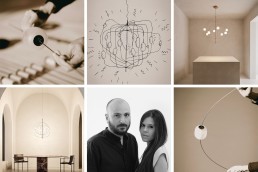
The realisation of Axia came from a project that is driven more by the pursuit of balance rather than the inception of a light in the traditional sense. From the very beginning, independant designers Vittorio Venezia and Carolina Martinelli, approached Axia as an idea: what spatial presence could a chandelier achieve if its most visible component, the wire, were removed?
This radical question became both the core and constraint of the project, prompting the team to hide every technical element within the structure itself, turning the central axis into the conductor that carries both electrical poles and gives the lamp its name – Axia, from the ancient Greek word meaning “value” and “axis”.
“Axia was born from the desire to reinterpret the chandelier typology in a contemporary way,” says Martinelli. “We were interested in working on a lamp capable of establishing a presence in space, yet with great visual lightness. Rather than focusing on the object itself, the research concentrated on how light could occupy and define space.”
“The initial question was very simple: what happens if we remove the wire from a chandelier? That’s where the project began. If light is no longer bound to a cable but flows through the structure itself, the lamp changes its nature: energy passes through the object, and the technology disappears, allowing only light, structure, and proportion to emerge,” adds Venezia.
The idea for Axia originated long before its realisation, but it wasn’t until Lodes approached the duo for a potential collaboration that it began to take shape. The designers shared their vision of reinterpreting the chandelier with no wires, a concept that Lodes was immediately drawn to. From there, the project evolved, with both teams agreeing to treat the design not as a singular object but as a flexible system capable of adapting to various lighting needs.
The project began in 2024, requiring two years of development, including concept, prototyping, technical refinement, and final rollout. The initial concept was the easier part, with the challenge lying in how they would make the technology “disappear” within the structure without compromising the clarity of its chandelier form.
The prototyping phase proved just how demanding the designer’s initial gesture of removing the wire would become once translated into materiality. The early prototypes were stripped-back technical rigs, built primarily to verify internal electrical continuity and the reliability of the connections between elements.
“The early prototypes were much more technical than the final product, but they already contained the fundamental principle of the project: a central rod divided into two poles of positive and negative, from which the arms extend, conducting electricity,” explains Martinelli.
As development progressed, the team moved through several distinct iterations: early versions relied on rods, but these soon were replaced with spring steel, whose elasticity offered greater efficiency, slimmer proportions, and the possibility of compact packaging that would help reduce its overall environmental impact. This shift, however, introduced new complexities – every section, tolerance and junction had to be recalibrated to ensure that the lamp maintained both its structural stability and its visual clarity. Throughout all these changes, one principle remained untouched: the central axis as the chandelier’s organising and conductive core, the element that unites material and light, and most crucially gives a sense of balance.
The production of Axia is based on a combination of precision engineering and a material-led approach. The lamp begins as straight metal rods and tubes, which are manufactured and finished while still in their linear forms. These parts are designed to be slightly elastic, so they can be easily bent without compromising their strength. This flexibility is essential, as it allows the natural curvatures to take shape during installation.
After shaping, the metal receives a PVD coating treatment. This finishing is not only fundamental for the refined aesthetic, but also plays a functional role, helping the metal maintain electrical conductivity so the structure can act as part of the circuit. In parallel, the diffusers are made from Pyrex glass tubes that are heated until soft, then shaped over the moulds. Once formed, the glass is sandblasted in a controlled chamber, where air and sand gently roughen the surface to create a matte finish that allows a soft and even light.
In the final stage, the electrical components are added, and the system is assembled. The whole design has been developed with modularity in mind, reducing the number of parts to make installation easier and allowing the lamp to be packed efficiently. Overall, this improves transportation, minimises waste while still maintaining the clarity and identity of the design.
“Sustainability and longevity play a key factor in our designs, especially in construction logic, hence why Axia is shipped in very compact packaging. At the same time, the product is designed to allow LED replacement over time, ensuring greater longevity and reducing waste. It represents a choice for more sustainable, long-lasting lighting,” says Martinelli.
To allow this, the structure is modular and can be disassembled into a few small elements: the central canopy with the transformer, the central axis, and the eight arms to which the LEDs and glass spheres are attached. “We like the idea of the assembly being a ritual,” adds Venezia.
In its final form, Axia expresses a kind of presence that goes beyond illumination. The designers have been blown away by the feedback of their chandelier, with users describing it as a lamp “that draws space even when it’s switched off”. Rather than occupying space with mass, it occupies space with light, allowing a gentle, diffused glow to define the atmosphere more than the object itself. This effect is heightened by the lamp’s soft output, which wraps the room in an elegant radiance. For the designers, Axia resolves into three words: balance, system, and light – a concise summary of its material logic and its quiet yet unmistakable presence.