
Memorial Brumadinho
Honouring the lives of 272 people who tragically died following a dam collapse, the Memorial Brumadinho creates an atmosphere of sombre reflection, in part thanks to a quietly respectful lighting scheme from Atiaîa Lighting Design
In January of 2019, a tailings dam at the Córrego do Feijão iron ore mine suffered a catastrophic failure. Located 9km east of Brumadinho in Minas Gerais, Brazil, the dam collapsed, releasing a toxic tidal wave of around 12 million cubic metres of tailings. This mudflow engulfed the mine’s headquarters, including its cafeteria, where many of the mine’s employees were enjoying their lunch break, before flowing more than five kilometres downstream towards the Paraopeba River, destroying houses, inns, farms and roads in the process.
The disaster killed 272 people – 250 of which were working in the mine – and affected 26 municipalities in the region, causing extensive damage to the local community, the water supply, and the environment in what stands as Brazil’s biggest workplace tragedy.
Following the disaster, the families of the victims formed an association to pursue justice for what happened. One of the compensations was the creation of a memorial that would commemorate those who lost their lives and honour their memory.
Brazilian architecture studio Gustavo Penna Arquitetos & Associados (GPAA) was chosen to design the memorial, doing so with close collaboration with the families throughout.
Situated on the site of the tragedy, one of the primary ambitions for the memorial was to transform the location into a space for reflection, learning, and transformation.
As well as presenting facts and figures about the day of the dam collapse and the history of mining in the territory, the memorial gives names and faces to the victims and tells their story.
Throughout the memorial, visitors will find an entrance pavilion, which includes a lobby with crystal geodes (a symbol of the “lost jewels”), a meditation space, a café, administrative and support areas, a grove, pathways and outdoor spaces, a reflecting pool, two exhibition halls, and a space dedicated to the dignified safekeeping of the victims’ remains, as well as a vast “rift” – designed to represent and make eternal the rift that caused the dam to collapse – that leads to a sculptured monument.
Across the memorial, light plays an integral role in creating an atmosphere of sombre reflection. Tasked with realising this was Mariana Novaes of Brazilian studio Atiaîa Lighting Design, who wanted to design a scheme that would be quietly respectful, inviting introspection and solemnity.
“I wanted to make people feel, that was the main idea – to feel the space, and feel the absence, but also to feel the presence as well. It was important to create a lighting scheme in which, hopefully, people would develop an emotional connection with the Memorial,” she tells arc.
“The architecture was designed in a way that people would experience different scales, and the contrast of daylight and darkness. The visitor enters from the outside into a small, dark room during the day, and then it opens out again, before entering the rift, which is a sensitive area of the project. Then this sense of different scales repeats during the journey through the rift until you access the Memorial and Testimony rooms. And later it ends in a viewpoint.
“I wanted to create something similar at night, and to balance light and darkness. I believe that when you allow darkness, you invite people to think, to reflect; darkness is a pause where you invite silence and introspection. The light is there to provide information, but through darkness, we stop seeing and we start thinking and feeling.”
Given the tragic story behind the memorial, and the input of the victims’ families, Novaes says that the reality of their pain placed the designers in a position of “profound humility”. “From the beginning, there was no I or we, but they. We were there for them. It was all about the victims and their families. The narrative belongs to those who can no longer speak, and those left immersed in grief. There is no consolation that can materialise in these circumstances. This was therefore our modest effort to honour the memory of those invaluable people whose lives and dreams were abruptly cut short.”
With this in mind, the lighting design is deliberately pared back, with low-level, warm lighting creating a soft, delicate glow where necessary. Each solution was designed to connect the visitor to the impacts of what happened, through a symbolic and sensitive interpretation.
Lighting helps to guide the journey and the experience of the memorial, highlighting planes, emphasising elements and symbols, determining zones of light and darkness, and creating perceptible contrasts across each space, according to what they represent and present; striving not to distort the characteristics and colours of the architectural materials or hide imperfections.
“When the dam collapsed, all I could think about was candlelight,” Novaes explains. “What I wanted was to light a candle for everybody. I had this in my mind because it is the most precious tribute, and it is present in any culture. This was our idea, and the architects came with a lot of messages, symbols, and meanings for the architecture, and we worked together to illuminate these messages.”
The memorial was constructed out of concrete that had been mixed with a pigment extracted from the toxic iron ore waste. The front façade of the memorial was illuminated in a way that would show all of the textures, or “scars” of the material.
The use of concrete throughout presented Novaes, on a technical level, with some difficulties, with regards to placement of lighting fixtures, as one of her main ambitions was for the light to feel “seamless”.
“We had to be very careful, because we didn’t want the fixtures to be present – we didn’t want people to see the luminaires,” she says. “We did a lot of research and tested many products, but the right answer was to use fibre optics, particularly in the rift, as these could be embedded into the walls, and the drivers, etc, would be hidden on the other side. There were also linear and grazing lights, and ellipsoidal projectors – there was a mix of products, but the most difficult part was to make them invisible, but I think we managed to hide them well enough.”
Walking into the memorial, visitors enter a dark lobby space with the date of the tragedy displayed on the wall, and where the only light source present guides them to the crystal geodes.
On the lobby’s ceiling is a small rectangular skylight, perfectly positioned so that on 25 January each year, at exactly 12.28pm – the moment of the disaster – a beam of daylight cuts through the ceiling and strikes the geodes, filling the space with reflected light. These geodes, Novaes explains, are a further tribute to those lost during the disaster. “The families refer to their lost ones as ‘jewels’. This comes from an interview at the time of the tragedy from the President of the mining company, who said that the company is a “jewel to the country”. Everybody thought, ‘you don’t say that. You never say that. The jewels are the ones that we lost, and this could have been avoided’.”
The contrast of the illuminated exterior to the darker interior spaces, Novaes feels, invites the visitor to take some time to adjust not only their vision, but also themselves, so that they can fully take in the different messages presented by the architecture.
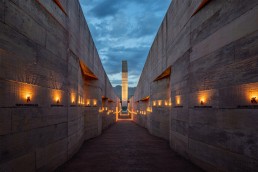
From this lobby space, visitors then enter the “rift”, a 230-metre-long channel, in which the names of the 272 victims are displayed, each with an accompanying, illuminated Ipê flower. Through these flowers, the symbolism continues, as Novaes explains.
“272 Ipê-Amarelo (yellow Ipê) trees were planted at the site to honor the victims. It is a tree native to Brazil, and its flower is the symbol of the country. It is associated with resilience and resistance, because it loses all the leaves and blooms exuberantly during the driest and coldest season – it is so beautiful. Despite everything, life goes on.”
The decision to include these illuminated ipê flowers was made during the development of the project, as the authorisation process for including the victims’ names in the rift walls took a long time – some are still not authorised. At the time of the project, some of the victims’ bodies had not yet been found.
“The initial idea was to illuminate the names of the victims, but iIn the end, the architects and the communication designers came up with the idea that, if the names are there or are not there, by illuminating the flowers, we would still have a symbol to honour each person. This was very important so that people could see them and process their losses.
“Interestingly, when you are in the rift and you see the flowers, someone told me that they felt that it was like a procession where you carry a candle.
“This never came to my mind when I was designing it – I was only thinking that every single person is present through light. But when you see all 272 lights together, he felt that he was in a procession.
“But when you are in a procession, the person carrying the candle is the one paying the tribute, but that is not the case in the rift – the lost ones are the light, they are the ones carrying the candle. Symbolically, they are guiding us through this memorial.”
Halfway down the rift are three rooms, each further honouring those that lost their lives in this disaster. In the first space, the Memory room, the families of the victims honour their loved ones; photos and selected objects that represent each person are present in this moving, emotional space.
The second room, Testimonial, presents facts and data from the tragic event that occurred on this site, while also providing some additional information on the territory, and the history of the space, and the mining history at Córrego do Feijão. The third and final room is a sacred space that holds the recovered remains of the victims.
“What happened there is unbelievable – it is really, truly sad. And this room is very important. In this room there is almost no light, and you are not permitted to take pictures, it is a place to pay your respects.”
In the middle of the rift, right after these rooms, stands a tall monument. Designed to appear as an abstract head that “feels and cries”, Novaes says that the architect “had the idea of representing humanity and its failures”.
“When the project originally started, this was a simple white square, from which the tears would come, and then later, a map of Córrego do Feijão was added to the surface, where we could illuminate the territory, the history, and so on. And when this head cries, the tears are also illuminated.”
From the sculpture, water cascades down the remainder of the rift, leading to a viewpoint that is pointed towards the site of the dam collapse, before culminating in a lake that “collects the weeping”.
Novaes continues: “The original architectural proposal didn’t include lighting in the lake, but I felt we needed to add some lights to the lake. The mine lights are still on, and the lake would be in darkness. How do we deal well with darkness? How do we interpret and understand darkness in our culture? Would the darkness and the mine lights being on send a good message to those visiting the site? This is the last area open to visitors at the memorial, and it was our last chance to pay tribute to the victims. In Brazil, there’s a popular expression we use when we can’t explain death: we say someone has become a star in the sky. So, on the surface of the lake, we added 272 ‘stars’.
“As a basis for the design of the points of light, a map of the celestial sphere projected onto the site on January 25, 2019, at 00:01, the date of the dam rupture, was used, once again to represent the victims and convey the message that, even amidst this tragedy, there is a horizon, there is light, there is hope. Let’s think about what we can learn from this.”
Since the memorial opened, it has received widespread acclaim, garnering attention not only for the striking architecture, but also its beautiful, reflective lighting design. The project was recognised at the IALD Awards earlier this year, and was also the recipient of the SPACES Award at the [d]arc awards. However, despite this acclaim, Novaes is more hopeful that the attention the project has received will help to spread the message about the tragic event that occurred at the Córrego do Feijão mine.
“I feel very honored to be a part of this project,” she says. “I’m happy, of course, for the recognition of the work we did, but my motivation for applying for all these awards was how I, as a designer, could further honour these victims and their families, beyond doing the best possible work on the project. I felt that this project and this story needed to be heard, I wasn’t thinking about the results; I was driven by the desire to share the story so that it reached as many people as possible. There is no memory until you know what needs to be remembered. That was my motivation, and when I see the results emerging, I am very happy, because it’s much more than the work itself; it’s the meaning and relevance of the memorial being recognized as well.”
Memorial Brumadinho was intended to be a place to feel, to pause, and remember those lost by this tragic disaster. The combination of its architecture and lighting design creates an atmosphere of collective reflection – far from merely providing wayfinding or displaying information, light brings an additional, atmospheric, intangible quality. It adds presence, highlights symbolism, invites introspection, and, most importantly, honours the victims’ memory.
www.atiaiadesign.com.br
The full interview with Mariana Novaes will be available to view on the [d]arc discussions YouTube channel soon.