
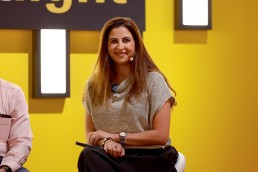
Nadine Baalbaki
At Light + Intelligent Building Middle East earlier this year, Lebanese lighting designer Nadine Baalbaki delivered a stirring presentation titled “Not All Dark Skies Are Happy Skies”, sharing her own experiences of “light poverty” in a war-torn country. Here, Baalbaki tells us more about these experiences, and why when we talk about dark skies, we need to take a more contextual approach.
Attend any lighting trade show, conference or talks programme around the world, and chances are the topic of dark skies will be present in some capacity. Indeed, conversations surrounding light pollution, and preserving the night sky have been on the lips of many lighting professionals in recent times. However, while this is still an important discussion, there is one designer who is calling for more contextual understanding, and recognition that “not all dark skies are happy skies”.
Based in Dubai, but born and raised in Lebanon, lighting designer Nadine Baalbaki, founder of Light The Detail, first spoke on the need for cultural and contextual sensitivity surrounding the concept of “dark skies” at Light + Intelligent Building Middle East in Dubai earlier this year – with specific reference to her own upbringing in a war-torn country, where a dark night sky would bring with it fear and uncertainty.
Speaking to arc, Baalbaki says: “The idea for my talk came a year before, when I was attending a talk, and the presenter showed a picture of the night sky of the UAE during the pandemic, where lights were turned off because nothing was functional.
“He praised the image and identified it as an ideal situation, and if I put my lighting designer hat on, I would agree, but when I saw the image, I felt a really heavy feeling. I delved deeper into that feeling and tried to identify my relationship with dark skies, and I could recognise that darkness brought back underlined traumas.
“I knew that this has to do with my upbringing in a country where we were living with severe power cuts through times of war, and where darkness at night became a synonym for fear. Dark sky was not security or safety, it was not looking at the stars and contemplating the beautiful night sky, it was moving away from the windows in case of any bombings. It was fear and anxiety in its purest form.
“All of these feelings emerged in a split second when I was confronted with that image. Yes, we want darkness, and I agree that the impacts of light pollution are detrimental, but we need to address the topic with more consideration. I wanted to convey a message that in order to reclaim night skies, we need to examine where people are coming from and how their relationship with darkness is shaped.”
Baalbaki lived in Lebanon for most of her life, studying architecture and gaining a Master’s degree in the subject from the Lebanese University. However, she made the decision to move to Dubai in August 2013, seeking a better environment for her young family at the time.
“The decision to move to Dubai was made because we didn’t want our kids to live through what we had in Lebanon, through wars and economic crises. So, we decided to move to the UAE seeking peace and mental wellbeing, rather than job opportunities.”
Growing up in such a tense environment meant that Baalbaki didn’t have early career aspirations in the same way that others may have done. “When you are growing up in a war zone, it doesn’t feel like you have a lot of aspirations,” she says.
“Sometimes I felt like I wanted to be a fashion designer, and I used to draw dresses, but to feel like you are inspired to be something is different when you are in this context. As a kid, when you dream, you dream of a stable life, to be able to make it to school on time and take part in your extracurricular activities, which often got cancelled because it was not safe. It was an interrupted cycle of aspirations.
“And because you are living in a context where everything needs to be rationalised, you need to think of a career that has more future. As much as I wanted to study psychology or photography, the future was not bright for these career paths in Lebanon back then. Architecture was more of a middle ground that I reached because I wanted to major in a creative field, but with a more safe and calculated future.”
As with many people that find themselves in the lighting industry, Baalbaki first discovered the world of lighting during her studies in architecture. Months before submitting her final thesis, she was contacted by a friend, who briefed her about an opening at Hilights, the lighting design company they worked for. She was offered the job on the spot at her interview, and has never looked back.
“In Lebanon, lighting design as a profession was not well known 21 years ago. When I told my father that I wanted to pursue it, he thought it simply meant placing chandeliers in the middle of a room, he was not aware of the prospects of the profession. That’s when I realised, if this profession exists and so few people know about it, then it must be a niche worth exploring. From the very first project I worked on, I knew instantly: this was it, this was where I belonged.”
After spending eight years with Hilights in Lebanon, Baalbaki took a career break of a year to focus on her young family – it was during this time that she moved to the UAE. Once settled in Dubai, she shifted her attention from design to manufacturing and business development, working as a Project Manager for Vbomedioriente – a Middle Eastern distributor for Viabizzuno – before eventually returning to lighting design, and establishing her own studio, Light The Detail, in 2023.
“The concept for Light The Detail began a few years earlier as a social media platform dedicated to highlighting the importance of lighting on our wellbeing. When you step into the field of lighting design, you quickly realise that while light profoundly affects our mood and mental health, its impact often goes unnoticed because it isn’t tangible. For instance, if you visit a doctor with back pain, they’ll likely ask about your exercise habits or whether your mattress offers proper support. But if you arrive with stress or recurring headaches, it’s unlikely that anyone will question whether poor lighting might be part of the problem.
“When I founded Light The Detail, I noticed a gap in how we communicate about lighting. As professionals, we often exchange ideas within the industry, but we rarely speak to the public in simple, relatable terms. I wanted to change that by explaining concepts like glare, colour temperature, and perception, and by showing how light shapes our mood, wellbeing, and mental health. What started as a space to share knowledge and raise awareness gradually grew with me. In 2023, I chose to redirect my path and fully embrace lighting design, so I rebooted it as a design studio.”
Since returning to lighting design, Baalbaki’s work has primarily been focused on the residential market across the Middle East, although she does also dabble in F&B, retail, and workspace projects. Throughout all of these though, she strives to adopt a human-centred approach.
She says: “When I started working in the lighting industry, I was told to focus on the visual aspect of lighting. But now, I feel like I’m more focused on the human being, on the people living in the spaces. Because I work a lot on residential lighting projects, I try whenever possible to meet the clients. Working in Dubai has presented me with the opportunity to work with a wide array of clients from different nationalities; with each nationality comes a certain character and certain relationship with light. At this stage, it’s crucial to consider who we are designing the lighting for – especially in residential spaces, where people will live with this lighting for years to come.
“My style is therefore more human-oriented, focused on the people who inhabit the space. I favour a subtle, minimalistic approach, aiming to let the light stand out rather than the light fixtures.”
This human-oriented approach to lighting has helped to give Baalbaki a broader understanding of the individual and cultural nuances of lighting design, something that contributed further to her feelings surrounding dark sky sensitivity. “Even in countries where light is abundant, people’s experiences of the night, or of darkness, can be negative, and they may respond by using excessive light,” she adds. “Understanding these perspectives is something I wanted to bring to the conversation. There are many discussions about light pollution and the importance of protecting dark skies, which I fully support. But to be effective, we also need to understand why people fear darkness and why they feel the need for so much light.
“It’s not easy; since the beginning of humanity, light has been associated with safety. Prehistoric people lit fires not only for warmth but to ward off predators. So, when we suggest reducing light or embracing darkness, it can provoke fear or anxiety among different communities.
“In Lebanon, for example, you wouldn’t see much advocacy for dark skies. Discussions focus more on how to provide illumination as a means to improving safety, security, and social engagement, while also preventing economical isolation. Yet these conversations often come from a place of privilege, where people have control over their light. They don’t usually emerge from deprived communities.
“It is true that ensuring safety and security in communities is fundamentally the responsibility of government authorities and requires the collaboration between several governmental bodies to implement effective strategies to fight crime. It is not the direct responsibility of the lighting design community.
“Although there is no conclusive evidence that increased outdoor lighting deters crime, light remains a factor that increases the perception of safety. In light deprived and unsafe neighbourhoods, communities tend to correlate light with safety and security. This is why broader discussions with governmental entities are essential: only when there is trust in the system can people begin to feel comfortable engaging with darkness.
“At the moment, the approach to these issues remains very global and generalised, and when solutions are generalised, sometimes the impact of those measures falls short. So, I think it is very important to look at the regional context.”
Even within these regional contexts, Baalbaki acknowledges that the root causes of light pollution can vary greatly, from elevation lighting, to road lighting, stadium facilities, and electrical boards and signage – a particular concern for herself in Dubai.
Because of this, she feels that a lot more work needs to be done on defining the dominant causes in each city and region, and to “tackle them systematically one by one”.
“In addition, we have lost the definition of nighttime as human beings, and when that happens, we lose our dark skies. Our lifestyles revolve around working during the day and living, working, socialising at night, we re-purposed the night function from resting to harvesting. Lighting doesn’t exist in isolation; it follows people, functions, cities and urban developments. When a city grows or aims to operate 24/7, lighting inevitably follows.
“It is a difficult balance, there is not just one aspect to look at, there are global factors. In order to make an impact, we need to read these factors, and dive deeper into regional and city-oriented approaches towards light, towards fighting light pollution.”
Following her presentation at Light + Intelligent Building Middle East this January, Baalbaki is hoping to spark a response in the lighting design community, and expand the conversation on a more global level.
“I was pleased with the audience’s response. Many were aware of concepts like light poverty, but sharing my personal experiences – how darkness affects me and shapes my approach to nighttime – resonated more deeply.”
More than anything though, Baalbaki hopes that, by expanding this topic beyond the region, she can help spread her message to re-address the imbalance in terms of light access and light poverty, as she states, “while people are sometimes suffering from excess of light, people from other places are suffering from a lack of it.”
She concludes: “I want to explore further how people would respond to darkness when they have lived their life under light deprivation? How do they perceive and interact with light? When does light becomes excessive? And can light poverty lead to light pollution? For Instance, I have noted a general response among Lebanese people when visiting Dubai. They are generally delighted by the abundance of light and they perceive it as a positive aspect in the city and do not recognise and acknowledge it as lighting pollution.
“To address light pollution and improve our relationship with the night, we first need to understand where people are coming from and how they experience darkness. Only then can we reconnect with the night as a natural and essential part of life.”