
Parco Storico Bricherasio, Italy
At Parco Storico Bricherasio, light introduces a fifth season: the night.
Beyond spring, summer, autumn and winter, the lighting design of Parco Storico Bricherasio reveals a new temporal layer – one that does not alter the identity of the park, but gently uncovers it.
Located in Fubine Monferrato, around 60km east of Turin, within a UNESCO-listed landscape, the historic park has evolved over centuries from a medieval woodland into a refined 19th-century English garden, preserving a rich botanical and cultural heritage.
The project forms part of a wider public regeneration programme funded under the Italian National Recovery and Resilience Plan (PNRR), and has been developed within a defined regulatory framework, including national environmental criteria (CAM), regional legislation on light pollution, and heritage protection requirements.
Within this context, the lighting design approach, crafted by Marco Palandella and Roberto Corradini of LDW Studio, embraces constraint as a driver of quality. Rather than limiting creative intent, regulation becomes a framework through which light is shaped with precision, responsibility and clarity.
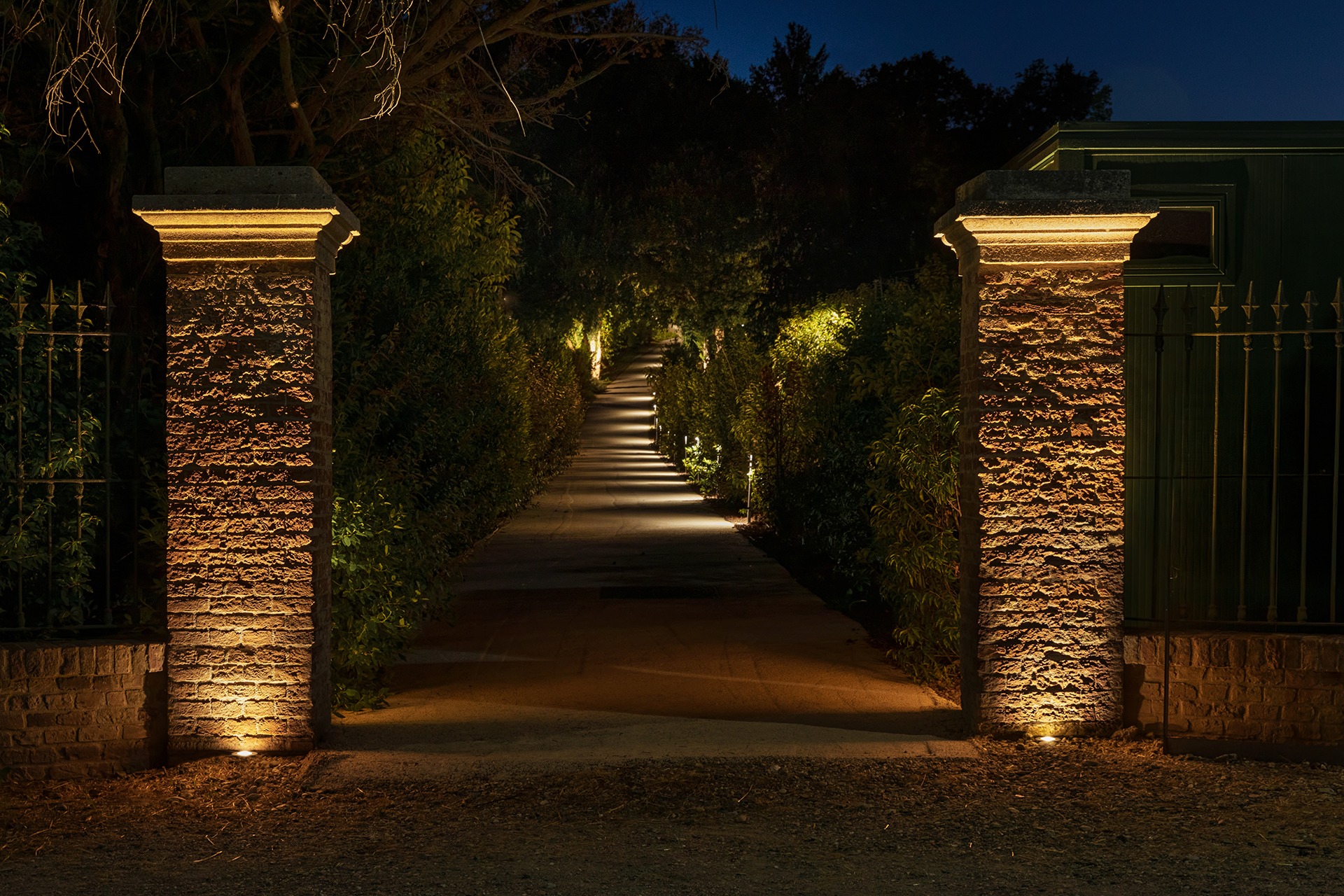
The lighting strategy from LDW Studio therefore adopts a restrained and respectful language, using warm white light (3000K) throughout, with no colour effects, in order to preserve the historical and natural character of the site.
The nocturnal experience unfolds as a gradual journey through the park, symbolically retracing the historic route once taken by Countess Sofia Cacherano di Bricherasio as she approached the castle by carriage. Light becomes a narrative device, guiding visitors along this path and revealing the landscape in sequences, echoing a slow, processional movement through space.
In this way, the project does not simply illuminate a path – it re-enacts a historical gesture.
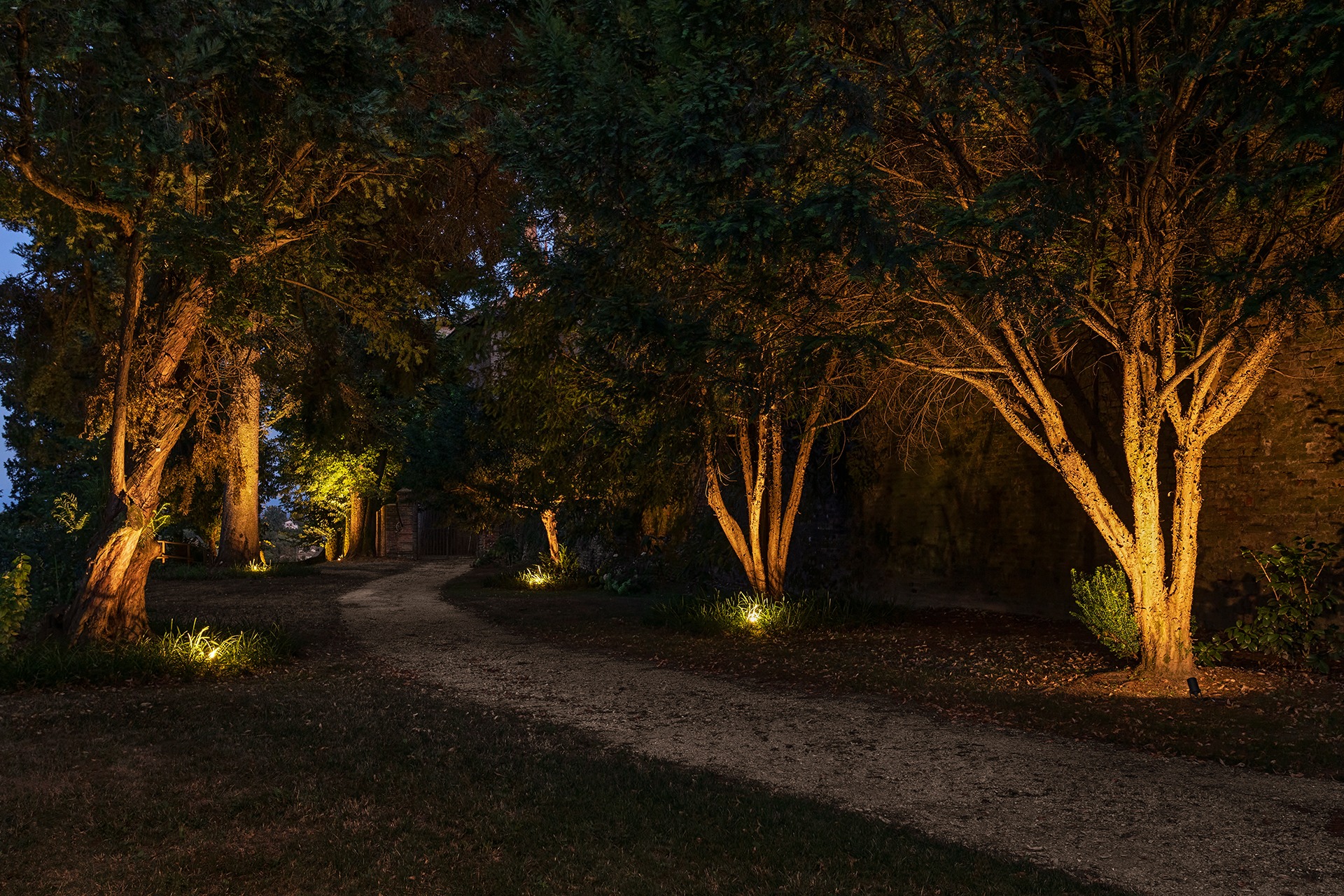
At the entrance, brick gate columns are gently modelled through grazing light, enhancing their materiality while maintaining visual comfort. The main avenue is defined by a sequence of low-level luminaires that provide a soft, rhythmic illumination, carefully integrated with the surrounding vegetation. Deeper within the park, discreet projectors highlight trees of varying scale, contributing to a layered perception of the landscape and reinforcing spatial hierarchies.
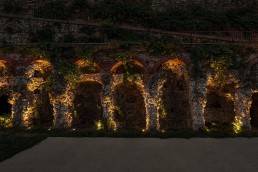
Architectural elements, such as stone arches along the ascending path to the castle, are revealed with subtle recessed lighting, while bollards and step lights ensure safe and legible circulation. The composition culminates with the castle itself, whose tower emerges as a distant focal point within the nocturnal scene.
Sustainability is embedded in every design decision. Developed in dialogue with the University of Turin, the project takes into account the photoperiodic responses of plant species, ensuring that artificial lighting does not interfere with the biological rhythms of the park’s vegetation.
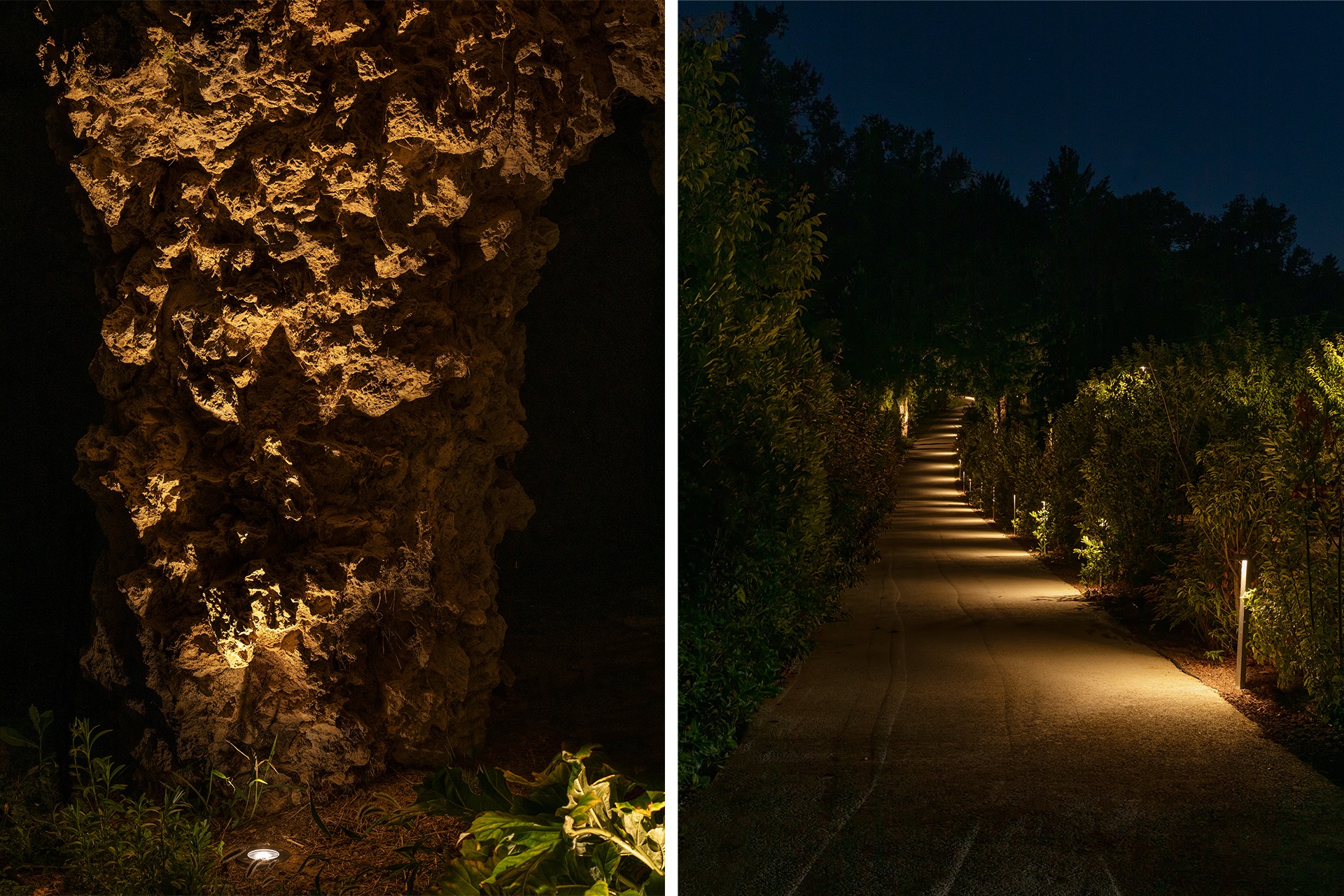
Light distribution is carefully controlled to minimise upward emission and reduce light pollution, with upward-facing luminaires switched off after midnight and adaptive lighting strategies applied across pathways. These measures ensure compliance with environmental regulations while supporting the ecological balance of the park and reducing energy consumption.
At the same time, the intervention enhances the accessibility of the park after dark, making it not only a destination for visitors, but a living and inclusive space for the local community of Fubine.
In this project, creativity does not oppose regulation – it finds its most refined expression within it. The result is a lighting intervention that is both expressive and measured, capable of enhancing the perception of the landscape without altering its essence.
In this way, the park does not simply become visible at night – it becomes complete. Night emerges as its fifth season: a quiet, coherent and atmospheric dimension that reveals the site in a new, yet deeply respectful way.
www.lightingdesign-workshop.com
Project Credits:
Client: Comune di Fubine Monferrato
Lighting Design: Marco Palandella, Roberto Corradini; LDW Studio, Italy
Landscape Design: GMP Studio Alessandria, Italy
Scientific Support: University of Turin (DISAFA)
Lighting Specified: Cree, LEDvance, L&L Luce&Light
Photography: Alessio Tamborini