
Qatar Pavilion
Honouring the “seafaring heritage” of both Qatar and Japan, Lighting Planners Associates has used a delicate approach to illuminate the “floating” Qatar Pavilion.
Taking inspiration from the traditional Dhow boat, the Qatar Pavilion at Expo 2025 is composed of a wooden exhibition building, wrapped in a white, sail-like membrane, designed to appear as if it is “floating” on the surrounding water table.
Designed by Kengo Kuma & Associates (KKAA), the pavilion looks to express the connection between Qatar and Japan – two countries that share the same seafaring heritage – and it continues through to the exhibition area, designed by AMO/OMA, with the theme “From the Coastline, We Progress”.
The curved membrane of the pavilion is connected to a series of symbolic arches at the foot of the building, creating a seaside promenade that evokes Islamic geometry, while the wooden box built inside the membrane is finished with cedar paneling, and coated with three different colours of paint, further emphasising the connection to the century-old dhow boats.
Working alongside KKAA, the pavilion was illuminated by Lighting Planners Associates (LPA), who used light to echo the architectural concept of a floating boat through a “gentle” lighting scheme.
However, as the pavilion is situated along the Expo’s Grand Ring, LPA examined how best to illuminate its white membrane in a manner that would allow it to stand out among its brightly lit surroundings.
“The architect and the Qatar team preferred to illuminate the façade from outside, rather than showing the transparency of the membrane; LPA carried out 3D simulation studies to find the best lighting position,” says LPA.
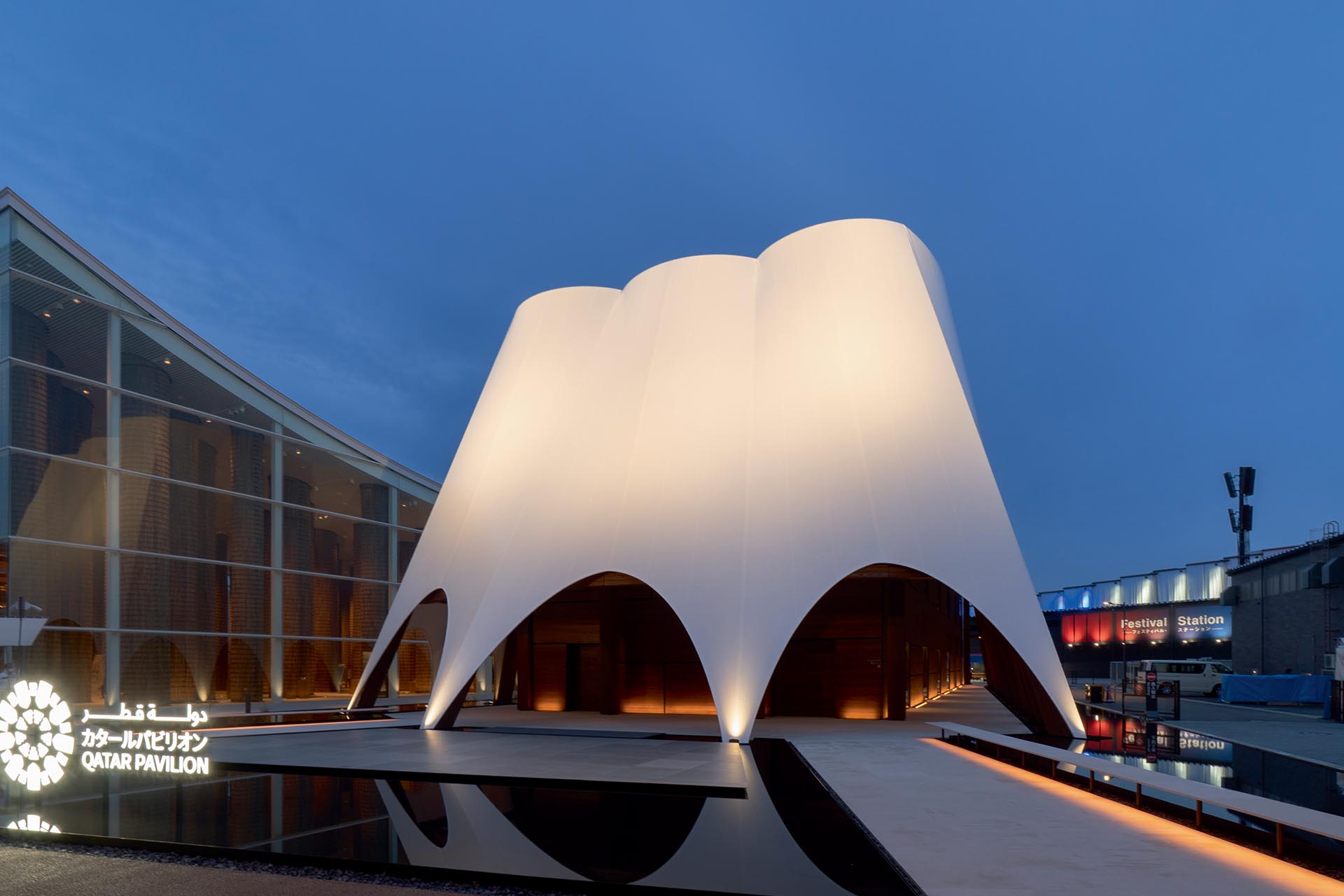
“As the sail membrane is white and smooth, and the façade has a simple, symmetrical shape, it was difficult to adjust the aiming angle and dimming level of multiple fixtures to achieve uniform brightness over the wide front surface of the façade. Since the membrane is sloped back at the top, light from ground level would not reach the top, and LPA concluded that spotlights mounted on eight-metre-high poles would provide sufficient luminance.
“Due to the shape of the site, the position of the light poles is asymmetrical to the pavilion, making it difficult to adjust the spotlight and illuminate the façade evenly. Even if the brightness difference was not noticeable to the naked eye, it would be accentuated through the camera, so each spotlight was individually dimmed to achieve uniform brightness.”
Narrow beam spotlights were used to wash the sides of the façade, to emphasise the shape of the membrane and create the appearance of sails filled with wind. Meanwhile, along the approach corridor, continuous arches are emphasised by uplights with anti-glare louvres. This is complemented further by under-bench lighting, which guides guests towards the entrance.
On entering the pavilion and its exhibition space, the visitor’s eye is immediately drawn to a gradational sand wall, representing Qatar’s desert landscape. The clear, acrylic pipes that hold the sand have both transmissive and reflective effects; this meant that, in order to avoid the reflection of indirect lighting on the pipes, light sources have been adjusted not to directly face this feature. Elsewhere, in the intro corridor, a backlit fabric wall, akin to the colour of sand, creates a soft light environment. Here, LPA ensured that the light source was verified to match the colour temperature of the luminous ceiling of the adjacent shop, visible through the clear acrylic pipe.
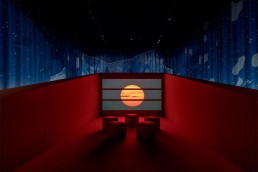
In a sharp contrast, the main exhibition room is enveloped by deep blue curtains, creating an “underwater atmosphere”. In the centre, a large, wedge-shaped object features the Qatar coastline in 12 niches, showcasing the country’s culture, ecology, hospitality, and heritage through a curved, backlit panorama panel.
The curtains are designed to represent the rich marine resources of Qatar, with a blue fabric base and shiny materials, such as dove and gold thread, while DALI-controlled dimming spotlights are used to minimise the base, highlighting the Qatar map pattern.
Explaining the lighting journey from the entrance to the exhibit space, LPA adds: “We designed a lighting sequence from a bright, ambient mood near the entrance, to shift to a contrasted, dark mood in the main exhibition room. In the introduction corridor, soft, diffused light through the fabric wall gently illuminates the sand wall, before the entire mood is dimmed down in the exhibition space to focus the visitor’s eyes to the coastline exhibition.”
In the exhibition space, lighting was also installed behind the curtains to match the position of the pigeonholes, while the shimmering light effect, combined with the drapes, gives the space a sense of depth.
Although there are many luminous elements in the space, the floor and the main object are both made of aluminium, with a vibrant finish that reflects light well, so the balance between the brightness of each element was adjusted to prevent the space from becoming too bright.
Indeed, given the luminosity of the materials in the space, a sensitive approach was needed to achieve the best results. The main exhibition space features a dark theatre at its centre, while the graphic on the blue curtain that runs along the entire space needed to stand out. This required very sensitive adjustments to the lighting, so we dimmed the spotlights down to just 5%. The luminous display panels and the reflective aluminium finish on the exhibits and floor helped to cast a gentle light onto the curtain.”
Finally, the VIP room on the second floor is based on the theme of cultural exchange between Qatar and Japan, with objects inspired by “paper” lightly covering the entire ceiling. Here, using a full-scale mockup, LPA decided how to hide the lighting fixtures themselves within the suspended ceiling feature, without shining directly on the ceiling.
“Several scenes were set up according to the intended use: a workshop scene with uniform brightness throughout; a reception scene with low brightness in the centre while emphasising the artwork on the walls. The vitrine box was also specially designed and fitted with bar lights that were custom-made to match the vibrant aluminium finish,” the studio adds.
Reflecting on the experience of illuminating the Qatar Pavilion, LPA says that, although the overall design and construction schedule for the structure was tight, the team approached it as they would any architectural lighting design scheme, from the design itself to the selection of the fixtures.
Within this vibrant Expo site, the Qatar Pavilion stands out for its gentle simplicity, with the lighting bringing a much-needed feeling of calm serenity to its visitors.
LPA concludes: “Many visitors stopped in front of the pavilion to enjoy the photogenic night view. The lighting approach and expressions are simple, yet by carefully considering the space and materials, the lighting design elegantly enhances the charm of the architecture and the space.”