
Sopo, New York, USA
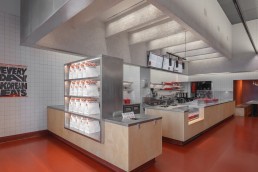
In the heart of New York’s Garment Center Historic District, a new fast-casual spot called Sopo offers a space of calm amid chaos. The restaurant serves everyday Korean fare with efficiency and flair – an ethos echoed in its precisely crafted interior. Designed by Brooklyn- and Los Angeles-based architecture studio Model Practice, the 900sqft space occupies the ground floor of the 1924 Arsenal Building, originally designed by Ely Jacques Kahn.
Model Practice took an editorial, restrained approach to the design. “We embraced the concept that a utilitarian loft factory’s architecture, like the Arsenal Building, needn’t be mundane,” says Christopher Lee, partner at Model Practice. At the centre of the concept is light – specifically, a thoughtful system of luminaires from architectural lighting manufacturer Coronet LED.
Albeit small, the space had soaring ceilings. Lee and fellow partner Minyoung Song leaned into this verticality with a suspended volume inspired by the Korean dosirak, a compartmentalised lunch box. “Sopo means ‘small parcel’ in Korean,” says Lee. “The client wanted the space to feel like an escape from the chaos of Seventh Avenue – one that elicited the same joy you’d get from opening a package. The dosirak metaphor felt like a natural fit.”
The pair created a floating “box” that hovers above the front-of-house area, its form reinforcing the logic of the space below while discreetly concealing access panels, speakers, and fire sprinklers above. Acoustic baffles span the length of the box, running perpendicular to the service line below to create visual compartments.
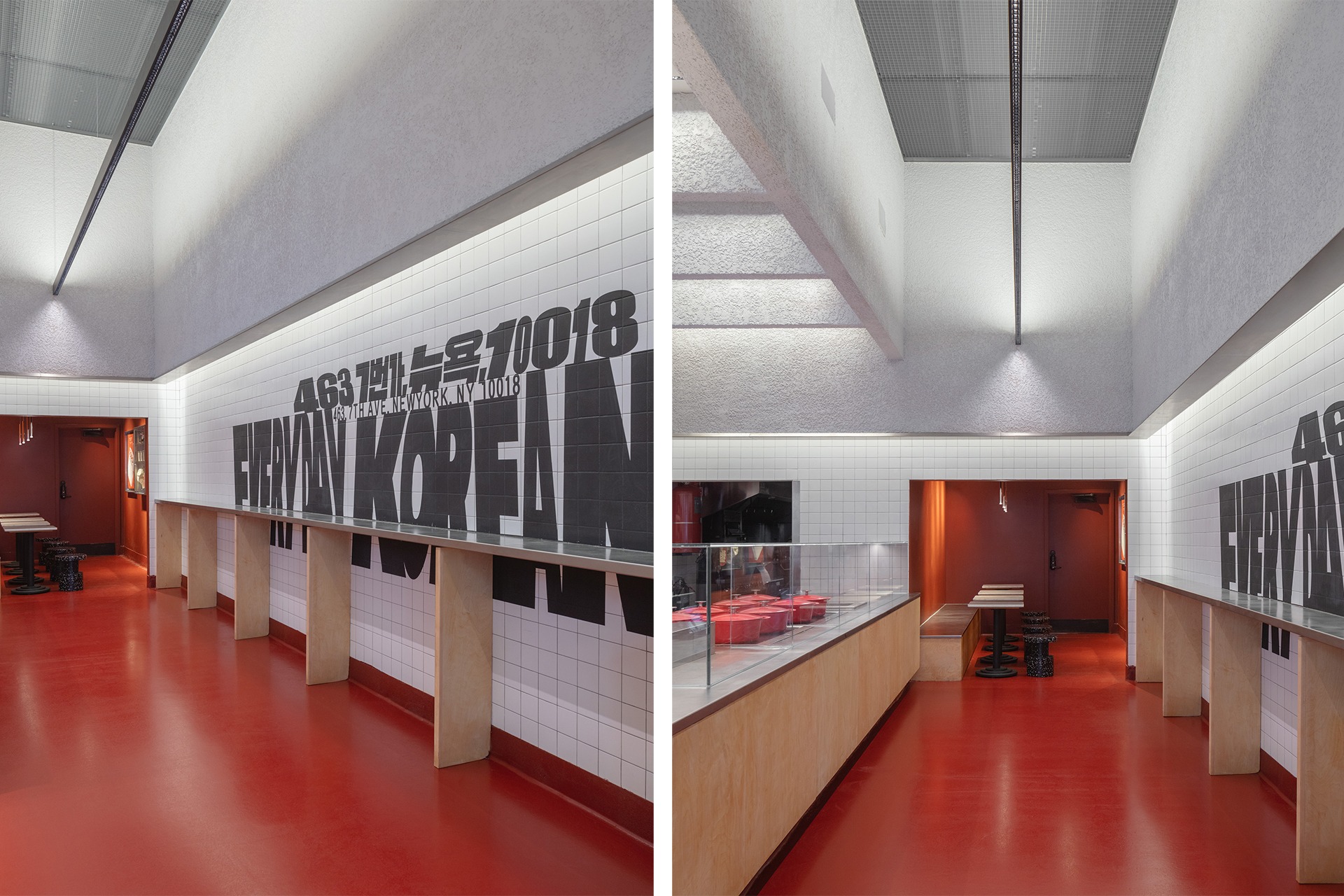
Lighting was key to the execution. Inside the box, Coronet’s Rush Sharp fixture casts a soft, even wash that defines the individual compartments and highlights the texture of the acoustic plaster that coats the volume’s interior. Meanwhile, the reflective surface on the box’s exterior catches light from adjacent fixtures, drawing attention to the form without overpowering the compact space.
Lighting was also leveraged to choreograph circulation through the restaurant. A 28ft long LS1 Sharp fixture from Coronet’s flagship LS Series runs parallel to the service line, drawing guests in the door and through the space. Specified with both uplighting and downlighting, the suspended luminaire draws more attention to the chapel-like ceilings. A tailored louver and optical system minimises glare and offers precise control over beam spread, ensuring a comfortable environment for customers.
Around the restaurant’s perimeter, the LS3 – another member of Coronet’s Declare-listed LS Series – adds dimension to the white-tiled walls. Slightly heftier in profile than the LS1, this linear fixture creates a soft perimeter halo. Its placement helps distinguish the compact service area from the quieter dining nook tucked in the rear, all without interrupting the openness of the floor plan.
That quiet integration was intentional. Aside from the LS1 Sharp, which boasts an ultra-slim profile, Coronet’s fixtures are concealed – tucked into the ceiling or integrated within architectural elements. The LS3 and Rush Sharp luminaires are completely hidden, casting soft, indirect light that gently defines the space without visual distraction.
To meet both performance goals and energy requirements, Model Practice collaborated closely with Coronet to specify precise light outputs across all fixtures. The manufacturer’s control-agnostic infrastructure made it easy to pair the system with manual dimmers, allowing staff to adjust brightness throughout the day.
As is often the case in hospitality design, expedience was a priority. Beyond aesthetics, Coronet’s flexibility proved essential to the project’s fast-paced timeline, allowing Model Practice to execute their vision without compromising the schedule.
The result is a finely tuned space where every detail, down to the beam angle, contributes to a larger architectural story – offering diners a brief but beautiful pause from the rush outside.
Project Credits
Architect: Model Practice
Builder: Stonegate Build
Environmental Graphics: Spreadworks
Brand Identity: Ordinary People
Photography: Naho Kubota
Lighting Manufacturer: Coronet
Client: Sopo