


The connected building is truly intelligent
Darren Smith, Specification Leader, Signify UK&I, discusses the benefits of Intelligent Buildings.
In today’s rapidly transforming world, the use of the built environment is fundamentally shifting. Traditional buildings, long seen as static and passive structures, are being reimagined as dynamic, responsive ecosystems. These ‘new age’ buildings are intelligent infrastructures that continuously collect, analyse and respond to data to create more adaptive, efficient, and sustainable spaces. This transformation is driven by the convergence of connected technologies, digital platforms, and the Internet of Things (IoT), enabling buildings to go beyond their physical functions and deliver measurable value to organisations and occupants.
Intelligent buildings and what they have to offer
The significance of intelligent buildings has become especially clear in the post-pandemic era. As companies adjust to new workplace realities, connected systems and the IoT applications built on them become indispensable.
- Intelligent buildings help progress on the sustainability agenda – according to the UK Green Business Council(UKGBC), the building sector has the greatest potential to reduce greenhouse gas emissions. 25% of UK greenhouse gas emissions in the UK come from buildings and infrastructure. Also, UKGBC states that newly constructed buildings are more energy-efficient, but 80% of buildings that will be in use in 2050 have already been built, so a major priority is decarbonising our existing stock.
- Intelligent buildings support greater flexibility, ensure employee safety and wellbeing – today’s employees expect healthier, more responsive workplaces. To attract and retain top talent, businesses must invest in intelligent infrastructure that supports hybrid work models, encourages productivity, and responds in real time to occupant needs.
- They also help businesses operate more efficiently, while enabling a differentiation in a highly competitive environment. The pandemic didn’t invalidate pre-existing workplace trends – it accelerated them.
Central to the rise of intelligent buildings is the digitalisation of the physical environment. Digital technologies allow buildings to operate as platforms that deliver various services, from predictive maintenance to real-time energy analytics. These “value services” are made possible by integrating connected systems and cloud-based data processing. By embedding sensors into lighting, HVAC, and security systems, buildings can gather continuous data about usage, occupancy, environmental conditions, and system performance. That data is then processed in the cloud, where it is analysed and visualised to inform better decision making. The result is an environment that evolves in real-time, optimising itself to serve the needs of both people and the organisation.

Taking the first step
LED lighting can be up to 80% more efficient than traditional lighting, and as LED lighting can last up to 25 times longer than conventional sources, so you also get the benefit of reduced maintenance costs.
However, there are further design-in possibilities available to further the benefits of this simple change. When organisations make the switch to LED lighting, a layer of lighting control can also be added to enable further savings. The lighting levels can be automatically adjusted depending on the activities taking place. These additional energy savings can come from daylight-sensing, scene/task setting and presence/occupancy detection, all of which will help to further reduce the energy consumption of lighting.
Among all building systems, connected lighting presents a unique opportunity to act as a foundation for intelligent capabilities. Lighting is already present in every building area and can be upgraded with little disruption. When equipped with connected LED technology, lighting becomes far more than a utility – it becomes a strategic part of the infrastructure.
Switching the connected lighting on
Connected lighting can play a significant role in enabling a building to become even more energy efficient, operationally efficient and sustainable. One such system is our Interact “connected lighting” system.
Intelligent drivers and sensors are embedded into the light fixtures to create either a wired or wireless infrastructure allowing for full remote control and management of lighting assets.
A remote cloud-based system can also be used to allow for multiple sites to be connected to one common platform/dashboard. It then becomes much easier to take complete control of all the lighting at an enterprise level, from anywhere, at any time.
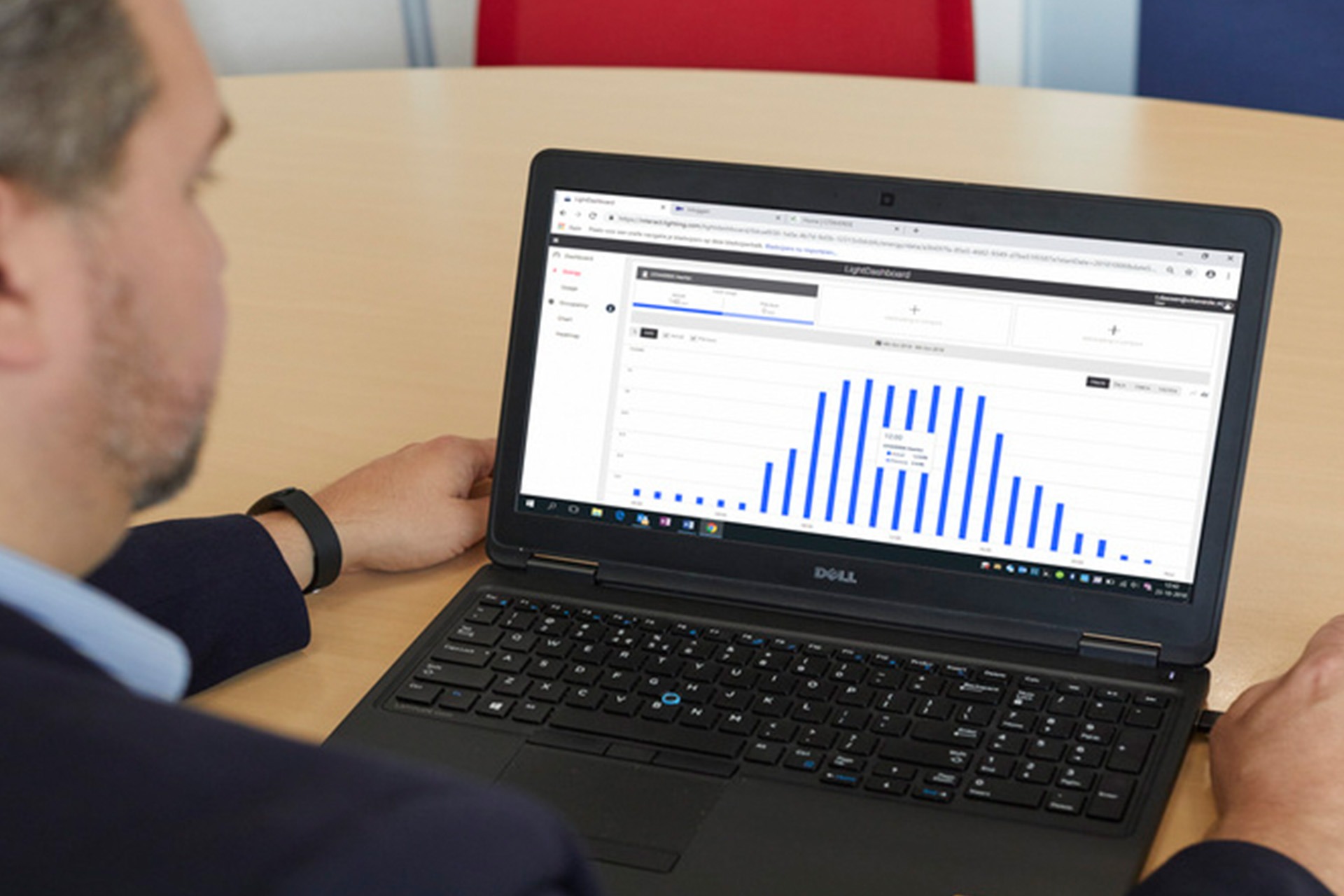
The Interact system offers an intuitive dashboard that gives insight into lighting usage and allows users to optimise lighting operations remotely. Interact offers a flexible, cost-efficient, scalable system that meets unique needs and is easy to understand and operate. It is easy to take advantage of IoT technology to suit the needs of every facility.
Platforms like Interact by Signify demonstrate the power of connected lighting as a digital backbone. Interact enables centralised control and monitoring of lighting systems across entire facilities. Through its software, lighting scenes can be adjusted, energy use tracked, and operations optimised for efficiency and comfort.
Below are some of the possibilities that a connected lighting system can offer:
Intelligent Occupancy sensors, which are embedded into luminaires, continuously gather data about presence and occupancy within the space. Heat maps can then be simply created to show which areas are being more frequently used and those that are not. This data can not only help the client to further optimise the lighting regimes/levels, but it can also be used to help improve operational costs by optimising stock locations and pick times.
The possibilities do not end here. Environmental sensing is also possible with smart sensors. Temperature can be continually monitored and feed information into partnering systems, ensuring the right amount of heating and cooling is applied to the space. Similarly, CO2 levels can be monitored to keep an eye on ventilation and air flows.
What the intelligent building can offer
The full potential of intelligent buildings is unlocked when these systems are integrated into a larger IoT-enabled ecosystem. With the continuous data streams that are collected and stored in a centralised data lake through cloud-connected sensors, facility managers gain real-time insights into how space is used and where the lighting is used the most (or least), enabling them to make evidence-based decisions about layout, staffing, and maintenance. Automated systems can adjust lighting, or temperature, based on real-time conditions without human intervention.
In the workspace, connected lighting can encourage the shift to smart offices. As more organisations embrace hybrid and flexible work arrangements, office environments must adapt. Intelligent systems allow for dynamic space management, where desks, meeting rooms, and other facilities can be reserved or allocated based on occupancy and demand. Environmental controls such as lighting can be tailored to individual preferences, enhancing comfort and productivity, for example. Lights become demand based by sensors embedded in the fixtures; this saves energy. On top of that, it generates data, to not only optimise the energy for lighting, but also to make demand-based HVAC possible, and to optimise the space layout. Also, lighting has a profound effect on people, and with connected lighting we can operate the lights according to a circadian rhythm, giving people a good night’s sleep when at home after a productive day. With this: The office becomes a social magnet, where people and purpose thrive.
As we look to the future, it’s clear that the most successful environments will not be the largest or the newest but the smartest. Intelligent buildings set the standard for how we live, work, and grow in a world that demands more from our spaces. They are not just changing buildings but redefining what buildings can be.