
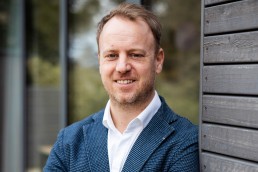
Till Armbrüster
Throughout his career, German product designer Till Armbrüster has blended architectural and decorative lighting, creating beatiful luminaires for Ingo Maurer and Licht Kunst Licht, and has recently launched his own design studio, Source to Space. Speaking to arc at Light + Building, Armbrüster tells us of his design philosophy, and golas for the new studio.
As a publication, here at arc have noticed in recent times a blurring of the boundaries between architectural and decorative luminaire design. Decorative lighting pieces are becoming much more technically-minded, while there has also been a definite emphasis in architectural luminaire design to make fixtures more aesthetically pleasing.
This is one of the primary reasons why we, as a magazine, decided to re-integrate decorative lighting content back into our pages. However, for German product designer Till Armbrüster, Founder of Source to Space, this is an approach that he has always tried to hold on to in his work.
“Typically, the protagonist in architectural lighting and decorative lighting is quite different – in architectural lighting, the protagonist is seen as the architecture, or the interior, or the people; while in decorative lighting, the protagonist is often the luminaire itself. But I don’t see it as being this black and white.
“I try to give an architectural luminaire a certain emotion, but also vice versa, a decorative luminaire should have a technical element.”
Born in Cologne, Germany, Armbrüster moved to the country’s “lighting capital” of Lüdenscheid at an early age – although it wasn’t until much later in his design career that he realised the significance of his hometown in the lighting industry. Instead, his early forays into design were more centred around carpentry and construction.
Speaking to arc editor Matt Waring during Light + Building 2026, he reflects: “In school, we had a lot of artistic classes, looking at different materialities and art styles. I fell in love with this work, but I was unsure if I was good enough to apply to art school; you have to apply with a portfolio, and I have to admit, I am not the best sketcher, I was much more into building. Because of this, I started an apprenticeship in carpentry, which helped me to develop my skills to build ideas.”
During this time, Armbrüster also built up his portfolio, and eventually enrolled in Aachen University of Applied Sciences to study Industrial and Product Design – initially thinking that, with his experience in carpentry, he would move into furniture design. But this was in the mid-00s, in the nascent days of the LED revolution, and lighting soon began to take hold.
“Quite early during my studies, I came into contact with lighting and luminaires. In my third semester, I did a luminaire project, and built a prototype that was only feasible with LEDs. This was in the early days of LED – I think it was a one-Watt Osram LED – and the concept was that I was conducting electricity over metal measuring tapes, that was not possible at higher voltages.”
A unique concept that, while it may not have led to a launchable product, did lead to another, incredibly exciting opportunity for a budding luminaire designer.
“I presented it to my professor, and he suggested that I show it to Ingo Maurer. I said ‘wow, are you sure I can go there with this?’, and he told me to give them a call, as Ingo and his team are very open to young people, students, etc.
“They asked if I wanted to send the prototype, but I said ‘no, I want to show it myself, it’s too important to me’. So, I put on the suit that I wore for my mother’s wedding, went to Munich, and when I arrived, I got a lot of laughter as nobody in Ingo Maurer’s office was wearing a suit – it was super creative, chaotic, everyone was wearing whatever they wanted.
“They really took their time looking at the product, and found it very interesting, but it was clear in the beginning that they wouldn’t turn it into a product in their series. But once I was there, I felt the atmosphere, I loved talking to the people, and it became clear to me that I had to work there. To be in this super creative team that was always doing new stuff, experimenting with materiality and light, was mind-blowing as a young student. I applied for an internship, and afterwards, Ingo said to me, ‘this is working well for me; you don’t have to go back to university, just stay here’.”
However, keen to finish his degree before fully entering the working world, Armbrüster returned to university, where he further honed his craft, designing and building lighting prototypes. Luckily, so impressed was Maurer with Armbrüster that, two weeks before he finished his degree, he received another call telling him that, when he graduated, he was to move to Munich to come and work for him.
For a young graduate, entering the wild and wonderful world of Ingo Maurer was quite an experience for Armbrüster, particularly as lighting technology was also entering a brave new world.
“There is a German term, ‘Schlaraffenland’, which translates to the ‘Land of Milk and Honey’. On the one hand, Ingo and his team had a courageous, hardworking, 24/7 attitude to design, and then on the other, the new technology of LED was emerging.
“The Ingo Maurer team was still working a lot with halogen and fluorescent lighting, but I was there right at the shift. I consider myself an LED native, because I was directly working with LED from a young age and created my expertise around this new development. The older colleagues on the team often came to me and asked, ‘can we solve this problem with LED?’. With this expertise, I found my place in the design team.
“It was quite a hard thing for all companies to shift from incandescent to LED, but as a young designer, it was fantastic because we could do so many things, play around, and create luminaires that had never been possible before.”
While Ingo Maurer as a designer cemented his legacy through his imaginative, creative, and oftentimes outlandish designs, Armbrüster’s early design influences were much more formal; the likes of Bauhaus and Dieter Rams of Braun – “traditional heroes of German design”, as he calls them.
“I still refer to these names, but somehow the work with Ingo was so different and so fascinating that I really went deep into this. Even though I couldn’t understand every design that he was doing, it was still a lot of fun to execute them and build them, because it was so experimental.
“We always used to say that if you open up a catalogue from Ingo Maurer, you will find a product that you absolutely love, and one that you absolutely don’t understand, but for everyone it is different, because his work is so much about emotion.”
During his time with Ingo Maurer, Armbrüster was involved in the design of a number of beautiful light pieces. Particular highlights of his though include the Zufall series of luminaires. Translated to “By Chance”, the Zufall family is a range of luminaires crafted from silicone – a material known for its extraordinary properties. Its flexibility, and ability to incorporate colour pigments in a pure, three-dimensional form made these light objects – which came in both a standing table lamp or a hanging, knotted pendant – truly unique. The soft, vibrant silicone allowed users to interact with the table lamp or redefine the pendant version’s design by adjusting the knot.
“We also produced a one-of-a-kind, larger scale piece that Ingo called the ‘Headache Lüster’, because it was so complicated to build,” Armbrüster recalls.
Another highlight from his years at Ingo Maurer was the collaboration with Moritz Waldemeyer on the iconic My New Flame LED candles. Inspired by Waldemeyer’s idea of creating a digital candle as a stunning combination of high-tech innovation and poetic expression, Armbrüster and the Ingo Maurer team developed, together with Moritz Waldemeyer, a family of luminaires from a single circuit board – almost in a flashback to his first foray into lighting during his university studies. At the upper end of a sleek black circuit board, a candle flame appears to flicker in the wind. Up close, viewers can see a double-sided rectangular display made up of 128 tiny LEDs per side, rendering the image of a burning flame. From a slight distance, or in dimly lit settings, the LEDs blend into a single, realistic-looking flame. The sophisticated programming of the LEDs, combined with their warm colour temperature, creates an astonishingly lifelike effect.
“The goal was to design the product in a way that highlights the magic of the digital flame, while embracing the raw beauty of the exposed circuit board,” Armbrüster says.
After seven years with Ingo Maurer, Armbrüster needed a change, and with a small family now in tow, wished to return closer to his hometown of Cologne. At the time, an opportunity arose for Armbrüster in the nearby town of Bonn, with lighting design studio Licht Kunst Licht.
“I knew Andreas [Schulz, CEO of Licht Kunst Licht], through a shared friend, and I was a bit scared that I would be asked to do proper lighting design. I considered my skills and thought ‘I am a product designer; I know a lot about light, but I don’t know anything about the project business’. But during this time, one of the first members of the Licht Kunst Licht team, Thomas Moritz, a product designer, had stepped down, and there was a need for a new product designer. To Work with Andreas and his team was truly outstanding. I have a deep respect in their work and how to make remarkable architectural lighting design on such global scale and importance. Here, I learned everything about architectural lighting design and to design and develop luminaires for this realm, that was a big step for me.
“Together, Andreas and I professionalised this department and expanded its role within the industry. I was also creating custom, one-of-a-kind luminaires, and consulting with the lighting designers on technical matters, both in Bonn and also with our colleagues in Berlin, and then later in Barcelona, because of the work that we were doing on the Sagrada Familia.”
The prospect of working alongside the architectural lighting designers on the Licht Kunst Licht team was a new challenge for Armbrüster, but one that he enjoyed. Explaining his role within the wider team further, he adds: “The lighting designers would come to me when we needed to make something special for a project – whether that was a centrepiece to complement the architecture, or something that could be integrated into the architecture that wasn’t available on the market.
“I became almost like a negotiator with custom manufacturers; on the one hand I was a translator between the worlds of a lighting designer who has an idea but isn’t sure on how to realise it; and on the other hand, the custom luminaire maker who would try to tell me that an idea is not possible. In those moments, I could say ‘no, I understand the idea, and it is possible’, and with my background, I would do it on my own.
“What was nice about being in an office with lighting designers is I could show them the concept that I was working on, and get very direct feedback where they would tell me if something was a good idea or to forget about it.
“One of the last products I worked on at Licht Kunst Licht was an outdoor, wall-mounted luminaire that we were designing for Trilux. So, I spoke to the team and asked ‘what do you need? What is important for an outdoor luminaire?’ Because my way of designing is not just about designing the outer form, the involved technologies and so on, it is also about the needs of the space, of the application. At Licht Kunst Licht, I learned to first find the right light for the space, and then to design the source.”
Of the products that Armbrüster designed for Licht Kunst Licht, he cites the Bicult – a desk luminaire designed for Trilux – as one of the particular highlights. The first desktop lamp to combine direct and indirect light output, Bicult features glare-free uplighting, and targeted, optimal downlighting to the work surface in one, compact form factor.
“It turned out to be a new definition for office lighting,’ Armbrüster adds. “Andreas introduced me to this concept – it was only a rough concept at the time, but as we developed it, Trilux said to us ‘this isn’t going to work – 5,000lm from under the eyeline is impossible’. To convince both Trilux and ourselves, I built a prototype of the powerful indirect light using thin-film optics to demonstrate that the concept was feasible. Based on this proof of concept, the team at Trilux then used all of their expertise in developing high-tech, high-quality products to turn the concept into a real luminaire — while still incorporating the original thin-film glare control. Even now, eight years after it launched, it is a special product – it is technical, sophisticated, and there is still nothing like it on the market.”
Fusing technical specifics with a sophisticated finish is something that Armbrüster has regularly brought to his product designs. Another such example of this is the Stellr, a downlight developed alongside Lucifer Lighting that merges the worlds of decorative and architectural lighting by focusing both on shadows, and the vibrancy of the objects it is illuminating.
Reflecting on the experience of designing Stellr, Armbrüster says: “Once the idea arose to make a surface-mounted luminaire for Lucifer Lighting, I read a quote from its owner, Gilbert Mathews, where he defines the company as “Design, Define, Disappear”. After our first meeting, I thought ‘how the hell do I make a surface-mounted luminaire disappear?’
“I was on the train back from Berlin, and for me, sitting on a train is always a very contemplative, almost meditative way of travelling, where you can really think differently. And I remembered about this waveguide material that is transparent when a light is turned off. To that point, it had only been used on flat surfaces, but I researched if we could injection-mould, or thermo-form it, and this became the birth of Stellr.
“It became this volumetric source, that changes the appearance of a room when it is turned on – it raises the ceiling, creates atmosphere, and an interplay with very different lighting qualities. And it is not purely decorative or purely architectural – it somehow merges these two things.”
After nine years at Licht Kunst Licht, Armbrüster made the decision to step out on his own and form his own product design studio – Source to Space. Building on his experience of understanding not just the technical components of a lighting product, but the context in which it will sit, Armbrüster hoped to use the experience he gained from both Ingo Maurer and Licht Kunst Licht for his own venture.
“I learned from two masters of light and saw how they followed their path, and so I thought it was time to go out on my own, and to go back to my core competencies of product design and designing of luminaires, and opening up more to the decorative market.
“For me, the similarity is more important than the difference: both architectural and decorative lighting are about balancing emotion and function. In architectural lighting, light helps the architecture create that effect. In decorative lighting, the object itself carries more of the emotional expression, while also delivering the light.”
Across both sectors though, Armbrüster says that sustainability is a core component of his “mission statement” for Source to Space – ensuring that, across his luminaire designs, he looks at new materials, ways in which his products can be more circular, building in repairability, and so on.
“Sometimes, clients are very open to this – of course nobody is telling me they don’t care about sustainability – but some go further than others and stick with it. For me, it is important to get people moving in this direction. I once read the quote ‘sustainability is not a goal, it is a journey. And it is important that you start walking. I started walking many years ago, and now I am trying to take as many people as possible with me on this journey, because I believe it is necessary – and because it sparks my creativity.”
To that end, he adds that his goals for Source to Space are not to be seen as a “fashionable” design studio, but rather, looks to create pieces that are more timeless, that through a combination of good quality design and technical specifications, become long-lasting products.
“This is something that was also very important for Ingo Maurer – we didn’t want to only create glowing pieces, but to have these artistic pieces that had proper lighting; this is what sets it apart from art pieces.
“It is important that a luminaire as a light source should fulfil its purpose, that it fits the application. It should make people feel in a certain situation comfortable and good. For instance, if you are designing a lighting concept, or a luminaire concept for an office, this is different than for a bar or restaurant. Although we have seen some merging of this, you need to understand the needs of both spaces. If you want to merge residential and office design you have to define the residential qualities, but still keep the qualities or needs of the office space for it to be a success.”
Discussing the current trends in the lighting market – particularly poignant considering our conversation was taking place during Light + Building – Armbrüster says that, while there has been a concerted push towards sustainability in recent years, he would like to see a similar movement in lighting controls, as the two can be mutually beneficial.
“Nowadays in lighting, there can be so many dynamic scenarios, but the controls are still too complicated. For me, controls are a big lever on the topic of sustainability, and of bringing sustainability and human centric lighting together.
“Sometimes, these can be quite contradictory, especially in the outdoor environment, we have seen a move into changing the colour of the lighting so as not to disturb certain species, or only using the light that people need during certain hours of the night.”
Looking ahead on a personal level, Armbrüster says that it is “a very exciting time”, as he works on new designs and some new collaborations – including with former Ingo Maurer colleague Sebastien Hepting – that will hopefully come to light in the next 12 months.
But as he expands his portfolio with new collaborations, Armbrüster says that, for him, it is not so much about working with big-name studios or manufacturers, but rather the people behind the names.
“All the different brands that I have worked with have been rewarding, but each come with their own challenges. To work with an Italian company is very different to a German one or to a US brand. It’s important to work with a good brand, but more so it is the people that you are working with, that you are in direct contact with. When I look to the future, I don’t look to a specific brand name, but for people that are committed to meaningful innovation in the field of architectural and decorative lighting, or the merging of it. In the aim to create new and sustainable luminaires.”
As he reflects on his career to date, from the many collaborations and innovative products designed, to the projects that he has been involved with through Licht Kunst Licht, Armbrüster says that the most rewarding moment will always be the “awe-inspiring effect” that lighting can inspire in people.
“At the beginning of my career, I realised that there are so many interesting aspects to lighting – things like aesthetics, like technical and health issues, but also emotion. And with all of these combined, it never gets boring. It is why I loved being at fairs and going to booths where products of mine were exhibited. In my years at Ingo Maurer, we would build the booths ourselves, install all the luminaires, and then when the doors open and people come in and you see the smiles on their faces and their eyes open wide, and you get that instant feedback, it reminds you of why you are doing this, why all the effort and the stress and the long nights are worth it – because you are doing it for people.”
www.sourcetospace.com