
Trezzi by Nordlux
A portable lamp shaped by fluted glass and restrained metalwork, Trezzi balances Danish clarity with softly spoken Art Deco character. From cocktail-glass inspiration to tool-controlled fluting, we trace its journey from concept to production with Anker Studio’s Jonas Birkebæk Poulsen and Nordlux.
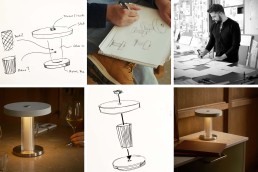
The inception of the Trezzi began when Nordlux asked designer Jonas Birkebæl Poulsen, co-founder of Anker Studios, to design a lamp for its ‘Design For the People Range’ with a simple but specific intention: a portable table lamp that felt equally at home in the privacy of one’s home or in a bar or restaurant. With that in mind, a simple image of a cocktail glass sparked Poulsen’s imagination. The cocktail glass is a social object; it lives in conversation, in low lighting, in the pause between sips, and is used both in the home and hospitality settings.
As Poulsen puts it: “The starting point was the cocktail glass, it’s a beautiful and refined object that belongs to the moment of conversation or the moment of atmosphere. It was the perfect foundation for a table lamp that can fit in both a private interior and a commercial environment.”
From that familiar silhouette, the idea evolved into a balance between fluted glass and stainless steel. The glass base draws from cocktail glass proportions, tactile and designed to be seen up close, while the metal shade on top introduces a sense of purpose and control.
The shade feels almost architectural: calm, and functional, anchoring the design and directing light downward in a way that works perfectly for dining tables, bedside use, or intimate restaurant settings.
“Fluted glass became a defining material because the design took its cues from a cocktail glass,” says Poulsen. “It offers both tactility and visual detail. The vertical fluting echoes the rhythm and refinement of classic glassware, catching and refracting light.”
However, fluted glass is more than just a decorative gesture; thanks to its geometry, it has a series of ridges that act as microlenses, catching and bending light as it travels through the glass. This transforms what could have been a simple diffused glow into something more layered and dynamic. Light stretches vertically along the grooves, creating depth and giving the sense of subtle movement that shifts when the viewer changes position. In other words, the fluted glass stand becomes an optical tool, one that enriches the atmosphere with its refracted glow of light that is both expressive and calm, with thoughtful geometry in its simplest form.
“This creates a layered effect,” says Poulsen. “The exterior feels calm and architectural, while the interior feels luminous and dynamic. The glass becomes both structure and atmosphere, shaping light into something warm, nuanced, and quietly expressive.”
In a similar kinship to the cocktail glass, Trezzi’s design language influence draws on the glamour and elegance of the 1920’s – one of Poulsen’s most cherished design periods – through the discipline of Danish Minimalism. Rather than adopting an overt ornament or decorative excess, Poulsen creates an essence of Art Deco in refined material detail.
Poulsen adds: “Material plays a key role. The glass remains honest, with fluting and slight shifts in thickness adding depth without visual noise. As light passes through, these surface details come alive, creating shadows and a sense of precision that echoes Art Deco craftsmanship without losing its contemporary edge.”
Behind Trezzi’s aesthetic is a layer of engineering designed to make the lamp feel effortless in use. The weighted glass base is central to that engineering because its mass gives the lamp stability on busy restaurant tables and domestic surfaces alike, while also contributing to a sense of quality and permanence when lifted or moved. As Poulsen notes, the weight communicates craftsmanship and durability, reinforcing the idea that this is a well-made object designed to stand the test of time. The technological integration follows the same philosophy; the moodmaker touch-dimming system from Nordlux was incorporated without visible interfaces. This allows the switches and interaction to remain invisible, so the purity of form is never interrupted. Together, these decisions ensure Trezzi’s material qualities aren’t just seen but are felt, making the physical experience of touching the lamp part of its visual language.
The development of Trezzi unfolded roughly over a year to 18 months, from the first sketch to the final product. The concept remained remarkably consistent throughout the process, with the initial silhouette – the glass base and metal lamp shade – never wavering. What evolved instead were the subtleties: the depth, spacing, and thickness of fluted glass. These details proved to be the most technically difficult. “The biggest challenge throughout the process was refining the fluted glass, achieving the correct shape and getting the groove details just right,” says Poulsen. “Small adjustments in depth, spacing, and thickness had a major impact on how the glass felt and how light moved through it, making this the most critical and time-intensive part of the development.”
After a lengthy cycle of refinement and iteration, this precision work helped shape the lamp’s optical performance and its tactility, ensuring the final product preserved the purity of the initial vision and the nuanced behaviour Poulsen envisioned from the start.
The final part of the journey was to turn Trezzi’s refined concept into a manufacturable object. This required a production process that could deliver both precision and consistency and was particularly crucial for the fluted glass element, which defines the lamp’s optical personality. According to Nordlux, the glass is produced using a moulding method that ensures accuracy in form: raw molten glass is poured delicately into the mould, allowing the vertical flutes and wall thickness to be tightly controlled from the outset. Once cooled, the glass tube is cut into the exact dimensions for the Trezzi’s proportions.
Glass, as Nordlux notes, is a naturally “lively” material, which makes achieving consistency of thickness one of the most challenging aspects of production. Using the mould helps minimise variation, ensuring an even profile that is crucial not only for structural integrity but also for the way light bends and refracts within the grooves. Each piece is then inspected individually by factory workers, who check for any deviations or defects before the components are assembled.
Much of the success that happens in production can be traced to the meticulous preparation undertaken before mass manufacturing can begin. Nordlux emphasises the importance of extensive pre-production checks, such as carefully reviewing 3D files, working drawings, and sample iterations to resolve potential issues early on. Only once every detail has been scrutinised were the tools committed to mass production, a process that helps prevent defects and maintain the clarity of design intent.
In addition to its timeless design, the Trezzi has a sustainable edge, as do all Nordlux products. The supplier’s facilities are powered entirely by solar energy, allowing the factory to be fully self-sufficient in electricity – the cherry on top of a material-driven product.
The journey of the Trezzi table lamp from a simple sketch to a fully resolved product is a reminder that clarity of intent can shape an entire design process. What began as just a simple everyday object shared in both the privacy of your lounge or the vibrant atmosphere of a bar, evolved into a lamp defined by careful engineering and the restrained confidence of the Art Deco and Scandinavian style. Like an Old Fashioned, its development went down remarkably smooth. Poulsen describes the process as “calm and intuitive”, where decisions naturally fell into place, and the focus of refinement never wavered or became tired. That clarity extends to its final form. With each fluted glass piece carefully moulded, inspected, and crafted through a tightly controlled production process, and with the lamp’s tactile weight, invisible control, and expressive light all working in harmony. Trezzi embodies the idea that minimalist objects can carry a lot of depth.
After making hundreds of lights and working with Nordlux for years, Poulsen tells arc he never gets tired of the journey and revels in the challenge of creating the perfect light that, in turn, creates the perfect setting. Poulsen adds: “I am most proud that the design has made it through the entire process and exists for people to enjoy and love. Behind every final design is a long journey where many ideas are tested, rejected, and refined. Only one will survive the demanding creation phase, and seeing that result in a tangible object is deeply rewarding.”
Images: Courtesy of Nordlux