
Zayed National Museum Abu Dhabi, UAE
Foster + Partners and Claude R Engle Lighting Consultants uncover the monumental journey of lighting Abu Dhabi’s national museum and the role of lighting in expressing nationhood.
The Zayed National Museum, the crowning jewel of Saadiyat Cultural District, was completed last year, its steel wings rising 123-metres into the air on Saadiyat’s tallest hill. Its completion marked the end of a long-anticipated journey, beginning with Foster + Partners’ appointment to design the museum in 2007. After years of stops and starts, the museum has finally emerged in full view: a landmark for the cultural district, a major cultural institution, and a homage to Abu Dhabi’s founding father, Sheikh Zayed.
Its striking architecture, defined by five soaring steel wings inspired by falconry, called for a lighting design that could communicate the building’s identity, heritage, and cultural significance. The lighting for the museum’s interior and exterior was developed as two distinct operations, working at different scales. Foster + Partner’s exhibition lighting team created an intimate scheme that guides visitors through the galleries, supporting close encounters with artefacts and the cultural history they embody.By contrast, the base build and architectural interior light was placed in the hands of lighting designer Claude Engle, whose approach aimed to bring the architecture to life after dark, giving the building a powerful nighttime identity of its own.
The lighting design’s implementation on the project began from the very get-go, evolving alongside Foster + Partner’s architectural and exhibition design. Working closely with architects, engineers, and curators from the earliest stages of the project to develop a scheme that responds equally to the futuristic, curved architecture, and to its role as a national museum.
For Laura Suico, Associate and Senior Designer at Foster + Partners, light became a “primary narrative tool”, shaping not only how the galleries are illuminated but how the history of the UAE is understood. “From the outset, a clearly defined cultural vision allowed us to position light as an integral part of the storytelling that expresses the museum’s identity,” she explains.
Engle, whose architectural lighting scheme encompasses the museum’s public interiors, landscape and exterior, describes the need for electric light to work in harmony with the building’s carefully choreographed relationship with daylight. The architecture itself sculpts daylight, casting shifting bands of shadow across the atrium walls and “falcon” wings.
Instead of competing with daylight, the artificial light is designed to support these natural effects during the day until taking over after dusk. Together, Engle and Foster + Partners’ schemes establish a shared philosophy: light is at its most successful when visitors notice the building, the artefacts, and spaces before they notice the lighting.
At the heart of the gallery lighting concept was an ambition to make the lighting almost imperceptible. Luminaires are concealed within the architecture and carefully controlled, their output developed in close dialogue with the building’s natural light. Rather than reading as an applied layer, light is experienced indirectly: through the modelling of surfaces, the articulation of volume, and the careful calibration of brightness. This marks a departure from more conventional museum lighting strategies, where fixtures often remain visible. Here, light reveals itself gradually, almost subliminally, heightening the visitor’s sense of immersion. In effect, the scheme supports an experience in which visitors can detach from the outside world and move through the history of the UAE, guided by the emotional storytelling of the galleries and installations.
Each exhibition gallery is housed within one of four suspended pods, with each pod dedicated to a distinct chapter of the exhibition. The lighting scheme balances continuity with individuality: a cohesive visual language runs throughout the galleries, while each exhibition is given its own atmosphere to support the narrative.
To achieve this, the lighting operates in two complementary layers. The first is a spatial layer, integrated within the architecture to define volume, orientation, and the overall gallery environment.
The second is a conversation layer, designed to bring artefacts into dialogue with their surroundings while meeting stringent conservation requirements. Working together, these layers create a seamless visitor experience, guiding movement through the museum while allowing each gallery to express its own character. Nowhere is this integrated approach more evident than within the pod galleries themselves, where a series of bespoke technical solutions allow daylight, architecture, and exhibition lighting to operate as a single system.
Foster + Partners’ exhibition vision brought a cinematic dimension to the galleries, using light to transport visitors through time, while the curatorial brief demanded carefully controlled conditions for the preservation of artefacts.
“While rigorously refined through analytical tools and mock-ups, many solutions were realised at full 1:1 scale for the first time. In several instances, the approach drew on technologies more commonly associated with theatre and temporary installations, where experimentation with light is more agile. This demanded a creative and open process, supported by a robust and well-tested design methodology,” says Suico.
“Equal attention was given to the showcase lighting, designed specifically for the museum. Each detail was carefully resolved to ensure that light supports the narrative while remaining discreet, enhancing both the spatial experience and the artefacts on display.”
Within the pod galleries, daylight and artificial light were conceived as a single responsive system. Electrochromic glazing, artificial lighting, and intelligent controls work together to adapt the environment to shifting sky conditions, solar intensity, and time of day.
A network of sensors monitors both interior and exterior conditions, while each showcase is individually calibrated to maintain appropriate lux levels, protecting sensitive objects without limiting future curatorial flexibility.
The same restraint shaped the architectural integration of light. Instead of relying on visible fixtures, the main gallery spaces use a continuous concealed ‘necklace’ system within the walls, bringing together tunable white projectors, gobo projectors, and theatrical lighting elements in one coordinated layer. The result is an immersive lighting approach that preserves the clarity of the architecture while keeping the source of illumination largely out of view.
Showcase lighting was developed as a distinct but complementary layer, with bespoke typologies integrated into the display architecture to minimise the visibility of luminaires and hardware. Precise beam control, colour stability, and glare management support both object modelling and conservation, while adjustable mounting, interchangeable optics, and accessible maintenance allow the system to adapt to changing curatorial narratives and object sensitivities without compromising visual coherence.While the exhibition lighting focuses on individual artefacts and the role of storytelling, Engle’s architectural lighting scheme operates at a larger scale, with a clear role in reinforcing the museum as a key monument in Abu Dhabi.
Engle covered the Timeline Garden and public realm, the soaring atrium, and the five falcon-inspired wings, with a clear goal to complement Foster + Partners’ vision rather than compete with it.
One of the museum’s unique attributes is how it is defined as much by daylight as by artificial light. Its architecture is built to sculpt light, casting shadow patterns, and sweeping bands of light across the atrium walls and columns. “The architecture sculpts the natural light, just as it is sculpted by it,” explains Engle. As a result, the artificial light was designed to work with these ever-changing conditions, remaining deliberately restrained until dusk.
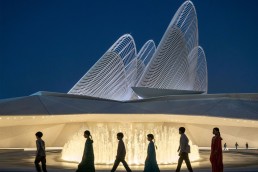
Rather than relying on conventional floodlighting, the exterior scheme adopts a more subtle approach. The museum’s five falcon wings are illuminated primarily from behind, while the suspended gallery pods inside glow from within, providing the perceived front light.
“There is no light pointing away from the wings,” says Engle. “We did not want any light to obscure the perception of the wings.” This extends across the wider site, where low-glare fittings, concealed handrail lighting, and discreet step lights define routes through the landscape without distracting from the building’s silhouette. By carefully controlling where light is seen, the scheme ensures the architecture remains the main visual element, both by day and night.
This careful choreography of light continues within the museum’s central space, where suspended pods provide a second role as a source of illumination.
The pods create brighter pools of light for the public programmes beneath them while the space between remains subdued. Walls beneath skylights are illuminated from above to reinforce the impression of natural daylight washing through the space.
“We wanted the lighting to ensure that all of the 17-metre-high walls are illuminated, especially when there is no daylight in that area,” says Engle. “Wherever there were skylights above a wall, we wanted light pouring down that wall, to suggest natural light entering and suffusing the space. This makes it feel open and airy. In fact, you feel as though you are walking in a planetarium and the pods are the heavenly bodies.”
Delivering a lighting scheme that remained almost entirely concealed required an equally discreet engineering effort behind the scenes. One of the most interesting stories of this project is how Engle’s team adopted a performance-led approach, where several instances, the required technology simply did not exist. One example was the miniature track fixtures recessed into the undersides of the suspended pods. This was specified for the first time in 2012; the fittings required to deliver around 600lm from a housing measuring less than 70x40mm, performance that would not become commercially available for almost a decade.
The museum’s complex geometry presented another technical challenge, raising the question of how to light a vast curved space without making it flat? With virtually no straight walls anywhere in the building, continuous lighting systems, including handrails, coves and track lighting, had to negotiate flowing curves and changing geometries throughout the project. Rather than developing bespoke products for every condition, the team worked with manufacturers to create families of adaptable luminaires capable of integrating across the museum’s eight ceiling types while maintaining a consistent visual appearance.
Throughout the project, collaboration remained central to refining the design. Working alongside Foster + Partners, several lighting strategies were revisited as the architecture evolved. Pendant-mounted fittings originally proposed around the atrium’s ring beam were replaced with concealed far-throw uplights integrated into the suspended pods, preserving the clean architectural expression, while fill lighting originally intended for the falcon wings was ultimately removed altogether, allowing the building’s sculptural form and internally illuminated pods to define its nighttime identity. The result is a lighting scheme whose greatest achievement lies not in drawing attention to itself, but in revealing the architecture with remarkable restraint.
Ultimately, the success of the lighting scheme lies not in its visibility, but in its restraint. Whether guiding visitors through the museum’s galleries or defining its presence on the Abu Dhabi skyline, light operates as a narrative medium rather than a spectacle. It reveals artefacts, sculpts architecture, and choreographs movement, creating a museum in which every transition is carefully considered. The Zayed National Museum is a prime example of how lighting is essential to cultural and heritage buildings and how it expresses the wider story of nationhood.
“Lighting operates as a guiding medium through the museum, shaping how visitors move, perceive, and engage with the space. It structures the journey by establishing hierarchy, directing attention, and revealing sequences with clarity and precision – bringing architecture, media, and artefacts into a coherent spatial narrative,” says Suico.
“Lighting also reveals cultural meaning by influencing how objects are seen and understood. Through contrast, focus, and controlled use of intensity and colour, lighting highlights materiality and context, framing artefacts as carriers of history.”
After more than a decade of design development, Engle’s achievement lies in making an extraordinarily complex lighting scheme seem almost effortless. Reflecting on the project, he says: “I worked on the project for many years, but nothing prepared me for what I saw in person during the weeks of final commissioning. I was stunned by the motion of the architecture and the endless details that went into making it look effortless. I hope visitors walk away with the desire to experience it again.”