
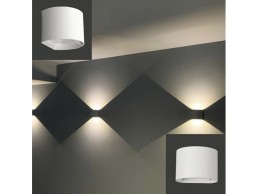
GAP Lighting Blanco
Blanco is a series of architectural surface mount wall lights suitable for interior and exterior spaces. Highly manufactured with one piece of pure aluminium and finished in matte white or graphite grey, Blanco will blend seamlessly with any space and lighting scheme. Engineered with tool-less adjustable levers which allow you to create artistic effects and select your optimum beam angle.

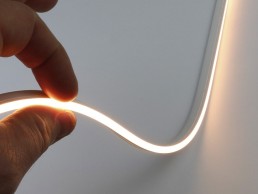
KKDC Groove Flex
The new ultra slim Groove Flex from KKDC is a thin (6mm) homogenous diffused linear light source that enables precise, fine architectural detailing possibilities for both indoor and outdoor applications. The tough IP67 ‘side-bending’ flexible silicone exterior houses KKDC premium quality LED technology, with CCT available in 2300K, 2700K, 3000K, 3200K, 4000K and colour consistency to complement the KKDC product range. Designed to be flush mounted via stainless steel mounting clips.
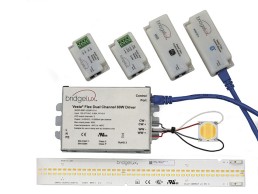
Bridgelux Vesta Flex
Vesta Flex is a family of dual channel LED drivers and control modules designed to reduce the cost and complexity of connected tunable white luminaires while delivering the flexibility required for project-based lighting installations. This specification-grade, future-ready solution is smart, interoperable, programmable, and flexible; compatible with control protocols including Wi-Fi, Bluetooth, DALI2 and 0-10V. Optimised to work with Bridgelux Vesta tunable white light sources, this unique turn-key solution from one supplier ensures compatibility and functionality out of the box.
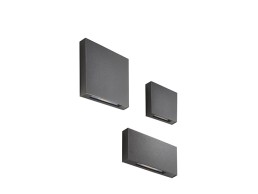
Cariboni Sans Serif
Sans Serif is a line of LED floor-washers, ideal for the lighting of pedestrian walkways, ramps, corridors and the external perimeters of buildings. With essential forms, the Sans Serif line stands out for its considerable visual comfort obtained thanks to the total-dark-light optical system. The light distribution is wide and even. The design and engineering of the product, combined with the use of LED technology, have allowed the depth of all three versions to be limited to just 26mm.
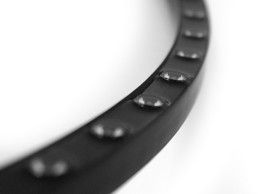
Linea Light Group Rubber 3D Bend Optics
The flexible and foldable polyurethane body is characterised by a micro optical system with a high precision light beam, which transforms the strip into a linear articulated bar, with an excellent wall grazing effect. It is available in three sizes and colour temperatures and two finishes: black and white. The black strip has excellent glaring control and very clear emission, with greater distinction in the initial part of the beam that softens as you go up. The white strip illuminates more at the beginning of the beam and is suitable for walls that need uniform light in the lower part.

Intra Lighting Tracker
Inspired by the soft and fluid forms from nature and architecture, Tracker bends with the ceiling beyond the horizontal movement. Its clean, spine-like look makes it fit every standard construction element. It can discretely blend in and support the creative choices of the architects and lighting designers. It’s a trimless luminaire with a seamless light curve that gives out homogenous light with the high light output.
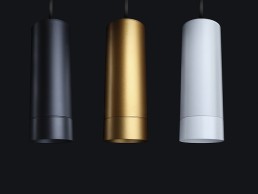
Soraa Aerial
Soraa Aerial combines unprecedented colour and optical performance with a classically proportioned cylindrical design to deliver beautiful and precise lighting that integrates seamlessly into architectural environments. Available as a surface, pendant or track-mounted luminaire, the range has been designed with the circular economy in mind and features a removable light module and control gear. Soraa Aerial is offered with a variety of beam and colour temperature options, and can be ordered in both standard and custom finishes.
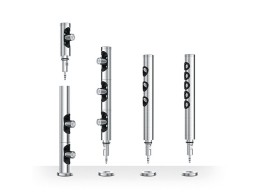
Precision Lighting Stacko
Stacko is the latest luminaire to join the award-winning Miniature Accent Lighting range from Precision Lighting. The new Minipoint system allows luminaires to be plugged and unplugged in seconds. Build unique lighting arrangements by ‘stacking’ components together, giving full control over the number of light engines, lumen output, beam width, finish and adjustability. High CRI and instant adaptability makes the Stacko collection perfect for any display application, including retail, museums and galleries.
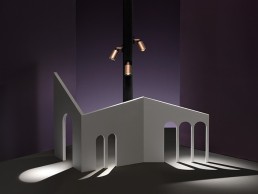
L&L Luce&Light Krill
Krill is a family of compact projectors with a pared-down design for lighting inside shop windows and display cabinets in the retail and museum sectors. Krill can be installed in variety of ways, so it can always easily reach the details that need emphasising. It has seven different accessories, including a magnetic plate and a double-jointed arm in different lengths that can be adjusted by up to 180°. The projector has a version with a fixed focus, available with either six optics, or a zoom lens with which the angle of the light beam can be adjusted and adapted as the objects on display change.
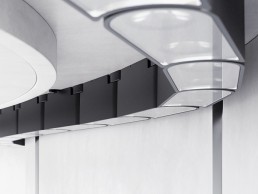
formalighting Cobra IP66
Cobra is an elegant, modular, serpentine system, which smoothly wraps around rounded or non-linear surfaces, lending itself perfectly to the seamless illumination of elegant architectural elements and surfaces. Cobra IP66 is the ideal solution for sophisticated architectural illumination in outdoor environments. Available in a variety of configurations to provide bespoke lengths for any project requirement, it works on constant current drivers at very low temperatures to maximise the system’s lifespan.
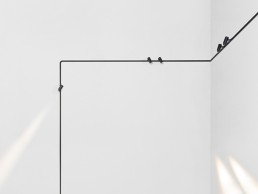
Arkoslight Minimal Track
Minimal Track is a low voltage (24V) surface track system, where miniaturisation reaches a new paradigm. Its ultrafine design is perceived as a minimalist line on the ceiling, creating a trimless visual effect. The system is composed of a matte black anodised aluminium profile and a flexible rectangular-section conductor that merge into total visual uniformity. Measuring 15mm wide and 10mm high, its surface application is practically imperceptible, with no connections, fastening elements or connection tracks in sight.
Light Symposium: Connecting health research with lighting practice
Asst. Prof. Dr. Karolina M. Zielinska-Dabkowska IALD, IES, CIE, MSLL, RIBA, looks at the interdisciplinary initiative Light Symposium Wismar 2020 and its historical development.
Thanks to state-of-the-art medical and environmental research, our current understanding about the impact of light and lighting is improving at a rapid rate (http://bit.ly/2OD9RvN). While the evolution of lighting technologies offers promising design possibilities, it also poses new challenges to planners and the general public. This is further complicated by the fact that today’s modern indoor lifestyle means we can be completely disconnected from nature and natural light. Instead, we live under artificial skies in man-made environments (http://bit.ly/3bgHhu5).
To answer the need for cross-disciplinary talks and in order to bridge the knowledge gaps in the field of architectural lighting design, in 2007, the concept of a Light Symposium emerged at the Professional Lighting Designers Convention (PLDC) in London. Michael F. Rohde, a German lighting designer and professor at the Hochschule Wismar (HSW) in Wismar, was inspired to create an interdisciplinary event where light and health could be holistically addressed and connected with research and practice.
In 2008, the first event, called the Light Symposium Wismar (LSW), was held in Germany, in conjunction with the 100th anniversary of the HSW, University of Applied Sciences: Technology, Business and Design. Soon after, Professor Jan Ejhed, a Swedish lighting designer, professor and head of the Lighting Laboratory at Royal Institute of Technology (KTH), Stockholm, joined forces and a new partnership was formed. It was proposed that the event should take place every two years on a rolling basis in Wismar and Stockholm. Since that first event in 2008, another five symposia have taken place in 2010, 2012, 2015, 2016, and 2018, where well known architects, interior designers, lighting practitioners, physicians, biologists, colour psychologists, ergonomists and other experts from Europe and overseas presented their experiences in lectures and workshops, and together with the numerous participants, created a lively discussion forum. Associations, universities, media partners and the lighting industry now regard this event as the benchmark for international education on the impact of lighting on health.
Due to the enormous interest in the fifth LSW in 2016, presentations were directly streamed online for the first time, allowing those who couldn’t physically attend, to participate in the event. All of these talks can still be watched free of charge at: http://bit.ly/2GUfcKU. Another element that was introduced was a follow-up book called: New Perspectives on the Future of Healthy Light and Lighting in Daily Life, which features best lighting design practice, lighting research and related aspects, as well as potential issues connected to medical science and lighting in man-made and natural settings. This publication includes contributions and research originally presented at LSW 2016. It is a valuable and vital reference source for students, researchers, academics, the lighting industry, lighting planners and policy makers. This book can be downloaded free of charge at the symposium website (http://bit.ly/2ODoAqJ).
Light Symposium Wismar 2020
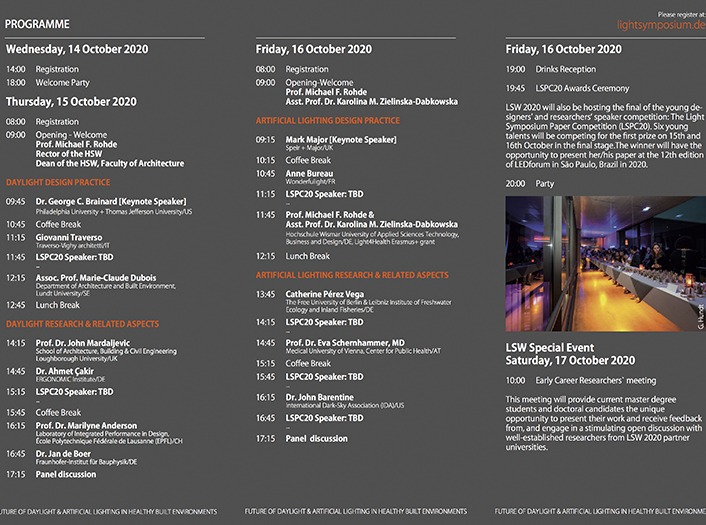
The approaching Light Symposium Wismar 2020 (LSW 2020) is a three-day forum that will bring together the latest insights into the future of daylight and artificial lighting in healthy built environments with respect to research, theory, technologies, design and applications.
It aims to deliver state-of-the-art discoveries and breakthroughs that explore how daylight and artificial light affect the mental and physical health of humans in natural and built environments. The symposium is an occasion for researchers, students, and practitioners who wish to keep up-to-date with recent findings.
The interdisciplinary structure of LSW 2020 promotes future-oriented discussions on the importance of light and the lighting design profession. There are fourteen renowned speakers from fields such as: architecture, lighting design, engineering, biology, as well as environmental and medical science. Experts from Germany, US, Canada, Switzerland, Italy, Austria, Sweden, and UK will present their talks in four different thematic tracks: Daylight Design Practice, Daylight Research and Related Aspects, Artificial Lighting Design Practice, Artificial Lighting Research and Related Aspects. This year, confirmed keynote speakers include neuroscientist Dr. George C. Brainard from Philadelphia University and Thomas Jefferson University, and Speirs + Major principal Mark Major. (Figure 2).
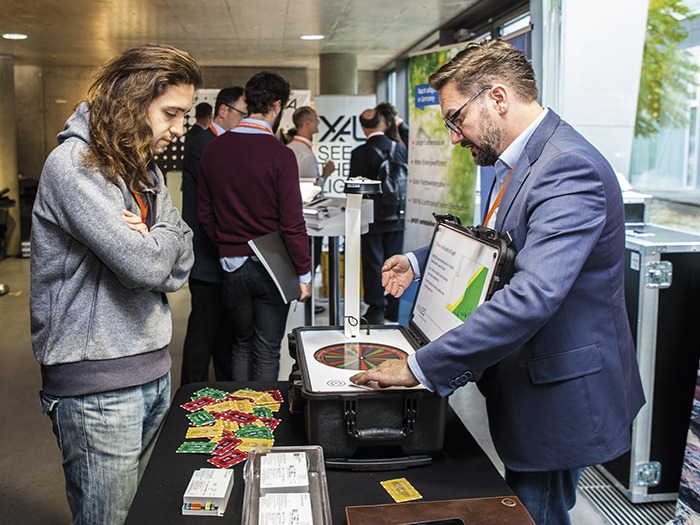
LSW 2020 is already financially backed by ten lighting manufacturers including: Bega, ADO Lights/TTC Timmler Technology, eldoLED, LED Linear, Lucifer Lighting, Osram, Siteco, Technolight Leuchten, We-ef and XAL. But organisers of the event welcome other lighting manufacturers who want to present and discuss their lighting products to the conference participants via a display booth (Figure 3).
Light Symposium Paper Competition 2020 (LSPC20)
LSW 2020 will also host the final of the young designers and researchers speaker competition. There are four topics: Fundamentals, Architecture, Health and Design. Six young talents (three Master’s students and three PhD students) will compete at the final stage for the prize on 15 and 16 October. The speakers will be judged on the quality of the content of their papers and the professional quality of the presentation itself. The jury, supported by independent experts, will decide on an overall winner, which will be announced on Friday 16 October during the LSPC20 Awards Ceremony. The call for papers will be released next month.
The symposium’s comprehensive supporting programme is also designed to stimulate discussion and debate – and the following activities all contribute to enhancing LSW 2020’s reputation as a quality lighting event: a guided tour to visit the UNESCO heritage old town of Wismar, a Welcome Party, and the LSPC20 Awards Ceremony.
The Future is Bright
Modern lighting technologies and design should address and, if possible, be based on evidence gathered by scientific studies. The implementation of new technologies such as LEDs is already changing the future of lighting design and will continue to do so. The impact of this, and the opportunities that exist are hard to define right now, which is why they are the subject of discussion. No wonder human health and wellbeing are areas of increasing interest and concern.
Furthermore, today and in the future, architectural lighting design needs to better acknowledge the need for interdisciplinary collaboration between scientists, medical researchers, the lighting industry and lighting designers.
This is why the Light Symposium plays a unique and integral role in continuing education, building on its foundation to enable developments in the field of lighting design as a discipline and profession.