
Issue 110
arc Jun/Jul 2019 – Issue 110
The green, green grass of home (or the office) is becoming ever more important in lighting design…
A recent study has revealed that a two-hour dose of nature a week significantly boosts health and wellbeing even if you simply sit and enjoy the peace. The research, published in the journal Scientific Reports using data from a Natural England survey, is based on interviews with 20,000 people in England about their activity in the previous week. Of those who spent little or no time in nature, a quarter reported poor health and almost half said they were not satisfied with their life, a standard measure of wellbeing. In contrast, just one-seventh of those who spent at least two hours in nature said their health was poor, while a third were not satisfied with their life.
The physical and mental health benefits of time spent in parks, forests or the beach are well known but for many of us living in urban areas, this is not a possibility - certainly during the working week.
So how can we, as the lighting industry, help?
As Karolina Zielinska states in her article on page 49, Biophilic Design: A Trend Watch, millions of people spend more than 90 percent of their day in enclosed spaces and typically work a five-day, 40-hour week. It’s of utmost importance to create harmonious and sustainable interior spaces to support human biology and respect plant life.
Biophilic design creates healthier spaces that support wellbeing, boost creativity, increase productivity and reduce staff absence. Adding green areas to the built environment also reduces indoor air pollution. Of course, we know that daylight is the best form of illumination for humans and plants alike. But when daylight in indoor spaces is not possible, then artificial illumination is vital. However, there is very little research and no established standards regarding this important topic. So much so that it is often left to individual lighting design practices to do their own research for individual projects (something that Julia Hartmann at lightsphere explains on page 57).
Obviously, this is not an ideal situation so we shall be tackling this subject at [d]arc room in London in September (www.darcroom.com) with a discussion dedicated to the importance and requirements of biophilic lighting. Details and registration options will be published shortly so keep an eye out for further announcements.
Paul James
Editor
arc

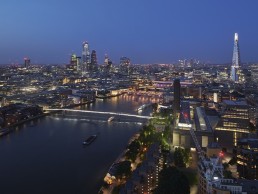
Illuminated River, UK
Following more than two years of planning, the first phase of the Illuminated River project was finally unveiled in July.
The project - an ambitious new art commission for London that will eventually see up to fifteen bridges along the River Thames bathed in new light installations - is the result of an unparalleled collaboration between London-based and international creative talent, local authorities and partners. Free to view, and accessible to all, Illuminated River hopes to act as a symbol for London’s creativity, ambition and spirit.
The artwork aims to celebrate the architecture and heritage of London’s historic bridges, and will encourage more people to enjoy the river and the riverside at night. Artwork for the first four bridges – London, Cannon Street, Southwark and Millennium – is expected to be seen more than 60 million times each year, by Londoners and visitors alike.
Conceived by internationally-acclaimed artist Leo Villareal alongside architectural practice Lifschutz Davidson Sandilands, Illuminated River is a philanthropically-funded initiative supported by the Mayor of London and delivered by the Illuminated River Foundation. Working with seven different local authorities, Illuminated River is the biggest single planning application ever made without an act of Parliament, and is the first time that the bridges along the Thames will have been cohesively and artistically lit.
The Foundation, led by Director Sarah Gaventa, developed the project in consultation and collaboration with more than 50 organisations on and around the Thames, including the Port of London Authority, Historic England, Transport for London, Network Rail, London Wildlife Trust, the Zoological Society of London and Cross River Partnership, alongside the seven local authorities, who have granted 30 planning permissions and eighteen listed building consents.
The first four bridges of the scheme are now lit up in unison, with sequenced LED patterns subtly unfolding across each unique structure. Villareal’s artwork replaces outdated and inefficient lighting on the bridges, providing a more long-term, sustainable solution for lighting the Thames. Designed by Atelier Ten, the lighting will minimise direct light spill onto the river and reduce energy consumption. While the former lighting ran all night, from dusk until dawn, Illuminated River’s connected LED lighting from official lighting supplier Signify will be switched off at 2am.
Villareal’s artwork continues in the footsteps of generations of artists who have been inspired by the Thames, using Signify’s connected LED lighting to ‘paint with light’, drawing on colours influenced by the palettes of Impressionist and English Romantic painters. With shifting hues that mimic the London sky during sunset, moonlight and sunrise, and gently kinetic patterns that are inspired by the natural and social activity of the river, Villareal’s artwork celebrates the Thames as London’s living artery.
The artwork has also been sensitively developed, paying attention to heritage, wildlife and the location of each bridge, respecting and revealing their individual histories and architectural features. The dynamic public artwork refocuses attention on the Thames bridges as social, historical and architectural landmarks, and celebrates their role in London’s global identity.
Signify’s Color Kinetics LED luminaires have been used to illuminate the bridges. Colour Kinetics Graze luminaires have been employed to light up the sides of the bridges, while the underneath features Colour Kinetics Reach Elite fixtures. Elsewhere, Colour Kinetics Blast luminaires have been used to light the bridge piers. These are all controlled using Signify’s Interact Landmark system, which will centrally manage the new connected lighting for all fifteen bridges.
Once completed, the project is expected to feature more than 22,000 LED light points, all monitored remotely by the Signify control system
Site works for the first phase of the project began in January 2019; two years after the winning team was announced by Mayor of London Sadiq Khan, and closely following the granting of planning permission. The Foundation is on track to complete phase two by Autumn 2020, which will include Blackfriars Road, Waterloo, Golden Jubilee Footbridges, Westminster and Lambeth bridges.
Once completed, Illuminated River will span from Albert Bridge in the west to Tower Bridge in the east. At 2.5 miles in length, along 4.5 nautical miles of the Thames, it will be the longest public art commission in the world, and is anticipated to be viewed over a billion times during its ten-year lifespan.
Coinciding with the launch of the first phase, the Illuminated River Foundation also announced an extensive, UNESCO-endorsed public programme. From boat and walking tours to exhibitions and new music commissions, the initiatives have been devised to celebrate the bridges and help reconnect people with the river.
At the centre of the engagement programme is a collaboration with Guildhall School of Music & Drama. Composers from both the Composition and Electronic Music Department of Guildhall School have been commissioned to create original scores inspired by the heritage, architectural context and Villareal’s artwork. The compositions have captured the character of each bridge, with some arranged for orchestra, and others using spoken work poetry, found sound and electronica to tell the story of the structures.
Listening to the pieces, audiences will be transported to past eras, to the time of Medieval candle makers of Candelwrichstrete (Cannon Street), or to the hustle and bustle of London’s frenetic Victorian streets. All the pieces act as an homage to the ebb and flow of the river, and the bridges that have enabled the city to thrive.
With each piece responding to one of the bridges, the Illuminated River Foundation has worked with various partners across London, including VocalEyes, who produce audio descriptions for blind and partially sighted people, to make the compositions accessible and available to the general public.
Hannah Rothschild originated the idea of lighting the bridges, and is a trustee of the Illuminated River Foundation. A supporter of the project throughout, on the launch of the first phase, she said: “The River Thames is London’s liquid history and its beating heart, and the bridges are the arteries connecting north, south, east and west. But at night these extraordinary structures, each with a unique history and style, evanesce into darkness and obscurity. This project, one of the world’s longest and most ambitious cultural commissions, will transform a snake of darkness into a ribbon of light, threading art through the heart of the city.”
Sadiq Khan added: “From the Fourth Plinth to art on the Underground, our city has a rich heritage of showcasing public art, and I am delighted that Illuminated River is bringing more free and accessible artwork to Londoners. The Thames has played a key role in the growth and development of our capital for centuries, and this unique artwork will help Londoners and visitors see it in a whole new way. The Illuminated River will celebrate the unique architecture and heritage of our bridges, showcase creativity, boost life at night and transform the way we think about the Thames.”
Leo Villareal continued: “With Illuminated River, the largest artwork I’ve ever conceived, I’m hoping to follow in the footsteps of Monet, Turner and Whistler and reveal the truly unique, inspiring and poetic character of the Thames. Studying the river and the history of London for the last three years was a fantastic experience that changed me and allowed me to grow as an artist.
“The integrated nuances and motions across the bridges create a unified piece that celebrates and enhances the river as a continuous living entity. I’m both delighted and humbled by the completion of this initial phase, and I can’t wait for the public to experience the first four bridges.”
Finally, Alex Lifschutz, Founding Principal of Lifschutz Davidson Sandilands, exclaimed: “This arts project will illuminate not just the river but also the history and architecture of our wonderful city by revealing its iconic bridges in a new light. The art subtly reveals their beauty and in some cases their muscularity, transforming even the humblest railway bridges into iconic forms. Of particular interest to me is that transformative quality – with literally the lightest touch, the art alters our view of our city and unites the river as never before.”
www.villareal.net
www.atelierten.com
dpa in Dubai, UAE
Since establishing its Dubai studio in 2004, dpa lighting consultants has steadily grown its portfolio in the Middle East, with a number of high-profile cases to add to an already impressive array of projects; from the Palm Jumeirah Masterplan in 2006, to Abu Dhabi’s New York University in 2008, the Capital Gate and Central Market in 2012 and the Founder’s Memorial - The Constellation, unveiled last year.
This portfolio has been extended further in the past eighteen months, with the addition of five new projects in and around Dubai.
Of these new projects, perhaps the most notable is the beautiful Mandarin Oriental Jumeira - a newly constructed, 5-star resort-style hotel located on Dubai’s Arabian Gulf shoreline.
Over a period of four years, dpa worked in close collaboration with the client and owner, WASL Group, Mandarin Oriental Hotel Group and architects DAR to design the lighting solutions for all public front of house areas of the hotel, both internally and externally.
Interior design for the guest rooms, public areas and ballroom facilities was undertaken by Design Wilkes, while Silverfox Studios provided the interior design for the Spa and Fitness Centre and the specialty restaurants, The Bay, Tasca and Netsu. Landscape design came courtesy of 40North and Cracknells.
dpa worked with all parties from initial conception stages, ensuring that the lighting design is cohesive throughout the hotel, as well as integrated within the interior design and architecture. By following the project through the construction stages and maintaining a regular presence on site, dpa ensured that the designs were fully understood, and coordinated with the various contractors, suppliers, consultants and site teams.
Whilst all spaces are special in their own way, the most impactful moments within the hotel occur in the Main Lobby and the Netsu Restaurant.
The Main Lobby is essential in creating a lasting first impression for arriving guests; at twelve metres tall, it provided a challenge to ensure that the lighting was sufficient to adequately illuminate the space during daylight hours, with the dimming range to provide subtlety and ambience after dark.
A discreet system was designed and specified, featuring high output linear downlights from iGuzzini. The System 53 allowed all of the downlighting components to be integrated within a series of elegant, recessed shadow lines, orientated to match the rhythm of the architecture and the ceiling. The beam angles and positions of the downlights were designed to provide emphasis along the central spine of the space, and at seating groups. Wall washers and more ambient downlighting were also incorporated within the same system.
At ground level, there is a colonnade of fourteen ‘Light Trees’, designed by Design Wilkes and Preciosa, while dpa provided technical and aesthetic input. The Trees feature approximately 900 individually addressed LED light points, illuminating hand-blown glass leaves. The leaves are programmed to produce dynamic ripples of light, individually varying their brightness to create differing effects.
The colonnade is arranged to lead the eye along the central water feature, and through to the landscaped, beach-adjacent courtyard and lap pool.
Additional illumination in the Main Lobby comes courtesy of LED Linear, whose XooLine Hydra White provides linear grazing uplight, while GenLED’s Neonflex adds concealed linear details around the water features. Elsewhere, VANN decorative wall and floor lamps are complemented by further illumination from Linea Light’s Archicove, KKDC’s Tana 504 S Line, iGuzzini’s Laser Blade and LightGraphix’s LD spotlights.
Within Netsu, a signature restaurant on the ground level, Silverfox Studios produced an industrial aesthetic, with a combination of rugged and natural materials.
The brief was to create a theatrical dining experience, and to use the central open Robata kitchen as a ‘stage’. In response to this, dpa implemented a series of suspended lighting trusses, mounted with Vision’s linear RGBW floodlights and projectors with variable beam angles and focusing. These projectors were used to provide warm white intensity at the points where food is displayed and served, and create dramatic coloured accents around the space.
The linear floodlights mounted on top of the trusses provide a coloured wash of light to the MEP service at high level, accentuating the height and industrial aesthetic of the space. This is further emphasised by ETC’s Source Four Mini LED fixtures, while additional general illumination is provided by GenLED’s recessed ceiling downlights and linear LED tape.
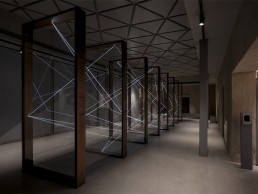
Elsewhere, dpa worked with Dubai Municipality to create two remarkable exhibits at the Al Shindagha Museum: The Perfume House, and The Story of the Creek.
Located within the dynamic and ever-evolving Shindagha district, the museum is a new addition to Dubai’s renowned cultural quarter, and both The Perfume House and the Story of the Creek represents a valuable insights into Dubai’s historic and contemporary story, alongside wider Emirati culture, social rituals and heritage.
The Perfume House sees a re-appropriation of its building, consisting of one main covered gallery with smaller galleries and an external courtyard, which helps to trace and define the narrative of scent and perfume making through the ages.
Individual galleries tell the story of the region’s complex and personal relationship with scent and perfume, whilst detailing the geopolitical and demographic impact associated with the inevitable trade routes that developed and strengthened over time.
The Story of the Creek, meanwhile, consists of main galleries and an interactive cinema experience, that helps to retell the story of Dubai Creek and its most important asset, it’s people.
For both locations, exhibition designers GSM Project developed a blend of traditional and contemporary, unique, interactive and immersive spaces that delight the senses while delivering a strong educational and heritage message.
dpa responded to this brief through the development of a robust yet flexible lighting concept that enabled all aspects of the museum experience to develop at an individual level. Traditional exhibits such as vessels and stonework, maps and chandlery were illuminated to enhance their tactile and material qualities, while more contemporary exhibits - such as interactive screens and models, history and scent stations - demanded a less intensive approach to illumination.
As impressive as the exhibitions are, the building itself acts as a canvas upon which the exhibition is cast. Extensive use of existing architectural features have been highlighted to enhance the contemporary exhibition against the more traditional building fabric, whilst still revealing colour, contrast, form and texture. This helps to complement and reinforce the sense of heritage within the building.
A combination of Felio Sylvania Beacon Muse track lighting, alongside LightGraphix and iGuzzini downlights, provides the main illumination in the exhibition spaces. This is complemented by the addition of iGuzzini’s Lightup Orbit uplights, and LED Linear’s VarioLED profile lighting.
Technology has formed a significant part of the realisation of this project; a sophisticated, dedicated architectural lighting control system forms the backbone of the scheme, ensuring the correct operation of the system whilst delivering flexibility, along with costs and environmental benefits. Conservation also played a major role when it came to illuminating certain spaces and artefacts within the exhibition. dpa worked closely with the curators to deliver precise amounts of illumination to specific sensitive exhibits.
Following its work at the Al Shindagha Museum, dpa lighting consultants was invited to design the exhibition lighting for the newest gallery space in Alserkal Avenue.
Ishara Art Foundation is a non-profit contemporary art space centred on South Asia, established by Smita Prabhakar, collector and UAE resident, and curated by specialist in South Asian art, Nada Raza. The current exhibition, Altered Inheritances, is a collection of work from artist Shilpa Gupta and Zarina.
dpa worked closely with the foundation team, and architect Rahoul Sing from RLDA Architecture, to conceptualise and develop a flexible and modern lighting scheme for the two floors of the gallery. As the art pieces and gallery layout will change from time to time, the lighting needed to be flexible in design to allow for all eventualities, yet at the same time be uncluttered, elegant and identifiably different from other galleries.
A carefully considered arrangement of recessed track under the mezzanine level allows for multiple luminaire mounting positions, together with Erco’s versatile Pollux spotlights and Logotec projectors, with interchangeable lenses and local dimming potentiometers, so that every art piece can be correctly addressed.
For the atrium space, the ambient and iconic lighting is created by three diminishing custom-made squares, suspended from the structural ceiling. Developed alongside No Grey Area (NGA), each square is fitted with the manufacturer’s Fusion Flex linear LED, creating an unbroken line of light. This is seamlessly combined with Erco track, giving the ability to arrange any configuration of spotlights, allowing the gallery to tailor the ambient and direct lighting exactly as required by the exhibiting artists.
More recently, in January of this year, dpa completed lighting for the new Lutetia of Paris beauty clinic, located in Dubai Festival City. dpa worked closely with interior designers Kinnersley Kent Design (KKD) to develop the lighting concept for both the landscape and the clinic interiors.
A sense of opulence is inherent within the design; the narrative for the clinic suggests calm elegance and the use of high specification materials such as wood, leather and natural stone, lends itself well to this aesthetic.
Lutetia of Paris has a private underground car park, so privacy and discretion were always paramount within the design. Concealed illumination from LED Linear’s VarioLED Flex range, whenever possible, helps to define the high level of detail given to each area, while lighting to the waiting areas for both male and female customers lends an air of calm within the dynamic DFC environment. Meanwhile the corridor spaces contain concealed and integrated lighting within grey leather clad walls.
Treatment and waiting/consultation rooms exist side by side and differ in character, creating an incredible challenge for lighting such defined spaces.
Le Barbier and Le Salon offer unparalleled levels of luxury and service within the personal grooming markets. This is highlighted in the individual stations, each fitted with integrated lighting in the mirrors, helping to maintain the high levels of privacy required.
Le Barbier follows a traditional ‘masculine’ material palette of dark metal, stone and glass, while Le Salon counters this with rich hues of gold panelling and pastel pink leather walls.
The VIP area follows through on this theme, as dark blue leather-clad walls offset against natural white stone and rich metallic accents. Lighting enhances the sense of luxury and quality through high levels of integration and detailing.
The use of Lutron’s sophisticated control systems for each area further adds to the feeling of quality through selective use of dimming and scene-set technology.
Shortly after the completion of Lutetia of Paris, Zabeel House was opened in the Greens & Views area of Dubai. Located in one of the city’s more diverse residential areas, Zabeel House carefully reflects its position, appearing as an urban oasis with a fresh, contemporary take on relaxed, informal luxury. This is accentuated by the lighting, which serves to both amplify and distil the best attributes of its surroundings.
On entering, the large lobby acts as a transitional space, helping to promote the high energy and vibrancy of this new development and its clientele. Spaces are functional with an emphasis on quirky objects such as oversized ants, vintage cameras and giant folded paper aeroplane structures.
The lobby space diffuses into the main bar, decked out with lush greenery that creates dappled and diffuse hiding spaces, and the Social Club dining area, designed to appear vibrant by day, and more opulent during the hours of darkness. Here, decorative lighting elements are complemented by a combination of iGuzzini’s Palco LV spotlights and Led C4’s Multidir Surface downlights, providing subtle illumination while adding a vibrancy to the greenery.
Guestrooms and corridors are treated simply, with focus maintained on quality of materials and textures, while the Business Centre offers a sophisticated and flexible environment in which network and conference go hand in hand. Softer illuminated spaces rub shoulders with large-scale glass-clad meeting rooms offering a more functional approach to light.
The gym, Health Club and treatment rooms are all versed in the same narrative, employing natural wood tones that contrast and complement with the more robust materials of wire mesh, breeze block and brick.
Lah Lah, the edgy Pan-Asian kitchen/bar brings this design language to its logical conclusion. Lush greenery again helps to break up the playful use of semi-industrial materials, while the lighting, controlled via a Dynalight control system, responds through varied states during the day and night, helping to create a vibrant space that is equally adept at hosting raucous after work drinks, relaxed dining or long, lazy lunches.
Speaking of the new projects, and dpa’s ongoing work in the Middle East, Nick Hoggett, Director of dpa lighting consultants’ Dubai studio, said: “dpa’s work in the Middle East goes back to 1976, working in collaboration with Howard Brandston on the Sheraton Hotel on The Creek in Dubai, and we have been active in the region ever since.
“We established a studio in Dubai in 2004 because of the level of work we were being asked to undertake there, and this has been incredibly successful for the practice as a whole, attracting numerous commissions covering a wide variety of project types. Work in Dubai remains exciting, and in recent times has seen a number of cultural projects come into the practice, as well as all the normal impressive hotels, retail and commercial developments, which adds a nice balance.
“Residential work is also significant, with both locals and ex-Pats wanting their properties to have high quality, well thought out lighting solutions, responding to the architecture and the family needs.
“Besides Dubai, the rest of the UAE and the whole region has a lot of interesting developments, some small and some incredibly huge and ambitious, which is very exciting for the future of dpa, both in Dubai, but also our Edinburgh, London and Oxfordshire studios, which are all also active with Middle East projects.”
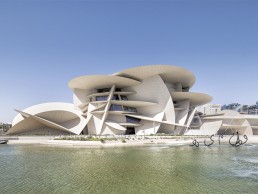
National Museum of Qatar, Qatar
After more than ten years of design and construction, the breath-taking National Museum of Qatar opened its doors in March of this year.
Designed by Pritzker Prize laureate Jean Nouvel, the museum was inspired by the desert rose - a crystal structure formed by sand, salt water and wind that naturally occurs in the Gulf state - and the unique architecture is intended to reflect the deep connection of the once nomadic people of Qatar with the desert, flora and fauna of the country.
Characterised by large convex disks, intersections and cantilevering canopies, the museum’s form is spatial and sensual, providing shade and refuge for visitors.
Inside, volumes of great expression emerge, with room sequences of both crouching and cathedral-like heights, sometimes evoking the intimacy of nomadic tents, sometimes the vastness of the firmament. Daylight filters in through gaps, apertures and spandrels in carefully selected locations, as the powerful, harsh sunlight of the region had to be tamed to fulfil conservation-related requirements. The natural light reveals the spatial room shapes, yet maintains a respectful distance to the mostly sensitive exhibits.
The exhibition itself takes the visitor on a 2.7km-long course that spans across the geological history in the Qatari peninsula’s distant past, introduces its flora and fauna, and illustrates the country’s rapid development from a loose affiliation of nomadic tribes and pearl divers of the past towards the technology savvy and affluent society of the present. Throughout, it focuses on archaeological findings and craftsmanship, as well as recent economic and political developments, while commissioned artworks from renowned local and international artists are also on display.
For the eleven galleries of the permanent exhibition, Licht Kunst Licht developed an architecturally integrated light narrative that accompanies the visitor in a scenic and suspenseful manner through the 700 million years of natural and cultural history of the Gulf state.
Because of the building’s unique design, the lighting designers at Licht Kunst Licht were asked in their initial design brief to “establish a lighting scheme that would not interfere with the architectural volume”, according to Martina Weiss and Stephanie Grosse-Brockhoff, Directors at Licht Kunst Licht who were Project Lead and Deputy Project Lead respectively.
“We were asked to keep both the light atmosphere and the fittings as unobtrusive as possible. It was even a request to make the luminaires ‘disappear’. Indirect lighting or a purposeful illumination of the envelope was not desired. In turn, this meant that we were looking into a more object-focused and introverted lighting approach, thus making the architecture appear through reflected light.”
The exhibition is characterised by a sequence of artefacts, models and reproductions in a variety of display cases, complemented by video projections and screens. The visitor moves between visual realms that barely overlap. The lighting concept had to take this progression into account, requiring a powerful orchestration of the exhibits and spaces.
For this reason, Licht Kunst Licht developed a two-layered lighting concept: general illumination provided by RCL’s Custom DR7 glare-controlled adjustable luminaires in the ceiling, and the emphasis of individual exhibits in the display cases by means of integrated and mostly invisible miniature luminaires, courtesy of XAL and corporate friends.
“The aim was to illuminate the exhibits rather than the space,” Weiss and Grosse-Brockhoff explained. “The approach using two layers was largely determined by two driving factors: first of all we tried to perforate the ceiling only where necessary. Secondly, we tried to minimise reflections of ceiling luminaires in the showcases. This motivated us to integrate lighting in display cases wherever possible. However, we didn’t use integrated lighting in display cases with glass ceilings.”
As part of their aim to “establish a lighting layout with as few ceiling apertures as possible”, adjustable RCL spotlights were recessed into the sculptural suspended ceiling. Light emanates through a small pinhole opening in a larger, flush mounted trim ring matching the ceiling colour.
The wide-ranging spatial geometries and extremely diverse exhibit proportions required varied photometric properties for the adjustable spotlights. Three different beam angles were used - spot, medium and flood - combined with optical accessories if and when required. These included sculptural lenses for an elliptical light distribution near walls, or honeycomb louvres for strong ceiling inclinations.
The showcases in the National Museum of Qatar are as diverse as the exhibition spaces themselves. Some rooms become displays in their own right, other configurations intertwine showcases with walls or floors, or the displays become large magazines of shelving that house a multitude of differently sized exhibits. Each lighting solution is therefore carefully adapted to its location and contents.
The path through Gallery 2, for instance, leads into the underwater realm of the marine habitat. A projection, designed by multimedia consultant Ducks, immerses the life-sized sea creatures in sunlight-infused seawater with its softly rolling waves, as seen by scuba divers in the reef.
Invisible to the observer, iGuzzini framing projectors are concealed in the overhead space of the display, precisely accentuating the models without disturbing the light effect of the rippled, moving water surface.
While freely positioned, dematerialised glass cases are solely illuminated through the ceiling-recessed spotlights, all displays that form an interface with the architecture contain hidden light sources. Such detail is found in the wall-integrated Arthropod display. Here, the country’s native butterflies are lined up in a splendid array. Concealed in the upper and lower cavity is a group of XAL’s Nano+ Just 26 Focus miniature spotlights that detail the delicate texture and vibrant colours of the wings.
The biodiversity wall, by contrast, functions like an oversized cabinet. Species of various sizes coexist in modular compartments, which integrate their own concealed linear illumination. It creates a soft breath of light while the accent lighting comes from the ceiling.
Elsewhere, the Al Zubarah Trench shows burial objects in a floor cavity enclosed with glass. Hidden in small coves in the display’s cross-section are XAL’s small, pivotable Nano+ Turn linear LED elements that emphasise the exhibits on the floor. While, like mannequins in a shop window, the historic festive dresses and jewellery are displayed in a full height showcase. Invisible to the observer, corporate friends’ C1-STS 2.0 accent lights are mounted in a channel in the case’s ceiling, eliciting manifold textures and colours from the fabrics despite the low illuminance levels.
The highlight of the exhibit, however, is the Baroda carpet, embroidered with the finest pearls and gemstones. It is displayed on a sloping surface and protected by a surrounding vitrine that pierces into the ceiling surface. Following its sides are rows of very small spotlights, from corporate friends. These apply a layer of discretely overlapping light cones on the precious carpet, allowing its materials to sparkle brilliantly in the directional light.
While the building stands out for its unique shape, the distinct geometry of the space caused some challenges for the designers, as Weiss and Grosse-Brockhoff elaborated: “There are no orthogonal angles, no horizontal ceilings or vertical walls. Intersections and cantilevering elements create barriers that potentially shield light sources from exhibits or pick up scallops.”
As such, each zone, exhibit and associated ceiling integrated lighting had to be verified in a virtual 3D BIM model. The goal here was to maintain a sense of order in the ceiling layout, and to align fittings with gridlines and special reference points wherever possible.
“The virtual 3D BIM model was very helpful to coordinate not only the architecture, museography and lighting, but also the light fittings among all other building service elements in the ceiling,” Grosse-Brockhoff and Weiss continued.
Although intended as one continuous journey, differentiation occurs through the varying exhibits and displays, according to Grosse-Brockhoff and Weiss. “Mostly, the atmosphere of the spaces is rather introverted and object-focused,” they said. “The image projections seem to open up ‘windows’ and vistas, and create a level of radiance.
“In some spaces, the showcases and walls intertwine, walls become carriers of photographs, or include displays. In these instances, the spatial envelope becomes a luminous surface that blends into the sequence of projections. This succession of focused display cases, projections and wall displays creates a lively variety of introspection and extroversion.”
The wealth and diversity of the exhibits throughout the National Museum of Qatar addresses visitors with a wide field of interest. The quality, sequence and presentation of the exhibits create ever-changing themes, and involve all the senses of the visitors, who are practically absorbed by the exhibition, and the quality and abundance of impressions.
The lighting plays a subtle, yet significant part in this. The finely tuned interplay of all components, such as the sparse but spatially defining daylight, the accentuating ceiling light, the differentiated display case illumination and the wall projections, creates a sensory experience, that resonates with the visitor long past their visit.
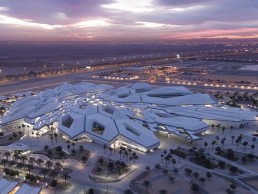
KAPSARC, Saudi Arabia
Early last year, Zaha Hadid Architects unveiled the King Abdullah Petroleum Studies and Research Centre (KAPSARC), a sprawling, multi-building, 500,000sqm micro city in Riyadh, Saudi Arabia.
In keeping with the architecture firm’s signature aesthetic, the complex is remarkable in its form; an irregular, angular, beehive-like structure that stretches across the Saudi desert. Its interlocking, cellular structure includes an office building, conference centre, library, IT centre and place of worship, as well as shaded outdoor spaces, courtyards and gardens, woven together by an open-air central plaza.
Lighting for the expansive complex came from New York’s Office for Visual Interaction (OVI), long-time collaborators with Zaha Hadid Architects (ZHA), having worked with the firm on projects dating back over the past 20 years.
“We have a long history of working with ZHA, and the collaboration is always very creative and interactive,” said OVI. “ZHA values our early lighting design input to incorporate into its designs. For this reason we were involved very early in the competition stage.”
Because of the architecture studio’s unique designs, creating a lighting scheme is not always a straightforward process, with the firm preferring not to issue a specific design brief, instead “setting out points and program parameters”, as OVI explained.
“It is the work of the design team to translate a ‘technical wish list’ of square metres and light levels into something amazing. Knowing the parametric designs of ZHA, a brief is not a fixed catalogue of requirements for them.
“As you look at their work, you will see there is not a ‘one solution fits all’ for any project. The same is true for the lighting design, which becomes a fourth dimension and gives architecture emotion and presence at night.”
With KAPSARC, OVI developed the lighting scheme for both the exterior spaces, and the vast interior. Outside, rather than overall floodlighting, which would not comply with the project’s sustainable design intent and LEED Platinum certification targets, a strategic lighting vocabulary was developed that harnessed the use of internal glow, balanced series of lighting layers and the precise use of contrast and silhouette to articulate the dynamic architectural forms.
As illuminating all sides of the façade would have flattened out the shape’s beauty, OVI instead opted to sculpt the volumes at night to enhance the sharp, angular geometry; Hoffmeister’s Hi-Vertical in-grade linear luminaires are positioned strategically to anchor specific façades, while Erco floodlights are placed out of sightlines within the skylight apertures to emphasise entrance volumes, keeping in mind distant viewing angles and the cohesiveness of the overall design of the complex. In respect of the sculptural effect sought after by the architects, the lighting design ensured no penetrations of the folded façade in any way.
Each building profile of the architectural dune-like forms has a different height and contour; there are no right angles or identical sections, resulting in highly atypical façades. As such, OVI carried out detailed 3D lighting calculations for each condition to determine specific lighting locations.
The lighting design plays a critical role in establishing the project’s night time identity, as OVI explained: “From a birds-eye view, lighting emanates from the centre, radiating out into the landscape. The heart of the complex is the Place of Icon, which glows magically at night. To complement this, it was important to articulate and enhance the angular geometry of the façades to accentuate their faceted form, which could be appreciated from a pedestrian view.”
The various buildings are connected by 10,000sqm of canopies that unify the campus while providing shading by day. Vertical illumination of the interior façades, uplit canopy ‘hoods’ and downlighting create a harmony of light, adding to its landmark status at night.
The buildings and canopies are oriented to work naturally with the sun’s path, providing both light and shade strategically at different times of day. Surrounding buildings shade the central canopies and interior space beneath, while at night, the internal lighting activates the apertures, creating an illuminated centrepiece that anchors the project and provides its visual character.
In the complex’s central courtyards, Hoffmeister’s Hi-Vertical in-grade linear luminaires illuminate the façades, while Erco luminaires highlight columns and provide general illumination, alongside iO Lighting’s linear LED strips, which accentuate the stretched textile canopies. This is complemented by stake-mounted, adjustable lighting in the courtyard planters, provided by iGuzzini’s Woody fixtures.
A lighting masterplan of energy efficient and sustainable solutions throughout the complex, as well as smart design and cooling strategies as an integral part of the design logic, enabled the project to meet LEED Platinum specifications, making it the first of its kind to do so in Saudi Arabia.
This unique, integrated design is energy efficient and balances the quality and brightness of artificial lighting in relation to usage and natural daylight, achieving an uncompromising architectural aesthetic with ambitions environmental credentials.
“We always approach our work in a way that optimises design objectives while meeting all technical and energy requirements,” said OVI. “Achieving this was challenging as technologies were changing from conventional sources to LED at the time, and the client needed to be reassured the ‘new’ technology would be reliable and just as effective as what they were accustomed to.
“It was a lot of extra effort during the design process, but as a result this project was awarded the first LEED Platinum rated building in the region.”
Throughout all interior spaces, the modular design generates consistent organisational logic and spatial strategies that drive all employed lighting elements: full height atria are filled with daylight from central skylights, while at night a skylight perimeter detail of precisely tuned floodlights provide the primary layer of illumination.
Selected vertical surfaces are washed to translate the prismatic notion of the hexagonal character to a comprehensive interior night time identity. Dark finishes of solid architectural railings along general circulation paths, embedded with iO Lighting linear LED handrail luminaires, create a strong visual contrast throughout the light finished spaces for intuitive wayfinding.
To further infuse the interior experience with the directionality of the architectural system, recessed linear light bands follow the angular contours throughout the interior spaces. On upper levels this linearity visually dissolves into segmented layouts to accommodate the shaped ceiling profiles.
The installation of these linear bands helped in unifying the many different interlocking structures, each with their own specific uses. And for OVI, it was key that the lighting helped to link these different structures. “It was important for the complex to be unified, however, each building has a very different function. For this reason a lighting design language and logic was developed for the project and tailored to each different building.
“For example, reinforcing the cellular geometry was key for the interior lighting. In some buildings with open spaces this meant continuous linear bands that wrap throughout the building, for others we used segmented linear bands to work with smaller scaled spaces, or staggered patterns instead of straight, or pendant vs recessed based on angled ceilings. There are a lot of subtle variations that can happen within a single concept.”
The linear unification of the interiors can be seen in the offices and seminar rooms, which each feature a custom ceiling system of recessed miniature LED bands that incorporate accent lighting, speakers, AV, fire points and many other services in one clean solution, along with Zumtobel’s Supersystem to accent feature walls.
In offices with raked ceilings, OVI turned to RSL’s pendant-mounted continuous linear luminaires to provide illumination through an ‘all-in-one’ integrated appearance.
As a spiritual centre, the Musalla is a symbolic embodiment of light, and the illumination is a transformative element generating emotion and an experiential journey for worshippers. The interior is characterised by a large, organic structural web. Delicate screen panels fill the openings of each frame, and a serene glow of white light emanates from behind the screens, by use of Philips Color Kinetics’ ColorBlast Powercore fixtures, setting the contemplative tone in the worship hall.
Downlights are precisely aligned with the screen detailing, piercing through to provide sparkle and the required illumination at floor level, with no visible hotspots or shadowing. In addition, based on different times of day, the colour of the lights shifts from white to a soft, golden hue.
While the Musalla was designed without any natural daylight, other areas used the abundance of natural light as an inspiration for the architectural lighting design, in the way that it sculpts the facets and forms of the architectural volumes.
“In this part of the world, natural light also means heat, so it was also important to find creative ways of shielding it,” said OVI. “The Place of Icon in the central part of the building complex is a wonderful example – the surrounding buildings are slightly higher, which helps shade (and cool) the centre. In addition, the scoop-shaped openings are oriented for wind flow and to bring light in and keep light out during different times of day.”
Although the task of working on such an unusual design could have caused some difficulties for OVI, the practice said that, owing to its years of working with ZHA, it is used to working on projects that are out of the ordinary.
“We are accustomed to breaking convention and working with unusual shapes and structures,” OVI explained. “Every project has constraints, but that’s what makes it challenging and ultimately results in a unique, one of a kind solution.
“One of the reasons why we enjoy our collaborations with ZHA is the truly open design dialogue. During our work sessions, architecture and lighting design really develop in parallel and always result in unique solutions that are fully integrated and tailored to the architecture.
“It is always a fascinating journey to work with them to discover a unique architecture and lighting story that emerges.”
In the case of KAPSARC, the collaborative approach resulted in a remarkable architectural achievement, where OVI’s lighting design serves to support and accentuate all of the buildings and their faceted forms and volumes, while elevating the cultural dimension of the project, reflected in the geometric motifs, materials and mesh elements.
OVI said: “This project is a good example of having a very strong fundamental idea that was carried through all design stages. Accordingly, we established a clear lighting design language that responded directly to this design.”
www.oviinc.com

Mark Needham
Global group Gallant Lighting has recently formed Harvard Power Systems Limited following the purchase of IP and related assets of Harvard Technology Limited. arc spoke to Harvard’s new Managing Director Mark Needham about the deal and what the future holds for the company.
Explain your journey of how you got to your position as Managing Director of Harvard Power Systems?
Like many in this industry, lighting was never a burning ambition. Out of IT and Electronics college, eager to be employed, I got a position as an office junior in the technical office of W.J. Parry, a wire-wound ballast manufacturer based near the Derbyshire/Nottinghamshire border. It was simply the first job offer and was grasped with both hands. Lighting quickly became the major interest, passion and the route of career progression. The Parry ballast business was acquired by a USA corporate who also owned the Venture lamps business. As Parry became Venture Lighting, a role in the commercial side of the business became the focus and there began the direct involvement in lighting component sales. Lighting technologies evolved, as did the focus and target, from HID ballasts, ignitors and lamps, through electronic control gear and controls, to today’s LED technology power supplies, drivers and light-sources. In more recent years I held the position of Sales Director for Venture Lighting Europe and Vice President EMEA for Fulham Company Lighting. Following discussions with Gallant Lighting and the previous close working relationship from roles within the Venture Lighting business, earlier this year I was appointed as Managing Director to head the newly formed Harvard Power Systems business.
How did the Gallant Lighting Group acquisition of Harvard Technology come about?
Aligned to a larger global deal, Gallant Lighting also acquired the complete Venture Lighting India group of factories and test facilities. The purchase of the IP and related assets of the former Harvard Technology business allows the continuation of the respected Harvard branded, high quality LED drivers and light engines whilst benefiting from the highly capable and well established low cost manufacturing facilities in India.
Can you shed some light on the problems that Harvard Technology suffered?
Not being involved with, or connected to the now closed Harvard Technology business, it would be incorrect to make an unqualified comment or judgement. However, there is no hiding away from the issues that face all businesses in the lighting industry today; low cost imports and price erosion along with marketplace & overall economic uncertainty to name just a few.
Solid state and digital technology creates a wide diversity of product requirements for lighting components such as LED drivers and LED light sources along with lighting control/monitoring systems and devices.
Maintaining such large product portfolios to expertly service all areas of these requirements is incredibly costly.
How will being part of Gallant Lighting Group benefit Harvard Power Systems?
Above and beyond the benefit of low cost manufacturing, the Venture Lighting India group of factories and test facilities bring a number of sales opportunities to the wider global markets. The Indian factories, now within the Gallant Lighting group of companies, each have notable proven histories producing high quality components and systems, 100% focused and dedicated to lighting. This vast experience forms a great synergy with the retained design and engineering skillset of Harvard to stand well within this tough marketplace.
Will there be a new strategy with Harvard Power Systems moving forward?
The strategy moving forward is to remain focused on what the business is good at: providing high quality, specification-rich lighting components, from our UK sales, technical and distribution base.
The whole IOT, connectivity, communication, monitoring and control business is becoming a fundamental requirement of all that is lighting. Strategic partnerships with the leading providers in this arena, the experts and those who are equally good at what they do, will also feature in our plans.
Do you have new product development planned or are you concentrating on existing products?
There is a healthy mix of existing products retained, legacy products withdrawn and of course new products in development. The group of senior engineers retained from the former Harvard Technology business are now supported in the Harvard Power Systems business by a wealth of experienced and highly educated design and development engineers and technicians throughout the Venture Lighting India group. There are already a number of exciting projects in the pipeline.
What does the future hold for the lighting industry?
Significant change brought about by solid state and digital technologies has completely reshaped the lighting industry to such an extent that light bulbs, tubes and lamps quickly became the legacy, whilst ‘fit & forget’ light fittings became the norm and the expected.
Energy saving and light efficiency remain at the forefront whilst the demand for best light quality, connectivity, control and monitoring as well as human centric lighting, such as automated colour tuning, will become more widely specified. Integration with other building services such as HVAC, safety, security and interoperability with such building management systems is the natural evolution in lighting.
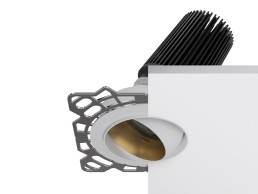
David Morgan Review: Ecoled Eyeconic Range
David Morgan casts his eye over the latest updates to Ecoled’s Eyeconic range of LED downlights, due to be on show at [d]arc room this September.
Small is beautiful, the phrase used by E. F. Schumacher as the title of his influential 1970s book on sustainable development, can also be used to describe the latest versions of the Eyeconic range of LED downlights from Ecoled.
In 2013, Ecoled was spun out as a separate lighting company from its parent company, the Cadisch Group, who specialise in shaping and finishing metals with a particular expertise in meshes for use in automotive and architectural applications. The Cadisch Group was originally founded in 1883 and has expanded into the architectural market, leading to the introduction of lighting products to complement their cladding materials. Their experience in metal finishing also adds value to Ecoled, who can offer an exceptionally wide range of finishes on their luminaires.
The extensive Eyeconic range, designed, manufactured and assembled in the UK, is one of the smallest diameter, adjustable angle high-power downlights available. Originally launched in 2016, the range has been recently upgraded with new light engines and optics. At the core of the Eyeconic range is the patented eyeball concept designed by Simon Cadisch, the Group Chairman, who has also been awarded several patents for other inventions. The eyeball design allows up to 28-degree adjustment and incorporates twin O rings, which it is understood provides IP65 rating on all versions. The O rings allow the eyeball to be snapped into the ceiling bezel, providing both adjustment friction and the IP seal. An additional O ring seals the lenses into the eyeball to achieve full IP65 rating for the downlights. An integral intumescent ring mounted on the eyeball ensures that the downlights comply with the 60-minute fire-rated standard. The range is also acoustic-rated to comply with Part E.
In the development of the original Eyeconic range, a decision was made to not base the dimensions on an MR16 lamp, the default size for most downlights before and during the transition from halogen to LED light sources. Ecoled was able to develop the new range with an eyeball diameter of only 45mm, which allows a ceiling cut out diameter of just 56mm and 62mm bezel diameter for the smallest adjustable type.
Despite the small size of the eyeball, the optics are changeable from below the ceiling with the aid of a very neat custom designed tool that forms a key element of one of the five patents filed for the Eyeconic range. This tool allows the threaded lens holder baffle to be easily removed and replaced. Without the tool it would prove impossible to remove the lens baffle or eyeballs for servicing from the trimless housings as the available space is so limited.
The lens holder baffle provides some degree of glare control as its depth recesses the lens into the eyeball. For higher levels of glare control an additional honeycomb louvre accessory is available. The black honeycomb louvre holder is moulded in silicone rubber, allowing easy insertion and removal from the eyeball. Where glare control is not the key issue the lens holder baffles are available in a wide variety of powder coated and anodised finishes.
The latest versions of the Eyeconic range have recently been launched after several years of engineering development. Available as adjustable or fixed, single or twin, trimless or with bezel, all featuring an interchangeable optic, the range is extensive.
One of the major design changes was an upgrade to the light engine based on the Cree XPH 35. This small multi die LED array allows high lumen outputs to be achieved even with very narrow beam angle optics. However, because the size of this Cree array is larger than single die LED emitters, a variety of beam quality issues can arise when narrow beam lenses are used such as colour over angle and non-uniform distributions. It is understood Ecoled worked very closely with their lens suppliers to develop custom versions and enhancements to overcome these potential problems. The samples I was shown of the 10-degree version produced a very clean beam when used for close offset wall grazing without any obvious colour over angle or beam quality issues.
When run at 1.0 amp the downlights consume around 14 watts and provide a lumen output of over 800 lumens giving an efficiency of around 59 lumens per watt allowing for thermal, optical and driver losses.
If the downlights are run at 350 mA, the lumen output is around 350 lumens with an efficiency of over 67 lumens per watt. For the lower drive currents, a shorter extruded aluminium heat sink can be used, thus reducing the overall height. When run at 1.0 amp the overall void depth required to accommodate the deeper heat sink is 116mm.
In addition to the fixed colour temperature types, the range also includes dim to warm versions with a beam angle of 30-degrees based on a 10 watt Bridgelux two colour temperature COB. Two dim-to-warm light engine ranges are available, from 2700K to 1800K and 3000K to 1800K.
As well as the eyeball versions, the Eyeconic 2.0 range also offers fixed downlight types that match the overall dimensions of the adjustable eyeball versions. A very effective wall wash, fixed downlight version, is also available, which when demonstrated in our offices gave a smooth wash with light output up to the ceiling. The wall wash also matches the diminutive fixed and adjustable types, with a ceiling cut out diameter of 56mm and 62mm bezel diameter.
A variety of trimless housings and other bezel designs are available, including squares, larger diameter round bezels and multiple aperture types. With the metal finishing expertise support from the Cadisch Group, a wide variety of decorative finishes can be applied to the bezels, giving the Eyeconic range huge appeal for the designer market as the range offers plenty of choice and design freedom.
The original version of Ecoled’s Eyeconic range was warmly received by the lighting design community. To date the fittings can be found in a plethora of high end residential, hospitality and leisure projects around the world, with the hope of continued growth with the recent complimentary additions to this range.
It seems likely that the light engine and optical enhancements incorporated in the new versions will boost sales of this small and rather beautifully designed range.
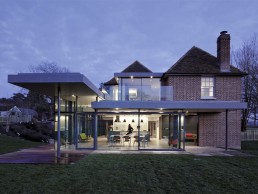
Home Sweet Home: Connecting the dots for healthy evening residential illumination
In the latest issue of arc, Asst. Prof. Dr. Karolina M. Zielinska-Dabkowska IALD, IES, CIE, MSLL, RIBA, turns her attentions a bit closer to home, looking at the importance of having healthy residential lighting schemes.
During the twentieth century, lighting designers would commonly use incandescent light sources for residential homes as they provided a visual comfort, with high quality colour rendering properties, along with relaxing ambient atmosphere. Unfortunately, it’s now difficult to buy incandescent light sources because they have been banned in many countries (https://bit.ly/2GwN2Wv). This article addresses some of the challenges in regards to health, brought about by the changeover to new LEDs and other related technologies, and tries to offer some context on how to keep up with these rapid transformations.
While we know it’s necessary to limit blue-rich light at night (as it prevents melatonin production and impaires nocturnal sleep), and that it’s important to maximise exposure to the blue wavelength of light in the morning (to trigger circadian timing, increase alertness), there are other issues that are misunderstood and often ignored. This includes flicker from LEDs and electromagnetic fields (EMFs), which can be produced by smart home lighting technology.
To begin, it’s difficult to quantify the impact LEDs have on the human body because not only is this complex, it’s also challenged by the fact there are currently no worldwide accepted, health-related standards or metrics in use with LED lighting products that can adequately guide consumers and specifiers. Although studies confirm excessive exposure to visible light can cause phototoxicity related damage to eye tissue, there are three variable factors that need to be more thoroughly researched and taken into account in residential applications. Namely, the levels of retinal irradiance (dose rate); the specific wavelength of light; and the duration (length of exposure). In retail outlets today, most customers are only able to buy light sources according to their wattage, lumen output, voltage, lamp life, CRI, and/or the CCT, which indicates their perceived colour, measured in Kelvin, listed on the packaging.
Unfortunately, the CCT metric is limited. It only tells the customer how warm or cool a light source appears to the human eye, and it fails to show the visible light spectrum generated by the light source which reveals how much blue light content it emits. This means two different LEDs with the same CCT can produce different amounts of blue wavelengths of light. Ideally, all packaging should provide the spectrum of light of LED lamps, using a metric called Spectral Power Distribution (SPD) but they don’t, and without this information, consumers are kept in the dark about what they’re buying (Lighting professionals have the opportunity to acquire more information directly from lighting manufacturers or they can measure the light source themselves with available tools).
While we know that the spectral composition of blue enriched light at home in the evenings negatively affects circadian physiology (https://bit.ly/2Ys5aLw), a possible alternative metric for residential lighting that could be included on packaging is the spectral G-index, introduced in 2019 by the European Commission’s Joint Research Centre (https://bit.ly/2JTVIZk). It defines the amount of short wavelength light in a light source relative to its visible emission. LEDs with a higher colour CCT have more blue or violet content, and will therefore usually have lower G-index.
As recent research also indicates that removing the blue component of light significantly decreases retinal damage after high intensity exposure (https://bit.ly/30ZpDVu), it would be interesting to confirm the G-index of products that use violet, blue-violet or purple LEDs instead of blue. Some medical researchers warn that blue-violet light has a much higher irradiance (photon energy) compared to standard blue-rich LEDs and might be linked with the development of age-related macular degeneration (AMD) (http://bit.ly/2YOawkx) and 415-455 nm are the most harmful to retinal pigment epithelial cells (https://bit.ly/2ZfHIOK).
Although human centric lighting (HCL) or circadian lighting has been promoted in recent years, the impact of artificial light on human physiology is complex and it requires far more investigation, research and testing (https://bit.ly/2K4Q7Q2).
Another concern is a flicker created by rapid fluctuations in the voltage of power supply or a dimming type called pulse width modulation (PWM). Although the flicker is often not consciously perceived by our eyes, the human brain can detect it, as it responds to light at frequencies up to, and beyond 120Hz (https://bit.ly/2GKkMjB). Flicker can cause various unpleasant symptoms such as headaches, visual fatigue and annoyance, as well as reduced task performance. Some individuals may also experience migraines and even worse, epileptic seizures (https://bit.ly/2CgiK90, https://bit.ly/2MktXdU, https://bit.ly/2SNAKxV).
Alas, today we will not find flicker-free retrofit LED lamps if they are powered from 110-220V AC, as the space available in such lamps means the LED drivers are not sophisticated. This is why it’s recommended that new homes have Cat6A structured cabling (https://bit.ly/2Yb3iYg) so luminaires can be plugged in like computers or wireless hubs. It’s also best for older homes to replace their cabling, but for many, this may be economically unsustainable.
There are simple devices such as a flicker wheel that can be purchased to examine if a light source in the home is flicker free. It should be tested when the LED is at full brightness and also when the light source is dimmed (http://bit.ly/2Kn4WNP, https://bit.ly/2JYEGtb, https://bit.ly/2GfL5zZ). Professional lighting designers can use an Illuminating Engineering Society (IES) approved flicker meter, which is integrated within a spectrometer (https://bit.ly/32TnMn5).
Smart Home Lighting
Another aspect worth mentioning that can impact residential spaces is the introduction of smart home technology, which connects devices to the Internet of Things (IoT) to automate and monitor in-home systems (https://bit.ly/2xhqepf). It’s possible to connect lighting to this system as well, instead of using standard analogue switches. A smart home often uses two forms of wireless connection: Bluetooth and Wi-Fi, as part of a Wireless Local Area Network (WLAN). Both will produce EMF as data is constantly exchanged. Some scientists still have reservations about the safety of this technology, as new studies reveal there may be adverse health effects from EMF (https://bit.ly/2LJdSyT, https://bit.ly/2YkBcJt, https://bit.ly/2GAU5xr, https://bit.ly/2OneT1M).
Also, there are risks involving cyber security, including the invasion of privacy and easy access to sensitive data (https://bit.ly/2rCVLyw). Urgent improvements are required before the technology is rolled out.
To measure Wi-Fi and Bluetooth, professional lighting designers can use Radio Frequency and Microwave meters (https://bit.ly/2Yrh1FE). At night, it’s a good habit to switch off and unplug all electronic devices so our DNA gets the opportunity to repair itself, but in the case of smart home lighting, this might not be possible as the system is interconnected and is constantly operating to collect data and then process and analyse it.
How do we minimise the negative impact of light at night?
During the day, we should aim to have natural light via windows and skylights and only supplement with artificial light where there is insufficient daylight available, for instance on gloomy overcast days, after sunset and during winter. In the early evening, the rule should be warm white lighting with a colour temperature below 3000K and it should contain as little blue light in the spectrum as possible. Ideally, at night, artificial lighting should be kept to a bare minimum with a recommendation of light with a spectrum greater than 600nm (amber, amber-red colour). All forms of this lighting at night should be indirect, preferably positioned at a low level, flicker-free and also dimmable. It’s also good to have the option of dim, diffused, warm white/amber coloured lighting in the bathroom that can be turned on when getting ready for bed. And a soft amber/red nightlight for the hall and toilet are a great idea if there’s the need to get up throughout the night. Remember too, that a bright LED bedside reading light can cause insomnia as well if not properly specified.
Another aspect of lighting that is often overlooked are LED lit screens. While there is research regarding their disruption to circadian health (https://bit.ly/2KaZVGW), there are no standards regarding their use. Preferably, we should put devices away at least two hours before sleep. This is especially important for children as the healthy development of their brain and body requires human growth hormone, which is only produced during the phase of deep or slow wave sleep, also called Rapid Eye Movement (REM). Generally, this phase occurs about 90 minutes after falling asleep. Exposure to any source of artificial lighting with blue light content such as mobile phones, iPads, TVs, as well as general lighting, delays this stage, resulting in fewer cycles of the REM phase and less growth hormone (https://bit.ly/2WDaH1L, https://bit.ly/2Ys5aLw).
A positive update is that exposure to bright natural light during the daytime seems to prevent sleep disturbances related to two hours use of blue-light emitting self-luminous tablets and the effects it might have on the suppression of the sleep promoting hormone melatonin (https://bit.ly/2SSPgEB). This highlights the importance of respecting the natural cycles that we have evolved with.
It’s also important to recognise that there are critical immune and repair processes that can only occur when we sleep in complete darkness, and whilst this benefits everyone, it’s absolutely critical for cancer patients in order for their body to regenerate and their immune system to fight the disease. The following study shows that even a little light at night can negate the effectiveness of certain cancer treatment (https://bit.ly/2BiYhhY). A dark bedroom is also vital for those with diabetes and obesity as blue-rich lighting at night has a negative impact on hormone and metabolic function. For these reasons, ensure no light invades your room from outside, especially if your street has energy efficient cool white LED street lighting, as the light they emit will have the same detrimental effects (https://bit.ly/2Ft1FqM, https://bit.ly/2JVoSqM, https://bit.ly/2Y4qUh4).
Your best option for now?
If possible, it’s best to use an incandescent light source in your home. These can still be bought online in clear and frosted versions. Do check the wattage allowance (there should be a sticker on the luminaire near the base) and the base type, and it’s prudent not to go over 100W. In most situations 60W will be more than enough for general lighting, with 20-40W for desk/bedside lamps. Also Himalayan rock salt lamps that use incandescent light sources can be used as night lights for bedrooms, children’s rooms, hallways and toilets.
My favourite light source for food illumination is still a simple wax candle, although I would recommend it only for special occasions. Even with all the latest lighting technology, dinner by candlelight cannot be matched for an ambient atmosphere of warmth, beauty and magic. Candlelight is very similar to the spectrum of sunset and with a high CRI, it provides a beautiful warm quality of illumination that’s flattering to skin tones. Plus, food served under this light will also look natural and healthy.
There are also vintage-style “Edison” incandescent lamps with a visible filament, often used as light sources for high-end restaurants and bars, which can add some sparkle to a room.
Although energy efficient, most vintage-style “Edison” LED lamps (with fake filaments comprised of tiny LEDs arranged to look like the real deal), still have drawbacks and they cannot replicate the quality of light and properties of incandescent lamps. But saying that, they may be an acceptable compromise if a low CCT is chosen, for instance 2200K, with a coloured coating to make their light warmer. Be aware though, these factors can vary depending on the brand.

Back to basics - two useful lighting design concepts
When designing human friendly home illumination, not only do the light sources matter, there are also two key design concepts to consider for quality lighting practice. The first I like to call the “layers of light” or “layering” for space perception. It was developed in the last century by American lighting designer Richard Kelly. This approach integrates three distinct types of lighting: ambient luminescence, focal glow and play of brilliants. Each type serves a different purpose and creates a different effect, all of which can be found in nature (https://bit.ly/2YozFBT).
“Ambient luminescence is the uninterrupted light of a snowy morning in the open country. It is fog light at sea in a small boat, it is twilight haze on a wide river where shore and water and sky are indistinguishable. It is in any art gallery with strip-lighted walls, a translucent ceiling, and white floor. (...) Ambient light produces shadow-less illumination. It minimises form and bulk.” Lighting professionals might use pendant, credenza or standing lamps made of diffused material or cove lighting to create general, background lighting in residential applications.
“Focal glow is the follow spot on the modern stage. It is the pool of light at your favourite reading chair. It is the shaft of sunshine that warms the end of the valley. It is candlelight on the face, and a flashlight on a stair... Focal glow draws attention, pulls together diverse parts, sells merchandise, separates the important from the unimportant, helps people see”. Focal glow is used to keep our attention where it needs to be, creating pools of light for example on a dining or kitchen table, highlighting a favourite painting, etc.
“Play of brilliants is the eighteenth century ballroom of crystal chandeliers and many candle flames. It is sunlight on a fountain or a rippling brook. It is a cache of diamonds in an opened cave. It is the rose window of Chartres... Play of brilliants excites the optic nerves, and in turn stimulates the body and spirit, quickens the appetite, awakens curiosity”. This form of lighting adds sparkle and it can be introduced as a decorative pendant lamp above the dining table or in a hall.
The second concept is that “light follows its function” where a lighting professional considers how each room will be used (to support the illumination based on the function of the room), and ensures there’s enough light so the people who use the space can easily perform their tasks. This system uses different light levels based on analogue switching or dimming, which can be activated by built-in wall controls with pre-set lighting scenes or a touch screen lighting control panel (https://bit.ly/2QvNMSZ, https://bit.ly/2QZ1qNK, https://bit.ly/2SNVTH2).
People require different light when performing visual tasks such as reading, watching TV, having dinner or relaxing on a sofa – and these are defined in lighting standards and guidelines. Unfortunately, these documents do not consider the ageing process, and as we mature we require more light to see at night. Also, these standards are very static and do not adjust for changing conditions such as a sunny summer’s day versus a gloomy winter’s morning or evening. Let’s hope this improves in the near future as we all often have a need for individualised lighting.
Both concepts are required to create pleasing, coherent residential lighting to support user needs and preferences. For all of these reasons, well-chosen and carefully positioned lighting equipment (in the form of downlights in the ceiling, pendant luminaires, standing and credenza lamps, and reading lights, as well as hidden lighting integrated within furniture and indirect cove lighting etc.), coupled with quality light sources and scene settings can create human-friendly lighting, that supports health while also adding a visual comfort to residential spaces.

Worth The Wait
The crucial challenge facing lighting professionals today regarding designing residential lighting schemes, is to provide LED lighting that is both visually safe and harmless to general health. This is difficult as there’s still a wide lack of knowledge about the shortcomings of the technology, coupled with an absence of lighting products with clearly labelled characteristics such as SPD and flicker. Plus, in the case of smart lighting, EMF levels need to be considered.
Unless people stock up on incandescent light sources (which, while less disruptive to health and life quality, are not as energy efficient), the main option is to buy LEDs, even though this technology requires far more testing and development before it can be considered fit for purpose and appropriate for residential lighting.
Light, be it natural or artificial, has a profound impact on our biology and the environment, so we need metrics that provide information relevant to this to enhance the existing practice of lighting design.
While the lighting industry has finally acknowledged the issue of blue-rich light disrupting the circadian clock, and numerous new metrics have been developed to help market “circadian lighting” such as circadian action factor, melanopic sensitivity, melatonin suppression index - these are very new, as is the field of chronobiology, which is still considered an emerging science. Without proper, repeated, long-term research and investigation, these metrics might not deliver either, so as lighting professionals it is our responsibility to push for unified science-based answers from the lighting industry and standard committees to address existing challenges.

Sakina Dugawalla-Moeller
Building a lighting community in the Middle East and Africa, Sakina Dugawalla-Moeller is a beacon of light in the desert.
Founder and Principal of Light.Func, Dugawalla-Moeller is also the Middle East ambassador for Women in Lighting (WiL).
Declaring herself the ‘Funny One’ in her company bio on her website, it is fair to say after our brief encounter with her on paper, it is clear she has a vibrant personality that has allowed her to shine brightly in the lighting industry.
“My fascination with light started before I even knew it had. My father had a very old camera that came in a leather case, which he used at every family function,” reflected Dugawalla-Moeller.
“Weekends were spent pouring over old photographs of picnics in Tanzania, where the family always sat in the shade of huge mango trees. I remember when I was about eight, talking to him about how the white light behind my mother really made her look a lot slimmer. I bought myself a camera as soon as I could afford it, a DSLR, and still spend a lot of time trying to capture light in different ways.
“It never ceases to amaze me that with a slight variation of settings, anything you photograph can appear a multitude of different ways. This is what lighting design is for me as well.”
Right from the start, Dugawalla-Moeller was fortunate to have a strong family behind her to support her through the educational system in Tanzania.
“Tanzania was still undergoing changes from a socialist to democratic state, and quality education was hard to come by,” she explained.
“My parents sent me away to boarding school in northern Tanzania where I studied the IGCSE system and then eventually onto another in Nairobi, Greenacres School, eventually finishing my 4th form at Dar es Salaam Independent School.”
With certain expectations from her father to become a doctor clashing with her loathe for the sight of needles, they both settled on her pursuing a career in architecture. She secured a scholarship to undertake her A-Levels at Kensington Sixth Form College in the UK when she was seventeen. Dugawalla-Moeller then went on to start a degree in Architecture at the University of Nottingham.
“A journey of self-discovery made me realise that what I really aspired to do was design for people, to enhance their lives in some way, and therefore architecture did not satisfy that need. I was convinced it had to be Interior Design, but my A-Levels did not allow for enrolment in a BA programme, and I didn’t want to spend another year learning just Art, which was the only avenue open to me,” she explained.
“As a result, my father played a role when he advised me, due to my political involvement in the state of Tanzania, I should consider studying Law. After sitting an exam, I was accepted at Holborn in London. On my way there in 2005 I stopped to stay with my uncle in Dubai and was fascinated by the East meets West skyline and society. With my uncle’s assistance, I enrolled at the Manipal University with a partial scholarship and graduated with a BA in Interior Design. During this time, I studied a lighting design module in my second year. My professor convinced me to intern at Erco, because she felt I had an unconscious eye and feel for light. I followed in many other great lighting designers’ footsteps and took a chance, which paid off. My first day at Erco was the start of a journey that when I look back, I think was always inevitable; it was here that I learned the key fundamentals of qualitative lighting design,” she elaborated.
Just two weeks after graduating, Dugawalla-Moeller was called in for a support role at iGuzzini, thanks to the impressions she had made during her internship.
“At iGuzzini, I learnt everything about business and lighting as a framework, working on mostly retail and residential projects. I stayed for four years, at which point I realised I wanted to grow more creatively.”
Dugawalla-Moeller went on to enrol in a Master’s degree in Scenography but was recruited by Linea Light Group before pursuing her Masters. She quickly got promoted to Global Lighting Design Leader, where she held multiple conferences with fellow lighting designers from around the world.
“This time allowed me to really teach design and create an open platform to exchange information, discuss challenges as well as learn new things.
“During this time, I worked on my first independently designed lighting project, the Eden Beach Club, with a client who I have retained when I moved on with my career,” she explained.
After completing three years with the firm, it was time for Dugawalla-Moeller to take the leap to open her own design firm, Light.Func.
“A few mentors inspired me to take the chance, and my manager was very kind and incredibly supportive in convincing me that it was the right choice in moving forward,” she reflected.
“On the 4th April 2016, Light.Func was born in Dubai. Light.Func had already been registered in Tanzania in February that year, because I wanted to have the name reserved just in case I finally took the leap.”
The beginning of Light.Func allowed Dugawalla-Moeller the chance to work towards her personal ambitions of sharing lighting design across the UAE.
“The UAE is known for great buildings, great design and great concepts – which are very accessible because we live here and are privy to luxuries many around the world cannot fathom.
“However, I found there was a disconnect in the accessibility to lighting design for some projects and clientele. I wanted it (lighting design) to be accessible to those that could not afford to pay large sums of money (mostly due to there already being a stringent project budget), whose projects were too small to garner interest, whose timelines were so constricted that it was impossible to get a lighting designer on board who was already so busy, as well as those who did not come from a professional background where they were privy to what lighting design was, its benefits and of course its importance.”
Dugawalla-Moeller also felt it was very important to give back to the community that had supported her during her career journey, by creating initiatives that would nurture and breed the next generation of lighting designers in the Middle East and Africa.
“My passion to have a lighting community was the reason why I did not seek employment at other much more established studios – because the lighting culture here is not as involved as the UK, for example.
“When I established Light.Func, there was no platform where lighting designers could come together, create, mentor, teach, learn, envy and respect each other,” she explained.
When asked about her approach to lighting projects, it was clear there was no one size fits all approach, and Light.Func’s open and all-inclusive approach dictates the team’s portfolio of work.
“Light for us always starts with daylight, and there are many things that determine how daylight plays a role: the time of year, the materials used, the orientation of the building, the list is endless.
“We do not design for the project or to build a portfolio or to achieve fame. I just believe that no project is too small, no client too demanding and no contractor too shifty – you still have to give it your absolute best. I think one of the reasons we stand out is because of our never give up attitude.
“We give back to the industry as much as it gives us. We actively promote the role a lighting designer plays in each project, by working hard to get this message out to society, both in industry and education,” she explained.
The first project the team completed as Light.Func was Molecule in D3, Dubai. The restaurant, bar and gallery with a take on bistronomy, embodied the client’s creativity in numerous aspects, from an undulating 3D-effect ceiling to partitions and walls that become a projection of protrusions.
“The lighting concept we worked on balanced the different areas and still created not only ambience and focused light but required a very technical solution for precise lighting on tables. The project also has a catwalk leading to the toilets upstairs, and to enhance brand image, light in a molecule pattern leads the way through this contrasting space to the bathrooms.
“Most importantly, it is the first project that I completed at Light.Func and was also shortlisted at the Light Middle East 2017 awards in the Restaurant and Bar category .”
Following on from her beginner’s success, Dugawalla-Moeller set out to fulfil a personal project just over three years ago. Light.ication was a pro bono project with the aim to create a platform of dialogue where independent lighting design studios mentor university students that are pursuing architecture/engineering/interior design and create lighting installations.
“In the UAE, the majority of graduates lack in this process because in this region the educational workload (having experienced it myself) is quite demanding and the opportunity for work experience is limited. Naturally, project timelines would not allow for graduates to really understand how an idea can go from sketch to realisation.
“The basis of Light.ication is to teach and experience the process of conceptualisation to reality by the next generation of designers. It also gives the studios a chance to teach and give back to the community.”
When working on new projects, Light.Func’s rule of thumb is to harness as much daylight as possible. The majority of spaces they provide lighting for tend to be occupied from sunrise to beyond sunset, so it’s important for the design to factor these working hours in for comfort and practicality needs as well as bearing in mind reducing energy consumption at different times of the day. Keeping an open channel of communication is also vital with everyone that’s involved in the project.
“We also map out a scope where we imagine the function of that space and how we can enhance it, firstly through vertical lighting and then subsequently filling it in with horizontal lighting,” explained Dugawalla-Moeller.
“This allows us to ensure that the intent we put forth looks beyond the project typology, its spatial characteristics and unique design elements. It looks at how we can enhance the experience of anyone in that space, temporary or permanent.
“We then consider the cultural language, environmental aspects, our dos and don’ts, carbon footprint and ultimately the budget.
“Working on A cappella, for example, the client didn’t want to spend too much as it was a risk they were taking to open an F&B tapas bar in a market that was economically uncertain at the time. The client, a restaurateur, didn’t like coloured light. We were able to convince him that the project typology meant that the use of some colour would benefit the space to bring in patrons, as well as add to the brand’s identification.
“The result was a budget he was almost shocked by and a beautiful space that he is very proud of. So, going back to what I was previously describing, it’s a right old challenge to change the way people think about lighting design, its accessibility and that through constant technical detailing, aesthetical intent can be achieved.”
As the Middle East ambassador for Women in Lighting, Dugawalla-Moeller has set out to spread the word of lighting and encourage the confidence of young female designers to stand up for recognition.
Establishing herself as a designer in the Middle East, we asked whether it differed to other experiences women may have had in other nations.
“You get two opposite reactions in the Middle East as a female designer – one is that people feel it’s the norm to have a woman working as a lighting designer. The second is immense respect, but only after initial shock – I get this mostly when I venture to site meetings. Engineers are often impressed that female lighting designers would have so much technical knowledge. In fact, they resorted to calling me Engineer Sakina, which is quite amusing.”
After establishing herself as an avid promoter of lighting design in the Middle East at Messe Frankfurt’s Light + Building, Dugawalla-Moeller was responsible for assisting in four different events at the show. It was here, in 2018, that she ran into Sharon Stammers and Martin Lupton of Light Collective and Women in Lighting, at the Light Middle East Awards.
“When the initiative was launched, I was not only honoured to be asked to be the WiL ambassador, but extremely excited because all the work I had been doing had paid off; now we have another platform that allows our community to communicate with the rest of the world,” she remarked.
“I am hoping that more women come out of hiding and take charge of their careers. It is not that lighting design has gender inequality, it is that women do not put their hands up, as I have, to actively go out and promote lighting as profession.
“More and more men, or as some of us like to call them WiLS – Women in Lighting Supporters – are also consciously helping their colleagues, family members and industry in support of the cause.”
Using her role to promote gender balance in her own practice is something Dugawalla-Moeller is working hard towards.
“We are trying to take Light.ication global, so that it shows the variety of creativity and technical acumen that each team can bring, and the teams can be gender balanced, with one of the leads as a woman. This means that in studios where there is no woman in a decision-making role, it creates the perfect opportunity to step up.
“I would like it to really change the way people see WiL, that we are not delicate flowers that sit and sketch beautiful lighting intent, we are as competent as any male lighting designer.”
As an ambassador, Dugawalla-Moeller is working to lead by example and promote the movement through being open about her own experiences, both successes and failures.
She has recognised that nearly every person she has come in contact with throughout her career has left an impact on her and informed her career, whether intentionally or not. “When I was sixteen, I went to build low cost housing in a village in Tanzania, and we built them side by side with the villagers. At night, there was not much electricity, so the sky was our light. It sounds a little romantic, but what it made me realise is that people should always inform who we become, and the spaces we inhabit inform our actions, functions and emotions. I embarked on a journey that started in the wilderness of Africa, but took me through the disciplines of architecture, interior design and ultimately to lighting design, because it was lighting that informed me mostly about how people function and feel. Hence, why at Light.Func we say, ‘Everyone has a journey, ours is light’.”
Taking a lesson from each encounter has let her develop a full understanding of who she is and who she wants to be as a leader to those she teaches. Coming from a humble background has led her to dedicate her conscientiousness and achievements solely to honour her family’s legacy for their hard work, and to her team at Light.Func that work with her through all hours of the day. “To achieve excellence through design is to set the bar higher for myself and the work we produce every day. To inspire my children and the next generation of designers to always excel to their own ability is important.
“I constantly talk to fellow WiL members, getting their feedback, supporting those that change roles and taking on ideas for future events. I have also created a Facebook page for WiL-MEA, especially because there are a lot of ambassadors that are isolated because their community is very small, as opposed to the UAE community. By including them, they are then able to grow their own communities for the future.
“We are also now planning to host WiL evening events every month, inviting a presenter or speaker who is female, whose role in life somewhat touches the subject of lighting, construction, architecture, design or entrepreneurship.
“The UAE has a huge group of women who are successful in their own right; Emirati and expat women who have made massive and milestone contributions to a sector of the community. My aim is to bring them together to inspire our community.”
Looking forward, Dugawalla-Moeller is firstly wanting to look at Africa. Raising more awareness for lighting and its benefits is key and time-sensitive: “The time is now for Tanzania and East Africa. I actively promote the dark sky, and though we love to beautify hospitality and commercial projects, constantly carrying out light pollution and energy conservation studies when auditing our own design is important.”
Teaching is also a high priority: “I learn every day and expect that I will keep learning every day until I retire. What I would also like to do is teach lighting design, beyond the approach of qualitative and quantitative lighting design, that the process is unique to each project. I have had the good fortune, through Light.ication, to have met many educators who invite me to do guest lectures at universities, but I cannot teach full-time or part-time because of the demands of Light.Func and outing off an MA of MSc.
“The next thing is to take my energy to Africa, really promote the value of good lighting design and then slowly start to find a balance between being a lighting designer and a lighting educator.”
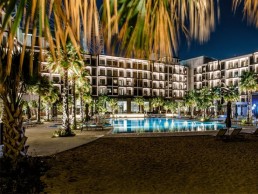
Bluewaters Island, Dubai
The Bluewaters Island in Dubai is a new vibrant destination that combines architectural, entertainment and theatrical lighting by neolight.
Bluewaters is an artificial island along Dubai’s elegant coastline, nestled between the two distinct palm beaches Dubai is so well known for. The iconic destination is also home to the tallest Ferris wheel in the world, the Ain Dubai, along with one of the most famous hotels, Caesars Palace and 200 exclusive shops and restaurants.
Back in 2014, neolight teamed up with Development Managers Mirage Leisure and Development, to create a lighting scheme suitable for the desired experience. Gary Thornton, Senior Project Designer at neolight, discussed the starting process of the initial designs: “The initial brief for the overall project (not necessarily the lighting), was for the destination to become a ‘world-class entertainment zone’ that encompassed a range of sectors, including two hotels, residential space, retail and entertainment, including the Ain Dubai (completed by others).”
The design approach for neolight was to establish a scheme that created a narrative between the different zones, aesthetics and feelings within the unique island setting. The lighting is used to unite connecting areas but also differentiate spaces across the island, as each zone has a considered lighting theme designed for the use of that space.
“We’ve worked on large resort-style projects before, but the sheer scale of this project was something that stands out as different for us. Additionally, the range of sectors involved (residential, hotel, retail, souk) meant that the lighting had to link and unify these spaces, whilst providing a differentiation between them all at the same time,” explained Thornton.
Dynamic and fun lighting was used for the Retail Wharf, creating a vibrant atmosphere, whereas lower level resort-like features were used for the hotel lighting. Key focal points, such as the conference centre entrance, were highlighted using direct and brighter fixtures, to give a red carpet feeling for guests upon entering.
Thornton added: “As they so often are, timescale and budgets were challenging. Four years sounds like a long time, but the sheer scale of the project meant that managing the size of the all-encompassing project was a huge challenge.
“There was even more coordination with all other consultants compared to a typical project, and a lot more site supervision and hand-holding with the contractor on site to manage the detailing and integration of light fixtures. We deployed additional staff through our Dubai office in order to manage this.”
Large canopy light structures have become landmark symbols for the island, adding vibrancy to the retail areas.
“The mushroom-like canopies are a huge structural feature and were a huge coordinated effort between multiple consultants and suppliers to design and implement bespoke items, (including visits, tests and staff from the UK, Paris, Spain and Dubai),” explained Thornton.
“These had to be a visual feature from across the water to the Bluewaters Island and carefully managed for their size and lighting functionality,” he added.
Achieving the integration, performance and control of full colour change lighting, gobo projection and sparkle points were also essential factors of the mammoth installation.
The gobo lighting adds a theatrical element with a hint of colour that softens the hardscapes of the pedestrian avenues that link the hotels. These lighting elements also encouraged the use of pathways, giving them an interesting distinction that distracts from using cars in a normally vehicle-heavy environment.
Linea Light Group’s Alcor steplights with anti-glare effect were used for these connecting pathways, and its Admiral immersion uplights (with AquaStop anti-suction system technology for the power cables), were used to create the elegant pool lighting, adding to the overall opulence of the space.
Each of the buildings within the wharf are lit with a unique identity that combines several illumination techniques. However, overall the different lighting schemes work together collectively and coherently.
Caesars Palace was lit using mostly an ad hoc selection of Linea Light Group’s fixtures to highlight and emphasise its elegant, contemporary architecture. Paseo bars, Portik ceiling lights and Quantum and Warp downlights were installed to bring out details and create evocative night scenes.
In contrast, the lower level hotel resort spaces are lit with a warmer white light that offers a welcoming respite to the more vibrant and busier retail spaces. Residential areas are softer again, creating a further distinction between uses, with soft washes to the balcony soffits on the façades.
With absolute control of the lighting elements, it was important for the team to ensure the schemes were designed with balance and are as sustainable and energy efficient as possible.
Unfortunately, due to budget constraints, the team had to cut back on dimming controls for the residential and hotel façades, which halts the ability to shift the intensities throughout the evening and nighttimes.
“Integration for the architectural lighting was an overall consideration that we strived to achieve at each stage, from the cove and slot details to light fixture containment,” explained Thornton. “There was also the need to use lighting to help to create a distinction between the different areas from residential to retail.
“Lots of decisions on how and why to illuminate aspects of the projects in the way we did were the outcome of coordination meetings, working to help other consultants understand the lit effect we were after and the concealed detail needed to achieve it, as well as conversations with the client and architects about achieving the look and feel for the overall vision of the project,” he added.
A combination of western lighting principles with Arabic culture creates a vibrant environment that is warm, welcoming, dynamic and exciting to experience.
“Our final impressions actually exceeded our initial expectations, and the client’s,” reflected Thornton.
“This was in part thanks to the evolution of the brief compared with the very first concept ideas we discussed, as it became a more entertainment-centric design, which is much more immediately appealing and exciting.
“This project was immensely enjoyable to work on, with the final results showing the rewards of hard work and one that everybody is extremely happy with, from us and the other consultants, through to the developer and client. Off the back of this project we have commenced design on another large project in Dubai, with Mirage Leisure and Development, called The Island, which features three hotels, residential apartments, a multi-purpose venue and large entertainment plaza.”
Harvard LED Business acquired by Gallant Lighting Group
(UK) - The newly formed Harvard Power Systems to be part of Gallant Lighting Group.
Global group Gallant
Lighting has recently formed Harvard Power Systems Limited, following the
purchase of IP and related assets of the company Harvard Technology Limited.
The new business will
re-establish the sales of Harvard’s LED drivers and light sources, operating
from its sales and engineering base near Leeds, Yorkshire, while all production
has been relocated to its specialist electronics manufacturing facilities in
India.
Gallant Lighting also
recently acquired Venture Lighting India, which will bring significant and
comprehensive manufacturing expertise to the group.
The UK-based Harvard
Power Systems business retains a group of key personnel from the previous
Harvard Technology company, and will benefit from their extensive knowledge and
skillset in the product engineering, material procurement and technical design
and development of the Harvard LED product portfolio.
Mark Needham, Managing
Director of Harvard Power Systems, said: “Harvard has a long history of first
class products and excellent product development. We are very excited to be relaunching
this great range of products and to build upon these with the latest
state-of-the-art designs, such as our CLi15 and CLi40 high specification LED
drivers.
“Working with both
historically and newly introduced OEM and distribution customers in the UK and
across mainland Europe, Harvard Power Systems will concentrate on its range of
LED drivers and light sources, while partnering with providers of controls,
connected lighting and IoT-enabled devices to incorporate into its drivers and
product packages.

A.C. Special Projects appoints new Business Development Manager
(UK) - A.C. Special Projects (AC-SP) expands its team to develop and implement new business.
New Business Development Manager, Muraly Kuhan, will work closely with AC-SP’s project managers and architectural lighting brand partners - including Traxon/e:cue, CLS, Acclaim and Chroma-Q - to develop and implement new business.
He has extensive architectural lighting sales
experience on both the product manufacturer and project specifier sides,
encompassing supply through to specification, design and installation.
Kuhan has worked closely with lighting designers, lighting consultants, architects, engineers and other specifying customers to provide solutions for them to realise their lighting schemes in a wide range of areas – including architectural façade, colour-mixing, and media. His day-to-day role will include conducting on-site product demonstrations and specifying client solutions.
Kuhan commented: “I am thrilled to begin a new journey with A.C. Special Projects. It is clear that the set-up and broad experience within the team can allow us to move forward and aid the lighting industry in many different ways. I look forward to getting the AC-SP name out there even more than it presently is, and ensuring that we continue to service our customers’ needs to the highest standards.”
AC-SP’s Managing Director, Lance Bromhead added: "I'm delighted to welcome Muraly to our team. With his wealth of architectural lighting product, project management and commercial experience, he will be invaluable in helping A.C. Special Projects to achieve its future growth plans.”
