
L&L Luce&Light Intono
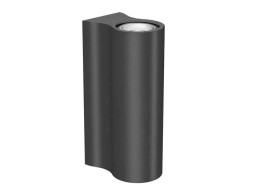
Intono is the new wall-mounted outdoor fixture that comes in four different sizes and single or double beam. The body is a minimalist cylinder that connects to the wall by a sinuous double curve. The neutral and adhering surface allows it to be painted in the same finish as the supporting wall. It can also communicate with smart speaker devices over Wi-Fi using ZigBee protocol, and can change lighting scenarios according to the music. Rated IP65 and IK08, LED or COB light source, wattage ranges from 2W to 20W, CRI 80 and CRI>90, colour temperature 2700K, 3000K and 4000K.

Brick In The Wall 200Cent
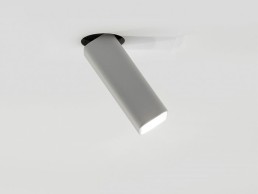
The 200Cent LED spot is now also available in a 26x26mm square version, which makes it as small as a two-euro coin, hence the name 200Cent. Despite its small size, it remains powerful, running at up to 750 lumens. The colour consistency is perfect (two-step MacAdam), and the colour rendering (CRI 92) is also outstanding.The 200Cent is an optimal crossing of outstanding technology and minimalistic design.
Linea Light Group Ink System
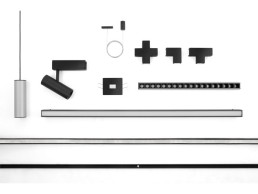
The Ink System is made up of several versatile items, united by the same concept. The elastic and thin cable, in the stretched version, houses a high performance stripLED and acts as a conductor on which it is possible to hook different devices: light profiles with diffused emission or UGR <19 thanks to special darklight cells, adjustable spotlights and pendant lamps. The range includes wall/ceiling paths, modular modules-channels with various junctions and endings that house the conductor cable and transform it into an elegant graphic sign.
www.linealight.com
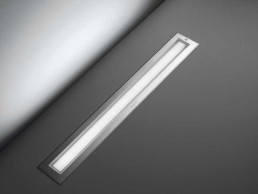
Augenti Matrix
A linear recessed fixture, the Matrix is equipped with secondary optics for different light distributions, which is useful for raising the lighting of façades. It has architectonical or frosted glass elements for a diffused distribution that, together with the glare control, make it suitable for pedestrian paths. Available in LED with fixed or dimmable output (Dali, 1-10V, Push) or in tunable White/RGBW for DMX-RDM.
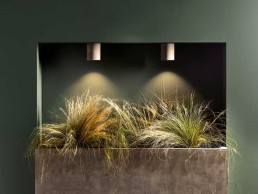
Astro Concrete Kos
A simple round or square geometric shape, Astro’s Kos downlight has a beautiful polished concrete finish. The Concrete Kos is individually cast by reinforcing raw concrete with weatherproofing additives, producing a robust and authentic product with natural imperfections and its own unique finish. Kos is perfect for blending into any architectural setting and can be ceiling mounted in both interior and exterior spaces thanks to its IP65 rating.
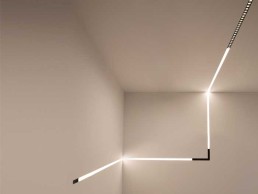
A.A.G Stucchi Senzafine
Senzafine is A.A.G. Stucchi system with all that you need to make an endless light line possible inside Multisystem tracks. The system is provided with various lengths, that match perfectly one to other, thus avoiding any visible junction of light. The different available opticts opal/microprismatic/UGR<19/lenses together with the various colour temperatures guarantee a wide choice and the maximum freedom in your lighting projects.
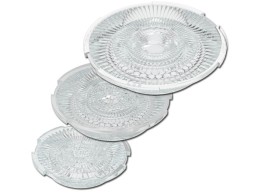
Khatod Cosmos Lenses
The low profile Cosmos lenses for COB LEDs with LES range from six to 22mm, and come in three sizes: 50, 70, and 90mm. They offer a full range of beam angles and meet MR16, PAR30, AR111 requirements. The frosted finish of the narrow beams makes the light flux smooth, diffused and very homogeneous. Perfect for luminaires in different kinds of environments, living spaces and any interior rooms, the lenses are easy to install, either using their holder or alone by exploiting the mechanical parts of the lighting fixture.

Eaton to spin off lighting business
(USA) - Eaton’s spin-off lighting business will include brands such as Zero 88, iLight and Greengate, alongside the manufacturer’s Airport Lighting business.
Eaton has announced its intent to pursue a spin-off of its lighting business, creating an independent, publicly traded company.
Included in the spin-off are UK brands Zero 88, iLight and Greengate, alongside Eaton’s global Airport Lighting business and Mains Lighting and Intrusion Systems operations, which primarily operate out of Europe and the Middle East.
The Crouse-Hinds Industrial Lighting business and Life Safety Division’s Emergency Lighting product lines in Europe, the Middle East and Africa will remain with Eaton.
Simon Sparrow, Managing Director of Eaton Lighting Systems, said: “We are excited about this announcement for several reasons. It better positions the lighting business to respond to evolving industry and customer needs, it enables lighting to compete more effectively across its diverse end-markets, and it enhances Eaton’s ability to focus investments in its core business.
“Over the next few months, Eaton will be working to finalise the spin-off and ensure a seamless transition for employees, customers and valued business partners. In the meantime, however, it’s business as usual.”
Eaton’s lighting division is one of the largest global lighting businesses, with more than 5,000 employees, and sales of £1.7 billion in 2018.
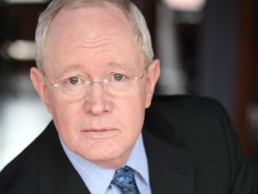
John Martin
After announcing his retirement following a 50-year career, in which he spent the last ten years working as Public Policy Consultant for the IALD, arc spoke with John Martin on his career highlights, and the increased profile of the lighting industry over the last decade.
How did you get into lighting?
I am not a lighting professional by training or experience. Starting in 2008, I served as a public policy consultant to the IALD. The skills required for that role included an appreciation of the importance of lighting design and an understanding of lighting technology, but it was actually better for me not to be a practicing lighting professional. That way, I did not bring my professional slant to any of the controversies or policy discussions in which the organisation was involved.
Can you give us a brief overview of your career to date?
Since I have just officially retired after 50+ years as a working professional, it’s difficult to be brief. The short list of my professions includes: teaching, legislative aide, education lobbyist, electrical contractor, corporate training director, and my work for IALD.
You were IALD’s Public Policy Consultant until the end of last year - what did this role involve?
As IALD’s Public Policy Consultant, I worked on several fronts to support lighting design and lighting designers. While the role evolved considerably over my tenure, the key elements remained constant: establish relationships with other organisations, work with governments and government officials at all levels, monitor governments for actions that could affect either lighting design or the business of lighting design, seek opportunities to raise awareness of the importance of lighting design, and communicate the impact of laws and regulatory proposals to IALD members.
How has the lighting industry changed and developed during your time with the IALD?
Three changes stand out over the past ten years: the rise of new technology (solid-state lighting); the consolidation and changing markets for manufacturers; and the growing public awareness of the impact of light and lighting on human health, productivity and comfort.
At IALD Enlighten Europe last November, you spoke of the ‘terrific progress’ made in raising awareness not only of the IALD but of lighting regulations around the world. How has the IALD been working to raise such awareness?
During the past ten years, the IALD has increased its visible involvement in policy issues in many ways: building relationships with other design- and construction-related organisations around the world, from the ILD and SLL to the IES in North America and Australia, Lighting Europe in the EU, as well as architectural societies, entertainment lighting associations such as PLASA or PEARLE and interior design associations; placing IALD volunteers on energy-code-writing groups wherever possible; and working with government officials in the EU, USA, Australia and elsewhere to raise the profile of the IALD and architectural lighting design in general. IALD’s ‘secret sauce’ has been our volunteers, members of the IALD who articulate the value of their profession, and who are able to analyse regulatory and legislative proposals to determine their impact on the practice of lighting design.
What will this increased awareness mean for the lighting industry as a whole? What impact has it had so far?
I hope that the increased awareness of lighting design helps the lighting industry become more visible (pardon the pun) to other design professions and to regulatory bodies. At the same time, we are entering a period in which light and lighting are more in the public consciousness than ever before; the combination of technological change (SSL) and increasing awareness of the importance of light in human health mean that lighting-related policy issues are no longer confined to energy efficiency, which has been the case for the past 40+ years. The growing issue of legal conflicts related to light pollution and the different ways in which these are tackled from a regulatory standpoint globally, is also showing the relevance of good lighting design. To date, the impact is that IALD has gained an official role as a “spokes-organisation” in places as diverse as Australia, the EU, and the U.S. State of California. In addition, IALD is playing a consulting role for organisations such as the International Well Building Institute (IWBI), authors of the WELL rating system.
Congratulations on your retirement! How do you plan on spending your retirement?
Professionally, I continue to be involved with the California Energy Alliance, an assembly of disparate organisations - from manufacturers to design professionals to labour unions - that are working together to improve California’s state-level energy regulation, which is widely seen as a leading indicator of how similar regulations will evolve in other U.S. States and at the national level. Personally, grandchildren and travel are already keeping me busy!
What would you say has been the highlight of your career to date?
I feel very privileged to have had the opportunity to work with IALD members from around the world over the past decade - they are uniformly interesting people, often insightful business owners, and imaginative thinkers. I have worked with IALD members from at least a dozen countries, which has itself been an education for me!
Finally, what do you think the future holds for the lighting industry?
Larger manufacturers will continue to consolidate and seek new revenue models, which in turn will put continuing pressure on independent lighting designers. In many arenas, “lighting as a service” will become a dominant business model. Smaller manufacturers and lighting designers may well make common cause to provide their own variations on the “lighting as a service” model. The policy importance of lighting in buildings will no longer be about the energy used for lighting. Increasing awareness of the power and importance of light may lead to an increasing demand for better lighting from building occupants and the public at large. The continuing debate will be, “Just what is ‘better lighting’?” As the cliché goes, ‘stay tuned for developments’!

Bright Side Studios launch immersive exhibition
(UK) - Bright Side Studios collaborates with award-winning, contemporary dance choreographer, the late Janis Claxton, to create an immersive exhibition this March.
A leading creative technology company in Edinburgh, Bright Side Studios, is working with Studiotech to create an immersive exhibition designed to put the audience at the heart of creating their own experience.
a Human Connection is inspired by its work in 2016 when Bright Side Studios and Janis Claxton won a Curiosity Award, supported by Creative Scotland, designed to allow collaborations to stretch artists and creative technologists and to find new ways of opening up the arts to new audiences.
Over the course of two weeks in the King’s Theatre rehearsal space, Bright Side Studios directors Susanna Murphy and Cristina Spiteri worked closely with choreographer Claxton and her dancers to explore the intersection between gaming, motion capture technology and dance. Their hope was to create an interactive environment, which reacted in real time to movement and put the participant in charge.
The use of Point Cloud allowed Claxton and the dancers to see the results as they worked and motion capture suits stored immense amounts of data that Bright Side Studios used to create a representation of the physical movement and a live interactive environment.
The result at that time was AbstrACTION, which was featured on BBC Taster and was released on Google Play, as well as being showcased at Future Play, for the Edinburgh Festival.
Working in partnership with lighting and technology specialist Studiotech, to ensure that technology is used to its full potential to make the interaction between the human body and lighting as natural as possible. They have now created an experience that encourages connection and plays on the visceral effect of movement using dynamic lighting solutions from Traxon Technologies. Award winning composer Pippa Murphy, a long term collaborator with both Bright Side Studios and Claxton, created a soundscape for the exhibition.
The exhibition, which has a theme of love running through it, showcases creative lighting technologies and ideas such as projection mapping, kinetic technology and human data integration. a Human Connection is sponsored by the international lighting technology company, OSRAM.
Murphy and Spiteri commented: “Being curious and passionate, experimenting and playing with technology can lead to incredibly innovative work and working with Studiotech and Traxon Technologies we have created an exhibition, which immerses the visitor to create a stunning experience for them. Janis sums it up best, as ever, with her words, “it’s all about love."
The exhibition will run 21 March t0 21 April 2019 in Edinburgh, Scotland.
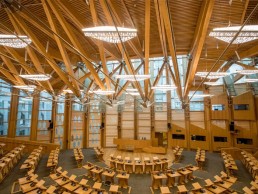
Scottish Parliament Debating Chamber, UK
KSLD’s work on the Scottish Parliament Debating Chamber has earned the Scottish firm a lot of plaudits. We spoke with Kevan Shaw, founder of KSLD, to learn more about the new lighting scheme.
In the heart of the Scottish Parliament building in Holyrood, Edinburgh is the Debating Chamber. Located directly above the Main Hall, it is purpose-built to meet the needs of the Parliament, the public and the media.
The modern space, finished in oak, sycamore and glass, provides an impressive centrepiece for Enric Miralles’ vision for the new Scottish Parliament.
The chamber is dominated by an impressive roof structure. Made from reinforced steel and oak laminated beams, the roof beams are held in place by 112 unique stainless steel nodes or connecting joints, made in Aberdeen. This means that there is no need for supporting columns in the 1,200sqm space.
A huge window, made up of 1,000sqm of laminated glass panels, spans across the west wall of the chamber. Each panel has a sycamore veneer layer, sandwiched in horizontal strips between two layers of glass, and features distinctive cut-out shapes that were intended by the architect to signify people and as such, give a human scale to the chamber.
Despite being a relatively recent building - it was officially inaugurated in October 2004 - the existing lighting in the Debating Chamber was reaching the end of its life and, because of the use of metal halide lamps, was now obsolete.
As a result of this, Kevan Shaw Lighting Design (KSLD) was brought in to replace the previous lighting and create a new scheme. The Edinburgh-based designers’ aspiration for the project was to “create a lighting design solution as rare in concept as the architecture itself, while achieving all possible innovations to support parliamentary business.”
Because Scottish Parliamentarians cannot sit without being broadcast continuously, the chamber is effectively a TV studio during parliamentary business. Such demands, combined with the architectural features within the chamber, meant that the previous lighting arrangement was not fit for purpose as Kevan Shaw, founder of KSLD, explained: “The idea in the original scheme was to use three-point lighting across all the seats, but there were limitations in this because of the balcony in the back; people at the back who were speaking looked like cardboard cut-outs because they were front lit against a dark background.
“It was also a pain to maintain; you couldn’t get to the fittings, and because they were metal halide lamps, they were only getting a year out of them before they lost output.
“The way the lighting worked was pretty poor as well. Because of the large, west-facing window, there were real problems with sunlight coming in, casting shadows everywhere, blinding everyone and making the cameras go doolally.”
KSLD’s brief, therefore, was to review the former metal-halide lighting and daylight ingress to improve glare and uniformity for the Members of the Scottish Parliament (MSPs) and the broadcasting team. The introduction of new HDTV cameras also meant that the lighting had to be upgraded to fulfil broadcasting standards. Because of the demands of the space, the only window to complete the work was during the summer recess - a period of just six weeks.
This meant that Shaw and his team were faced with three options: install LEDs into the existing fixtures, replace point for point what was already in place, or create an entirely new scheme. After a series of site trials and time-lapse daylight studies, in which KSLD mapped out exactly how sunlight passed through the chamber, Shaw determined that a radical concept would better suit the parliamentarians, the broadcasting team and Miralles’ original architecture, rather than an LED retrofit.
A key facet of this “radical” concept was the introduction of custom-made suspended luminaires, created in collaboration with Mike Stoane Lighting, that cast soft but high light levels of light, suitable for broadcasting, while simultaneously celebrating the architectural structure previously obscured by hundreds of pole-mounted spotlights.
The leaf-like shape of the bespoke fittings not only connects the interior of the chamber to the nature outside, but it also reflects the plan-form of the chamber itself, therefore locking it into the architecture. The leaf motif gives the fixtures an additional, distributive sense, as they appear to float across the ceiling of the chamber, as if caught on a passing breeze. However, despite the apparent random configuration of the fixtures within the complex ceiling structure, in both layout and height, they achieve the required lighting distribution. The additional uplighting provided by the new fixtures means that, where previously only the parliamentarians were lit, the new scheme now illuminates the whole volume of the space.
The fittings are further connected to the architecture of the chamber through light guide extractors within the stepped acrylic wings of the ‘leaves’. These extractors appear as abstracted figures, each representing the number of sitting MSPs, and are derived from the recurring graphic silhouette that features elsewhere in the architectural language of the chamber.
KSLD has a long history of working with Mike Stoane Lighting, and Shaw was delighted at the lengths to which the Scottish manufacturers went to ensure the highest quality in the bespoke fixtures.
“We have worked with Mike Stoane Lighting since they started, so we know them all very, very well, and they went above and beyond the call of duty, under some very trying conditions, especially the time-frame,” he said.
“This was a super picky project, and there were things that came up in the construction of the fixtures such as blemishes in anodising, blemishes in the acrylic finish, as they were all engineered in pieces, that weren’t acceptable. And there seemed to be one thing after another that caused these quality issues, but these issues, instead of landing at me, were being caught by Mike Stoane - they were telling me about it and they were sorting it, whereas a lot of manufacturers don’t do that.”
The fittings were also created with a degree of robustness, factoring in a redundancy, should any aspect of them fail during parliamentary proceedings. “Each fitting has two strips each side, four strips in total, and each line has a power supply, control gear and an LED strip. There are four of these in each fitting, so there’s a redundancy in place,” Shaw explained.
“Essentially, it means that if you lose one of them, it’s actually very difficult to tell. Although you’ve taken 25% of the light out of the fitting, it’s not visually apparent. So if they lost a section, or even a couple of sections in the course of a week, then over the weekend when the parliamentarians are not sitting, they can get up to fix it.”
Additional backlighting was also added, with spotlights and linear fittings from Mike Stoane Lighting, Alpha LED, Lightnet and LightGraphix carefully installed into the existing timberwork, removing the “cardboard cut-out” appearance of the backbenchers.
Control-wise, KSLD replaced the original scheme with Lutron-controlled DALI lines, as Shaw elaborated: “The original scheme was just switched. We had all the power lines in the ceiling, and we repurposed these to become DALI lines with minimal re-wiring, because in six weeks, we couldn’t rewire the whole thing.”
Further redundancy measures were implemented into the DALI controls as well. “Everything is programmed so that if the system fails, if the wiring fails, instead of failing to off, everything fails to on, so every step of the process of what could fail has been thought through, to prevent failure causing disruption to the chamber,” Shaw explained.
The need for scene setting or dimming within the chamber was paramount, and detailed examination of thermal performance and pre-programmed timed operating states through DALI dimming control, on the basis of planned patterns of use, allowed KSLD to calculate the LED and fitting life of 25 years - a target that they were aiming for.
Further to the new lighting scheme, KSLD designed and installed a series of louvres on the window. Constructed of sand-etched acrylic, these simple, fixed louvres are the end result of extensive tests and trials where Shaw and his team created a digital mock-up of the chamber and, using a time-lapse study of the way that sunlight interacts with the space, were able to create a system that reduces the problematic additional glare, while still allowing natural light to enter the chamber.
While KSLD worked with the parliamentary corporate body, a committee of employees and parliamentarians, and Lee Boyd Architects, who have a continuing role in managing the architectural issues and the work that has to go on within the building, the lighting designers were given a free rein in creating the new scheme - after an extensive consultation process, but the results have been greatly received by all involved, as Shaw elucidated.
“We had the parliamentarians, represented by the corporate body, the broadcasting department, the events team - when there’s nobody sitting in the chamber they do walkthrough tours - and we had the tourism team to keep happy. But it has been really exceptionally well accepted by everybody, to the point where tour guides now actually talk about the light fittings; they tell the story of the shape of it, the story of the parliamentarians.”
Indeed the chamber has also garnered a lot of attention on the industry award circuit, getting shortlisted for the 2018 [d]arc awards / architectural, and winning first prize at the Codega Awards. However, Shaw remained humble about the awards success, instead saying that he prefers a different sort of praise.
“It’s nice to get awards and external recognition, they’re not the most important things.
“I actually got an email from an MSP saying how much they love the new lighting. Most of the time, people notice lighting because they don’t like it, but to get to the point where people notice what’s not a really in your face scheme, it’s quite a major thing. And the fact that it’s become part of the story of the chamber, that to me is more valuable than getting awards.”
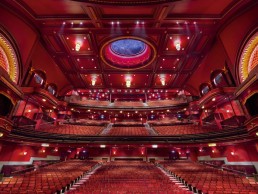
Mayflower Theatre, UK
As part of a new £7.5million refurbishment, 18 Degrees has created a lighting scheme that celebrates the beautiful architecture of Southampton’s Mayflower Theatre, while creating a comfortable environment for theatregoers.
The Mayflower Theatre in Southampton, the third largest theatre by capacity in the UK outside of London, last year marked its 90th anniversary with a new, £7.5million refurbishment.
The renovation project, taking place in a twelve-week window starting in June 2018, was extensive, with the theatre seeing a completely new colour scheme introduced throughout. The radical transformation has seen the Grade II listed theatre move from its previous green colour scheme to a regal red and gold, intended to represent the heritage of the building.
The restoration also saw most of the auditorium seating refurbished or replaced, while the orchestra pit was moved to below the stage area, and accessibility into and around the theatre has also been improved.
London-based lighting design practice 18 Degrees was appointed as lighting designer for the project as, following consultation with architects Foster Wilson and theatre consultant Charcoalblue - both companies that 18 Degrees had previously worked with - lighting was identified as a key element within the refurbishment. Not only to bring the theatre forward in terms of technological advancements, but also to complement the new interior look and feel, creating a comfortable environment for theatregoers.
Speaking on the initial design brief, Christopher Knowlton, Director at 18 Degrees, said: “The Mayflower Theatre CEO Michael Ockwell was very clear that under the original lighting he couldn’t read his programme. With the colour of the auditorium being taken to a martini red, there was a concern that the low lighting levels would become even lower.
“The overarching project goal was to improve the audience experience. The theatre’s 1920s lighting design was much unchanged since its installation, leaving the auditorium dimly lit and consuming significant energy. In some areas patrons were finding their seats and reading programmes in just 1 lux.
“We set out to create a well lit environment where navigation and accessibility was improved and architecture celebrated.”
Layered into this were enhancements to the circulation lighting used within performances to ease wayfinding, and lighting some of the architectural details within the space that hadn’t ever been lit before. This included elements such as the dome and sun rises, with the new lighting, provided here by Universal Fibre Optics and Lumino respectively, revealing the gold leaf, and providing texture to the auditorium’s rich new colour palette.
To create the new environment and pay tribute to the heritage and architecture of the theatre, 18 Degrees’ design approach was to provide layers of light that would present the auditorium beautifully, yet have subtle variations in function. This was realised through general, comfort, decorative and accent lighting - a response to the performative nature of the space.
General illumination was provided by the installation of more than 200 new Lucifer Lighting downlights. Carefully integrated into the historic fabric of the building, after gaining permission from English Heritage, who oversaw the restoration works, this light created a soft, even illumination to the space, improving distribution and increasing the illuminance during general, day to day use. This means that heritage lighting now only needs to be used for performances. Dimming, distribution and illuminance levels were all carefully plotted, along with extensive onsite testing for performance and colour rendering.
All heritage lighting within the venue was retained - a key component of the design plans - as 18 Degrees decided to refurbish and repair the fixtures, replacing the old halogen lamps with Global Design Solutions LEDs. The use of LED lighting throughout provides increased functionality, while ensuring a more conscious approach environmentally for the venue, leading to a longer term, more efficient lighting solution.
For these heritage fixtures, the original 1930s cabling was concealed within the architectural fabric of the building. Accessing this would mean breaking into the Grade II listed building, so instead 18 Degrees continued to use this wiring with new LED lamps and drivers especially designed for this application.
New comfort lighting, in the form of nearly 300 new LEDFlex linear lights integrated into the end of row arm rests and handrails, provides low levels of light during the performance to allow for improved visibility when accessing the walkways. Totally concealed, these linear lights only offer illumination into the aisles, while the low level of light ensures that patrons are not lit or distracted while watching a show.
The final component of the new lighting scheme was the newly designed orchestra pit. Split into two mechanical lifts, concealed seats within the pit can be raised or lowered to provide an additional four rows of seating, if needed. Due to the pit’s close proximity to the stage, beam control was critical, as Knowlton explained: “As the lighting was located eighteen metres overhead, it led us to design a series of apertures to project narrow beam LED theatre lanterns to illuminate and zone the area accurately.”
Controlling the many new lighting fixtures and scenarios in the auditorium meant the need for a new state-of-the-art control system to ensure that the lighting could be controlled individually or in groups. Working with Charcoalblue and ETC, 18 Degrees designed and commissioned a control system where every light can be individually controlled, either via touchscreens and buttons, or via the lighting control desk.
“The lighting control on this project represented a huge paradigm shift for the theatre,” Knowlton elaborated. “Previously lighting was controlled from a number of dimmers controlled via DMX. A small number of addresses would be used to call up elements such as decorative fixtures or downlights.
“The new all-LED system required many more specialised drivers, taking the original DMX addresses to 365. This allows every light to be individually controlled, which is both a benefit and a challenge. For a receiving house theatre like Mayflower, giving an incoming company that many DMX addresses to control would be highly impractical, so a solution was developed with ETC where the Paradigm Control System can operate with only a small number of DMX addresses when accessed via DMX. When the theatre is not in performance mode, a touch screen and wall stations around the auditorium are used to control the lights for day-to-day operation.
“At the start of the process, there were a lot of people asking who would ever use all those addresses and what for? By the end of the project, we had found an ever-growing number of opportunities to use the house lights as part of the theatrical experience.”
Because of the vibrant new colour scheme, 18 Degrees had to carry out a series of tests to ensure that the new lighting complemented the deep red interiors.
Knowlton continued: “People often forget that colour is really about relative contrast, so even when the theory is telling you something should work, it’s not until you see it for real that you can tell if it works.
“In an auditorium, light levels are often very low, and dimming between 0-30% can dramatically change the appearance of colours. It was therefore decided that we would test all materials and paint finishes under the lighting conditions that we would have in the theatre. This process meant the whole team spent a lot of time looking at samples in a dark room with the selected downlights.”
The lighting design firm’s close, collaborative relationship with Foster Wilson also helped to yield positive results. “Foster Wilson were great to work with, developing a palette of materials and finishes that were tested under the exact lighting conditions in the theatre with the new lighting to ensure that we all agreed on the finishes under the correct lighting, so there were no surprises when the lights were switched on for the first time,” Knowlton said.
“When you work with collaborators that understand each other’s practice, it’s so rewarding, and I think the results show how successful this can be.”
Indeed the end result shows the remarkable success of the renovation, with the new lighting design perfectly complementing the deep, luxurious new red colour scheme. The space feels fresh, yet with a warm, comforting sense of heritage, while the beautiful architectural elements are wonderfully celebrated.
Knowlton is equally pleased with the final product, on both a practical and aesthetical level: “The lighting design functions really well. We have reduced the energy consumption on a day-to-day basis, while at the same time providing higher light levels that are more equally distributed.
“In such a large space it would be easy to flatten the space with so much light. However, the integration of lighting into seating and features prevent that from happening, allowing the building to have an identity of its own, while allowing each show to sit comfortably within.
“The lighting supports the space and its function: a response to the architectural form rather than an imposition on an old building.”
However, while Knowlton is pleased with the new lighting scheme, he said that it was the reaction from those working at the theatre that he’ll remember. “There was a beautiful moment where we got control of the lights for the first time and could really show off what we had done,” he said.
“The BBC had been in earlier in the day to film their restoration documentary and the stage curtain was lowered. All of the staff who had not been allowed into the building site for twelve weeks were ushered onto the monochromatic black stage when the curtain was raised and they got a first glimpse of the new colour scheme and lighting. For some it was quite emotional - a testament to the way the theatre is run by passionate members of a huge team.
“Mayflower Theatre and the people who bring it to life made it very hard not to fall in love with this project. The Mayflower plays a huge part in local community life, and to have even a small role in regenerating the space has been an honour.”