
Wiley Publishing, USA
New York-based One Lux Studio has created a lighting scheme for the newly renovated headquarters of Wiley Publishing, utilising both direct and indirect light to open up and revitalise the formerly dark, enclosed space.
Wiley Publishing, formerly John Wiley & Sons, has been in operation for more than 200 years, since its inception as a small printing shop in lower Manhattan in 1807. The family-run firm, now into its seventh generation, has constantly evolved over its 210-year tenure, from letterpress pamphlets to digital apps and interactive online learning tools, and now this evolution has extended to its workplace, following a renovation of its company headquarters.
Located in Hoboken, New Jersey, with beautiful views of the Hudson River and Manhattan beyond, the interior renovation has transformed the offices into sophisticated, open workspaces, while the large windows fill the space with natural light.
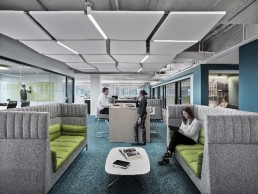
Working alongside architects TPG Architecture, Manhattan-based One Lux Studio designed the lighting for the newly renovated headquarters, providing new solutions not only for the office space, but for public areas also, including the ‘collaboration lounge’, elevator lobbies and cafeteria.
Using a blend of decorative and architectural fixtures, the new lighting scheme utilises both direct and indirect fixtures following the workstations, while linear indirect uplighting at the core highlights the edges of the space. The public areas incorporate more playful lighting elements, with zig zags, angular and organic patterns of lighting blending with the ceiling system, revitalising the space.
Stephen Margulies, founding partner of One Lux Studio explained how the new scheme helped to transform the offices post-renovation. “The existing space had enclosed perimeter offices, which affected daylight penetration,” he said. “The interior open plan areas were dark, vast areas with tedious grids of 2x2-foot fluorescent troffers with little definition or interest.”
The goal for One Lux Studio, therefore, was to develop a lighting system that took advantage of the new open plan concepts. However, Margulies was concerned that, in doing so, they’d end up with large, open areas with “monotonous” lighting solutions.
“Careful attention was placed on creating interesting arrival and circulation design solutions, and the workstation areas had a ‘neighbourhood’ approach where the light fixtures are related to the workstation zones, creating brighter zones at the workstations and darker zones in the circulation areas. We created spaces that were intimate within a vast floor plan,” he explained.
“Additionally, a large format, 4x4-foot ceiling tile was used for the workplace. This, in conjunction with the indirect lighting components, created a unique solution.”
The use of indirect uplighting throughout the project circulation areas, provided by EcoSense, adds an interesting dynamic to the space not normally seen in office environments, and Margulies explained why One Lux Studio made this decision: “The ceiling heights were pretty restrictive,” he said. “Acoustic tile ceilings needed to be at eight foot, ten inches to conceal major mechanical systems.
“Large open spaces with this ceiling height can feel compressed, so the concept of using a direct/indirect lighting solution for the workplace proved to enhance the volume of the space.” Major circulation areas made use of exposed ceilings, adding an element of ‘rawness’, while also enhancing the spaces by providing even greater volume and variety. Elsewhere, a patterned ceiling effect in the elevator lobby, and lowered, zig zag panels in communal areas bring a sense of playfulness, further differentiating the various spaces.
However, while the ceiling proved restrictive in some areas, there were other occasions where the lighting team were able to elevate them higher, further enhancing the new, open feel of the headquarters.
“The existing mechanical systems were kept in place, which created a few challenges for some areas,” explained Margulies. “Since the workplace lighting hung below the ceiling we avoided many conflicts, and allowed the ceiling to be as high as physically possible.
“There were a few surprises when the existing ceilings were removed; however, recessed lighting equipment that only required 3.5-inches of recess depth avoided most conflicts. This coordination became most important in the amenity spaces like the conference centre and food service areas, where ceiling heights were pushed even higher to enhance the user experience.”
As with most projects, budget proved to be a big driver for One Lux Studio, but Margulies and his team found that their approach – particularly the blend of direct and indirect lighting – used very few light fixtures when compared to traditional open office lighting solutions. However, by referencing other projects where similar solutions were successfully implemented and carrying out tests to prove the concepts, they were successful in getting these solutions in place.
The end result for Wiley Publishing’s new headquarters is a bright, airy, interesting workspace, awakening an office that had previously felt dark and vast, underutilising the space available. Margulies was delighted with how the project has turned out, praising the work of TPG Architecture.
“The architect has created a new, unique experience for the Wiley employees,” he said. “As the space was recreated in an existing office building, the comparisons were immediate.
“Daylight and fantastic views of the Hudson River were magically awakened. Large, tedious spaces were transformed into ‘musical experiences’, having the beat change as one walks through the space.”

Executive Office Building, Russia
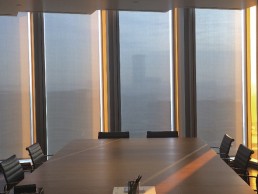
LAPD has provided a full lighting design for an executive office tower in Moscow, transforming the building into a beacon in the cityscape of the Russian capital.
LAPD Lighting Design worked on the interior, façade and landscaped areas of this executive office tower in Moscow.
The approach to the façade lighting was to create a cage of light around the building itself, connecting the top and the bottom of the building. The client wanted the building to have visibility from afar and so the entire top element was transformed into a beacon-like lantern with prominence within the Moscow cityscape.
Cool white linear LED lighting with a carefully selected beam width was used to light down glass fins cladding the building top. Various test were carried out on different types of glass and different LED optics to ensure that the fins held the light as much as possible all the way down their length and lit the entire volume.
Clear glass with a frosted interlayer produced the best effect and the best structural performance. Eight linear lines of light then ran down the building, highlighting architectural details around the façade and connecting the lantern top with the base of the building. Cool white light was used to connect the cool white lantern with the cool white lighting around the building base, forming the cage-like structure.
The linear LEDs from Insta were colour controllable and, on the client’s request, the lines of light that framed the two-coloured expanses of façade were adjusted to match the vivid glazing colours that were chosen.
A control system was specified to enable these lines of light to chase, pulse, change colour and create different effects for special events.
Grounding the ‘cage of light’ was achieved by highlighting all the columns around the base of the building, along with the entrance canopy itself, with a matching cool white light. The columns were treated as architectural elements by using a linear light source concealed in a detail above the column. Again, using appropriate optics a sheet of light was created travelling down each column. This avoided downlights visually scarring the canopy above and creating unwanted scallops detracting from the pure forms.
The canopy needed to echo the experience of the building from afar. As a result a frosted glass canopy was created that was backlit using cool white LEDs. This created a similar level of impact at low level to that created by the lantern from afar.
These architectural lighting treatments around the base of the building balanced the strong lantern effect of the building top but also contributed to the landscaping lighting.
General illumination to the entrance area and car parking areas around the building was provided by using a lighting column from the Hess City Elements range. These provided a neutral cylindrical form against which the building could be viewed without conflict from feature elements. The columns allowed asymmetric, symmetric and road optics to be used from a column without a change in its appearance. A warm, soft level of light was produced with low glare.
Feature lighting was provided to the furniture elements around the buildings, while linear hidden lines of light were integrated into the furniture in collaboration with the manufacturer to create a soft warm glow under each seating area. Feature lighting was also provided to uplight the trees themselves. These uplights were raised above floor level slightly to ensure they still functioned during winter months where a carpet of snow resides across the landscaped areas. As with all of the exterior lighting products specified, they needed to be able to operate at temperatures down to -40-degrees Celsius. Again, a soft warm colour temperature was used to harmonise with the lighting elsewhere around the building base, and to contrast with the cool colour temperature on the façade.
Lines of staggered light mimicking those running down the façade were recessed into the ground to lead occupants from the roadside right up to the building canopy.
Once inside the building these strong linear lines of light flip up onto the ceiling of the reception area to continue the draw into the building. Four continuous lines of light from XAL were used to draw the eye towards the feature wall at the end of the reception space.
This feature wall was created by using continuous linear LEDs with a six-degree optic to graze light up the back wall, which consisted of a suspended horizontal, linear mesh. The front of the wall was constructed from cast, layered glass orientated horizontally. The resulting moiré pattern effect between the backlit mesh and the front layered glass was an intriguing shimmer that continually changed as the viewing angle changed.
Lines of light were also used within each lift lobby, continuing the theme throughout the building. These lines were framed within floating rafts that were covelit along all sides.
The developer moved into the tenth floor and appointed LAPD to illuminate all of their office spaces. Lines of light illuminated the naked concrete surfaces and Italian wooden walls in the reception, waiting and circulation spaces. Square downlights from XAL are also used to provide accent in key places.
Meeting rooms and smaller office spaces use a combination of linear and accent lighting within troughs from Kreon. This allows control to provide bright, uniform levels of light for meetings and low levels of accent light for presentations, along with options for variations between the two. The linear and accent lighting was designed to match in colour temperature.
Open plan office areas are illuminated by suspending Zumtobel Aero luminaires to achieve the desired illuminance levels on the desks and on the ceiling itself.
There was also a strategy written up by LAPD to ensure that tenants within other floors lit their offices in such a way that the building had a homogenous look at night from outside. This included requirements to conform to different orientations of lighting in different areas but still provide flexibility within their design. The strategy included a decorative treatment to all interior columns for all floors.t
PUK Hydroeclipse IP65
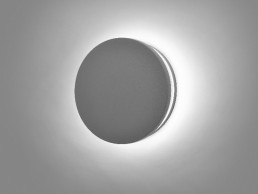
A new range of outdoor wall-mounted appliques, including ten different models of round, square and rectangular shapes.
Used mainly for decoration of outdoor areas, once switched on the Hydroeclipse range creates a beautiful luminous halo, discrete and elegant, that highlights the wall texture.
With a depth of just 33mm and surface-mounted, the most representative shape is the round luminaire, that seems to recreate a lunar eclipse effect.

Concord Beacon Muse XL
The Concord Beacon Muse XL provides total control and adjustability of both beam angle and light levels combined with typical Ra97 colour rendering, offering a truly flexible product for gallery and display applications. The Beacon Muse XL features intelligent LED technology and ancient lens principles to create a fully adjustable spotlight. Boasting an increased output over the original Beacon Muse, the luminaire provides a flexible, high quality solution. The beam angle can be adjusted from ten to 70-degrees as well providing a dimmable range between 5-100%.
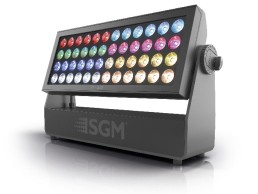
SGM P-10
The SGM P-10 low-profile, yet extremely powerful, full colour LED luminaire carries the functionalities of a washlight, a strobe light, a floodlight, a pixel light, and a blinder with a non-fading continuous output. It incorporates 48 high-power RGBW 24W LEDs with eight individually controllable segments and a staggering output of 40,000 lumens. With all this crossover technology combined in one single luminaire, SGM’s P-10 is truly the perfect multi-purpose LED fixture and a solid long-term investment.
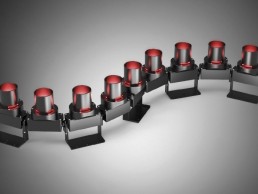
Radiant Lighting 3D LED Flex 40 IP65 System
The 3D LED Flex 40 IP65 System is a three-dimensionally flexible, high power, modular, linear LED lighting system, incorporating a patented articulated ball-joint system between the heatsink modules, allowing it to follow building surfaces that are non-linear with curved profiles and façades.
Each 100mm module incorporates four Luxeon Z red LEDs, a highly efficient 8-degree Gaggione lens, and custom anti-glare snoots. Each module is individually addressable via DMX.
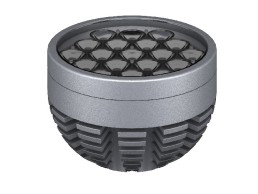
Nexo Luce OVO 18UN
OVO 18UN by Nexo Luce is designed to create a dramatic ultra-narrow light beam on façades and architectural surfaces. It is equipped with 3.5-inch optics for accurate projection while able to reach up to 59lux at 80-metres distance. This LED projector has an adjustable beam position; aluminium and stainless steel body AISI 316L; and is suitable for outdoor installations thanks to IP65 waterproof protection and thermal shock-resistant tempered safety glass.
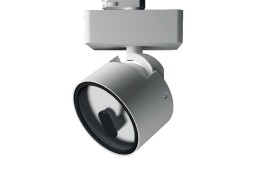
Targetti ZENO NSP
ZENO NSP is the first projector in the Targetti portfolio equipped with the Narrow Spot optic system, developed to create a defined and precise beam. ZENO NSP is suitable for museum or retail lighting where a perfect visibility and illumination is needed.
The NSP optic works by reflection: the lamp is hidden from sight and aimed towards the parabolic reflector, which collimates the beam and emits a particularly defined cone of light.
The discrete and elegant design of the product makes it able to perfectly integrate in every environment.
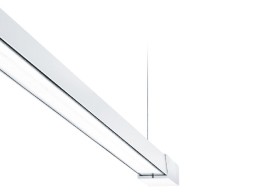
Zumtobel TRINOS
The TRINOS industrial LED luminaire combines the flexibility and functionality of a trunking system with the durability of an IP65 solution. As a result, precise and high-quality work is supported in locations that demand higher protection against moisture and dust.
A three-piece sealing concept ensures the highest levels of resistance, safety and performance at all times. The proven split-lens technology from the TECTON C portfolio is also used in the TRINOS luminaires, which are protected from contamination and moisture from above, below and at both ends.
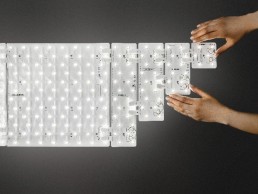
Cooledge TILE Exterior
Imagine the infinite design possibilities to create and build with light. Cooledge’s TILE Exterior frees light from the constraints of fixtures to illuminate any architectural geometry, scale with ease, and give designers entirely new ways to accentuate buildings. Unlike traditional light sources such as standard wash, flood or grazing applications used to light buildings, TILE Exterior’s IP65 rated system sets uniquely new standards for outdoor applications to enable whole building façades, canopies and entrance-ways to come to life with light.
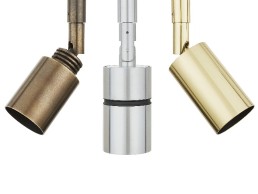
Precision Lighting Single Source series
Precision Lighting have taken the Retro, Evo and Microspot and given them a healthy injection of new light engines, impressive optics and neat modifications. The Single Source series has been developed specifically to replicate the best characteristics of a halogen light source whilst maintaining the efficacy improvements from LED. The single TIR optic light engines produce clean, crisp shadows, with high peak intensities down to a six-degree beam angle. Each family is available in two output packages of 405 and 700 delivered lumens.
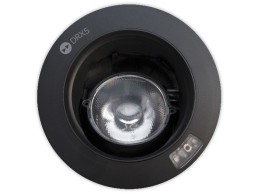
Remote Controlled Lighting DRX5
With a cut out of just 145mm, DRX5 is also small behind the scenes so it’s suitable for low ceiling voids. A variety of powerful beams enables pin spotting or flooding without breaking the ceiling line. The four-degree beam is the most precise option of its kind, even when positioned on grand high ceilings. DRX5-S offers wider options, all of which are single optics. All have motorised, remote controlled full 360-degree pan and 35-degree tilt and are compatible with DALI, DMX and RCL’s award winning iDirect app.
