
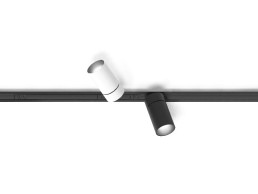
Reggiani Yori Evo Ghostrack
Yori Evo Ghostrack lets you create unique lighting schemes and configurations. Thanks to its brand new patented technology it features an invisible adapter and driver for single or clusters installations on a standard 3-circuit track. The series includes new optics that allows outstanding light output, beam angles and intensity peaks. The range now offers a wider choice of accessories for flexibility and ten brand new finishes to make a unique scheme.

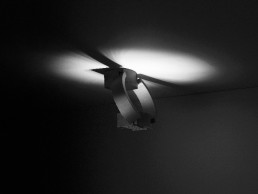
L&L Luce & Light Palladiano
Palladiano is a family of fixtures, designed by Francesco Iannone, whose distinctive design can offer multiple configurations. It is enormously versatile, thanks to its harmonious shape, featuring two distinctive semi-circular arms and adjustable optics. Its personality really comes to the fore in combination with the optical accessories – colour and shadow-effect that bring to mind natural environments and create unique settings.
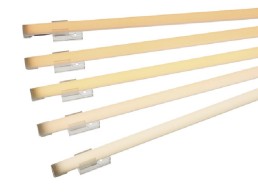
Luci Efro
Efro is a meticulous structural design for humidity-resistance and will provide assurance of electrical safety in bathrooms.
It has a dot-free surface for reflective surface material and a high efficacy LED package with three steps Macadam 607 lm/m, 8.4 W/m in 2700K, Ra>93. Five colour variations 4200K, 3500K, 3000K, 2700K, 2400K. Five length variations 162 mm, 302 mm, 582 mm, 862 mm, 1142 mm. It has an optional aluminium channel for wall mounting and is ideal for vanity lighting purposes with high colour rendering and smooth lighting distribution.

Ansorg Aila
Aila, the new aisle lighting solution by Ansorg, delivers energy saving and cost efficiency to food retailers. The LED luminaire has a flat design and is available in a surface-mounted and recessed version. It features a pivoted lens system with different beam characteristics for asymmetrical light distribution and fast adaption. It effectively showcases shelf products, and the wide beam version additionally ensures high quality centre aisle lighting, as a result of its flexibility, Aila is also suitable as basic, POS or gondola top lighting.
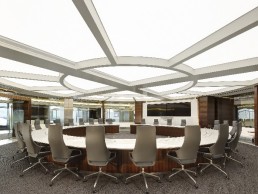
Cooledge Surfaces
SURFACES is the fusion of architecture and light-delivering immersive illumination that replicates natural light, creates more human-centric environments and accentuates architectural materials that define spaces. Photometric files are available for all standard product options to make specification simple and ensure adherence with design requirements. It can be created anywhere from surface-mounted, suspended or flush mount ceilings to walls. Tunable white capability in a scalable platform optimised for large areas and designed for simple installation.
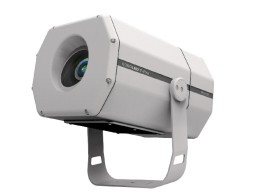
Griven GoboLED 7 - Pro Unlimited Outdoor Image Creation
Brighter than a traditional 575W discharge lamp and packed with multiple effects and patterns, GoboLED 7-Pro will offer broad creative design integration for permanent exterior installations projecting a bright and accurate rendition of graphic designs or logos in outdoor and indoor locations.
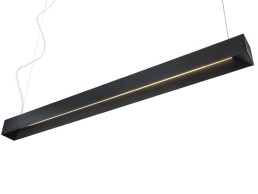
LED Luks Plain
The Plain LED suspended luminaire, designed by Kai Piippo of ÅF Lighting, produces a medium beam downlight, a wide beam uplight and achieves up to 135lm/W. Being one of the early adopters of Sunlike LEDs from Seoul Semiconductor, it delivers light close to the sunlight spectrum with CRI97.
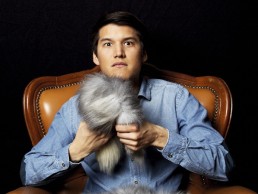
The Paranormal Unicorn
There’s a new name in the lighting world that is fast gaining recognition for its innovative approach to design, and for the variety of projects that already fill its extensive portfolio. And it’s a name that sticks in the mind.
Founded in 2011 by Austrian-American art student Stefan Yazzie Herbert, The Paranormal Unicorn describes itself as an ‘audio-visual artist collective’ that specialises in stage and lighting design. Based in Vienna, Austria, the firm originally began as a platform for Herbert and two friends, carpenter Benni Frener and Philipp Gantioler to launch a prospective music career.
“We were hobby DJs who wanted a cool stage show for ourselves, so we made our very first project together: Stage One,” explained Herbert. “After quickly realising that nobody really wanted to book us as DJs but they still wanted the stage, we started renting it out to raves and festivals. As we got to know people in the industry, we were asked to do more and more commissioned work.”
Now, Herbert runs The Paranormal Unicorn with current business partner Dominik Hell-Weltzl, and over the years the company’s skill set has expanded to include video and content production. Though Herbert says that their passion is still rooted in light and stage design: “That’s where we shine – no pun intended.”
Herbert’s fascination with light began while helping out friends at design studio Neon Golden on an installation at Viennese club ‘Grelle Forelle’ during his studies at the University of Applied Arts in Vienna. “During that project they taught me how to solder, how dimmers work and gave me a rough understanding of electronics,” he said.
“Later, after the success of Stage One, people started to know me as ‘the LED guy’, so lights and projects associated with light seemed to follow me. The more I worked with the medium, the more I fell in love with it.
“I had previously done quite a bit of work as a VJ but once I started working with LEDs, my passion for projected light fell by the wayside. The intensity and emotion of emitted light was much more powerful to me than what projected light could ever give.”
Since the inception of The Paranormal Unicorn, Herbert has been very open about his relative lack of experience in the lighting world, but he’s always keen to improve his knowledge through working with others. While this approach brings with it an element of risk, Herbert believes that such risk is the only way to truly reach the next level.
“Every time anybody wants to do something never done before, it’s a risky move,” he said. “And besides, if I knew exactly how to do everything already, life would be boring. Every new project is a learning experience – at least, the fun ones are – and for several of the more complicated projects I’ve worked on, I don’t think there’s anybody in the world who would have known exactly how to handle it.
“Throughout my career I’ve taken on projects that others perhaps wouldn’t have. It’s scary doing something bigger or more complicated than you’ve ever worked on before, but if it takes you to the next level, it’s almost always worth it. Sure, it’s risky and I’ve taken a black eye or two when I’ve underestimated the breadth of the project, but if I could do it all again, I would still rather take the black eye than turn down an amazing opportunity.”
Herbert’s notion that you “don’t need to be an expert in order to make things happen” is a refreshing approach, but he feels that by accepting your own limitations, it allows you to develop your skills and progress further.
“Embracing your own ignorance gives you the power to find people who are better than you in that specific field, and that improves the quality of a project,” he explained. “I constantly try to surround myself with smarter and more experienced people. Knowing the extent of your own skills is paramount. If you overestimate yourself, the project will ultimately always suffer from it.”
Indeed this collaborative element of his work is something that Herbert wants to see more of in the lighting world. “I hope to see more collaboration between fields,” he said. “As a society we are tending more towards specialisation but in my opinion, the most fascinating innovations are happening where multiple areas of expertise overlap.
“All of the technological inventions that are currently being hyped, like smart lighting and wireless technology aren’t really changing the aesthetics of lighting that much. Interconnectivity between people is more important than between devices.”
While The Paranormal Unicorn has often taken on jobs without knowing how to complete them, Herbert believes that this constant drive to find new projects in new areas helps make them unique. “What really makes our company stand out is that we aren’t afraid to try out new things, and really enjoy working in new fields,” he said.
“We’ve forayed into unknown territory so often at this point that we’ve become quite good at learning new workflows and interfacing with new teams. We never shy away from a challenge, and we’re always excited to see what’s going to come next.”
By venturing into the unknown throughout their tenure, The Paranormal Unicorn has landed a number of really fascinating projects, including light art installations, music video productions and stage designs for festivals and touring musicians. There are two projects though that, for Herbert at least, stand out among the others: “From an artistic standpoint, Hidden Noise is by far my favourite project that I’ve created, and Gravitas was the most fun from a teamwork perspective because it involved so many different fields of expertise.”
The Hidden Noise project, created in 2014, was one born out of necessity for Herbert. A failing university student, his professors had voted to kick him off his course, but after being granted one last chance, he needed a good idea to keep him in school.
Luckily, inspiration came to him during a workshop with Christina Kubisch, where he was given ‘electro-magnetic transducer headphones’ to work with. These devices could sense the environment for anything that used electro-magnetic waves (Wi-Fi, motors, lights, etc.) and convert those waves into audio signals. It was here where inspiration struck.
“My classmate David Osthoff and I loved this idea of an entirely new world that was constantly around us but that we couldn’t see,” Herbert said. “We wanted to visualise it in a way that immediately made sense to the viewer. So we created a technique using the transducer, an LED stick, a photo camera and a video camera that made it possible to ‘show’ this hidden world by visualising these audio waves.
“All of a sudden, you could see the hidden processes around us in plain sight. Subways starting and stopping, car motors zipping by, power lines humming all became suddenly visible. There is no judgement in the art piece, though it is intended to cause awareness about the ubiquity of this hidden noise around us.”
Hidden Noise is a remarkable, visually stunning art installation, and since its creation, it has been exhibited in Austria, China and Cuba. The reception it received meant that Herbert was ultimately not kicked out of university, although he revealed that he did later drop out anyway.
Herbert’s second favourite project, Gravitas, was something altogether much more high-octane. Following their work with Austrian drum and bass artists Camo & Krooked on their 2014 Zeitgeist European tour, in which The Paranormal Unicorn created a full-scale festival production for the show, including integrating its Möbius stage element, Herbert teamed up with the musicians, and the Red Bull Skydive team, for a very special music video that literally lit up the sky.
For the music video, The Paranormal Unicorn was approached by Red Bull to create a portable lighting system that had all the functionality needed for a full-colour, synchronised light show, while simultaneously being able to stand the wear-and-tear of skydiving.
“It was a perfect project for me because it encompassed so many different fields,” explained Herbert. “First off was the choreography. Because the Red Bull Skydiving team didn’t know anything about light, and I didn’t know anything about skydiving, we had to work together to develop a choreography that utilised the best of both worlds.”
After receiving the song to base the programming on, The Paranormal Unicorn worked closely with the skydiving team in order to come up with an interesting show that would showcase both their abilities as athletes and realise the full potential of the lighting system that they had created.
The technical aspect of the project provided the most difficult challenge though. Building a system that worked perfectly from a 4,000-metre jump all the way to the floor was no easy feat, thanks to a myriad of factors that they never had to consider before, like pressure, altitude and temperature. Alongside this, everything had to be wireless, and work with small batteries so that the enclosure for electronics weighed as little as possible.
After climbing to the required height, the jumpers synchronised their suits in the plane via remote control. All jumpers had earplugs so that they could stay synchronised and maintain awareness of what part of the choreography they were in.
Once the signal was given, the four athletes jumped out of the plane, followed by the cameraman, who had a 5kg camera attached to his head. The jumpers went through their choreography and then landed on an LED landing strip, also prepared by The Paranormal Unicorn. Because several angles were used in the video, the scene was repeated five times in total. “The weather didn’t always agree with us and we had to cancel a few jumps, but through thick and thin, we pulled through,” Herbert said.
“For me, what really made this project so much fun was the creative reign that I was given by Red Bull. They let me film, edit and direct the final video as well. We partnered with our friends at Frame Fatale for the post-production process and created something that we could all be proud of.
“Having knowledge about all of the different aspects involved in making a project like this is what made it work in the end. It’s projects like these that make me want to keep learning and innovating.”
The work that Herbert has done with The Paranormal Unicorn means that he could be classed as a ‘Light Artist’, rather than a lighting designer. However, while art and design are closely related, if he had to put a label on it at all, he seems himself as more of a designer.
“I have definitely created art in the past and continue to do so on occasion, but most of my creations are firmly in the realm of design,” he said. “But the label I give myself depends on the work I am currently doing. Sometimes I am a lighting designer, sometimes I’m a light artist, but I have donned the mantel of lighting technician, creative director, technical project manager and even lighting consultant.”
Whatever his title, Herbert is keen to take The Paranormal Unicorn further in the future, and while his profile has been boosted over the past twelve months, from speaking at the inaugural Trends in Lighting event, to hosting his own talk at TEDx Dornbirn, in which he designed his own stage, he’s still unsure what the future holds.
“I wish I knew! This year we’ve already had amazing opportunities to start working in a few new industries, from set design to product development,” he said.
“What is more fascinating to me though is the unknown. There are so many industries that are a complete mystery to me and I imagine that the next few years will be doing our best to see what industries could benefit from using light in crazy and innovative new ways.”
Indeed this quest for innovation is a driving factor for Herbert, who gets fairly philosophical on the subject: “I really believe in true innovation, completely new fields of thinking,” he said. “I want to use technology in order to create new ideas, try out things never done before, and to do it beautifully, aesthetically. If I can come up with one truly new idea before I die, in the world of lighting or otherwise, I can die in peace.”
But aside from his approach to lighting design, and what the future holds for The Paranormal Unicorn, there’s only really one question left to ask: where does the name come from?
“The Paranormal Unicorn doesn’t really mean anything, and none of us can really remember how it came about,” Herbert said, “but it does represent us quite well. It’s childish, fanciful and fun.
“We don’t take ourselves too seriously and we hope nobody else does either!”
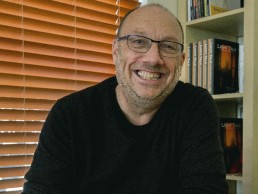
Martin Klaasen
Words: Robert Such
Throughout his long and distinguished career, lighting designer Martin Klaasen has been involved in a long list of iconic projects in Asia and Australia as well as being at the forefront of lighting education in the region.
In the lighting business for almost 40 years, Martin Klaasen, Principal at Klaasen Lighting Design (KLD), traces his ability to manage the ups and downs of his career to the influence of a number of people. Making the top of the list though is his grandmother: Geneviève Dreyfus-Sée. An architect in France, as well as a writer and educator, she has been Klaasen’s biggest inspiration.
“What I most admired in her,” says Klaasen, “was her perseverance, belief in herself and her independence. She did not care what people thought of her, whether she was successful or not. She studied and wrote about the history of architecture because she was passionate about it. She wrote about her experiences bringing up her children during the war, wrote children’s books to share the stories she taught her children, because she believed in it and just wanted to share it.”
And over the past 26 years as his own boss, Klaasen’s own “persistence and belief have always kept me going,” he says. And passion, too. “While I was passionate creating beautiful lighting projects at the beginning of my career, I am now passionate about sharing my knowledge with the new generation,” he says. It is this passion that motivates Klaasen to blog, write articles, and speak at lighting event seminars about “how lighting can be used to improve and look after the world we live in,” he says.
His own contribution to doing that is made through projects mostly in the area of hospitality, commercial, corporate and public building lighting and residential urban developments. “Good lighting design contributes to more comfortable and pleasant environments, easier way-finding, and beautification of the cities we live in,” he says. “Most of all it is the way we achieve it through our sustainable approach, minimising energy consumption, capital and operational costs. Added value creation through good lighting design.”
Over the years, other people have influenced the direction of the award-winning lighting designer’s life and career, too. “Of course I do admire groundbreakers like Zaha Hadid, Jean Nouvel, Philippe Starck,” he says, “but they are not the essential motivators in my life.”
Gerrit van den Beld was, however, such a person. Van den Beld was his boss and mentor at Philips. He taught Klaasen how to pace himself and “how to take things one at a time, sleep on problems rather than react emotionally,” he says. “He was instrumental in forming my lighting design personality.”
Klaasen worked at Philips after graduating with a master’s degree in Industrial Design from the Technische Hogeschool in Delft in The Netherlands. “As I like building and creating things,” he says, “I settled on industrial product design…Industrial design teaches you the process of design, from concept to realisation and till today it has been the foundation of my successful career.”
When Klaasen finished his studies he started to look for a job at Philips, where he had completed his final master’s degree project, which was “designing an intelligent washing machine that could read the laundry and decide the washing program by itself,” he says.
Among the job opportunities on offer to him was one of lighting designer at the Philips Lighting Design and Engineering Centre in Eindhoven.
“I was immediately fascinated by this group of people,” he says, “designing the lighting for Olympic Games, big commercial hotel developments and so much more. I decided there and then on the spot to take this exciting job and never looked back.”
Also making Klaasen’s list of people that have had the greatest influence on his lighting career is American businessman and author Robert Kiyosaki. “He gave me insight on becoming more business savvy,” says Klaasen. “Good designers are not necessarily good business people and I certainly was not when I started my business.”
Klaasen started his own business in 1991, after moving to Singapore in the late 1980s for Philips, who had tasked him to “set up what at the time was called the Support Centre for Professional Lighting in Singapore,” he says.
Experiences and events that eventually motivated Klaasen to leave Philips were an uncertain future at the company and meeting lighting designers Tony Corbett of Anthony Corbett Associates and BAA’s Barry Arnold.
It was only when Klaasen arrived in Singapore and met Tony Corbett did he realise “there was such a thing like an independent lighting designer,” he says. “Inside my protected corporate Philips cocoon, I basically only knew of Philips product and was limited to using their products to design anyhow.”
By 1990 Klaasen’s job future at Philips was uncertain as the company “was going through severe restructuring,” he says. At that time, though, American lighting designer Barry Arnold asked Klaasen whether he was interested in joining him. Intrigued, and because he had been thinking about starting his own practice due to his uncertain future with Philips, he decided to leave the company. However, not to work as an employee of Barry Arnold, but “in a cooperation with my own company [Lumino Design International] which I incorporated for that purpose,” he says.
Things didn’t work out though. Conflicting ideas about how they would be working together meant that Klaasen left shortly after.
Working from home, a few projects that Philips had passed on to him, such as the Sheraton Senggigi Resort in Lombok and the Melia Purosani Hotel in Yogyakarta in Indonesia, and The Raffles Hotel in Singapore, which was in its final stages, kept him going for the first few months.
The company expanded through the 1990s, but the financial crisis in the latter part of the decade drove Klaasen to set up in Perth, Australia, where he bought a stake in a local firm, Lighting Images, eventually taking it over in 2000.
Lighting projects in Perth included the Burswood International Casino’s Main Entrance and Gaming Hall, and the Riverside Drive and Foreshore along the Swan River. Both projects won later IES Australia and New Zealand Lighting Awards.
In 2010 Klaasen decided to sell his stake in Lighting Images—“I could no longer identify myself with the direction we were going, quantity over quality of design, so I wanted to regain full control about the artistic and creative quality of our work towards our client,” he says—and rebranded himself as Klaasen Lighting Design, opening for business at the start of 2011.
Since then KLD’s lighting design work has included the Mandarin Oriental Majapahit Hotel Surabaya; the Eastern & Oriental Hotel Penang in Malaysia; His Majesty’s Theatre in Perth; the Atlas Bar at Parkview Square Singapore, and the recently completed Alila Yangshuo Hotel and Resort project in China.
Having been in the lighting business for so long now means that “lighting has gradually become an integral part of my life,” says Klaasen. “I live and breathe lighting and lighting design now. It is a constant in my life. Certainly, as a business owner you need to have a constant eye out for opportunities, to be alert to trends and technology advances, look and learn from what others are doing. This is not a nine-to-five activity. It is a permanent and continuous part of life. We learn from others, good and bad. Over time you learn to appreciate what others do or learn from what they failed to do. It motivates and inspires me to do better.”
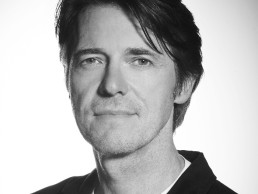
Paul Traynor
arc talks to lighting designer Paul Traynor, principal of London-based Light Bureau which has just merged with Scandinavian lighting design consultancy, ÅF Lighting.
How did you get into lighting design?
During an apprenticeship in the project design office for Pfizer in Kent I was working at a drawing board draughting record plans of a project I helped to install. It was the first environment I’d been exposed to where people were trained and educated professionals and I saw there was another future open to me. It made me realise I could pursue formal education if I wanted and I applied to Medway College of Design to do a photography diploma. The course was full and I was told to apply next year, so I moved to London and traded on my draughtsman’s skills, working for good money in construction firms. I developed design skills and it was a really interesting time, so I didn’t re-apply to Medway. I was then recruited above my skill level in a consulting engineering practice and then I got to experiment in lighting and I was hooked. I went to work in an architect-led multidisciplinary office to focus on and develop my specialism and decided to get a decent qualification, so I studied for a four year part-time degree at South Bank University.
When and how did you start Light Bureau?
In 1998 I was due to get married and as I worked in the same firm as my fiancée, I chose to leave and to see how I could cut it in a dedicated lighting firm instead of being a specialist in a generalist office. I had some good options but only one company talked to me about career development and I went there, but it was design and supply so I had new barriers to working with some clients and architects and that frustrated me. I couldn’t see any point warming up contacts at the firms I had spoken to ten months previously, they still wouldn’t be talking to me about long term opportunities, so I decided to chance it myself. All of the projects I was working on were clients I had brought myself and I was promised more if I took the big step of self-employment. My first day in February 1999 I started work on Accenture’s new headquarters in London - not bad for a fledgling one man band!
Name some of your memorable projects. Why do they resonate?
Apple Computer, Stockley Park because that’s where I negotiated out of a bad design solution that the architect was insisting on to a better one I could foresee. It was difficult and stressful but the result was better than I had imagined and the architect and client were very happy. Until they told me I had been right it never occurred to me what the implications would have been if I had been wrong! Boots the Chemist at Bluewater on the other hand was a disaster - I was not so experienced in retail and I underestimated how much ambient and nuisance light would reduce the visual impact of a feature wall I designed. A more recent notable project would be the Yellow Pavilion, which was ephemeral but which embodies key principles that Light Bureau upholds - it’s simple, visually strong, uses very few products and they are discrete, and throughout the whole process we validated and curated. As we say, Light as Craft.
How did the ÅF Lighting deal come about?
My good friend Kai Piippo and I started our companies about the same time and we met in Prague on an early ELDA AGM and bonded on an intensive ‘cultural’ weekend. Since then we’ve compared stresses and problems, which is common with people who start a design firm with no aptitude (or desire) in running a business. I was shocked when Kai sold to ÅF but every time I saw him after that he was looking increasingly relaxed and fulfilled - he was working on great projects and getting them done because he had the support and structure that our businesses tend to lack, led as they are by designers, not by business people. When ÅF decided to step outside Scandinavia and go international, they put the pin in London and Kai made an intro. Nineteen years after starting Light Bureau I was ready to become part of something significant and all of my colleagues saw even more benefits than I did, so it’s been a unanimous and inclusive process.
How do you think being part of ÅF will benefit both companies?
ÅF wanted to become truly international, although they had a lot of that happening already. Light Bureau has always done a significant amount of overseas projects so that was a good fit. With ÅF, Light Bureau gets access to some incredible specialisms and some substantial resources; we’ve missed opportunities in the past by lacking some areas of expertise or reference projects and now we have access to more than 100 designers and a massive and impressive portfolio. ÅF really value the quality of Light Bureau projects and how we work, there are some really good synergies and from signing the contract in October it’s been positive and very big-picture. The enthusiasm and drive are very infectious qualities.
Will your role be changing?
I will continue to run Light Bureau and we will carry on trading under this name, as it seems to have significant meaning and value. We’ve spent a long time building our brand and reputation. I make no secret of the fact I am under contract for three years during which time I’ll earn-out, but after that I fully expect to stay on and negotiate a new contract and continue. But as part of ÅF the remit expands and I am part of the advisory board as it’s called and will work on strategies for developing the profile and business for the whole of ÅF Lighting, not just Light Bureau, also on training and education for our designers - we are developing our own ÅF Academy, which really motivates me.
Do you think mergers of lighting design practices is something we’ll see more of?
Yes, I think so. Lighting has become a very interesting aspect of construction design and bigger firms who previously only focused on their core activities of, typically, consulting engineering and architecture now see the real value that a well-realised lighting deign can bring to a project. It brings prestige to such a company and they want to be able to provide this service as part of their overall business offer. Lighting design does suit a small business profile and is scalable, from one person at a kitchen table, but when you hit double digit designer numbers and into the teens, there’s usually a lack of structure that makes up-scaling difficult. So I think that mergers and acquisitions like this could become more common.
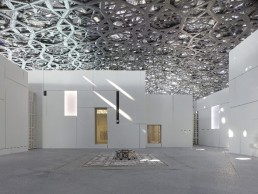
Louvre Abu Dhabi, UAE
Designed by French architect Jean Nouvel with lighting design by 8’18” and daylighting by BuroHappold, the Louvre Abu Dhabi has created a buzz of excitement since opening in November. For once, the reality has lived up to the hype.
Rarely has the opening of a museum created as much excitement among the international media as the Louvre Abu Dhabi. The project has garnered as many column inches in the popular press as it has in the architectural media. And with good reason. The museum has met with critical acclaim for its stunning design and dynamic lighting, both artificial and natural.
Pritzker-prize winning architect Jean Nouvel sought inspiration for the concept of Louvre Abu Dhabi in traditional Arabic architectural culture, and designed Louvre Abu Dhabi as a ‘museum city’ in the sea. Its contrasting series of white buildings take inspiration from the medina and low-lying Arab settlements. In total, 55 individual but connected buildings, including 26 galleries, make up this museum city. The façades of the buildings are made up of 3,900 panels of ultra-high performance fibre concrete (UHPC).
The museum design is a collaboration between traditional design and modern construction techniques. The tranquil environment encourages visitors to enjoy the ever-changing relationship between the sun and the dome and between sea, buildings and land.
The construction of the museum took place from 2013 to 2017. The museum’s growing collection of more than 620 important artworks and artefacts spanning the entirety of human history around the world. It includes ancient archaeological finds, decorative arts, neoclassical sculptures, paintings by modern masters and contemporary installations. At opening, 235 works from the museum’s own collection are displayed in the galleries.
Louvre Abu Dhabi was born from a unique intergovernmental agreement between the United Arab Emirates and France, signed in 2007.
The agreement embodies a vision shared by the two countries to develop the first universal museum in the Arab world. It establishes Louvre Abu Dhabi as an independent institution, and includes the use of musée du Louvre’s name for 30 years.
The lighting design was completed by French practice 8’18” headed by Rémy Cimadevilla and Georges Berne, who is based in the 8’18” Shanghai studio. They worked closely with Jean Nouvel (who also independently developed the Luxiona Troll Paralum fixture for the project) on the lighting concept and, in the case of the of the vast dome, 180 metres in diameter covering the majority of the museum city, they collaborated with Yann Kersale (SNAIK) on the artificial lighting sheme using 4,500 Zumtobel fluorescent fixtures.
“We feel its mass and we perceive a vision of thousands of broken lines,” commented Cimadevilla. “When the museum is closed to the public, the dome radiates an exterior glow from within. It creates a kinetic effect by the movement of the lights - the dome flickers. The fixtures create a multitude of dynamic splashes in hot and cold white.”
The dome consists of eight different layers: four outer layers clad in stainless steel and four inner layers clad in aluminium, separated by a steel frame five metres high. The frame is made of 10,000 structural components pre-assembled into 85 super-sized elements, each weighing on average 50 tonnes.
The dome’s complex pattern is the result of a highly studied geometric design by BuroHappold. The pattern is repeated at various sizes and angles in the eight superimposed layers. Each ray of light penetrates the eight layers before appearing or disappearing. The result is a cinematic ‘Rain of Light’ dappled effect as the sun’s path progresses throughout the day. At night, it forms 7,850 stars visible from both inside and out. This ‘Rain of Light’ effect has been the subject of many models and mock ups over the years and is one of the defining features of the concept.
The effect is effortless in its beauty, but it took bold, imaginative and ingenious engineering to allow the sun into the museum galleries while protecting the priceless artworks inside.
Working in tandem with Jean Nouvel, the BuroHappold team evaluated a number of concepts by which to bring the element of water into the building, finally settling on the inclusion of tidal pools that reflect the light that filters through the glazed roof in dappled patterns on the interior walls, creating gentle movement that correlates and responds to the museum’s unique natural setting.
Filtered natural light is present in all the galleries, either from lateral windows with views onto the surrounding environment or through ‘zenithal’ lighting. This involves the use of glass mirrors to capture sunlight and direct it into the gallery spaces while also scattering rays to avoid glare. There are seventeen glass ceilings within the museum galleries. Each is made up of eighteen different types of glass panels. In total, there are over 25,000 individual pieces of glass. These glass ceilings incorporate both natural and artificial lighting to provide an optimal lighting system for the artworks on display.
Louvre Abu Dhabi’s complex engineering concept has made it one of the most innovative and challenging museum projects built in recent times.
To meet stringent environmental control requirements within the museum galleries, the design team developed a system, including the lighting, that does not deviate by more than one degree from 21 degrees centigrade or 5% humidity range. This guarantees exceptionally stable environmental conditions for artworks and visitors.
The interior exhibition spaces, comprising museum galleries, temporary exhibition spaces and Children’s Museum, make up 8,600sqm, with permanent galleries covering approximately 6,400sqm.
In order to avoid the clutter of lighting masts and projectors that would spoil the architecture, 8’18” developed a second layer of light - a virtual window utilising Lucibel cove fixtures. Based on the built frame, it takes the place of a concrete panel “as if a field of light is hidden behind the walls of the museum,” muses Cimadevilla. “This abstract light, slightly unreal, is designed with hidden sources with specific optics. We called this the ‘Lico’ specific light window.”
“It’s an abbreviation of Lighting cove,” says Berne. “It is flexible in its dimensions in height with a width up to six metres. Its purpose is to bring a vertical lighting of atmosphere in the spaces under the dome, the circulations areas, the reception and all the public spaces.”
The third layer of light to the galleries has been dubbed the ‘flying carpets’. Horizontal windows of direct / indirect lighting (supplied by Firalux) and Artemide Cata Lens projectors create flexible solutions for each gallery depending on the requirements of the exhibits.
“Neutral white fluorescent wallwashers [from ERCO] are installed at the periphery,” describes Cimadevilla. “Then, the warm white projectors [from Artemide] are installed in the frame of the carpet of light. Finally, the ceiling lighting is completed with general indirect/ sdirect lighting [from Firalux] in cold white revealing the texture of the different exhibits.”
Louvre Abu Dhabi is destined to be a culturally iconic piece of architecture that will transform the image (and the visitor numbers) of the UAE’s second biggest city, much like the Guggenheim has done for Bilbao. Even if you are not an art lover, you cannot fail to enjoy the building... and the light.
www.8-18lumiere.com
www.burohappold.com
www.jeannouvel.com
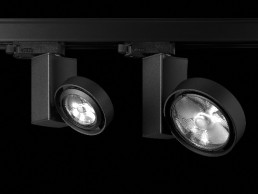
David Morgan Review: Soraa ARC range
David Morgan takes a closer look at the ARC accent range from Soraa, a new line of luminaires built around its LED engines and optics.
Only nine years after Soraa was originally set up to commercialise the production of white LEDs based on Gallium Nitride on Gallium Nitride (GaN on GaN) LED technology, the company has now launched a range of luminaires incorporating their LED light sources and light control components.
The Soraa story started in 2007 as a team of pioneering professors from the worlds of engineering and semiconductors – Nobel Prize winner Dr Shuji Nakamura, inventor of the blue laser and LED, Dr Steven DenBaars, founder of Nitres, and Dr James Speck of U.C. Santa Barbara’s College of Engineering – came together with funding from Vinod Khosla to develop and commercialise GaN on GaN technology for LED lighting.
In the short period since Soraa was formed, the company has been very successful at creating awareness and demand for the superior light quality of their retrofit lamps and light engines that give a lit effect very close to halogen lamps.
Soraa is now a recognised and established supplier of high quality retrofit LED lamps and concentrates its marketing activity on lighting professionals to specify Soraa for retail, hospitality, gallery and premium residential projects.
Having launched the company and demonstrated that the GaN on GaN technology works well, Soraa has now decided to go beyond providing light sources and has developed a range of luminaires built around its LED engines and optics.
The initial offering includes a limited variety of both ambient and accent lighting luminaires. The Soraa ARC accent range, which I am reviewing here, includes spotlights, downlights and a double-wire pendant system. Two sizes are available, based around the diameters of the Soraa MR16 and AR111 light sources. All the existing Snap beam shaping, colour temperature adjustment and glare control accessories can be used with the versions fitted with the Snap 10-degree lenses.
In terms of light quality, output and lit effect there are no big surprises from these products since the various luminaires incorporate the same light sources and folded prism optics used in the Soraa retrofit lamps and light engines. The light quality is as close to halogen as I have seen from any LED source and the lighting specifiers I work with all have good things to say about the lit effect of Soraa lamps.
The range is modular so that the same heat sink casting, light engine and Snap accessories are used on all products of that diameter. The heat sink is a nice quality die cast aluminium component instead of the machined extrusion provided with the Soraa light engines and the size has been reduced to the minimum size while still ensuring safe operation of the LED source. The running temperature of the 20-watt 100mm spotlight heat sink was still comfortable to touch after a few hours. The light output from the smaller size light engine fitted with a 50mm lens is 1,000 lumens at 18 watts, except for the 10-degree Snap version, which is around twice the level from a Soraa MR16 9-watt lamp.
The European versions of the spotlights incorporate a side-mounted integral mains voltage driver enclosure. They are supplied with a global track adapter, which will fit into a wide range of existing installed tracks, particularly those found in retail applications. Dimming the spotlights at the moment can only be controlled by phase dimmers but it is understood that DALI dimming versions will be available in due course. Clip on anti-glare snoots in both straight and angle-cut types can be fitted to the spotlights after any Snap accessories have been first installed.
The downlights are available in only one size, based on the 50mm light engine, in square and round versions with trimmed and trimless mounting options. Only adjustable angle versions are available at the moment, with a maximum aiming angle of 35-degrees. Downlight and wall-wash trims fit into the housings and are available in four colour finishes including Tangerine, which I assume provides a goldish effect.
The adjustable surface-mounted projectors are supplied in two sizes and are also based on the same light engine sub assembly used for the spotlights and other products. The cylindrical design can be partially recessed into the ceiling, hiding the driver enclosure to create a slim, fully adjustable projector that can angle up to 90-degrees. At the moment, only phase dimming is available for this series.
The pendant versions are also available in two sizes and come as a kit with the driver housed in the ceiling plate and two insulated wires supporting the light engine. It is not clear from the Soraa literature how the length of the cables can be adjusted but I am assured that this happens in the ceiling canopy
The ARC range appears to have been carefully developed to produce the widest range of options using the minimum number of components, which is pragmatic. This results in numerous versions that can be used in a wide variety of lighting applications.
However, the overall design of the individual luminaires has a somewhat bland appearance. Whilst the aim may be to allow the range to be used in a wide variety of applications, in fact it does little to promote the Soraa brand or differentiate it in a crowded display lighting market. Maybe a ‘Soraa Inside’ sticker would help to point out that is not just another spotlight range.
The luminaire market is unlike the light source market and often requires many variations on each theme to match each niche. Both distinctive and vanilla designs for the same type of product are often required from the same brand in order to satisfy specifiers and end-users.
For lighting specifiers who are already familiar with Soraa, recognise the superior light quality and are looking for a simple range of spotlights, then the ARC range may well be suitable. However, I feel that the downlight range will need to be expanded to offer more sizes, higher output and other options in order to make much of a splash in this particular overcrowded market.
The pendants and adjustable luminaires are both fine but are orphan products in need of a wider family.
It is hard to gauge the impact of this product launch on Soraa’s OEM customers who are currently using their integrated light engines. Will these customers continue to invest in developing new products and versions if Soraa has now become a direct competitor in the luminaire market?
The Soraa ARC range is well designed and engineered and is likely to succeed in specific markets but it may be that there is an opportunity to project the Soraa brand more effectively with a more refined and distinctive design. Perhaps that should be the plan for the second generation of Soraa luminaires.