
Waveguide Lighting Starshot
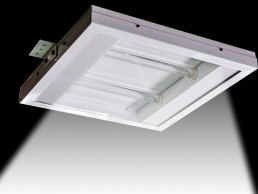
The Starshot luminaire is available with IP40 sealing for internal use and in IP65 versions for external installation. Measuring a 400 x 400mm and suitable for surface mount, recessed or chain fitting, four standard outputs are available. Starshot has power consumptions of 43 to 107W, giving light outputs ranging from 5,156 to 12,958 lumens at a colour temperature of 5,700K with a CRI of 75. Waveguide’s patented end lit rod technology ensures that the LEDs are hidden from direct view, reducing glare. The width, shape and angle of the light beam is controlled using a reflector.

Fuhua UEL18LCP1-SPA LED driver
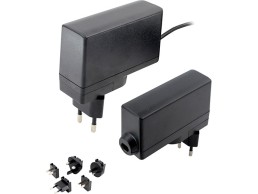
UE18LCP1-SPA 18W indoor LED driver with wide input voltage and interchangeable AC plugs, meets Energy Star Level VI and CoC Ver 5 tier 2, 4KV surge immunity IEC/ENG61000-4-5, low leakage current ≤ 100μA and carries CB, CE, cULus, TUV-GS, TUV-PSE, TUV-RH and RCM marks.

Plessey 15° and 50° Orion LED modules
Plessey has extended its range of ultra-slim Orion LED modules based on its Stellar beam forming technology. Orion LED Beam Forming Modules deliver a compact 3,000 lumen beam from a module which can be as little as 5.6mm thick, less than one-tenth the thickness of standard alternatives. The recently launched PLWS3000 25° FWHM beam angle module has now been joined by modules with 15° and 50° beam angles
Zumtobel PANOS infinity family
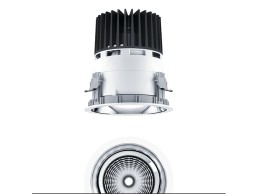
The PANOS infinity family has four new variants: a choice of round and square designs, frameless or with a mounting frame, with diameters of 68mm, 100mm and now also with a diameter or edge length of 200mm. These ‘building blocks’ invite architects, lighting designers and electric planners to devise optimal task-specific lighting solutions for every room. The new additions introduce the possibility of warm dimming and an excellent colour rendering index of CRI> 90, along with colour temperatures of 2,700K, 3,000K and 4,000K.
Dutch Design Week, Netherlands
The fifteenth edition of Dutch Design Week took place in Eindhoven on 21st - 29th October and was a catalyst for a host of creative and daring installations including some where light was the focal point.
Eindhoven manifested itself as the centre of design and the future showcasing work of 2,500 designers during the nine days of Dutch Design Week (DDW) held in October. Their ideas and solutions gave visitors a new perspective on current topics and issues, as well as making DDW an event with global impact. Due to the comprehensive programme of talks, debates and live music, visitors were able to reminisce long after the closing of the exhibitions. The event attracted an estimated record number of 295,000 visitors.
Under the banner of the theme ‘The making of’, this year’s edition focused on the making process and the makers. The event showed a lot of work from renowned designers, but also, like every year, allowed young talent and the experimental to thrive. This took place in more than 430 curated exhibitions and presentations spread across 100 locations in the city.
Fittingly Philips Lighting, based in Eindhoven, presented two creative LED lighting installations as part of the festival. Both lighting installations are part of the ESCAPE – embracing the freedom of beauty exhibition at Kazerne gallery and creative hub in Eindhoven on display until February 2017.
Light Forest combines sculptural lighting effects directly into a uniquely detailed wall surface. Designed by Amsterdam- based design firm BCXSY using the Philips Luminous Patterns product system, the lighting installation explores how we will free ourselves of the traditional concepts of ‘light fixtures’ and instead embed lighting directly into the walls and ceilings that surround us. The dynamic programming of the light patterns replicates the soothing experience of cascading patterns of light in a forest.
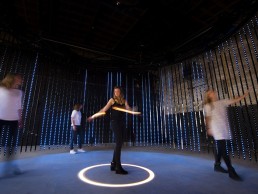
Lightfall is the latest in a series of lighting installations created by Paul Thursfield, Head of Service Design at Philips Lighting Design and Simon Rycroft, Senior Strategic Designer at Philips Lighting that explore generative and interactive light and sound as part of their research into new light experiences. Lightfall is a cascade of light triggered by people who dip their hands into the pool of light at the centre of the pavilion. The unique light and sound signature is generated based on the parameters programmed by the artist and sensor inputs from people in the pavilion. The pavilion is constructed from a circular curtain of Philips Color Kinetics LED lights.
“LED technology allows us to radically rethink the way we construct and interact with architectural lighting. We’re thrilled to exhibit two pieces as part of Dutch Design Week that explore the beautiful possibilities of using light in new and innovative ways,’’ said Pierre-Yves Panis, Head of Design for Philips Lighting.
Also on display at Kazerne but just for the duration of DDW was Vapour light by Studio Thier & van Daalen, a series of lighting elements as waving luminous vapour that can vary in shape, colour and intensity.
The irregular shape found its origin by the artists’ fascination for movement of structures in nature and the contrast between straight and organic shapes - the way a flower blooms, how beautifully vapour disperses in the air or the hypnotising effect of rolling water.
These movements were translated into a series of light objects, that take on a surprising appearance. Gracefully, it may take different forms and curves by pulling or twisting the flexible outer shell.
By doing this, the shape can be manipulated. The subtle emission of light appears on the pattern of the luminous bar. The flexible outer shell absorbs the light and glows out on its surrounding as a decorative lighting solution.
The initial series consists of two colours and two sizes, both in a horizontal and vertical version. The transparent shell has a soft appearance like vapour, whereas the black version has a more graphical identity.
LED light is implemented in an in-house developed light fixture. It is possible to change the intensity of light with the use of a dimmer.
The colour temperature can be changed into warmer or colder light on request.
www.ddw.nl
www.lighting.philips.com
www.thiervandaalen.com
Stephen Gough
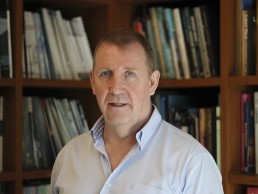
Often recognised for his former footballing talents, Stephen Gough is a lighting designer who grabbed the industry by the horns. From working two jobs at once to Director of Project Lighting Design, his story is one of inspirational perseverance and global recognition. Robert Such caught up with Gough to talk light and career progression.
Back in the 1980’s, when Stephen Gough - would-be lighting designer and director of Project Lighting Design (PLD) - used to turn up for meetings, people would recognise him, and ask: Aren’t you the footballer? “Yeah, but this is my other job,” he would reply. At that time, his ‘other job’ was with Hong Kong-based lighting firm Ricardo Lighting.
In his early twenties, Gough had been assigned to Ricardo Lighting’s special projects department. He had been given the job of promoting Japanese firm Yamada Shomei Lighting’s products to foreign architects working in Hong Kong.
“It was perfect,” says Gough, “I got to the office at 10am, worked till 4pm, and then went back to football training. The Yamada Shomei Lighting engineers visited us regularly and they taught me a lot about their products and how to calculate light levels and the basic principles of good lighting. I went to Japan a few times to see their factory and completed projects and learn more about their equipment.”
Working with engineers, studying lighting diagrams and architectural drawings was not altogether alien to Gough. “I left school at fifteen,” he says, “and my first job was as an apprentice at the local engineering company. They built steel bridges and dockside cranes. I suppose it was a good foundation for me. I learned to draw and read drawings, and it was a no-nonsense kind of environment.”
At the same time as he was doing his engineering apprenticeship, he was also playing football in his home town of Annan in south-west Scotland. When a football scout spotted him playing, and asked if he wanted to play football professionally in Hong Kong, Gough, a centre forward, jumped at the chance to play football and travel.
But even though he enjoyed the game, he always had it in the back of his mind that “if the football didn’t work out, what was I going to do?” he says. “That’s what drove me to look for a job.” He eventually saw, and replied to, a newspaper advert for the Ricardo Lighting job.
“Hong Kong was, and still is, a fantastic lighting spectacle,” he adds. When a new lighting scheme was completed, he would “rush round to look at it and try to analyse the lighting”.
Then, in 1985, Gough suffered a bad knee injury—repaired years later through Anterior Cruciate Ligament (ACL) reconstruction surgery—that put the brake on any footballing career plans.
During his time working at Ricardo Lighting, Gough met Tony Corbett of Anthony Corbett Associates. Gough considers Corbett to be his lighting mentor. Corbett had moved to Singapore in the early 1980’s to set up his architectural lighting practice, and in late 1985 he approached Gough to help him set up in Hong Kong.
“Tony really inspired me,” says Gough. “When he presented to our clients he would just roll out the drawings and so eloquently describe his concept. I suppose I did my university in light with Tony. He was a very demanding boss to work for for long hours in the office, but we also had great fun. He liked to party and we would visit the best new restaurants and clubs to check out the latest design trends.”
Despite being “brilliant”, says Gough, Corbett “was a tough cookie to work for.” And so, wanting to be in charge of his own projects, Gough decided to move on and to open his own firm in Hong Kong, which he did in late 1989.
PLD’s first projects were small restaurants, bars—like the Joe Bananas pub in the Wan Chai District of Hong Kong—and some private residence work. Through these the firm gained recognition, and soon Gough was able to pitch for bigger projects, such as the retail mall at the top of the Peak Tram in Hong Kong.
In 1991 Gough set up a small office in Singapore. “We had been appointed on a couple of hotel projects here,” he says, “and I found that there was a vibrant design scene. We still had the Hong Kong operation and I used to commute back and forward.”
To date some of PLD’s standout works include the Singapore Flyer, a 150-metre diameter Ferris wheel, and the Marina Bay Sands Integrated Resort, which includes the lotus flower-shaped ArtScience Museum.
“It was such a privilege to work with Moshe Safdie (the architect that designed the Marina Bay Sands complex), Aedas Architects and the MBS team,” says Gough. “Our scope covered 2,600 hotel rooms, public areas, guest rooms and suites, F and B outlets, the convention and exhibition facilities, the casino and gaming areas, the retail mall, and the arts and the science museum.”
After that, developers came knocking on his door, literally, wanting to speak to the person who had designed the MBS lighting.
Although well-known for lighting high-end hotels, PLD has also illuminated large retail developments, like The Dubai Mall and the Shanghai IFC Mall.
Currently the firm has 25 projects underway, managed by its offices in Bangkok, Shanghai, Dubai, and more recently London, since 2015. In Dubai and London, the offices go by the name of Light Touch PLD, and in total the firm has some 50 staff spread across all of its offices.
“Having this presence across Europe, the Middle East and Asia gives us exposure to a vast client base,” says Gough.
The Dubai and London offices are working on lighting the glass and steel sphere for the 2017 Kazakhstan Expo, retail malls in Egypt and other projects in the UAE and Africa, while the Bangkok office is working on lighting buildings in Bangkok, Sri Lanka, Bali and Korea. PLD’s Singapore office is working on projects in China, such as the Bulgari Hotel in Shanghai, and on commissions in Singapore, the Maldives, Indonesia and India.
Although Gough has a core team of staff that know what’s required when designing the lighting for an exterior or an interior, whether it’s for a high-end hotel, a house or a retail complex, Gough gets involved at all stages.
“Good lighting is like anything else, you have to work at how it’s detailed, how it’s constructed, how it’s installed. You have to be heavily involved in how it’s put together,” he concludes.
After some 30 years, Gough is still busy, still travelling - just not to play football.
St Nickolas, Russia
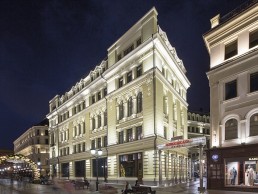
Working in close collaboration with Moscow-based engineering practice Spectrum, BDP has provided a lighting scheme that is respectful to the St. Nickolas building's Russian heritage, while still endowing it with an impressive presence at night.
A late example of Russian imperial style architecture, St. Nickolas is a unique apartment building built in 1900 and located on Nikolskaya Street - one of the oldest streets in Moscow - a few steps from the Kremlin. The building was purchased by Vesper with the intention to convert it into luxury residential apartments.
International design group BDP has designed a lighting system to accentuate the strong architectural lines of the building as well as highlighting the more subtle baroque and classical details, endowing the prestigious development with an impressive presence at night. This included 130-metres of primary façade lighting, interior public areas and lobbies, circulation routes and stairs.
The project came to BDP through Spectrum, who were the multi-disciplinary engineering practice working on the job. Based in Moscow and looking for a lighting consultant to assist them with their project, BDP was recommended by another architect. “We developed a very good working relationship with Spectrum and we navigated many design challenges, including the language barrier, to deliver a successful project,’’ said Tom Niven, Lighting Designer, BDP. ‘‘Spectrum was pivotal to the project and without them, it wouldn't have been possible to get the end result we have.’’
The discrete size and inherent energy efficiency of LED technology was used exclusively throughout due to their minimal intervention with the fabric of the historic façade.
The interior lighting was designed to respect the heritage of the spaces. BDP worked closely with the architect and the Spectrum design team to integrate discrete, minimal luminaires that softly illuminate the space with low impact on the listed interiors. Continuous recessed lines in the walls and soffits, combined with cove details to provide ambient illumination and decorative fittings, were kept to a minimum so as not to compete with the ornate interior architecture.
During the design process, the project posed many challenges for the lighting scheme, with numerous key hurdles to overcome.
Firstly, the St. Nickolas building is listed with Russian Heritage to the equivalent of UK Grade 2 making the façade works particularly sensitive. Therefore all cabling had to be concealed from view on the reveals so, in conjunction with the team’s Russian engineering colleagues, BDP had to define a cable route for each luminaire. All luminaires and the horizontal containment were RAL matched to the render finish and taken up vertically from each level at a single point. No penetrations through the building were allowed, so all power and data went back to one point in the roof, with the cabling carefully concealed behind the rainwater pipes. Cable runs were meticulously calculated to ensure, even on the longest runs, there was no voltage or data drop.
The second challenge the team had to face was digital light modelling.
‘‘Our preferred methodology is to be ‘hands-on’ with light but due to the distance between the site and ourselves, mock-ups were not deemed necessary by the client,’’ explained Niven. ‘‘Instead he called for digital light modelling and supplied us with a highly detailed 3D laser survey model. Using Studio Max, luminaires were constructed and joined with their IES webs to create a realistic interpretation of the lit effect the client could expect.’’ Relying solely on digital modelling in this way is an approach BDP wouldn’t usually take, but the accuracy of the results are plain to see from the comparison shots.
The final key potential problem area for the BDP team was contextual sensitivity.
As a residential building, the risk of glare and spill light to residents was significant. The relatively thick window reveals were used to hide fittings from view but custom anti-glare louvres were also designed for most of the luminaires where there was any potential risk of glare. Careful focusing was also used to ensure correct light distribution.
‘‘Given the distance of the building from London, site visits were limited throughout the project,’’ added Niven. “Extremely detailed focusing information was supplied to the installation contractor to allow for aiming. A fully addressable DALI control system allowed for tuning of light levels throughout the night as well as special scenes for Russian celebration days.’’
Although the St Nickolas project posed challenges for BDP, the resulting lighting scheme is one of great precision and sensitivity to the building's heritage status.
“For me personally, this project posed significant challenges on many levels but is ultimately a testament to international collaboration. Working closely with our Russian counterparts Spectrum, we were able to overcome many technical issues and create a beautiful building that I am immensely proud of,” concluded Niven.
Inventronix EBS Series
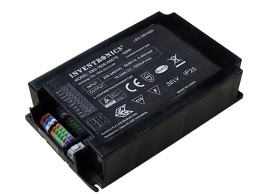
Inventronics’ new EBS series are an intelligent programmable constant-current family of drivers available at 40W, 80 and 160W; and output currents from 450mA to 1050mA. Designed for robust Class I or Class II environments they provide market leading protection against common mode surge; the most frequent cause of failure in outdoor lighting. An always-on 12V/200mA auxiliary channel provides power for sensors and wireless controllers, and programming options including output lumen compensation (OLC), DALI, AC dimming, and intelligent timing provide flexibility.
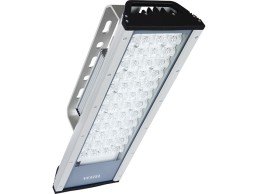
Vestel RGB Projector
Generating up to 256 levels of colour, the Vestel RGB projector is designed to illuminate logos, icons and branded spaces. The luminaire enables businesses to preschedule colour-changing lighting displays thanks to its compatibility with DALI-DMX and other smart controls. Offering a higher Lumen output of 7000 lm, it maximises efficiency, ensuring a longer lifetime operation of up to 50,000 hours.
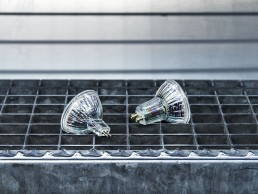
Ledvance MR16 LED lamps
Ledvance, a fully-owned subsidiary of OSRAM, showed a range of PAR16 and MR16 LED lamps among other products with casings made completely of glass, and most models are optionally dimmable. In many cases these products can simply replace those halogen lamps that are no longer permitted to be put into circulation in the EU from 1 September 2016. Thanks to glass casings they look deceptively similar to their traditional role models. The LED spots, with up to 575 lumens, are manufactured in Germany.
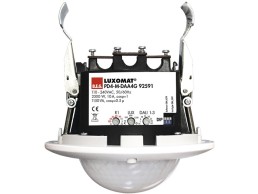
LUXOMAT PD4-M-DAA4G
B.E.G.’s LUXOMAT PD4-M-DAA4G is a compact DALI lighting management system tailored for training rooms and classrooms, offering uniform lighting conditions. Contained in a single case are: a highly-sensitive occupancy detector, a DALI controller which can group DALI electronic ballasts, a DALI power supply and a push button control for up to 3 lighting zones. Up to 64 DALI units can be connected, and an integrated relay offers yet more options for individual setup according to local requirements e.g. for HVAC or another lighting zone.
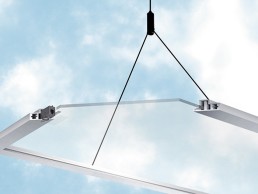
artesolar SKYLED
SKYLED has been created with an innovative design that confers high decorative potential due to a transparent surface with up/down light emission up to 100lm/W based on the latest technology of prismatic polycarbonate on top, guarantee a pleasant, homogeneous and indirect light effect. Two dedicated steel cords enable easy suspension of the luminaire, thanks to the transparent supply cable and the new trim less suspension kit can opt for a very clean and minimalistic ceiling suspension, making it ideal for spaces where elegance prevails.
