
Geoff Archenhold: Digital Lighting Revolution
The transition from traditional light to LED is continuing to dominate the architectural lighting industry. Dr Geoff Archenhold talks us through the digital lighting revolution, the benefits, the problems and everything in between.
Will Digital Lighting PaE?
One of the big issues rocking the lighting industry is the transition from traditional light to LED. Traditional routes to market are under significant price pressures as the barriers to markets have been reduced. The traditional players have already started to divest lighting assets, with the most recent being Royal Philips which has released 25% equity in Philips Lighting’s IPO to raise €750m to spend on healthcare activities instead. The advantage of being the world’s largest independent lighting company will enable Philips Lighting to significantly rationalise its cost base and look to jettison unprofitable areas in a timely fashion. This is similar to Osram when it was carved out of Siemens, which has sold whole divisions and created a new strategy but took several years to transition and no doubt Philips will follow a similar course of disruption.
The problem is that the second wave of technology change has hit the sector and this time it’s a much bigger tsunami, with the potential to make even larger market disruptions that could see companies such as Osram and Philips completely acquired within the next five to seven years.
This new Digital Lighting transition will require:
• New technology development more suited to smaller and more nimble businesses.
• Different skill sets for deployment.
• Network designers, engineers and technicians.
• Security consultants and advisers.
• Different lighting installers.
• Data analytic engineers.
• Marketing teams utilising the new lighting associated assets.
• Understanding that new routes to market will occur through different sectors such as IT and Value Added Resellers.
So the question is: will new Digital Lighting technologies PaE? (PaE relates to Power and Ethernet Systems, which combines LED fixture power and Ethernet digital connectivity.
Digital Ceiling Concepts
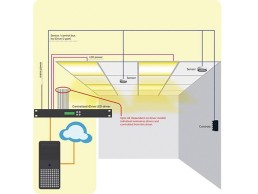
Cisco is currently undergoing a technical revolution by connecting more devices, people, and processes to drive new user experiences and better business outcomes. The digital ceiling concept converges multiple building networks - lighting, heating and cooling, IP video, IoT sensors, and much more - through a secure and intelligent network platform. Such systems help unlock new experiences and efficiencies whilst lowering building operating costs over typical 50 year lifetimes. Through digitisation it’s possible to put high-resolution sensor data into huge databases that can be analysed using Neural Networks and AI to gain a deeper insight into the building and its environment. Digital Ceilings utilise IP to connect disparate building networks, systems and services through converging services to enable:
• Lower-cost, more efficient building and tenant services: the Digital Ceiling lowers the cost of building system installation, operation, and management through unified communications and centralised control of global facilities.
• Transformative new experiences: different building systems can now easily and securely work together.
• New business insights: by combining connected building endpoints with sensors, organisations gain deeper insights into how employees, customers, and guests are using indoor spaces.
The fundamental difference is that the disruption takes place around standard IT based systems that are already installed throughout modern buildings. Therefore, there is no need to invent new protocols, wiring systems and solutions to overcome old lighting systems and utilise what is already installed throughout the building.
Here lies the issue for the lighting industry - it doesn’t know anything about IP addresses, RJ45’s, PoE, Network configuration or Network Security.
What are Power and Ethernet Systems?
The majority of Power and Ethernet Systems for lighting would consist of a centralised LED power system that provides DC currents passed to light fixtures or sensors held in the digital ceiling. There are two ways of achieving a PaES:
1. Power over Ethernet: Allows both power and control signals to be transmitted along the same RJ45 cable to an intelligent light containing an electronic LED and control interface.
2. Non-PoE solutions: Power to LED fixtures is provided from centralised LED driver units which may include the ability to use sensors with RJ45 or other connecting systems.
PoE systems are commonly used today within buildings to support telephone and security CCTV systems where devices have low power requirements. There are two reasons why PoE isn’t being deployed in lighting installations:
1. No ratified standard for high power (>25W) devices.
2. Current high power systems are hugely expensive (>£200 per light).
PoE systems have a significant cost implication as the only high power (>25W) systems available are proprietary, which limits high volume deployments. The good news is that new PoE standards are shortly to be ratified to allow LED fixtures of up to 96W to connect to standard IP networks which should drastically cut PoE hardware costs moving forward.
It is expected that PoE++ known formally as 802.3bt (types 3 and 4) will be ratified by the first quarter of 2017 with compliant systems available on the market by the end of 2017 with prices of PoE++ devices predicted to rapidly fall to less than 25% of today’s costs.
Non-PoE solutions
In contrast to PoE a much lower cost solution is providing Ethernet connectivity to a centralised LED driver which then provides DC power to remote fixtures or sensors. Such solutions offer the same benefits as PoE without the cost of expensive PoE end points (similar to LED drivers).
The advantages of PaE solutions
There are significant advantages of Power and Ethernet solutions above and beyond the digital ceiling concept, covering all sorts of installation phase savings and maintenance phase savings.
Creating new User Experiences and Lighting Services
With an IP backbone linking multiple building systems in a smart, connected architecture, future lighting systems will enable highly customisable indoor environments and personalised employee workspaces that improve safety, comfort, productivity and business deliverables.
New services can be offered by Digital Lighting Solutions including:
• Optimise employee workspaces: Many organisations are using ‘hot-desking’ or ‘hoteling’ to create reserved work spaces. Employees can customise light and room temperature in their reserved spaces. • Create comfortable environments automatically: Indoor spaces could dynamically adapt heating and cooling systems based on real-time occupancy.
• Get people to destinations faster: Digital solutions can be integrated with digital signage and wayfinding applications that automatically connect with employees’ and visitors’ personal devices.
• Create human-centric environments: One can control lighting intensity, colour, temperature, and other factors in every space to adapt to the needs of occupants. • Power new retail experiences: Lighting powered by the network can be used to feature special promotions and sale items; guide customers to specific items with light; closely approximate natural light to show truer colours and reduce returns; measure store traffic patterns, better understand customer and staff behavior, and optimise sales with light-fixture sensors.
PaE helps optimise business operations
PaE systems and digital lighting creates business value beyond pure lighting by utilising built-in sensors and harnessing big data analytics to drive better business outcomes:
• Improved building use: With in-depth analytics it is possible to gain visibility into real-world usage of spaces to better manage, plan, and optimise a building’s use. • Improve physical security: Integrate physical security applications, video surveillance, and security controls that use presence sensors.
• Boost business results with analytics: Collect light, sensor, and usage data of the environment to optimise traffic flow in retail stores, track and optimise sales, and identify premium locations for featured products and services.
With the ability of being based on standard Ethernet solutions, PaE systems allow scalable lighting systems to many tens of thousands of devices making them uniquely positioned compared to RF based solutions limited to hundreds of devices at most.
Conclusions
The digital lighting revolution is upon us and I strongly believe that Ethernet based solutions will prevail as the prominent future lighting technology platform moving forward. With the soon to be ratified PoE++ standard set to reduce PaE system prices over the next three years, the lighting market will enter a new evolutionary phase. New lighting players will be created such as IT network security and configuration consultants yet traditional lighting fixture manufacturers will suffer as they find they cannot add any value in the new supply chain, resulting in a significant shakeout of players.
The leaders in lighting may be companies such as Google, Facebook, Cisco, Microsoft or Apple moving forward – Watch out Philips and Osram!
Geoff Archenhold is an active investor in LED driver and fixture manufacturers and a lighting energy consultant. The views expressed in this article are those of the author and do not necessarily represent the views of mondo*arc.
g.archenhold@mondiale.co.uk

David Morgan Review: LG Display OLED Panels
Following an impressive array of product designs at Light + Building earlier this year, David Morgan discusses the current situation, development and future application of LG Display’s OLED panels following a visit to UK distributor Applelec's London showroom.
In the six years since I last reviewed OLEDs it is surprising how little has really changed in terms of applications or usage for this technology in general lighting.
In 2010 the general feeling was that OLED was an interesting novelty technology looking for a suitable application. Presentations from leading lighting designers at industry events showed stills from Kubrick’s film 2001: A Space Odyssey of illuminated floors and ceilings as an ideal OLED application, while other designers showed exactly the same images as being the kind of application to avoid at all costs.
Ingo Maurer, Philippe Starck and many other design superstars were recruited to develop interesting luminaires based on OLED. Apparently Philippe Starck found the quality of light from OLED panels to be boring and the technology incomprehensible. The general conclusion was that the light quality from OLED panels was very flat, fog like and not very exciting but if it could be produced cheaply enough then it might stand a chance in the office lighting market.
While most of the early manufacturers of OLED materials for lighting applications, including Philips, have now withdrawn from the market, given up making panels and shut down or sold off their pilot production facilities, the Korean based LG corporation have gone in the reverse direction and are still putting considerable effort into development and persuading us to use their products.
LG Display took over the OLED development from its sister company LG Chem in 2015, and are currently marketing a variety of shapes and sizes of rigid and flexible panels for lighting applications. LG Display is the world’s largest LCD panel maker and produces display components and systems for TVs, mobile phones and other digital devices. At one point Philips was a major investor in the company but has now sold its shares.
The most impressive applications for curved OLEDs to date are in big screen curved TVs including the LG 3D 4k Ultra HD 65”. This application is definitely a very good use of flexible OLED sheet and I assume this generates the investment required for products to be used in lighting applications.
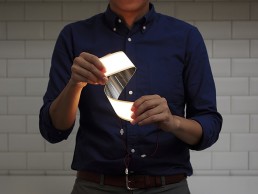
Back in the world of lighting, the most interesting novelties shown on the LG Display booth at Light + Building in Frankfurt this March were the flexible OLED sheets. At the moment the two sizes available are 200mm x 50mm and 406mm x 50mm but prototypes of an impressive 320mm x 320mm flexible sheet were also presented.
The rigid panels are remarkably thin at less than one-mm and the flexible sheet is even thinner at only 0.41mm. Both types give a completely flat and even light output with high CRI of over 90. The surface brightness of the panels is not uncomfortable to view directly so secondary optics or glare control accessories are not required, thus increasing system efficiency. There is no UV in the output and blue levels are much lower than most standard LEDs and similar to those in sunlight. The panels run at a cool 35°C and do not require additional heat sinking.
The efficiency and life of the LG OLED panels has increased significantly compared to the products on offer in 2010. Efficiency, in the range from 50lm/W for the flexible sheet up to 65lm/W for the rigid panels, compare quite well with other LED panel solutions based on side lit or back lit diffusing optics. Lifetime of 30,000 to 40,000 hours to L70 is not as high as other LED technology but is much higher than previous generations of OLEDs.
The obvious applications for OLED fall into a number of areas including: commercial, architectural and decorative lighting. Ceiling panels for office and commercial lighting is still potentially the largest market for OLED if the size of the panels can be increased to fit a 600mm x 600mm grid system and the efficiency and life expectancy can be further increased. The minimal OLED panel thickness could be an advantage over conventional LED panel designs, possibly allowing ceiling void depths to be reduced but, after allowing for the size of driver and electrical connection components, the thinness of the OLED is probably not the determining factor in the overall luminaire height.
To capture a significant share of this market, the OLED panels will need to be cost competitive with conventional LED panels, which have been widely used over recent years. Unfortunately for OLED manufacturers, the more basic types of LED panel have now become a low cost commodity item so the opportunity in that market has probably disappeared.
Using the flexible sheet to develop upmarket office lighting systems with greater design appeal, including curved recessed office lighting modules or soft shaped linear office lighting systems giving a greater volumetric lighting effect, might be a possible strategy to gain sales in this market.
There may also be an opportunity to use the flexible sheet material for backlighting materials in high end interior projects where space is very limited. Although lighting designer Graham Rollins of LDI pointed out the sparkle given by flexible LED sheet, incorporating individual LEDs can add attractive sparkle when backlighting decorative glass materials whereas the OLED panel would give a flatter lit effect.
Beyond these potential larger volume commercial and project applications, there is also a wide variety of uses in high end decorative and custom luminaire designs where the various shapes and sizes of flat LG panels and the curved sheet material opens up new design possibilities. Not having to worry about heat sinking or developing diffuser optics for luminaires produced in low volumes will be a significant advantage.
The reference OLED designs that LG showed at Light + Building earlier this year, including pendants and task lights, went some way towards demonstrating the potential of their technology and it will be interesting to see if, after a number of false dawns, the time is now right for OLEDs to be adopted in both niche and larger lighting applications.
David Morgan runs David Morgan Associates, a London-based international design consultancy specialising in luminaire design and development and is also MD of Radiant Architectural Lighting.
Email: david@dmadesign.co.uk
Web: www.dmadesign.co.uk
Tel: +44 ( 0) 20 8340 4009
© David Morgan Associates 2016
Waldmann ACANEO
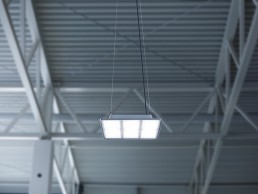
ACANEO is a long-life LED spotlight that permits efficient illumination of factory halls up to 30-metres high. With advanced LED technology, a light yield of up to 140lm/W and life cycle of more than 60,000 hours (L80B10), it offers impressive energy and economic efficiency, with optimised lighting technology for well-distributed low-glare hall illumination. The downlight works reliably in dusty, humid and oily air and can be used in temperatures of more than 50º Celsius.
Zumtobel CAELA
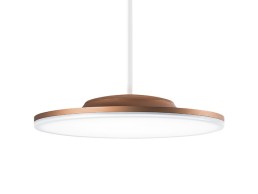
The new CAELA LED luminaire family from Zumtobel and GRAFT Architects meets the demands that can be placed on a decorative task luminaire. A slim design and two different kinds of light distribution define this LED luminaire range. Alongside the standard symmetrical light distribution, a square version of the wall-mounted luminaire features an asymmetrical distribution that has been optimised to meet the lighting requirements in corridors and staircases. CAELA appears slim and elegant as a wall-mounted, ceiling-mounted or pendant luminaire, adding a decorative touch in offices, restaurants and in residential areas.
Fluxwerx Profile
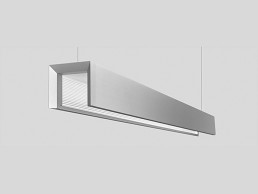
Profile is a linear LED pendant luminaire with hollow aperture design, delivering longitudinal clarity and transparency through the fixture. Using vertically oriented optics, without horizontal lenses or diffusers, it has complete absence of glare. Profile is available in direct and direct/indirect versions, as well as vertical surface illumination (VSI) and symmetric and asymmetric distributions. Manufactured in four and eight-foot nominal sections, it can be installed individually or in continuous runs. Its agnostic drivers can be integrated with any sensor, lighting control or building energy management system.
Corvi Flat Series
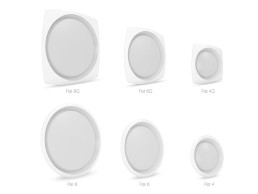
The Flat series manifests itself in a square and round form. One of the thinnest recessed luminaire, its minimalist tone achieves beautiful aesthetics. These products boast great functionality, with up to 150lm/w, an inbuilt driver, dimmability across the range and power features packed within 30mm of product height. This luminaire series argues the redunancy of the metal heatsink, and seamless design engineering. With a UGR value of below nineteen, Flat series is easy on the eye and glare is controlled.
Trilux 74 R/Q LED
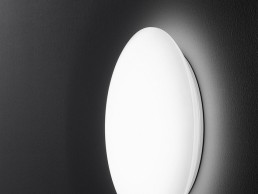
The new 74 R/Q LED, with its softly formed body and indirect light component, features an elegant appearance and creates a pleasant ambience. The luminaire is available in round (74R) or square (74Q) versions as well as Active (WW) and RGBW variants. Designing with either surface-mounted or suspended luminaires, alongside a raft of frame accessory options provides further flexibility. Combining with a light management system increases the level of energy efficiency and opens up the potential of delivering Human Centric Lighting.

Arkoslight Drum
Drum, designed by Arkoslight’s Head of Design, Rubén Saldaña, is a large dimension downlight, for surface or suspended mounting, offering major luminous flux and apt to be unhooked from the ceiling as you wish. Drum is dimmable, to adapt the light volume to the specific needs of each application.
Formally, its design is expressed in a circular strip, slightly arched towards the centre, and a minimum bezel. The luminaire boasts an excellent light diffusion in the entire illuminated surface and a seductive effect of natural light clarity.
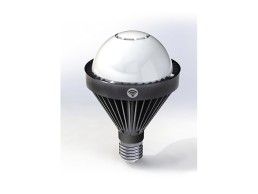
Unibrite Technology Cloud Guardian
Smart Lighting using IOT is changing the lighting industry, calling on LED illumination to be connected to the cloud. Cloud Guardian, with a patented technology inside, utilises the Snell Law theory and merges the mechanism of light refraction and reflection. It re-directs the light path using an optical lens and changes light shapes through different lens curves. It clears the space on the top of the lamp to provide an ideal location for BLE signal, free from obstruction.
www.unibrite-tech.com
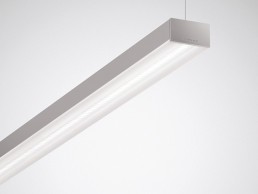
Trilux Solvan Flow LED
Architects, designers and end-users are given maximum flexibility with the Solvan Flow LED. Accents are set by a single suspended luminaire or seamless continuous lines can also be created with ease. Further diversity is provided thanks to flexible mounting methods, various lumen levels and different optical systems. Compatibility with light management systems makes the intelligent all-rounder the ideal start for connectivity. Ideal for office or education applications.
Nualight announces sale of Lumotech’s LED driver business to Fulham
(UK) - Fulham adds Lumotech’s LED drivers to existing lighting components and electronics business, bringing new sustainable lighting solutions to global OEMs and distributors.
Nualight, a specialist LED lighting technology company has reached an agreement to sell certain assets from Lumotech, its driver and motion detector business to California, USA based company, Fulham. With completion of this acquisition, Lumotech will become Fulham’s new European Design Centre.
With its acquisition, Fulham will add that product portfolio to their existing range of LED drivers, modules, engines and further lighting solutions. Fulham will also strengthen its European presence through Lumotech’s existing sales channels, bringing new sustainable lighting solutions to global OEMs and distributors, including the new HotSpot Plus, an all-in-one LED emergency lighting system with a dimmable LED driver and a replaceable battery. The sale is expected to complete on July 01, 2016.
“This strategic acquisition will give our European customers immediate access to the latest LED drivers and systems, and it will provide Fulham with new sales opportunities in Asia-Pacific, Middle East, and other regional markets where LED lighting is in demand,” said Bob Howard-Anderson, CEO of Fulham Company Group “In addition, creating a new European Design Centre will put Fulham in a better position to serve our global customers, especially since Europe leads the market in LED luminaire design technology.”
The asset acquisition is expected to be complete on June 30, 2016. The terms of the acquisition were not made public.
“We are delighted to have found an ideal partner in Fulham who already has a strong focus towards intelligent lighting components and can now draw upon the technological expertise of Lumotech as the industry continues to innovate. Nualight will help support the transition process and work towards a smooth handover for our customers. As Nualight, we continue to make strategic changes, in which our clear focus is to further develop our core LED lighting business in our specialist areas,” said Peter Mazalon, Nualight CEO.
www.nualight.com
www.lumotech.com
www.fulham.com
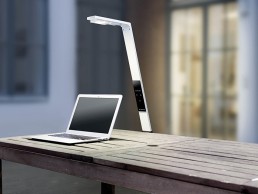
Luctra FLEX
Available in orange, black, white and aluminium finishes, FLEX can operate as a table or wall lamp. Its angled design supports itself against a wall or the side of a table by using a height-adjustable rubberised protective sleeve. FLEX’s integrated lithium-ion battery is capable of powering the lamp for up to ten hours, delivering portable human centric lighting. The biologically effective light is able to replicate daylight, with its cold white and warm white LEDS that produce an illuminance of up to 1,000 lux, and between 2,700K and 6,500K. FLEX’s lamp head can be rotated 180° to provide direct or indirect lighting. With a height of 136cm, the cordless workplace lamp weighs just 2kg, allowing for easy relocation.
