
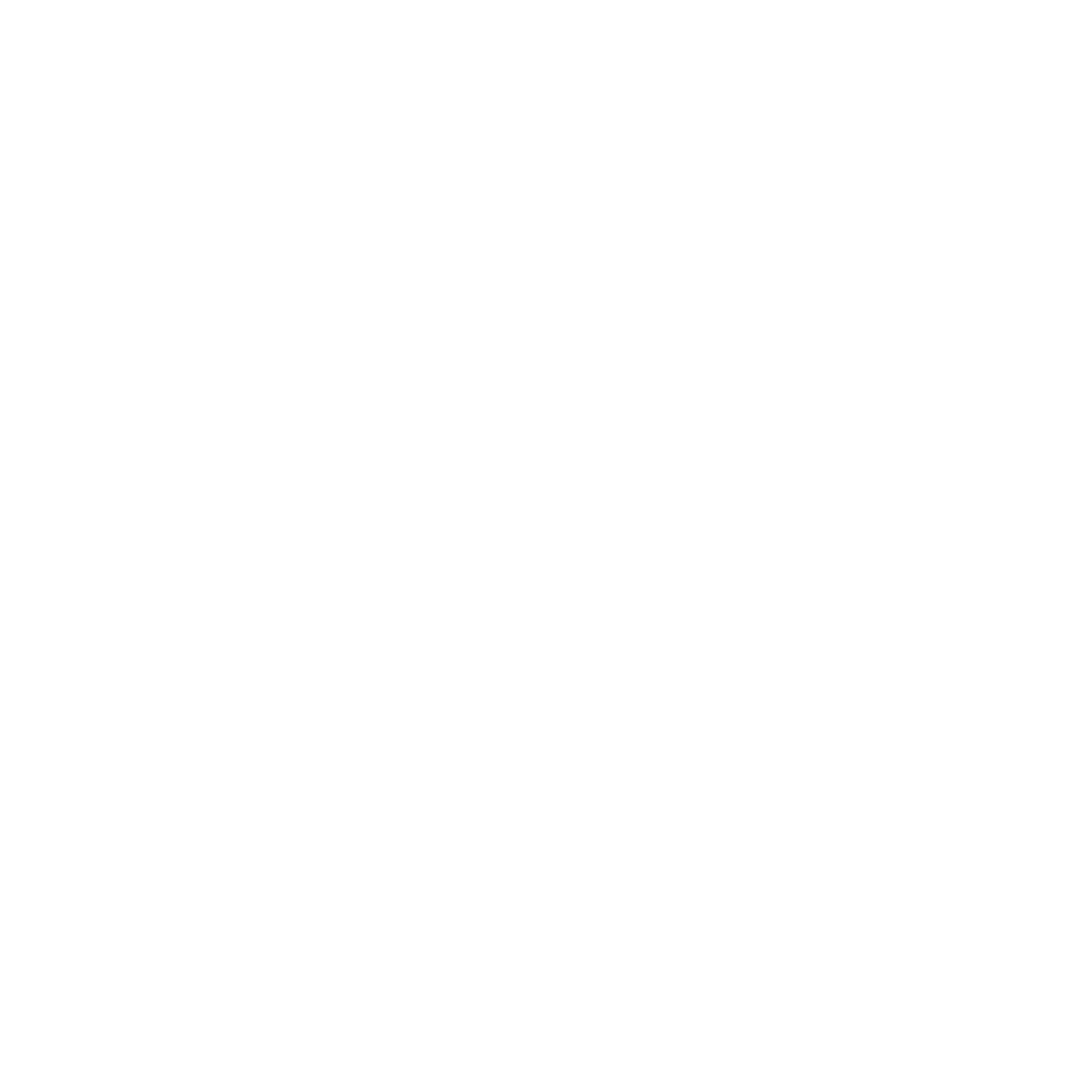
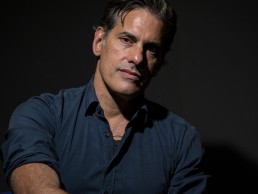
Yorgo Lykouria
Following the success of Zumtobel’s Ambitus in this year’s Red Dot Awards, arc speaks to its designer, Yorgo Lykouria, about his design approach and his attitudes towards light.
For many designers, be they lighting designers, interior designers, product designers or architects, their raison d’etre is to create beautiful, sculptural works of art. But as the old adage of ‘form follows function’ would denote, it’s essential that these works of art are not merely superfluous and serve a purpose too.
This is one of the core philosophies of designer, architect, film maker and writer Yorgo Lykouria. Founder and Creative Director of Rainlight Studio, Lykouria has built a career on the apparent contradiction of beautiful yet purposeful designs.
“Rainlight Studio was conceived on the idea of a ‘union of opposites’,” he told arc. “It’s about this idea that design and business have to come together somehow. We’re not artists creating something that somebody will like or not like, we’re working for industry, and we have to create something that has a purpose, has a sense of beauty that the market will recognise and that serves the needs of the people.
“At the same time, there’s an aspect to design that is purely esoteric and cultural, intellectual and poetic, beautiful and timeless that touches your soul.”
Referred to by many as an “Industrial Poet” for his contemporary, humanistic approach, which goes beyond the senses to engage a sense of wonder, Lykouria originally studied mechanical engineering, before completing a Master’s in Architecture at Dalhouise University in Halifax, Nova Scotia. “I wanted to be a car designer, but in the process of studying mechanical engineering I realised that I’m not cut out for physics. I’m fascinated by it intellectually, but I didn’t want to spend my life doing that,” he explained. “I switched to architecture, because I discovered that there was something in architecture that really appealed to me, this idea of doing something for society.
“You’re born into this world and the table is already set, the house is already built, and we live in it. And yet, things start to fall apart, they get boring or out of date or irrelevant, so the idea that we have to constantly refresh that for who we are as a society really fascinated me and I thrive on it.
“But in architecture I was always a bit of an outsider in a way, because even as an architect I thought about things in a different way than most; I was interested equally in philosophy and society and art, as much as how a building stands up and how a connection comes together.”
In 2002, Lykouria established his self-titled, London-based studio which he ran as a multidisciplinary practice for 12 years. From here spawned Rainlight. “Rainlight is very much the same entity, but Mark II – improved, newer, better, stronger, faster,” he said.
“The improvement is this idea of unity of business and culture. When I was running Lykouria, I was more insular in my approach to things, I was more focused on my language, my identity, my ethos, etc. Of course, that remains, but I found a way to connect to clients, to industry, to society in a much better way.
“It sounds like I was a monk or something, but in some ways, I was like that, in that I believed in this idea of design as a pure thing that we have to protect. I think what changed my thinking dramatically was taking a little break of a couple of years to write screenplays, to work on a novel and make short films. Being immersed in that culture taught me that the creator of the work is not the important part, it’s the work that matters. When you talk about stories, it’s the narrative that matters, not the storyteller.
“I became really immersed in the idea of narrative, because I realised that there’s a very human aspect to that. If you look at stories through all of time that still connect with us, that tells us something.”
As such, Lykouria explained that his typical design approach is to “not leave any fingerprints”, creating something that stands alone in its own right without being tied to any particular “signature style”. He continued: “What’s great about this is that it allows me to refresh who I am as a designer, to constantly grow and explore with every single project.
“It serves my own impulses as a designer, as a creator in a bigger way than having to get stuck with a sort of language or identity or fingerprint or whatever you want to call it. I’m free, and I can recreate that feeling for every project, which is also great for the work because every client deserves their own project.
“I don’t want to replicate things, and that’s hard for designers because we have certain fascinations. So, to start with a clean slate every time, a blank page, is terrifying.”
This idea of starting every project with a blank page feeds into Lykouria’s overall design approach, to the point that he doesn’t seek or take inspiration from any external sources. “The inspiration comes from within,” he said. “I don’t like the state of things in design where you see people go into Pinterest to get ideas or create mood boards – I think that is soul destroying because what you’re doing is denying yourself the opportunity to come up with an idea. The minute you flood your mind with forms, then that’s what you’re going to do, it’s preordained.
“‘Design begins with an open mind’ is something I’ve been saying for the last two decades. It’s about finding that state of mind where you have an open mind and allow ideas to come in. My process is to live life in a way that I’m constantly being fed, whether it’s art, music, film, books, other experiences. Everything feeds the imagination, and when you are really conscious and present, they infuse into your being and things come out when you need them.
“Even when I was a student in architecture school, I didn’t look at references or magazines, and there were projects where I was struggling with ideas because I was forcing myself to be alone. But by doing it over and over again, I became more fluent in that connection with that part of my subconscious and being able to draw things out of it. It’s creating a motorway between your consciousness and your subconsciousness. But you can only do that if you practice it.
“I really believe that design is a bit mystical or psychological – there’s something about it where it’s not just a method, it’s not just something you can talk about per se. It’s like when a potter makes a pot, or a musician writes a song, it’s intuition, you just have to be in the moment.”
Across his diverse portfolio of work, Lykouria’s approach could be classed by some as minimalism. However, he has a different term for it: “Instead of minimalism, I call it clarity, and this is the idea that you’re not doing things that are meaningless or superfluous in design – the things that you’re doing have real sharpness and attention.”
This belief came after the realisation that minimalism as an approach “is a complete dead end”. “The problem with it is that it has no identity,” he continued. “So when we’re talking about design and doing things for industry or companies for people or a project, it’s platonic forms. It doesn’t belong to anybody.
“For me, that created a kind of backbone to the process of design, which has this austerity in some way. I don’t like to do things that are decorative for instance; it can be beautiful, but it still has to have intention, that things in nature do. A flower can appear decorative, but every piece and every form and colour has a purpose.”
With a varied back catalogue of work spanning architecture and product design, Lykouria has a wealth of experience in multiple sectors, but despite this, he doesn’t feel that he has a particular specialism in one particular field. Instead he is able to draw from each sector on everything he does. “For me, every project is special, whether we’re doing a little stool to sit on, or whether we’re doing a light to light up a space, or a chair, every project is special and deserves a place.
“Carlo Scarpa, the architect/designer/poet once said that the architect has to have a triple mind, the mind of a thief. The idea of this is that you could look at a piece of architecture or design purely from an engineering viewpoint or a materials viewpoint or a construction viewpoint and nothing else, or you could look at it entirely from a formal point of view and try to interpret it as a poetic statement. All of these facets come in and when I’m in the midst of design, it’s really invigorating and also exhausting, and also very consuming because I find my mind constantly switching from one plane to another.
“I would say that our work steals moments of consciousness from people, because if you’re in a room that someone designed, or if you’re sitting on a chair that someone designed, that experience is impacting you. You’re not walking through the woods, for instance, it was created. And so, as the person who is making those experiences, you have an obligation to do something good for the people that use them to give you a sense of joy.”
One of the latest designs from Lykouria and Rainlight is the Ambitus, a lighting fixture developed by Zumtobel. The fixture, which won a Best of the Best award in the 2021 Red Dot Awards, is inspired by natural light sources such as the sun, and mimics the basic function of natural light to enhance spatiality for a more conscious experience.
In combination with a perforation on the underside, the lamp showcases a visually accentuated ring-like shape that creates an aesthetically pleasing effect to evoke various associations with natural light phenomena. At the same time, the round shape produces a harmonious light distribution, even when the luminaire is viewed from different angles.
Lykouria has had a longstanding appreciation for light, dating back to his architectural studies, describing it as “the primary element of architecture”. “When I did my thesis, I was exploring the immaterial aspect of architecture, so it looked at light and acoustics and the experience of space in a way that wasn’t really talked about in architecture. You couldn’t really define how one experiences a space, but you also couldn’t define how you design that. You can talk about where you want a column or a wall or the stairs, but nobody ever talked about the phenomenological aspects of architecture. That part fascinated me.
“For me, light is not a functional thing, I would say that it’s very strong poetry. It completely changes the experience of a space, it’s so important. Everyone needs to be aware, architects as much as clients, that lighting is the thing that makes and defines and interprets a space. Without light, there is no form, you don’t see things. You could take a simple box, a white cube, and light it in such a way that it suddenly becomes a beautiful space, because of the light.
“If you look at the work of Tadao Ando, if he were to just look at a concrete box, it’s always that shaft of light, that moment of where the light is that makes it splendid and beautiful. Light is everything, and that’s why I love theatre and concerts and film; cinema is all about light because any moment is curated and made perfect, and you can live in this poetic state all the time. I think that’s what light brings to things.”
Lykouria first worked with light around 20 years ago, partnering with Siteco on the production of a fluorescent light fixture. “I worked with a lighting technologist from Siteco who was a brilliant mind. I asked a lot of questions and challenged the whole ethos of the fluorescent light fixture, which all started to look the same. I wanted to do something minimal and streamlined, and we managed to create this beautifully elegant, simple fixture that no one had ever done, but it was at the end of the life of the fluorescent tube.”
The advancement of lighting technology, and the departure from fluorescent fixtures to LED was a guiding factor in Lykouria’s approach for the Ambitus. He explained: “The fluorescent tube was this wonderous, amazing thing that was a total departure from the filament lamp. It did great things and, in its time, for the 50s, 60s and 70s when we had modernism and very austere geometry and the gridded world of architecture, that linear geometry worked beautifully. When you look at these old masterpieces, every line is exactly where it should be, it’s perfection, and the lighting follows that structure as well, so when we look at a building at night, everything’s in the right place.
“Fast forward five decades where we’re not so disciplined about form, we’re challenging geometry or doing things that are really complex, whether they’re fractal geometric forms or whether they’re fluid geometries. Suddenly you wonder where there’s place for the florescent tube. I realised this as I was working on a tower project in Sharjah in the UAE, designing the interiors. The building was triangular at the base, and at the top, and it flips at the midpoint where it becomes a hexagon, so the geometry changed and at every level it was a different footprint.
“When we were trying to lay out a lighting grid that made sense, it was impossible because if you looked up at the building, if you had anything linear it wouldn’t work. So I realised that the only way to solve this was to do a circular point source of light. I tried to find one and it didn’t exist in the market. Even today with Zumtobel, when we did the market survey, we couldn’t find a single reference that was an office luminaire.
“The most challenging lighting fixture is the office luminaire – we’re using computer screens and you need no glare, so you need uplighting and increased control, there are a lot of technical demands. It’s not just creating a donut and lighting it – yes, you can do that, but it’s not a good office light. It’s not good light in any application.
“This was where my experience and background in engineering and architecture came together, I was adamant in this project that it had to be driven by technology and driven by a good technological basis of design.”
Further to this, a “strong, symbiotic relationship” with Zumtobel helped in developing the finer technical details. “It was a really great sparring match, and I wanted it that way,” Lykouria continued. “I said to them that I wanted an engineer to fall in love with it, I wanted a lighting designer to love it, I wanted an architect to love it; it had to have excellence as a design object in every possible sense, so you should be able to take it apart and wonder at how minimal and elegant it is.
“In the beginning, Zumtobel were very respectful of the design and they wanted to do what I wanted to do. I kept challenging and poking and pushing for more and more, and that engaged them more as engineers and designers to then bring more to the table and to share in the process – we became an integrated team, they were very hands on.”
Designed explicitly for the office environment, Lykouria is hopeful that the Ambitus will help to bring a new light, a new ambience to the workspace. “The worst kind of lighting is when you put a grid over a space and have uniform lighting that creates a mist of nothingness, where everything has the same intensity and it’s just bland. That’s why people hate offices and respond badly to this whole idea of the corporate office, because that’s just the machine, it’s not for people.
“My approach is to allow there to be some darker spaces, spaces with a certain colour of light. I love the idea of being in a space where you can have different experiences. This is part of what makes an office environment so stressful, you can have this bland sameness all through the day, nothing changes. Light is really important in that respect because you can create different atmospheres and emotional states so a person can move to different spaces.”
Following the success of the Ambitus, Lykouria has more plans to work with lighting, with a new fixture currently in progress with USAI. Beyond that, the world is his oyster.
“The exciting thing is that I don’t know what the future holds,” he said. “We’ve got several projects on the go right now. I would love to design things that move; whether that’s boats or planes, that’s something that I hope will be in my future.
“I just look forward to the next project, every project is an opportunity to grow and learn, to test your knowledge, test your experience, and for me it doesn’t end, it’s an ongoing thing. I hope that we can continue to grow Rainlight in this way, to grow the team and the culture and do more work that is relevant in the world.”


Carmela Dagnello
Carmela Dagnello, UK Ambassador for Women in Lighting and Senior Lighting Designer at WSP, recently carried out a survey examining gender equality in the lighting industry. Here, she tells us more about the findings.
When the Women in Lighting initiative was first formed in 2019, its primary aims were to provide a platform for women to network and share stories, to raise the profile of female designers and encourage women to achieve more in the industry.
In a relatively short space of time, the project has taken the lighting world by storm and has done incredible things to showcase the amazing work of women in the industry. However, while it has helped to create more equality in terms of female representation on awards panels, conference line-ups, and so on, some issues remain surrounding implicit inequalities within the workplace.
To that end, Carmela Dagnello, UK ambassador for Women in Lighting and Senior Lighting Designer at WSP, has undertaken a research project looking into gender equality in the lighting industry in terms of the pay gap, diversity in leadership roles, sexism and harassment.
Since entering the world of lighting design seven years ago, Dagnello has been an active member within the lighting community, although it wasn’t until she applied for her Master’s at Hochschule Wismar in 2014 that she realised that lighting design was a career she wanted to pursue.
“In Italy, I studied industrial design, my aim in a previous life was to be a product designer,” she said. “When I was at university [Politecnico di Bari], I got a job in a lighting showroom, mainly selling pieces from Italian and international decorative lighting brands.
“When I was working in the showroom, I always really liked how the light was coming out of the products. But I never thought about architectural lighting, because I was not aware of what architectural lighting was until I decided to move out of the country, and I applied for a DAAD scholarship to complete a Master’s in Germany.”
Dagnello studied Architectural Lighting Design at Hochschule Wismar, where she learned about the multifaceted aspects of light and lighting design. “Since I was interested in lighting products, I wanted to understand more what was behind the product. Not the production itself, but how the designers were thinking about how to create certain effects of lighting. It was my first experience of holistic lighting design, and this is how I became interested in the psychology, science, the architecture, the art – so many different aspects of lighting that I never considered before,” she continued.
“Both during my studies in industrial design and later on, I went to Salone del Mobile in Milan so many times, looking at products and wondering why they were so useful or beautiful – what’s behind them? What is the key that makes this product beautiful? I’m now basically translating these questions into lighting design, always thinking ‘how can the lighting work within this space? How can we make this space beautiful?’”
During her studies in Wismar, Dagnello met professor and fellow WIL ambassador Karolina Zielinska-Dabkowska (“I love her, her integrity and dedication to the profession have always inspired me.”), who advised her to spend her second-year internship in London. “I never imagined in my life that I would come to London. I didn’t know what London was or what I would find, I never had this London dream,” she said. “I followed her recommendation and started to apply for internships. I was accepted to Atelier Ten and stayed with them for a year. It was mind-blowing.
“I was struggling for so many years in Italy to find what I wanted to do, but the moment I put myself into lighting, I found the light at the end of the tunnel. I finally, for the first time in my life, did what I felt was right for me.”
Following her internship with Atelier Ten, Dagnello worked for a couple of manufacturers, before joining WSP in 2018. “At a certain point, I found WSP, and I didn’t know much about them, but I knew that they were engineers working on lighting projects such as London Bridge Station. I met with Sacha Abizadeh [UK Creative Lighting Associate Director at WSP] for the interview, and he showed me a variety of projects that he has done, and I was inspired by these huge infrastructure projects as something that would really challenge me.“We don’t have any limitations in the kind of projects that we accept here, so it means that your mind can be challenged all the time, thinking about different spaces, different users, different ways you can apply lighting.”
Dagnello added that working as part of a larger engineering firm has helped her broaden her knowledge and skillset, not just from a lighting design perspective, but in other fields as well. “It’s not only the scope and the size of the project, but also the interdisciplinary collaboration that we have here, which I think is really important for lighting designers,” she said. “You don’t need to be an expert of ventilation, mechanical or structural engineering, but you can make other people’s knowledge your own and use it to integrate better, to innovate, to do something different, something new.”
Alongside her work with WSP, through which she is currently working on several high-profile projects including the HS2 Old Oak Common station and “an unconventional office space that combines human centric and biophilic lighting, transforming at night into a real nightclub”, Dagnello has been actively involved in the Women in Lighting project for the past two years, eventually becoming the UK ambassador earlier this year – a role that came very easily to her.
“I remember I went to a WIL event in February last year and I said to Katia [Kolovea] ‘I want to do something, tell me what I can do’. But then Covid happened; I was still participating and following the activities, but I was still not sure how I could contribute to it.
“Then one day, Katia said to me ‘you told me you wanted to do something – do you want to become the ambassador?’. I took a bit of time to reflect about it, if it was maybe too heavy, but I spoke to Sharon [Stammers] and she was really supportive and encouraging. So I took my time, and after a while I thought ‘if I become UK ambassador for Women in Lighting, I really want to do something that is good for women’. I still didn’t know what I could do, but I thought it doesn’t matter how much time it took, I was going to put in the effort and figure it out, so I accepted.”
As is the case for every ambassador around the world, one of Dagnello’s main responsibilities is to serve as a point of contact to local designers and help to foster a sense of community. However, the size of the UK market means that this duty is slightly different for her.
“In places like Brazil, Mexico and Italy, they are very active. Giorgia Brusemini, the Italian ambassador, is amazing. She has created a real community, organising Brilliant+, a shared moment where women can learn and share something together. In Italy, consultants work mainly by themselves, they own their own studio or they’re architects that work as lighting designers as well. Women in Lighting there has fostered a sense of mutual aid, for example – if someone has a problem, or needs some resources to deliver a project, they can call each other.
“Here in the UK, the background is different, everything is bigger. Consultancies for instance already have larger groups of people and the level of competition is high. So I wondered what I could do to bring some benefits to the UK lighting community.”
Taking inspiration from the United Nation Global Solidarity movement for Gender Equality, HeForShe, Dagnello set up the survey examining gender equality within the lighting industry. Her goal was to dive a little deeper into less visible issues such as gender equality, biases, and some of the everyday issues that women face, both in the industry and society as a whole.
She explained: “Here, in the lighting industry issues are not related to figures – in general you see the numbers of men and women in offices are quite balanced. I wanted to do something that looks a bit deeper behind the numbers.
“I wanted to investigate if there were actually other issues going on, for example the gender pay gap, differences in leadership roles, sexism and harassment.”
The survey, which had nearly 150 respondents, asked a series of quantitative questions relating to participants’ personal information and professional experience; it also gave respondents the space to anonymously share stories on instances of gender inequality that they have either witnessed or experienced themselves. It is here that Dagnello found the most eye-opening data.
“What we could see was that people have this drive to talk about their experiences. Through the survey, we’ve given people the chance to liberate themselves of what they’ve probably only told to relatives or friends, never in public. Having the survey be completely anonymous, we’ve given them the chance to finally get these things out.”
Alongside the individual stories, some of the most alarming data came in the discrepancies in perceived equality between male and female respondents. For instance, 94% of male participants perceived a higher grade of equality in the workplace, compared to only 59% of women, while 88% of men also thought that every gender gets equal opportunities, compared to 50% of women.
“On one hand, we can say that lighting is a good industry because there is a good balance between men and women, especially in design consultancies. It’s a little different when you look into manufacturers and engineering, which are both still more male-dominated. At WSP, the lighting team is quite upstream; there are 11 of us, of which seven are women, some in leadership roles.”
The stories were particularly illuminating when it came to the issues of sexism and harassment, with many participants sharing their own shocking experiences of discrimination, both in the workplace and on-site. While in some respects this is not new information, Dagnello believes that by giving participants the chance to get their stories out in the open, it will help to encourage more dialogue and lead to more actionable change going forward.
“I also saw through the survey that many women are having problems reaching the higher levels – maybe because sometimes their companies don’t have the right policies or the right mentality and they’re not aware of how to fight for that.”
There is also another aspect to consider within the data. Dagnello explained: “When I was working on this, I watched so many TED Talks about female empowerment. Women don’t realise a lot of the time that they put themselves in the shadow without knowing it, because in the past we have been in the shadows for so long that it has become natural to us: don’t say anything, don’t speak up, don’t be loud. I would love to try to educate women to recognise certain behaviours in ourselves and try to overcome that, because I think women should not be afraid of getting the same opportunities and receiving the same respect as anyone else. I don’t see why this is not happening.”
As such, Dagnello is hoping that the survey will help to increase men’s awareness of the gender inequality that exists within the workplace. “Women sometimes don’t recognise some forms of harassment, like being talked over or mansplaining. But men, even more, don’t recognise them. And this is the other side of the coin, because if we need to fight for equality, we need to fight together. We need men. We need to raise awareness. If you are aware of something, you can fight it. If you’re not aware, you can’t.
“But recognising the issues is the first step towards taking actions. With this survey, I wanted to put everything on paper so that people can say ‘OK, we’ve got a problem now, I didn’t know that there was a problem. What do we do next?’ I hope that this would inspire someone.”
As for her own experiences, Dagnello believes that she “has been lucky” in that she hasn’t had any personal experience of harassment or discrimination for being a woman, but she has seen it happen to other people.
“I think what made me undertake this survey is because I saw other people being hurt by these behaviours, and I think I have a sense of justice that I wanted to try and regulate things, I wanted people to speak up. Even if you speak up with friends, with partners, tell them the things that happened to you, otherwise nothing is happening, nothing is changing.”
Looking forward, Dagnello hopes that this survey will act as a catalyst to raise awareness on gender equality and “how we can empower ourselves in different aspects of our life”. She also hopes to follow up with some “empowering sessions with women” so that they recognise inequality when they see it and know how to call it out. By providing these opportunities for women to share their stories, she is hopeful that it will have a lasting effect going forward.
“Sometimes people don’t know what to do when subject to gender inequalities. They don’t know how to speak out, and not everyone is so strong that they can do so by themselves,” she said. “I think that human beings learn by example, but if you’ve never seen someone else do something, you don’t know where to start, and it’s hard to be the first person. You need to be strong and have lots of courage to be able to do that.
“Maybe if we provide the tools to women, to learn to change little things, we don’t need to have a revolution of the whole world, but we will be able to live a little better.”
The full survey is available to view on the Women in Lighting website.
www.womeninlighting.com
www.wsp.com

Clemens Seipelt
In August of this year, Lichtvision Design expanded its footprint in the Far East with the opening of a new studio in Shanghai. arc caught up with Clemens Seipelt, Regional Director Asia at Lichtvision, to talk about the new office and the benefits that it will bring to the practice.
How did you get into lighting?
I was fascinated by lighting while jobbing at a stage and event production company when I was a teenager. I was then introduced to the field of architectural lighting design by friends and their studies at the University of Applied Science in Hildesheim, Germany.
Can you give us an overview of your career to date?
I studied the field of design with a Bachelors at HAWK in Hildesheim, Germany and one year at PUCP in Lima Peru. I then gained a Master’s of architectural lighting design at KTH Stockholm Sweden. Since graduating, I’ve worked as Lighting Designer in Lima, Peru, Berlin, Germany, Santiago, Chile, and to date have worked for seven years now in Hong Kong with Lichtvision.
Can you give us a bit of background on Lichtvision as a studio? How has it grown and changed over the years to get to this position?
Since around 2008 Lichtvision has worked on projects in Asia. Firstly, working remotely out of Berlin until we finally opened an office in Hong Kong in 2012. The office and team have been slowly but steadily growing from one to nine people in the Hong Kong office now. Hong Kong has always been a fantastic hub connecting east and west and a great city from where to enter the Chinese market. A large amount of our projects are actually located in China. The idea and dream of an office there was always there, as Hong Kong’s reach isn’t as far. We can concentrate on the greater bay area but northern and eastern China is still very far away. Clients want you to be close. It was ok, but never ideal. The pandemic however hindered us from travelling there altogether. So we adapted to the situation and opened an office to be flexible in the region. We’ve immediately felt the positive response.
What led to the opening of Lichtvision’s Shanghai office?
China is such an incredibly big market with so much potential and opportunities. Being part of this big wave of innovation and architectural development possibilities is exciting and fun. Every city is developing in their own way and is developing fantastic new buildings, landscapes and environments and it feels great to be a part of it. The bulk of our projects are located in China. Simply being local reduces travel costs and allows us to be more agile and cost efficient - flexibility and speed is a must in China. Working remotely is difficult, especially in pandemic times where travel is extremely restricted.
What benefits do you hope the new Shanghai office will bring to the wider Lichtvision team?
Expanding all of our mindsets, cultural exchange, and opening up our office even further to the east. ‘Getting out there’ and becoming an even more global and culturally inclusive team. Especially the team’s direct exposure to a wider market of Chinese designers bringing along cultural differences and design approaches.
How will the new office impact the firm’s work in the Far East?
Having an office within China now, we will be able to travel freely within the biggest market for us. In the short run, we can finally catch up on some overdue construction site visits or attend mock-ups in person for ongoing projects. We are now being present again and able to meet face to face, which is a big advantage. In the long run we will be more cost efficient and flexible, saving costs on air tickets when attending meetings in China, let alone the time spent travelling.
As Regional Director for Asia, what will your role be within the new Shanghai office?
As we keep most of the Shanghai office administration here in Hong Kong, I’m mainly responsible for the office management, administrative and operational capabilities, maintaining good contact and relationships with our existing partners and clients. A big part of my work will be to extend our client and partner base.
Lichtvision already has a base in the Far East with its Hong Kong office. How will the opening of the new Shanghai office affect this?
With our office in Hong Kong we are already very present in the greater bay area (Hong Kong, Macau, Zhuhai, Shenzhen, Guangzhou) but still far away from northern and western China. Now with this new set-up and a presence in Shanghai we are able to cover the region pretty well. The ongoing pandemic challenges us a lot as travel between Hong Kong and China is extremely restricted and until now only possible with very good reasons and lengthy quarantine procedures in both locations. Having a presence in China allows us to travel freely and a total game changer.
What have you got lined up for the new studio?
We have a few really exciting retail projects for a big German sports brand in the making. Furthermore, we currently support GMP Architects, which won a big competition for an outstanding revitalisation scheme of an old 860-metre-long old stainless steel factory. It will be turned into a wonderful complex featuring the new main location of the Shanghai Academy of Fine Arts, a museum, library, retail and F&B.
What do you think the future holds for the lighting industry?
Covid brought quite a bit of pressure onto the lighting market. We can definitely feel a more competitive environment. It is a challenge, but we need to roll up our sleeves, adapt and deal with it. China is investing a lot and there are lots of opportunities. Hence why we are looking forward to the future.
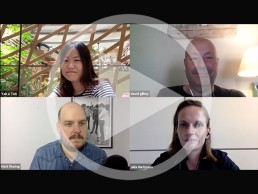
Decorex | The Edit - Nature & Biophilia in Lighting Design

Originally recorded for The Edit at Decorex, arc Editor Matt Waring hosts a panel discussion with Yah Li Toh (Light Collab), David Gilbey (d-lighting) and Julia Hartmann (lightsphere) on Nature and Biophilia in Lighting Design.
In this session, the panelists break down what biophilia is in relation to lighting design, and discuss how lighting can enhance wider biophilic designs.
Video courtesy of Decorex.
www.decorex.com
www.lightcollab.com
www.d-lighting.co.uk
www.lightsphere.ch
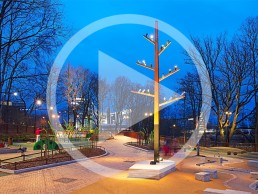
Valmont Structures: Koli Tapered Wood Poles

Decorative Koli wooden poles from Valmont Structures are naturally captivating and sustainably resourced. These square tapered Koli columns bring unique personality to pedestrian and traffic areas through natural beauty and creative application.
Valmont harvests the raw materials from sustainably managed, PEFC certified forests and manufactures the shafts from GL28h glued-laminated timber. Beautiful, environmentally friendly - just one way the company conserves resources and improves life.
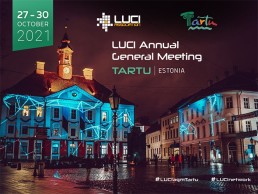
LUCI to hold AGM during TAVA2021
The LUCI Association is hosting its Annual General Meeting next week (27-30 October) in the Estonian city of Tartu, to coincide with the TAVA - Tartu in Light festival.
A key event within the LUCI network's calendar, the LUCI AGM is the only international forum for cities on urban lighting. The event will feature plenary conferences, working group meetings and open conference sessions on new lighting trends and projects from cities around the world.
Although hosted in Tartu, Estonia, the AGM will be a hybrid online/on-site conference, showcasing the city's lighting projects, as well as the TAVA - Tartu in Light festival.
Some of the themes and discussions taking place during the AGM include:
- Lighting in European Capitals of Culture
How have previous, future, and recently awarded EU Capitals of Culture integrated lighting into their wider cultural policies?
- Beatriz Garcia, Associate Director of the Centre for Cultural Value
- Helen Marriage, Director, Artichoke / Creative Director, Galway 2020
- Piia Rantala-Korhonen, Director of Oulu2026
- Massimiliano Burgi, Project Manager for Lumen-Social Light, Matera 2019
- Smart steps towards smart lighting
How can cities build their vision on smart lighting, choose their paths, and take steps towards realisation?
- Helene Qvist, Smart City Consultant, City of Albertslund
- Zoltán Pap, Managing Director, BDK Budapest
- Rik van Stiphout, Programme advisor Light & Culture, City of Eindhoven
- Youngho Baik, Member of Advisory Committee Urban Lighting Seoul
- Philip Ross, Studio Philip Ross, co-author of the white paper
- Lighting projects from cities worldwide
Speakers from cities worldwide will be presenting projects and research on diverse topics such as light’s impact on health, lighting masterplans, public lighting design criteria, measuring light pollution, real-time smart lighting and more. Hear about projects in Helsinki, Kazan, Lyon, Brussels, Medellin, Pessac, Putrajaya, Reykjavík, Tallinn and Vilnius.
- Light and light art in Tartu
Learn about host city Tartu's urban lighting and light art projects, join a fun lantern-making workshop and experience the TAVA - Tartu in Light festival.
Online participation is free and attendees can register here.
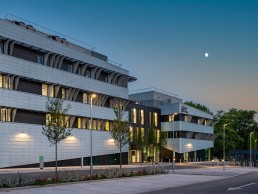
DW Windsor acquired by Luceco
(UK) – Luceco, manufacturer and distributor of high-quality wiring accessories, LED lighting, and portable power products, has acquired the entire issued share capital of DW Windsor Group.
DW Windsor Group, based in Hertfordshire, UK, operates through three business units – DW Windsor, Urban Control and Pulsar. DW Windsor specialises in the design and UK-based manufacture of high quality outdoor and streetlighting equipment for the specification market; Urban Control provides network solutions for infrastructure assets facilitating data collection and control, including the monitoring and control of streetlights; Pulsar supplies architectural floodlighting solutions for landmark buildings across the world.
The business will continue to operate from its existing headquarters and the senior management team will remain with the business post-acquisition.
John Hornby, CEO of Luceco, commented: “DW Windsor is one of the strongest brands in the UK’s specification exterior lighting industry with a strong track record of delivery on public sector lighting projects and impressive network technology credentials. It is highly complementary with the Group’s Kingfisher Lighting business, which supplies non-public sector projects, and we are excited about the opportunity to offer the expanded product portfolio to both customer groups.”
Terry Dean, CEO of DW Windsor Group, added: “I am delighted that DW Windsor Group has been acquired by a new owner who understands our industry, can support the next phase of growth and offers a wealth of opportunities for our team. I will continue to lead the business and I look forward to working with John to bring the two companies together.”
www.luceco.com
www.dwwindsor.com
Applelec: Green Applelec LED Light Sheet
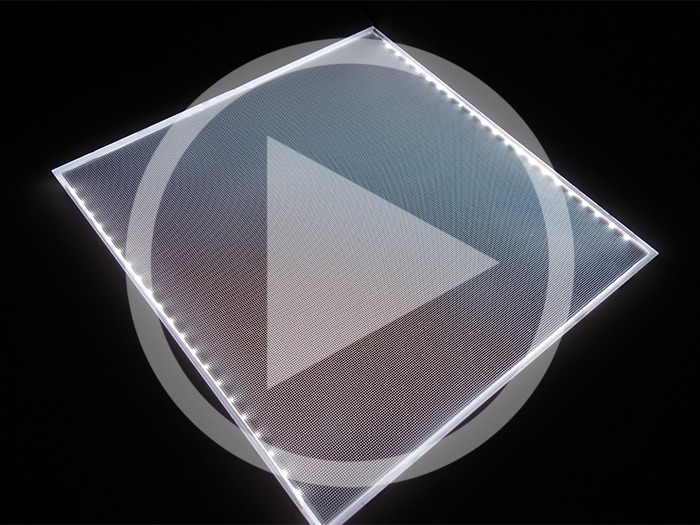
Supplying the design industry with the first, fully environmentally friendly light panel, Applelec Lighting announces the launch of its Green Applelec LED Light Sheet.
Manufactured at Applelec’s West Yorkshire premises, Green Applelec LED Light Sheet has been developed to help improve its carbon footprint, whilst still delivering a premium backlighting product. Providing a more sustainable option, Green Applelec LED Light Sheet is the first light panel to utilise recycled and recyclable materials.

Buro Happold and Paladino join forces
(USA) – As part of a concerted effort to improve its sustainability consultancy offering to clients, Buro Happold has acquired Paladino Company, one of the world’s leading sustainability consultancies.
Having worked together on a number of world-renowned projects for nearly a decade, the two companies have helped to deliver some of the most innovative engineering and design solutions, such as the Tower at PNC Plaza in Pittsburgh, PA – a LEED Platinum-certified project that has been dubbed “the world’s greenest high-rise”.
Paladino Company is internationally recognised as a climate action trailblazer, and work with world-leading multidisciplinary engineers and consultants. The acquisition increases Buro Happold’s breadth and depth of expertise to help architects, developers, corporations and the public sector use sustainability as a business tool.
The move also creates a platform for the continued growth of Paladino and Company. The firm is known for bringing wellness, resilience and sustainability to real estate projects, into new sectors and US markets, working with clients to minimise costs, increase profitability, create market demand and increase occupant satisfaction through its building design and operations.
Mike Seyle, United States Regional President, Buro Happold, said of the move: “Driving our growth strategy in the United States, joining forces with Paladino and Company not only broadens our geographical reach but also enriches our sustainability strategy and consultancy offerings to our clients. Both Buro Happold and the team at Paladino recognise the pressing global challenges of climate action, community building and human wellness that require solutions at scale.”
Tom Paladino, CEO of Paladino and Company, added: “Formalising the collaboration between our likeminded firms will bring a new level of speed and intensity to our sustainability solutions. Our boutique consulting DNA pioneering playbook and diverse national client base add points of leverage to Buro Happold’s mature platform. This expanded practice field [of offering] creates space for our people to learn and grow, which in turn will grow the firm.”
James Bruce, CEO of Buro Happold, concluded: “This exciting move underscores not only our core expertise area but also our commitment to climate action and to delivering sustainability solutions for all our clients. Having worked alongside Paladino and Company for nearly a decade, it’s a natural evolution to formally bring them into the wider Buro Happold portfolio to create significant new opportunities for our clients.”
www.burohappold.com
www.paladinoandco.com

Luminii acquires Precision Lighting and RCL
(USA) – Chicago-based manufacturer Luminii has announced the acquisition of two British lighting manufacturers: Precision Lighting and Remote Controlled Lighting (RCL).
Precision Lighting and RCL are sister companies under common ownership and management that produce individually unique product lines. By bringing both brands into the Luminii fold, it is hoped that it will allow the collective companies to broaden their global reach into new territories, while enabling Luminii to further innovate by engineering new LED lighting technologies and products that service commercial and residential markets.
Jeff Parker, CEO of Luminii, said of the acquisition: “The mutual benefits of this dual acquisition are far-reaching. With the addition of Precision Lighting and Remote Controlled Lighting, we are well positioned to immediately expand our product offerings across geographies, including the US, where we are already well established.
“The company is concentrating heavily on engineering efforts in the miniaturisation space, as evident from our Stenos launch earlier this year. With Precision Lighting’s micro-lighting products and systems, we can now offer a broader range of micro-LED solutions to our customers while also expanding opportunities globally to introduce Luminii’s flagship products in major hubs including London, Europe and the Far East. RCL also brings an entirely new category of remote-controlled lighting solutions, opening doors to be specified into applications we were previously unable to support.”
Alex Ruston, Managing Director of Precision and RCL, added: “We are delighted and I can’t imagine a better partner to accelerate our growth worldwide. Luminii’s track record and complementary product strategy felt naturally aligned to ours, making this an easy decision for our team. With our distinctive product innovation in the micro-LED and remote lighting category, and Luminii’s linear expertise, we feel we have an amazing opportunity to multiply our joint innovation in the lighting space.
“The US has been a vastly untapped market for both Precision and RCL. This strategic company advancement with Luminii helps us further diversify our customer base, expedites our product visibility in the US, and gives us the momentum we need to bring our products to new markets.”
www.luminii.com
www.precisionlighting.co.uk
www.rclighting.com
eldoLED: Tunable White Lighting Reimagined
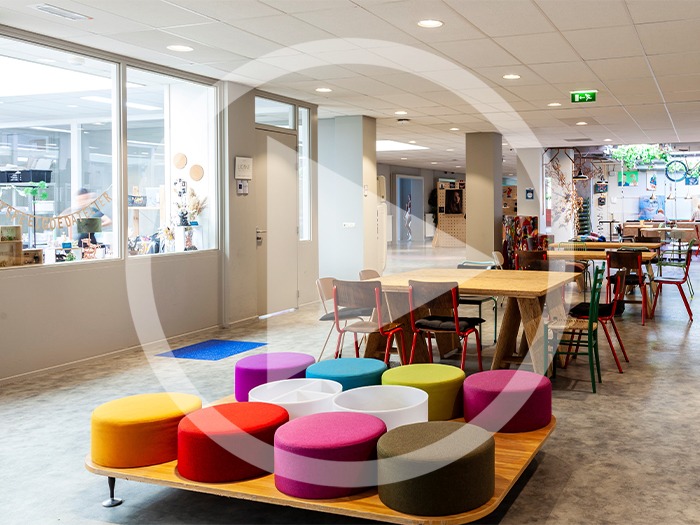
eldoLED has implemented Human-Centric Lighting for the Handelshuys renovation in Uden, the Netherlands. The company’s LED drivers with its signature LightShape technology resulted in perfect Tunable White lighting for a flawless flicker-safe and deep-dimming experience. This solution paired well with eldoLED’s Bluetooth radio for Casambi wireless control. View the results and specify LightShape for your upcoming projects.
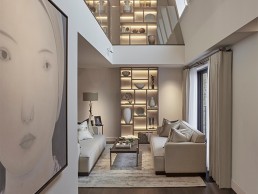
Sally Storey publishes new book
(UK) - Sally Storey, Founding Director of Lighting Design International and Creative Director of John Cullen Lighting, has published a new book in partnership with RIBA Books.
Entitled Inspired by Light: A design guide to transforming the home, the book aims to provide practical insight to designers with an abundance of visual inspiration on successful lighting solutions and schemes - from the fundamental principles of lighting design, to working with LEDs, to advice on lighting unusual spaces.
Accompanied by lavish photography and accompanying lighting plans, Inspired by Light looks to showcase the most up-to-date information on trending and lighting technologies that aim to transform how light is used within a space.
Speaking of the new book, Storey said: “With the arrival of LEDs, which revolutionised the industry, I felt that a book that explored how to use this new tool would be of benefit to the industry. There is very little advice currently available for designers and the design savvy to fully understand how to select LEDs. The outlining of all the important technical elements within the book is critical to the understanding and proper selection of LEDs, and to illustrate the various techniques that can be used and how they are important to distinct styles of interior.
“Good LED technology has allowed for greater opportunities and benefits within the industry, due to its miniaturisation, which allows for more discreet integration into architecture and joinery. With LEDs lasting longer than ever before, it is so important to get the lighting right from the outset or it will be a costly mistake.”
Throughout the book, Storey draws inspiration from across the UK and around the globe, including a contemporary villa in Dubai and an alpine chalet, and presents a variety of interior and exterior real-world projects old and new large and small.
With its visually engaging and approachable style, it is hoped that the book will provide a fascinating insight into current and emerging lighting technologies, and will appeal not only to architects and designers, but anyone interested in making the most of lighting at home or at work.
Inspired by Light is available now on the Riba Books website.
www.lightingdesigninternational.com
www.johncullenlighting.com
