

SLL Pockets of Light
Held in her own hometown of Abbots Langley, UK, Kristina Allison, SLL President Elect, organised a Remembrance-themed edition of Pockets of Light, hoping to inspire a future generation of lighting designers.
This November, the Society of Light and Lighting (SLL) brought its popular Pockets of Light event to the small village of Abbots Langley, situated just outside Watford, UK.
Pockets of Light, for those not in the know, is an event based around bringing lighting to the next generation through engagement with schools.
The pop-up event aims to provide pupils of varying ages the opportunity to engage with lighting equipment to test out their effects, before setting them a task to design a lighting scheme for a building façade, which is then brought to life by supporting lighting designers and manufacturers.
Pockets of Light, as an event, was made famous by the UK-wide Night of Heritage Light event in 2015, led by Liz Peck. It has since been delivered at a number of locations, by different people with different schools all around the UK.
Rather than being fixed annual events, Pockets of Light are instead down to individuals or teams with a drive to undertake the event and go into schools to talk about light and lighting design. This year, Kristina Allison, Environmental, Sustainability and Net-Zero Lighting Capability Lead at WSP, and President-Elect of the SLL, felt that drive, and decided to bring the event to her own hometown of Abbots Langley.
Speaking with arc, Allison says: “Last year, after seeing all the wonderful photographs from Light Night Leeds, led by David Battersby (Gamma Illumination) and Dan Lister (Arup), I wanted to have a go at doing my own version of Pockets of Light in my local community, at St Lawrence Church in Abbots Langley, Hertfordshire.
Typically, although not always, Pockets of Light events have been hosted at churches or cathedrals – “the intricate nature of the architecture lends themselves nicely to being artistically lit,” Allison adds. So, with this in mind, and armed with an array of beautiful photos of past PoL events, she set to work to get the local community on board with the event.
“Initially, I contacted the St. Lawrence Church, and they were very receptive to the idea. The next critical step was to have the involvement of the local schools; I reached out to Parmiters, St. Michael’s Catholic High School, and Future Academies Watford, who are all close to the village.
“I pitched the idea of the STEM lesson and the Pockets of Light event, and all were keen to be a part of it. It is a bit of a challenge to get through to the right people at the school and hope that they will be receptive to the idea. It was my aim to provide the STEM lessons in lighting design for secondary school-aged pupils. I think this is an important time in education, and a time when we start making decisions about what we might like to do after school life and for a career. I also feel that this is the time where school pupils will have had little to no exposure to lighting as a career option. This is often confirmed when asking a lighting professional now ‘how did you get into lighting?’.
“There was an extra special part in making this all happen – very close to the village is the Warner Brothers Studio Tour in Leavesden. Again, I managed to get in contact with the right people and pitched the idea. Keen to support the local community, Warner Brothers offered to fund the event and to give tickets for the Harry Potter Experience tour to the design winners.
“All the wonderful people and companies who contributed to the STEM lessons and the event were so willing to support me in making this event happen. I think this is maybe for a few reasons – firstly, because people are nice generally and like to help in STEM community projects; and secondly, because the creative arts industry isn’t so well funded by government, the community (both at large, and the lighting community) step in to make things like this happen.”
As the event was held in early November, Allison and the involved parties settled on a theme of ‘Remembering Remembrance’. “I discussed theme ideas with the village church, and we thought, if there were to be a theme, what could it be? We all agreed that the event would be held the evening before Remembrance Sunday, so the timing of it would suit the theme of remembrance too,” explains Allison.
“And as St Lawrence Church is an 800-year-old Saxon church, with a lot of architectural interest and a rich history with a war memorial at the front, it seemed like the perfect theme for this Pockets of Light.”
With a theme in place, Allison prepared a STEM lesson presentation, covering the fundamentals of lighting, lighting techniques, materials and textures, and examples of how to apply them. The lessons were delivered to 76 GCSE year 10 and year 11 age pupils (14-16 year olds) who, Allison says, were “so curious and engaged with the lighting equipment laid out on the workshop benches”.
“Having the opportunity to explore the lighting products, what they did, and the lighting effects they created was new to them – it was exciting.”
The event was supported by lighting manufacturers Architainment, Architectural FX, iGuzzini, Martin Architectural, Tryka, Urbis, and Thorlux – all of which supplied equipment for the STEM lessons and event. Matthew Wright from Martin Architectural joined Allison on one of the lessons, bringing with him a moving gobo projector. “The pupils loved seeing the colourful patterns projected onto the otherwise plain wall,” Allison recalls.
“After the lighting design lesson, they then experimented with the lighting equipment I set up for them to play around with. I set them a task to sketch their design ideas onto line drawings of the church façades that I had pprepared on paper, and illustrate the lighting techniques they’d learnt during the lesson.
“This is another key part in STEM and Pockets of Light – having the unique opportunity to play with lighting, to understand how light behaves and explore the effects that can be made. Once the school STEM tour was finished, the designs were then reviewed based on creative, technical, theme, and buildability merit, with four winning façade lighting designs selected to realise as part of the event.”
Allison selected four winning designs alongside a team of lighting professionals that included Matthew Wright and Sean O’Callaghan, Martin Architectural; Juan Ferrari, Hoare Lea; Ryan Rolph, Tryka; Helen Loomes, SLL; Simon Fisher, FMark; and Scott Pengelly, Urbis Schréder.
It was with the support and coordination of this team that the lighting equipment needed to realise the winning designs was pulled together on time. After a day of setting up, the event itself was a big success, and Allison was overwhelmed with the support that it received from the local community.
“Light has that ability to bring people and communities together, this was clear on the night of the event, where more than 200 people from the local areas came out on a cold November evening to see the creativity on display,” she says.
“Following the event, I have received many positive comments too – the schoolteachers and the pupils came along to see their creations realised and were thrilled; the church commented on how it had ‘once again put the church at the heart of the community’. Another particularly poignant comment I overheard on the night was that it ‘nearly brought me to tears’ – the theme of remembrance combined with the wonderful designs from school pupils really hit a chord with the public on the night.”
Immediately following the event, Allison recalls that she felt “a bit taken aback”, left reeling from the organisation that went into the event, but also the overwhelming feedback that she received.
“So much thought and organisation had gone into pulling it all together, I was still taking it all in,” she says. “The photographs from the community were showing up on social media and on LinkedIn posts, it was beautiful how the lighting design community had supported me, and how the local community loved it. I’m still a bit in awe of all that were involved.
“I have been invited to go back to the schools, and the church is interested in hosting the event again, so from a community engagement perspective, all my hopes and goals for this Pockets of Light event have definitely been met. I hope someone else will see these photographs and, like I was, be inspired to take on the challenge and organise their own version of Pockets of Light.”
The chief aim for the event though, Allison feels, was to engage the next generation in the power and magic of lighting design – something that she feels was a big success.
“The ultimate goal was to pass on knowledge of light and lighting design to school age pupils, and to show them what a career in lighting might entail. Lighting is such a fascinating subject, including product design, creative, and also in technical ways.
“Maybe the lessons gave a general appreciation of the lighting used within our built environment, or hopefully planted a seed in a pupil’s mind for a future career in lighting.”

David Morgan Review: Organic Lighting FortaCast
FortaCast, the latest in-ground linear lighting system from Organic Lighting, incorporates several innovative and patented design features. Keen to find out more, David Morgan takes a closer look.
There are many points of entry for people working in the lighting industry, from the purely artistic to the highly scientific. In the case of Laurence St. Ives, the founder of both Organic Lighting and Orgatech Lighting, his way into the market was as an importer of German and Italian office furniture designed for use with desktop PCs in the 1970s.
As the use of PCs became widespread, minimising glare on computer screens from overhead fluorescent lighting was a major concern. To address this issue Laurence developed the first free-standing high lumen output office up-lights, helped by some lighting design and optical development from Stanley Lyons at Thorn Lighting, whose company manufactured the metal halide lamps.
Orgatech in the UK was founded in 1976 to sell these up-lights, quickly followed in 1979 by the launch of a USA company, which is still running today. Laurence moved to the US in the 1980s, first to New York and then to California.
Organic Lighting was created in 2002 as a sister company to Orgatech Lighting to focus on colour changing LED lighting and, in 2009, with the advent of white LEDs, it is claimed that Orgatech became the first in the USA to introduce professional-quality flexible lighting strips.
The latest luminaire development from Organic Lighting is the FortaCast in-ground linear lighting system, which incorporates several innovative and patented design features.
In-ground linear lighting systems have become a popular tool for creating lines of light for exterior and interior lighting applications, but they have proved problematic for electrical contractors to install and to maintain.
To overcome these issues, the FortaCast bodies are made from glass reinforced concrete (GRC) and are designed to be installed by paving, general contractors, and landscaping contractors rather than electrical contractors.
The IP68-rated flexible Aqueon LED light engines used in the FortaCast system are a separate element from the GRP housing and are installed and removed via the last section in the run, with the help of miniature nylon rollers built into the housing.
FortaCast GRC bodies can support a drive overload of up to 4,500kg and are available in a variety of colours and surface textures to coordinate with other paving and landscape materials. It is understood that the GRC materials used have a lower carbon footprint than cast concrete due to the higher percentage of glass and aggregate in the mix.
The FortaCast system includes four standard profile sizes, offering various lengths in each size, standard radiused sections, corner sections, angled-joint sections and end sections, which act as the insertion point for the LED light engines. In addition to the standard shapes and sizes, Organic Lighting can develop custom-shaped housings to meet project requirements – for example to accommodate road cambers or irregular surfaces. The smallest section profile in the range is 51mm wide x 70mm deep with a 29mm wide window. The largest section profile is 102mm x 102mm with a 51mm window.
The standard circular sections are based on the mid-size 76mm x 76mm profile with nominal diameters of 1.2-metres, 0.9-metres and 0.6-metres.
The Aqueon LED light engines incorporated in the FortaCast system are available in fixed white colour temperatures from 2700K to 5700K, in amber, tuneable white, RGB and RGBW versions. Power consumption of up to 6W/m for the white light engines and 9 W/m for the RGBW type. Dimming and streaming pixel DMX control are both available.
The light engines are factory sealed and submersible with a rated life of 60,000 hours. The maximum light engine length is 15-metres and at the end of life the old light engine can be removed and a new one inserted without having to remove the top covers or disturb the housings along the FortaCast run.
The installation instructions for the system are detailed and a little daunting, including a requirement for the contractor to have at least five years’ experience and preferably certification from the Interlocking Concrete Pavement Institute.
The GRC body sections are aligned together with a joiner piece, which includes drainage channels. The mating surfaces are then bonded together on site with a special adhesive. Once all the housing sections are in place and protected with a removable cover tape, then the paving or concrete floor can be installed.
Once the floor is complete, the final assembly can be made. At this point the rollers are installed with some silicone grease to aid the insertion of the flexible light engine, and the two-part windows are bonded in place. A lower laminated glass window is bonded to the primed concrete surface first with a high shock absorbing performance tape. Then the top diffusing PTFE window, which is provided with an adhesive lower surface, is bonded directly on top of the glass. Joints between the windows are then sealed with silicone.
The FortaCast system has been developed to make long-term maintenance and replacement of the light engines as simple as possible in order to give a potential life expectancy of up to 30 years. It is refreshing to see such a fully developed lighting system that offers maximum creative opportunity to the lighting designer while also being highly functional and maintainable.
Portland International Airport, USA
Considered a source of pride for the local community, phase one of Portland International Airport’s renovation was revealed this summer. The newly designed space introduces biophilic elements that create a tangible connection to its Pacific Northwestern surroundings. Fisher Marantz Stone collaborated with ZGF Architects in illuminating the new-look terminal.
Seeing your local airport as a beloved source of pride may seem, to many of us at least, an unusual viewpoint to have; but then, Portland is an unusual place.
The slogan “Keep Portland Weird” has come to typify the Oregon city in recent years, and this was one of the driving forces behind the lighting design for the recent renovation and expansion of Portland International Airport (PDX).
“While I’m sure ‘Keep Portland Weird’ means various things to different people, in the context of this project, it reminded us to keep our focus on creating a warm and inviting experience for the traveller that was decidedly in and of the great American Northwest,” said Charles Stone, Founder of Fisher Marantz Stone (FMS), the lead lighting designers on the project. “By that, we mean that our lighting would support a constant connection to nature, the forest in particular, in an environment that tells you that you are home when you arrive in Portland.”
The constant connection to nature, and to Oregon’s beautiful, verdant landscapes, was also a primary design focus for the architects, ZGF, who sought to “evoke the feeling one gets while walking in the forest”.
Jacob Dunn, Principal at ZGF, adds: “The idea of a walk in the forest makes all the sense in the world given where we are in the Pacific Northwest. This drove us down a lot of different pathways, everything from the use of wood, respecting and being good stewards of this important cultural and natural resource, to the way that we think about light in the space, looking at different lighting archetypes and how we experience light as we are taking a hike through the woods.”
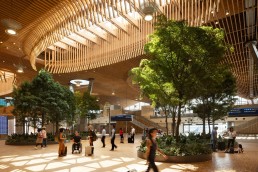
Central to this woodland theme, the renovated airport is now characterised by a vast, undulating, nine-acre mass timber roof.
Designed to celebrate Oregon’s history of forest product innovation, the wood used here was all sustainably and locally sourced from landowners and mills within a 300-mile radius of the airport, including sustainably harvested wood from small family forests, community forests and tribal nations.
Expansive glazing, coupled with 49 skylights across the site, provide views of the airfield and the surrounding forested landscape, as well as allowing for ample natural light inside, all further highlighting the design decision to reference the state’s natural beauty and cultivate a strong sense of place within the airport.
Through collaborations with Terrapin Bright Green and landscape architect PLACE, ZGF applied the concept of biophilia holistically throughout the airport. As a result, almost every corner of the terminal features touches of Oregon’s greenery and ample access to natural light. Pathways are filled with trees and plants, with 72 large trees – some up to 25ft tall – located at the seam and throughout the terminal; cascading gardens; and more than 5,000 strategically placed plants. The landscaping provides a sense of wandering through a forest, and acts as a wayfinding tool that guides passengers from security checkpoints to their ultimate destination.
The introduction of this lush greenery also helped to “break down the scale” of the airport and further enhance its position as a “beloved community architectural gem”.
Dunn continues: “We were expanding the footprint of the airport, but we didn’t want to feel like a faceless box, with a giant roof and a bunch of things happening on the ground. ZGF travelled with the PDX leadership to tour the latest and greatest airports, and this was one of the main criticisms – the airports were great, but they felt like people processing machines with one giant roof and a nebulous space below.
“So, the roof and the use of daylight was a big part in terms of defining the rooms within the terminal, and to make it feel like more of an episodic continuum from space to space, with clear thresholds defined by the geometry of the roof, and the experience from the light and skylights as you move through the different spaces.”
Such a clear focus and ambition from the architects meant that realising the lighting concept was relatively straightforward for FMS, as Stone explains: “Fortunately, the architect and landscape architects made it easy for us.
“When you stand in the terminal and look around, you are surrounded by a world of warm timber and oases of green. We provided a balanced illumination of the wonderful natural materials – mostly timber, and the abundant live greenery.”
Central to the lighting design was the introduction of 400 bespoke fixtures, that significantly contribute to the overall warmth of the terminal, highlighting the materiality of the timber roof, as well as providing general illumination to the space.
“The extraordinary custom, individually addressable, die cast aluminium pendant fittings evenly distribute 3000K, warm light onto the undulating roof, while downward light is a cooler 3500K,” Stone continues. “The shape of the fitting was derived from a classical form, but of course the visual texture created by the tines does take us back to one of the initial directives of ‘Keep Portland Weird’. These fixtures are more than a metre across at the top, but in the scale of the Terminal building, they don’t look large at all.”
These custom pendants work alongside a meticulously planned daylighting strategy, which consists of skylights of different shapes and sizes that filter daylight through the mass timber roof’s lattice and large-skylight openings, illuminating 60% of the terminal alongside the custom hanging fixtures.
“The various typologies of skylights were tuned to the ways in which we experience different types of light in the forest, but also in terms of their programmatic requirements for glare and functionality below,” Dunn continues. “We also looked at the way that light registers in a three dimensional field of objects; if you take a typical skylight, it’s just a plane – the roof and a hole – and the light comes through, it doesn’t catch anything other than maybe the skylight curve, but in a forest there are all the different trunks and branches and leaves in the canopy that catch and register that light in unique ways. Even the way that we articulated the lattice so that it would catch and refract and bounce around that light was something that was taken directly from these natural lighting archetypes that we had seen.”
Alongside this, depending on the space below, extra attention was taken to the type of glazing installed. In the ticket hall, for example, the skylights were frosted with frit to create more of a diffuse daylight effect, akin to the morning fog of a coastal forest. This, Dunn explained, served two purposes: it evoked another forest-like feeling, and also reduced the amount of glare for staff working in the ticket hall below.
Further to this, ZGF and FMS collaborated on some very sophisticated calculations and metrics surrounding the light levels and energy efficiency.
Dunn explains: “We had a couple of metrics and goals that were set forward, partially driven by our certification requirements, but also thinking about what the right metrics are to help drive us to create the right kind of space in terms of the way that it felt, and then also how much energy we saved. We knew that the daylighting was one of the key energy efficiency saving measures that we were employing, so we really wanted to make sure that we had enough light that made a significant impact on the energy use of the building as well.
“Usually, what we would do is look at spatial daylight autonomy, daylight simulation metrics, and generally there’s a single point in time in metrics where we use computer simulation to say, ‘during 9.00am on the Equinox, how much of this floorplan gets above a certain threshold of footcandles?’
“Then at some point, our calculation processes got more sophisticated. We said, ‘we care about 9.00am on the Equinox, but we also care about every hour the space is occupied’. We looked at annual simulations, which just explodes the way that we have to think about it, because now it’s a temporal metric over space. Our threshold became that we wanted there to be a 50% spatial daylight autonomy, which means 50% of the space is adequately lit for more than 50% of the time, and that then becomes a good benchmark that says it is going to feel like it’s daylit for most of the time, and we’re going to achieve those daylight savings.
“However, Portland is a really interesting animal – we have predominantly cloudy winters, and almost completely sunny summers, and the annual metric hides a lot of the nuance around designing for these conditions. This was all conversations that we had with Charles and the FMS team about what we use to drive this; we ended up focussing on the cloudy condition, because we know that we want the place to feel daylit on a typical cloudy Portland day in the wintertime.
“We also looked at very detailed tracking simulations and tools and methodologies to make sure that the sun was in the right place at the right time. Charles was a huge help with this, because when we were looking at what kind of visual contrast ratio is going to be acceptable versus painful in this situation, he could use his experience to say roughly what we should be shooting for.”
Speaking of the collaborative process between the architects and lighting designers, particularly on the daylighting strategy, Stone adds: “We spent a great deal of time together considering the roof apertures, the nature of the curves of the ceiling, dimensions and colour of the timber, treatment of the space above the timber slats, and other aspects of materiality, reflectivity, and aperture characteristics.
“We also carefully considered the character of the glazing, the overall light transmission, and the external shielding strategy; all around the compass of the curtain wall perimeter of the Terminal. Consideration of contrast ratios and glare were of paramount concern in our studies. A 365-day, quantative daylight analysis was performed. Physical models were built and studied. Yes, we spent a lot of time together on daylighting.”
On the sustainability targets, Stone added: “Of course PDX is a LEED (pursuing Gold) building and uses all LED sources – but so is every large project today. I think the magic of the sustainability of the lighting is in the daylighting design and its integration with electric light. ZGF produced exhaustive studies to ensure that the design maximises daylight utilisation. This is quite a challenge in the Portland climate where winters are grey and dark, and summers are replete with abundant sunshine and long days. The controls system designed by PAE is the other piece of the puzzle. As the system is commissioned and finetuned, PDX will substantially reduce electrical lighting costs.”
The abundant natural light in the space, coupled with over 70 fully mature trees and more than 5,000 plants throughout the interior landscape, strengthens the project’s biophilic ambitions, which also included more “indirect experiences of nature”, such as the non-uniform wood grain in the roof beams, the “biomorphic forms” of the domes and roof vaults, and even the “water ripple pattern” in the flooring, designed to evoke the flow and movement of the Columbia River, which runs through the Pacific Northwest.
The lighting further contributes to this feeling, particularly after dark, when the electric lighting can take centre stage. “If you walk about the terminal at night, you will see our dappled light concept in the areas of the trees and other greenery,” Stone adds. “We were able to introduce a higher contrast ratio to enhance visual interest than you would find in most airports. There is also crucial supplemental horticultural lighting.”
All of these design decisions help contribute to an environment that, in a marked contrast to typical airport settings, alleviates stress – something that was of primary concern for all parties involved.
“A big goal for the port was to destress the experience of travel, because often it is way too stressful,” says Dunn. “A good example of this is in one of my favourite spaces of the airport, right after you go through security and into the ‘recomposure area’, where you’re putting your belt and shoes back on. In most airports, you have to carry your tub to a crappy bench at the end of a security line or tucked away in the corner – it’s the least dignified experience after going through security. But for PDX, it’s a wonderful experience.
“You go through security, which has a higher ceiling with lower equipment, that creates a vista that pulls you through and makes it feel more open. There are then custom benches that are a series of planters either flush with the ground, or raised up to form seating, so when you’re around these full grown trees that are underneath this beautiful skylight, the sun’s coming in, it’s hitting those trees and creating a dappled light effect that connects you to nature as you go through this experience that could be really stressful. That is a perfect example of how, by being more biophilic, you create a better experience than the typical recomposure experience that you get from other airports.”
As a well-seasoned traveller, Stone agrees that the new design of the terminal has contributed greatly to an altogether more harmonious aesthetic. He adds: “I truly believe that the variety of visual experiences we helped create at PDX is going to make it a traveller’s favourite. Every time I walk through the Terminal, I say ‘Oh, wow!’. I’m a rather jaded, ‘millions of miles’ traveller, and PDX still thrills me.”
Another feature Stone was particularly impressed by was ZGF’s decision to prefabricate the new roof right next to the existing building, meaning that the airport could remain fully operational while the renovation was taking place.
Dunn explains this process in more detail: “One of the goals for the project was that we could not impact flight schedules at all – all work had to be done while the airport was 100% operational. This was a challenge, but it was achieved through the prefab onsite, next to the terminal building. This meant that it could be getting erected, and demolition could be happening at the same time. We would then move the new roof across the airfield by crane between 12 and four in the morning when there were no aeroplanes. It then took around two days for them to get connected to the building, which made it possible to keep it operational throughout.”
“The architect’s solution of building the new terminal roof at the other end of the airport, then moving it over the existing Terminal, and demolishing the old is just brilliant,” Stone adds. “We basically designed most of our work for a ‘new’ building. Tremendous cost savings were achieved by the overlapping construction technique; and the freedom it gave the design team helped produce a stunning result.”
Indeed, the completed part of the project – phase one of two – showcases what can be achieved when both architects and lighting designers push towards the same, biophilic goal. The marriage between architecture and lighting across the renovated terminal creates an atmosphere rarely seen in airports – one of rejuvenation and warmth.
Dunn was effusive in his praise of the lighting design, and the way in which it enhances the materiality of the architecture: “It is an incredible design – it reminds me of some of the cathedrals that I visited in Europe when studying abroad, it’s so thoughtfully designed.
“I love the hanging pendant strategy to give additional space to the occupied zone, to mediate that space between us and the roof structure with the combination of down and up lighting. This also reflects a nuanced understanding of how we experience light in the space. The uplighting of the pendant to light the bottom part of the domes of the roof was a fantastic move to be able to celebrate the architecture, and to engage with the way we experience light through surface brightness – through luminance vs illuminance. Overall, it animates the space in a way that is referential to the architecture, and also the way that we experience life.”
Stone adds: “The final product really looks like the renderings, and verifies the quantitative studies that were done. We built so many models and mock ups of the pendant light fitting and the ceiling that we knew exactly how it was going to look – except for the massive scale, I wasn’t prepared for that.
“We ran a many-stepped, reiterative design process. I am pleasantly surprised, but I had a lot of faith in the studies that we did. The effect of the warm, glowing roof, its visually interesting patterns, the curious and unique pendant, and the greater than average contrast ratios, are the secret sauce. The response from the travelling public has been fantastic too – Portland has something new to be proud of.”
Speaking of pride, Dunn shares how he has seen, first hand, the positive response from the local community towards the new-look terminal. “I was dropping my son off at school, and one of the other parents in our group said ‘has anybody seen the new Portland airport? It’s incredible,’ and they said to me, not knowing that I had worked on it, that they were moved to tears. That was one of the most rewarding experiences of my life,” he says.
“We knew it was a high risk, high reward kind of project. There was a lot of pressure to do a good job, because we knew the stakes and how much the community loved this airport, but we couldn’t be happier with the way that it turned out.”
Such local pride in an airport may seem weird to some of us, but Portland is a weird place. Let’s keep it that way.
WILD Announces 2025 Board of Directors
(USA) – Women in Lighting Design (WILD), an organisation dedicated to empowering women in the lighting design industry, has announced its new Board of Directors for 2025.
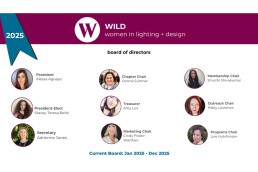
Alessa Aguayo will be returning as President, while Amy Lux, Haley Laurence, Cindo Foster Warthen, and Louis Hutchinson will stay on as Treasurer, Outreach Chair, Marketing Chair, and Programs Chair respectively.
New addition to the board include Stacey Teresa Bello as President-Elect, as well as new Secretary Adrienne Jones; new Chapter Chair, Donna Summer; and new Membership Chair, Shruthi Shivakumar.
Following the announcement, Stacey Teresa Bello, says: “I am honoured to accept the position of President-Elect and am looking forward to working with the incredible group of women on the WILD. The work that the board has accomplished and continues to do for the advancement and visibility of women in the industry is extraordinary, and I can’t wait to contribute.”
Donna Summer, new Chapter Chair, adds: “I am honoured and thrilled to be selected as the incoming Chapter Chair for the WILD board of directors. This is a moment of immense pride and excitement for me, and I am grateful for the trust and confidence placed in me.
“WILD’s mission of equity and inclusion is close to my heart. As we move forward, I am eager to work with our dedicated board and members to engage with our existing chapters, foster new ones, and expand our connectedness within the lighting industry. I am excited to contribute to this mission and to collaborate with all of you to create a brighter, more inclusive future for our industry.”
WILD is a volunteer-run organisation dedicated to empowering women in the lighting design industry. Through networking events, educational workshops, and mentorship programmes, WILD provides a supportive community for women in all stages of their careers, and advocates for equity, dignity, and autonomy for women and the benefits of a gender-balanced industry.
www.womeninlightinganddesign.org

Rachel Gibney promoted to Principal by Available Light
Available Light has announced the promotion of Rachel Gibney to Principal.
“Rachel has been instrumental to the growth of Available Light from designing world-class projects and running our Core Design Process Committee to opening and managing our Phoenix Studio,” said Steven Rosen, Founder and President. “Over time, she has deeply absorbed and contributed to our aesthetic, culture, and design process. At the same time, her desire to enhance our team’s technical skills—generating computer daylighting studies, developing virtual real-time 3D presentations, studying the effects of light on humans, and more—has made Rachel a real boon to the firm. From higher-ed STEM complexes to museums, Rachel uses light to tell meaningful and compelling stories with lasting impact. Rachel’s design skills and collaborative spirit are of great benefit to our clients.”
Gibney joined the firm as an intern in 2013 and steadily progressed through the ranks from Junior Associate to Associate, before opening the Phoenix Studio in 2022, where she served as Associate Principal. Prior to joining Available Light, Gibney began her career as a theatrical lighting designer in Arizona. Today, she remains passionate about using theatrical design techniques to create memorable moments for both museum and architectural projects. She approaches her work with the belief that “lighting design is the art of storytelling through an audience’s subconscious observations”.
Her talents have been instrumental to the success of many award-winning museum and architectural projects, including the University of Connecticut Science 1 Research Center and the Penn State University College of Engineering Research & Teaching Space (West 2).
Gibney holds a BFA from the University of Arizona and an MBA from Southern New Hampshire University. An industry leader, she is an Allied member of the AIA, serves on the IES Phoenix section board, and contributes to two IES standards committees. She is an educator in the Master of Interior Architecture (MIA) program at ASU’s The Design School. Previously, she served as an adjunct faculty member at the University of North Carolina School of the Arts and the Studio School of Design.
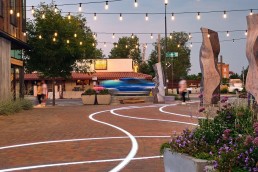
Organic Lighting - FortaCast
Organic Lighting’s FortaCast is a floodproof drive-over inground fixture made of low-carbon, precast polymer concrete. It simplifies the traditionally costly and complex installation of inground lighting. Uniquely, FortaCast offers customisable designs, including curves, circles, squares, intersections and logos, alongside long, continuous light lines. Its innovative engineering and patented design allow up to 15-metres of encapsulated LED to slide in from a single point, making maintenance as simple as changing a lightbulb.
Organic Lighting will be exhibiting at LiGHT 24, find them at stand U36.
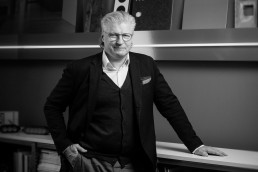
Lichtkompetenz founder, Joerg Krewinkel, dies
(Switzerland) – Joerg Krewinkel, founder of Lichtkompetenz, has died, the studio has announced.
In a post on LinkedIn, the practice issued a statement that read: “It is with deep sadness that we share the passing of our founder, Joerg Krewinkel. Joerg was a visionary leader whose passion and dedication shaped Lichtkompetenz.
“Joerg built not just a company, but a whole community. His impact on the lighting design industry and all of us personally is immeasurable. We will always remember his commitment to creativity, excellence, and innovation.
“Our thoughts and prayers are with Joerg’s family during this difficult time. As we move forward, we will honour his legacy by continuing to pursue the vision that he held so dearly.
“Lichtkompetenz would not be what it is today without Joerg. We will forever be grateful for his leadership and inspiration.
“Rest in peace, Joerg. You will be greatly missed.”
Krewinkel started working in lighting in 1988 with Staff Leuchten, which was later taken over from Zumtobel and merged to Zumtobel Staff. He moved to Switzerland in 1996, working in marketing and sales for several years in Zurich.
In 2002, he established his own firm, Lichtkompetenz, out of Zurich. His international network saw him work on projects around the world – from Switzerland, across Europe, Asia and the Middle East, and also saw the establishment of three further branches in Sofia, Bulgaria, Hong Kong, and Los Angeles.
Specialising in retail, hospitality, and luxury residential projects, Lichtkompetenz as a studio stands for visionary solutions that shine economically and ecologically for a long time.
The [d]arc media team passes on its condolences to Joerg’s family, and to the Lichtkompetenz team.

Ideolux - Pro Chain Graze
Introducing the Pro Chain Graze: a unique modular linear LED wall grazer that delivers unparalleled flexibility. This innovative design can be adjusted or curved to meet various positioning needs, making it ideal for accentuating curved or irregular façades and coves. With customisable control every 300mm (one pixel), it ensures precision in crafting a stunning graze effect, elegantly illuminating architectural outlines.
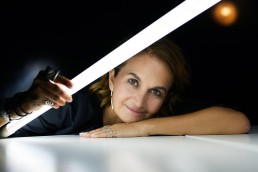
Eleftheria Deko
As the international lighting design community continues to grow, we have over the years seen the emergence of some thriving scenes – regions or nations where the profession is progressing at a rapid rate, producing a strong collection of designers. One such region is in Greece, where the balmy climate and beautiful, classic architecture has inspired many to take up lighting design. However, it wasn’t always this way.
“If you are a pioneer, you scratch your feet, because there is no path. And there was no path in Greece back then for me.”
So says the acclaimed, multi-[d]arc award winning Eleftheria Deko, who led the way in bringing lighting design, as a recognised profession, to Greece, crafting an extensive portfolio of work that spans the stage, artistic installations, and architectural lighting design since the early 90s.
Her introduction to lighting design, as with many designers around the world, was through the theatre. However, in the very early days, she was in front of the lights, rather than behind them.
“My background was in dance, I was dancing from five years old,” she recalls. “I love dance, it’s a unique way of artistic expression. I grew up in the dance world, thinking that I would become a dancer, a choreographer.
“But I was always fascinated by the backstage, and the magic of lighting, even the fixtures themselves, and the “blinding” effect of the light – when you are on stage, you are bathed with light. This feeling helped also my shyness as I was nervous on stage, and with the front spotlights, I couldn’t see the audience directly, which helped my stage anxiety. So, my first reaction to lighting was being the subject of it, and dancing with it.”
This love of dance was combined with a growing interest in photography when, on her 12th birthday, Deko was given a camera by her father.
“It was a new world for me to see things in frame, and very carefully to choose the framing. If I look back at some of these first photographs, it is very interesting to see that I liked to shoot shadows and shades of buildings. As a lighting designer now I like the playful duet of light and shadow. My moto is: music without pauses is unbearable, so is lighting without darkness’.”
The final thing that Deko feels influenced her “on a subconscious level”, was her hometown. “I come from a Cycladic Island, and the light there is very ‘crispy’. I don’t know the word in English, but to me, it is something that you can touch; you can even munch the light. Its reflections, the shadows, the hues of sunlight on Cycladic nature and the traditional architecture, for me, it is magical. As a child, I was playing in the fields of Tinos Island, and I remember the shadow ‘painting’ on the sand and the reflections of the beautiful shiny stone that this island is known for.
“These, together with my love and studies in Art History influenced the way that I see light, and how deeply inside me these things have been absorbed, in a way they come out afterwards. But I never thought of lighting design as a profession.”
And so, after graduating from the school of Philosophy in Athens and having a diploma as a dance professor, Deko packed her bags and left for New York, where she first studied performance – chorography at New York University. But even here, lighting had already begun to take hold.
“On the Master’s programme, there was an elective module on lighting design. This was the first that I took – before dance, before anything, the first module I enrolled in was lighting design. This was because I wanted to do the lighting for my choreographies, I didn’t know then that this first urge meant to bring me to my life’s vocation.”
So impressed was she by lighting, that Deko started a two-year programme on lighting design at Alwin Nikolais school alongside her Master’s degree, and was asked by the course leader to do her thesis on lighting. She adds: “Although I was there for dance, everything was lighting design. If I was asked if I, myself, made the decision to change to lighting design, I would say that life made the decision for me.”
With further encouragement from the university faculty, Deko landed more lighting roles with dance companies in New York, including the Blue Mercury co. from the Alvin Ailey American Dance Theater – an intense experience, as Deko recalls. “Blue Mercury came to give a performance at NYU theater and our professor at the time was getting married and moving to California. The chairman, instead of hiring someone else, trusted me, and asked if I would do the lighting, and without a second thought I said ‘yes, of course, it’s a professional dance company’. I had no money to pay for technical crew, so I had to hang and focus 180 lights all by myself, working from 7am until 4am the next morning for a week, going home to shower, and take a one hour power nap. But I did it, and I did it well.”
The following year, Deko was asked to teach at NYU – a testament to her work lighting the performances – and started doing lighting for other dance companies that were graduating from the university. “I was very good and quick because as a dancer I knew very well how to write the lighting cue notes, and so on.”
She then landed a role as Technical Director and in-house lighting designer at the highly reputed HT Chen and Dancers company. However, a change in personal circumstances meant that in the early 90s, Deko moved back to Greece, where she found herself caught in a strange sense of limbo. “It was very strange for me coming back to Greece, because people didn’t trust me as a lighting designer, but they didn’t approach me as a dancer either, but by then, I was a lighting designer, not a dancer anymore.”
In fact, Deko’s first jobs back on home soil came through connections that she had made in New York, when a US-based company asked her to work on a performance for the Summer Festival of Modern Dance in Crete. This, however, was the spark that lit the flame, with Deko fast building her reputation in the stage lighting world and working steadily throughout the 90s, eventually leading to her establishing her own practice, Eleftheria Deko & Associates, in 2001, just as a major opportunity came calling – the Olympic Games Athens 2004.
“I was approached by the director of the opening ceremony, and he asked me to be a part of the creative team that was realising the scenario that he had in his mind, and he asked me if I would like to do the lighting as well. My first thought was positive, although it was a huge show! At the time, the ceremony’s scenario was broken down into four sections, and I thought of having four lighting designers – one for each section, each with their own style.
“I wanted to bring in Luc Lafortune, lighting designer of Cirque du Soleil, [television lighting designer] Robert Dickinson, Durham Marenghi, and myself. In the end, it came down to myself and Robert Dickinson, as at the time, he had the experience of working on big events like this, he did the Atlanta Olympic Games, and also working with television cameras. This was another important factor to consider – the lighting might have looked good for the eyes in the stadium, but it had to look good for television as well, for the 5 billion TV audience. Especially with the cameras at the time, as they were not digital yet; you had to sacrifice either your warm colour hues of reds, oranges, yellows, or sacrifice the cooler colour hues of blue, turquoise, etc. We gave priority to the blues because of the Aegean Sea and the Greek sky.”
While Deko was working prolifically in theatres across Greece prior to the Olympic Games (by 2002, she had done 350 shows), she had also started to show an interest in the architectural field, visiting trade shows such as Lightfair in the US, Euroluce, and Light+Building, to see how the two worlds were coalescing.
“I always liked interior design, and I was going to these trade shows for inspiration for theatrical lighting, but also to see the architectural lighting evolution. I was very lucky, because it was the period that theatrical stage lighting and architectural lighting were starting to shake hands, LEDs were just appearing and shaping the beam, colour, were making their presence in architectural fixtures.
“I remember looking at a new outdoor fixture of iGuzzini that was shaping the beam, with a strong lens and shutters, and I liked how architecture was starting to borrow elements from the theatre. DMX and smart dimming were also emerging in the architectural world, and these were things that I knew very well, they were my tools in creating scenes in theatre.”
Deko recalls one of her early ventures into architectural lighting, when she was approached by a hotelier in northern Athens to create “something more theatrical” for the hotel lobby – a project that further springboarded her into the architectural sphere.
“When I was asked to do the lobby, I created a nice atmosphere by using lights from outside coming through the windows where we had to customise the fixtures to avoid glare. Everybody was fascinated, and following this, I was asked to do the showroom of a furniture store, then iGuzzini’s distributors in Greece approached me to teach my concept behind lighting design in theatre, in order to give to designers inspiration to think of lighting in a different way. Sharing is so inspiring for both sides and to me, it is very boring to do the same thing repetitively.
“From working in performing arts lighting, I knew the interesting things you could do with shaping, colour, dimming; these elements could give a different atmosphere, a different touch than a beautiful chandelier in the middle of a room.
“I always thought that the power of lighting is not only to make things visible or being comfortable in sight; the power of lighting is more. It can create magic. We knew it very well in stage lighting, so I thought ‘why not in architectural lighting as well?’”
As more architectural lighting projects came to Deko, so did more teaching opportunities. After her work on the Olympic Games, she was approached by the theatre department at Aristotle University of Thessaloniki’s School of Fine Arts. As a faculty member she taught stage lighting for 14 years (2005-2019), and considers her time teaching the next generation here as “one of my greatest achievements”.
“I also taught lighting in the architectural department of the Open University for two years. I hope I have influenced the new generation of lighting designers to go beyond what they already know, to go beyond what is given to them and create the need for new lighting fixtures, new ways of control, but more, the new philosophy, new thinking of lighting and its impact.”
One of the core facets of her teaching was what she calls the “Seven Notes of Lighting”, seven qualities that are the same across stage and architectural lighting. These include: intensity, direction, diffusion, colour, rhythm and movement, shaping, and light objects. “Like in music, with seven notes, you can create endless music and songs, so too with the combination of these seven elements, you can create endless lighting cues for architecture or for stage.”
Indeed, these seven tenets form a key part of Deko’s design approach, however before even considering these, she takes a broader view, tries to empty her preconceptions, her mind, and look anew at every project and how lighting can “create a dialogue” with the space or building.
“I believe that the architecture is the protagonist, and lighting should accommodate, highlight it. Lighting should not impose, it should respect architecture and highlight its elements. It’s the same in theatre. A lighting designer should not show off and add more than necessary just for the image, they should always decide with respect to the architecture or to the play, and with measure.
“What I start from is the play, if it is stage lighting, or the building itself in architecture. I let the building or scenography speak; some are more photogenic, some are not – and these make the work of a lighting designer more difficult – but I think respect, observation, simplicity, and a less-is-more approach is best to start with. Together with the team, we brainstorm on ideas until we come up with something that is fulfilling to our minds, then we apply the seven elements, right position for direction, intensity, colour temperature, diffusion etc. and we develop the design. This way, projects do not look like each other, and the lighting is created specifically for each project, not ‘to our style’. When the lighting of a building has such mentality behind it, it breathes beautifully at night.”
However, by taking a more “restrained” approach and focusing only on what is needed, rather than adding more than necessary, Deko adds that she can sometimes get into conflicts with clients, leading to some difficult decisions.
“If there is something that the client wants, and if it is in contrast with our philosophy, what I call our ‘ethics of aesthetics’, if it is fighting with our principles, I just ask the client to consider again if they want our studio to do the design. I’m very polite and honest, and I respect the desire of the clients, but if it’s opposite to our principles, we don’t want to continue on undertaking that collaboration.”
Difficult conversations to have with clients, but this is something that Deko is no stranger to, having had to fight for a seat at the table when she first started out in lighting design.
She discusses the battles that came with being the only woman in a male-dominated field: “When I came back to Greece in 1992, there were only male electricians and directors of photography. I had to behave in a certain way, dress in a certain way, and in the beginning, I wasn’t respected as a lighting designer, they were saying ‘this young girl will not tell us what to do’. There was a moment when the electricians told to the artistic director of the national theatre, ‘if you bring her here to do the lighting, we will go on strike’.
“Another time they came to me and said, ‘I cannot pay you as a lighting designer, but if you pretend to be the assistant of the set designer, I could’. I had to say ‘I’m sorry, I am a lighting designer. I can help the set designer and the director, with no payment, but I will not sign as a different person than I am’.
“There were many difficult moments – I often got called a male name, not my name – but what brought me through is my humour. I would walk into the theatre and say to the guys, ‘good morning, ladies!’ And soon the ice broke.’
“I never stopped, nothing put me down. I said, ‘it’s their problem not mine’. My passion is my work. I do my best, and I always treat everybody with respect and a smile, in the theatre, on the construction site, I have the same respect for the owner, the architect, the electrician, the person who cleans the floor. For me, this is a very important.
Very soon I gained respect from all, both men and women in both fields. Today there are more women lighting designers in Greece than men. This is a kind of revenge.”
Indeed, the level of work that Deko has consistently produced throughout her career, including not just the Olympic Games opening ceremony, but the incredible lighting of one of Greece’s most important landmarks, the Acropolis, has seen her gain worldwide recognition, especially from the design community – she has four [d]arc awards to her name, including three in one year for the Acropolis project. It is this recognition, that she feels holds most weight.
“With the Olympic Games and the Acropolis, I feel very blessed, and very lucky, to have two of these globally recognised projects in one lifetime – I can retire now.
“If you are the first who did something, you have nobody to share what you have gone through. You stay with it, keep it inside and you move on to the next day. To have this recognition from colleagues, it is very moving. It is like an embrace from your artistic family, your professional family. It is important to get recognition from your clients, of course, but the recognition of people who know the work is really beautiful and uplifting.”
Across her many accolades though, Deko has always remained humble, treating each award as recognition for her home country. “The first international award that my team and I received was the Emmy for the Opening Ceremony of 2004 Olympics. I was honoured to give the acceptance speech, and for me, this award was a moment that was for all of Greece. It was not me holding it, it was all Greeks. It was also elevating the level of Greek lighting design.
“Every achievement, if it’s an award, praise, recognition anything, it’s not for the individual, otherwise it becomes egoistic. It is for the team. I am who I am because of my team. I got here because of my parents, my teachers, my colleagues, my path, so these trophies award everybody’s efforts.”
As for the “next day”, Deko is showing no signs of slowing down. Although she admits that she feels very “fulfilled”, there is still a “flame and a passion about good lighting” that burns bright inside her.
As a studio, Eleftheria Deko & Associates has a broad array of projects currently in the works – many of which following a similar theme to her award-winning work on the Acropolis, which taps into her ongoing fascination with Ancient Greek history and culture. “The inauguration of the Temple of Poseidon in Sounion took place in September. We are also working on the Temple of the Goddess Aphaia in Aegina. These temples, along with the Acropolis, if you place their precise location on a map, create a perfect isosceles triangle – the Ancient Greek metaphysics is amazing to me, I wonder how they managed to choose these locations 2,500 years ago.
“One of my great passions for lighting is heritage, museums and ancient monuments. With these projects I go back to school again.”
“In school I liked ancient Greek history and philosophy very much. My godfather was one the most famous archaeologists in Greece, and because of our close relation, everybody thought that I would become a scientist, an archaeologist just like him. But I was more artistic as a person, although he still inspired me with his wisdom. “Hopefully another two monuments will have been completed by the end of 2025 – one is the Dikteon Cave in Crete, which in mythology was the birthplace of Zeus, and the other is the fortress of Acrocorinth at the ancient city of Corinth, as well as the new archaeological museum of Cyprus.”
And Deko is hopeful that she can continue to be an inspiration for the younger generation of designers emerging in the industry. While she may have left her former teaching roles, she has other plans in mind that she hopes will inspire.
“Not that I feel old, but when we grow older, we have to give space to new people, younger people to express themselves – I’m trying to give more opportunities to the younger people on my team.
“I also feel the time has come to write. I would like to write a book, not about my technique on lighting, but about my philosophy and approach, as if it might inspire someone. By writing it down, I can take the big message and focus it down on pages.”
As for the future of lighting design, Deko has high expectations for where the profession will go, and how it will be perceived by the wider design sphere.
“I think that lighting design is becoming a very, very attractive profession. Lighting designers have the tools and the power to create magic, and I think we are entering the great era of lighting design. Obviously working together with architects and interior designers, but I think lighting design will be recognised for the impact it has independently. Lighting is evolving very fast in a fascinating way!
“In Greece we have an expression, ‘Pan Metron Ariston’, which means ‘everything in measure is perfect’. So, I think in this new era of lighting, with all this speedy evolution in technology, we should let the Greek proverb about measure be our guide.”
An in-depth report on Deko’s work on the Acropolis can be found in arc 119, or you can read the full article here.
At-Turaif, Saudi Arabia
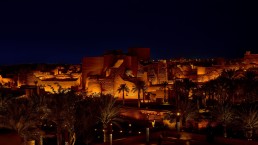
The UNESCO World Heritage site of At-Turaif has been given a sympathetic lighting scheme from Speirs Major Light Architecture, that magically transports visitors back in time to the 15th century.
In the desert to the northwest of Riyadh, on a raised site at the edge of the ad-Dir’iyah oasis, lies At-Turaif – an ancient, labyrinthian city that dates back to the 15th century.
Regarded as one of the more important political and historical sites in Saudi Arabia, At-Turaif represents the “capital of Saudi dynasty”, was the original home of the Saudi royal family, and the country’s first capital from 1727 until Ottoman control of the area in the mid-1800s.
Now, the historical district, characterised by its Najdi architectural style, is a UNESCO World Heritage site, and has been subject to an extensive restoration programme that aims to transform the space into an open museum, showcasing its rich history.
As part of this ongoing restoration, Speirs Major Light Architecture (SMLA) was brought into the project, with the goal of bringing the epic scale and historical significance of the district to life after dark through a beautifully layered and nuanced tapestry of golden light.
Through a rich, amber, “apricot” light, the lighting designers hoped to articulate the stories hidden in the layers of buildings, courtyards, and architectural remnants across the near 10,000sqm site, capturing and reflecting the site’s extraordinary spirit, and creating a remarkable experience of a living national monument.
Speaking to arc, Keith Bradshaw, CEO and Senior Partner at SMLA, reflects on the unique atmosphere of the space: “We’ve never done anything quite like this before, because it isn’t just a building, it’s a small city. The story of the place is one of its most poignant aspects, because in and of itself, it is a ruin, but as with most ruins, there is a mythology and a certain spirit to the place. It is a site that is potent with atmosphere.
“As a piece of architecture, and as a place, it is imbued with something – not to compare it to Stonehenge, but it has that kind of spiritual energy, and because of that it is precious. The opportunity to create the after-dark experience of such a special and significant site is a rare honour. As a practice, we have been fortunate enough to work on several exceptional sites, including the Sheikh Zayed Grand Mosque in Abu Dhabi, and the Dom Tower in Utrecht. Our learning from those projects helped to inform our approach at At-Turaif. We are fascinated by the stories and memories that live within these unique places, and how we can use light as a narrative tool to draw them out, creating a meaningful connection between people, place, and architecture.”
Bringing the stories and historical significance of the site to life was a central focus of SMLA’s “thought piece” for At-Turaif – a narrative document that delved into the overall concept of the lighting scheme, requested by the Diriyah Company, the project client.
“We started by thinking about the way that light could amplify the story of the place, as much as we understood at that early stage, how we could bring this remnant of a civilisation back to life. We wanted to use light to show the spirit of what was there.”
While Bradshaw and the SMLA team understood the history of the site from the outset, it wasn’t until they walked among the ancient walls of the city that they began to fully appreciate the significance and regard with which the Saudi people held At-Turaif.
“What really brought it to life for me was when we walked around the site with a few of the tour guides, who told us the stories of what would have happened on various sites, the economy of the city, and how it worked. As with most heritage projects, the more you can understand or empathise with the people that lived there and how it operated, the more inspiring it becomes.
“We could see that it really meant a lot to the Saudi people too. By talking to them, we got a sense for how significant a project it was for them.”
Coupled with the strong cultural weight of the project, the client also had some very stringent expectations for the lighting design. To meet these, SMLA created an incredibly detailed plan of the site, using a LIDAR scan of the city, into which the team added the various textures, tones and shadows.
Bradshaw continues: “It was a very sophisticated visualisation, way beyond anything that we had done before. Once we had this pure, three-dimensional, textured model of the project, we could set the viewing angles exactly as the client wanted and show them how it would look up close, from two-kilometres away, five-kilometres away, and so on. It was an amazingly detailed concept.
“Our job then, beyond the concept, was to bring that into being with real light, real tones, real textures. We created a scheme where, from these distances, the elevations look amazing, but also, when you’re actually in the place, walking the streets, you become really immersed in it. It becomes this timeless space that feels as it did 500 years ago.
“You can create amazing images with light – subtle layering between one surface and the next. When you are looking at is effectively 20, 30, or 40 façades together, you have to find a balance, and so much of this project was about finding the appropriate three-dimensional balance.
“It was very challenging to ensure that what looks beautiful from afar, also feels beautiful when you are there. That when you are walking down those streets you feel the magic of the space.”
The rough materiality of the handmade, mud-brick walls throughout the city contributes a great deal to the ambience. Described by Bradshaw as a “gift” to graze with light, the walls of At-Turaif exemplify the rich history and story of the space. SMLA therefore, along with the client, wanted to find the perfect colour temperature to showcase this unique aspect of the site further.
“The first time we went there, it was sunset, and it was spectacular. We were immediately enchanted by this very particular, almost sand putty material, with a very fine grain texture. We’ve never lit anything quite as freeform and imperfect as that before.
“As soon as we saw that tone of sunset begin to hit the surfaces, it just popped, it resonated. It was like the space was telling us, ‘This is the light that I look good in’. That’s where this specific warm, rose gold, apricot light came from. It is right at the edge of a monochrome light where you feel that you are enveloped in an intense golden glow.”
Iain Ruxton, Associate Partner at SMLA, explains the painstaking process that the lighting designers went through before reaching this particular tone of light: “There was a lot of experimentation at the beginning of the project, when we did a large-scale mock-up to sell the idea to the client. At that point, we had enough lights installed where we could play around with colour and find the right combination. It took quite some extensive playing around before we found a solution that we were happy with, to then take to the client.
“Colour is an interesting thing, as although the site is relatively homogenous in terms of material, there is still quite a lot of variation. The mix of light that gives you the right colour on one wall doesn’t necessarily look right on another, because it is a slightly different colour. There’s more subtlety in it than you might think, from finding the right colour points and getting the client agreement, to walking in around the site, checking the levels and colours of each fixture and finetuning them. It’s not a theatre stage; there’s nowhere you can stand and see everything. Every single light was personally visited and focused. It was an incredibly fine grain of focusing effort that we had to do – a really complicated site to get focused up and programmed properly.”
Indeed, the placement of the luminaires themselves – around 2,500 Martin Professional fixtures – was integral to the success of the lighting scheme, and in creating the magical glow that SMLA desired.
“It was very important to remove the 21st century as much as possible,” says Bradshaw. “We wanted the light to feel like it was coming from the buildings and the walls themselves, which meant that we had to be very clever. Most of the luminaires are on the ground, so it feels like the city is glowing from the bottom up – and it is done in a very discreet way, with appropriately concealed fittings.”
“The fixtures have double casements, and are semi-recessed into the gravel that lies between the heritage wall, which we could not touch at all, and the street itself,” adds Adrien Flouraud, Design Associate at SMLA. “The gravel acts as drainage, as during the rainy season the site is susceptible to flash flooding, so we had to be sure that our casements were fully drainable as well. The luminaires from Martin are very robust and can handle this very well. From the 47° heat to the flash flooding, the amount of failure or return we have seen is absolutely minimal.
“But nothing is fixed anywhere, almost everything is only held in place by gravity, there are no screws, no drilling, nothing.”
A site of this scale, with such a high number of luminaires, called for a large-scale, extensive control network – something that could have been a challenge given the sensitivity and remote nature of the site. However, Ruxton says that establishing the control network was more straightforward than first expected: “We were quite lucky with the amount of electrical infrastructure and IT networks that were already on-site. There was a sitewide, high-capacity fibre optic network around the site already, with many small technical rooms around the site servicing the existing security camera network, cafés, point of sale, and so on. Luckily, we were able to reuse this network.
“There is one control system, but it is distributed through a number of controllers that are networked together. It all runs on Pharos, and the way that Pharos works means that it scales very well – you can put multiple controllers together and once set up, it all behaves as one. This gave us a bit more resilience and helped us a lot in the stage-by-stage commissioning.”
The control network is also flexible enough to factor in further expansion, as the recovery and restoration of At-Turaif continues.
“The whole city as you see it now is 95% complete, and there are potentially more bits and pieces to come in the future as more of the site continues to be rediscovered,” explains Bradshaw. “There is an ambition over the coming years to reveal more of the archaeology, as there is still a huge amount to be discovered. This is going to be fascinating for us to continue thinking about lighting on the other areas of the project.
“Factoring in the future development around the site we needed to look at not only the visitor experience, but also the views,” adds Flouraud. “We know that there will be further residential developments on the nearby wadi, so we have created scenes that are ready for this. Nobody can see them now, but effectively in our designs they are ready. There are some people who, in five year’s time, are going to be living in homes that don’t exist yet but when they move in they will find they get an amazing view every night.”
While the core focus of the lighting scheme is on the rich, warm amber lighting, the design also includes a special activation that reflects the importance of the lunar calendar in the Muslim faith. Each month, celebrating the new moon, the lighting shifts to a shade of blue externally, with the warm light remaining within. “The resonance of those opposites of silver against amber is just beautiful,” says Bradshaw.
Finding the perfect shade of blue for the ‘Full Moon’ scenario took another several rounds of finetuning and reviewing until all parties were satisfied, but the result creates a remarkable contrast. Flouraud continues: “When you shift to the Blue Moon theme, there is a real ‘village’ feel of what is inside the walls, contrasting with the outer façade. We had to be very precise to be sure that the inside walls were at the right level and not overlit compared to the outer walls. It was a lot of tuning between all these internal and external elements.”
The efforts that SMLA have gone to in illuminating At-Turaif have resulted in a scheme that beautifully showcases this landmark structure. In its raised position, the site is the major focal point in the landscape when viewed from the developing Diriyah Project across Wadi Hanifah. Balancing the external identity and the views and experience within the monument is at the heart of the design, and this is something that Ruxton feels has been successfully realised.
“Of course, it needs to look amazing when viewed from outside the site, but it also needs to be amazing to be inside and to wander about and experience it. These two quite different objectives that are not the easiest things to balance, but I think in the end we were very successful at that. We think it looks great, everybody else seems to think that it looks great; almost as importantly, it feels great. If you are in it and walking around exploring it, it feels magical at night, so I think we’ve done it justice in that respect.”
Bradshaw adds that the cultural significance of the space, and how the lighting adds to this, is what stands out to him. “It’s a real privilege to be able to work on a national monument that means so much to people.
“What I am most proud of is that when we talk to the Saudi people that were briefing us about the spiritual feel and importance of the place, they say that when you are there, it feels like we brought that to life. The people that I felt really helped us to understand the brief properly have said to us that it is exactly what they wanted us to create, and that it makes them feel very emotional, which is something that people don’t often express in our world of architectural lighting; it is not just clever, it is emotional, which is very special.”

DALI Alliance Lighting Awards 2024 open for entries
The DALI Alliance Lighting Awards are officially open for entries for 2024, the global industry organisation has announced.
With a number of new categories for 2024, this year’s programme represents a refresh of the awards to better recognise the diverse innovations and applications from across the lighting industry.
The traditional application categories have been consolidated into a list of four awards: Residential, Commercial Interior, Commercial Exterior, Industrial & Infrastructure, and Horticulture. Alongside the updated application categories, this year’s DALI Lighting Awards will include the following innovation categories:
- Best Use of D4i: Recognising innovative applications of DALI D4i technology in lighting systems, including enhanced data communication, energy management, and advanced control capabilities.
- Best Emergency Lighting Integration: Celebrating exceptional designs and solutions that effectively incorporate emergency lighting, ensuring safety, reliability, and compliance with standards during emergency situations.
- Best Human Centric Design: Honouring projects that prioritise human wellbeing by utilising lighting solutions that support health, comfort, and productivity through dynamic and adaptive lighting environments.
- Best Building Data Integration into Other Building Systems: Highlighting projects that excel in integrating lighting data with other building systems, such as HVAC, security, and energy management, to enhance overall building performance and efficiency.
- Innovation in Lighting: Recognising cutting-edge technologies, and advancements in lighting control solutions.
- Sustainability and Energy Efficiency: Highlighting projects that excel in sustainability, energy conservation, and environmental impact.
- Smart and Connected Lighting: Honouring advancements in smart lighting systems, IoT integration, and connected lighting solutions.
- Non-networked Lighting: Celebrating innovative applications in small or stand-alone spaces.
These new categories align with the growth of technologies, advancements in lighting innovative approaches that are being adopted by the sector.
Another significant change for this year’s Awards is that submissions will no longer be submitted to a specific category. Entries will be reviewed internally by the Awards judges, to assign the entries into a primary category. An assessment will also be made to determine if the entry fits into other relevant categories, allowing the possibility of a single project winning multiple awards.
The DALI Alliance believes that these updates to the awards will enable more submissions from a wider representation of the lighting sector, from emerging professionals to established industry leaders.
Paul Drosihn, General Manager of DALI Alliance, said: “We are very excited to launch this year’s DALI Alliance Lighting Awards, especially with a refreshed approach. We are confident these changes will make it more straightforward for those from across the lighting industry to enter, as well as providing more opportunities to get recognition in meaningful categories.
“The awards have already built up an enviable reputation and are highly regarded across the sector. The updates will further increase this, thanks to a more comprehensive evaluation process.
“We’re looking forward to seeing this year’s entries.”
As well as benefiting from the prestigious nature of the awards, winners will have their work promoted and highlighted through the work of DALI Alliance. This will offer excellent exposure and alignment with a credible, authoritative organisation.
The awards opened on 22 August, 2024 for entries, with interested participants having until 7 October, 2024 to make their submissions. More information on the awards and how to enter can be found on the DALI Alliance website.
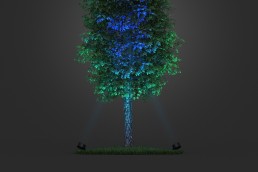
David Morgan Review: Hydrel FLAME
David Morgan takes a closer look at the LIT Award winning FLAME from Hydrel - one of the most technically sophisticated exterior architectural lighting companies in the world.
When a company that started life in California in the early 1960s by setting out to develop the best and most reliable underwater lighting system then continues to innovate to this day, in the 21st century by recently creating a novel approach to colour mixing luminaires, I thought that further investigation was needed.
Hydrel, now part of the Acuity Brands group, has grown into one of the most technically sophisticated exterior architectural lighting companies with a wide range of surface mounted, inground, and underwater luminaires. Components are produced and products assembled in-house with manufacturing sites in Crawfordsville, Indiana, and Winona, Minnesota.
One of the latest product developments from Hydrel is the FLAME range, based on the successful SAF range of DMX controlled RGBW projectors. The FLAME range adds separate control of two sets of RGBW light engines to produce novel dual colour lit effects. The range received the LIT award in 2023 for Lighting Product Design of the Year.
It is surprising how sometimes it is the simple ideas that can be the most effective. Who would think that providing a double set of DMX addresses for a single RGBW luminaire would produce such interesting and attractive lit effects?
However, it is interesting to note that Hydrel includes a prominent note on the FLAME micro-site saying that the effects produced are intentional in case the viewer might get the impression that the effect was caused by a problem with the colour control or optics.
The range consists of three sizes of projector, each with three distributions. The smallest size – the SAF7F RGBW, which I tested – incorporates seven RGBW light engines fitted with 45mm colour mixing lenses. The seven light engines are controlled separately in two groups to produce the unique dual colour lit effects.
The narrow distribution gives a centre beam angle of 10° with three light engines and an outer beam of 30° with four light engines. The two sets of light engines are independently controllable. The wide distribution gives a centre beam angle of 30° with an outer cone of 70°. The third distribution, called Lotus, combines 10° centre beam with 70° for the outer cone, which produces the most obvious colour separation from the two sets of light engines.
Hydrel has included a useful and engaging visualiser on the FLAME micro web site where the user can adjust the beam type, adjust each light engine individually, and also show the lit effect from various viewpoints, on different wall surfaces, including white paint, stone, and red brick.
Hydrel give lumen output figures for the two groups of light engines separately. The highest output is for the narrow distribution with 823 lumens at the centre and 730 for the outer. This size of luminaire runs at 46 system Watts, giving a reasonable overall efficacy for an RGBW luminaire.
The next size up is the SAF14F RGBW with 14 light engines, delivering a maximum total lumen output of 2,699lm with a power consumption of 64.7W.
The largest size in the range is the SAF28F RGBW with 28 light engines, providing a maximum total lumen output of 4,949lm with a power consumption of 165W. The overall diameter of the luminaire body is 406mm and is designed for use on larger projects.
The SAF7F sample I was given to test came with the Acuity Fresco controller, so I was easily able to adjust the colour and intensity of the two sets of light engines. The colour blending lenses worked well and there were no colour separated shadows from each light engine. The industrial and engineering design of the SAF FLAME luminaires is sophisticated and well detailed. A wide range of mounting and glare control accessories is available, and the luminaires incorporate well considered luminaire adjustment locking features. The die cast luminaire components are of high quality with concealed fixings. Two four-channel DMX drivers are housed within the luminaire to give the eight DMX addresses.
According to Chris Sorensen, Senior Director of Engineering at Hydrel, who led the FLAME development team, the motivating idea behind the development of the FLAME range was being inspired by projection art installations while simultaneously feeling tired of saturated RGB colour chases. The team members challenged themselves to build a new tool with which to ‘paint the night’ in a new way.
Apparently the first FLAME mock-ups were done using Photoshop, where images of two beams were arranged on top of each other so that the colour and blending of the beams could be independently controlled. It is understood that considerable effort was needed to develop the optical system to produce the best colour mixes for each distribution while avoiding disturbing artifacts. A patent is pending for the optical system used in the FLAME range.
I look forward to seeing further developments of the FLAME system and to seeing the projects where the unique lit effects have been used to the greatest advantage.
www.hydrel.acuitybrands.com
www.flame.hydrel.com