
David Morgan Review: Lightly Technologies Hikari SQ
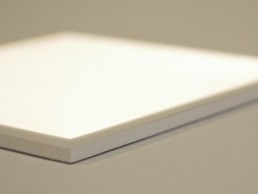
Since their appearance at last year’s darc room, Lightly Technologies’ ultra-thin LED Hikari SQ panels have been gaining a lot of attention. Here, David Morgan casts his eye over the slimline sources that will be on show at darc room this September.
When a small start-up company manages to raise more than £400k of equity investment by crowdfunding to develop and market a ‘Post It’ note-sized light panel I was intrigued and wanted to know more about the technology and the team behind the company.
The two founders, Matt Hanbury and Brian Charman, met in 2012 while they were both working at Philips Lighting. Matt started at Philips on its engineering graduate scheme and was sent to its OLED factory in Aachen, Germany to work on mechanical engineering for OLED modules. At that time Brian was manager of the Philips Lighting Experience Showroom, where he introduced new lighting technologies, including OLEDs, to customers and specifiers. After leaving Philips, Matt worked in Japan for Apple on the production engineering and development of iPhone displays, which introduced him to a wide network of suppliers in Asia. Both of these experiences gave him tremendous exposure to the detail design and mass production of thin illuminated panels. On moving to Dublin, Matt decided to start his own company to create a new light source that would fulfil the initial promise of OLED light sources but without the associated high costs and their inadequate performance.
After some months of frantic development work, a prototype of a panel was ready, and with patent protection for the design in place, Brian joined as joint founder of Lightly Technologies in June 2016 to help commercialise the concept. After self-funding the company for the first year, an initial round of Angel investment with family and friends was completed by mid-2017 to allow the company to continue to invest in development and tooling.
The first modules, in pre-production form, were unveiled at darc room in London last September and were branded Hikari SQ. Hikari is Japanese for light and the modules were square, hence the SQ addition. Matt and Brian were encouraged by the positive reaction at the show from both lighting designers and luminaire manufacturers and embarked on a second round of fundraising, which completed in early 2018. The investment raised has allowed the company to invest in production tooling, stock and most importantly sales and marketing activity.
When I first spotted the company at darc room I was impressed by the thinness of the panel, the even lit surface and the high level of light output.
My immediate impression was that it was another version of an OLED panel but after realising that the technology was based on traditional LED sources combined with advanced optical design I purchased a developer kit and we have been investigating how to incorporate the Hikari SQ into our luminaire developments.
The design of the Hikari SQ is based on a thin side-lit, injection-moulded micro prismatic controller. The quality of the optics ensures that the panel is evenly lit across the surface, allowing uniformity, and there are almost no telltale signs of LED dots around the edges.
The Hikari SQ is 100mm x 100mm and 3.5mm thick, and provides up to 400 lumens with an efficiency of 80 lumens per Watt. Surface brightness is up to 10,000 nits, which to my eye is on the limit of comfort for a small light source, although it is in fact lower than a T5 fluorescent lamp.
The technical characteristics are familiar ones for LED sources with a lifetime of 50,000 hours. The initial range of colour temperatures will be 2,700k, 3,000k and 4,000k with a CRI 90 and R9 over 60. Uniformity across the surface is 85-percent and the beam angle is 100-degrees. It is understood that no extra heat sinking is required but when run at full power it should be mounted onto a sheet metal base of some form.
Apparently, the greatest interest in the modules so far has come from the retail and hospitality sectors, where potential uses include statement chandeliers in entrances as well as decorative and high-performance luminaires for these applications. The first luminaires incorporating the Hikari SQ are likely to be launched this autumn.
The plan is that once the 100mm x 100mm module is fully launched other shapes and sizes will be introduced. Dynamic white versions are also likely to be introduced soon, with colour changing following later on in the product pipeline.
As a luminaire designer, my first questions to any supplier offering a new light source are what the primary lighting applications are, where it can be used and how this source will help me to create novel, attractive, functional and commercially viable luminaire designs.
One of the key issues for me is whether the Hikari SQ can be used as a naked light source. The OLED sales story that large areas of evenly lit panels are attractive always seemed somewhat questionable. It is one thing to experience and enjoy the perfectly flat light effect of Anthony Gormley’s Blind Light fog installation, but most lighting projects require a mixture of accent lighting and indirect lighting with the light sources hidden from view as much as possible.
My reaction to the Hikari SQ has oscillated from initial enthusiasm to a more considered concern that there may be insufficient specific applications to generate volume sales. However, it may turn out that the Hikari SQ will have many niche applications rather than a few killer uses and that these will be sufficient to give the company the critical sales momentum needed to thrive.
We worked on a project some years ago with Joe Geitner of George Sexton Associates where the Hikari SQ would have been the perfect light source. We ended up making a custom LED panel that worked fine, but the overall depth of the luminaire could have been reduced significantly if the Lightly source had been available then. Joe Geitner’s comments on the Hikari SQ were positive for use in cabinet lighting but he felt that the 100mm x 100mm size might be a limitation for other uses. As the product range develops, the offering will become more attractive as it will offer more uses, for more applications.
If Lightly can gain sales growth with the initial module and go on to create a full range of ultra-thin LED modules in a variety of shapes, sizes and colours then the future will most certainly look bright for Lightly Technologies.

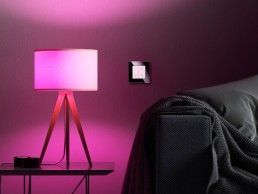
ABB joins new partnership programme with Signify
(Germany) – ABB enters a partnership with Signify (formerly known as Philips Lighting) by unveiling a new range of smart light switches at the IFA trade show, Berlin.
Aimed at encouraging companies to develop devices, applications and systems that interact with its smart lighting ecosystem Philips Hue, the Friends of Hue programme has attracted many of the market’s leading technology providers including Amazon, Apple and Google.
ABB’s new range of Friends of Hue smart light switches integrates with the Philips Hue lighting system via the Hue bridge. This allows users to set up their light switch in the Philips Hue app and control and personalise home lighting and ambience via an ABB Friends of Hue switch.
Paavo Tammisto, Global Product Group Manager of ABB’s Wiring Accessories said: “We are delighted to announce this partnership between Signify and ABB. Both of our companies share a vision for fully connected smart homes with the ability to control every aspect of lighting from a single remote access point.”
The new ABB switches can turn lights on and off, dim specific bulbs and recall stored light presets. A Friends of Hue-specific energy harvesting module is due to be integrated in to the ABB ranges carat, solo, Busch-axcent and future linear. The new Friends of Hue light switches from ABB will be available in Q1/2019.

Gamma Illumination opens new MENA office in Dubai
(Dubai) – Gamma Illumination, UK based designer and manufacturer of low energy lighting solutions, has expanded its operations in the Middle East and North Africa (MENA) with the opening of its first office in the region and the appointment of Arsalan Bari as Vice President.
Gamma Illumination has been active in the MENA region for the past five years and Bari will bring experience to the position with over ten years working for well-known companies in the lighting industry.
Bari, Vice President, commented: “I am delighted to be joining such a fast growing and forward-thinking company and look forward to helping the Gamma team continue its momentum in the MENA region. Gamma has already built a reputation for its fusion of high quality and great value, whilst providing industry leading turnaround times and a trusted service to its customers. I look forward to working with the team to continue to do this throughout the region.”
Cate Hickling, Sales Director at Gamma Illumination, added: “These are exciting times at Gamma Illumination and we are delighted to welcome Bari on board. Bari’s experience, regional knowledge, as well as his connections will enable us to continue to build on our presence within the MENA region.”

IALD Announces Call For Entries For 2019 Awards
(USA) - The International Association of Lighting Designers (IALD) has announced the submission and entry process for the 36th Annual IALD International Lighting Design Awards is now open.
The oldest international architectural lighting design competition, the IALD International Lighting Design Awards, showcases excellence in architectural lighting design through its winning projects.
“The IALD Awards programme is designed to elevate the profile of lighting designers by recognising exceptional architectural lighting design around the globe,” said IALD President David Ghatan, IALD.
“Projects that win IALD awards are remarkable examples of the many ways in which users experience spaces—as a result of lighting and of the visual atmospheres created by quality designs.”
“We encourage projects of all sizes and scopes to enter,” said IALD Awards Chairperson Morgan Gabler, IALD. “What matters is that your project has a compelling story and makes a powerful impact on a space.”
The early bird pricing for entering the awards programme will end 2 October 2018 and the final deadline for all submissions is 5 November 2018.
The award-winning projects will be announced on Wednesday, 22 May 2019 at the 2019 IALD Education Trust Benefit Dinner and 36th Annual IALD International Lighting Design Awards Presentation in Philadelphia, PA USA.
For more information about the IALD International Lighting Design Awards and the 2019 Call for Entries, visit iald.org/awards.
Alteme Licht Chiara
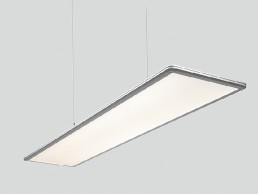
Its delicate profile with lateral light integration and its suspension cable providing the power supply means Chiara is discreet and appears to be floating in the room. When switched off, the semi-transparent, micro-structured conical prism sheet allows a hazy view. The entire electronics are integrated into the canopy and come with an optional accessory set. It can also be accommodated in a suspended ceiling to reduce the visual impact to an absolute minimum.
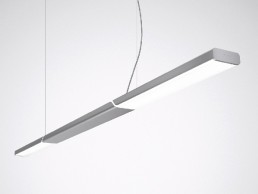
Trilux Parelia LED
The Parelia LED pendant luminaire not only features an unusual length of more than two metres, its interrupted direct light component is connected with the indirect component via a light line, which also lends it a highly distinctive character. For example, it facilitates a continuous line model where the direct and indirect light components alternate along the line.
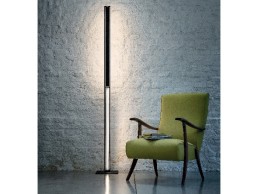
Linea Light Group Tablet FL
The Tablet FL is an aluminium upright luminaire with a metal base and optional white or black finish. It’s rectangular, slender and minimal in shape, it has two swivel modules in series with topLED sources and polycarbonate diffuser. Controlled at 350 degrees, the light on each support can be directed in all directions or limited to defined portions of the room, acting as ambient light or for relaxation corners.
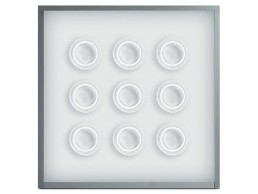
Fluxwerx Loop
Loop is a series of linear suspended and recessed luminaires. Its aperture design merges geometric shapes with advanced LED technology, making the lights suitable for different environments. Equipped with the novel Radial Anidolic technology, they deliver highly efficacious, axially symmetric lighting distributions. The small transparent optical lens allows a high level of visual comfort from all viewing angles as well as a uniform illumination of work surfaces and has a high energy-efficiency.

XAL Leno Surface
Leno Surface is a strikingly flat surface-mounted luminaire suitable for both wall and ceiling mounting. Its flat design is based on LED side feed (LGP) technology paired with a magnetic mounting system. The powder-coated, extruded aluminium profile, with a total height of only 28mm, is available in white, grey or black. For the cover, there is a choice between an opal model, with a fifteen percent increased light output, and a micro-prismatic model.
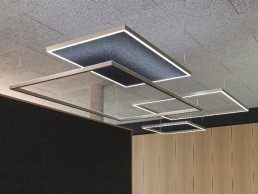
Sattler Gioco
The new Sattler luminaire, based on the Golden Ratio, is available in five sizes. Whether as a rectangle or a square, direct or indirect light emission, Gioco offers a high degree of flexibility and creative scope for a wide range of applications. Its clear lines and transitions along the edges are enhanced by the anodized brush finishes. The fixture comes with an optional Acoustic Panel set, which may be added at any time and ensures a noticeable reduction of reverberation and a corresponding improvement of the overall room acoustics.
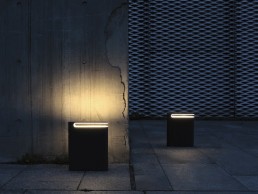
Joy Lighting Clip
Clip is an outdoor lamp series that provides indirect lighting, and as the name already suggests, it features shapes that are inspired by the contour of a clip. The top cover serves as a glare shield, while the bright inner sides at the gap disperse the light in the desired directions. The black aluminium bollard lamp measures 305 × 251 × 51mm, while the wall lamp features a depth of only 69mm. Both lamps offer a colour temperature of 3,000K at 10 watts and a light output of 250 lumens.
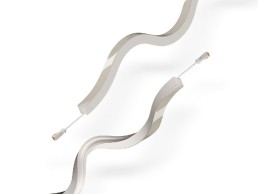
LED Linear VarioLed Flex VENUS True Colour
A new polyurethane encapsulation technology enabled the production of this light line for indoor and outdoor use. It is available in two models: Top View bends two-dimensionally perpendicular to the luminous surface, while the 3D model enables a homogeneous light line, which can be twisted or bent in three dimensions. Both models feature the same cross-section, an intelligent cable feed and special end caps which enable a seamless luminaire-to-luminaire installation.