
Meixi Urban Helix, China
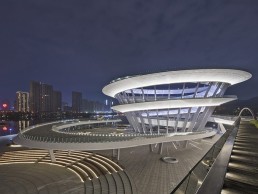
Merging the natural elements of water with the urban development, the Meixi Urban Helix is a beautiful new structure, uniting the two worlds of nature and man-made constructions.
Located in the southwest of Changsha, China, this new urban axis, designed by German architects KSP Jürgen Engel Architekten, is a multi-functional public space where visitors can enjoy panoramic views of Lake Meixi, as well as the planned city expansion that it overlooks.
The structure ascends above a man-made plateau on the lake, spiralling to a height of 34 metres through an exposed ramp measuring six to eight metres wide. The interior of the helix provides visitors with a reversing path ramp leading from the structure’s highest point down to the new urban area.
Lighting for this impressive structure comes courtesy of New York-based lighting designers Office for Visual Interaction (OVI). By combining few directly visible lighting elements with a backdrop of indirectly illuminated architectural finishes and surfaces, OVI has created a consistent, balanced lighting scheme spanning the structure.
OVI regularly collaborate with architects and design teams very early in the design process, maintaining a regular dialogue as the project develops. This project was no different, as OVI worked with KSP Jürgen Engel Architekten from the competition stage of the project. Because of this, OVI was able to develop a strong lighting concept that remained consistent as the project progressed.
Markus Fuerderer, Project Lead and Product Design at OVI, explained: “We extracted the essence of the architecture to generate a well-conceived lighting design scheme.
“For Meixi Urban Helix, we envisioned an iconic gesture for the exterior nighttime identity with a continuous, flowing band of radiant light that creates a visual connectivity of the double-helix ramp and connecting bridge. To intensify this infinite metaphor, we kept all structural elements, such as the radiant vertical helix columns and the undulating wave structure of the bridge, dark in contrast.”
In order to effectively articulate the project as a flowing, infinite band of light, OVI sought to increase this character further by continuously up-lighting the helix ramp and bridge surfaces consistently. Colour capability was also included as a means of visually separating layers of the outer ramp surfaces from inner surfaces, creating visual clarity and added depth.
For the nighttime identity of this iconic new structure, concealed linear LED uplight coves illuminate the ramp undersides at night to articulate a continuous, spiralling ribbon of light. To increase visual depth, RGBW capable luminaires have been specified, allowing to distinguish the outer ramp surface from the inner surface by adjusting the light colour.
Elsewhere, handrail-integrated linear LED luminaires provide additional illumination for bridge and ramp areas to guide visitors through the ascending and descending paths, connecting between the structure and the new urban area.
While these lighting fixtures help to enhance the nighttime identity of the structure, OVI was keen to reduce the perceived amount of illumination for visitors to enhance the spectacular panoramic nighttime views. Fuerderer continued: “We designed a low-mounted guiding element of sparkle using miniature marker lights along the inner ramp perimeter that light the walkway and intuitively guide visitors up and down the helix.”
Situated on an artificial island with an area of about 20,000sqm, radiant in-grade lines of light correspond with the paving pattern that originates at the centre of the helix’s geometry. Zooming in, concealed step lights and under bench lighting details accentuate the stage and steps, while miniature in-grade LED uplights at the base of each vertical structural beam illuminate the edge of the vertical elements. This serves to generate a subtle visual framework for the spiralling ribbon, complementing the fluidity of the design and contrasting it against the nighttime backdrop of the city.
One of the most remarkable things about the Meixi Urban Helix is the consistent, uniform lighting across its span. This, according to Fuerderer, is an integral part of the structure’s design. “A key feature of the lighting gesture is the continuous appearance of the illuminated, flowing, infinite band of light along the bridge and helix,” he said.
“We designed a miniature linear cove detail at the bottom edge of the sectional profile. This cove accommodates a high performance linear wash luminaire with optimised optics by Electrix Illumination to generate a soft light gradient across the entire ramp overhang, reaching up to eight metres in distance.
“An important visual aspect of this detail is the shielding: the cove detail is dimensioned to avoid direct views into the light source, while maintaining the architectural integrity of the design.”
OVI’s overriding approach to lighting design, across an extensive portfolio that has seen it work with the likes of Zaha Hadid Architects, Foster + Partners and Grimshaw, is to “reinforce the architectural features and give life to a project ‘after dark’”.
And Fuerderer believes that this philosophy has been met again with the Meixi Urban Helix. “The lighting design should be a natural extension of the architectural language and we feel that is the case here.
“There are so many visitors at night that we hope we have given them the opportunity to experience a magical moment when they visit this unique place.”

Four Seasons Hotel at Burj Alshaya, Kuwait
In Kuwait City, where the ever-expanding landscape is becoming overwrought with large, ostentatious skyscrapers, a new, altogether more subtle and sophisticated development has emerged.
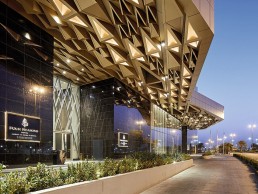
The Burj Alshaya, a mixed-use project featuring the new five-star Four Seasons Hotel Kuwait, the corporate headquarters for global enterprise Alshaya Group, and a connecting podium, features a unique design concept that takes inspiration from the culture and tradition of the region.
Designed by architects Gensler, the Burj Alshaya was developed around the tradition of the ‘mashrabiya’, an element of traditional Arabic architecture that sees windows enclosed with a latticework – a technique that has been used since the Middle Ages to provide shade and privacy while maintaining views.
A hybrid architectural element that is both functional and decorative, the mashrabiya merges the form and function of the Islamic window screen with a conventional jalousie, taking on the materiality of local culture.
This element was one of the key design drivers in a concept that sought to develop a building envelope that was both efficient and iconic, related to Arabic architecture, whilst embodying a novel approach to reducing the effects of the high ambient temperatures and intense solar radiation that characterise the local environment.
Tom Lindblom, Principal and Global Hospitality Leader at Gensler explained: “Our inspiration was to redefine a vernacular tradition. Arabic architecture is one of the world’s most celebrated building traditions, known for its radiant colours, rich patterns and symmetrical silhouettes.
“We wanted to produce a coherent and practical design, rich in layered ornamentation, which emanates the luxury and quality that Four Seasons and Alshaya embody.”
The resulting design reinterprets this tradition, presenting a contemporary take on traditional patterns and forms, via a three-dimensional lattice in various scales and locations across the development. The diamond pattern of the lattice provides solar control for the building, and the approach integrates the project’s main elements by wrapping the east and west elevations of both towers and covering large sections of the podium with a mashrabiya type envelope. While there are no mashrabiyas on the northern or southern façades, fritted glass with diamond-like patterning helps maintain the design continuity, providing shading and privacy while also offering a sense of drama and dynamism both from the inside and outside of the building.
The geometry of the shading fins enhances climatic performance for the occupied spaces and continues over to wrap the roof terraces and shade outdoor activities from the sun, while providing a recognisable and significant addition to the city’s skyline.
Alongside the aesthetical appeal of the façade design, it offers additional economic benefits, as Lindblom explained: “Buildings with fully glazed façades offer tremendous views and natural lighting, but they also encourage heat gain when the sun comes out. We developed a unique response with the objective to reduce interior heat gains and glare.
“The size of the individual diamond modules changes according to the location, therefore ensuring the interior benefits from suitable amounts of daylighting.
“Having carried out daylighting and shading studies with façade engineers, we modelled the façade to ensure the design utilises natural sunlight from within whilst reducing reliance on electric light, maintaining human health and a productive work environment during daytime.”
At 22 storeys high, the Four Seasons Hotel features 284 rooms and suites, including two large ballrooms with conference suites, an expansive pool-level terrace, three restaurants and two lounges, and a world-class spa and fitness facility.
Gensler worked very closely with Toronto-based interior designers YabuPushelberg and engineering partner KEO International on the hotel’s interior design, striving to bring the design concept of the façade inside, creating a holistic, seamless experience for locals and international guests.
“The room layout and how the interior spaces work is extremely dependent on the architecture and the façade,” continued Lindblom. “Decisions on where to position the fritted glazing were key to maintaining and maximising the views out of the towers and also had a bearing on the furniture arrangement, so we had to work very closely with YabuPushelberg and all parties to ensure the final design delivers the functional requirement with an interpretation of local vernacular culture in a contemporary manner, echoing Alshaya’s philosophy and the Four Seasons’ brand.”
In keeping with the Four Seasons brand, the hotel provides a luxurious experience for its guests – something that Lindblom believes is exemplified by the scale of the facility. However, despite this grand scale, there is a sense of intimacy throughout, as Lindblom explained: “While the front-of-house components are grand in their own scale, they are all well-connected and intimately knitted with one another, and often visually connected with the exteriors for a total immersive ‘inside-out, outside-in’ experience.”
Inverse Lighting designed the lighting for the project, working collaboratively with Gensler to create a lighting concept that accentuated façade geometry at night time. Lindblom continued: “The other surrounding buildings are all competing for attention at night with elaborate and ostentatious lighting schemes, but with our towers we wanted something more sophisticated and understated, to complement the complex geometry of the building and to stand out from the rest of the skyline.”
Inverse’s lighting design incorporates programmed lighting that the client can animate and vary depending on their requirements. The standard illumination on any usual day is to graduate the light up the tower and through the canopy, bringing people’s eyes through the whole project. This is something that Lindblom feels was “core to the symbiosis” of the lighting design and architectural concept.
Onur Sunguroglu, Director at Inverse Lighting, added: “The façade lighting was developed to compliment the traditional patterns. Rather than floodlighting the whole cladding, we, after a full scale lighting mock up of a façade panel in London, decided to position the luminaires on the façade, not only emphasising the patterns but also the lighting itself, creating diamond shape patterns.
“We also developed structural details for fixing the lights to the façade so they became a part of it, not just an item attached on to it.”
As guests enter the hotel, they are greeted by a tall, dramatic entrance lobby, featuring a huge, freestanding spiral staircase that curls to a height of thirteen metres, the world’s biggest hanging crystal, created by Lasvit, and numerous complex works of art, including a Marc Quinn sculpture.
Alongside the huge lobby area, Inverse tackled the multifarious lighting requirements of large but flexible events spaces, an atmospheric spa and corridors to the 217 guest rooms and suites.
In illuminating these spaces, Inverse worked closely with YabuPushelberg, a firm that they have a long-standing working relationship with, to create a scheme that was “integrated within the fabric of the space as much as possible,” according to Sunguroglu.
“We mostly followed the lead of the interior designer, who created these majestic spaces,” he added. “So the unspoken brief was to enhance the guest experience by reinforcing the interior design with lighting.”
Throughout the hotel, the lighting is discrete, often recessed into the floor, ceilings and furniture so that fittings are out of sight. This brings the focus firmly on the high-spec brief and the larger decorative pieces.
Hidden lighting has also been used in the long corridors to transform what might otherwise have been prosaic passageways into dynamic, welcoming spaces, helping to gently ease visitors into the relaxing mood of the spa and lounge spaces.
“Integrated lighting plays a vital role in creating the luxury atmosphere,” continued Sunguroglu. “A prime example of this can be found in the spectacular lobby stairs, where light was completely integrated into the stairs, creating a glowing centrepiece and enhancing the effect of a swirling ‘stairway to heaven’.”
Elsewhere, Inverse implemented a number of decorative lighting elements with YabuPushelberg, to further exemplify the luxurious atmosphere. A rectilinear chandelier in the Al Soor lobby lounge, along with custom pendant lanterns produced by Viso, help to unify the design of the lobby and pool areas with the décor in the guestrooms.
The lighting design also covered meeting and prayer rooms, bar and dining areas, a pool deck and the rooftop restaurant, designed by Kokai.
The architecture and interior of the Four Seasons, and Burj Alshaya as a whole, reflect the city’s modernity, while paying tribute to the local traditions, while its sleek, avant-garde luxury places the building as the stylish new centrepiece of Kuwait City, creating a prestigious backdrop for business and the new focal point for the city’s social scene.
Indeed the reaction to the building is something that has not gone unnoticed by Gensler, as Lindblom enthused: “We think it’s great that everyone has reacted so well to it.
“During the design stage we made a conscious decision not to include a hotel sign at the tower top, as the architecture design is so unique that the building becomes immediately recognisable.
“The hotel is now so well known in the local community and people have no difficulty finding its location – I think that’s a testament to its strength.”
www.inverselighting.co.uk
www.gensler.com
China Resources Land Archive Library, China
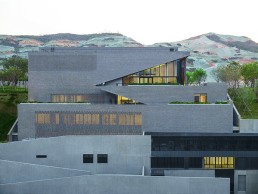
To the east of Shenzhen in Xiaojingwan, leaning against a mountain and facing the sea, sits the China Resources (CR) Land Archive Library, an exquisite new facility that houses archival storage, exhibition areas and office space, bringing a sense of culture and history to the surrounding coastal communities.
Designed by New York-based architects Studio Link-Arc, the library appears to lean against its surroundings, and features layers of platforms and long footsteps, based on the trend of its surrounding environment.
The building is covered in handmade grey bricks, which unify the structure and add texture to the exterior surfaces. These bricks are articulated in many different ways, bringing a sense of texture and calm to the building, while better expressing the flow of both natural and artificial light throughout.
Lighting design for the CR Land Archive Library came from Chinese firm Beijing Ning Field Lighting Design, the team behind last year’s IALD Radiance Award-winning Harbin Opera House.
Beijing Ning Field came on board with the project having met architects Yichen Lu and Qinwen Cai of Studio Link-Arc at the China Pavilion of the World Expo in Milan in 2015. Through conversations, the lighting designers learnt that Studio Link-Arc attach a great deal of importance to lighting design in their work, and when the CR Land Archive project came up, they recommended Beijing Ning Field for the job.
Dongning Wang, Director of Beijing Ning Field, explained the brief handed down by the architects: “The architect wanted the building to be elegantly lit with a balanced combination of natural and artificial light.”
This balanced lighting concept covers both the interior and exterior schemes, with a particular focus on “reducing the influence of outdoor lighting on the night sky”.
For the landscape and architectural lighting design, Beijing Ning Field mainly relied on internal transmitted light, supplemented with low-level ambient light, which minimises the negative effect of over-lighting at night. Hollowed-out brick walls bring daylight into the interior space at day time and extend the view of the space, while after dark, it adds a warm glow to the building outline, forming a contrast of light and dark and enriching the sense of the exterior space.
“With the lighting, we wanted to create a self-glowing building, which looks natural and in harmony with the surrounding environment,” Wang explained. “In Shenzhen, a city with great light pollution, we wanted to use light in a low brightness to create a peaceful and noble land at the top of the mountain.”
The idea of creating a self-glowing entity extended to the landscape design also, as Wang and his team utilised fibre optic fixtures to illuminate the plants and flowers on the path leading up to the building.
“The main purpose is not only to lower the illumination levels, but also to eliminate the inherent image of light fittings and create a romantic effect that the green plants and flowers are self glowing. The light from the fibre optics softly glows the plants nearby without polluting the quiet and dark night sky.”
As visitors approach the building, they are met with an entrance canopy of black steel. As part of its quest for a more subtle, hidden lighting scheme, Beijing Ning Field chose to use recessed downlights in black, concealing the light fittings in the daytime. These recessed lights are small in size, with a narrow beam angle to control glare.
Stepping inside to the lobby area, the design is implicit and steady. Light fittings from Erco and PAK are again all concealed to ensure the integrity of the interior design. Track lights are installed at the seams of the brick masonry walls below a large skylight, which keeps the aesthetic view of the surface while blending artificial and natural light.
The reception desk is softly illuminated by light fabrics, which help to create a welcoming atmosphere, while the warm glow from light coves on the ceiling outlines the perimeter of the interior space.
The idea of a subtle, hidden lighting scheme throughout the building is something that the architects and lighting designers worked on from the very start of the project, as Wang explained: “In the rendering images of the lobby submitted by the architects to the owner, you could feel the effective fusion of natural light and artificial light and the pursuit of the purity in the space.
“In the lighting proposal we submitted to the architect, the picture was even cleaner. There are hardly any exposed light fittings on the ceiling. Instead of having an even horizontal lighting in the space, we persuaded the architects to instead apply lighting by zones and emphasise ambient lighting, thus achieving a pure visual impression.”
Similarly in the lounge and exhibition areas, Geosheen strip lighting is installed with a perforated cover, intended to blend into the ceiling’s aluminium grilles.
“In order to conceal the light fittings and keep the ceiling clean, we communicated with the architects and decided to use an aluminium grille as a drop ceiling,” Wang elaborated. “The grilles are perforated where the light fittings are installed. The key was to find the optimal perforation rate for concealing the light fittings when the lights were off, while making sure that the light transmitted to the space evenly and without glare when the lights are on.”
To the rear of the lobby is a grand staircase glazed in a bright golden hue, which acts as a visual focal point for visitors entering the building. At the top of the staircase is a large skylight, filling the space with a natural light. However, to provide a shading element during the day, and an indirect light source at night, the lighting designers developed an electric ‘organ curtain’, following some natural light simulations carried out with the architects.
During the day, this organ curtain is fully opened, and natural light enters the space through the skylight, providing general lighting to the space. At night, the curtain is closed, and PAK spotlights mounted on either side are pointed up towards it. This light is then reflected and evenly scattered into the space, giving the appearance of daylight.
As with the architecture of the building, the lighting design remains very subtle and minimalist throughout, creating exactly the kind of gentle ambience that both architect and lighting designer strived for. “We want people not to focus on the techniques of the lighting design, but on the aesthetic atmosphere of the building itself,” Wang said.
“Lighting harmonises the relationship between natural light and artificial light, making people feel the beauty of the light.”
The harmonic relationship between natural and artificial light throughout the CR Land Archive Library is emblematic of the relationship between Beijing Ning Field and the architects at Studio Link-Arc, this despite the distance between the two firms.
“It was a challenge to communicate effectively with the design team over long distances,” Wang revealed. “The project is located on a mountain far away from downtown Shenzhen, while the architects are in New York, USA.
“However, we established several communication groups with the architects in WeChat. In these groups, we discussed the technical drawings and were able to solve problems by photos, voice messages, videos, etc.
“Despite the architects being far away in New York and the fact that we seldom communicated with each other in person, the trust and constant communication meant that we could achieve a good design result.”
Alongside the constant long-distance communication, Studio Link-Arc’s sound understanding of the importance of effective lighting design meant that the project was always going to be a success.
Wang continued: “Throughout this project, the architects had a better understanding of the process and function of lighting design. During the work, the architects communicated with us to make comments on the lighting designs several times, but they respected our professional opinions and rarely commented on technical aspects. From this point of view, we implemented our own lighting concept in a relatively complete way, and the architects and owners were both happy with it.”
With just reason, the lighting design seamlessly fits into the fabric of the building, providing a natural illumination inside, while casting a delicate glow on its exterior.
More than just providing an aesthetic detail, Wang believes that the lighting scheme brings an ethereal quality to the building.
“Lighting endows the building with a calm power, emanating from the inside of the building,” he said. “Light provides occupants with emotional power and the space with rhythmic change.
“Buildings are capable of moving the heart with the help of light. It is lighting that makes the CR Land Archive Library on the mountain more like a monument, depicting the enterprise’s glorious history.”
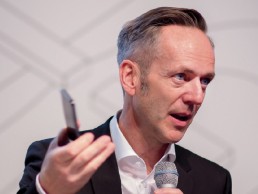
Dieter Polle
Following the launch of DIAL’s new book, Smart Building Design - Conception, Planning, Realisation and Operation, arc caught up with Managing Director Dieter Polle to discuss Smart Lighting, and its role in the wider realm of building design.
How did you get into lighting?
I’ve been fascinated by light since I was a child. At university I was fascinated by these giant spheres and goniophotometers standing in all black rooms. I liked that lighting engineers focus on the interface to humans and that all the science is about improving the wellbeing of people in spaces. These interesting aspects came together with my passion for design and architecture, so what else could I do than become a lighting specialist?
Can you give me an overview of your career to date?
After my study of electrical engineering and lighting at university in Karlsruhe, I got my first professional experience at a mid-size design-orientated luminaire manufacturer as a lighting designer. After a short time an interesting offer came to me. DIAL was just founded and was looking for someone to design a photometric lab as well as a white lab. I took the chance. DIAL grew continuously, offering new challenges to me. We built an excellent lab and offered seminars to customers who wanted to learn about lighting. After some years I took over the position as a team leader of the lighting team. DIAL’s growth continued and I had the chance to take over as Managing Director a few years later. This was a challenging role, and it is still challenging me. In the last few years we’ve established DIALux, we’ve introduced LUMsearch, a luminaire search engine, the DIALux mobile app, and many more online services. The building design field was developed as well, and we developed a design theory for intelligent buildings that we now teach.
You’ve been Managing Director of DIAL for almost 20 years now, how has the company, and the lighting industry as a whole, changed in those years?
20 years ago DIAL was already an interesting company. Perhaps 20 employees were sitting in a few rooms in an old factory. We conducted seminars in lighting and KNX and DIALux’s success was just beginning. Today 90 employees are working at DIAL. We are working in our new company building, whose architecture we designed by ourselves, along with the lighting and the intelligence inside. It was an opportunity for us to show to customers that we understand what we are teaching. The lighting industry has sped up a lot. LEDs have become the one and only relevant light source, and the digital transformation of nearly everything is also happening in lighting and building automation. Many manufacturers are questioning themselves about what this means for their products and business models. Everyone is asking how they might earn money in future. In general we observe a huge uncertainty, and there are good reasons for it. Disruption happens.
How has the emergence of ‘Smart Lighting’ impacted DIAL?
Many people are talking about ‘Smart Lighting’. Some think that ‘smart’ means that it can be controlled via smart phone. For me, smart lighting is where the user does not have to worry about it. It switches on when you need it and offers the quantity and quality of light wherever you need it. For this to happen, a good designer is needed, along with a customer who wants to get such a solution. For us it is interesting and melts together our core competencies in lighting and smart buildings.
DIAL has just launched a new book: Smart Building Design - Conception, Planning, Realisation and Operation. What is the background behind this book? How was it conceived?
With this book we want to explain to readers how smart buildings can become reality. In short, by designing them. We believe strongly in the vision that architecture will become dynamic and intelligent. This is technically possible already and has been for quite a long time, but has never happened. Whenever you tell someone something about building automation most people reject it. They fear it might be too expensive, has no sense and does not function. They are right. The reason is: building automation it not part of a holistic design process. The design of the automation, how the building should behave, needs to become part of the general design process of the building. For the stakeholders this has been difficult to understand. From the designers perspective it is clear and easy: There is one product to design and it consists of both a shape and its function or behaviour. The synergy is one single thing, a product you might call a smart building.
Who is the book primarily aimed at? Lighting Designers? Manufacturers? Architects?
All of them. Of course the architect has the strongest position to put things forward into this direction. I know many architects, not all of them are convinced that technology and software will play a key role in the value of the buildings they design. Yet.
The book offers an insight into DIAL’s thoughts on how “Smart Buildings” should be designed. How important is lighting in the Smart Building concept?
Lighting is only one part. Doubtless an important part, because it affects people so much and because it plays a key role in the perception of spaces. But the challenge and the biggest value of intelligent buildings can only be achieved when everything is connected. It is a huge mistake to treat light individually.
Is this the first book that DIAL has produced? Do you have plans to work on any more?
Our first book was about how lighting can improve wellbeing. We wanted to put an emphasis on lighting design for the wellbeing of people instead of focussing on illuminances and power consumption, as it is too often the case. Lighting designers need to know that lighting affects wellbeing, and this needs to be taken into account. We are influencing people’s behaviour and health. We conducted research and published the results with this first publication. The results became a key aspect of the seminars we offer for lighting designers at DIAL today.
What do you think the future holds for the lighting industry?
What a huge question! Many possibilities, less restrictions, huge challenges but also risks. Everything is possible, technology gets cheaper and the margins shrink. IP connectivity of nearly every item allows solutions nobody thought of yesterday.
David Morgan Review: formalighting Motolux Range
Following its appearance at darc room, David Morgan takes a closer look at formalighting’s extensive Motolux range of motorised architectural lighting products.
When a lighting company started by two Italian brothers in London in the 1960s grows into an international business with headquarters in Milan and Hong Kong, sales offices in New York, London and Shanghai, it seems certain that the company will also have a highly adventurous approach to product development.
formalighting was founded in the UK by brothers Guido & Lorenzo Maghnagi as a distributor for a number of Italian lighting brands, including iGuzzini. The Maghnagi brothers chose to open their showroom in the Business Design Centre in Islington.
Working with leading Italian designers, the company then started to develop its own architectural lighting products. Lorenzo moved to Hong Kong and established one of the first European-owned lighting factories in China to manufacture these ranges. The combination of Italian design flair with the lower manufacturing costs available in China has allowed the company to expand steadily over 50 years and it now employs more than 180 staff worldwide.
When I first met Lorenzo in the 1970s, I would not have predicted that formalighting would become the kind of company to create an impressive range of motorised architectural lighting products, but that is precisely what they have achieved.
The benefits of being able to aim and focus projector luminaires without the need for cherry pickers, scaffolds or ladders have become more obvious due to increasing health and safety at work legislation. These requirements have dramatically increased the costs of manual aiming in larger spaces. Conversely, the production costs of remote-controlled luminaires have fallen as the various enabling digital technologies develop, which in turn has widened the market opportunity.
Looking specifically at formalighting’s Motolux range, it initially started as a collaboration with an American engineer who had an existing patent for a fairly simple form of motorised lighting, although the history of motorised and remote-controlled lighting dates back to a much earlier period in the 1920s. Technical pioneers, including Herbert F King from Massachusetts, first filed a patent for a fiendishly complicated mechanism with separate control of pan and tilt, all driven by electric motors, which would allow products on display in shop windows to be individually lit in sequence. A little later in 1929, Charles Andreino from Canada patented a similarly complex remote-controlled, motorised spotlight system that included focus control.
The first, and fairly limited, product introduction of the Motolux range was at Light + Building in 2016, which resulted in a new patent for the motorised multi-axis gimbal rings. The initial range was well received and the formalighting development team spent the next two years leading up to this year’s Light + Building show creating an impressive twelve different product families incorporating the technology. These families include individual recessed downlights, multiple recessed projectors, track mounted projectors, pendants and surface mounted luminaires, as well as some exterior IP-rated versions of these types. In many cases the remote-controlled versions are based on the original, manually aimed, luminaires, which are still available for simpler projects.
The Motolux range is so extensive that there is not enough space in this review to discuss any particular luminaire in detail. If I was to choose one of my favourite products I would opt for the Moto Ola, a minimal pendant gimbal with motor control suspended on two slender power cables. The Moto Ola can be fitted with a Soraa Snap light engine so that all the Soraa snap accessories can be attached magnetically. The head can be rotated in both axes although at this point, as far as I know, the suspension cable length is not remotely controlled. However cable length control is available, if required, with the rather larger Moto Roulette pendant.
The smallest track mounted spotlight in the range is the Moto Zero 40 Compasso, which is only 40mm in diameter. The mechanisms incorporated within the various luminaires are highly miniaturised, and have been cleverly designed so if the luminaire body is rotated manually, no mechanical damage is caused and automatically resets to the start position when powered up.
The Motolux range introduced this year includes a very wide variety of light engine options and complementary technologies which supplement and compliment the motorised control. Mechanical focusing is available as one option but other versions incorporate the LensVector liquid crystal solid state focusing system, which I reviewed in arc 104. One of the advantages of incorporating Lens Vector is that the luminaire size is reduced to that of a non-focusing product. Apparently, formalighting was one of the first companies to develop luminaire designs incorporating the early LensVector technology.
A dedicated Motolux hand transmitter is available that enables all the functions to be individually controlled for each luminaire, but there are also versions incorporating Casambi wireless control. When a luminaire is selected for control either by the hand transmitter or via Casambi, a green indicator LED lights.
The variety of light engines available includes tuneable white, dim to warm and colour changing. The remarkable full spectrum Lumenetix LED module, providing both tuneable white and colour changing, can also be incorporated in the range complete with Casambi control, which is another first for formalighting.
formalighting has created a well-designed and very comprehensive range of remote-controlled luminaires that can be used in a wide variety of architectural and retail lighting applications. Their ambition to push the boundaries of product development has set them on a clear trajectory to increase the overall market size and their share of this market segment.

Intra Acousto
Acousto is a luminaire that features a sound absorber with excellent absorption, making the area not only quieter but also more private. Acousto is suitable for applications when creating large and open spaces with a majority of hard surfaces and an echo or when you’re simply seeking a different and green solution. The addition of the MOSSwall panels not only help absorb the noise but also bring nature indoors with maintenance-free.
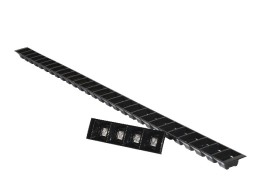
LEDiL Daisy
Make your office look good and increase wellbeing in the workplace with DAISY, the LED optic for a modern, glare-free office.The 1.1-metre long black shade eliminates glare and is a perfect fit for today’s office. As well as making the luminaire look elegant, the housing works seamlessly with the lenses to provide uniform lighting with high in-use-efficacy.
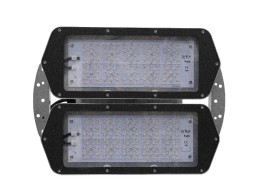
Prilux Hexagon
Hexagon is the new modular projector designed by Prilux. Its performance and versatility makes it a great choice for high-altitude enclosures, sports, cultural, industrial buildings and tunnels. Equipped with DALI regulation system as standard, it allows for creative lighting spaces, adapting them to the needs of each application.
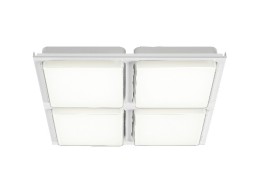
Sylvania Pixer
Pixer is an architectural office luminaire range that focuses on aesthetics as well as ambience. The product is based around illuminated ‘Pods’ that can either be recessed (to create a clean/flush ceiling) or dropped (offering flexibility and creating enhanced ambience) a mix of dropped and recessed pods provides a unique solution with enhanced visual interest. Pixer can be manipulated into either a square or rectangular form and meets and exceeds UGR <19 standards with SylSmart technology as standard on certain models.
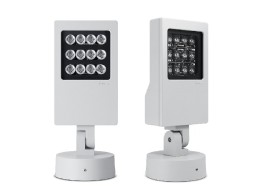
Unilamp Athlon
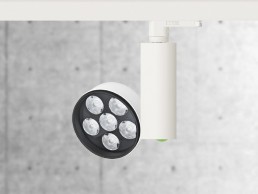
The Athlon family is a functional mini spotlight/floodlight. The slim and clean design of Athlon allows a hidden installation. Athlon is designed for a streamlined time effective installation. Tight beam control utilises selected lenses from world-renowned manufacturers. Athlon is available with symmetric, asymmetric and bisymmetric light distributions and the broad range of accessories such as a ground spike, tree strap, colour filters, honey comb louver and glare shield hood makes it a dynamic floodlight choice.
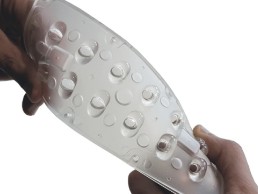
Khatod Nactus 6X2 SIL
These optical modules are made of ultra-clear silicone, consisting of twelve optics with 25.40mm lens pitch. Engineered for 3.5x3.5mm Power LEDs, they also fit 5x5mm package LEDs. Three beams: IESNA Type II/ III /V medium cutoff. IESNA Type III optics also meet ME3A requirements. Designed to comply with IP65 rating and IK10 rating (20 Joules). No glass cover is required. They system boasts high optical efficiency, great temperature resistance, non-yellowing effect and also available with holder in PC, on request.

Smart Lighting increases workplace satisfaction, research shows
(Netherlands) - Research from Signify indicates that investing in smart lighting could lead to increased workplace satisfaction among employees.
Over half of small and medium-sized enterprises struggle to recruit talent and two in five have issues retaining employees, according to new research from Signify, formerly Philips Lighting.
The findings show that over half of the employees surveyed said they’d be in favor of their company investing in connected tech, specifically smart lighting, ahead of other improvements.
“High workplace satisfaction influences engagement and the reputation of a business as a great place to work. So it’s no surprise that SMEs are looking into connected tech options to enhance engagement,” said Bianca van der Zande, research scientist at Signify.
“Nowadays with new technologies including LED and IoT, lighting can be a powerful influencer in the workplace. It has a big impact on how people can control lighting.
“With about half of the surveyed employees being in favour of having smart lighting installed, this could be an excellent way for SMEs to make the workplace more appealing to current and potential employees. We want to see this reflected in our working environments where connected tech is an important way to appeal to the best and brightest.”
When it comes to connected technology usage among SMEs, nearly one in five (17%) already use it in some form in their business, and just under a third (29%) are interested in doing so in the future.
Dr. Craig Knight, Chartered Psychologist, Honorary Research Fellow (Exon), Director of Identity Realization Ltd, agreed on the importance of lighting at work, saying: “Light can have astonishing effects within the workplace. It has been shown to be at once invigorating, calming and sculptural. Yet too many businesses pay scant attention to light, offering cheap rather than effective solutions. Science suggests that poor lighting strategies put wellbeing, happiness and productivity in jeopardy.”
The benefits of smart lighting could go beyond improved employee wellbeing and engagement. Of the SMEs that have areas that customers or clients visit, over a third thought that smart lighting would improve the customer or client experience. Employees are even more positive about the effects though, with 61% believing that smart lighting would give customers and clients a more favourable opinion of a business.