
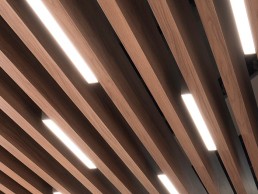
KKDC KOH 40
KOH 40 is the new linear general/office lighting solution from KKDC which uses high output interchangeable LED modules (Switched/1-10V/DALI) configurable in short lengths or continuous linear systems. KOH 40 is available in Recessed, Surface mounted or Suspended options for direct/indirect lighting in a range of premium paint colour finishes. A choice of LED and cover options in Prismatic/Diffused or Black Louvres for optimum performance.

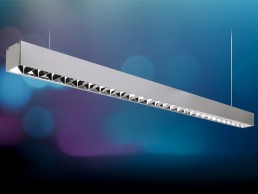
Megaman Gabio
Megaman has introduced a range of aluminium linear LED pendants, Gabio. The patented louvre is available in 20W and 30W versions, producing up to 117 lumens per watt. Able to be configured with direct as well as direct-indirect lighting the louvre suits a variety of design requirements. Furthermore, Gabio features a unique design, incorporating light cells within its junctions, which conceals the joins completely to create unbroken lines of light, which delivers excellent design consistency.

Forge Europa celebrates 25th anniversary
(UK) - Forge Europa celebrates a quarter of a century in business.
Founded in 1993 by Peter Barton, Forge Europa, an LED lighting solutions firm that manufactures LED solutions focused on innovation and quality whilst providing accompanying customer service and technical support, celebrated its best year in 2017.
Forge began as a sole trader operating out of a spare room at Barton’s home. Since then, the company has gone from strength to strength and today delivers innovative LED lighting solutions to customers in 34 different countries. The company invested heavily in R&D and testing facilities to aid its position at the forefront of LED technology and has developed a number of industry firsts, including ranges of interlocking LED displays and underwater lighting, as well as precision optics for anything from designer lighting to helicopter landing pads. Forge Europa received a Queen’s Award for Enterprise for Outstanding Innovation in 2009 and the building of its imposing Lighting Solutions Centre, which was opened by HRH, Duke of York in 2012.
Barton, founder and CEO commented: “Starting the business in 1993 was a leap into the unknown, which required a huge amount of hard work and tenacity, mixed with occasional inspiration and, of course a bit of luck. However, without doubt my biggest asset in the beginning was a very supportive family that had tremendous faith and convinced me that anything was possible. LED technology has changed beyond recognition since 1993 when, effectively, white LEDs, which are now the mainstay of the lighting industry, didn’t exist. One thing I have learnt is that a company must constantly keep innovating to stay ahead and therefore I’m absolutely delighted that, despite the ongoing challenges and uncertainty of Brexit, our 25th year has been our most successful so far. We have a very professional team with a diverse range of talents, many of who have been with the company for a long time. I thoroughly appreciate all their hard work, loyalty and, occasionally, requisite sense of humour. After 25 years of growing success, I believe that our best times are ahead of us.”
Ian Dixon, Commercial Director, has been involved for eighteen of Forge’s 25 years and puts this down to a unique combination of the continuous development in LED technology, the evolving diverse market place and a business that continually invests and re-invents itself to keep it at the top of its game. Dixon commented: “Forge Europa’s customers are the life blood of the company and working with them across so many market sectors is not only interesting but an absolute pleasure.”
Technical Director David Scott-Maxwell has been with the business for thirteen years and commented: “It’s been both highly challenging and hugely stimulating to have helped Forge Europa grow at the leading edge of the LED Lighting Revolution over the last decade or so. But LED Lighting is still really only in its infancy - so here’s to the next ten years!”
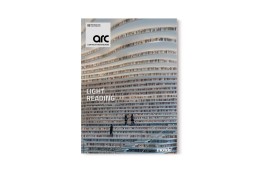
Issue 102
arc Feb/Mar 2018 – Issue 102
Read all about it!
As a print and book lover, it is very satisfying to be able to publish some spectacular library projects in this issue.
I grew up living next to a library so spending time there, whether revising for exams or just discovering books, became second nature to me. Of course, back then there was no such thing as Google and even home computers were only just becoming available to all (OK, I’m showing my age now) so visits to the library were commonplace for conscientious students like me!
A few years ago, well after I had left my home town for a career as a journalist, I was sad to discover that the library had closed down (although it recently got rehoused at the town bingo hall!). Without that library and the love it gave me for reading and writing I may well have gone on a different career path but here I am writing as an editor about some new libraries that have caught our eye as architecturally stunning buildings with lighting playing a crucial part in their success. Of course, the libraries of today need to diversify to survive (and indeed thrive) and it is the re-imagining of libraries as cultural hubs that has led to projects like Tianjin Binhai and The Word becoming realised.
And it’s ambitious projects like these that allow light to come to the fore. The lighting for both these projects, although not a huge part of their budgets, were crucial to their success as architectural icons in their own right. In Tianjin, China the flexible cove lighting radiates throughout the building’s curvaceous cavern around the glowing auditorium eye. The Word in South Shields, UK flies in the face of the government’s austerity programme to create a phenomenally successful cultural hub with a spectacular lighting centrepiece engineered in a cost effective way. It has been a pleasure to feature these projects and I hope you enjoy them too.
Paul James
Editor
arc
* For those of you who are attending Light+Building be sure to pay us a visit at our stand at 4.1 FOY12. We’ll be distributing thousands of copies of this issue as well as our decorative lighting magazine darc and the International Lighting Design Survey. See you there!
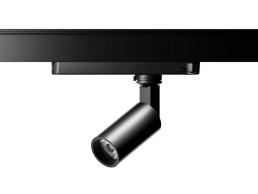
Formalighting Moto-Zero Compasso 40 Track
The smallest motorised track spotlight on the market, mounted vertically or horizontally, with a light head measuring only 40mm in diameter and 74mm in length. Available with a beam angle as narrow as 4-degrees, the Moto-Zero Compasso 40 is ideal for applications where size really does matter, and smaller is better. The movement of the light head and the light intensity are controlled at the tap and slide of a finger with the formalighting wireless app.
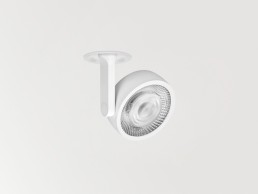
Arkoslight Six
Six, designed by Arkoslight’s head of design, Rubén Saldaña, is a spotlight for either track or single recessed installation, standing out by its optical lightness and elegance. Its disc-shaped body with slightly convex rim encloses an innovative combination of reflector and lens, and the joint action of both directs the light beam with maximum uniformity and minimum distance. Moreover, Six connects directly to the track adapter through an articulated arm, allowing orientation of the fitting in any direction.
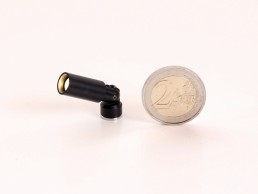
Mike Stoane Lighting Protozoa
Protozoa, like the 16mm Surf Type S when that launched in 2009, is the smallest technical luminaire in its class. Merely 9mm and 37.5mm tall at maximum extension, it has full 360-degree pan and 180-degree tilt adjustment. A very low glare, high-grade optic delivers a generous 13 to 60-degree zoomable clean beam. Launched with 3000K and 90+ CRI initially, it is available in surface mount and soon also semi-recessed, stick mount and repositionable track mount.
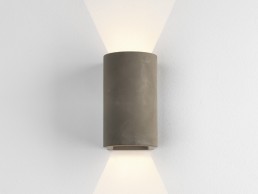
Astro Lighting Dunbar 160
Inspired by the flowing lines of a Mobius strip, Astro’s concrete Dunbar 160 combines a soft curve structure with the crisp linear edge of its light output, where deeply recessed LEDs provide powerful yet glare-free illumination. Celebrating the character and charm of raw material aesthetics, the Dunbar 160 is individually cast by reinforcing raw concrete with weatherproofing additives. The result is an authentic luminaire with natural imperfections and a unique finish.
Nexia Moon
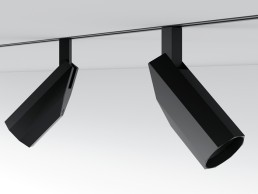
“We conceive light as an emotion”. Nexia has launched a totally unique range of spotlights. Moon, with its exclusive and architectural design, features the latest lighting technology. Nexia offers complete and upscale lighting solutions, taking care of light control with a new range of technical accessories, the use of Bluetooth, VCL technology, dim to warm and tunable white dimming controls.
The Wedding Gallery, UK
For betrothed couples looking for a one-stop shop for their wedding planning needs, the Wedding Gallery at One Marylebone is the perfect location.
Located in a repurposed Anglican cathedral – formerly Holy Trinity Church – on Marylebone Road in central London, The Wedding Gallery provides a wealth of luxury retail establishments and wedding planning services, alongside a 400-capacity venue, all under one roof.
The 20,000sqft Wedding Gallery covers every detail needed for a wedding, from hair and make up, gowns, jewellery and suits to photographers, flowers and wedding stationary. The store also offers cakes and catering, with an on-site kitchen for taste tests.
Couples can also hire DJs and speechwriters, or visit the ‘hub’, where they can put on headphones and watch wedding singers and bands on a big screen to book musicians.
To make sure that no details are missed, wedding planners are on hand to provide advice, while insurance packages are also offered for worst-case scenarios in case one partner has a last-minute change of heart.
Perhaps more impressive than what is inside the Wedding Gallery is the building’s beautiful, neo-classical inspired architecture. Built in 1828 to the design of Sir John Soane to celebrate the defeat of Napoleon, the building boasts a grand portico and belfry tower.
The Grade-I listed building could be seen as being imposing, but the owners sought to use the facility’s impressive architecture to create an inviting environment both inside and out, especially at night.
The Wedding Gallery wanted the building’s architectural lighting to creatively provide upmost emphasis on the surroundings, with the ability to control the various areas using a touch-screen controller to maximise the usability. As such, they contacted Essex-based ErosPhos and EPS Lighting to design and supply the lighting respectively.
A multidisciplinary architectural lighting design practice, ErosPhos also covers lighting control systems design and engineering to provide clients with complete lighting solutions, while EPS specialises in determining and specifying appropriate LED lights and lighting controls based on three main criteria: performance, usability and effectiveness.
“Lighting had to be efficient, cost-effective and easy to install,” said Russell Vanstone, Technical Director at ErosPhos. “EPS used the light fixtures’ photometry to create a rendering based on the product’s performance, not an artistic representation. This allowed us to correctly specify and present the solution to the client, ensuring the end result is as expected.”
The exterior lighting was intended to serve two purposes; general illumination, but also as part of a rental package for events held on site. Because of this, EPS provided the ability to override the automatic controls. It also included a DMX input for a theatrical lighting desk, allowing event users to control façade lighting for different kinds of events. Based on these criteria, ErosPhos specified high-output, exterior-rated LED fixtures from Acclaim Lighting.
ErosPhos’ lighting specifications consisted of forward and side-facing flood fixtures, inclusive of lighting on the roof. Those lights include a combination of flood and linear grazing.
Acclaim’s Dyna Accent LED flood fixtures are used to uplight the building’s entrance doors and pillars, while DynaFlood XT QW highlighted the trees in the garden area to create dramatic effects. Designed for dynamic illumination of façades, structures, landscapes and monuments, the Dyna Flood utilises Acclaim’s quad colour technology in either RGBA or RGBW.
“The client initially wanted an ‘all white’ install, but through demos and mock-ups we managed to show that colour was indeed the best way forward,” explained Vanstone.
“We had to ensure that the building didn’t look like an animation from a cartoon, which unfortunately can happen when a building is lit in colour if the design isn’t done correctly, but the feedback from everyone is that the building has never looked better.”
Elsewhere, Acclaim’s DynaDrum SO QW bathes the cathedral’s front entrance and clock in light, while Dyna Flood fixtures were also used to side wash the structure. The lighting designers also specified linear outdoor LED DynaGraze AC DMX fixtures, which enabled them to create multiple configurations, including RGB, RGBW and Dynamic White.
“The creativity of the design and the use of colours has satisfied the client and the visitors of the event space,” Vanstone continued. “The lighting versatility, the simplicity and the output of the system greatly justifies the investment. Now, when visitors go to the old church, their wedding journey starts with a beautiful experience through colour that hopefully continues throughout their lives.”
Initially just brought in to provide lighting for the building’s exterior, ErosPhos were also asked to look at the interior of the building as well, and after putting together a design for this, they consulted with the client’s in-house construction team.
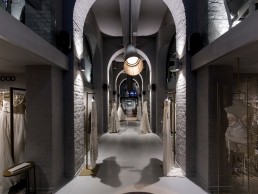
Inside the church, the many retailers are located throughout weaving tunnels and catacombs, adding a sense of exploration and playful, maze-like quality for guests as they navigate their way around the facility. However, such an unusual layout meant that there was a total lack of any natural light.
As such, it was essential that the lighting scheme developed by ErosPhos was fit for purpose. As with the exterior, Vanstone and his team provided design renders and mock-ups to make sure that what they were proposing would work, and also worked closely with interior designer Christian Lahoude to ensure that the lighting designs really maximised the architectural designs.
“We had to ensure that we specified the correct function and emergency lighting, which not only complied fully with the BSEN standards for emergency lighting and general illumination levels, such as that on stairs, we also met the design requirements and catered for the fact that this is indeed a very high-end retail environment,” Vanstone continued.
“We see way too often that effect comes before the relevant standards for illumination, and stairs are in darkness, for example, but with the right optics and distribution it is possible to meet the relevant standards, and also deliver on the architectural aspect.”
Lighting for the interior also came from Acclaim Lighting, alongside Nobile Italia and Hadler. Because of the building’s Grade-I listed status, ErosPhos were not able to make any structural changes to the building, nor damage the exterior façade. As such, all products were fitted using construction glues, and where actual fixings were required, these were done so using fixings that won’t damage the fabric of the building. The same applied for the building’s interior, where cable trays and recessed ceilings were used throughout.
Aimed at being a one-stop shop for couples looking for a luxury wedding, it was important that the Wedding Gallery had a lighting scheme to match the high-end luxury of its retail establishments. The design provided by ErosPhos complements not only the fine goods on display, but also the ornate architecture of this impressive building, adding to the already magical wedding experience and aiding in creating those special memories.

Lorenzo Maghnagi
With formalighting celebrating it’s 50th anniversary this year, arc caught up with founder and president Lorenzo Maghnagi to find out about the company’s past, present and future.
When was formalighting established and how did it come about?
About 50 years ago in the UK, we joined forces with other Italian design industrialists to develop downlighters for the architectural lighting sector, promoting Italian design through our showroom in London. Later, I was inspired by emerging Lighting Designers and Architects originating from South-East Asia, and envisioned our focus on architectural lighting for the commercial project specifications market, and formalighting branched off to realise an international presence with the expansion of a Hong Kong office. The business soon evolved to manufacture its own range of Italian designed architectural lighting and the expansion of our European headquarters in Milan.
How did formalighting look back then compared to now?
This year marks formalighting’s 50th anniversary. We have progressed from an international multi-brand distributor of Italian architectural lighting in the UK , to designer, manufacturer and global distributor of our own range featuring over 120 product families in four collections (interior, exterior, motorised and now decorative). Our family business has grown to involve a new generation (including my daughters - a lighting consultant/PR specialist and a lawyer - and my son-in-law, a software engineer). The energy on our booth at Light+Building and the interest in our new products really made me appreciate how far formalighting has come and the recognition and reputable position it plays. The global scale of the company has also been a realisation of my dreams, especially the recent opening of our USA office.
What was the big breakthrough in formalighting’s evolution?
It’s been a combination of conscious decisions and relentless hard work. Our decision to be where we could control production, the prices and product design, by establishing our wholly owned European, state-of-the art manufacturing facility in China, has been significant in our evolution. It forced our continuous investment in manufacturing processes and technology, the component industry, machinery, factory processes and standards and electrical engineering innovations, to ensure long term quality and functions in our fixtures. In turn this enabled our understanding and vision for lighting trends, rising design, architectural trends and technology. formalighting’s Italy office furthered our exposure to talented designers and architects who have helped steer our image. We also benefited from the guidance and expertise of Architect Franco Mirenzi, who designed our booth at Light+Building. However, I feel like our ‘breakthrough’ is yet to come, as the recent decision to cross over to the US market, combined with our product engineering and compatibility with advanced market technologies, are just now coming into fruition.
How important has your motorised technology been to your product portfolio and how did it come about?
The motorised technology has raised our profile in the hospitality sector. The Motolux range, which we launched at L+B 2016, came about from our collaboration with a US engineer. Within two years formalighting’s engineers developed the Motolux range to include over twelve product families and implemented innovative functions and mounting installations. We had the foresight to experiment with a range of technologies on the market, which led us to appreciate the benefits and applications of motorised lighting. We were amazed by the requests from visual merchandisers and lighting designers. The motorised lighting is not limited to architects and design needs anymore. It proves formalighting’s commitment to service and investment in R&D. We even took the motorised technology to a niche and developed a range for motorised jewellery and showcase lighting, which sparked a lot of interest at L+B 2018.
You are incorporating new technologies into your products. How has this made your luminaires better?
Synonymous with our commitment to service, these new technologies enable our luminaires to offer additional options to users, without requiring additional remote equipment or expensive set-up/installation costs. formalighting was first in the market to integrate the control of LensVector technology by the Casambi app (instead of another dedicated app), enabling users to adjust another feature, the beam angle, with a finger swipe of a touchscreen. Naturally it is an added benefit if the user can use the same interface to dim selected fixtures, move the fixtures, create scenes and timers. This is all in addition to our luminaires also incorporating the latest and most advanced LED technology with high density LEDs of CRI 93 or more and R9>60 offering perfect optics and interchangeable accessories.
What did you launch at Light+Building?
Product development is my passion so it was difficult to be selective. We presented eight new innovative product families in our Motolux range, of which many are the first in the market - for example, the Moto-Ola Pendant, a motorised disc-shaped light head that tilts vertically and also flips within its gimbal/disc remotely, so it can be used for direct and indirect light, adjusted by hand-held remote control or by our Casambi app. We also launched a collaboration with Italian designer, Maurizio Giuseppe Scutellà, the LineaVolo range, blending the line between architectural and decorative.
Can you tell us any plans for the future?
This next generation is our future. They have fresh ideas and plenty of energy, focused on growing the business by remaining fully committed to continuously invest in R&D, launch new designs and investigate packaging and material alternatives to reduce our carbon emissions.
We believe that sensors together with IoT development, will become a key part in lighting management/data collection, so our plan is to continue to integrate new technologies and relevant softwares in our fixtures and systems as lighting having its own artificial intelligence, which is part of human needs and evolution, has become part of the world’s infrastructure. So we hope to continue opening offices worldwide to increase our global presence and to facilitate our product system offerings.
Victor Palacio
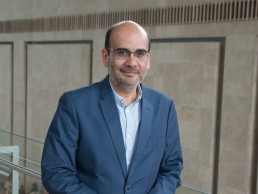
Firstly, a lighting designer and now former IALD President, Victor Palacio reminisced on his childhood days working for his father, whilst humbly looking back at his successful career in the lighting industry and where it has carried him to today.
As with many career paths, Palacio did not originally set out to be part of the lighting industry. Instead, when taking the typical school tests to determine which field of work to head towards at aged ten, young Palacio dreamed of being an Olympian by the age of 20. Much to his dismay, he has not exercised a day since… Progressing on from those early aspirations, he then determined he wanted to be a scientist, which explains his continuous interest in technology and attentiveness to the science of light.
A clear personality trait Palacio carries is that of a caring mentor. This attribute came to the forefront during his time in college when he began teaching computer technology classes to high school students during the early 1980s, when computers were the latest boom in technology.
After leaving college, Palacio worked in a flux metre manufacturing company as an electronics specialist before moving on to work with Fuji Film, just at the beginning of the 1986 World Cup in Mexico. Fuji Film was one of the official sponsors of the games and gave Palacio an unforgettable experience: “It was amazing! I was learning about photography and was involved in the installation of the mini developing labs. I learnt a lot - even about the science of light - related to photography and film printing and was lucky enough to be part of the World Cup team.”
Shortly after, Palacio moved on due to a nationwide employment collapse, which affected a lot of the Mexican population. This was the moment when Victor’s father saw a gap in the market and decided, along with his business partner, to establish his own commercial business in lighting. During expansion, his father decided to open a projects department, so the company wasn’t solely working in sales. This led to bringing an architect on board who, in turn, suggested Palacio was brought in to make up the electronics drawings. Immediately hooking Palacio’s interest in the lighting industry, he was taken on board to work on a museum lighting project, which would determine his passion for lighting design and historic preservation for years to come.
Just like other creative minds, Palacio has always had an interest in differing subject matters. During his time at University, gaining qualifications in electronics, he also opted into studying humanities modules, such as Art History. This sparked his interests in the design world, which was evident in later jobs he picked post-graduation. After completing various technical courses throughout his early career, he began to delve into the study of light and the technical attributes of a lighting engineer. Becoming, what he referred to, as the ultimate “geek”, he heavily studied the IES Lighting handbook whilst making calculations on computers before Windows was widely available.
Once he commenced work inside some of Mexico’s most renowned museums, Palacio began to pay close attention to the impact lighting was having on the many historic artifacts, as well as the buildings themselves, as many museums are situated in historically sensitive buildings. This required particular attention to be paid to the preservation properties and the artworks they housed. As a result, Palacio undertook a brief course at the National School of Preservation, at the National Institute of Anthropology and History. This led to pairing another fellow teacher, who specialised in preservation, with Palacio’s experience in exhibitions, to develop a course in museum lighting. After taking full control of this course after a time, Palacio decided to complete a postgraduate course in Architectural Preservation – again, claiming himself to be the “geek in the corner of the room making lesson plans on architecture from the fifteenth century!”.
“We were getting complaints from those in charge of looking after the care and preservation of the site of the museum project we were working on at the time, about both the artwork and the architecture. “So for me, it was much better to learn about it all from the very beginning, and develop a design that considered what they deemed important,” Palacio explained.
When discussing his philosophy and approach to lighting design nowadays, it is clear Palacio is very conscious about this idea of preservation. At the beginning of his lighting career, with his technical hat on, he was more focused on the light levels and colour renderings. But he now finds it far more compelling to “explore the impact of lighting on the aesthetics and, I think, that’s something that happens to a lot of lighting designers,” he claimed.
“Highlighting architecture, façades and features were what we focused on originally as a firm. Then I began to think, as did my colleagues, that even though it’s an important factor to architectural lighting, it’s not the main goal we are striving to achieve. We began to consider other factors related to the functions of places, for example the working place, to the productivity in residential spaces, to relaxation and commercial places to experience shopping. All of which, to some of us, came intuitively and to others in a knowledgeable way; we started focusing on peoples’ experiences.”
As many lighting designers and professionals in the industry began to notice, the non-visual impacts of lighting, the use of lighting on energy supplies, impacts on the environment and concerns of light pollution, are predominantly hot topics of consideration when working on new lighting projects, as well as being big matters of discussion during world conferences. “I think that’s going to be relevant for the profession of lighting design and for practitioners to become aware of. These are all side effects of lighting, which in the end sometimes don’t become the side effects but the main effects of lighting,” commented Palacio.
“Our philosophy of working is to create the visual experience of spaces. When we talk about visual, we relate it to lighting, experience is related to people, the spaces are related to the places where people perform activities, whether they’re recreational or commercial, interiors and exteriors; we focus our design ideas on that. When we are defining what lighting will be in a place, we will contribute in an important way to the experiences people will have in that space.”
When analysing the Mexican market and its general attitudes towards lighting design, some have regarded it as falling behind some of the bigger competitors such as North America and Europe. Palacio observed: “I think that unfortunately in Mexico the market has a very strong commercial component on the design side. That means a lot of commercial firms are getting into the design area, which makes it more difficult for lighting designers to develop their work, because they have this strong competition. I’m aware I may sound a little controversial saying this, but I guess lighting designers in Mexico haven’t made a clear decision to devote to lighting design.”
As we have seen in recent topical discussions in the lighting community, it is evident the role of the lighting designer is a blurred one. Palacio notes it is important we understand that the majority of us live in an upper market. For those that exist in a closed market, the situation is very different. Not to be mistaken for complaining, Palacio reinforces his point that he is not criticising the role of the manufacturer for offering the same services as a lighting designer; “I know I can provide better design services than they do!
“If I started designing products and tried to manufacture them, I know they would do a better job than I could,” he added.
Palacio has observed that a lot of potential problems could be a result of a lack of marketing from the lighting designers themselves. In order to be better as independent designers selling their skill set as their business, Palacio believes it is key to highlight the value of marketing yourself as a lighting designer.
“It’s up to us, the lighting designer, to stand out and speak for ourselves, have a louder voice and be better at convincing clients that they really need a lighting designer in their team,” he commented.
“I have heard some say manufacturers or commercial firms should stop offering design services, but I don’t agree! It is all healthy competition.”
During a time when Palacio was working with his father, he realised he had more of a passion to work on the design side, but was constantly blocked by people telling him it was a difficult profession to chase and there’s not a big enough market to be successful in it. But luckily he found the opposite to be true, and did find a market for lighting design and clients that appreciated him offering an independent service, which included specifications without being commercialised.
It is evident across Palacio’s portfolio that he has had a successful career in lighting and has validated his decisions to branch off and work independently, away from his father’s packaged approach.
Looking back, one of Palacio’s first and most notable projects was with the Mexican Museum of Anthropology between 1998-2001. Working with precise halogen lamps, the installations replaced the old theatrical fittings from the 1960s that highlighted numerous ancient artifacts, including pieces of the Aztec Calendar. Originally the ten theatrical luminaires aimed up to 15,000 watts into one stone, but were replaced with six fixtures using a combination of 35 and 70 watts aimed at the stone.
“At the time, the best tools we had were these metal and ceramic power lamps with very precise optics, low power and nice colour renderings,” Palacio explained.
The Fine Arts Palace in Mexico City is another notable project Palacio and his team at Ideas en Luz, has worked on. This time, focusing on the exterior of the building, they designed an entirely LED based scheme for their first exterior project. Completed only three years ago, the lighting design included fixtures from multiple manufacturers in order to find the perfect fit for each specific need. The main façade has throws of up to 70 metres high reaching two metre high sculptures at the top. It also proved to be a great opportunity for designers and contractors to collaborate on the field with the local firm Avantgarde Illuminacion.
One of the first corporate projects Palacio’s team worked on was with the IBM headquarters in Mexico City. Wanting to use indirect lighting was made easier through the strong collaborative relationship with the architect, who took that idea and designed the ceilings in the shape of the holds in order for the building to take advantage of the indirect lighting.
After establishing himself as a talented and respected lighting designer in Mexico and internationally, Palacio moved on to new heights when he stepped up as the IALD President. “Jeff Miller, who is a past president of IALD, thought, along with the board, that they needed to highlight the ‘I’ of IALD [International], because as it stood it was mainly a US centric membership. So one of the first steps out of the US was Mexico. I was lucky enough that the board had got in contact with many of my colleagues and myself at this time. I began to volunteer with the IALD and witnessed the efforts made to make the IALD a global organisation from the very beginning,” he reflected.
Many in the industry will be familiar with Palacio’s metaphor for the IALD’s globalisation and the fostering of memberships; instead of chasing butterflies and catching them in a net, it’s better to build a beautiful garden that will attract all the butterflies. The IALD have carried this approach forward in order to engage and nurture these memberships instead of increasing numbers for the sake of it. Originally, designers and practitioners were sceptical of the IALD, especially in Europe, and it wasn’t until the attractive garden was built, that some of the higher profile names in the industry became members, which in turn encouraged many more to follow.
Furthermore, during his time as president, Palacio was proud to witness the first steps on the field of the international certification of lighting designers, (CLD). Not wanting to enforce a lighting programme into universities, Palacio believed it was better to formulate an internationally recognised certification through the association instead.
“I was lucky enough to be part of the task force group, which started off testing the waters to see if it was feasible to develop the certification, and then be there at the time when it was officially developed with specialists into a certification programme,” Palacio explained.
Additionally, developing further on the globalisation, the IALD has worked hard to establish relationships with the IES for decades in the United States, as well as focusing on building friendships and collaborations with other lighting design associations internationally. For example in Brazil (ASBAI), France (ACE), the Spanish Lighting association and most recently, Palacio announced: “We will be forming a new collaboration with the Italian lighting design association”.
When initially in the nomination stage of obtaining presidency, Palacio had to complete a questionnaire that asked what he expected the IALD would achieve after his three years in term (one year as president-elect and two for presidency), and it is clear his main objectives were successfully achieved; building international bridges and fostering consistency through maintaining a ‘steady ship,’ so to speak. He believes when you have more people interested in bringing their perspective, you need to be very careful to be consistent in all the layers involved in every single action, strategy and with precision: “These are important because it’s a continuous effort that needs to be kept flowing, but still have someone chairing with a thoughtful mindset. You’re building something that needs to be bold and strong otherwise it will fall down sooner or later.”
Passing on the baton to David Ghatan, Palacio is filled with confidence that he possesses the necessary characteristics needed for the role; “I really admire him as a young professional; he is able to be sensitive to what’s going on around him. He’s a very good listener and is very good at synthesising peoples’ ideas. I have seen how he has embraced the role, the family feeling and sense of community that comes with the lighting industry, and think he will make a very strong contribution to the IALD…it takes up a lot of your time, mind and emotional strength but I see he has all of that under control. I am very happy to see him taking over and for me to take some rest!”
It is evident through Palacio’s nurturing nature; he has gained a lot of knowledge and experience from the industry and has earned the respect of many. For future generations of lighting designers, his two cents of advice would be when determining careers, to ensure you are moving in a clear direction and make definitive decisions. No graduate is going to land their dream role as principle designer for a firm such as Spiers + Major; it takes hard work and perseverance. “I have seen it in Mexico, we have one special lighting course at the National Autonomous University of Mexico, but when I speak to some students, they say they have been unsuccessful in becoming a lighting designer so they now work somewhere different,” Palacio remarks with disappointment.
“They have put a lot of passion into it, but there is a lack of courage. Of course it’s not easy, as it is in any profession, but you need to work hard, learn and be part of the community. This is not a profession for lone riders, it’s for teams.”
When asking who inspired and still inspires him in the industry, Palacio found it difficult to narrow down names, but did refer to Kaoru Mende from Japan for the cultural influences in his work, Mark Major and Jonathon Spiers for their portfolio of work that he used to cut out of magazines as a young designer himself to show off to his then students, and Barbara Horton, a fellow former IALD President and influential female lighting designer and businesswoman. In South America; Monica Luz Lobo, Pascal Chautard, Douglas Leonard, brand development by Fisher Marantz Stone, and Spanish designer Rafael Gallego. Fianlly, not to leave out the leadership of Gustavo Aviles in Mexico and the personal inspiration brought by his wife Liliana, as a professional supporter.
“All of them are people who have embraced the profession in a great way and they have brought their talents into the industry, and there are many more I have not mentioned still. Each professional has a special contribution!”
So much for taking some time to gather his thoughts and put his feet up, Palacio and his lighting team are moving swiftly into the New Year with more project proposal requests than ever before and focusing on establishing international collaborations - not allowing geographical locations to be limitations.
