
Arkoslight introduces Warp by Geckeler Michels
(Spain) – Spanish lighting brand expands into the decorative lighting segment with the launch of Warp – a suspension luminaire developed in collaboration with Berlin-based design studio Geckeler Michels.
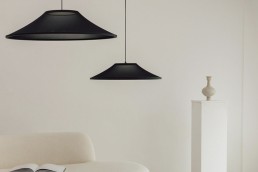
Defined by its purity of form and material lightness, Warp explores the interplay between tension, translucency, and gravity. The fixture starts from a simple circular base, and the textile shade is naturally pulled downward, forming an elegant, flowing silhouette. This organic transformation is central to the design concept: the lamp exists in its final form only once gravity is allowed to shape it.
Warp’s textile diffuser is both elastic and translucent, offering a filtered, ambient light effect while maintaining a visually lightweight profile. The use of a flat, integrated LED light source avoids the need for a visible bulb, allowing the continuous fabric surface to remain uninterrupted. The luminaire is available in two sizes and a single black colourway, and it ships flat, emphasising ease of transport and straightforward assembly.
The name “Warp” draws inspiration from astrophysics, referencing the distortion of space-time described in Einstein’s theory of relativity. The design metaphorically reflects the way gravity influences both space and form, an idea that plays out literally in the lamp’s suspended structure.
Designer Geckeler Michels explains,“Warp explores fluidity and transparency of the textile in a simple gesture. A clear and elegant manner, which highlights the behaviour of the material with light.”

Is Beauty a Building Block?
https://vimeo.com/showcase/11485671/video/1034344534
Speaker: Martina Frattura, Founder, The Beauty Movement
Lighting Designer Martina Frattura explores the relationship between beauty and light, while addressing the contemporary relevance of aesthetics in the built environment
Liz West’s exhibition transforms The Mercer Art Gallery
(UK) – British artist Liz West brings a new light exhibition to Harrogate’s The Mercer Art Gallery, inspired by West’s experience with Seasonal Affective Disorder SAD.
H.A.P.P.Y is a counterbalance to West’s personal experience of S.A.D. She experiments with colour and light to create environments that inspire joy and curiosity, and the exhibition runs through the Spring and Summer, a time when West is at her happiest.
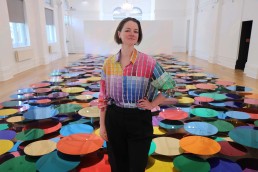
At the heart of the exhibition is ‘Our Colour Reflection’, an immersive artwork composed of 765 multi-coloured mirrored discs arranged across the floor, transforming its environment into a vibrant spectacle of shifting colour and luminosity.
Harnessing both natural and artificial light to create an ever-changing landscape of reflections, the mirrors bounce colour onto walls, ceilings, and viewers themselves, encouraging interaction and personal interpretation. As visitors move through the space, their perspectives shift, revealing new combinations of colour and light in an absorbing sensory encounter.
West says: “It’s a great pleasure to be exhibiting my work at The Mercer Art Gallery. I have visited this beautiful spa town many times over the years whilst growing up in Yorkshire. With the window coverings in the elegant Spa Promenade Room being removed for the first time in decades, the interplay of colour and light within the space will be kaleidoscopic and dynamic.”
Curator at The Mercer Gallery, Karen Southbank, adds: “Liz’s work encourages us to become aware of our surroundings in new ways. It leads us to tune into our own emotional responses, memories, and experiences – each person will have an individual and personal reaction. We’re thrilled to host Liz West’s work at The Mercer, it’s a major artist event in North Yorkshire.”
H.A.P.PY will be on display at The Mercer Gallery from 13 April – 5 October 2025. For more information and tickets, click here.

Panel Discussion to explore ‘Design in Balance’ at CDW
(UK) – Design in Balance will take place on 21 May at the Senator Allermuir, focusing on the intersection of aesthetics, functionality, and sustainability in contemporary design.
The event is presented in partnership between Artemide and [d]arc media and will feature contributions from a range of professionals across architecture, art, and lighting design:
- Karen Cook, Architect, Spice Design
- Liz West, Artist
- Victoria Jerram, Lighting Designer, Victoria Jerram Lighting Design
- Clementine Fletcher-Smith (Rodgers), Lighting Designer, Speirs Major Light Architecture
The conversation will be moderated by Helen Ankers, Managing Editor at [d]arc media.
The panel aims to explore how different aspects of design – beauty, usability, performance, and sustainability – can be integrated to create more balanced outcomes.
The event is open to registered attendees, and RSVPs are required via email to marketing@artemideuk.com. Light refreshments will be provided following the discussion.
Alongside the talk with Artemide, [d]arc media will be running a full talks programme at the House of Detention from 20–22 May for its third consecutive year. The programme brings together designers, architects, and lighting professionals to explore the relationship between light and interior design. Curated by the team at [d]arc media, the talks, sponsored by David Village Lighting, are free to attend.
Explore the full CDW programme here
For all events and talks, attendees must be registered for Clerkenwell Design Week: Register Here
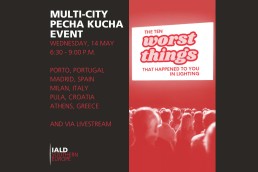
IALD Southern Europe celebrates the International Day
(Europe) – International Association of Lighting Designers (IALD) is set to celebrate International Day of Light on 14 May with a multi-city, Pecha Kucha event, connecting five cities in one night.
Lighting professionals and educators from Porto, Madrid, Milan, Pula, and Athens will come together, both in person and online, for a night of sharing fast-paced storytelling and shared experiences.
Organised by the coordinators and the LIRC Ambassador of the IALD Southern Europe Chapter, alongside local volunteers and sponsors, the event embraces the Pecha Kucha format - 20 minutes and 20 seconds per slide. Exploring the theme “The 10 Worst Things That Happened to You in Lighting”, speakers will share real moments from their professional journeys – some unexpected, some humorous, all insightful – showing how even the toughest situations can spark creativity, resilience, and growth.
Thanks to the support of O/M, Varona, iGuzzini, LED Luks, and Luun, participants will join live events in person or connect online via Zoom. The event is free of charge, and early registration is encouraged, as seats are limited and assigned on a first-come, first-served basis.
For more details and to register, visit https://bit.ly/SEU_PechaKucha
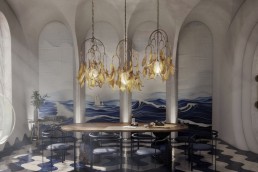
Saule Collection by Larose Guyon
Discover the whimsical creation of the Saule Collection by Canadian studio Larose Guyon. The pendant that is redefining lighting as kinetic art, blending meticulous hand craftsmanship with poetic design to create pieces that move, shimmer, and transform the spaces it occupies.
Félix Guyon and Aubrée Larose, the visionary founders behind Larose Guyon, always knew they were destined for the world of design, long before their creative paths ever crossed. Their mutual fascination with light fixtures became the foundation of a partnership grounded in artistry, function, and emotion. For them, light is more than mere illumination; it’s poetry in its purest form.
This belief gave birth to Larose Guyon, a studio devoted to crafting handmade lighting pieces that embody the beauty of nature while forging a deeper connection between people and their environments. Their latest creation, the Saule collection, is a poetic interpretation of the willow tree, capturing its graceful movement through a whimsical, kinetic design.
The Saule is defined by its hand-shaped leaves that are suspended from elegant, curving brass arches, each crafted with care to reflect the gentle sway of willow branches. Inspired by the principle of equilibrium, similar to a baby’s mobile, the fixture responds softly to the surrounding air, casting mesmerising reflections as the brass leaves shimmer in motion. “We wanted to design a fixture to capture the essence of movement in a simple, natural way – just like the gentle rustling of wind through leaves,” says Guyon.
The kinetic element is a cornerstone of the Saule collection, imbuing each fixture with a sense of life and dynamism. The movement encourages interaction, allowing the light to breathe with its environment and subtly shifting the mood of the space it inhabits. The fixture’s organic elegance is amplified by the sculptural composition, where the brass arches rise like tree branches, bringing both volume and height.
“For a long time, we have wanted to incorporate mobility into our fixtures, to create a visual dance reminiscent of nature’s rhythm. The inspiration from the willow trees led us to explore designs that allow for movement within the light, reflecting the dynamic interplay between light and shadow,” says Larose. “Throughout the design process, we focused on capturing the essence of the willow tree’s beauty, ensuring that each piece in the Saule collection embodies grace while providing functional lighting. This journey has not only elevated our artistry but also reinforced our commitment to creating designs that connect with nature’s poetry.”
Adding to the fixture’s delicate balance is a soft pink glass globe, which serves as the light source. Paired with a smaller, suspended globe, this design detail is evocative of delicate ripened fruit and introduces gentle warmth and depth. The subtle contrast of glass and metal adds complexity and charm – each choice in material is thoughtfully considered to elevate the composition.
Creating Saule was a year-long endeavour filled with exploration and refinement. The design process guided by a desire to echo nature’s forms and imperfections, embracing asymmetry, texture, and movement. Jewellery-like details, including brass chains and golden finishes, enhance its overall aesthetic, resulting in pieces that feel both precious and grounded.
Each brass leaf is meticulously handcrafted in Larose Guyon’s Verchères studio, where their team of artisans shape the metal to evoke the fluidity of nature. The process is detailed and time-intensive, beginning with the selection of high-quality materials and continuing through refined techniques that produce rich textures and lifelike forms. Much like fine jewellery-making, the work requires exceptional precision, care, and an artistic eye. “Each leaf is treated like a miniature sculpture,” the team explains, “imbued with both artistry and intention.”
The process of creating the leaves begins with a tightly woven fabric made from brass fibres. Each leaf is individually hand-cut, ensuring that no two pieces are alike. Once cut, the leaves are pressed into a custom-designed mould, created by Guyon and 3D printed in-house, to imprint a rich, textured surface. After moulding, every leaf is hand-shaped to create a natural, organic flow, allowing the brass fabric to move and settle like real foliage. This meticulous, hands-on process highlights the craftsmanship at the heart of Saule, bringing a sense of authenticity to each fixture.
Maintaining consistency while honouring the individuality of each handcrafted element is a balance Larose Guyon has refined over the past decade. Their experienced team adheres to rigorous quality standards without compromising the organic beauty that makes each piece unique. The result is lighting that transcends function – each fixture is a shimmering work of art.
Available in a variety of sizes and configurations, the Saule collection was designed with versatility in mind. This stems from the founders’ backgrounds in interior design and their deep understanding of spatial needs.
“We understand the importance of adaptable design,” they note. “By offering multiple variations, Saule can seamlessly integrate into a range of interiors, from expansive entryways to cosy, intimate spaces.”
Larose adds: “When it comes to design, there are no strict rules. That’s the beauty of using our pieces, they can elevate and transform any space.”
This adaptability is key to Saule’s charm. Envisioned as the “jewellery of interior spaces,” the collection enhances any room much like a statement necklace elevates an outfit. Whether placed in minimalist, modern, rustic, or eclectic settings, the fixture’s fluid elegance transcends stylistic boundaries. The founders add, “our pieces are made to transform and elevate any environment.”
At its heart, Saule is designed to inspire. It invites people to pause, reflect, and connect both with nature and with the artisanal craftsmanship behind each detail. The hope is that every piece sparks a sense of wonder, offering a serene and timeless presence that lingers long after the light is switched off. With Saule, Larose Guyon captures nature’s poetry in motion and brings it into the home.
Images: Larose Guyon, Chanel Sabourin
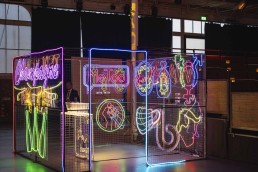
ATEA and Arup win [d]arc awards installation competition
(UK) – The winner of this year’s highly anticipated [d]arc awards installation competition has been announced: ‘Ten Years in Neon’, a striking collaboration between ATEA and Arup.
Created to mark 10 years of the [d]arc awards, the installation reflects on social, political, and cultural shifts of the past decade. Drawing inspiration from the storytelling format of the Bayeux Tapestry, the piece reinterpreted modern history through a continuous narrative of neon.
From global protests and climate crises to moments of collective joy and resilience, the installation weaved these themes into a luminous tapestry of colour and form. Initially presenting as a vibrant pop-art piece, it gradually revealed deeper layers of meaning, prompting reflection on the pride, sorrow, hope, and anxiety that have shaped recent memory.
Part of the annual [d]arc awards celebration, which this year took place in Woolwich, London – the installation competition continues to be one of the most exciting and creative showcases in architectural lighting. The 2025 edition saw a dynamic range of submissions from talented design teams, all of whom transformed the venue into their creations of light, energy, and imagination.
Other installations from the night included:
Rako Controls & AE7 – The Voyage So Far
Unibox & Buro Happold – The Choice
Radiant Architectural Lighting & dpa lighting consultants – Piece of Cake
Kingfisher & Foster + Partners – Puzzle
Signify & Hoare Lea – [d]ecastrike.
Lutron & Jan Erika – X
formalighting & Michael Grubb Studio – TEN-tacles
Tryka & Nulty – Pendula
Vivalyte & Speirs Major Light Architecture – Power of Ten
Artemide & WSP – Reflexions
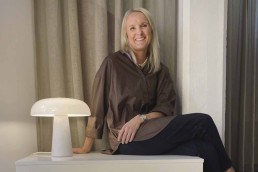
Lone Bødker Pedersen
Product Manager at Danish lighting brand Nordlux speaks with darc about the design aesthetics and culture the brand adhere’s to, along with her role in trend predictions and material selection within the company.
stablished in 1977, Danish brand Nordlux has since grown to produce and distribute lighting across more than 50 countries. With a passion for inspiring people to make the most of lighting, it is dedicated to bringing great lighting with top-end technology at a competitive cost for a wide audience.
The Nordlux Group consists of three brands: Nordlux, Design For The People, and Energetic. Nordlux provides attractive, value-for-money light sources and luminaires, while Design For The People focuses on award-winning Danish design products. Energetic provides LED products (mostly lamps) with the newest technology.
Speaking with darc, Lone Bødker Pedersen at Nordlux discusses her journey into the design world and how she became Product Manager at the brand.
Bødker Pedersen grew up in Aalborg, Denmark, where she continues to live with her husband and two boys. Aside from her career in product design, she has a keen interest in the world of fashion and interiors while also taking pleasure in spending time with her family, travelling, and CrossFit.
“I studied business but didn’t go on to university,” she says. “[But] I think I knew from an early age my career would be in something creative. I grew up surrounded by a family passionate about the arts, but I gravitated most to my grandmother, who was a tailor. She taught me how to sew and about the differences in materials, patterns, and spotting trends. As I grew up, my passion for interiors grew, and I knew I could uplift these skills to guide my career.
“I started my early career working in fashion, where I quickly worked up the ranks to a management position and then on to be a buyer. This is where I realised I have a passion and keen eye for colours and materials, and looking further ahead than the current trends. My interest in interiors then led me to a sales role at a design practice where I was able to use my skills from the fashion industry, and where I really found my career focus. Doing such versatile roles gave me a well-rounded perspective on the challenges within interior design and the products I was working with.
“Lighting has always been a fascination of mine, and the impact it has on a space. This prompted my move to Nordlux where I started in Press and Brand focus, which gave me a great understanding of the company culture and DNA. I would be asked my opinion on product launches, future planning ideas, trends within the market, and it felt very natural for me to give my perspective and ideas, which led me to my current position here at Nordlux.
“I’m currently in charge of all the creative material and design briefs for our external designers for decorative lighting. I also visit the various shows across the globe that cover lighting and interiors to keep up to date and know what’s new. I work closely with our technical manager, who helps with structural elements and the finer details. Also, I’m working with our suppliers to follow the production and quality very closely from the initial design, to receiving material swatches, to the first product sample, if there are changes or adaptations needed, right through to the final, ready-to-sell product. I also oversee the design protection and trademark of product names.”
When it comes to trend predictions and market responses to product launches, Bødker Pedersen takes inspiration from her travels. “A mix of many things inspires me, but I would say travel inspires me most; capturing how different cities make trends their own, from architecture, interiors and fashion. I also take inspiration from the traditional styles from the past, walking through Milan or Paris and observing the classic, vintage lighting and thinking how it can be adapted to a more contemporary look, tastefully pulling the past into the present. For me, Italian designers from the 1950s and 1960s produced some of the best design ever made, and that goes for lighting, furniture, and perhaps even fashion.”
When it comes to inspiration for a new design at Nordlux, the team takes inspiration from the brand’s Danish heritage and contemporary view on lighting. “We have also developed a design DNA that is established by key phrases we stick to in the process, ‘made to last’ being one. Lighting that lasts for many years and is timeless in its design. I look at materials that age well, that adapt to different settings and consider them based on the overview of CO2 emission as well. We also try to keep our decorative option retro-fit, but will base the decision to use integrated LED if we feel the design requires it.”
Bødker Pedersen continues, explaining how a light is so much more than an accessory or piece of furniture. “Light for me is a mood maker to a room, it’s the final touch, and without these light spots, there would be no feelings. There is a rule from Frida Ramstedt’s Interior Design Handbook that says we should have five to seven lighting points in every room, more than what we initially think. It’s how we can create light and shadow to give the space depth and atmosphere, and how the true effect and colour of the other elements like paint and fabrics are seen to our naked eye.
“For me, lighting should bring atmosphere and the finishing touches to a space. We have a Danish term called Hygge, which means cosy and content. For example, at home I will always switch just my Talli floor lamp on in the corner of the living room, this light is just hygge for me, I really love the ambience it creates and what makes my home feel more than just a home, but a cosy place for me to enjoy.”
Reinforcing the idea of longevity, she goes on to explain that a product’s “made to last” quality is one of the key elements a well-designed product should hold. “For me, it’s a mix of the design itself but also the way the materials work together and how they are put together, which of course needs to maintain functionality and look aesthetically pleasing in every setting.”
When asked whether she has a signature design aesthetic and if that influences the brand’s direction, Bødker Pedersen explains that she aims to route everything back to the Scandinavian and Danish way of working. “What is significant to us and our best successes is when we work with the mixing of materials, for example, the Strap series combines metal, leather and now felt. We also provide different colours of the leather so the end user can decide this on installation to complete the look. We see this works well and will continue to work this way. We also mix the shapes we use, both organic and geometric, to create a counterbalance effect within the collection.”
Continuing, Bødker Pedersen explains that one of the most frustrating aspects of product design is realising when a design cannot be brought to fruition as you intended, despite many iterations and attempts. “[This is especially true] with lighting, where we want the light output to be beautiful and uniform.”
On the flip side, she adds: “The most rewarding part is receiving the feedback from our internal team, our customers, and the interior designers and then seeing how our lights are used on such a variety of projects, both residential and commercial.”
With reference to technology, like many, she regards fixed LEDs as one of the best and worst developments within product design. “It has been so innovative to create new designs and shapes, however, we have found a market that still very much prefers the retrofit option, and it’s finding the balance to meet the needs of the end-user but not having to compromise on great design.”
Reflecting on one of the most significant moments in her career, Bødker Pedersen highlights her work on the Glossy table lamp, the first product she launched. “I worked with Danish designer Maria Berntsen, who thought of a small acrylic table lamp with a mushroom shade that was initially for outdoor use. However, I found something within the shape so distinct and recognisable, so I wanted it to be more exclusive in the materials chosen and change it to an interior lamp. We looked at what materials would work and have the right effect, which led us to look at marble for the base. We then added the small brass detailing and developed the shiny, or should I say glossy, glass shade. Our Technical Manager also developed the inner side of the shade so there would be no dark spots or shadows. I feel the product is my total darling. It has won a Red Dot design award, and we have now developed it further, creating a mini version using Pink Jade, which I found inspiration for at Clerkenwell Design Week 2024, where I saw many coloured stones with that almost translucent effect.”
Summing up what it means to work with light, Bødker Pedersen describes it as “life-changing” yet retracts that for sounding too cheesy! “Light has such a big effect on so many people, so I do stand by that, even though it is just light. We are actually doing something to change people’s lives. We are lifting people’s quality of life with light.”
Catching up on current trends, we asked what Bødker Pedersen is observing in the industry at the moment. “I would say shape-wise, it seems to be chubby shapes and volume items that fill up a space. In lighting, we are seeing bigger pendants that fit this, too. Materials like fabric, in particular Linen and Tyvek, are also popular. I feel the fabric gives the same experience as opal glass, where the light is warm, and we can appreciate it most. Regarding colours, it is the warm, earthy tones. Black is not as popular at the moment and is being replaced with more chocolate brown tones. I also think we will still see burgundy even later in the year, as it has been dominated in fashion, and I think it will follow in interiors. Chrome and stainless steel were among the top trends at 3 Days of Design in Copenhagen last year, and I think we will continue to see these cooler metals. Wood has never been out of style, but we are seeing a shift from the lighter wood to the darker, which adds warmth and richness to the products.”
Looking ahead, what can we expect from Nordlux? “We will continue with our current successes, but we will be looking into new materials, moving away from metals and looking more at stone and fabric and the more organic materials. In terms of colours, we will be continuing with the neutral none-white pallet, such as beige and brown. We will also move away from the brushed and shiny brass and look more at the antique brass, which I feel is more timeless.”
Catch some of the brand’s timeless pieces on show at Clerkenwell Design Week this May in the Light exhibition at the House of Detention.
Mission Rock
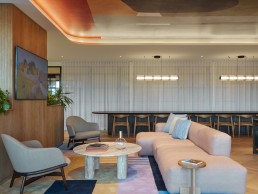
Mission Rock is a newly developed residential complex in the Bay Area of San Francisco, USA. With two residential towers boasting multiple amenity spaces, Michaelis Boyd was brought on board to create a harmonious, practical yet luxurious scheme.
ondon and New York-based architecture and interior design studio Michaelis Boyd was appointed to complete the amenity spaces for the Canyon and Verde residential towers in Mission Rock, San Francisco, which opened in 2024. Speaking with darc, Rina Kukaj, Partner at Michaelis Boyd’s NYC studio and Mission Rock’s lead designer walks us through the project’s design intentions and executions.
Both towers offer residents spectacular views over the San Francisco Bay and into the iconic Giants’ baseball stadium. Working in collaboration with real estate company Tishman Speyer, which Michaelis Boyd has crafted a series of projects with over the last decade, the areas developed by the team included entrance lobbies, mailrooms, lounges, games rooms, screening room, arcade, communal workspaces and kitchens, a podcast room, meeting rooms and external terraces, all aimed at enhancing convenience and fostering a sense of community.
Joining the project at a later stage, Kukaj and the team only had a couple of months to bring the brief to fruition for these varied spaces. The design concept for both towers was influenced by the studio’s approach to its renowned hospitality projects, blending the functionality of public spaces with the comforts and warmth typically found in a private home.
“The brief was to provide amenities that felt like an extension of a home filled with energy and colour to reflect the San Francisco palette: a blend of many styles and influences. Some of the forms and colour palette lean on the mission revival with a touch of mid-century modern,” she explains.
“We have been working with Tishman Speyer for several years, so we know each side’s general requirements and interests. Equally, we share a common ground on a desire to think outside the box and create something wholesome and unexpected for each project we approach. Here, it was no different. Mission Rock Bay Area was a fresh canvas with ample opportunity to achieve a new community and a sense of place.
“The project had a very short schedule for the interior design, so we all had to focus to ensure the design was on point from the very beginning.”
When asked what role the decorative lighting played, Kukaj explains that the approach for each area varied due to the building’s constraints or levels of natural light. “Some of the amenity spaces were located within the core of the building, where access to natural light was limited. These areas required special attention in terms of artificial lighting. Our intention was not to replicate natural light, but to use decorative lighting to introduce an additional layer of ambience and enhance the overall interior experience.” Some areas consisted of in-house custom-designed pieces by Michaelis Boyd, and elsewhere the team specified fixtures from brands including Allied Maker, Astro Lighting, Circa Lighting, Lightology, Pure Edge, Rich Brilliant Willing, Roll & Hill, Sonneman - A Way of Light, Tech Lighting, Vibia, and Visual Comfort. These pieces were chosen to ensure the ‘eclectic home meets elevated boutique hospitality spirit’ came across. The lobby at Canyon features two custom-designed pendants, designed by Michaelis Boyd and fabricated by PTY Lighting, that respond to the expansive volume and ceiling height of the space. These fixtures were created not only to provide a sense of scale but also to introduce an element of playfulness, setting the tone for the eclectic and inviting atmosphere of the interior.
“We wanted to ensure this layer to the interior provided the additional touches of playfulness and charm throughout the amenities.”
Regarding the architectural lighting, the team made a conscious effort to keep these details simple and low profile. “The decorative lighting was carefully curated to accentuate key areas and provide the necessary functionality. Rather than relying solely on general illumination, we layered the interior with smaller, focused accents of decorative lighting. This approach not only addressed the practical needs of the space but also complemented its eclectic style, adding depth and visual interest throughout.
“Lighting is critical to a space. It not only supports functionality, but it also adds an additional layer of artistry to a project, both interior as well as exterior.” Local artwork was a key element to the interior spaces and formed a core part of the design’s brief from the very beginning. “From the outset, we were interested in local art and local artists. We also wanted to ensure the art complemented the subtlety yet boldness of the interior design palette. Ownership procured the art with support from an agency, but overall, it was a very collaborative process with all involved, and we are happy with the outcome.”
Reflecting on this as their first project in San Francisco, the Michaelis Boyd NYC studio is very pleased with the finished product. “The important thing is the amenities are continually in use by the tenants of the building,” says Kukaj. “They are using the spaces in so many ways and for so many purposes, which is wonderful to see.
“The project has been well received by our clients and, most importantly, by the new tenants. The amenities are always in use, and more recently, the project has won best amenities in San Fran, so we are delighted.”
[d]arc media to host Stories of Light book launch at CDW
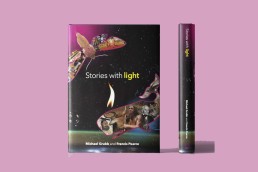
(UK) – As part of Clerkenwell Design Week 2025, [d]arc media will host the official launch of Stories with Light, a new book by lighting designer Michael Grubb and journalist Francis Pearce.
The event will take place on Wednesday, 21 May at 17:00 in the House of Detention. Supported by Applelec in partnership with GENLED Acolyte, the event will include a Q&A session with the authors, followed by an informal drinks reception. The launch forms part of the [d]arc thoughts talks programme, presented in collaboration with David Village Lighting.
Described by its authors as a "cabinet of curiosities", the book blends anecdotes, historical facts, and scientific insight to reveal the many surprising ways light intersects with design, culture, and daily life. It is intended for a broad audience – from designers and students to anyone curious about the world through the lens of light.
Attendance at the event is free for Clerkenwell Design Week visitors, but registration via the official CDW platform is required. Guests are also required to RSVP Here for catering purposes.
For more information visit clerkenwelldesignweek.com or follow [d]arc media for updates.
Zaha Hadid Architects + Erco to host Inclusive Design talk
(UK) – arc magazine’s Editor Matt Waring to moderate an engaging talk that examines the process of creating inclusive spaces.
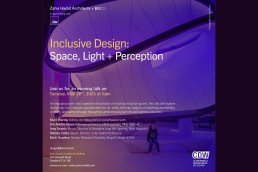
[d]arc media is delighted to be collaborating with Zaha Hadid Architects and Erco, on a special evening event during Clerkenwell Design Week, dedicated to the process of creating inclusive spaces.
Join us at Zaha Hadid Architects Gallery from 6pm on Tuesday 20 May, for an insightful discussion with leading industry experts Amy Rennie from Buro Happold, Katie Gaudion from The Royal College of Art, Bidisha Sinha from Zaha Hadid Architects, and Jim Ashley-Down from Erco.
Spaces are limited, so if you are interested in attending, please book your slot here or contact rsvp.uk@erco.com
In Conversation with Frankie Boyle
https://vimeo.com/showcase/11485671/video/1034341689
Frankie Boyle delves into the inspiration and products powering Intra-spectrum, as she sat down for an exclusive Q&A with [d]arc media managing editor Helen Ankers.