
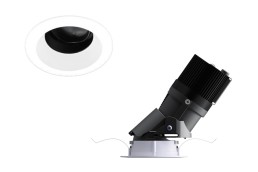
Amerlux - Hornet
A 2.5” downlight that combines innovation with elegance. Enjoy precision adjustable lighting with a 40° tilt and minimal beam cutoff, Wall washers for smooth coverage without back flash and downlights for quiet ceilings. Perfect for offices, galleries, and upscale retail settings, it delivers up to 2,000 lumens at 90 CRI and 100 LPW, ensuring exceptional output and efficiency.


101 Goswell Road London, UK
When Zaha Hadid Architects sought to renovate its Clerkenwell headquarters, it called on Erco to install a flexible lighting system that would befit the site’s transformation.
Known for radical designs like the MAXXI art museum in Rome and the London Aquatics Centre, Zaha Hadid Architects (ZHA) faced a different type of challenge in overhauling its London headquarters. Instead of a new building, the architecture practice has renovated 101 Goswell Road, a former garment factory. A custom-designed lighting system from Erco played a crucial role in this transformation, allowing the historic building to become a flexible environment for multi-faceted and collaborative forms of work.
ZHA has occupied the seven-storey former factory since 2012, but the team was previously divided between this property and a converted schoolhouse on nearby Bowling Green Lane. A shift in thinking came as a result of the Covid-19 pandemic, when employees were primarily working from home. The ZHA directors saw an opportunity to consolidate to a single location and rethink how the office should function. Rather than trying to pack in as many desks as possible, the idea was to support different types of work style, offering staff greater choice and flexibility in how they work.
“We needed to give them a reason to make the journey into the office,” explains Director Chris Lepine. “We came to the conclusion that space for meetings and collaboration was key.”
With larger floorplates and a more visible street presence than the old schoolhouse, the Goswell Road building was considered the most future-proof option, but it also presented challenges. The building had very low ceilings and a stair and lift core located close to the end wall, so natural light was unable to reach much of the interior.
“We had one very long wall with no daylight coming through,” recalls Lepine. “We realised that, if we were going to do this refurbishment right, we would have to create lighting that did the space justice.”
Enhancing the feeling of spaciousness was the starting point for the human-centric lighting system developed with Erco. Opton wall-washers improve the overall perception of brightness, while Jilly downlights for track create the impression that ceilings are higher than they actually are. Illumination is delivered discreetly to where it is needed, rather than across the entire space, with light fittings that are largely hidden from view. This improves visual comfort without creating obvious patches of light and shadow. “Sometimes I don’t realise the lights are on until I’m right under them and look up,” adds Lepine.
With spotlights that can be easily repositioned in the track without tools, a key advantage of the Jilly system is its flexibility. This was a key goal in the reconfiguration of 101 Goswell Road, which was developed with ZHA’s Analytics + Insights unit (ZHAI), a research group that uses digital data and artificial intelligence to intelligently predict the future of workspace design.
“In the past, there was a one-size-fits-all approach in office design, but that has completely gone out of the window,” says Ulrich Blum, Co-Lead of ZHAI. “Workspaces need to be adaptable to, even on short notice, cater for differences in how teams work together.”
This led to a design that provides fewer desks but offers a wider variety of spaces where people can come together. One example of this is the fourth floor, which has been converted into a social space that can facilitate casual meetings and chance encounters.
Circulation spaces are located towards the centre of the floor plan, anchored by a multi-faceted cork wall that extends through the full height of the building. Track mounted Opton and recessed Starpoint luminaires in 3000k give a warmer colour temperature here, emphasising this as the building’s ‘heart’, in contrast with the cooler tones of lighting within the workspaces. Opton spotlights meanwhile offer dramatic, directional illumination to architectural models and drawings that are dotted throughout the building, as a testament to the impressive scope of architectural projects that ZHA produces.
Casambi Bluetooth wireless control allows lights to be easily switched or dimmed, either individually or in groups, which comes in useful when ZHA wants to change up its displays. But it also makes it easy to create spatial variety, so staff can find a place to work that suits them best.
“When people work from home, they are able to personalise everything,” says Blum. “This autonomy is something they really cherish, so we needed to give them the ability to influence their environment.”
The system is also responsive to fluctuations in occupancy, turning off lights automatically in spaces that are not in use, which improves energy efficiency.
The ground and basement floors combine exhibition galleries with facilities for design research and digital fabrication, allowing ZHA to create varied showcases of architecture innovation. These floors also facilitate other public-facing activities, from intimate dinners and drinks events, to workshops and panel talks. Erco’s Parscan 48V spotlights allow ZHA to highlight different zones, depending on the use.
“We can orient the room in different ways,” says Melodie Leung, Associate Director at ZHA. “Sometimes we want it to be very broad and unified as a space, other times we want it to be more dramatic.”
Leung believes these shopfront-style spaces play a crucial role in helping people understand the process behind ZHA’s architecture. One recent exhibition incorporated dynamic lighting effects that gave a sense of animation to the objects and materials on display. “It’s really important for us to create an environment,” she adds, “so when people enter, they’re entering the world of Zaha Hadid Architects.”
Since moving back into 101 Goswell Road in late 2021, ZHA has been trialing different combinations of remote working with in-office collaboration. The response so far has been positive, with staff noticeably mingling and interacting even more, despite being in the office less. The result is a dynamic environment that feels befitting of an architectural practice with its focus firmly on the future.
Zaha Hadid Architects and Erco are reuniting for this year’s Clerkenwell Design Week, celebrating their continued collaboration. Attendees are invited to join engaging talks and exclusive tours of the remarkable office and gallery project, a stunning example of innovative design and lighting expertise.
Trilux chosen for eco-friendly office campus
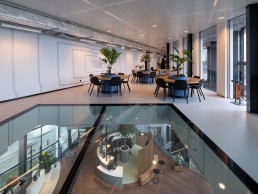
(Netherlands) - Trilux’s latest project at Tripolis Park in Amsterdam, showcases a pioneering office campus that blends heritage-listed buildings with a striking new 11-story structure. Created by Flow Development, the revitalisation focuses on user wellbeing, maximum sustainability and future-proof technology.
Tasked with delivering a smart, energy-efficient lighting solution across indoor and outdoor areas from a single source, Trilux has installed approximately 13,000 light points. Standard luminaires, including 39er G3, Onplana, Lenty and Sonnos, were customised to meet the project’s demands. A standout feature is the foyer’s So-Tube light sculpture, while outdoor spaces and cascading roof terraces are illuminated by ConStela, 8841 bollard luminaires and Skeo Q units. These luminaires seamlessly bridge the historic and modern elements of the campus.
3,000 lights incorporate advanced TRI-Sensors that provide motion detection, daylight control and environmental data via a wireless mesh network, optimising the indoor climate and energy performance through a future-ready Smart Grid.
"At the start of the project, the specification focussed on high-quality, glare-free light – without mentioning Human Centric Lighting (HCL), which dynamically changes the light colour to mimic daylight and is perceived as particularly pleasant," recalls project leader Willem Dammers, CEO of TRILUX Benelux.
A demonstration convinced Flow Development to include Tunable White luminaires with HCL throughout the campus. Employees can even adjust the light intensity or colour to suit their preferences via an app if desired.
Triplos Park has received numerous certifications and awards, supporting its position as a unique and pioneering office project. Its ratings in sustainability, design and user wellbeing include a BREEAM-NL "Outstanding" rating making it one of the most sustainable buildings in the Netherlands. The "Well Platinum" certification attests to the campus’ outstanding work environment, promoting mental, physical and social well-being for users.The site is home to major tenants such as Uber and an international law firm, whose employees benefit from the exceptional design. Visitors and residents alike enjoy the spectacular architecture and the publicly accessible park.

Creative Alternatives to Cat A
https://vimeo.com/1034342305
Speaker: Jonathan Rush, Hoare Lea in collaboration with Recolight
All too frequently, relatively new luminaires from Cat A fit outs can end up in the waste stream. However, recently the design community and developers are beginning to work together on creative alternatives. Here Jonathan Rush of the End Cat A Lighting pressure group looks at some success stories.

Lights in Alingsås announces its 2025 workshop heads
(Sweden) – The workshop heads for the 2025 edition of Lights in Alingsås have been announced.
The eight selected lighting professionals recently gathered for the three-day concept meeting for the 2025 edition. Two out of eight are experiencing Lights in Alingsås for the first time, three are returning for their second time, while three former students return as leaders.
This year’s workshop heads include Phillip Rose, Associate Partner at Speirs Majors Light Architecture; Amardeep Dugar, architect, lighting designer and researcher; Christina Mordeglia, architect and lighting designer at Beersnielsen; Sjoerd van Beers, Co-Founder of Beersnielsen; Meta Romanens, lighting specialist and teacher at Hochschule Luzern; Niken Wulandri Sutanto, freelance architect and lighting designer; Roberto Corradini, independent architect and lighting designer; and Isabel Villar, Senior Lighting Designer at White Arkitekter.
Over the weekend, the lighting designers learned about the organisation behind the event, explored this year’s theme, and selected their preferred lighting locations. They presented their ideas to the event board, which will be developed further during the workshop with participants and students.
A familiar lighting designer for Lights in Alingsås is Roberto Corradini, coming back for the third time. He looks forward to meeting the participants during the workshop this fall.
Philip Rose of Speirs Major Light Architecture, known for his prestigious projects, joins for his first Lights in Alingsås.
Niken Wulandari Sutanto and Meta Romanens first met in 2016 while studying at the same university (Wismar, Germany). They happened to choose the same site in the Lights in Alingsås workshop that year and worked closely together during that week. Since then, Niken and Meta have kept in touch sporadically.
They met for the first time since 2016 at Light + Building 2024, where the seed was planted for applying together as Workshop Heads. This is now their first project together.
Sutanto says: "It’s nice to be back again in Alingsås, working together. So far, we have agreed on many things, like site selection, concept, etc. We are very much alike,”
Frida Almqvist, Workshop Manager says: “Lights in Alingsås is an extraordinary platform for collaboration and creativity. It is an honour to bring together such a talented group of professionals who will inspire and guide this year’s participants.”
Dali Lighting Awards announces 2024/2025 winners
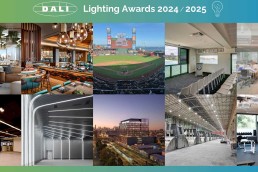
(Worldwide) – The 2024/2025 winners of the DALI Lighting Awards have been announced, recognising excellence in lighting control projects. Organised by the DALI Alliance, the awards highlight applications of lighting control protocols in real-life settings.
Winners:
- Residential – Philips Dynalite – Atlantis the Royal
- Commercial Interior – bluebottle – 480 Swan Street + Australia Post
- Commercial Exterior – Synapse Wireless – Oracle Park, San Francisco
- Industrial & Infrastructure – Beijing Hanmingde Technology Development Co., Ltd.
Innovation Awards:
- Best Use of D4i – Synapse Wireless – Oracle Park, San Francisco
- Best Emergency Lighting Integration – Crown Electrical – Coogee Surf Lifesaving Club
- Best Human Centric Design – KUMUX & Inventronics
- Best Integration into Other Building Systems – Signify – BorgWarner R&D Building
- Innovation in Lighting – Sunricher Co., Ltd. – Zhongguancun International Innovation Center
- Sustainability and Energy Efficiency – bluebottle – 480 Swan Street + Australia Post
- Smart and Connected Lighting – Beijing Hanmingde Technology Development Co., Ltd.
- Emerging Talent Award – Malkit Singh – Heap59
Highly Commended:
- Tridonic – Illuminating the Bibliotheca Alexandrina (Commercial Interior)
- Signify – BorgWarner R&D Building (Commercial Interior)
- Sunricher Co., Ltd. – Zhongguancun International Innovation Center (Best Human Centric Design)
- Lumen Resources – Willowdale Residential Aged Care (Best Integration into Other Building Systems)
- mwConnect – Exploring HVAC and Lighting Controls Integration (Best Integration into Other Building Systems)
- Nilsen Networks Pty Ltd – Health and Medical Research Building (Sustainability and Energy Efficiency)
A panel of expert judges, including lighting designers, media specialists, and global lighting leaders, selected the winners and highly commended entries.
Paul Drosihn, General Manager of the DALI Alliance, says: “Our congratulations go to all the winners and highly commended entries. The quality of submissions was incredibly high, and choosing the standouts was no easy task. These awards truly showcase how DALI technology continues to push the boundaries in lighting design and performance.”
For more information on the 2024/2025 DALI Lighting Awards, visit https://www.dali-alliance.org/awards2024/

Disruptia returns for its third edition in Madrid
(Spain) – UK-based creative consultancy Light Collective will host the third Disruptia event on innovation and change on 3 April 2025 in Madrid, Spain.=
At its core, Disruptia aims to explore the concept of disruption, defining disruption as a radical transformation of an industry through technology. The event will bring together professionals from various disciplines, including lighting design, product design, visual arts, architecture, and artificial intelligence, to discuss emerging trends and challenges in the field.
Light Collective, known for its work in curating industry-related events, recently expanded its presence in Latin America with a new branch led by former collaborator Magali Mendez. Disruptia was the first Light Collective LATAM event, and it is scheduled to return to Mexico City 2025.
The one-day event will feature keynote presentations and discussions with experts across fields. Attendees will have opportunities to exchange ideas, address industry challenges, and explore new technological developments. The programme also includes networking sessions.
Speakers include Ignacio Valero, Tupac Martir, Sophya Acosta, Marta Handenawer, Anne Bureau, Chris Pype, Nubi León, Africa Sabe, Rebeca Sánchez Pastor, Macarena Saenz, Juan Luis Fuentes, Jose Luis Revueltas and Tapio Rosenius.
The event is supported by formalighting, Ayrton, LEDLuks, and Anolis, and is partnered by APDI - the Spanish Lighting Design Association.
Tickets are available here: https://www.tickettailor.com/events/lightcollective/1582513

Comment: Manuela Hamilford
Biophilic Lighting: Designing with Nature in Mind. Manuela Hamilford, Founder of Hamilford Design, discusses the importance of creating mindful spaces that have people’s wellbeing at the forefront.
In the evolving landscape of interior design, there is a growing recognition of the importance of creating spaces that do more than just look good - they need to make people feel good too. Biophilic design has been a particularly powerful tool in transforming interiors and is increasingly discussed - it was even the subject of a recent panel discussion I was a part of at last year’s LiGHT 24 exhibition in London. The concept centres around reconnecting people with nature and natural light cycles, which have been shown to positively impact wellbeing, emotions, and sleep patterns. Biophilic lighting enhances both the aesthetic and emotional experience of a space.
When I founded my interior design studio, my goal was always to create spaces that foster wellbeing and happiness. Biophilic design has long been present in interiors, traditionally seen as maximising natural light and incorporating natural materials. However, we are now delving deeper into its psychological aspects. A Human Spaces research report found that biophilic design can improve productivity by 6% and boost creativity by up to 15%. It’s not just about adding a skylight - it’s about thoughtfully integrating lighting in a way that connects a space to the natural world. In our projects, we are reassessing our approach to biophilic lighting, which has become a key element in modern interior design, both residentially and commercially.
At its core, biophilic lighting is about designing with the natural world in mind, creating lightscapes that mimic the rhythms, colours, and qualities of natural light. Natural light plays a vital role in how we experience a space, influencing our mood, energy levels, and even our health. By harnessing the principles of biophilic lighting, we aim to enhance the sense of connection to nature, even when indoors.
One of its key principles is mimicking natural light cycles - incorporating daylight and its changing qualities while using artificial lighting to replicate the warmth, intensity, and colour temperature of natural sunlight. Having grown up in Italy, I am particularly aware of the challenges in a city like London, where natural light can sometimes be scarce. Introducing lighting that mimics outdoor light can significantly improve the experience of a space.
Incorporating biophilic lighting starts with a deep understanding of how light behaves in nature. The first step is to maximise natural light wherever possible - large windows, skylights, and open spaces are crucial in ensuring daylight is used to its full potential. However, natural light cannot always meet the needs of every space, particularly in the evening or in areas lacking direct access to windows.
This is where thoughtful artificial lighting comes into play. We often use a combination of warm, diffuse light to replicate the glow of daylight. Dimmable LED lighting in soft white and amber tones allows us to simulate the natural progression of daylight, from the bright glow of morning sunshine to the gentle hues of evening. The goal is to create an indoor lighting environment that reflects the shifting colours of the outdoors.
Throughout the day, sunlight transitions from warm yellow in the morning to crisp blue at midday, before softening to deep reds in the late afternoon and evening. Blue light, similar to natural skylight, stimulates serotonin production, promoting alertness and focus. As night falls and blue light diminishes, melatonin levels rise, encouraging relaxation and sleep. Striking the right balance between these two hormones can significantly impact sleep quality and overall wellbeing.
Beyond lighting temperature, the quality of light is key. We integrate layers of lighting - ambient, task, and accent lighting - to create a balanced effect that suits the needs of a space. Ambient lighting fills a space with overall illumination, task lighting focuses on specific areas or functions, and accent lighting highlights particular features or artworks.
We incorporate biophilic lighting into a wide range of projects, from luxury residential homes to commercial spaces. Each project provides an opportunity to explore how light can transform a space and evoke a connection to nature.
One particularly memorable project was a penthouse in central London, where the client was passionate about bringing nature into their urban home. We installed large floor-to-ceiling windows to flood the space with natural light, complementing this with carefully selected lighting fixtures inspired by organic forms. Tree-branch-shaped pendants and softly glowing table lamps brought a sense of the outdoors inside. We also integrated adjustable LED lighting systems that allowed the temperature of the light to shift throughout the day. Knocking through walls to open up the space and using glass doors to divide areas maximised light flow. Additionally, we incorporated living green walls, wood, and other natural materials to enhance the biophilic experience.
In commercial spaces, biophilic lighting has been linked to increased productivity and creativity. Offices that integrate natural elements and lighting often report higher employee satisfaction, improved focus, and enhanced collaboration. In our designs, we have found that biophilic lighting fosters a more positive, energised environment - whether in a home, an office, or a restaurant.
The benefits of biophilic lighting extend far beyond its visual appeal. Research shows that exposure to natural light - or light that mimics it - has a profound impact on health and wellbeing. Natural light helps regulate circadian rhythms, leading to better sleep and increased daytime energy levels. It also improves overall health by reducing stress and anxiety.
Looking ahead, demand for biophilic design, particularly in lighting, is only set to grow as more people recognise the importance of creating spaces that support physical and mental wellbeing. Advancements in technology, such as dynamic lighting systems that adjust in real-time to changing daylight conditions, will further enhance the impact of biophilic lighting on the spaces we design.

Comment: Conran and Partners on Lobby Lighting
Authored by Chris Thornley, Associate Director at Conran and Partners, below is a run down of important factors to consider when designing a lobby space. From types of lighting to the size of the space and the people who use it, there are many influencing elements to consider.
The hotel lobby has had a bad reputation over the years. Stale and stagnant places home to hoards of weary travellers coming, going, queuing, and complaining. An endless sea of furniture that is very rarely utilised, with guests preferring to escape to the privacy of their room or the more atmospheric F+B environments. With soaring ceilings and half a quarry of marble adorning any available surface, the historical focus was on decadence and grandeur.
My first memory of a major shift in ‘lobby culture’ is the likes of ace hotel and citizenM, where the palatial gave way to the cosy. Young twenty-somethings were desperate to spend hours in their lobby spaces, perched on their sharing tables with a coffee and a MacBook. It seems that this turn of the century shift towards a more lifestyle approach is here to stay, with the larger brands emulating this model in various iterations across their portfolios. The particular recipe is adjusted to suit location, brand and audience, but the key focus is always on the atmosphere.
Lighting in the lobby is only the first chapter in the whole story of the journey through the subsequent spaces. It is the first and last impression. Catering to everyone, from the weary business person who has just stepped off a 12-hour flight and has a few short hours before a day of meetings to the excitable leisure traveller looking to use all possible facilities, and everyone in between. There is no right answer to how a lobby space should be lit, however there are some general rules that designers should always follow.
Do make a statement. The designer who tries to please all will inevitably end up disappointing everyone. When we look at designing hotels, and lighting in the lobby, we are usually looking at a customer group ranging of all ages and background. Try to hone in on - and design for - the guest as a single person with specific requirements and preferences, otherwise everything becomes too watered down.
Interpret the context in an abstracted way. In a world of Pinterest where the soul of a hotel can become generic, take inspiration from the local culture, whether historical or contemporary. We often collaborate with lighting companies to create completely bespoke and one-of-a-kind installations that commit to the overall concept for the space, rather than something that is selected from a brochure and transplanted. For example, at Park Hyatt Changsha, we have collaborated with Czech lighting brand Lasvit to create a bespoke chandelier that is inspired by the iconic fireworks of Changsha.
Have an idea of budget and ceiling height before you start designing. Especially with lobby design we are usually dealing with very large and often tall spaces. If you were to ask me the generic recipe of things to go into a lobby space, amongst the reception desk, sofa groups and floral displays, I would also add the ‘feature chandelier’. However, some spaces are just not large enough to handle the scale and it ends up making the space feel squashed and uncomfortable. Also, designing breath-taking Murano glass chandeliers, which seem to go as far as the eye can see, is all well intentioned and easily done on visuals, until you have to shrink it to a quarter of the size to fit budget. There are fantastic solutions to suit all budgets but it is harder to back-track once you have sold them the Rolls Royce.
Consider day to night, this comes back to the atmosphere. There are no hard and fast rules but, if you have a grand lobby space, you want the lighting scheme to celebrate the grandeur throughout the day and - as the evening draws in - become cosy and seductive. One thing that we considered with Park Hyatt Changsha is the season beyond the window. With cold and grey winters, we wanted the lighting scheme to offset this with warmer tones. During the summers, which are very warm and bright, the scheme can feel slightly cooler. This seasonal approach to lighting feels like the natural evolution to the typical day to night concept.
Never illuminate people from five storeys high. Drama and height are fantastic tools for us to work with as designers, but human nature sees people drawn to more human scale spaces. Lighting and its placement can play a pivotal role in combatting cavernous spaces. German Gymnasium is one of our projects that, although not a lobby space, has all the hallmarks of one volumetrically. We worked very closely with the lighting consultant to ensure that there was a great deal of low level lighting to juxtapose the scale with a feel of intimacy and warmth.
Steer away from lighting with too many light sources. This is rooted in practicality. We have all seen amazing lighting installations where a few luminaires have gone and are yet to be replaced. The impression that this gives is one of unkemptness and lack of care, which directly reflects on the brand overall. When specifying the dramatic large scale pieces we often illuminate objects rather than have the light being the focal point. Lanson Place Parliament Gardens, our latest hotel in Melbourne, is a good example. We designed a 41-metre long light installation where the decorative elements are ceramic sheets that appear to be dancing from the entrance to the guest elevators – a nod to the history of the building as a printworks. Rather than these elements being individually illuminated, they are highlighted from subtle spots placed discretely around, giving the impression of illumination.
Last, but certainly not least, coloured lighting. There are some very specific instances where this can be done well but generally just no.
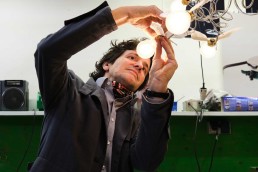
Axel Schmid
The Ingo Maurer studio is one of the most renowned lighting brands in the world with a reputation as creators of luminous art, transforming functional light into extraordinary design statements. Six years after the passing of its visionary founder, the company continues to honour his legacy while forging a bold future of its own. In this exclusive interview, darc’s Ellie Walton sits down with Axel Schmid, Head of Design, to discuss his own journey into light, Ingo Maurer, and explore the brand’s unique philosophy.
Axel Schmid’s journey with Ingo Maurer started 30 years ago when he was a student in Stuttgart, Germany. His teacher, Richard Sapper had taken a sabbatical and invited Ingo Maurer to step in and teach. After completing his studies in 1997, Schmid looked for work in the design industry, first applying at the Konstantin Grcic office in Munich where he was unfortunately turned down; however Grcic encouraged Schmid to drop by whenever he was in town. On one such visit, while en-route to a ski trip, Schmid went to see Grcic, and on a whim decided to also visit his old teacher Ingo Maurer at his studio, hoping for advice on how to get a job in design. It was in that moment Maurer offered Schmid a job – and from there his journey in design began. After his ski trip of course!
Initially Schmid viewed lighting design as temporary venture, planning to stay for six months to a year before moving onto other design fields. As a young designer, he had aspirations to explore as much of design as possible - from staircases to planes and more, however, several factors kept Schmid working at Ingo Maurer for two decades.
“First and foremost, it’s the people,” says Schmid. “No matter what job you do, who you work with makes such a difference. The collaborative and passionate environment in the studio fosters a sense of belonging.”
Secondly, his inquisitive and curious hunger has never been left starved at Ingo Maurer, as he credits the variety of work the company takes on as a continuous challenge. While the work is concentrated on lighting, the materials that can be experimented with and the range of designs that can be produced is remarkable.
“In an average day I can go from drawing, model making, clients presentations, to supplier negotiations, and production discussions and it extends beyond traditional design such as interacting with architects and other designers, as well as other manufacturers - making each day different. So, suddenly I had this really colourful day job and there wasn’t a moment I thought - now I’m ready for the next thing, because I never felt like I was repeating myself and getting tired,” says Schmid.
As Maurer grew older, questions about the company’s future began to arise. When Schmid joined in 1998, Maurer was already 66-years-old, an age where people commonly retire in Europe. However, Maurer never intended to step away, continuing his work and unwavering passion for lighting design. As the company evolved, he remained deeply invested and eager to see where it would go. The unique combination of a design studio with its own production – a rarity in the industry – offered a creativity and structural stability that many other workplaces lacked.
Since Ingo Maurer the company was established in 1966 it has grown into one of the most respected and worshipped lighting design companies in the industry and when darc magazine was offered the chance to visit the studio in Munich earlier this year, it was an opportunity we couldn’t say no to. Upon arriving in Munich, it became clear Ingo Maurer’s presence extended far beyond the showroom walls, as everywhere one passed an Ingo Maurer novelty could be spotted - from illuminating airport shops or glowing from apartment windows. More than just a cult following in the design community, Ingo Maurer is clearly a proud part of Munich’s history. Yet, according to his colleagues the man behind the studio’s name was never quite satisfied and was defined by his relentless pursuit of innovation and uniquely open-ended approach to design, always striving to push boundaries and reimagine what was possible – this approach has inevitably trickled down to the rest of the team and become the studio standard when it comes to design.
“He, [Ingo Maurer] was sometimes driven by insecurity, he always wanted to be better than what he had done before and he wanted to achieve more than what some might think he was capable of,” says Schmid. “So, to achieve this he created a space where anything was possible. Maurer didn’t want to create an idea, and we all follow his direction, he wanted everyone’s unique input and take on a completely different journey from that same starting point because people’s unique thoughts, experiences and upbringings will take on different directions and cover a wider field of possibilities.”
One of the latest novelties from the Ingo Maurer studio is the Nalum, a pendant luminaire debuting at Milan Design Week, alongside the Shhh! and Dish Rack wall light. During our visit earlier in the year, darc was given exclusive coverage of Nalum, which features a transparent linear glass tube that serves as a vessel for a second ‘floating’ vertical glass piece, shaped with fluid, undulating contours. Handblown in Italy, the Nalum appears to be entirely sculpted from water and light. Emphasising its maritime connection, tiny surfer figurines ride the waves and rips in the glass, adding a whimsical touch to the piece.
The design was created by Sebastian Hepting, a member of the Ingo Maurer team, who was inspired by the movement of waves and the interplay of light. The name Nalum combines the Hawaiian word for wave Nalu – which also signifies reflection and contemplation - with Lum, evoking illusion of light.
Hepting’s vision stemmed from a fascination with creating a transparent glass luminaire free of visible technical elements. This was achieved by seamlessly integrating the light source, which is subtly achieved by holding it in place by magnets within the outer-glass tube, providing both uplight and downlight. Additionally, the suspension enhances the dynamism, using a single filigree cable running through the luminaire, to direct light precisely. The inner floating glass is also flexible, allowing the user to constantly re-stage the wave shape and the resulting lines of light.
Determining when a project is truly finished remains one of the biggest challenges at Ingo Maurer. Unlike traditional production development, the studio avoids rigid design freezes, preferring to remain open to new possibilities until the very end.
Schmid says: “Often you may find an idea and initially you are very enthusiastic. I’ll stand there in front of the lamp, and my colleague Julian Auch [Designer] will come over and give a fantastic input, and then another colleague comes over to tinker with the idea and before you know it you are leaving the day thinking ‘wow this is great’ - but then the next day you find yourself completely unsatisfied and starting all over again.”
Suppliers can often introduce unexpected constraints, such as material availability, prompting the team to reconsider and refine their designs rather than completely deviating from the original concept. While this fluid approach could seem inefficient to other lighting brands, it embodies the essence of what Schmid calls the “Ingo Maurer-way”, where innovation is driven by curiosity, adaptability, and an openness to the unexpected.
The initial design process begins from a source, what that source may be ranges but typically starts with the material, whereas lights such as Dish Rack came from an untypical source, in this case an image of a turn-of-the-century kitchen. However, what’s key is that the source of inspiration tends to be something unexpected or unusual. While many would assume that material choices are predetermined, as we’re learning, the company’s approach is far more organic.
Schmid says: “I encourage and count on my colleagues to have an interesting life and experiences, and from that they should stumble upon interesting things. That’s how unusual materials and ideas enter our company because someone started riding motorbikes and was inspired by an engine leak, or took a vacation and found a unique perspective on their environment. So, this is why I emphasise to my team to have an adventurous life, so they can live, they can enjoy and be inspired to create.”
When materials aren’t sourced externally, the team takes a laboratory-approach, rigorously evaluating each option for its compatibility with electricity, transparency, heat resistance, and overall aesthetic. Given the company’s small-scale production, they often rely on simpler materials, making use of handcrafted techniques that would be impractical for mass manufacturing. Thus, the hands-on approach allows them to create pieces that feel distinct and personal, embracing imperfections that set them apart from industrial designs.
One example of this philosophy in action is the use of eggshells in the Reality Lamp, which was kindly gifted to the visiting journalists at the Ingo Maurer event. The idea emerged from a longstanding fascination with eggshell as a material and its shape, as well as its interaction with light and its potential as a housing structure for the embryo. While collaborating with a pigment expert, the team discovered the unique qualities of eggshell as a surface treatment, its delicate texture and subtle translucency made it a fantastic material to use in various projects, including a five-metre-long egg-shaped installation with an eggshell finish for a private client in the Caribbean.
The Reality Lamp takes this concept further by using an actual eggshell, challenging conventional product design. The designer behind the piece, Theo Möller, was drawn to the idea of creating a lamp both fragile and seemingly impractical. Despite the risk of breakage during production, packaging, and even customer handling, the team embarked on the challenge and named the piece Reality to reflect its daring nature and the fact that in reality this lamp is simply an eggshell.
Similar to the way the studio approaches inspiration and material, the team embraces technology into their philosophy too. Rather than simply incorporating new technological advancements for the sake of modernity, the team actively seeks out innovations that redefine lighting functions. For instance, when LED technology advanced to produce high-quality, warm white light, the team questioned the traditional approach to designing lights around light bulbs. Instead, they explored ways to create fixtures that leveraged the directional nature of LEDs, leading to entirely new forms of lighting and experiences.
The studio’s collaborative atmosphere is another defining aspect of its success and has become a sought-after work environment for aspiring designers. With around 40 team members, the company maintains a close working environment. The design department, in particular, operates with a personal and informal approach, allowing fast decision making and fluid creative changes. This unique dynamic became evident when external collaborators observed the team’s process, highlighting how different Ingo Maurer’s work style is from more corporate design studios. When Italian lighting brand Foscarini acquired Ingo Maurer in 2022, the differences between the two big lighting brands were apparent and while the teams have found the dynamic “a strange but refreshing flick between the two”, it appears to be working.
The acquisition followed the death of Ingo Maurer, who passed ownership on to his two daughters. They decided to sell following external guidance and while multiple buyers emerged, it was Foscarini that ultimately became the right choice. There was a deep appreciation there for Maurer’s legacy and desire to preserve the team’s dynamic, one which makes the studio so special.
Rather than seeking to implement sweeping changes, Foscarini took an observational and supportive approach with its focus on understanding how the company had operated over the 50 years and how it functions on a smaller scale. This external perspective provided the Ingo Maurer team with a chance to reflect on their own processes, something they had not actively done before. The collaboration allowed them to identify what was worth preserving and where improvements could be made, ensuring that the company remained a force that challenges rigid tradition.
At the time of writing, Schmid was gearing up for Milan Design Week with his team focusing on a strong presence at the fair with the multiple new novelties making their debut. As for projects, Schmid teased us with some exciting developments in the works, though details remain under wraps, carefully tucked away in a folder - most likely labelled ‘Top Secret’. Meanwhile the company focuses its energy on ensuring the latest innovations are as close to market ready.
“We have to be ready for Milan,” he says. “If someone sees a novelty they’re interested in, and they find out it may be a month or six-weeks until its ready we will most likely lose their interest.”
As the Ingo Maurer team gears up for Milan Design Week, balancing the pressure of debuting new novelties with the ever-evolving creative process, one thing remains constant - light itself. Beyond the logistics of production and presentation, Schmid reflects on the fundamental question that has shaped his career:
“What is light?” he asks. “You can manipulate it with the shell you put around it, but at the same time, it also shapes us. It’s not just brightness or heat – it’s’s time, it’s speed, it’s something that always moves and always changes.”
The question ‘what is light?’ was reinforced during the press trip workshop – where Schmid, along with lighting designer Ulrike Brandi, explored the intricate interplay between the subjective and objective aspects of light, emphasising its profound influence on perception and emotion. They highlighted how light extends beyond mere functionality, shaping spatial experiences and human interactions in significant ways. The workshop provided a hands-on opportunity to experiment with light and shadow, sketching all that we could see from mere candlelight, reinforcing the idea that lighting design is both art and science, deeply connected to human perception and emotion.
While Schmid may have originally thought the world of lighting was nothing more than a stepping stone in his career, the deep rooted fascination for light, which has evolved within him, ties in with his reason for such a long career at Ingo Maurer. The ever-evolving nature of light continues to keep work fresh and engaging with its endlessness. He tells darc: “We cannot let the sun through the door, we can only comprehend and imagine the sun as a sphere.” Reinforcing the idea that light is an expansive, boundless realm that is always offering new discoveries.
To close, Schmid offers his advice for any aspiring creatives and young product designers out there with ambitions to work the Ingo Maurer way: “Work with models from the very beginning,” he instructs. “Focus on solving the technical aspects first - LEDs, wires, batteries - rather than the shape of the lamp, at least in the beginning. Experiment, make samples, and observe daylight and shadows. That’s one key aspect to pay attention to.
“The other is understanding whether you’re interested in production. Designing a lamp isn’t as simple as sculpting a single material into shape. It requires working with multiple components, tinkering, and collaborating with workshops or suppliers. You need to enjoy the process of constructing and assembling different elements to achieve a final result. That’s always part of it - it’s not just about shaping a single piece and calling it done.”
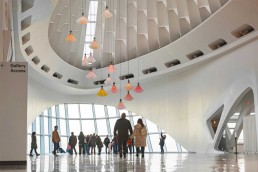
Winter Series: Meadow
A site-specific installation created by Dutch artist duo Drift provides a contemplative space for awe and wonder beneath the soaring wings of the Burke Brise Soleil.
Windhover Hall of the Milwaukee Art Museum comes to life with Meadow, the second iteration of the seasonal Winter Series. The installation by Drift open to the public during 18 January 18 – 13 April 2025, complements the organic architecture of the Quadracci Pavilion with luminous, dynamic blooms.
Described by Drift as an “upside-down landscape,” Meadow is an installation of choreographed kinetic flowers crafted with aluminium, stainless steel, robotic components, and vibrant fabric shades. The result of years of research conducted by the artist duo, Meadow mimics the deceptively simple workings of nature. The installation “blooms” - opening and closing to a gentle choreography using software researched and developed by Drift that creates an ever-changing display. The presentation is site-specific to the Milwaukee Art Museum in its number of flowers, choreography, and colours, which are inspired by North American wildflowers.
“Drift has long worked at the intersection of nature and technology, and I’m excited to present to our visitors their work within the context of the Quadracci Pavilion, a biophilic space designed by architect Santiago Calatrava,” says the exhibition’s curator Shoshana Resnikoff, Demmer Curator of 20th- and 21st-Century Design. According to the architect, The Quadracci Pavilion’s design “responds to the culture of the lake: the sailboats, the weather, the sense of motion and change.” Movement and interrelatedness among things play an important role in Calatrava’s work, and this sentiment is also echoed in Drift’s Meadow installation.
“We are honoured that we have the opportunity to immerse our artwork Meadow in the awesome space that is the Calatrava building of the Milwaukee Art Museum,” says Lonneke Gordijn and Ralph Nauta of Drift. “As longtime fans, it was a dream to design this artwork specifically to fit Windhover Hall. We worked with the perspective to draw the eye into the height of the open atrium to make visitors wander through the space vertically.”
“The first Winter Series presentation was a remarkable success, and I’m delighted to continue the series with an installation that transforms this iconic space into a garden-like setting for everyone who enters the Museum,” adds Elizabeth Siegel, Chief of Curatorial Affairs at the Milwaukee Art Museum. “Meadow will leave visitors wonderstruck.”
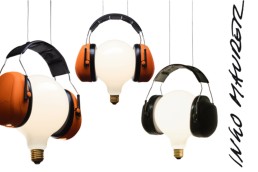
Ingo Maurer to Unveil Shhh! pendant at Euroluce 2025
(Germany) – Munich-based design studio introduces Shhh!, a new suspension lamp debuting at Euroluce 2025. Known for innovative lighting designs, the brand continues to experiment with the concept of the light source, reinterpreting it in unexpected ways.
The pendant integrates an ear defender headset around a lamp, creating a distinctive visual statement. This design juxtaposes industrial protection equipment with a traditional light source, offering a blend of irony and poetic expression.
While the lamp appears to be the primary light source, the actual illumination emanates from within the noise-proof headset. The light filters through, producing a diffused glow, while two directional spotlights beneath the headset provide focused illumination.
Developed through a workshop on brand identity by Ingo Maurer’s creative team, Shhh! explores the interplay between perception and reality. The design challenges conventional expectations, merging aesthetic appeal with functional lighting solutions.