
RIBA CEO to open the Sustainable Design Forum 2026
(UK) - Sustainable Design Collective (SDC) announces that Dr Valerie Vaughan-Dick MBE, Chief Executive Officer of the Royal Institute of British Architects (RIBA) will deliver the opening address at the Sustainable Design Forum 2026.
Dr Vaughan-Dick's address will set the context for the day’s programme, exploring both the opportunities and challenges in advancing sustainability across the built environment. Her participation highlights the important role of industry leadership in supporting progress and spanning environmental responsibility, social value, and inclusivity.
Now in its fourth year, the forum will take place on Thursday, 23 April 2026 at Crypt on the Green, Clerkenwell. Curated by SDC, a voluntary think tank of architects, designers and specifiers, the Forum is designed to foster meaningful, discussion-led engagement across the workplace design community.
The programme will include presentations, panel discussions and interactive sessions, including the Forum’s established ‘speed dating’ roundtables. New elements this year include ‘A Masters in Sustainability’, featuring Dr Asif Din, Dr Joe Croft and Sam Allen in a rapid-response format with audience participation.
Contributions from leading practices will include M Moser & Associates, presenting their ‘Living Lab’ project, and John Robertson Architects, exploring the opportunities and value of retrofit.
Founded in 2022 by Harsha Kotak and Joanna Knight, SDC brings together over 30 leading A&D practices as members.The Forum runs from 10:00am to 6:00pm, followed by networking drinks. Tickets are limited and available in advance:
www.sustainbledesigncollective.co.uk

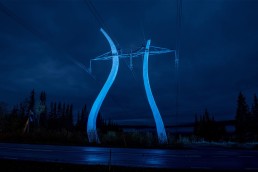
Sweden’s first designed power line pole us Pharos controls
(Sweden) - After 14 years of service, Sweden’s first designed power line pole has been revived with new fixtures from Lumenpulse and lighting controls from Pharos Architectural Controls.
Located in Brattland, just outside Åre, the power line pole stands 32-metres high and is a pioneering combination of art and engineering. With the Åreskutan mountains in the background, it has become something of a landmark for those travelling from Östersund.
Stockholm Lighting Company delivered the hardware, lights and controls at the first installation and for this upgrade. The pole’s lighting is managed by a single universe Pharos Designer LPC controller. As a rugged, compact unit, the Designer LPC offers complete reliability operating 24/7.
This system allows to change expression according to the season, showcasing different colours and lighting schemes to reflect the natural environment around it or, create scenes also celebrate national days in Sweden.
Lina Strömmer, Managing Director at Stockholm Lighting Company, says: “Many people who pass Brattland see the pole as a welcome signal lighting the way for them. The Designer LPC from Pharos has allowed us to create a fun and flexible system with customisable optics to future-proof the pole and continue to create a design that meets the client’s needs.”
Ryan Sainsbury, Regional Sales Manager for UK. Ireland, N. Europe and Benelux at Pharos Architectural Controls, adds: “The dynamic lighting transforms the pole into a visual landmark for the community. By utilising our Designer LPC, this unique structure can provide not just efficient functional
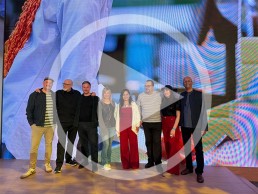
Bucket List event at Light + Building 2026
https://vimeo.com/1176887633?share=copy&fl=sv&fe=ci
Hosted at the Signify Light + Building stand, this year we celebrated 50 iterations of our much loved Bucket List editorial by bringing together a number of designers involved in the feature, who shared their personal Bucket List lighting moments.
Light and Health: A definitive exploration continues here
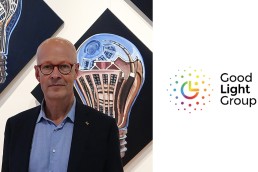
In this issue, Dave Hollingsbee introduces the Good Light Group - an organisation focused on the impacts of lighting on human health.
Keen eyed regular readers of this column will notice that the usual GreenLight Alliance logo has been swapped with that of the Good Light Group.
This in no way suggests that the work is all done when it comes to sustainability. While it is true that huge progress has been made over the past five years: terms like “harmonised metric” are known and understood, as are LCAs and EPDs; many readers likely have encountered TM66 and TM65.2 metrics; and remanufacturing (rather than buying new) has become mainstream. The tide may finally be turning on Cat A fit outs too.
Expect to see more on these topics and case studies, in the future, but now we share the stage with another vitally important topic within our sector, and it is not unrelated: Light and Health.
By light and health, we don’t just mean “tuneable white”, “warm dim”. These are nice features but arguably have muddied the waters or distracted from the real issues. Truly “human centric” or “circadian” lighting is about much more than simply dimming and dropping CCT as the day goes on. Warm dim could be argued to be the equivalent of boiling sustainability down to just recycling. It’s a start, but there is so much more to understand.
It is important that we do. Just as our industry has improved impressively in terms of light LED source efficiency (the inescapable lm/W) and sharpened up aspects like colour rendition, optical control and controls – there remains an elephant in the room.
There is a growing body of evidence pointing to myriad threats to human wellbeing if we don’t alter the way we approach artificial indoor lighting. Conversely, with this technology, and by interpreting the evidence correctly, there is unprecedented opportunity for parties all across our industry to intervene intelligently and positively.
It is a large, complicated and evolving subject. So, this is where we bring in the Good Light Group (and the closely affiliated Good Light Group Asia).
The Good Light Group exists as non-profit organisation operating globally, with a legal structure as a foundation, registered in 2019. Its main objective is to gather and interpret precisely these facts, and to promote the exposure to healthy light across all sectors. To establish and promote the benefits of natural daylight and electric lighting that compensates for its absence, as well as the health risks associated with spending all day indoors, where the light is normally too dim during the day and too bright in the evening.
Affiliated scientists work together with lighting designers to inform on the practical implementation of the latest research developments.
Founded in 2019, it is funded by individual members and commercial sustaining members. The group seeks to promote science-backed, actionable interventions for Healthy Light. The backbone of the group is its 33 Science Advisors from around the world.
The group share fantastically informative newsletters, host webinars with its experts and guest speakers. It issues very accessible videos, brochures and infographics.
In coming issues, we will explore a variety of fascinating and important studies, recommendations, emerging data and case studies. We will introduce eminent scientists working in this area, share papers and recommend further reading and viewing resources. But for this first issue, the Good Light Group founder Jan Denneman starts unapologetically by answering WHY? Never mind the ethics, or the science for now, how do I sell it to the bean-counters?
From €3 to €300: The Greatest Missed Opportunity in Lighting
Lighting’s Established Narrative
Indoor lighting is typically positioned in three ways. First, as functional infrastructure. Light is required to perform visual tasks; it must comply with standards, deliver sufficient illuminance on the task plane, limit glare and ensure visual comfort. Second, lighting supports architectural quality. It reveals materials, articulates texture and volume, structures space and shapes atmosphere. It is the medium through which architecture becomes perceptible and meaningful. Third, lighting is framed as sustainable. LED technology has drastically reduced energy consumption, intelligent control systems minimise unnecessary operating hours, and luminaires are increasingly designed with circularity, reuse and reduced embodied carbon in mind.
All three perspectives are valid. Without adequate light, we cannot function visually. Without well-designed light, architecture loses expression. Without energy efficiency and material responsibility, lighting is not future-proof. Yet a fourth dimension is largely absent from the discussion: the influence of light on human performance. Economically, this dimension outweighs the other three combined.
The Economic Blind Spot
The 3-30-300 rule makes this imbalance visible. Popularised by real estate advisor JLL, it describes the typical annual cost structure of an organisation and the building it occupies as approximately €333 per square foot per year, roughly equivalent to €333 per tenth of a square metre per year. Of this amount, approximately €3 relates to utilities such as energy and water, around €30 covers rent or capital costs, and roughly €300 accounts for personnel expenditure. While exact figures vary by country and sector, the proportions are remarkably consistent.
In offices, schools, healthcare facilities and industrial environments, people represent by far the largest cost component. Salaries, social contributions, recruitment, training, turnover, absenteeism and productivity losses due to fatigue or illness dominate operational expenditure. Yet the lighting industry continues to position itself primarily within the smallest category. Lighting is typically presented as an energy-saving measure, and investment decisions are frequently evaluated on the basis of payback periods derived from electricity costs. From an economic perspective, this focus is disproportionate.
The LED Success Story... and Its Consequence
Two decades ago, this emphasis on energy was understandable. Lighting accounted for approximately 15-18% of total electricity consumption. Improvements in efficiency delivered meaningful financial savings and carbon reductions. The transition to LED technology has fundamentally changed this landscape. High luminous efficacy, improved optical performance and advanced control strategies have reduced lighting’s share of total electricity use in many modern office buildings to only a few percent.
Technologically, this is a success story. Economically, however, it has reduced the relative leverage of further energy savings. Even an additional 10-20% reduction in lighting energy consumption has a modest financial effect when compared to overall personnel costs. The strategic leverage of lighting no longer lies primarily in the €3 category.
The 1% That Changes Everything
Consider a simple scenario: An organisation with 1,000 employees and average total personnel costs of €60,000 per employee per year has an annual payroll of €60m. A 1% improvement in productivity, or a 1% reduction in absenteeism-related costs, represents €600,000 per year. In many buildings, this exceeds not only the total annual energy cost of lighting, but often the total energy cost of the building itself.
When a marginal improvement in human performance outweighs the financial impact of eliminating the entire lighting energy bill, it becomes difficult to justify evaluating lighting primarily on the basis of energy efficiency. It would be comparable to assessing an orchestra by the weight of its instruments rather than by the quality of its performance. Efficient instruments matter, but the purpose of the orchestra is the music. In buildings, that performance is human performance.
Light Beyond Vision
The economic argument is reinforced by developments in chronobiology. In 2002, researchers including David Berson and Ignacio Provencio identified intrinsically photosensitive retinal ganglion cells in the human eye. These cells contain the photopigment melanopsin and are particularly sensitive to short-wavelength light (around 480 nanometres). Unlike rods and cones, they project to brain regions responsible for regulating circadian rhythms, including the suprachiasmatic nucleus in the hypothalamus.
Research by George Brainard and Steven Lockley demonstrated how evening light exposure suppresses melatonin and shifts circadian timing. Charles Czeisler and colleagues documented the relationship between circadian misalignment and impaired cognitive performance. Till Roenneberg introduced the concept of social jetlag, describing the mismatch between biological rhythms and social schedules, with measurable consequences for wellbeing and productivity. These findings confirm that light is not merely a visual stimulus but a biological regulator.
The Indoor Light Mismatch
Modern indoor lifestyles often provide insufficient vertical illuminance at eye level during the day while exposing individuals to relatively bright and often blue-enriched light in the evening. This pattern differs significantly from the natural daylight cycle under which human physiology evolved. Research led by Mariana Figueiro and Mark Rea has attempted to quantify circadian stimulus in relation to vertical light exposure. Studies indicate that higher daytime circadian stimulus is associated with improved sleep quality and increased subjective alertness. Publications in the Journal of Clinical Sleep Medicine have linked greater workplace daylight exposure to longer and better sleep.
Sleep is a critical mediator in this relationship. Chronic sleep restriction is associated with reduced attention, impaired executive function and increased error rates. In knowledge-based environments, this translates into lower productivity and diminished creative capacity. In safety-critical contexts, it increases operational risk. If lighting environments support better circadian alignment and sleep quality, they indirectly influence performance outcomes. In economic terms, this shifts lighting firmly into the €300 category.
The Light Diet
In my work on light and health, I describe this dynamic as the “light diet.” Just as nutrition influences metabolic health, patterns of light exposure influence circadian regulation and overall functioning. While individuals increasingly monitor diet and physical activity, few consider the quality and timing of their daily light exposure. Yet light is one of the most powerful external regulators of human biology. Indoor lighting is therefore not neutral background infrastructure, but a structural determinant of wellbeing.
From Insight to Initiative
To translate these insights into practice, the Good Light Group was established as an independent, non-profit platform dedicated to promoting healthier indoor lighting. The organisation addresses not only circadian-supportive lighting, but the broader biological consequences of reduced daylight exposure in modern buildings.
While much of the recent discussion has focused on melanopic stimulation and circadian regulation, natural daylight provides a far richer spectral composition than most indoor environments. Contemporary buildings filter out ultraviolet B radiation that enables vitamin D synthesis in the skin, and significantly reduce exposure to near-infrared wavelengths that are increasingly being studied for their role in cellular and mitochondrial processes. The cumulative biological implications of spending most of our lives indoors under spectrally limited light environments are only beginning to be understood.
The Good Light Group operates at the intersection of science, design and industry. It seeks to make emerging research accessible to architects, lighting designers, developers and policymakers, while encouraging dialogue between chronobiologists, photobiologists and building professionals. Its aim is not to prescribe simplistic solutions, but to foster a broader understanding of light as a multi-dimensional environmental factor that affects human physiology beyond vision alone.
By advocating for daylight integration, adequate vertical light exposure, biologically informed electric lighting strategies and deeper investigation into full-spectrum light environments, the Good Light Group promotes a more comprehensive definition of what “good light” means in contemporary architecture. The objective is to move the conversation from compliance and energy metrics toward measurable human outcomes and long-term health resilience.
Rethinking Sustainable Design
Recognising lighting as part of the €300 category has direct implications for design. Daylight strategy should be integral to architectural conception rather than an afterthought. Façade design, orientation, spatial depth and glare management fundamentally shape indoor light conditions. Electric lighting should complement and reinforce natural circadian rhythms. Vertical illuminance at eye level deserves greater attention than horizontal lux values alone. Temporal variation and spectral composition should be aligned with time of day and functional requirements.
For the real estate sector, this perspective implies that investment decisions should not be based solely on energy performance. When personnel costs exceed real estate costs by an order of magnitude and energy costs by two orders of magnitude, it is econom-ically rational to treat indoor environmental quality as a strategic variable. ESG frameworks increasingly reflect this shift. The environmental dimension remains important, but the social dimension encompasses health and wellbeing. Certification systems such as WELL and Fitwel explicitly include circadian lighting and access to daylight within their assessment criteria.
Sustainability in Full Meaning
The point is not that light is a panacea. The point is that light is a controllable environmental variable with demonstrable biological effects, and that these effects carry economic consequences. Developers and investors who focus exclusively on energy performance reduce sustainability to a technical metric. True sustainability includes social sustainability.
A building that is energy efficient but leaves its occupants chronically fatigued or disengaged cannot be considered sustainable in the full sense of the word. Sustainability must therefore be defined more broadly. Lighting must be energy efficient. Luminaires should be designed for circularity, reuse and reduced embodied carbon. Manufacturing processes must become more sustainable. At the same time, lighting must contribute to healthy and resilient users.
This requires a different design approach. Daylight must be integrated from the earliest stages. Electric lighting must support rather than override natural rhythms. Vertical light exposure and temporal dynamics must be deliberately structured. Users should understand how light affects them, enabling more informed interaction with their environment.
The principal barrier to this shift is not technological but economic and cultural. Building owners invest, while tenants benefit from improved performance. As long as these interests remain disconnected, short-term capital expenditure will dominate decision-making. Nevertheless, change is visible. Organisations competing for talent increasingly recognise the importance of workplace quality. ESG metrics are expanding to include wellbeing indicators. Human performance is entering the sustainability conversation.
The move from €3 to €300 is not an argument against energy efficiency. It is an argument for proportionality. Lighting should not be understood solely as a cost item to be minimised, but as a strategic investment in people.
The question is not whether we can afford to design lighting that supports health and performance. The question is whether we can afford not to.
This series is curated by Dave Hollingsbee of Stoane Lighting,
dave@mikestoanelighting.com
Materials: Axia - Lodes
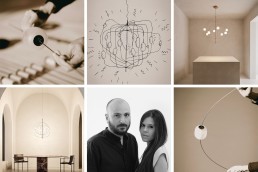
Born from the desire to rethink the chandelier without visible wiring, Axia unites structure, energy, and refined materiality. Its development traces a journey of experimentation that culminates in a system of pure balance and light.
The realisation of Axia came from a project that is driven more by the pursuit of balance rather than the inception of a light in the traditional sense. From the very beginning, independant designers Vittorio Venezia and Carolina Martinelli, approached Axia as an idea: what spatial presence could a chandelier achieve if its most visible component, the wire, were removed?
This radical question became both the core and constraint of the project, prompting the team to hide every technical element within the structure itself, turning the central axis into the conductor that carries both electrical poles and gives the lamp its name – Axia, from the ancient Greek word meaning “value” and “axis”.
“Axia was born from the desire to reinterpret the chandelier typology in a contemporary way,” says Martinelli. “We were interested in working on a lamp capable of establishing a presence in space, yet with great visual lightness. Rather than focusing on the object itself, the research concentrated on how light could occupy and define space.”
“The initial question was very simple: what happens if we remove the wire from a chandelier? That’s where the project began. If light is no longer bound to a cable but flows through the structure itself, the lamp changes its nature: energy passes through the object, and the technology disappears, allowing only light, structure, and proportion to emerge,” adds Venezia.
The idea for Axia originated long before its realisation, but it wasn’t until Lodes approached the duo for a potential collaboration that it began to take shape. The designers shared their vision of reinterpreting the chandelier with no wires, a concept that Lodes was immediately drawn to. From there, the project evolved, with both teams agreeing to treat the design not as a singular object but as a flexible system capable of adapting to various lighting needs.
The project began in 2024, requiring two years of development, including concept, prototyping, technical refinement, and final rollout. The initial concept was the easier part, with the challenge lying in how they would make the technology “disappear” within the structure without compromising the clarity of its chandelier form.
The prototyping phase proved just how demanding the designer’s initial gesture of removing the wire would become once translated into materiality. The early prototypes were stripped-back technical rigs, built primarily to verify internal electrical continuity and the reliability of the connections between elements.
“The early prototypes were much more technical than the final product, but they already contained the fundamental principle of the project: a central rod divided into two poles of positive and negative, from which the arms extend, conducting electricity,” explains Martinelli.
As development progressed, the team moved through several distinct iterations: early versions relied on rods, but these soon were replaced with spring steel, whose elasticity offered greater efficiency, slimmer proportions, and the possibility of compact packaging that would help reduce its overall environmental impact. This shift, however, introduced new complexities – every section, tolerance and junction had to be recalibrated to ensure that the lamp maintained both its structural stability and its visual clarity. Throughout all these changes, one principle remained untouched: the central axis as the chandelier’s organising and conductive core, the element that unites material and light, and most crucially gives a sense of balance.
The production of Axia is based on a combination of precision engineering and a material-led approach. The lamp begins as straight metal rods and tubes, which are manufactured and finished while still in their linear forms. These parts are designed to be slightly elastic, so they can be easily bent without compromising their strength. This flexibility is essential, as it allows the natural curvatures to take shape during installation.
After shaping, the metal receives a PVD coating treatment. This finishing is not only fundamental for the refined aesthetic, but also plays a functional role, helping the metal maintain electrical conductivity so the structure can act as part of the circuit. In parallel, the diffusers are made from Pyrex glass tubes that are heated until soft, then shaped over the moulds. Once formed, the glass is sandblasted in a controlled chamber, where air and sand gently roughen the surface to create a matte finish that allows a soft and even light.
In the final stage, the electrical components are added, and the system is assembled. The whole design has been developed with modularity in mind, reducing the number of parts to make installation easier and allowing the lamp to be packed efficiently. Overall, this improves transportation, minimises waste while still maintaining the clarity and identity of the design.
“Sustainability and longevity play a key factor in our designs, especially in construction logic, hence why Axia is shipped in very compact packaging. At the same time, the product is designed to allow LED replacement over time, ensuring greater longevity and reducing waste. It represents a choice for more sustainable, long-lasting lighting,” says Martinelli.
To allow this, the structure is modular and can be disassembled into a few small elements: the central canopy with the transformer, the central axis, and the eight arms to which the LEDs and glass spheres are attached. “We like the idea of the assembly being a ritual,” adds Venezia.
In its final form, Axia expresses a kind of presence that goes beyond illumination. The designers have been blown away by the feedback of their chandelier, with users describing it as a lamp “that draws space even when it’s switched off”. Rather than occupying space with mass, it occupies space with light, allowing a gentle, diffused glow to define the atmosphere more than the object itself. This effect is heightened by the lamp’s soft output, which wraps the room in an elegant radiance. For the designers, Axia resolves into three words: balance, system, and light – a concise summary of its material logic and its quiet yet unmistakable presence.
In Focus - Federico de Majo
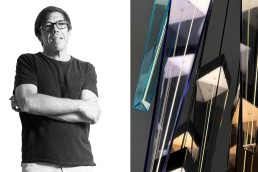
Zafferano’s Stalactite is a prismatic, three-sided glass pryramid lighting fixture that creates extraordinary special effects and commands attention in the space. It combines a strong sculptural identity with simplicity and versatility. Zafferano’s founder and president Federico de Majo tells us more.
What is the concept behind this product?
The concept originated from a spontaneous idea during a dinner with a LED filament technology manufacturer. A quick sketch on a piece of paper explored elongated, soft shapes, which then evolved into a more defined geometric form: a three-sided pyramid. That sketch stayed with the factory owner, and shortly after, the first feasibility study arrived. The result is a luminous prism, a sculptural object that combines purity of form with a strong visual presence, almost like a glowing stalactite suspended in space.
How long have you been working on the product for?
The development process was quite extensive. Each component ‒ from the light source to the decorative glass elements ‒ proved technically demanding and required careful study and refinement. It was not a short journey, but the time invested allowed us to achieve a result we are very satisfied with.
What was the most challenging aspect of producing this piece?
The construction of the glass pyramid. Cutting and bonding the glass panels had to be absolutely impeccable from every angle, as every detail needed to be flawless both structurally and aesthetically. Maintaining precision while preserving transparency and brilliance was key. We used extra-clear glass sheets with colour treatments applied through lustres fired at 180°C, a meticulous process that required great precision and craftsmanship.
What materials have been used?
The diffusers are made from flat glass sheets, assembled into a triangular-based pyramid and enhanced with layered colour finishes achieved through high-temperature processes. The metal structure features a glossy black nickel finish, designed to emphasise the brilliance and purity of the glass. The design process combined hand sketching, technical feasibility studies, and close collaboration with manufacturers.
What technologies does the product use?
Stalactite features a double dimmable light source. The primary source sits beneath the metal frame of the glass, while the secondary one is a vertical luminous filament running the full height of the diffuser, kept taut by a small magnet. This combination creates a remarkable visual effect - the filament illuminates the glass from within, turning the entire pyramid into a glowing, jewel-like object. The lamp uses LED TRIAC dimming technology at 2700K, with a CRI >80 and a beam angle of 55°, delivering 1,472lm at just 12W.
What kind of environments, clients or projects is this product suitable for?
Indoor residential and contract spaces. It works beautifully both as a single pendant and in modular compositions: think of high-ceilinged environments such as stairwells, hotel lobbies, and and large architectural volumes: indeed, the product is available in curated compositions of up to 13 elements. A shorter-diffuser version is also coming soon, which will extend its suitability to rooms with standard ceiling heights.
What makes this product different from others in your portfolio and from other lighting products on the market?
This is a unique piece due to the combination of the prismatic three-sided glass pyramid, the dual light source (which creates extraordinary special effects and commands attention) and the wide range of colour and compositional options. It combines a strong sculptural identity with simplicity and versatility. The possibility to customise compositions (from single pieces to large clusters) and choose from five different glass colours allows designers and architects to benefit from an exceptional level of creative freedom.
Describe the product in three words.
A luminous crocus: prismatic, sculptural, captivating.
www.zafferanoitalia.com
Till Armbrüster
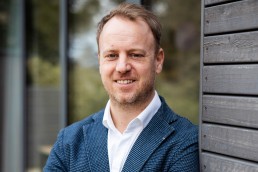
Throughout his career, German product designer Till Armbrüster has blended architectural and decorative lighting, creating beatiful luminaires for Ingo Maurer and Licht Kunst Licht, and has recently launched his own design studio, Source to Space. Speaking to arc at Light + Building, Armbrüster tells us of his design philosophy, and golas for the new studio.
As a publication, here at arc have noticed in recent times a blurring of the boundaries between architectural and decorative luminaire design. Decorative lighting pieces are becoming much more technically-minded, while there has also been a definite emphasis in architectural luminaire design to make fixtures more aesthetically pleasing.
This is one of the primary reasons why we, as a magazine, decided to re-integrate decorative lighting content back into our pages. However, for German product designer Till Armbrüster, Founder of Source to Space, this is an approach that he has always tried to hold on to in his work.
“Typically, the protagonist in architectural lighting and decorative lighting is quite different – in architectural lighting, the protagonist is seen as the architecture, or the interior, or the people; while in decorative lighting, the protagonist is often the luminaire itself. But I don’t see it as being this black and white.
“I try to give an architectural luminaire a certain emotion, but also vice versa, a decorative luminaire should have a technical element.”
Born in Cologne, Germany, Armbrüster moved to the country’s “lighting capital” of Lüdenscheid at an early age – although it wasn’t until much later in his design career that he realised the significance of his hometown in the lighting industry. Instead, his early forays into design were more centred around carpentry and construction.
Speaking to arc editor Matt Waring during Light + Building 2026, he reflects: “In school, we had a lot of artistic classes, looking at different materialities and art styles. I fell in love with this work, but I was unsure if I was good enough to apply to art school; you have to apply with a portfolio, and I have to admit, I am not the best sketcher, I was much more into building. Because of this, I started an apprenticeship in carpentry, which helped me to develop my skills to build ideas.”
During this time, Armbrüster also built up his portfolio, and eventually enrolled in Aachen University of Applied Sciences to study Industrial and Product Design – initially thinking that, with his experience in carpentry, he would move into furniture design. But this was in the mid-00s, in the nascent days of the LED revolution, and lighting soon began to take hold.
“Quite early during my studies, I came into contact with lighting and luminaires. In my third semester, I did a luminaire project, and built a prototype that was only feasible with LEDs. This was in the early days of LED – I think it was a one-Watt Osram LED – and the concept was that I was conducting electricity over metal measuring tapes, that was not possible at higher voltages.”
A unique concept that, while it may not have led to a launchable product, did lead to another, incredibly exciting opportunity for a budding luminaire designer.
“I presented it to my professor, and he suggested that I show it to Ingo Maurer. I said ‘wow, are you sure I can go there with this?’, and he told me to give them a call, as Ingo and his team are very open to young people, students, etc.
“They asked if I wanted to send the prototype, but I said ‘no, I want to show it myself, it’s too important to me’. So, I put on the suit that I wore for my mother’s wedding, went to Munich, and when I arrived, I got a lot of laughter as nobody in Ingo Maurer’s office was wearing a suit – it was super creative, chaotic, everyone was wearing whatever they wanted.
“They really took their time looking at the product, and found it very interesting, but it was clear in the beginning that they wouldn’t turn it into a product in their series. But once I was there, I felt the atmosphere, I loved talking to the people, and it became clear to me that I had to work there. To be in this super creative team that was always doing new stuff, experimenting with materiality and light, was mind-blowing as a young student. I applied for an internship, and afterwards, Ingo said to me, ‘this is working well for me; you don’t have to go back to university, just stay here’.”
However, keen to finish his degree before fully entering the working world, Armbrüster returned to university, where he further honed his craft, designing and building lighting prototypes. Luckily, so impressed was Maurer with Armbrüster that, two weeks before he finished his degree, he received another call telling him that, when he graduated, he was to move to Munich to come and work for him.
For a young graduate, entering the wild and wonderful world of Ingo Maurer was quite an experience for Armbrüster, particularly as lighting technology was also entering a brave new world.
“There is a German term, ‘Schlaraffenland’, which translates to the ‘Land of Milk and Honey’. On the one hand, Ingo and his team had a courageous, hardworking, 24/7 attitude to design, and then on the other, the new technology of LED was emerging.
“The Ingo Maurer team was still working a lot with halogen and fluorescent lighting, but I was there right at the shift. I consider myself an LED native, because I was directly working with LED from a young age and created my expertise around this new development. The older colleagues on the team often came to me and asked, ‘can we solve this problem with LED?’. With this expertise, I found my place in the design team.
“It was quite a hard thing for all companies to shift from incandescent to LED, but as a young designer, it was fantastic because we could do so many things, play around, and create luminaires that had never been possible before.”
While Ingo Maurer as a designer cemented his legacy through his imaginative, creative, and oftentimes outlandish designs, Armbrüster’s early design influences were much more formal; the likes of Bauhaus and Dieter Rams of Braun – “traditional heroes of German design”, as he calls them.
“I still refer to these names, but somehow the work with Ingo was so different and so fascinating that I really went deep into this. Even though I couldn’t understand every design that he was doing, it was still a lot of fun to execute them and build them, because it was so experimental.
“We always used to say that if you open up a catalogue from Ingo Maurer, you will find a product that you absolutely love, and one that you absolutely don’t understand, but for everyone it is different, because his work is so much about emotion.”
During his time with Ingo Maurer, Armbrüster was involved in the design of a number of beautiful light pieces. Particular highlights of his though include the Zufall series of luminaires. Translated to “By Chance”, the Zufall family is a range of luminaires crafted from silicone – a material known for its extraordinary properties. Its flexibility, and ability to incorporate colour pigments in a pure, three-dimensional form made these light objects – which came in both a standing table lamp or a hanging, knotted pendant – truly unique. The soft, vibrant silicone allowed users to interact with the table lamp or redefine the pendant version’s design by adjusting the knot.
“We also produced a one-of-a-kind, larger scale piece that Ingo called the ‘Headache Lüster’, because it was so complicated to build,” Armbrüster recalls.
Another highlight from his years at Ingo Maurer was the collaboration with Moritz Waldemeyer on the iconic My New Flame LED candles. Inspired by Waldemeyer’s idea of creating a digital candle as a stunning combination of high-tech innovation and poetic expression, Armbrüster and the Ingo Maurer team developed, together with Moritz Waldemeyer, a family of luminaires from a single circuit board – almost in a flashback to his first foray into lighting during his university studies. At the upper end of a sleek black circuit board, a candle flame appears to flicker in the wind. Up close, viewers can see a double-sided rectangular display made up of 128 tiny LEDs per side, rendering the image of a burning flame. From a slight distance, or in dimly lit settings, the LEDs blend into a single, realistic-looking flame. The sophisticated programming of the LEDs, combined with their warm colour temperature, creates an astonishingly lifelike effect.
“The goal was to design the product in a way that highlights the magic of the digital flame, while embracing the raw beauty of the exposed circuit board,” Armbrüster says.
After seven years with Ingo Maurer, Armbrüster needed a change, and with a small family now in tow, wished to return closer to his hometown of Cologne. At the time, an opportunity arose for Armbrüster in the nearby town of Bonn, with lighting design studio Licht Kunst Licht.
“I knew Andreas [Schulz, CEO of Licht Kunst Licht], through a shared friend, and I was a bit scared that I would be asked to do proper lighting design. I considered my skills and thought ‘I am a product designer; I know a lot about light, but I don’t know anything about the project business’. But during this time, one of the first members of the Licht Kunst Licht team, Thomas Moritz, a product designer, had stepped down, and there was a need for a new product designer. To Work with Andreas and his team was truly outstanding. I have a deep respect in their work and how to make remarkable architectural lighting design on such global scale and importance. Here, I learned everything about architectural lighting design and to design and develop luminaires for this realm, that was a big step for me.
“Together, Andreas and I professionalised this department and expanded its role within the industry. I was also creating custom, one-of-a-kind luminaires, and consulting with the lighting designers on technical matters, both in Bonn and also with our colleagues in Berlin, and then later in Barcelona, because of the work that we were doing on the Sagrada Familia.”
The prospect of working alongside the architectural lighting designers on the Licht Kunst Licht team was a new challenge for Armbrüster, but one that he enjoyed. Explaining his role within the wider team further, he adds: “The lighting designers would come to me when we needed to make something special for a project – whether that was a centrepiece to complement the architecture, or something that could be integrated into the architecture that wasn’t available on the market.
“I became almost like a negotiator with custom manufacturers; on the one hand I was a translator between the worlds of a lighting designer who has an idea but isn’t sure on how to realise it; and on the other hand, the custom luminaire maker who would try to tell me that an idea is not possible. In those moments, I could say ‘no, I understand the idea, and it is possible’, and with my background, I would do it on my own.
“What was nice about being in an office with lighting designers is I could show them the concept that I was working on, and get very direct feedback where they would tell me if something was a good idea or to forget about it.
“One of the last products I worked on at Licht Kunst Licht was an outdoor, wall-mounted luminaire that we were designing for Trilux. So, I spoke to the team and asked ‘what do you need? What is important for an outdoor luminaire?’ Because my way of designing is not just about designing the outer form, the involved technologies and so on, it is also about the needs of the space, of the application. At Licht Kunst Licht, I learned to first find the right light for the space, and then to design the source.”
Of the products that Armbrüster designed for Licht Kunst Licht, he cites the Bicult – a desk luminaire designed for Trilux – as one of the particular highlights. The first desktop lamp to combine direct and indirect light output, Bicult features glare-free uplighting, and targeted, optimal downlighting to the work surface in one, compact form factor.
“It turned out to be a new definition for office lighting,’ Armbrüster adds. “Andreas introduced me to this concept – it was only a rough concept at the time, but as we developed it, Trilux said to us ‘this isn’t going to work – 5,000lm from under the eyeline is impossible’. To convince both Trilux and ourselves, I built a prototype of the powerful indirect light using thin-film optics to demonstrate that the concept was feasible. Based on this proof of concept, the team at Trilux then used all of their expertise in developing high-tech, high-quality products to turn the concept into a real luminaire — while still incorporating the original thin-film glare control. Even now, eight years after it launched, it is a special product – it is technical, sophisticated, and there is still nothing like it on the market.”
Fusing technical specifics with a sophisticated finish is something that Armbrüster has regularly brought to his product designs. Another such example of this is the Stellr, a downlight developed alongside Lucifer Lighting that merges the worlds of decorative and architectural lighting by focusing both on shadows, and the vibrancy of the objects it is illuminating.
Reflecting on the experience of designing Stellr, Armbrüster says: “Once the idea arose to make a surface-mounted luminaire for Lucifer Lighting, I read a quote from its owner, Gilbert Mathews, where he defines the company as “Design, Define, Disappear”. After our first meeting, I thought ‘how the hell do I make a surface-mounted luminaire disappear?’
“I was on the train back from Berlin, and for me, sitting on a train is always a very contemplative, almost meditative way of travelling, where you can really think differently. And I remembered about this waveguide material that is transparent when a light is turned off. To that point, it had only been used on flat surfaces, but I researched if we could injection-mould, or thermo-form it, and this became the birth of Stellr.
“It became this volumetric source, that changes the appearance of a room when it is turned on – it raises the ceiling, creates atmosphere, and an interplay with very different lighting qualities. And it is not purely decorative or purely architectural – it somehow merges these two things.”
After nine years at Licht Kunst Licht, Armbrüster made the decision to step out on his own and form his own product design studio – Source to Space. Building on his experience of understanding not just the technical components of a lighting product, but the context in which it will sit, Armbrüster hoped to use the experience he gained from both Ingo Maurer and Licht Kunst Licht for his own venture.
“I learned from two masters of light and saw how they followed their path, and so I thought it was time to go out on my own, and to go back to my core competencies of product design and designing of luminaires, and opening up more to the decorative market.
“For me, the similarity is more important than the difference: both architectural and decorative lighting are about balancing emotion and function. In architectural lighting, light helps the architecture create that effect. In decorative lighting, the object itself carries more of the emotional expression, while also delivering the light.”
Across both sectors though, Armbrüster says that sustainability is a core component of his “mission statement” for Source to Space – ensuring that, across his luminaire designs, he looks at new materials, ways in which his products can be more circular, building in repairability, and so on.
“Sometimes, clients are very open to this – of course nobody is telling me they don’t care about sustainability – but some go further than others and stick with it. For me, it is important to get people moving in this direction. I once read the quote ‘sustainability is not a goal, it is a journey. And it is important that you start walking. I started walking many years ago, and now I am trying to take as many people as possible with me on this journey, because I believe it is necessary – and because it sparks my creativity.”
To that end, he adds that his goals for Source to Space are not to be seen as a “fashionable” design studio, but rather, looks to create pieces that are more timeless, that through a combination of good quality design and technical specifications, become long-lasting products.
“This is something that was also very important for Ingo Maurer – we didn’t want to only create glowing pieces, but to have these artistic pieces that had proper lighting; this is what sets it apart from art pieces.
“It is important that a luminaire as a light source should fulfil its purpose, that it fits the application. It should make people feel in a certain situation comfortable and good. For instance, if you are designing a lighting concept, or a luminaire concept for an office, this is different than for a bar or restaurant. Although we have seen some merging of this, you need to understand the needs of both spaces. If you want to merge residential and office design you have to define the residential qualities, but still keep the qualities or needs of the office space for it to be a success.”
Discussing the current trends in the lighting market – particularly poignant considering our conversation was taking place during Light + Building – Armbrüster says that, while there has been a concerted push towards sustainability in recent years, he would like to see a similar movement in lighting controls, as the two can be mutually beneficial.
“Nowadays in lighting, there can be so many dynamic scenarios, but the controls are still too complicated. For me, controls are a big lever on the topic of sustainability, and of bringing sustainability and human centric lighting together.
“Sometimes, these can be quite contradictory, especially in the outdoor environment, we have seen a move into changing the colour of the lighting so as not to disturb certain species, or only using the light that people need during certain hours of the night.”
Looking ahead on a personal level, Armbrüster says that it is “a very exciting time”, as he works on new designs and some new collaborations – including with former Ingo Maurer colleague Sebastien Hepting – that will hopefully come to light in the next 12 months.
But as he expands his portfolio with new collaborations, Armbrüster says that, for him, it is not so much about working with big-name studios or manufacturers, but rather the people behind the names.
“All the different brands that I have worked with have been rewarding, but each come with their own challenges. To work with an Italian company is very different to a German one or to a US brand. It’s important to work with a good brand, but more so it is the people that you are working with, that you are in direct contact with. When I look to the future, I don’t look to a specific brand name, but for people that are committed to meaningful innovation in the field of architectural and decorative lighting, or the merging of it. In the aim to create new and sustainable luminaires.”
As he reflects on his career to date, from the many collaborations and innovative products designed, to the projects that he has been involved with through Licht Kunst Licht, Armbrüster says that the most rewarding moment will always be the “awe-inspiring effect” that lighting can inspire in people.
“At the beginning of my career, I realised that there are so many interesting aspects to lighting – things like aesthetics, like technical and health issues, but also emotion. And with all of these combined, it never gets boring. It is why I loved being at fairs and going to booths where products of mine were exhibited. In my years at Ingo Maurer, we would build the booths ourselves, install all the luminaires, and then when the doors open and people come in and you see the smiles on their faces and their eyes open wide, and you get that instant feedback, it reminds you of why you are doing this, why all the effort and the stress and the long nights are worth it – because you are doing it for people.”
www.sourcetospace.com
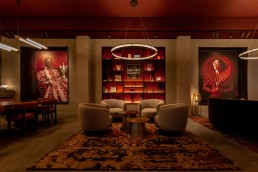
Radisson RED Twickenham, UK
Designed by DLSM Studio, with lighting from Into Lighting, the newly opened Radisson RED at Twickenham’s Allianz Stadium celebrates the heritage, energy, and community spirit of rugby culture, with an additional vibrant flair.
At the home of English rugby, a new hospitality destination has opened up that fuses vibrancy and tradition, in an effort to encapsulate the aesthetic of the modern game.
Radisson RED London Twickenham is situated within the iconic Allianz Stadium (Twickenham) – owned by the Rugby Football Union (RFU), and operated by Aimbridge Hospitality EMEA, the property has been fully reimagined with the bold, dynamic personality of the Radisson RED brand, underpinned by a design narrative that celebrates the heritage, energy, and community spirit of both the RFU and rugby culture.
Spearheading the design of this new hotel was DLSM Studio, whose work spanned across the property’s 150 guest rooms, reception, lounge, co-working areas, event spaces, and washrooms – as well as two newly formed social concepts: The Loft, and The Huddle.
The Loft, situated on the mezzanine floor, consists of a bar, gaming area, and premium lounge space; while The Huddle, on the ground floor, is the main bar and restaurant for the property, appealing to both locals and hotel guests alike.
With this in mind, DLSM Studio approached the studio not only as a design exercise, but as a chance to reposition the hotel’s role within Twickenham.
Guided by extensive strategic insight, the team undertook a detailed study of the hotel’s operations, guest profiles, community needs and wider market potential, identifying the importance of creating a destination that would resonate beyond matchdays, when the stadium welcomes up to 82,000 spectators.
The result is a concept that actively appeals to local residents as well as guests, with co-working spaces, all-day lounge zones and art-infused social areas offering a warm, everyday backdrop to work, relax, dine, and gather.
Alongside the community-centred approach, DLSM Studio hoped that the interiors could match both the identity of Radisson RED as a brand, and also of RFU – a process that Emma Caballero, Interior Designer at DLSM Studio describes as “surprisingly smooth”.
“We found the sweet spot in between RFU’s brand identity, and that of Radisson RED. By selecting materials such as black metal, which can feel harsher and more urban, and coupling with reeded glass, which feels a bit softer and more elegant, there was a marriage of materiality, tactility, and different levels of energy across the various zones that works really well. There were high expectations, as both RFU and Radisson RED were really excited about how the future of the hotel could look – they both saw the potential of what we could bring, especially to the new spaces.”
DLSM Studio therefore understood that lighting would be integral to achieving this urban, yet elevated aesthetic. To that end, Into Lighting was invited to tender for the role of lighting designers by the RFU, project managers NBM, and DLSM Studio, based on its portfolio of completed hospitality projects.
“We knew that lighting was going to be key from the get-go, and it is something that we considered from the beginning of the concept stage,” Caballero adds. “Into was appointed when we were still doing the mock-up room. We had already developed the visuals for the whole hotel and had them approved by the RFU, so we knew what we wanted to achieve, but we didn’t know exactly how. Hosting a workshop with Into and talking through our vision, their team broke it down and proposed a very layered scheme with various approaches to the architectural, feature, and integrated lighting.They advised on where exactly to position LEDs, on the finishes to the artwork, and so on – they were really helpful.”
Darren Orrow, Director at Into Lighting, adds: “DLSM Studio had a strong vision for the interior design concept and the ambience. They wanted to push the boundaries creatively while also aligning with Radisson’s brand guidelines. Some bespoke, high-impact lighting concepts featured in their vision, and we had a series of design workshop sessions where we explored, challenged and developed a number of ideas – reviewing working samples and mock-ups.”
The lighting concept for the hotel was developed in conjunction with DLSM Studio as an integral part of the interior architecture – supporting further the bold brand identity of Radisson RED, while responding sensitively to the building’s unique context within such a renowned sporting location.
The approach, Orrow explains, was therefore centred on creating an atmosphere that feels “energetic, yet refined”, blending moments of drama with warmth and intimacy.
“Lighting was used not simply to illuminate, but to shape perception, guide movement, and create emotional resonance throughout the guest journey – from arrival and public spaces through to more intimate areas of retreat,” he says.
A carefully layered strategy combines architectural lighting, decorative elements, and accent illumination to establish depth and contrast. In public areas, controlled highlights draw attention to textures, materials, and key design features, while darker interstitial zones allow the illuminated elements to stand out, creating a sense of rhythm and visual intrigue. The lighting also aims to respond to the bold forms and colour palette set out by DLSM Studio, enhancing materiality without overpowering the interior narrative.
Orrow continues: “Dynamic contrasts between light and shadow were intentionally employed to reflect the vibrant, playful character of the Radisson RED brand, while warmer tones and softer transitions ensure the spaces remain welcoming and comfortable for guests. Throughout the project, glare control and visual comfort were prioritised, particularly in lounge and social areas, ensuring the lighting supports both social interaction and relaxation.”
Working closely with DLSM Studio, Into homed in on a palette of architectural light fixtures, integrated fixtures for use in joinery, and decorative and bespoke options. The decorative solutions primarily came from DLSM Studio, who Orrow says “had a strong narrative and aesthetic for the decorative lighting”.
From here, Into assessed through lux calculations how much light these would contribute to the overall ambience. Using this data, Into then considered if and where any additional architectural lighting was needed – resulting in the specification of additional integrated lighting, downlighting, and track spotlights.
“We also assessed the required dim protocols for the decorative lights, and their compatibility with the lighting control system. In some cases, this meant some fixtures were not suitable and had to be reselected,” Orrow adds.
“Into provided guidance on a number of large scale bespoke light features, which were a crossover between architectural and decorative features.”
Elaborating further on the narrative and aesthetic for the decorative lighting, particularly in the public-facing hospitality spaces, Caballero says that DLSM Studio had two different strategies.
“For the ground floor, we took a calmer and more welcoming approach, easing guests into the space, while still having that bold, fun aesthetic associated with Radisson RED – but it was about creating an approachable entrance to the hotel.
“Decorative lighting, such as table and floor lamps, was therefore used to soften the space, creating cosy nooks to compliment the layered interiors that are brought to life with curated dressing items and quirky artefacts, reflecting the rugby culture and Radisson RED personality.”
Indeed, the lobby of the hotel has been transformed into a vibrant, multifunctional space where dramatic colour contrasts, layered textures and curated artwork create a sense of energy and connection – a sense that Orrow feels is further strengthened through a combination of “high impact and unique statement lighting pieces”, while ensuring that all textures, graphics, and displays were theatrically lit.
Taking centre stage in the lobby space is a bespoke, sculptural installation of a female rugby player integrated into a structural column, symbolising the RFU’s commitment to its “Every Rose” five-year action plan to elevate women’s rugby. This statement piece serves to reinforce the hotel’s connection to its setting, while amplifying the inclusive values at the heart of the RFU’s vision.
Connection was also key to the design of The Huddle, the hotel’s standalone restaurant, where DLSM Studio looked to create a stronger link with the local community.
Influenced by the crafted materiality of historic rugby equipment, such as stitched leather and rugby shirt-inspired stripes alongside warm timber detailing and tactile finishes, the restaurant presents a playful, artisan-led environment that shifts between casual dining, weekend socialising, and the high-energy atmosphere of match days.
Lighting here emphasises the warm materiality of the space. Into wanted to create a warmer, cosier environment in The Huddle, so they specified 2700K for all architectural lighting and 2200K for all integrated lighting to architectural details, joinery and decorative lighting. In all other areas the colour temperature of the decorative lighting was adjusted between 2200K and 2700K to suit the use of each space and what CCT worked best visually with a particular light fixture.
In the first-floor event space Into specified tuneable lighting for the bespoke light rings. The lighting in the event space is DALI addressable, which gives the Client maximum flexibility on the use of the space and zoning of the lights.
Through careful circuit grouping of light fixture types, Into could also transition from higher ambient light levels during the day, to low-level, intimate, and theatrical lighting post-dusk and into the evening.
On the first floor, in The Loft, everything was designed to be bolder, and more fun and playful, with a focus on having key, feature ceiling lights.
“We had the idea of bringing the feeling of motion and movement, inspired by the players on a rugby pitch,” Caballero adds. “We wanted to add a neon-style light running across the whole floor, like a long exposure of film. Into was really helpful in terms of specifying this lighting. They had done this before, so they were mindful with the key suspension elements, so that we didn’t have too many, but enough to make it a flowing piece. The lighting really brings energy to this social space.”
An experience that was not without its challenges though. On the key difficulties that were faced during this project, Orrow recalls that, due to the fact that the site was a preexisting hotel under another brand, there were elements of the ceiling, wiring and services that were initially considered to be retained due to cost. “This meant that we had to design ceiling recessed and mounted lighting with this in mind to avoid any existing architectural construction and services,” he says.
“It was a challenge to balance use of existing locations and void depth with the new interior design layouts. But, as the project progressed, it was decided that the ceilings would be replaced, and we then had to rework the detailed design to accommodate this, while not undoing the detailed lighting design and circuiting approach.”
Caballero concurs, adding: “Transforming this property into a Radisson RED brand with various stakeholders involved required a strategic approach to design. Meeting the needs of the RFU, Aimbridge and Radisson, the property required a bold re-design to signify change and extend its appeal to the wider community, which included a review of the hotel’s offering. Delivering spaces that welcomed hotel guests and the public to rest, gather, dine and socialise within, from morning through to night.”
Indeed, this focus and emphasis on transitioning the spaces through the day with the lighting has paid off, as the dramatic, atmospheric light installations help to shape the hotel’s overall identity, intensifying the bold visual language that is at the heart of the Radisson RED experience.
Reflecting on the project, Orrow concludes: “The lighting enhances the architectural language of the hotel, and amplifies the interior concept, delivering a distinctive atmosphere that is rooted in both place and brand.
“We have worked with DLSM Studio on many projects over the years – they understand the value a lighting designer brings to a project. They listen and learn, but still challenge to ensure their vision is realised. Through this close collaboration with both DLSM Studio and the client team, we feel that we have delivered a cohesive, immersive environment that balances bold expression with subtlety – creating a memorable experience for guests at this landmark location.”
Client: RFU, Aimbridge Hospitality EMEA
Lighting Design: Darren Orrow, Anthony Stead; Into Lighting, UK
Interior Design: DLSM Studio, UK
Lighting Specified: Aromas, Astro, Atea, Bomma, Chantelle, Demo Lights, Dyke & Dean, Eicholtz, Enigma, Encapsulite, Flos, Frandsen, Illumination, Insight, Kemps, Lamp Twist, Light Box, Made In Design, Marset, Mode Lighting, New Works, Nocturne Studio, Optelma, Philips Kazzar, Polpo Products, Pooky, Royal Design, Segula
Photography: Stevie Campbell Creative
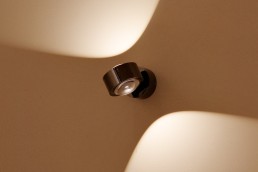
Neko - Spin
Spin explores light through rotation, combining dual emission with convex optics and refined surface finishes in a compact, sculptural form. The adjustable head enables precise control and dynamic symmetry, shaping soft yet defined illumination. Designed to enhance spatial perception, it brings both atmosphere and architectural clarity to refined interior settings.
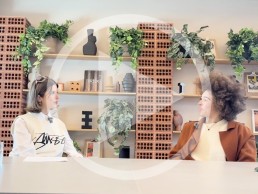
[d]arc discussions - TMT Group HQ with Georgia Ingleton
https://vimeo.com/1174771250?share=copy&fl=sv&fe=ci
Ellie Walton sits down with Georgia Ingleton, Director at Sheila Bird, to unpack the studio’s playful, narrative‑rich workspace crafted for construction firm TMT Group. Their conversation traces the material language, lighting choreography, and immersive spatial gestures that together elevate the everyday craft and culture of construction into a compelling design story.
Signify Launches 2030 Sustainability Programme
(Netherlands) – Lighting manufacturer Signify has announced Brighter Lives, Better World 2030, a new sustainability programme aimed at expanding energy‑efficient lighting solutions and helping customers reduce environmental impact. The initiative introduces a series of targets and business changes as the company responds to increasing global demand for electrification, efficient energy use, and resource‑conserving technologies.
“Brighter Lives, Better World 2030 is designed to deliver solutions that improve lives, save energy, and make better use of resources - which is exactly what our customers are asking for,” says As Tempelman, CEO of Signify. “It shows that impact and opportunity go hand in hand, as we create real value for society, while building a stronger, more resilient company.”
“We're proud to introduce the third chapter of Brighter Lives, Better World. Our new program builds on the progress of the past decade, remaining fully committed to our 2040 net zero ambition, with new targets that focus on reducing the energy and resource consumption of our customers, while continuing to drive innovations that improve safety & security, health and well-being,” says Maurice Loosschilder, Head of Sustainability at Signify.
Energy efficiency features prominently in the 2030 plan. Signify outlined two major commitments for the end of the decade:
- Cumulative energy savings of 60 TWh for customers
- A 35% reduction in CO₂ emission intensity across its product portfolio (annualised)
The company’s existing Green Switch programme, introduced in 2020, has reportedly supported more than 37,000 projects worldwide involving the transition to connected LED systems. Signify says the programme has assisted over 10,000 local authorities in upgrading municipal lighting.
A related initiative, the updated Signify Switch programme, will continue offering guidance to customers on selecting efficient lighting, pursuing financing, reducing emissions, and implementing solar lighting where electrical grid access is limited.
Signify also announced Signify Circle, a new offering for professional customers that focuses on resource efficiency through durable, repairable, upgradable and recyclable lighting products. These will be grouped into four categories:
- Circle products
- Light as a Service
- Remanufactured products
- Spare parts and upgrade kits
The company plans to expand circular products and services within its European Professional business, aiming to increase revenues in this category from 10% today to 27.5% by 2030.
Sophie Breton, President of Signify’s Professional Business in Europe, said customers are increasingly interested in long‑lasting products that can adapt to changing needs. The company states that Signify Circle will offer clearer labelling and customer education based on defined circularity criteria.
Signify emphasised that the 2030 programme is supported by broader goals related to responsible manufacturing, fair working conditions, human rights considerations, and improving lighting access for underserved communities.The company says progress updates will be provided quarterly alongside its financial disclosures.
Light + Building 2026 draws almost 150,000 visitors
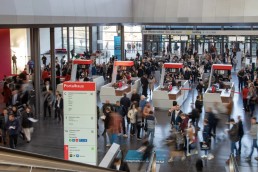
(Germany) - Light + Building 2026 concluded last Friday, after a six-day programme that highlighted current developments across the lighting and building sector. From 8-13 March, the event brought 1,927 exhibitors from 49 countries to present technologies ranging from building electrification and digital connectivity to lighting and architectural design solutions.
Exhibitors showcased a broad range of innovations, including systems incorporating AI, bidirectional charging, multifunction interfaces, and connected lighting technologies. Many products and demonstrations focused on evolving the integration of digital solutions into modern lighting.
The event recorded 144,767 visitors from 143 countries. The largest international visitor groups came from China, the Netherlands, Italy, Switzerland, France, Austria, the UK, Spain, and Greece. Organisers reported that global air travel restrictions and geopolitical developments in the Middle East affected the ability of some attendees, particularly due to disruptions with major hubs like Dubai. Despite this, the fair maintained a strong presence from Germany and the wider Central and Western European region.
Wolfgang Marzin, President and CEO of Messe Frankfurt, comments on the role of the fair facilitating professional change and collaboration: “Light + Building 2026 has once again demonstrated just how innovative and forward-looking this industry continues to be. At the same time, it shows how important personal encounters and direct exchange remain, particularly in times like these. Light + Building fulfils its role by bringing together people from industry, the skilled trades, planning and design, creating the foundation for dialogue, cooperation and new ideas. This exchange strengthens the industry's cohesion and provides important momentum for its continued development. The future lies in electrification.”
Design considerations also remained central to many presentations. Companies showcased high-quality luminaires, varied design approaches, and carefully calibrated light colours intended to enhance interior environments. Sustainability featured prominently, with several exhibitors highlighting the use of durable materials, long-life components and principles of circular product design. Overall, the event pointed towards a continuation of comprehensive lighting solutions that combine technical precision with environmental and design considerations.
www.light-building.messefranfurt