
ICFF 2026 announces expanded lighting features
(USA) - The International Contemporary Furniture Fair (ICFF) will return to the Javits Center, New York, from 17-19 May 2026, introducing new partnerships and curated initiatives under the theme Common Ground: A Global Dialogue on Design and Shared Values. Taking place during NYCxDESIGN, the event aims to position contemporary design as a collaborative platform across disciplines including lighting.
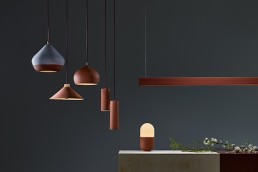
While traditionally associated with furniture and product design, the 2026 edition places a stronger emphasis on interdisciplinary exchange and material innovation, with several features relevant to architectural and decorative lighting professionals. A notable addition to this year’s programme is an expanded lighting presence within the Juniper Recharge Lounge. The space is conceived as a lighting-led environment designed for networking and informal meetings, using illumination as both functional infrastructure and atmospheric device. Rather than a conventional seating area, the lounge is intended to demonstrate how carefully considered lighting can influence wellbeing, orientation and social interaction in temporary public interiors.
The fair's widing programming connects lighting in initiatives that reflect ICFF’s emphasis on material responsibility, innovation, and interdisciplinary dialogue. These include an upcoming exhibit led by Jonsara Ruth, Design Director of the Healthy Materials Lab at Parsons School of Design, with further details to be announced, as well as an expanded focus on lighting through enhanced programming in the Juniper Recharge Lounge.
An expanded Emerging Designer Spotlight initiative will run as a year-long editorial programme culminating in a live presentation at the fair. Alongside the WANTED platform, featuring schools, studios and prototypes, the initiative provides opportunities for early-career designers working across furniture, objects, materials and lighting typologies.
Meanwhile, the talks programme will address topics such as healthy materials, housing affordability and cross-cultural design practice. These themes increasingly intersect with lighting design through issues such as circadian wellbeing, inclusive environments, energy consumption and technological integration.
In a new partnership with Habitat for Humanity New York City and Westchester, a new program that supports Habitat’s work to expand access to permanently affordable homeownership and advance equitable housing solutions. Through this partnership, ICFF is bringing the design community together around a shared commitment to housing equity, with part registration proceeds supporting Habitat’s mission across New York City and Westchester County. The collaboration will also provide material resources and in-kind support, extending the impact of the fair well beyond its run and reinforcing how design can play a meaningful role in creating positive, lasting change.
Returning Programs & Features for 2026:
- Mainstage: An elevated lineup of global speakers on material innovation, sustainability, cultural storytelling, hospitality, and technology. Sponsored by Moroso.
- The Oasis: A space to relax, meet, and host intimate talks spotlighting sustainability, innovation, and human-centered design. Sponsored by Ethnicraft, Leon Speakers, and Mohawk.
- Welcoming Lounge by Ligne Roset: The iconic brand returns to host the Welcome Lounge at the entrance of the fair.
- Aqua Atelier by Grohe: An exploration of sustainable water practices and new materials within the Kitchen & Bath pavilion, featuring conversations led by industry experts.
- Juniper Recharge Lounge: A serene, lighting-driven space designed for reconnection, networking, and restoration.
- Rarify Dining Lounge, in partnership with Be Original Americas: A destination celebrating authenticity and contemporary craft through shared meals and conversation.
- ROOM x OFS: ROOM x OFS return this year with a collaborative studio and lounge space where conversations and content merge. The ROOM x OFS space will host live discussions with design thought-leaders as part of their "In the ROOM" podcast. ROOM will also unveil the next episode of its acclaimed Designers on Design video series live on the ICFF Main Stage, featuring tête-à-têtes with today's top design talents.
- ICFF Editors Awards: Honoring excellence across product categories and disciplines, highlighting standout work and emerging voices. The awards take place May 17 at 5:00 PM.
ICFF will be running from 17-19 May. Register is open now: www.icff.com/register

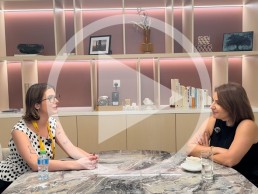
[d]arc discussions - One Office with Lama Arouri
https://vimeo.com/1171096526?share=copy&fl=sv&fe=ci
Ellie Walton visits the One Offices in Dubai to talk with Lama Arouri, Managing Director of Studio N, on its sophisticated lighting scheme, plug-and-play, and tips for lighting the modern workspace.

[d]arc awards voting is now open!
(Global) - All projects have now been shortlisted by this year’s expert judging panel, and all eligible products have now been entered, meaning the [d]arc awards peer-to-peer vote is now open. All independent lighting designers, light artists, interior designers, architects, and product designers are now invited to vote in the [d]arc awards and receive a ticket to the April awards ceremony.
The [d]arc awards remain one of the most respected peer-to-peer programmes in the lighting calendar, celebrating creative excellence across architectural, decorative, and artistic lighting. With the shortlist confirmed, voting is open exclusively to independent lighting designers, light artists, interior designers, architects, and product designers
How does it work?
- Only independent designers and architects may vote
- Manufacturers are not eligible to vote
- All 13 categories must be completed for votes to be counted
- A company email is preferred for verification
- Professional credentials may be checked before voting is approved
Those who complete across all 13 categories will automatically receive a complimentary ticket to this year's awards party at Fireworks Factory, Woolwich in London. However, participants must vote in all 13 categories to guarantee free entry. Anyone who does not cast votes in all categories will be required to purchase a ticket to attend.
With 2025's theme centred around Art, the awards promise a visually spectacular event. Lighting installations and displays will draw creative inspiration from some of the world's most influential artists, including Yayoi Kusama, Andy Warhol, Damien Hirst, Carnovsky, James Turrell, and William Heath Robinson.
Supplier tickets are now available to purchase:
- £500 + VAT per ticket
- £400 + VAT if entered the awards
With 500 independant designers expected to attend, the event offers an unparalleled networking opportunity. To book, suppliers can contact Mo Naeem at n.naeem@mondiale.co.uk.
This year’s shortlist was selected by a distinguished group of speakers from the LiGHT 25 exhibition: Magalena Gomez, So It Is Design; David Atkinson, DALD; Krishna Mistry, Mistry Lighting; Sanjit Bahra, Design Plus Light; Tad Trylski, TandEm; and Zoe Faulkner, Troup Bywaters + Anders. The panel applied their deep expertise across architectural and artistic lighting to identify the standout projects of the year. While the judges have set the stage by determining the shortlist, the final outcome rests entirely in the hands of the independent design community
Voting is now live, so if you're an independant lighting designer head to https://darcawards.com/
**
With thanks to this year's sponsors: OneEightyOne, David Village Lighting (Artemide), DRK Lighting, ERCO, formalighting, Signify, DALI Alliance, Pharos Architectural Controls Ltd, Nicolaudie Architectural Control, Huda Lighting, LiGHT 26, LEDFlex Group, LED Linear, Lucent Lighting Ltd, Vivalyte (together with their UK distributor Nox Obscura), and awards manufacturer, Applelec.
And a big thanks to our lighting design partners this year: Arup, Buro Happold, dpa lighting consultants, Foster + Partners, Foundry London, Nulty+
original BTC
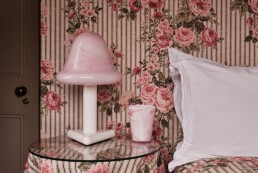
The Neo table light in Strawberry is a highlight of the five-piece Neotenic collection by Original BTC and Buchanan Studio. Bringing new audiences to ancient glassblowing techniques, the Neo table light fuses Buchanan Studio’s romanticism and edge with a shared appreciation of utilitarian design and commitment to British craftsmanship.
Neotenic celebrates the beauty of swirly glass, with its rippling colours and natural variations. Neo shades are mouth-blown in-house in Oxfordshire by O.BTC in three finishes of Strawberry, Chocolate and Vanilla. With great care and skill, opal glass is swirled with colour to create a mesmerising marbled effect. The Neo table and floor light sit on white steel table and floor light bases. Clean edges and smooth curves are further softened with a layer of subtle texture, resulting in a contemporary yet timeless form that perfectly complements the glass above. A tilting mechanism allows for the shade to be moved, adding further to its character and playfulness.
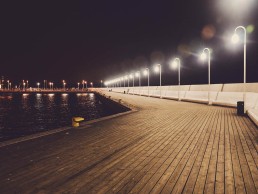
Lighting the night to enhance our surroundings
Artificial light at night (ALAN) is one of humanity’s great enablers. It allows us to function, move, and connect after sunset, supporting public safety, productivity, and social interaction. From the first oil lamps of the 17th century to today’s LED-illuminated cities, light at night has been synonymous with progress and prosperity.
Yet the way we illuminate our nights is evolving. The growing awareness of energy use, carbon emissions, and ecological impacts has prompted a collective shift toward lighting that is both human-centric and environmentally responsible, with efficiency and effective use of energy in mind. Optimal light at night is not about switching lights off, but about using the right light, at the right place, at the right time, controlled by the right system, ensuring illumination supports people while minimising its footprint on nature and optimising the budget of municipalities.
Why introduce artificial lighting at night
ALAN offers great opportunities for any city, park or street. Adding lighting at night can make communities safer, more economical, and improve well-being. A good lighting design can improve quality of life, enabling evening recreation, supporting tourism, and reinforcing the identity of public spaces. Upgrading outdated systems unlocks major energy savings, and switching to connected LED luminaires can cut consumption by 70% while reducing maintenance and operational costs.
Safer environments that preserve the integrity of the night sky: Populated areas are illuminated to keep our communities safe. According to research conducted by the World Council on City Data, in association with Signify, upgrading to connected street lighting can reduce crime rates by 21%, as well as reduce nighttime traffic accidents by 30%. With the right lighting designs and technologies, we can deliver the same safety benefits while preserving the night sky, limiting reflected light, and minimising how much light is emitted. For instance, the inclusion of motion sensors in street lanterns to only illuminate spaces when needed, and smart optics that direct light only to where it is needed, both avoid any wasted emission of light.
Efficient lighting, only when we need it: Connected lighting systems can program lighting to automatically dim or switch off at certain hours of the night, when there is little or no human activity. This can deliver reductions in overall energy use for municipalities, where public street and area lighting can account for as much as 40% of a city's electricity consumption. Signify Interact, for example, allows centralised scheduling of all street and area lights in a city, making lighting behaviours easy to manage and modify based on seasons, animal activity, and other considerations. Connected lighting technologies like Interact ensure that only the light that is required is used, lowering energy costs and supporting emissions reduction targets.
Protecting natural ecosystems: Too much light at night can disturb our natural sleep cycle and can impact the behaviour of wildlife. Fortunately, street lights can be adjusted to reduce sky spill, which DarkSky defines as the 'unwanted spillage of light onto adjacent areas,' and programmed to automatically switch off or dim when not in use.
The challenges
One the other hand, one can’t ignore the challenges. Poorly installed or misdirected luminaires contribute to skyglow, reducing the visibility of stars and altering the natural rhythm of night and day. Glare and light trespass disturb sleep and compromise comfort, while the wildlife – from bats and migrating birds to insects – depend on darkness to feed and navigate.
From an environmental and economic perspective, wasted light means wasted energy. Each unnecessary kilowatt-hour adds to carbon emissions and municipal costs. With biodiversity loss and energy efficiency high on the global agenda, avoiding unnecessary light has become both an ecological and economic imperative.
Many areas of the EU lack regulations addressing the environmental impact of ALAN, and where rules exist, they vary widely between countries, regions, and even cities, creating inefficiencies in tackling the issue at a European level. For example, France regulates the colour, timing, and direction of lighting; some regions in Spain quantify blue light using the spectral G-index; and Italy enforces 18 different regional lighting laws. Cities like London and organisations such as the ILP provide general design guidance referencing CIE environmental lighting zones to manage effects like skyglow and façade lighting, following the principle of “the right light, in the right place, at the right time, controlled by the right system.”
Practical guide to lighting specification
When you specify lighting, you shape how effectively people, places, and nature experience the night. Your role goes beyond design; you advise clients on using the right light, in the right place, at the right time. Effective projects begin with early, thoughtful planning that avoids excessive light and aligns functional, environmental, and social goals.
When you plan a project, consider these essentials:
- Assess the need: Is lighting truly required, and to what extent?
- Understand users: Identify visual tasks, activity patterns, and safety needs.
- Respect the environment: Recognise nearby habitats, dark-sky areas, or EU Natura 2000 areas.
- Check regulations: Review applicable national, regional, and municipal ordinances.
- Set sustainability goals: Define measurable outcomes for energy savings, biodiversity protection, and long-term maintenance.
Responsible lighting starts with collaboration. Effective projects depend on shared understanding and clear communication between all stakeholders (lighting designers, installers, contractors, municipalities, ESCO/utilities, operators).
In the early stages, discuss both the benefits of good lighting and the potential side effects of poor implementation. This allows you to align expectations, define realistic budgets, and include commissioning and maintenance within the scope from the beginning. Even within limited budgets, well-balanced design using modern optics and controls can deliver excellent results. This approach helps empower clients to appreciate the long-term value of responsible lighting choices
Leading the way to responsible lighting solutions
At Signify, we advocate for the following techniques as a powerful way to illuminate responsibly:
- Conserve: To use light only when needed, set schedules and motion detection to use light only when needed
- Contain: direct light only towards the intended area and prevent unnecessary spillage
- Control: Adapt light output to no more than what’s necessary
- Colour: Choose your light spectrum depending on the surrounding environment and biodiversity
Together, these four techniques enable customers to use light intelligently, efficiently, and with respect for people and the environment. If paired with solutions with circularity built in, there can be unparalleled economic benefits.
Optimal lighting at night represents progress, not compromise, and Signify is leading the way in harmonising technology, design, and environmental care. Achieving optimal light at night requires collaboration among policymakers, designers, manufacturers, and operators. Signify is committed to ensuring that every lumen serves a purpose to support life and minimise ecological impact. Together, we can restore the balance between human needs and the natural night.

Registration Opens for IALD Enlighten Europe 2026
The event is intended for a range of industry professionals, including designers, architects, engineers, manufacturers, and suppliers. Developed by lighting designers, the conference aims to offer participants opportunities for in‑depth dialogue and networking in a format distinct from larger trade shows or broad industry exhibitions.
"Paris, the 'City of Lights,' provides the perfect setting for our professional community to gather, learn, and take inspiration," says Christopher Knowlton, IALD Chief Executive Officer. "IALD Enlighten Europe 2026 will bring together the brightest minds in the industry for meaningful discussions that will shape the future of architectural lighting design."
Sessions will be led by speakers from across the architectural lighting sector on topics that will address developments in lighting controls and systems integration, artificial intelligence, and emerging technologies, health and well‑being considerations, and sustainability.
Carla Wilkins, IALD, CLD, President of the IALD Board of Directors, notes that peer‑to‑peer learning remains a key element of the conference: “We learn at all stages from those with the most relevant guidance, regardless of hierarchical norms. Whether someone is early in their career or an established professional, the event aims to provide new insight and support ongoing development in the field.”
Registration details, venue information, and the event agenda are available at iald.org/ee2
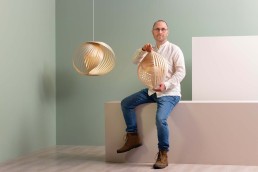
In Focus - Ilkka Kauppinen
Secto Design’s Adilo is an unassuming flat-packed pendant that transforms into a graceful spiralled luminaire through a simple unravelling mechanism. 14 years in the making, industrial designer and Finnish artisan, Ilkka Kauppinen discusses the journey of Adilo as a rebellion against bulky wasteful packaging.
What is the concept behind this product?
Traditionally, large lamps are difficult to transport: they are fragile, require substantial volume, and demand excessive packaging. I wanted to design a lamp that could be folded flat for transport, solving these challenges without compromising its visual or material qualities.
How long have you been working on the product for?
I first sketched the core idea and geometry around 15 years ago. Over that time, I returned to it in short, intensive phases, experimenting with different materials and manufacturing methods. Once the right tools and materials became available, the final development phase took approximately a year.
What was the most challenging aspect of producing this piece?
The most challenging part was finding a functional opening mechanism. I tested an unreasonable number of fastening and structural solutions, and for a long time, nothing worked the way I envisioned it. The frustration built up to a point where giving up simply was not an option. Eventually, one evening, I had a genuine lightbulb moment and realised the structure could be tensioned using a string. That single insight unlocked a solution that is both intuitive and user-friendly. From there, everything finally began to fall into place
What materials have been used? Please describe the design process.
The primary material is PEFC-certified ultra-thin birch plywood, which gives the lamp its warm, natural glow while also providing the necessary structural performance. Its flexibility and strength were essential to achieving the folding structure. Additional polymer components are used where precision and durability are required. Because functional materials and mechanisms cannot be fully resolved on paper alone, the design process relied heavily on hands-on prototyping, testing, and iteration.
What technologies does the product use?
When I first sketched the lamp, many of the materials and manufacturing methods required to realise it did not yet exist. Advances in technology have since made it possible to bring the idea to completion. In particular, developments in ultra-thin birch plywood and contemporary manufacturing techniques have enabled a level of precision and efficiency that would not previously have been achievable at a practical scale.
What kind of environments, clients or projects is this product suitable for?
The lamp is suitable for both private and public interiors. It is available in two sizes, allowing it to adapt to different spatial scales and contexts.
What makes this product different from others in your portfolio and from other lighting products on the market?
This piece differs significantly from my earlier work, as my background is largely rooted in technology, but that technical thinking is clearly present here. At the same time, the project carries strong personal significance, having stayed with me for many years. I would not have continued working on it without a deep belief in the value of good design and in the importance of seeing an idea through properly. I can say, with confidence, that there is nothing quite like it currently available.
Describe the product in three words.
Unfolding natural lighting.
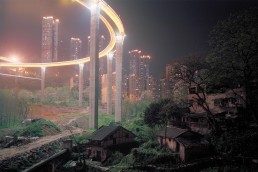
Brice Schneider Comment: Selling Our Shadow
Concerned that our modern environments are becoming too overlit and “disconnected”, Brice Schneider, Design Director at Nulty, offers a perspective shaped by nearly two decades of practice across several continents, inviting the lighting design community worldwide to reflect more deeply on this global phenomenon.
Light reveals, but shadow gives meaning. Somewhere in our pursuit of brightness, we have forgotten this. We flood our cities with artificial illumination, erase darkness from our interiors, and measure progress in lumens per watt. Light is clarity, we are told an enabler of safety, productivity, and visibility. But in this relentless pursuit of brightness, what have we lost?
Shadows are more than the absence of light. They shape depth, create rhythm, and bring texture to space. They offer contrast, making light more meaningful. They whisper of time’s passage, of morning stretching into noon, dusk dissolving into night. Yet, in our modern environments – overlit, sterile, and disconnected – we have sold our shadow, unaware of the price we would pay.
There is an old story about a man who made a terrible bargain. In Peter Schlemihl’s Remarkable Story, the 19th-century novella by Adelbert von Chamisso, a traveller trades his shadow for a bottomless purse of gold. At first, he revels in his fortune, until he realises what he has truly lost. Without his shadow, the world rejects him. People recoil, unable to trust a man without one. He becomes an outsider, unable to belong.
Traditionally, Schlemihl’s story is seen as a cautionary tale about wealth and social exclusion, but there is another way to read it. What if his loss of shadow represents something deeper? A disconnection not just from society, but from the natural world itself?
Like Schlemihl, we have made a bargain of our own. In exchange for the convenience of perpetual brightness, we have severed our relationship with the natural play of light and dark, warmth and coolness, presence and absence. We have created environments where time no longer unfolds naturally, where space feels flat, where the quiet drama of sunlight and moonlight has been replaced by static, mechanical illumination.
Schlemihl, desperate to reclaim what he has lost, spends years wandering in search of belonging. Perhaps, like him, we are beginning to realise that in selling our shadow, we have lost something essential something that can only be recovered by reconsidering how we design and experience light.
In recent years, the shortcomings of over-illuminated, rigidly controlled environments have become undeniable. The Covid-19 pandemic forced many to examine their surroundings more closely, exposing the discomfort of living and working in spaces that feel lifeless. The absence of natural rhythm, the gentle shifts of daylight, the presence of shadow, became impossible to ignore.
As we move forward, lighting must be rethought not only in terms of function but in terms of experience. Global sustainability initiatives such as the UN’s 2030 Agenda and the 2050 climate goals challenge us to rethink not just how much energy we use, but how light shapes our relationship with place, time, and wellbeing.
For too long, we have treated artificial illumination as a fixed commodity, something to be controlled and measured. But light in the natural world is never static. It shifts with the seasons, dances with the wind, softens under cloud cover, and transforms as the day unfolds. Yet, conventional lighting design has largely ignored this fluidity, enforcing a mechanistic, uniform glow rather than an illumination that breathes and responds to its surroundings.
Even recent efforts to create human-friendly lighting, designed to better support sleep cycles and wellbeing, remain limited. Most of these approaches focus only on daylight hours, overlooking the complexity of nocturnal illumination. Light at night is not just about visibility, it affects the behaviour of wildlife, the growth of plants, and the subtle interplay between light, air, and water.
But this is beginning to change.
Rather than treating light and darkness as opposing forces, we should embrace the in-between spaces – those liminal moments where light shifts, softens, and reveals the textures of its surroundings. These are the places where light is alive, changing not just with time, but in response to the world around it.
Inspired by Iain McGilchrist’s exploration of meaningful connections, this approach restores depth, emotional resonance, and harmony to environments, countering the sterility of static, overlit spaces. Light, like a storyteller, carries the memory of its journey from the way it filters through a dense forest canopy, to the way it glows softly against textured surfaces, to its quiet shimmer on water. These moments of connection create spaces that feel layered, immersive, and deeply human.
At the heart of this philosophy is the idea that less is more when used at the right time. Instead of flooding spaces with uniform brightness, light should emerge and recede, responding to the natural flow of the day and the needs of those who inhabit it.
The future of lighting should not simply be about meeting lux levels; it should be about intentionality, responsiveness, and context. It should recognise the role of environmental psychology: the way lighting influences mood, perception, and emotional connection to space. Just as music uses silence to give sound meaning, lighting should use shadow, contrast, and rhythm to bring depth to the built environment.
Lighting is not just functional; it is deeply emotional. The way a space is illuminated shapes how we feel within it – whether we experience a sense of warmth and intimacy or detachment and sterility. If designed thoughtfully, lighting has the power to enhance connection, guiding perception in a way that feels natural rather than imposed.
A more artistic, poetic approach to lighting could reshape our relationship with the night, communicating how and why certain lighting strategies evoke emotional responses. Instead of seeing darkness as a problem to be solved, we could learn to work with it, using soft glows, layered shadows, and patterned light to create visual transitions that reduce the need for excessive brightness.
Light should not dominate its environment; it should belong to it.
Patterned illumination, subtle shifts in texture and contrast can be more effective than sheer brightness in shaping perception, improving visual acuity, and reducing overall energy consumption. A well-placed glow can guide without overpowering. A thoughtful shadow can define space more effectively than a flood of light.
The goal is not just to see, but to experience.
For too long, we have treated light as something to impose upon the world. But light does not exist in isolation; it is shaped by its surroundings, transformed by what it touches. It moves, it breathes, it changes.
To reclaim our shadow is to recognise this; to understand that light is most beautiful, most profound, when it dances with darkness.
Rather than selling our shadow for the illusion of control, we should learn to embrace its presence, designing light that is not just functional, but poetic responsive, alive, and in harmony with the world it inhabits.
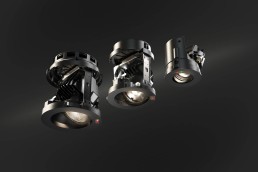
David Morgan Review: Super Nova
Launched at LiGHT 25, the Nova is the latest development in remote controlled, motorised luminaires from Luminii brand RCL. Keen to find out how the technology has developed since he last reviewed an RCL product, David Morgan puts the Nova under the microscope.
It has been more than five years since I last reviewed an RCL motorised recessed downlight so I was intrigued to see and test its new miniaturised Nova luminaire that was launched at LiGHT 25.
In the intervening period between the two reviews, RCL has been acquired by Luminii Lighting, based in Niles, Illinois with operations across the United States, Canada, the UK and the Middle East.
RCL product development and engineering is still based in Wimbledon, south London. Final assembly of all RCL luminaires is also undertaken in the UK at the RCL HQ, with components and sub-assembly sourced globally. RCL shares facilities and staff with sister company, Precision Lighting, and both firms focus on the specification lighting market. RCL grew out of a custom product request to Precision Lighting in 2001 for a remote controllable motorised lighting system for use in ballroom illumination. Since then, the two companies have grown from two to 25 employees in the UK, with approximately 40,000 RCL motorised luminaires installed worldwide. Luminii employs around 200 people across the world.
The benefits of being able to aim and focus projector luminaires without the need to use cherry-pickers, scaffolds or ladders are as relevant today as they were when RCL started. The costs of manually aiming multiple luminaires continues to rise while conversely the production costs of remote-controlled luminaires have fallen as the various enabling digital technologies develop, factors that have widened the market opportunity.
Although the first recorded example of remote-controlled, motorised lighting dates back to the 1920s, RCL has developed the concept into a recognised luminaire category. The Nova takes the development to the next level.
It is understood that the development of the Nova was triggered by requests from specifiers over recent years for smaller luminaires both in diameter and depth. Although the original application for RCL motorised downlights was for use in ballrooms with very high mounting height, the requests indicated that a wider market exists, including difficult to reach spaces and multi-use spaces where the lighting needs to be adjusted on a frequent basis. High-end residential homes, galleries, fashion retailing, restaurants and multi-use spaces in cruise ships are among the target applications for the Nova.
The cut out required for the Nova is only 100mm in diameter, with an aperture size of 50mm. The recess depth required is just 130mm. The Nova is approximately 30% smaller than the previously smallest RCL luminaire, the DRX5, while still delivering up to 85% of the lumen output. With a full 360° rotation and 35° tilt, it can be used in a wide range of lighting applications. The Nova is available with either a trimless housing or with a moulded bezel. For the US market, an IC rated enclosure is also available. A clear moulded window is integrated into the flange, which allows communication with the hand controller and is a tell-tale sign that this is not a standard downlight.
The Nova incorporates a variety of technical innovations that both reduce the size of the luminaire but also improve the aiming accuracy and extend the working life. The use of a flexible PCB, typically used in cameras, has helped to reduce the overall size. Digital stepper motors have been used, which also reduce the luminaire size, provide more accurate aiming and scene recall, while also giving a longer working life than previous motor types. A new flat flexible ‘clock-spring’ cable system overcomes the most common failure mode caused by broken wires. It is understood that during development the Nova undertook 30,000 movement cycles without failure, believed to be three times more than any other RCL luminaire.
The Nova range includes three different light engine options. The standard fixed white 18W light engine is available in narrow, medium and wide distributions with a delivered output of 1200lm. The 15.6W Intense fixed white light engine provides a narrow 6° distribution, delivering up to 35,000 Candela of peak intensity from a lumen output of 646lm. The three standard light engine colour temperatures are 2700, 3000 and 4000K, all with minimum 90 CRI. The Nova range also includes two tuneable white light engines 1800-4000K and 2700-6500K. The 7W TW narrow distribution version delivers 555lm and the medium and wide distributions deliver 1,200lm. A digital zoom based on the Lens Vector system is also available with a range that spans from 6° to 55° depending on the light engine used.
The usual beam control and glare control accessories including honeycomb louvre, and three different strengths of micro softening filter can all be added on site and are retained with a spring clip.
The Nova is controlled by all the existing RCL control options. The RCL handheld controller is required during set up and can then be used to control all the Nova functions. The Nova can also be configured to work with a variety of other control systems.
RCL Control is an iPad based wireless system that can be used to regulate up to 200 luminaires. DMX can be used to control dimming, pan and tilt. DALI can control dimming and colour temperature. Up to 10 saved scenes can be recalled with DALI, including aiming and zoom. Movement control is via the hand controller if the scene has not been pre-saved.
RCL founder and inventor-in-chief Joe Ruston, with his early Royal Navy weapons engineering background, is no longer involved with the company following the acquisition by Luminii. However, the innovative engineering culture, based at the RCL HQ, continues with a multi-disciplinary development team for the Nova project including George Ridley (project lead), Peter McClelland (design director), and Richard Jarvis (engineering manager), with electrical engineering contributions from Ed Cooper and Bart Jozwicki.
I was impressed with the lighting and mechanical performance of the Nova sample that was demonstrated to me by sales manager, Matthew Norse. It will be interesting to see if the Nova is able to widen the market for motorised downlights with its smaller size and lower price point than previous RCL products.
Materials: Trezzi by Nordlux
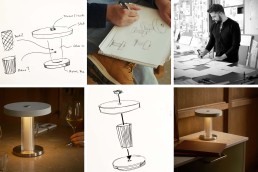
A portable lamp shaped by fluted glass and restrained metalwork, Trezzi balances Danish clarity with softly spoken Art Deco character. From cocktail-glass inspiration to tool-controlled fluting, we trace its journey from concept to production with Anker Studio’s Jonas Birkebæk Poulsen and Nordlux.
The inception of the Trezzi began when Nordlux asked designer Jonas Birkebæl Poulsen, co-founder of Anker Studios, to design a lamp for its ‘Design For the People Range’ with a simple but specific intention: a portable table lamp that felt equally at home in the privacy of one’s home or in a bar or restaurant. With that in mind, a simple image of a cocktail glass sparked Poulsen’s imagination. The cocktail glass is a social object; it lives in conversation, in low lighting, in the pause between sips, and is used both in the home and hospitality settings.
As Poulsen puts it: “The starting point was the cocktail glass, it’s a beautiful and refined object that belongs to the moment of conversation or the moment of atmosphere. It was the perfect foundation for a table lamp that can fit in both a private interior and a commercial environment.”
From that familiar silhouette, the idea evolved into a balance between fluted glass and stainless steel. The glass base draws from cocktail glass proportions, tactile and designed to be seen up close, while the metal shade on top introduces a sense of purpose and control.
The shade feels almost architectural: calm, and functional, anchoring the design and directing light downward in a way that works perfectly for dining tables, bedside use, or intimate restaurant settings.
“Fluted glass became a defining material because the design took its cues from a cocktail glass,” says Poulsen. “It offers both tactility and visual detail. The vertical fluting echoes the rhythm and refinement of classic glassware, catching and refracting light.”
However, fluted glass is more than just a decorative gesture; thanks to its geometry, it has a series of ridges that act as microlenses, catching and bending light as it travels through the glass. This transforms what could have been a simple diffused glow into something more layered and dynamic. Light stretches vertically along the grooves, creating depth and giving the sense of subtle movement that shifts when the viewer changes position. In other words, the fluted glass stand becomes an optical tool, one that enriches the atmosphere with its refracted glow of light that is both expressive and calm, with thoughtful geometry in its simplest form.
“This creates a layered effect,” says Poulsen. “The exterior feels calm and architectural, while the interior feels luminous and dynamic. The glass becomes both structure and atmosphere, shaping light into something warm, nuanced, and quietly expressive.”
In a similar kinship to the cocktail glass, Trezzi’s design language influence draws on the glamour and elegance of the 1920’s – one of Poulsen’s most cherished design periods – through the discipline of Danish Minimalism. Rather than adopting an overt ornament or decorative excess, Poulsen creates an essence of Art Deco in refined material detail.
Poulsen adds: “Material plays a key role. The glass remains honest, with fluting and slight shifts in thickness adding depth without visual noise. As light passes through, these surface details come alive, creating shadows and a sense of precision that echoes Art Deco craftsmanship without losing its contemporary edge.”
Behind Trezzi’s aesthetic is a layer of engineering designed to make the lamp feel effortless in use. The weighted glass base is central to that engineering because its mass gives the lamp stability on busy restaurant tables and domestic surfaces alike, while also contributing to a sense of quality and permanence when lifted or moved. As Poulsen notes, the weight communicates craftsmanship and durability, reinforcing the idea that this is a well-made object designed to stand the test of time. The technological integration follows the same philosophy; the moodmaker touch-dimming system from Nordlux was incorporated without visible interfaces. This allows the switches and interaction to remain invisible, so the purity of form is never interrupted. Together, these decisions ensure Trezzi’s material qualities aren’t just seen but are felt, making the physical experience of touching the lamp part of its visual language.
The development of Trezzi unfolded roughly over a year to 18 months, from the first sketch to the final product. The concept remained remarkably consistent throughout the process, with the initial silhouette – the glass base and metal lamp shade – never wavering. What evolved instead were the subtleties: the depth, spacing, and thickness of fluted glass. These details proved to be the most technically difficult. “The biggest challenge throughout the process was refining the fluted glass, achieving the correct shape and getting the groove details just right,” says Poulsen. “Small adjustments in depth, spacing, and thickness had a major impact on how the glass felt and how light moved through it, making this the most critical and time-intensive part of the development.”
After a lengthy cycle of refinement and iteration, this precision work helped shape the lamp’s optical performance and its tactility, ensuring the final product preserved the purity of the initial vision and the nuanced behaviour Poulsen envisioned from the start.
The final part of the journey was to turn Trezzi’s refined concept into a manufacturable object. This required a production process that could deliver both precision and consistency and was particularly crucial for the fluted glass element, which defines the lamp’s optical personality. According to Nordlux, the glass is produced using a moulding method that ensures accuracy in form: raw molten glass is poured delicately into the mould, allowing the vertical flutes and wall thickness to be tightly controlled from the outset. Once cooled, the glass tube is cut into the exact dimensions for the Trezzi’s proportions.
Glass, as Nordlux notes, is a naturally “lively” material, which makes achieving consistency of thickness one of the most challenging aspects of production. Using the mould helps minimise variation, ensuring an even profile that is crucial not only for structural integrity but also for the way light bends and refracts within the grooves. Each piece is then inspected individually by factory workers, who check for any deviations or defects before the components are assembled.
Much of the success that happens in production can be traced to the meticulous preparation undertaken before mass manufacturing can begin. Nordlux emphasises the importance of extensive pre-production checks, such as carefully reviewing 3D files, working drawings, and sample iterations to resolve potential issues early on. Only once every detail has been scrutinised were the tools committed to mass production, a process that helps prevent defects and maintain the clarity of design intent.
In addition to its timeless design, the Trezzi has a sustainable edge, as do all Nordlux products. The supplier’s facilities are powered entirely by solar energy, allowing the factory to be fully self-sufficient in electricity – the cherry on top of a material-driven product.
The journey of the Trezzi table lamp from a simple sketch to a fully resolved product is a reminder that clarity of intent can shape an entire design process. What began as just a simple everyday object shared in both the privacy of your lounge or the vibrant atmosphere of a bar, evolved into a lamp defined by careful engineering and the restrained confidence of the Art Deco and Scandinavian style. Like an Old Fashioned, its development went down remarkably smooth. Poulsen describes the process as “calm and intuitive”, where decisions naturally fell into place, and the focus of refinement never wavered or became tired. That clarity extends to its final form. With each fluted glass piece carefully moulded, inspected, and crafted through a tightly controlled production process, and with the lamp’s tactile weight, invisible control, and expressive light all working in harmony. Trezzi embodies the idea that minimalist objects can carry a lot of depth.
After making hundreds of lights and working with Nordlux for years, Poulsen tells arc he never gets tired of the journey and revels in the challenge of creating the perfect light that, in turn, creates the perfect setting. Poulsen adds: “I am most proud that the design has made it through the entire process and exists for people to enjoy and love. Behind every final design is a long journey where many ideas are tested, rejected, and refined. Only one will survive the demanding creation phase, and seeing that result in a tangible object is deeply rewarding.”
Images: Courtesy of Nordlux
LinkedIn Experience Centre London, UK
Merging architectural and decorative elements seamlessly, Ström has crafted a lighting scheme that perfectly complements the interior design of LinkedIn’s all new Experience Centre.
The largest online professional network, LinkedIn has recently unveiled a new, in-person meeting ground that can transform its digital experience into a real-world environment. Situated in its London offices and dubbed the LinkedIn Experience Centre, the space has been created with the goal of bringing together customers, social impact organisations, and industry experts across hiring, B2B sales, and marketing, inviting members, customers, and employees to collaborate, innovate, and connect in person.
This dynamic hub was designed by Ab Rogers Design (ARD), and has been broken down into three core areas – The Arcade, The Theatre, and The Executive Suite – each bursting with their own unique character.
Formerly an empty, underused space at the base of LinkedIn’s London offices, the Experience Centre presented a new opportunity, not just for ARD, but also for LinkedIn, to present itself in a whole new way.
Mara Irsara, Senior Associate at ARD, explains: “When LinkedIn approached us and we won the design competition, they were so excited to start on the project.
“As they had never created a space like this before, we had some deep conversations with the stakeholders to understand the business, the priorities, and how to translate that onto the floorplan.
“It was really interesting getting this knowledge from the stakeholders, because every market has different priorities. In London, it was more important to have an executive suite that acts as a ‘show off’ space, as well as a theatre to create events or host people. And then, as we expanded the concept, to reflect the building’s footprint, we developed the front-facing ‘Arcade’ space. This faces onto the road, and is very extroverted; and as you go further into the building, it becomes more introverted.”
This, Irsara says, is reflected in the choice of elements that are used in each space. The Executive Suite, for example, is more private, intended for VIP guests and boardroom meetings, while the outward-facing Arcade is designed more as an “internal street”, inviting visitors to linger and spend some time. In between these two areas is a theatre space, and production facilities for activities like podcasting.
Through each of these distinct spaces, lighting plays a central role in creating the desired ambience and defining the unique character and identity of each space – from creating pockets of interest and setting the right scene for a meeting to highlighting textures, working with interactive elements, and adding drama.
To that end, ARD invited lighting design studio Ström to tender for the project, as the interior designers felt that they had reached a point in the concept design where the input of a specialist lighting design consultant was needed in order for the unique space to meet its myriad needs.
Expanding on the design brief for the lighting, Anna Clara Sandgren, Co-Founder of Ström, tells arc: “The brief was focussed around creating an environment that promotes human ‘face-to-face’ connections and a sense of a public-facing space, more than an office. There were a number of interconnecting zones with their own functions (meeting booths, interactive learning zones, an auditorium, coffee bar), as well as the separate Executive Suite with a more premium/chic residential look and feel. But overall, the character of the spaces needed to work visually together.”
“It was important to provide breathing space for the interactive experiential designs by Deep Local, which are largely internally illuminated, while also providing suitable lighting to the artwork, supplied by Acrylicize, which included traditionally wall-hung prints and tapestries, as well as being integrated within the timber and glazed wall panels,” adds Emilio Hernandez, Co-Founder of Ström.
“The space is vibrant and full of visual interest, so we felt that it was important that the architectural lighting scheme didn’t try too hard, and instead brought a sense of calm through soft lighting to walls, with fixtures that were concealed or blended into the ceiling services.”
With a building profile that was not very deep plan, and a lot of north-facing glazing along one wall, Hernandez adds that the space felt like “quite a controlled environment”, which allowed for a gentler approach to the lighting that could add depth, without dominating the eye.
On entering the building, a glowing timber backdrop, illuminated by track-mounted wallwashers, frames the reception desk, alongside a large Santa & Cole Cirio circular pendant, that anchors the space and creates an inviting arrival experience.
“ARD asked us to propose something for the reception lobby, as it is the interface between the entrance, the lifts, the security gates and the reception desk, and the ceiling was just exposed concrete,” Hernandez says. “The Cirio pendant was a very simple intervention, but it works really well. Luckily, Santa & Cole provide really good Revit information and models of its range, and we were able to work with ARD to understand the drop of it, the size of each element, whether we use frosted glass or porcelain, to get the balance right so that the space was bright enough for a reception, elegant enough, and that the piece didn’t get lost in the exposed services ceiling.”
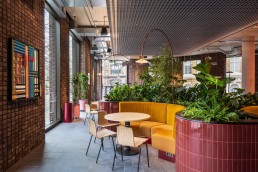
Leading from the reception, the lively, internal ‘street’ of The Arcade features meeting spots, lush planting, and playful design elements. Track-mounted wall washers and spotlights accentuate textured brickwork, featured artwork, and the bright, bold exterior of The Theatre. A Hunter Douglas perforated raft ceiling houses strategically placed recessed downlights that punch light onto the tables and enhance the planting below. An integrated line of light frames the feature ceiling and supplements ambient light levels, while illuminating the soffit above for an elevated effect. Muller Van Severen lamps droop over circular tables, casting an intimate glow, and are complemented by lighting integrated within banquette joinery to create visual interest.
“When you already have the space set out with such a strong concept, when we came on board, we wanted to understand the elements. For us, the track system gave a lot of flexibility to both light the artwork elements on the wall and in between the glazing, while also highlighting the tables and workspaces within the space,” Hernandez says.
Sandgren adds: “ARD uses a lot of colour, patterns and artwork, so we knew that we needed to have really good lighting onto the vertical surfaces to pick up the richness of the colours that they would be using. We also added little details such as the lighting underneath the seating, as we knew that it had to be something a little bit more, as the space is going to be used for evening events as well. During the day, there is so much daylight that the only thing that needs to be lit really well is the elevation; but at night, this space really comes to life with lots of evening events, so it was important that it felt like an inviting place to come to.”
“There are only a few places where people are actually going to be sat with a computer for a while,” Hernandez continues. “Most places, it’s going to be interactive, face-to-face meetings and discussions. We have picked a few key areas that are more ‘traditional’ meeting spaces, where we have used an acoustic hood pendant, so that people can zone out a little bit more from the rest of the space, but if you wanted to have a more informal meeting, there are tables with downlights, light bouncing off the walls, the decorative pendants, lighting built into the underside of the banquettes – there are a lot of different elements that make you feel that there is enough light. It feels professional, but it is also quite casual.”
One of the central features of The Arcade space is the vast, perforated raft ceiling that stretches through the entire avenue. As well as concealing the MEP services, Ström was able to subtly integrate architectural lighting elements to complement the drooping pendant lights over each table, providing the right level of functional light.
Hernandez explains: “Although it is a flexible space, the tables are fixed, and through our collaboration with ARD, they were able to change the spacing of the perforations in the ceiling to fit off-the-shelf downlighting. This meant that we could place them seemingly randomly in the ceiling, and visually, they disappear, but you get that punch of light onto the table that you need.”
“The decorative lights do a big job in terms of the overall design language, but didn’t provide enough useful lighting on the tables or the planting, which is why we doubled up with the discreet lighting in the ceiling,” Sandgren adds.
The downlighting in the grid ceiling is also offset by an indirect cove of light that runs around the grid’s perimeter, providing an added ambient light to the space that works alongside the focused downlighting and decorative pieces.
Underneath this grid ceiling, one of the central focal points of the Arcade is the lush greenery that runs through the middle. While providing adequate lighting for this plant-life could have presented a problem for Ström, Sandgren adds that the abundant natural light entering the space made their job easier on this front.
“It is always a chicken and egg discussion – what plants are being specified, what light is available, etc. Fortunately, the space is heavily glazed and north facing, so suitable plant species were specified to make use of the natural light. This enabled us to focus on more subtle spike lights and decorative lights nestled within the planters.
“It also helped reduce energy consumption. We liaised with Cambium Plants, which has a lot of experience providing planting for offices that are resilient to various light levels and improve air quality without having to provide thousands of lux to the plant canopies. While there are some fantastic options on the market for hydroponic lighting, using natural light is always our preference where possible, as it reduces cost, maintenance, and risk for the client.”
Sitting in the centre of the development, The Theatre forms the beating heart of the Experience Centre. A dramatic, in-ground line of light wraps around the base of a curved coral structure, which is balanced by high-level, curved track lighting, creating a sense of flow and movement that encourages people to explore beyond. From outside, it is a captivating view that catches the eye of passersby.
“We really fought for this feature because in the original renders, it was unlit, and while I don’t like putting a big architectural element in unnecessarily, we felt that this curve was such an important part of the space that it had to be lit from both directions. It means that at night, when you walk by the building, you see this red wall pop from the street,” Hernandez adds.
Inside the auditorium, a linear lighting profile washes the curved timber wall, and together with low-glare lighting within the ceiling from iGuzzini’s Laser Blade, it provides a discreet and flexible base layer for the specialist AV theatre lighting configuration.
To the rear of the project lies the more “introverted” Executive Suite. Designed to feel more intimate and cosy, the lighting design reflects the shift in character to a more chic-residential style space.
Moving from exposed services and raw materials to a cleaner aesthetic with plastered ceilings and white fittings, the lighting similarly shifts to a warmer tone. Cove lighting enhances the vertical timber finishes, adding depth and warmth, while also complementing the Vibia pendants that hang above a soft seating space.
Meeting rooms feature tunable white technology and high colour rendering, creating ideal meeting conditions that users can tailor via a control system. In the boardroom, a back-illuminated ceiling by Optelma enhances the sleek design look, and supports ambient light levels, while adding drama through an array of illuminated colours.
“The Arcade space is a lot more vibrant and high contrast, whereas in the Executive Suite, it is calmer, more of a traditional executive office – there were softer materials, more fabrics, so the lighting was adapted to match.”
Irsara adds: “It was really important that the lighting would be friendly and respond to the space. Especially in the Executive Suite, everyone that enters there says that it feels really residential, and that is exactly what we wanted. So, the lighting reflected this really well, adding to the mood that we wanted to create.”
Indeed, throughout the project, there is a strong harmony between the interior design and the lighting design, not just through the subtle integration of architectural lighting, but also in the selection of decorative elements – a selection that Irsara says was the result of Ström and ARD’s richly collaborative relationship.
“In some instances, we wanted a specific product, but in others, Ström suggested exactly what we needed,” she says. “We have worked with Anna for many years, so we know each other’s style, and she knows what we like.
“What we really appreciated from Ström was how they also suggested elements that could be integrated into the interior design. The downlights integrated into the grid ceiling in The Arcade give the right amount of light, without needing to add an additional element, keeping the rest of the ceiling as free as possible.
“Lighting was not something that has been overlaid as a function – it was considered and integrated into the design from the beginning. It sounds really obvious, but so often it isn’t the case. Sometimes, all a client cares about is having enough light and it’s hidden somewhere. But here, the lighting is functional and beautifully integrated into the MEP or existing architectural elements, which gives space for the feature lights to really shine and stand out.”
“It was an interesting collaboration, because ARD included us in a lot of the decisions, but equally, they really think about lighting when they design,” adds Sandgren.
Ultimately, the collaboration between Ström and ARD was to the project’s benefit, with the lighting and interior design marrying together beautifully throughout.
Reflecting on the project, Hernandez says: “We hope that the lighting helps to bring depth, texture, and scale to the space. The challenge with open plan environments of this size, with 4.5-metre ceilings, is that you’re trying to simultaneously give a sense of space, while retaining a cosy, inviting feel.
“The reception pendant, for example, could have easily appeared lost, or overbearing. It fills a difficult junction without any other ceiling or interior features to riff off of. The same applies to the curved floor recessed linear. Its detailing within the stone floor and width are important for it to feel like part of the interior, as opposed to an extra piece of lighting stuck on top.
“I’m sure that many lighting designers will attest that it is not uncommon to not receive any feedback directly from the client, especially on larger projects, in which case you can take the stance that no news is good news, as you will usually find out if something is not to the end user’s liking. The response from the client here though has been overwhelmingly positive, so much so that they are looking to replicate this in other regions.
“We’re lucky and grateful that working with ARD feels like we are on the same team, so the feedback is daily, rather than a more formal process at the end of the scheme.”
Finally, Irsara concludes: “Sometimes clients will say ‘you don’t need a lighting designer’. But for us it is really important to say, ‘No, you do – exactly why you think you don’t need one, that is one more reason that you do’. Lighting is something that, if it is good, you don’t notice it, because it gives the right level of wellbeing and feeling in the space. Maybe we don’t even see it, but that’s the beauty, and the difficulty of it. We believe this, and that is why Ström were part of our team from day one.”

Silhouette Awards to announce winners this month
(Worldwide) - The Silhouette Awards has entered a key phase of its 2026 programme as organisers prepare for the upcoming winners’ announcement, scheduled for 27 February 2026 at 3:00 PM (UK time).
This year’s awards attracted a wide range of entrants from across the world, continuing the initiative’s focus on recognising and supporting emerging talent within the lighting industry.
The announcement event will be livestreamed on the Silhouette Awards’ official YouTube and LinkedIn channels. The programme for the session is expected to follow a similar structure to previous years, featuring the introduction of the selected winners, the announcement of their assigned mentors, brief talks from several mentors, and a concluding virtual networking session for all participants.
You can follow the results via https://www.youtube.com/@silhouetteawards