
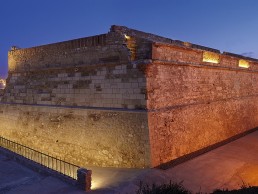
Victoria Grande Fort, Melilla, North Africa
The history of Victoria Grande Fort is a vivid one. Originally built to keep people out, it then found itself used as a space to keep people in. Later turning to ruins, it was the job of DCI lighting practice to enhance the restoration work taking place by Chacel 8 Architecture and its team through subtle, unobtrusive design.
Built in 1736 by military engineer Juan Martin Zermeño, the Victoria Grande Fortress in Melilla, a Spanish city in North Africa, was originally designed as a defence fort. Following this, it was used as a prison before becoming derelict through lack of use; today the ruins are open to the public and serve to form the identity of Melilla.
Working as part of a restoration team headed up by architect D. Jose Antonio Fernandez of Chacel 8 Architecture, DCI lighting practice was asked to take responsibility for new architectural lighting that would help to tell the story of the ruins’ history and charm.
The architectural lighting design is the result of carefully applied LED technology in terms of its integration into the architecture - the luminaires disappear, become transparent even, so as to not interfere with the visual enjoyment of the space. Two distinct works take place in the space - one, when the natural light is present and the architecture itself perfectly tells the history of the ruins, and another when natural light fades and gives way to the creation of a theatrical atmosphere, accompanying the visitor along their journey through the ruins with a continuous play of light and shadows. A number of imaginative linear lighting solutions have been implemented – sometimes they fly under the vaults, drawing swift lines that uplight the ceilings, or create a play of dramatic backlights in the stone blinds when observed from outside the walls of the fortress.
Around the perimeter, the lighting is integrated into the moats – washing the walls with a play of colour temperatures, recreating the fire glows and blending smoothly up the vertical plane. The light variations in colour temperature achieve a pictorial effect and the accents punctuate the reading of the whole façade. On the side walls the battlements are shaped vertically by light, giving order and rhythm to the image of the fortress, with its volume clearly outlined.
One of the biggest challenges with this project came with its age. In the eighteenth century there was no artificial lighting but the ruins’ story in the present day was to be told through the help of artificial lighting. According to Javier Gorriz of DCI, this was solved by playing with light, shadows and carefully hiding the different light sources from the visitors. Traditional light sources from the time such as the oil lamp have also been recreated, uniquely designed through a collaboration between Chacel 8, DCI and Ilumarte Lighting Systems. The Candle VGMelilla is composed of a printed circuit board with three LEDs of different colour temperatures, controlled by a ZigBee RF module. Spread around the grounds there are 110 units with individual manual control.
Structurally, the main challenge – as with all restoration work – related to the minimal amount of space, both visually and to house the infrastructure for the various electric lighting and communication equipment supplies.
“For us, the key to this lighting project is how the light is able to tell the story,” said Gorriz. “It captivates the eye of the beholder, transforming the different space when natural light fades and the magic takes over through artificial lighting.”
Constant lighting tests during the implementation phase and the KNX control system enabled DCI to adapt the reality originally captured in the original project. “We feel that the lighting design transports visitors to another time, subtly directing their attention to the story we want to tell,” said Gorriz.
Commenting on the project’s stand out features, Gorriz told mondo*arc: “This was one of my first projects of relevance and it has marked a significant moment in my career. The architect and project manager D. Jose Antonio Fernandez, along with the Department of Development of the autonomous city of Melilla, knew perfectly how to transfer their passion for the projext on to each member of the multidisciplinary team.”
Through a keen interest, care and consideration the fortress has been returned to the city of Melilla to tell the story of its history, albeit from a different view point.”
Pic: Martin Garcia Perez

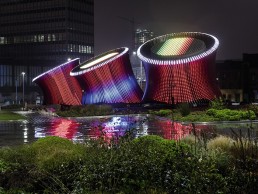
NOMA Earth Tubes, UK
Cundall Light4 was appointed by The Co-operative Group and Hermes to provide the lighting design for the three earth tubes adjacent to the new Co-operative Group office building at 1 Angel Square in Manchester. Using an Osram Lighting Solutions package, they have designed a showstopper.
Public lighting installations are becoming more common in our cities, both as individual elements in the landscape or as integrated schemes within façades and bridges. Local authorities and the public have an increasing understanding of their importance in defining an area’s ambience, creating a social destination and supporting a sense of pride. With each new lighting installation, the publics’ expectation grows, it is also true that the younger generation are more exposed to and aware of lighting installations and as such they continually need to see something different.
NOMA is an £800m, 20-acre mixed-use redevelopment scheme in NOrth MAnchester (NOMA). The Co-operative Group, working in partnership with Hermes Investment Management and supported by ERDF (European Regional Development Fund) are creating 4,000,000sqft of office, residential, retail and leisure space in NOMA. The central feature of the site is the three concrete and aluminium fin earth tubes. The purpose of the earth tubes is to supply fresh air to the Co-operative Group office, 1 Angel Square. It is these three earth tubes for which the client required a lighting installation.
The project brief was to deliver an interactive and ever changing light installation. The design needed to relate to the local and wider community and be available to them as a blank canvas for their own ideas and designs.
In the past, an installation that consisted of a static display or a limited range of animations quickly faded into the city scape and became invisible to passers-by. What was once innovative or an attraction, finds itself little more than a way finding sign at best. Therefore the new lighting installations must have evolving content and in particular content that engages with the social mood of the area, while capturing and reflecting a global event. Better still, content that can be created by the community gives an installation an ever evolving, deeply personal and engaging longevity.
In 2014, Cundall Light4 won the proposal as lighting designer for the earth tube lighting installation. In responding to the brief and through a desire to make the earth tubes a global landmark, Cundall Light4 set about identifying who and how people would view and engage with the earth tubes.
In the age of iPad and smartphone technology, it was obvious that this would be one avenue of interaction, but there was also the need to engage with that cheeky five-year-old who is walking past with his mum on the way to the shops. Various ideas of capturing and replaying the movement of people and using fixed furniture as an input device to create the light show were studied. To display the lighting effects, a range of lighting designs were created and presented to the NOMA stakeholders. The preferred design utilised three lighting elements that can be operated together or independently. These elements are known as the curved fin lights, crown lights and linear lid lighting.
Along with the review of the interactive options and selection of the lighting design elements, a series of content ideas were proposed for the day-one scenario. The content ideas included a sunrise to sunset lighting animation that follows a person as they walk past the earth tubes; an app where a person’s music would turn the bass - middle and treble waveforms into light; recreating the tram network and current tram positions; a flower arrangement to suit the seasons and so on.
It was always a requirement that the lighting programming should be easy to update and refresh using open source software. This would allow for future light shows to be created by local schools, art students and visiting artists to the city. Once the installation has settled down and established itself, the content will be created by the visitors. Making it quite unique, making the installation a true community project.
During the design period, a number of companies were invited to create mock ups to show what was possible with different equipment and control systems. During this time it became clear that Studiotech using Osram lighting components had the knowledge, skills and equipment to deliver Cundall Light4's lighting design aspirations.
Following a European wide tender process Studiotech started on site in July 2015. The project ran over a period of just over three months and there were up to twelve Studiotech engineers on site at any one time working through all kinds of weather conditions to complete the project. Studiotech was the Principal Contractor with overall responsibility for the lighting component design, associated brackets, containment and overall installation of the lighting solution; from the digging of the trenches and ducts to the programming of the finished product.
Studiotech turned to Osram and the Traxon product range to provide the solution to cope with the intricate and non-uniform nature of the structures and then engineered the proprietary product into a bespoke and interactive solution that seeks to enhance the experience of all who journey through the NOMA neighbourhood. The flexible nature of these products means that each section can be fully customised. The whole lighting installation is managed via e:cue control servers to provide the tools necessary to control the lighting displays and deliver the interactivity required. NOMA is a complete Osram solution.
The installation totals 28,440 individually addressable lights or 9,480 individually addressable lights per tube. A total of 14km of cable was used to provide power and data to the tubes. As far as energy consumption is concerned, when the tubes were tested it was found that each one was using only 15 amps which, when converted into power usage, equals just 3450W.
Pic: David Lake Photography
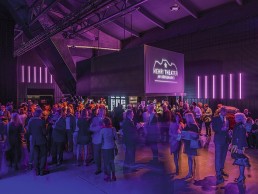
Mehr! Theatre, Germany
A market hall isn't the most traditional of spaces for a theatre, but then there is nothing traditional about Mehr! Entertainment Group's latest venture in Hamburg. With lighting design from jack be nimble distinguishing flexible realms within a historical building, an unforgettable theatre experience has been created.
The Hamburg Grossmarkthalle in Germany was completed in 1962 under the supervision of architect Bernhard Hermkes and set new standards with its futuristic construction of glass and concrete. Today it is under heritage protection as one of the last examples of pre-stressed concrete construction in Hamburg.
In November 2012, the City of Hamburg and Mehr! Entertainment signed an agreement to construct a theatre in a section of the Grossmarkthalle, with the aim of bringing a new cultural site to connect with all of the market’s current merchants and dealers. It is hoped the space will open up to the wider public and feature a sustainable concept and new cultural venue.
The Mehr! Theater is completely integrated and free-standing in the Hamburg Grossmarkthalle. The ceiling structure of pre-stressed concrete arches and its interior height have been respectfully preserved in the architectural design of the theatre, while at the same time, have become an impressive feature in the space.
As part of the theatre’s vision, which is able to hold a seated audience of up to 2,400 people and a standing audience of up to 3,500 - offering a wide variety of possibilities for productions, shows, events, exhibitions and more, architectural lighting implemented at Mehr! aims to distinguish flexible realms within the historical building, adding further to this unforgettable theatre experience. The challenge for the lighting design carried out by Berlin-based jack be nimble (JBN), was to support the open construction design while referencing the historical architecture.
With a published opening concert date set months in advance – including the London Symphony Orchestra as guests of honour – there was no room for delays in delivery and as such it was imperative that JBN met with the construction team early to intercept problems in the planning phase and coordinate the site execution meticulously. Fortunately, the team was able to meet with the architects just as lighting became a topic of interest.
“Our initial involvement was structured as conceptual input, planned to last about a month,” said JBN’s Sophia Klees. “The project grew organically out of an initial sketching session to incorporate nearly every phase of development: concept, design, detailed design, custom-luminaire design, control systems and site supervision. The planned areas also grew to include foyer, cloakroom, stairs, circulation, bar, seating area and lavatories… everything but the stage itself.”
In contrast with most theatres, the auditorium, foyer, and bars were combined into a single open space without separation via partition walls or suspended ceilings. JBN worked to create lighting scenes that differentiated functional areas; guided visitors intuitively; and created the appropriate mood throughout the performance visit. The brief was focused on two specific areas: the entrance / foyer and the circulation areas to the sides of the theatre. Given its unique location, the challenge was to entice visitors into the theatre and beguile them with the interior.
In terms of project specifics, the primary challenges for JBN concerned budget and timing as Klees explained: “We had to find a way of achieving grand gestures with the lighting using a fraction of the budget typically required… We looked at ways to reduce the complexity and therefore cost of the design by minimising the luminaire schedule. We then re-used elements across the design, benefitting from economies of scale.”
A special linear lighting fixture was developed for the project. It evokes the industrial context of the surroundings while employing modern LED technology to reduce energy usage. The lighting element repeats throughout the project using different arrangements and unique lighting atmospheres are assembled forming subtle coherence for the overall space.
Colour temperature played a significant role in the lighting concept and bright white lights in cool colours (6,000K) are used in the foyer for increased visibility at a distance. The industrial character of the lighting is designed to also make a statement that this theatre is different. As visitors step deeper into the theatre the atmosphere becomes more colourful, warm and dim and due to the unique open space, the architectural lighting functions as an extension of the show.
In terms of natural light, as a theatre it has been intentionally limited for most of the spaces. The entrance however, was deliberately opened to allow sight into the building during daylight hours. In the evening, the industrial bright lights of the foyer glare into the surroundings, proclaiming the presence of the theatre. Coloured lighting is limited to the interior, creating a fantastical environment inside the auditorium and circulation areas.
“The lighting scheme had to adapt in response to the expaned brief,” continued Klees, “becoming simultaneously more sophisticated and holistic. The custom linear luminaires create a sense of continuity across the theatre. We introduced a progression in the white lighting, leading from cold, industrial lights in the foyer to warm lavatories at the opposite end. The entire system was joined into a central control panel to grant show designers absolute control over each light point.”
The lighting scheme includes state-of-the-art DMX control gear to modify colour, intensity and position as an integral part of the architecture. A custom touch-panel interface provides access to pre-programmed scenes and individual lighting elements. Additional functionality was provided to integrate the architectural lighting directly into the production controls, enabling the different spaces to blend seamlessly.
Aside from time constraints, JBN had three primary structural constraints to work within, as Klees explained: “Firstly the theatre is housed within a listed building, limiting drilling on existing structural elements and difficult manual installation at height without equipment. Secondly, the theatre was designed with the potential to be deconstructed after 20 years. This meant the lighting needed to be reversible and easily able to vanish after the lease expires. Finally, the flexible layout of the auditorium can accommodate a variety of uses from corporate events for 300 to musical productions with an audience capacity of 3,500. The lighting placement needed to accommodate this flexibility and also create an appropriate environment for events of various sizes.”
Minor delays in the construction phase meant the slot for lighting installation and commissioning was pushed right up until opening night, however after nearly two-weeks of round-the-clock effort the system was declared operational and the doors could open for the show. Fortunately, having been involved throughout the project JBN had tackled most of the technical integration problems along the way, but according to Klees the moment the lighting design was unveiled was a nerve-wracking one for the entire team.
“From our backstage vantage point we saw for the first time the effect of our months of planning and execution as the thousands of visitors enjoyed the concert and opening party,” she said.
“With each project we attempt to create a physical manifestation of our philosophy, embedded in our studio’s name. User-centred design (jack), ideas with conviction (be), and flexible solutions (nimble).
While this project was no exception, for Klees, Mehr! stands out for several reasons: “The opportunity to be intimately involved from inception to realisation was unique,” she said.
“The trust granted us by the architects and the theatre environment meant we could focus much more acutely on the theatrical impression of the lighting rather than strictly the functional; and the grand scale of the space continually impressed, with merged functional areas and a sprawling curved ceiling more than 20m above the floor.”
With a clear design, custom luminaires and flexible set of controls, the lighting design for this unique theatre is certain to take visitors by surprise for years to come.
Pic: Andreas Meichsner
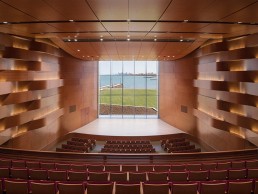
Ryan Centre for the Musical Arts, USA
With more lakeside views than you can shake a stick at, Goettsch Partners' Ryan Centre for the Musical Arts has been brought to life by Schuler Shook's integrated lighting scheme, which marries illumination with art and music with design.
The Ryan Centre for the Musical Arts is the new home for the Bienen School of Music at Northwestern University, one of the top music programs in the US. Located in the southeast corner of the university's campus, directly adjacent to Lake Michigan, one of the Great Lakes of North America, the centre features dramatic views of the lake and down the shoreline toward the Chicago skyline. The building also serves to enclose the new Arts Green, creating a new 'quad' for Music, Theatre, and Visual Art buildings.
US-based lighting design practice Schuler Shook became involved in this project in 2010 when Northwestern University initiated an architectural competition for the new music building. The practice was invited by Chicago-based architects Goettsch Partners (GP) to join its team as lighting designers and theatre planning consultants. The GP design was selected as the winning entry and began work immediately on the design and documentation phases of the project. Following an 18-month pause for fundraising, the project went into construction in 2013 and was completed in 2015.
When asked about the main architectural challenges of the project, Scott Seyer, Principal, GP, and senior project designer for the Ryan Centre, explained: “The overriding challenge was to create a beautiful design solution that performed well acoustically and was within the project budget. GP worked closely with the owner and its consultants to find cost-effective solutions that maintained the original intent of the winning design competition scheme.’’
Patrick Loughran, Principal, GP and technical principal for the Ryan Centre project, also commented: “The design changed substantially over time in order to get the project within budget; however, most of the big changes led to a more efficient and better building design. Northwestern University was very interested in low-maintenance lighting solutions that would not overly tax the building engineers in their operation. “Below-grade light was used sparingly, and lamps with long life and easy access were specified,’’ continued Loughran. “The design brief always included rich building materials exposed to view: glass, wood, limestone walls, granite flooring, decorative fabrics, and so on. The lighting had to be designed to showcase these materials, and the solution here does so very successfully.’’
The Ryan Centre has many unique rooms with many different lighting requirements – the lobby, opera black box, choral rehearsal, practice rooms, classrooms and teaching studios. The recital hall, the crown jewel of the building, had the most complex lighting design of all. Its lighting had to be integrated into an intricate system of wood panels.
Loughran explained: “The goal was to keep the lamps hidden from the audience, avoid scallops, and effectively provide the desired illumination. The structure of the wood wall and ceiling panel system had considerable acoustical constraints, and the lighting system had to be detailed around these requirements. Similar to the architecture in the room, the lighting design had to bow to acoustics. In all cases, acoustic considerations were paramount.’’
The lighting concepts were based on transparency and technical proficiency. GP desired the building to be transparent and inviting, and planned for the building to allow maximum exposure to daylight in all classrooms, performance spaces, practice rooms, and offices. All fittings were specified to be completely integrated into the architecture, with no decorative luminaires used. The stringent acoustical requirements for the music building required that many of the classrooms and practice rooms had no ceiling penetrations to ensure acoustical separations from adjacent rooms.
As the project was designed between 2010 and 2011, it wasn't able to take advantage of some of the newer advances in LED illumination, lighting quality, control, and cost. Therefore the lighting in the building is a combination of fluorescent, LED, metal halide and some halogen in high ceiling, full-range-dimming applications. The overall result is very high quality lighting performance balanced with energy efficiency, which is reflected in the attained LEED Gold certification.
Schuler Shook's lighting concept is focused around three main rooms / areas in the building: the recital hall, atrium and choral and recital room.
Firstly, the recital hall's 400-seat music performance space includes bands of warm wood that undulate against each other. While this was done primarily for acoustical purposes, it gave the lighting design an opportunity to highlight the 'hills and valleys' of the walls. All of the topside horizontal surfaces were detailed to incorporate linear white LED strips from Philips Color Kinetics – with louvers from Tempest - carefully positioned to glow upwards onto the wood band above. Kurt Versen halogen downlights, installed on the ceiling of the recital hall, are extremely well shielded to avoid reflections in the glass wall behind the stage and are completely adjustable.
The atrium - the heart of the Ryan Centre - is a three-story space that traverses the building from front to back, allowing significant daylight penetration at all hours of the day. The space serves as the audience lobby / foyer for the recital hall and the opera theatre, and also as a pleasant student gathering space between classes. One key feature of the atrium is the dramatically sloped limestone wall indicating the entrance to the recital hall. This wall is highlighted from below with recessed metal halide uplights from ERCO, and from above with carefully placed downlights from WE-EF. Additionally, Focal Point wall-wash fixtures illuminated the atrium's perimeter wall slot.
The same lighting scheme is used for the portion of this wall that extends into the exterior of the building, giving the building a high level of transparency after dark; along with Forms+Surfaces bollard luminaires, illuminating the centre's exterior pathway into the atrium.
The choral and recital room serves a dual function: as a choral rehearsal room, with the performers seated in the curved rows; and as a small recital hall, with the performers on the flat floor. As with the recital hall, warm wood is the primary finish element, and the lighting is designed to enhance the warmth of the walls and ceiling via ETC pipe-mounted theatre lights and Kurt Versen recessed downlights. All of the sources in this room are halogen, to provide smooth dimming throughout the dimming range with no stepping or drop-out. Illumination levels were designed for choral classroom requirements, and lower light levels are created with the control system from ETC, which is pre-programmed for both uses.
Schuler Shook has developed a lighting scheme that celebrates GP's contemporary architectural design in providing a welcoming and productive space for its students, along with a dramatic and moody atmosphere for both small-scale and major performances.
Pic: Tom Rossiter
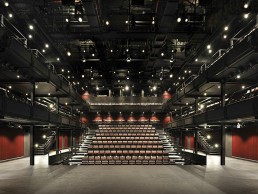
National Theatre, UK
Outlined by environmental design consultants Atelier Ten, the lighting of London's newly refurbished, multi-purpose National Theatre has transformed this Grade II listed building into a place of artistry and community. mondo*arc takes an exclusive and detailed look inside to discover the method behind the magic.
In an effort to bring together world-class artists, emerging talent and the public, London's National Theatre is undergoing extensive refurbishment and remodelling to transform this Grade II listed building. The £80million project, known as NT Future, has created a new scenery art studio, a public viewing gallery as part of the remodelling of the workshops and the new Clore Learning Centre. Additionally, the Cottesloe Theatre has reopened after modernisation as the Dorfman Theatre with an improved foyer.
The main foyers and public spaces of the National Theatre have also been revitalised with the creation of new bars and cafes on the riverfront, a new bookshop, a new entrance and the landscaping of the public realm and terraces.
A previous refurbishment had diluted the drama of architect Denys Lasdun’s original design for the main foyers. Following on from this, environmental design consultants Atelier Ten developed a new lighting concept, working closely with the theatre and architect Haworth Tompkins, to play with the balance of darkness and light. The lighting design creates a sense of darkness by minimising the spill of light onto the diagrid of concrete coffers, contrasting with focused lighting of specific horizontal and vertical surfaces. To bring warmth to the Brutalist board-marked concrete, a 2,700K colour temperature was selected for all lighting. The design incorporates playful elements of accent using gold reflector cones in luminaires over seating areas and red-sleeved pendants over bars and atrium areas.
Atelier Ten worked with Aether Lighting to develop a custom family of luminaires for the project, bringing a sense of unity throughout the new and refurbished spaces. In the main foyer areas, 40 custom luminaires were developed. Of these luminaires, the key family types were drum downlights, spotlights and fluorescent pendants.
Mounted within the concrete coffers, the drum downlights have a bronze anodised finish to match the original metalwork used by Lasdun. This family of luminaires was created for various purposes, all using warm 2,700K Xicato LED modules. Firstly, a simple version with a deeply recessed LED and honeycomb louvre was used for circulation areas, with an optic designed to prevent any spill light leaking onto the side of the coffers.
In seating areas around the bars and café, a version with a rich golden reflector was designed so that they could be viewed across the foyer to add an element of sparkle, drawing customers to these areas.
A further variant was designed with miniature LED spotlights as outriders around the main cylindrical downlight, concealed high in the coffer and used to provide accent on tables and benches. For mounting on a suspended bar over seating areas to highlight bench tops, a miniature version of the bronze anodised drum was created.
Spotlights of varying sizes were created for use throughout the foyers, while a track mounted version was developed for the bookshop, house restaurant and understudy bar. With different finishes to suit the various spaces, these luminaires use 1,000lm Xicato modules, with the driver mounted in a rectangular gear box coupled to the track.
For the lighting of the large open areas of the foyer, a 'big brother' version of the spotlight with 2,000lm Xicato modules was used. These were mounted to existing lighting bars using proprietary clamps with remote drivers concealed in existing enclosures.
Additionally, to provide grazing uplight to the board-marked concrete, a version of the spotlight was developed for mounting within in-ground boxes beneath the concrete fins. Along with wall-mounted versions, developed with extended arms for lighting of posters and display, a further miniature track-mounted version has been used within the Dorfman foyer to highlight the mesh wall coverings.
For the accent of key spaces, and as the theatre's signature luminaire, Aether's fluorescent pendants use T5 lamps, housed within an acrylic tube with minimal mounting arrangements, for a simple uncluttered aesthetic. In collaboration, various red and straw coloured sleeves and gels were selected by Haworth Tompkins to complement other elements within the interiors.
Vertical versions of the pendant can be found in the triple height atrium spaces of the main foyer and Dorfman foyer, and have been used in groups, mounted to a hoop, to create chandeliers within the Sackler entrance, Main Lytleton foyer and the Cathedral window in the Olivier foyer. Fitted above the bars and box office and within the kitchen café, horizontal versions of the pendant show its versatility.
In addition to the custom fixtures, mounted between the timber ceiling slats in a random arrangement within the Dorfman foyer, Mike Stoane LED Channel luminaires were installed to provide ambient light and a key aesthetic element.
For the replacement of the house lighting within the Dorfman auditorium, GDS ArcSystem fittings were used with 10W LED sources and DMX control. As an essential requirement of the theatre consultants Charcoal Blue, these had the advantage of exceptionally smooth dimming down to zero and were stirrup mounted, directly to the soffit, with remote drivers concealed behind the wall cladding.
When it came to the 'found spaces', housing the new café and bar areas, Atelier Ten created a simple lighting aesthetic to complement the interior design. KKDC Liniglow and TiMi linear LEDs (2,700k) were used extensively for concealed lighting to bar fronts and the back bars and within the refurbished toilets to bring out the colour of the bright red mosaic tiles. As well as this, Liniglow XL was used in the house restaurant, concealed behind the banquette seating to softly uplight the concrete walls.
KKDC's SEN 47 wall washer was also used to great effect behind the new cloakroom to graze the board marked concrete and bring out the texture.
For the workshops and other back of house spaces, the main driver of the lighting design was functionality. High performance luminaires with an industrial aesthetic were selected in keeping with the architectural design of the original and refurbished building. The lighting of the triple height paint studio was particularly challenging due to the extremely high lighting levels required on floors and walls. Faced with this challenge, Atelier Ten carried out extensive modelling to optimise the lighting and meet the uniformity and 1,500 lux light levels required.
Not only has the lighting design provided the drama, sense of place, and functionality required of the theatre, but it has also been key in reducing the energy use of the National Theatre. Efficient lamps and luminaires were the first step, and controls were the second towards cutting energy demand. With this in mind, a new Lutron QS control system was installed throughout the new and refurbished areas, using DALI addressable controls, occupancy sensing and daylight harvesting. Over 50 Lutron panels were distributed throughout the building, networked together. A Lutron graphical head end provides the NT control of the complete system and iPads can be used for mobile control and scene-setting.
Cost savings were inherent in Atelier Ten’s lighting design, as the DALI protocol is so robust as to allow the reuse of exsiting wiring in the foyers to transmit power and control. Each luminaire can be individually addressed, enabling simple zoning configuration to suit the new layouts.
Through the careful design and specification of lighting and controls, Atelier Ten has reduced the energy use by 70% from the previously existing scheme. More significant, however, is the sense of drama that has returned to the foyers of the National Theatre.
Furthermore, Philip Payne non-maintained emergency LED fittings were used throughout, powered from the NTs central battery system. Philip Payne also developed a special exit sign for the Dorfman auditorium with dual supplied LED strips and DMX control, allowing exit signs to be dimmed during a performance to a low level, but automatically returning to full brightness in the eventuality of a power or DMX failure. The design also allowed the facility for complete blackout of the exit signs with a soft dim up return, giving the NT’s show designers opportunities for dramatic blackout effects.
Within the new multifunctional meeting / event rooms off the main foyer, iGuzzini Laserblade wall wash luminaires were used to provide even illumination of the walls. This was used in combination with custom-made low-glare downlights from Aether Lighting as a simple way of providing flexibility to the rooms.
Throughout the new workshop areas, Etap fittings use T5 lamps as LED at the time of design wasn't sufficiently efficient or cost effective for the lumen packages required. The fittings were specified for their highly efficient reflectors, so for the majority of the workshops wide beam reflectors were selected. Within the scenic paint studio, a combination of asymmetric and narrower beam reflectors were used to illuminate the vertical and horizontal painting surfaces to the necessary illuminance (1,500lux) and uniformity.
Within the multipurpose Cottesloe Room located in the Clore learning centre, Etap was also used for a custom-built system of its Kardo fitting. To suit all types of event arrangements, as well as an overspill space for the foyer, the suspended Kardo system was specified with a combination of ambient downlights from fluorescent modules as well as inbuilt track sections to allow spotlights to be mounted. In addition, DMX controlled RGB colour change LEDs were concealed on the top of the profile to provide soft light to the ceiling coffers, which can be adjusted to suit the use of the room.
For general back of house downlights in corridors and other ancillary spaces, Wila’s Econnect LED Nero and Tentec LED Power Nero were used for their efficiency.
All external and public realm lighting was provided by Philips. Specifically, within the public realm, four-metre columns were installed with clusters of Philips iW Burst Powercore spotlights. Lensed with different beam angles, these provide the necessary ambient light as well as some theatrical drama from pools of light. The same iW Burst fittings were used to uplight the overhanging concrete soffit around the perimeter of the building and mounted to the refurbished lighting masts within the open square areas adjacent to the river front and Dorfman foyer. These fittings are controlled via the NTs DMX network so that they can be incorporated as part of a show setup if required and also have the ability to change their colour temperature from a warm to cool white.
Philips also provided LED handrail lighting that is used on the public realm stairs and on the newly landscaped terraces Philips IP rated Riga LED tape was concealed behind a baffle on the concrete perimeter wall and under new timber benching to provide low level lighting.
Atelier Ten's lighting scheme adapts to the National Theatre's multi-purpose usage - a place to eat, rehearse, relax and perform. With precise selection of luminaires, the spirit of the building has been elevated to reflect its world-renowned status.
Pic: Philip Vile
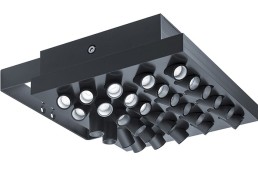
Zumtobel SUPERSYSTEM outdoor
SUPERSYSTEM outdoor is a compact luminaire specifically for pathway lighting. The optics, inclination angle and aperture angle of the LED tubes are ideal for illuminating narrow paths and lanes. There are three versions with 12, 18 or 30 LED tubes for mounting to the façade and to 4.5m or 6m masts. All are IP66 rated. Colour temperature is 3000K (warm white), with the option of 4000K (neutral white).
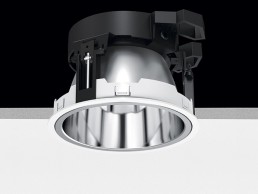
WILA alphabet zono
Alphabet zono by WILA offers a family of high-output LED downlights - both round and square - designed to set new standards in the downlight segment. Thanks to numerous versions and special designs, such as insect-proof designs or those with 49mm recessed depth, this product line copes with most building challenges. System efficiencies of up to 142Llm/W result in energy savings and short pay-back periods.
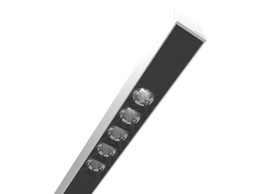
Vice Lighting Darkway U030
Darkway U030 is a modern concept of linear downlight with square distribution. This luminaire is designed to host multiple reflectors of different beam angles, generating a flawless square distribution ideal for diverse general lighting applications. These specially-designed reflectors of complex microfaceted surfaces ensure an even colour mixing and ultimate visual comfort (glare free). Darkway U030 is available in configurable lengths with various opportunities for customisation to suit the geometry of any space.
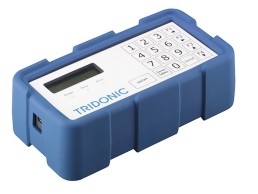
Tridonic ready2mains
ready2mains technology from Tridonic enables data to be transmitted in digital form via the existing mains. Dimming commands can therefore be easily transmitted and executed without the need for expensive rewiring. Electrical contractors will benefit from this new technology, as will users looking for greater convenience from their lighting systems. Conventional non-dimmable lighting can now be replaced easily and cost-effectively with dimmable LED lighting – in everything from workshops and offices to museums and shops. With ready2mains all that is required is to remove the existing conventional luminaires and install new dimmable LED luminaires. The associated Drivers must be equipped with ready2mains functionality. This digital interface is already integrated in all LED Drivers in the TALEXXdriver EXCITE and PREMIUM series.
The interface between the control unit and the luminaires is the ready2mains Gateway which transmits the dimming commands in digital form via the mains cable, ensuring reliable and robust data transmission. There is no need for any additional data cables such as DALI/DSI or 1-10V systems. Multiple control units or Gateways can be used in parallel, if required. The total connected load of a Gateway in the ceiling installation housing is 400 VA so up to 15 LED luminaires with ready2mains functionality can be connected. The maximum cable length is 250-metres.
ready2mains technology also makes it easier for luminaire manufacturers to configure the Drivers during manufacture. The ready2mains programmer enables luminaires to be configured, controlled and dimmed via the mains. All that is required is a ready2mains interface in the relevant Driver. The programmer uses simple phase control for digital command transmission. Configuration commands are transmitted in this way, such as the required output current of the LED Driver or a virtual midnight function for LED street lights. The current can be configured in 1 mA steps to achieve the precise illuminance needed. Up to five Drivers (maximum of 400 W) can be configured in parallel.
Luminaire manufacturers can benefit from using the programmer at the production stage because automated configuration of the luminaires via the mains will save time and costs. With ready2mains it is possible to incorporate programming functionality in existing production lines with a high degree of flexibility. And for simple integration in automated test procedures there is a USB interface with appropriate software Drivers.
The ready2mains programmer works with different protocols –in addition to ready2mains, it will work with DALI via the integrated DALI/USB interface and with the proprietary U6Me2 for the outdoor sector. If required, manual programming via the integrated keypad is also possible.
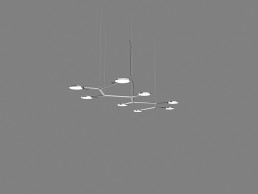
Sattler AVVENI
The AVVENI is a modular lighting system that easily adapts in every layout plan and architectural situation. This setup allows the lighting fixture to be anything between a single spot and a complex pendant structure with multiple lighting heads. These heads rotate around all axes by means of an innovative magnetic hinge system. Furthermore, the floor, table, ceiling, and pendant versions come in two different styles: flood and spot light.
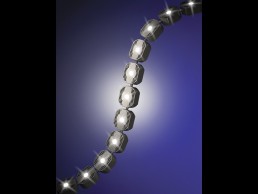
Radiant 3D LED Flex 100
The Radiant 3D LED Flex 100 system has been developed to incorporate the latest generation of Xicato LED modules. Ensuring excellent colour consistency between LED arrays and high colour point stability over time, this system combines mechanical flexibility in three dimensions with the Xicato remote phosphor technology. Several versions are available, including wide beam indirect and reflector types for accent lighting and wall grazing.
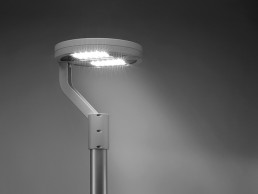
PUK Italia Hydrocity
Debuting at Light+Building 2016, Hydrocity LED is a pole-top round fixture that will be available in two main versions: Hydrocity 01 with single arm, cycle-pedestrian or street optics and Hydrocity 02 with double arm and a rotosymmetric optic. Available from 18W up to 72W, the range features a high-power LED chip by CREE. Its main application areas are public parks, parking lots, city squares, pedestrian paths, sidewalks and low-traffic roads.
