

Luminii launches Gen 2 LED Platform
(USA) – Luminii has announced the launch of its Gen 2 LED platform, a comprehensive next-generation system that re-engineers the core lighting “engine” behind the majority of Luminii’s LED strip lighting and made-to-order linear fixtures.
More than a product update, Luminii’s Gen 2 platform represents a full-scale evolution of the company’s linear ecosystem, introducing five new LED strip families, expanded outputs and CCTs, improved efficacy, tighter cut increments, enhanced dimming performance, and a standardised LED strip architecture that both simplifies the portfolio and expands compatibility across fixtures and extrusions.
Jeff Parker, CEO of Luminii, says: “With our next-generation LEDs, we focused on advancing what matters most to specifiers and lighting designers: quality of light, performance, precision, and reliability. This is a foundational upgrade to the platform our customers rely on every day, delivering meaningful gains without adding unnecessary complexity.”
As part of the Gen 2 LED platform, Luminii is introducing five next-generation LED strip families, spanning 21 outputs and 13 CCT options, designed to replace and consolidate previous tape generations, while expanding performance and flexibility. The Gen 2 LED strip families are available in region-specific configurations to support both North American and EMEA markets, while all strip lights are standardised to a 10mm form factor, allowing them to fit into more compact extrusions and fixtures, while simplifying connectors and installations.
The Gen 2 platform delivers measurable, specification-driven advantages, including colour quality of 97+ CRI and 95+ R9; efficacy reaching 120+ lm/W for Vibrant Color, and up to 160+ lm/W for High Efficacy; extended run lengths, enabled by 4oz copper PCBs, reducing voltage drop over long distances; ultra-short increments of 16.8mm; improved dotting with dual-CCT LED packages in Warm Dim and Tunable White strips; and enhanced wet-location performance using a new white silicone co-extrusion.
Warm Dim performance is further elevated through PWM (Pulse Width Modulation) dimming compatibility with Luminii’s PS-UNI power supply, delivering a smooth, deeply nuanced dimming curve without the need for specialised drivers.
The goal for Gen 2 is that it will support Luminii’s core customers, including lighting designers, architects, interior designers, AV dealers, and home builders by delivering more output flexibility with fewer strip families, expanded Warm Dim and Tunable White options, smaller profiles for tighter architectural integration, and backward-compatible migration paths from legacy products.
“From a sales perspective, Gen 2 strengthens every conversation we have with our customers,” says Amy Bonder, Chief Commercial Officer at Luminii. “We are delivering clear performance advantages, broader specification flexibility, and a simplified platform, all without increasing cost. It makes Luminii easier to specify, easier to sell, and even more competitive across a wide range of projects.”
All Gen 2 LED strip lights and reels are available worldwide, with a phased transition plan in place to support customers migrating from previous generations throughout 2026.

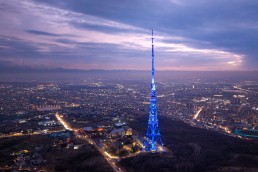
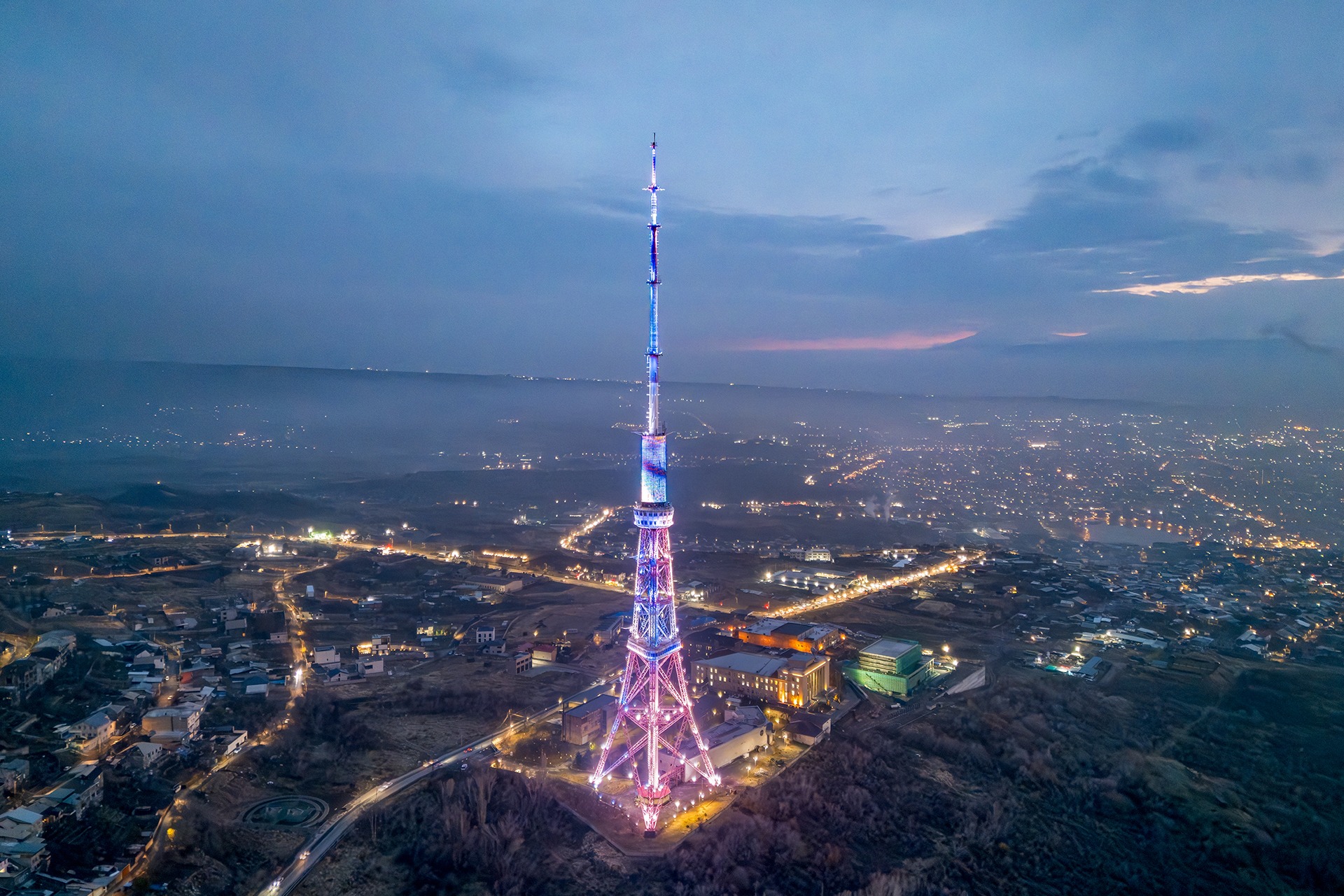
Yerevan TV Tower, Armenia
Standing at 311.7-metres-high, the Yerevan TV Tower is the tallest structure in Armenia.
This tower, one of the most recognisable landmarks in the Armenian capital, has been transformed into an interactive media art installation that responds to real-time city data and individual interaction.
A newly created lighting design, crafted by Ukrainian artist and lighting designer Mykola Kabluka, Founder and Design Director of Expolight, seeks to reimagine the role of the tower in the urban space, transforming it from a purely infrastructural object into a “living” light beacon that changes the city’s night landscape.
Launched on 30 December, the installation “reflects the rhythm and mood of Yerevan in real time”. The lighting content for the tower is generated dynamically, based on city life data: traffic flows, sunsets, temperature, and wind. Through this lighting intervention, the TV Tower looks different every day – a living light organism that breathes with the city. It also responds to events by launching themed lighting programmes – celebrating holidays, announcing sports victories, welcoming guests to the city, and appearing in the colours of the flags of different countries.
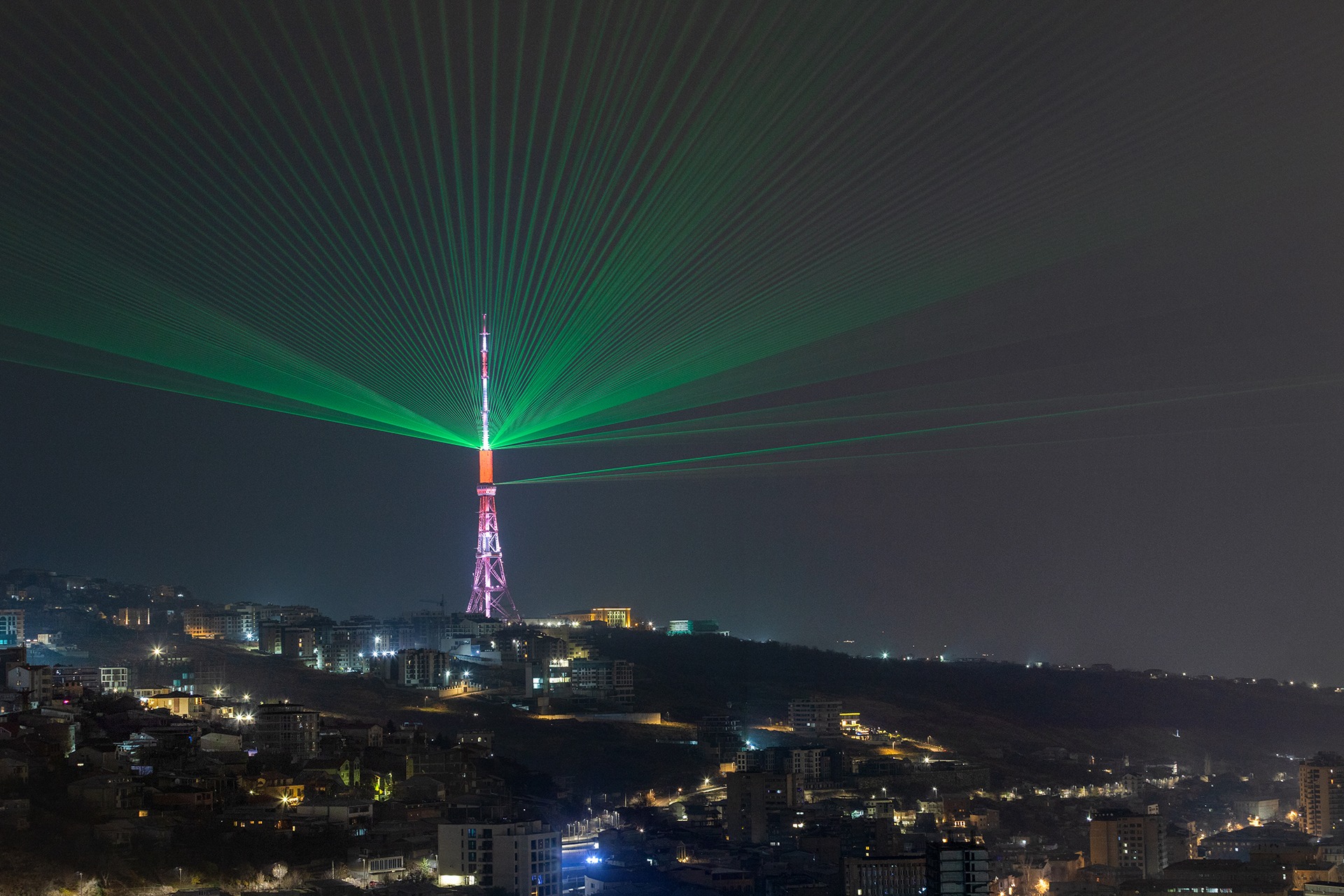
Every hour after sunset, the TV Tower is lit up with a special light show, symbolising the beginning of a new hour. This ritual, Kabluka believes, “makes time visible”; each new hour has its own colour, emphasising the rhythm of the city and transforming the passage of time into a shared urban experience.
Personal interaction with the installation of this scale also plays a central role in the project. Through a uniquely designed mobile application, residents and visitors of Yerevan can choose lighting scenarios by scanning a QR code on the central square and observation deck near the Mother Armenia Monument. Users can select from a set of symbolic wishes and corresponding colour themes, triggering light “pulses” that are reflected across the tower and its integrated laser systems.
Speaking further on the concept behind the installation, Kabluka says: “We wanted to create a living light sculpture that would become part of Yerevan’s cultural space and reflect the rhythm, energy, and collective presence of the city. Our custom system allows the tower to respond to individual interaction in real time, so everyone can convey their light wishes to the city and send positive affirmations to the world – in the universal language of light.”
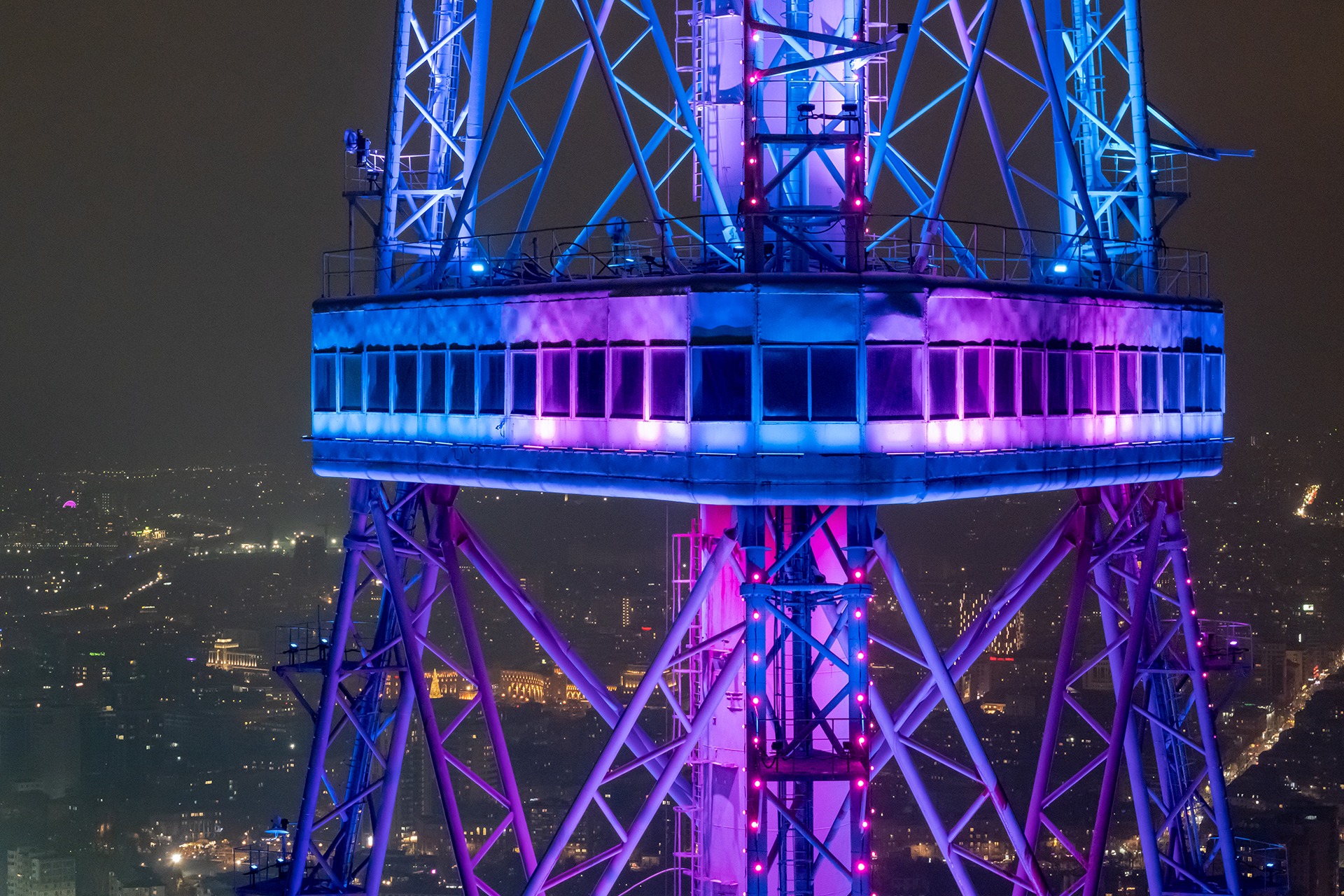
The project is based on a custom-designed lighting system comprising 486 media luminaires and more than 15,000 individually addressable light pixels, integrated across the full height of the Yerevan TV Tower, transforming the structure into a dynamic media surface. These elements are regulated by Expolight’s proprietary software, enabling complex visual scenarios, real-time content generation, and responsive interaction.
The project features uniquely engineered long-range laser systems, visible from distances of more than 10km. Fully coordinated with aviation authorities, the lasers operate within strictly defined airspace parameters, ensuring compliance with international safety standards.
The next phase of the project will synchronise the TV tower’s lighting with the fountains on Republic Square, linking two major urban landmarks into a single coordinated light-and-sound system. Once completed, the installation will operate as a unified composition, where fountains, lasers and the TV tower lights function in precise synchrony, creating a large-scale spectacle in the heart of the city.
Combining architecture, advanced lighting technology and individual engagement the project positions the Yerevan TV Tower as a new symbol of unity and technological progress – transforming an infrastructural landmark into a shared urban experience shaped by light.
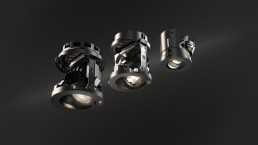
Nova - Luminii
Nova, from RCL by Luminii, is the smallest motorised recessed downlight in the company’s history, delivering architectural-grade performance in a discreet four-inch profile. Built on a next-generation electronics platform, Nova combines precision motorisation, wireless Thread-based control, and refined optics with beam angles as narrow as 6°. Available in Static White, Tunable White, and LensVector digital zoom, Nova expands design flexibility for luxury residential, hospitality, retail, and commercial applications worldwide.
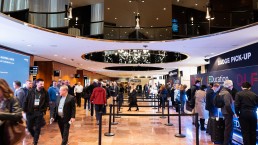
Registration opens for LEDucation 2026
(USA) – Attendee registration is now open for LEDucation 2026, taking place on 14-15 April at the New York Hilton Midtown.
The 2026 event marks the 20th anniversary of LEDucation, which is recognised as one of the most influential and widely attended gatherings in the North American lighting industry. The 2026 programme will feature more than 400 exhibitors across four exhibit halls, and 40 accredited presentations – virtually and in-person – covering the latest advancements in lighting design, research, sustainability, technology, and more.
LEDucation Co-Chair and Co-Founder, Burt Grant, says: “Reaching our 20th year is an incredible milestone for LEDucation. I’ve had the privilege of watching this show evolve from the very beginning. It’s a testament to the passion and commitment of the lighting community. We are proud to celebrate this anniversary by continuing to expand and offer opportunities for industry connection, education, and innovation.”
New for 2026, LEDucation will introduce “Designer Hours”, where, from 9-11.30am on Tuesday 14 April, exclusive priority access will be granted to lighting designers, architects, interior designers, landscape architects, and engineers. This new feature, organisers hope, reflects LEDucation’s ongoing commitment to enhancing the designer experience with a dedicated window for those who want to begin their day with focused conversations and meaningful engagement with exhibitors, before the Exhibition Hours open for all attendees at 11.30am.
“Each year, we look for ways to strengthen then impact that makes LEDucation such an essential event for our industry,” says LEDucation Co-Chair Jamie Eck. “With input from the design community, Designer Hours quickly stood out as a meaningful addition. It gives designers uninterrupted priority time to kick off the show with in-depth conversations with exhibitors – fuelling ideas and collaborations that advance our community.”
Alongside the exhibition, LEDucation 2026 will once again feature an accompanying Conference Programme. This will feature more than 40 accredited presentations led by experts across design, research, sustainability, energy efficiency, codes, controls, emerging technologies, and more. Virtual sessions will be offered on 9-10 April, providing an early opportunity to participate in select educational content ahead of the in-person event.
Attendees are also invited to experience the 2026 IES New York City Section (IESNYC) Student Lighting Competition, presented by LEDucation in the Trianon Ballroom. Student projects will be on display throughout both days of the show, interpreting the 2026 theme, Everything Old is New Again. More than a competition, the initiative reflects LEDucation’s ongoing commitment to supporting the next generation of lighting professionals and connecting emerging designers with industry leaders. The awards ceremony will take place on 14 April at 5pm.
LEDucation is a nonprofit event, and its proceeds directly support the Designers Lighting Forum of New York (DLFNY). Funds generated from the show help fuel DLFNY scholarships and ongoing educational initiatives – empowering the next generation of lighting professionals and strengthening the future of the industry.
To register and explore the full programme offerings, visit the LEDucation website.
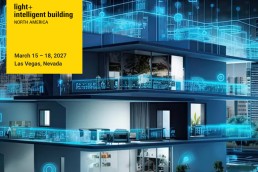
Light + Intelligent Building North America announced for 2027
(USA) – Messe Frankfurt, alongside the IALD and IES, have announced the launch of Light + Intelligent Building North America – a new trade show and conference uniting architectural lighting, connected controls, software, and building systems integration.
Debuting on 15-18 March 2027 at the Las Vegas Convention Centre, the new show will take on the mantle of Lightfair, after Messe Frankfurt acquired a 33% stake in the event in 2024.
The revamped show is designed first and foremost for the lighting industry – lighting designers, architects, engineers, agents, and specifiers – and expands the conversation to the broader building-technology ecosystem, including system integrators, facility operators, IT/OT teams, owners/developers, and utilities seeking high-performance, secure, and low-carbon outcomes.
“North America is ready for a single destination where the lighting community and the building-automation ecosystem meet,” says Latoya Gooding, Senior Show Manager. “This launch delivers a product-to-product experience – seeing luminaires, controls, software, and services working together – so attendees can specify, integrate, and operate smarter, safer, lower-carbon buildings.”
For decades, Lightfair has helped to shape the North American lighting conversation. Building on this legacy, and the lessons of recent cycles, Light + Intelligent Building North Americas hopes to bring the best of Lightfair’s core assets into a new, purpose-built platform focused on systems integration, secure controls, commissioning, analytics, and real-world performance.
Rather than viewing the launch as a “rebrand”, Light + Intelligent Building North America is viewed as a “next-generation show” that carries forward what worked – design excellence, CEU-eligible education, specifier engagement, and a strong agent/distributor network – while expanding into interoperability, lighting and controls, and building-level outcomes.
Importantly, the same partners that co-owned LIghtfair will co-own this new event, ensuring continuity of standards, community, and stewardship for the lighting industry, while delivering a future-ready experience where luminaires, sensors, controls, software, and building systems perform together.
“This launch advances the IES mission to improve the lighted environment by bringing standards, research, and education together with live, systems-level demonstrations,” adds Colleen Harper, CEO and Executive Director, Illuminating Engineering Society (IES). “From controls narratives and code compliance to measurable outcomes in comfort, safety, and energy, attendees will find CEU-eligible content and practical tools they can apply on day one.”
Christopher Knowlton, CEO of the IALD, continues: “Great lighting design is at the heart of great architecture – and it is most powerful when it connects with every element of the building.
“Lighting design no longer exists in isolation – expanding the verticals served by this event not only mirrors the evolving state of the lighting industry but also reinforces the critical role that lighting professionals play at the heart of intelligent, health and integrated environments. This is an important step in positioning our field for greater impact, visibility, and collaboration across the built environment.”
Light + Intelligent Building North America is purposefully aligned with Messe Frankfurt’s global Light + Building portfolio, connecting the region’s specifiers, designers, engineers, agents, and integrators with an international community of manufacturers, startups, standards bodies, and thought leaders.
By tapping the depth and diversity of Light + Building Frankfurt, the North American launch delivers a familiar, world-class experience – tailored to regional codes, market dynamics, and project realities – so lighting and building-technology teams can move from concept to integrated performance with confidence.
“As part of Messe Frankfurt’s global Light + Building ecosystem, this North American launch is intentionally aligned with our worldwide standards of design excellence, innovation, and cross-disciplinary collaboration,” says Steffen Larbig, Brand Director, Director Brand Management, Light + Building. “Exhibitors and attendees will benefit from shared best practices, interoperable frameworks, and international pathways – while we bring fresh energy to the region with live integration labs, CEU-level education, and a curated marketplace built for specifiers and building-technology teams. It’s a launch that connects North America to a truly global platform, and accelerates what’s possible.”
Exhibitor sales for Light + Intelligent Building North America open in January 2026, while attendee registration will open in October 2026. More information on both exhibiting and visiting can be found on the event website.
www.lightintelligentbuildingna.com

SGM Lighting appoints new Managing Director
(Denmark) – SGM Lighting has announced the appointment of Jesse Lilley as Managing Director, overseeing the company’s operations from its headquarters in Aarhus, Denmark.
In his new role, Lilley will lead all aspects of SGM’s business and manufacturing operations – ensuring operational excellence, and strategic alignment with the company’s long-term vision. He will play a pivotal role in bringing together SGM’s renowned Danish innovation with the advanced engineering and production capabilities of its parent company, Golden Sea, driving growth and strengthening SGM’s position in the global lighting market.
Following its acquisition by Golden Sea, SGM continues to build on its strong creative and technological heritage while strengthening its position across both the architectural and entertainment lighting markets.
Lilley brings more than two decades of international experience in the professional lighting industry, combining deep commercial and operational expertise with a strong understanding of design and innovation. His career includes senior leadership roles at Lumenpulse and across the LMPG Group, where he played a key role in shaping the Lumenpulse brand and supporting the global growth of several companies within the group.
Recognised for his ability to connect strategy, brand, and execution, Lilley has worked extensively across continents and cultures, leading teams that bridge the worlds of technology, design, and innovation. His appointment reflects SGM’s ongoing commitment to innovation and its strategic expansion within both the architectural and entertainment lighting markets.
“The lighting industry is undergoing real transformation – and that’s where opportunity lies,” said Lilley. “SGM’s Danish roots give us a foundation of creativity and design integrity, while the vast engineering capabilities at Golden Sea in China provide the scale and precision to innovate faster. Our mission is to continuing bringing these strengths together to create lighting that inspires, empowers, and elevates designers everywhere.”
“We are delighted to welcome Jesse to the SGM team,” added Chris Agius Ferrante, VP of Golden Sea. “His international experience, proven brand leadership, and deep understanding of both the architectural and entertainment lighting markets make him ideally suited to guide SGM through its next chapter of growth.”
As Managing Director, Lilley will focus on operations, enhancing collaboration between SGM and Golden Sea, and positioning the company for sustainable, long-term growth. By combining SGM’s creative Danish legacy with the global scale and engineering excellence of Golden Sea, the company is poised to reaffirm its position as a leader in high-performance, design-driven lighting solutions for both architectural and entertainment applications.

Chris Schulkins joins Stoane Lighting
(UK) – Stoane Lighting has announced the appointment of Chris Schulkins as London Specification Sales Manager. On joining the brand, Schulkins will complement and extent the availability of its Specifier Support Team.
With previous experience at brands such as KKDC, LightGraphix, and Factorylux, Schulkins has extensive experience in the architectural lighting sector, and a strong network across the London design community.
His appointment marks an important step for Stoane Lighting, as it looks to strengthen its support for specifiers and clients in the region.
Sales Director Ruairidh McGlynn says of the appointment: “Chris joins us at an exciting time, as we continue to grow our presence in London and reinforce Stoane Lighting’s commitment to design excellence, sustainability, and service. We’re looking forward to the energy and expertise he brings to the team.”
Chris adds: "I'm really pleased to be joining such a talented and passionate team – thank you for the warm welcome. I truly admire the way Stoane Lighting continues to minimise environmental impact while driving positive change across the industry. I can't wait to get started and contribute to the fantastic work already happening in collaboration with the vibrant design community."
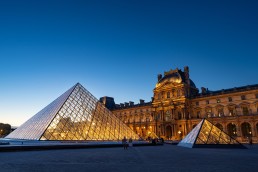
The Louvre, France
Luminaires from GVA Lighting, utilising optics from Gaggione, showcase the architectural splendour of Paris’ iconic Louvre Museum.
From royal lineage to worldwide acclaim, the Louvre is more than just a museum: it is a living symbol of art, culture, and French architectural genius. Its galleries safeguard some of humanity’s greatest masterpieces, but the building itself, a monumental palace at the heart of Paris, deserves to be celebrated in its own right. Today, a new chapter unfolds with an exterior lighting project that enhances the museum’s grandeur while preserving its timeless spirit.
GVA Lighting was entrusted with this prestigious endeavor. Using its Lira luminaires, seamlessly integrated onto historic lantern structures, the project combines elegance with cutting-edge engineering. The light now flows across the façades, tracing sculpted details and highlighting the palace’s rich ornamentation, all under the timeless gaze of I. M. Pei’s iconic glass pyramids.
At the very heart of this achievement lies the expertise of Gaggione, a French company that has specialised for more than 30 years in optical design and the manufacture of high-quality optics through precision plastic injection.
Gaggione offers both standard and fully customised solutions, enabling designers and lighting professionals to meet the most demanding challenges in illumination. For the Louvre, its advanced optical components bring exceptional precision and purity to every beam, ensuring that the Lira luminaires reveal the monument’s historic stonework with subtlety, accuracy, and grace.
This project is more than just a lighting installation. It is a celebration of the Louvre’s architectural beauty, a dialogue between heritage and modernity. As night falls, the museum transforms into an open-air masterpiece, offering Parisians and visitors from across the globe a renewed experience of awe and wonder.
www.optic-gaggione.com
www.gvalighting.com
The connected building is truly intelligent
Darren Smith, Specification Leader, Signify UK&I, discusses the benefits of Intelligent Buildings.
In today's rapidly transforming world, the use of the built environment is fundamentally shifting. Traditional buildings, long seen as static and passive structures, are being reimagined as dynamic, responsive ecosystems. These ‘new age’ buildings are intelligent infrastructures that continuously collect, analyse and respond to data to create more adaptive, efficient, and sustainable spaces. This transformation is driven by the convergence of connected technologies, digital platforms, and the Internet of Things (IoT), enabling buildings to go beyond their physical functions and deliver measurable value to organisations and occupants.
Intelligent buildings and what they have to offer
The significance of intelligent buildings has become especially clear in the post-pandemic era. As companies adjust to new workplace realities, connected systems and the IoT applications built on them become indispensable.
- Intelligent buildings help progress on the sustainability agenda – according to the UK Green Business Council(UKGBC), the building sector has the greatest potential to reduce greenhouse gas emissions. 25% of UK greenhouse gas emissions in the UK come from buildings and infrastructure. Also, UKGBC states that newly constructed buildings are more energy-efficient, but 80% of buildings that will be in use in 2050 have already been built, so a major priority is decarbonising our existing stock.
- Intelligent buildings support greater flexibility, ensure employee safety and wellbeing – today's employees expect healthier, more responsive workplaces. To attract and retain top talent, businesses must invest in intelligent infrastructure that supports hybrid work models, encourages productivity, and responds in real time to occupant needs.
- They also help businesses operate more efficiently, while enabling a differentiation in a highly competitive environment. The pandemic didn't invalidate pre-existing workplace trends – it accelerated them.
Central to the rise of intelligent buildings is the digitalisation of the physical environment. Digital technologies allow buildings to operate as platforms that deliver various services, from predictive maintenance to real-time energy analytics. These "value services" are made possible by integrating connected systems and cloud-based data processing. By embedding sensors into lighting, HVAC, and security systems, buildings can gather continuous data about usage, occupancy, environmental conditions, and system performance. That data is then processed in the cloud, where it is analysed and visualised to inform better decision making. The result is an environment that evolves in real-time, optimising itself to serve the needs of both people and the organisation.
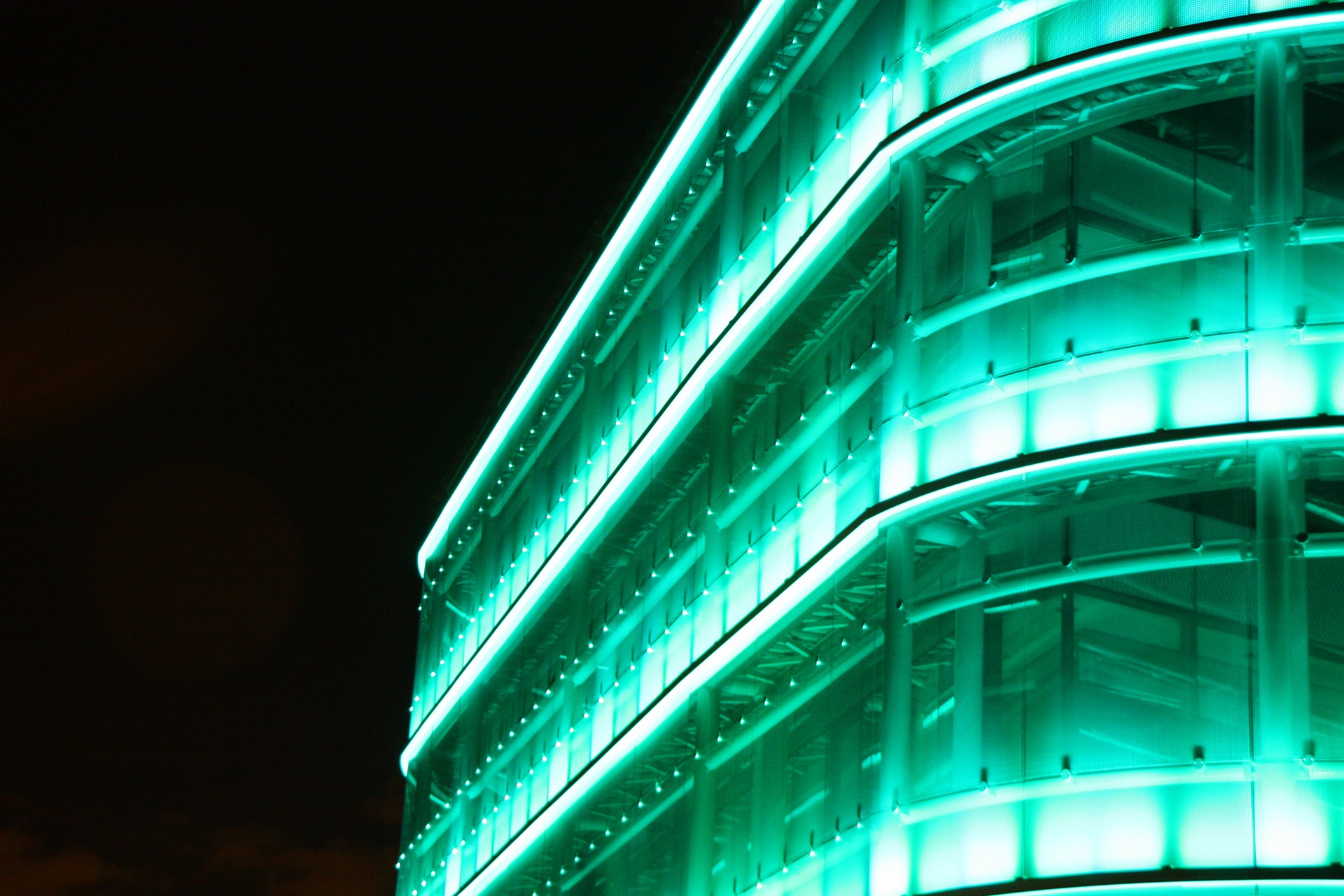
Taking the first step
LED lighting can be up to 80% more efficient than traditional lighting, and as LED lighting can last up to 25 times longer than conventional sources, so you also get the benefit of reduced maintenance costs.
However, there are further design-in possibilities available to further the benefits of this simple change. When organisations make the switch to LED lighting, a layer of lighting control can also be added to enable further savings. The lighting levels can be automatically adjusted depending on the activities taking place. These additional energy savings can come from daylight-sensing, scene/task setting and presence/occupancy detection, all of which will help to further reduce the energy consumption of lighting.
Among all building systems, connected lighting presents a unique opportunity to act as a foundation for intelligent capabilities. Lighting is already present in every building area and can be upgraded with little disruption. When equipped with connected LED technology, lighting becomes far more than a utility – it becomes a strategic part of the infrastructure.
Switching the connected lighting on
Connected lighting can play a significant role in enabling a building to become even more energy efficient, operationally efficient and sustainable. One such system is our Interact “connected lighting” system.
Intelligent drivers and sensors are embedded into the light fixtures to create either a wired or wireless infrastructure allowing for full remote control and management of lighting assets.
A remote cloud-based system can also be used to allow for multiple sites to be connected to one common platform/dashboard. It then becomes much easier to take complete control of all the lighting at an enterprise level, from anywhere, at any time.
The Interact system offers an intuitive dashboard that gives insight into lighting usage and allows users to optimise lighting operations remotely. Interact offers a flexible, cost-efficient, scalable system that meets unique needs and is easy to understand and operate. It is easy to take advantage of IoT technology to suit the needs of every facility.
Platforms like Interact by Signify demonstrate the power of connected lighting as a digital backbone. Interact enables centralised control and monitoring of lighting systems across entire facilities. Through its software, lighting scenes can be adjusted, energy use tracked, and operations optimised for efficiency and comfort.
Below are some of the possibilities that a connected lighting system can offer:
Intelligent Occupancy sensors, which are embedded into luminaires, continuously gather data about presence and occupancy within the space. Heat maps can then be simply created to show which areas are being more frequently used and those that are not. This data can not only help the client to further optimise the lighting regimes/levels, but it can also be used to help improve operational costs by optimising stock locations and pick times.
The possibilities do not end here. Environmental sensing is also possible with smart sensors. Temperature can be continually monitored and feed information into partnering systems, ensuring the right amount of heating and cooling is applied to the space. Similarly, CO2 levels can be monitored to keep an eye on ventilation and air flows.
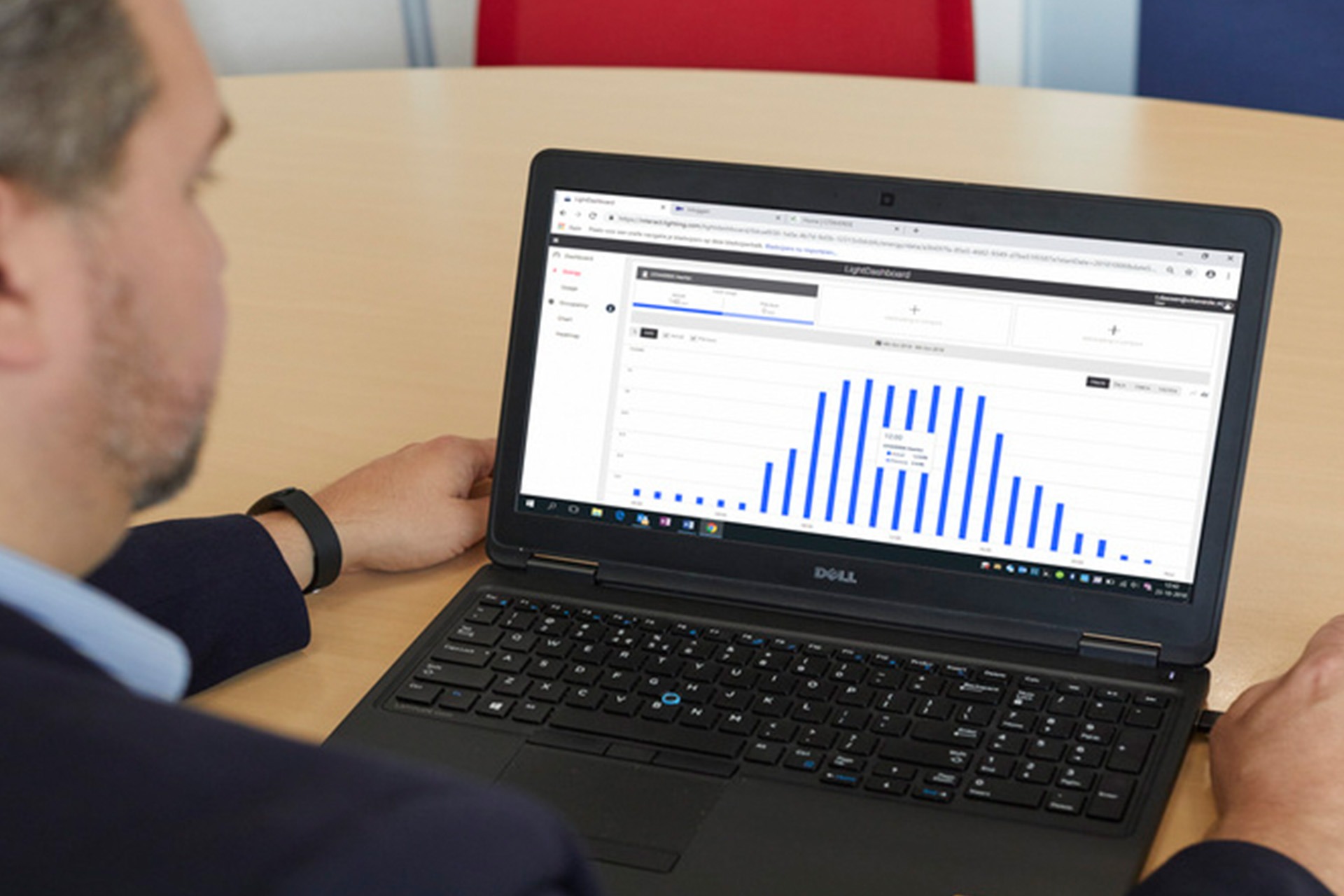
What the intelligent building can offer
The full potential of intelligent buildings is unlocked when these systems are integrated into a larger IoT-enabled ecosystem. With the continuous data streams that are collected and stored in a centralised data lake through cloud-connected sensors, facility managers gain real-time insights into how space is used and where the lighting is used the most (or least), enabling them to make evidence-based decisions about layout, staffing, and maintenance. Automated systems can adjust lighting, or temperature, based on real-time conditions without human intervention.
In the workspace, connected lighting can encourage the shift to smart offices. As more organisations embrace hybrid and flexible work arrangements, office environments must adapt. Intelligent systems allow for dynamic space management, where desks, meeting rooms, and other facilities can be reserved or allocated based on occupancy and demand. Environmental controls such as lighting can be tailored to individual preferences, enhancing comfort and productivity, for example. Lights become demand based by sensors embedded in the fixtures; this saves energy. On top of that, it generates data, to not only optimise the energy for lighting, but also to make demand-based HVAC possible, and to optimise the space layout. Also, lighting has a profound effect on people, and with connected lighting we can operate the lights according to a circadian rhythm, giving people a good night's sleep when at home after a productive day. With this: The office becomes a social magnet, where people and purpose thrive.
As we look to the future, it's clear that the most successful environments will not be the largest or the newest but the smartest. Intelligent buildings set the standard for how we live, work, and grow in a world that demands more from our spaces. They are not just changing buildings but redefining what buildings can be.

When Terrain Beats Pathogens: Strengthening the "Milieu Intérieur" of Lighting Firms so Design Can Breathe
Wojtek Cieplik, industry consultant at Brandt Partners, shares some best practices for how design studios can change their processes to better protect their designs.
Viruses do not cause every illness; vulnerability does. Lighting is similar. The pains specifiers feel on site – glare that slips through, installs that fight back, submittals that ping‑pong – rarely trace to the light fitting alone. They trace to the organisation’s terrain: portfolio sprawl, brittle development cycles and decision rights no one can draw on a page. This is my conviction: most site failures start in governance or alignment, not mistakes of a designer or a salesperson.
Architectural readers know the symptoms:
- Install friction from unclear fixings
- Visual comfort missed because UGR guidance is absent or hard to act on
- Photometric claims that do not match test conditions
- Submittals bounced because environmental and compliance data live in PDFs and inboxes
- Spectral stewardship treated as rhetoric while human and nature‑centred constraints arrive late
Five operating levers that change site outcomes
1) Portfolio and variant immunity
- Prune low‑value variants by 25-35% in two passes
- Door A/B/C rules for Configuration, Variant and Custom
- Modular platforms: mounting, optics families, standardised drivers
2) Process immunity
- Short, gated development (3-4‑week artefacts): proto photometrics, installer mock‑ups, supplier confirmations, compliance flags
- Pre‑qualified parts to absorb EOL shocks
3) Documentation immunity
- Single source of truth for submittals: datasheets, certifications, environmental documents, IES/LDT, install guides, BIM
- Pictorial one‑pagers + 60‑second QR micro‑videos for tricky steps
4) Governance immunity
- Named mini business owner per family
- Decision rights on one page
- WIP cap: ≤ 2 live NPD items per family; single‑page dashboard of leading indicators
5) Sustainability immunity
- Design for disassembly, repairability and migration paths
- Where relevant, pair TM66/EPD with spectral and wildlife guardrails at gates
From diagnosis to action
In recent SME turnarounds, the changes that moved the needle were organisational, not technical. A rapid organisational diagnostic locates the weak spots in the terrain. Where leaders need high‑resolution visibility into time use, talent retention and organisational blind spots, a short enterprise health audit precedes the 12‑week sequence. Two decisions a week for 12 weeks then shift outcomes. Track targets: first‑pass submittal rate ≥ 85%, premium freight ≤ 1.5% of revenue, returns -30% on targeted SKUs within two quarters.
When a diagnostic makes sense
- Time use is opaque, and meetings crowd out design and delivery
- Decision rights for variants, pricing and sunsetting are unclear or escalate by default
- Submittal data lives across PDFs and inboxes, first‑pass approvals are low
- Talent churn or disengagement signs appear, or leadership alignment is disputed
What changes on site when the terrain improves
- First‑pass submittals go up; RFIs per project go down
- Install time on tricky assemblies halves
- Lead‑time variance shrinks; premium freight becomes the exception
- Glare guidance and spectral envelopes move from slideware to trusted documentation
Organisational levers → site outcomes (at a glance)
Organisational lever: Portfolio and variant immunity → What changes: fewer one‑offs, clearer boundaries → Site metric: premium freight ≤ 1.5% revenue
Organisational lever: Process immunity (gated development) → What changes: risks surfaced early → Site metric: lead‑time variance -20%+
Organisational lever: Documentation immunity (single source) → What changes: credible packs → Site metric: first‑pass submittals ≥ 85%
Organisational lever: Governance immunity (decision rights, WIP cap) → What changes: faster, consistent decisions → Site metric: RFIs per project -25%+
Organisational lever: Sustainability immunity (guardrails at gates) → What changes: health and nature constraints built‑in → Site metric: zero glare‑related RFIs on pilot
Three short vignettes
- Decision rights fog → clarity in weeks
Problem: variant requests escalated to three directors; no Door A/B/C; quote engineering hours ballooned; premium freight creeping
Intervention: one‑page decision‑rights map; published Door A/B/C with SLAs; mini business owner; NPD WIP capped at two per family
Outcomes (10 weeks): first‑pass submittal rate 86 → 92%; premium freight 2.1 → 1.3 percent; RFIs per project -28%
- Single source of truth → fewer returns, faster installs
Problem: environmental and certification data scattered; submittals bounced; installer packs inconsistent
Intervention: submittal single source of truth; pictorial one‑pagers with 60‑second QR micro‑videos; weekly first‑pass yield review
Outcomes: first‑pass submittals +18 points; returns -33%; average install time on a tricky assembly -46%
- Leadership archetype in place → portfolio discipline
Problem: portfolio creep and brittle cycles; no one accountable for glare and spectral guardrails; mounting decisions ad hoc
Intervention: Platform Product Lead; pruned 27% of options; modular platform; guardrails at gates
Outcomes: lead‑time variance -22%; engineering hours per quote 30%; contractor NPS up; glare‑related RFIs on pilot → zero
Why this matters now
Market pressure is not letting up: shutdown waves in Zhongshan, Foshan and Dongguan; US brand liquidations; margin compression across Europe. Meanwhile, Milan shows the design frontier is alive — yet performance and install reality often lag. The decisive factor is organisational terrain.
A simple start
If you can draw decision rights for variants, pricing and sunsetting on one page, publish Door A/B/C rules, and cap WIP to two live items per family, you will feel the difference in 12 weeks. Strengthen the milieu intérieur — decision rights, portfolio discipline, install‑first habits, credible submittals and hybrid leadership — and most “bugs” become routine. Begin with one product family, one diagnostic pass and two decisions a week.
Wojtek Cieplik is a Berlin‑based industry consultant and executive search partner in lighting. Previously with OSRAM and LED Engin, Wojtek helps SMEs strengthen organisational health and hire hybrid leaders to improve project delivery.
Signify invites press to Netherlands F1 Grand Prix
This summer, arc editor Matt Waring was invited to the Netherlands Grand Prix in Zandvoort by Signify, to celebrate the 1-year anniversary the lighting brand's partnership with the Mercedes AMG Petronas Formula 1 team. Here, he reports back on the adrenaline-fuelled visit.
At the end of the summer, I found myself in the Dutch seaside town of Zandvoort, alongside a select group of lighting journalists, to experience the thrills and spills of the Netherlands Formula 1 Grand Prix.
And why would a group of lighting journalists be interested in this, I hear you ask? The trip was coordinated by Signify; the Dutch brand is one of the lead sponsors of the Mercedes AMG Petronas Formula 1 team, and as this partnership celebrated its 1-year anniversary, it wished to celebrate the occasion at what was its “home” race. Despite admittedly not being a massive fan of Formula 1 beforehand (my knowledge extended to “Jenson Button is from the same town as my mum”), I felt that this was too good an opportunity to pass up, and I was also very intrigued to see how the partnership between a lighting brand and a Formula 1 team would work.
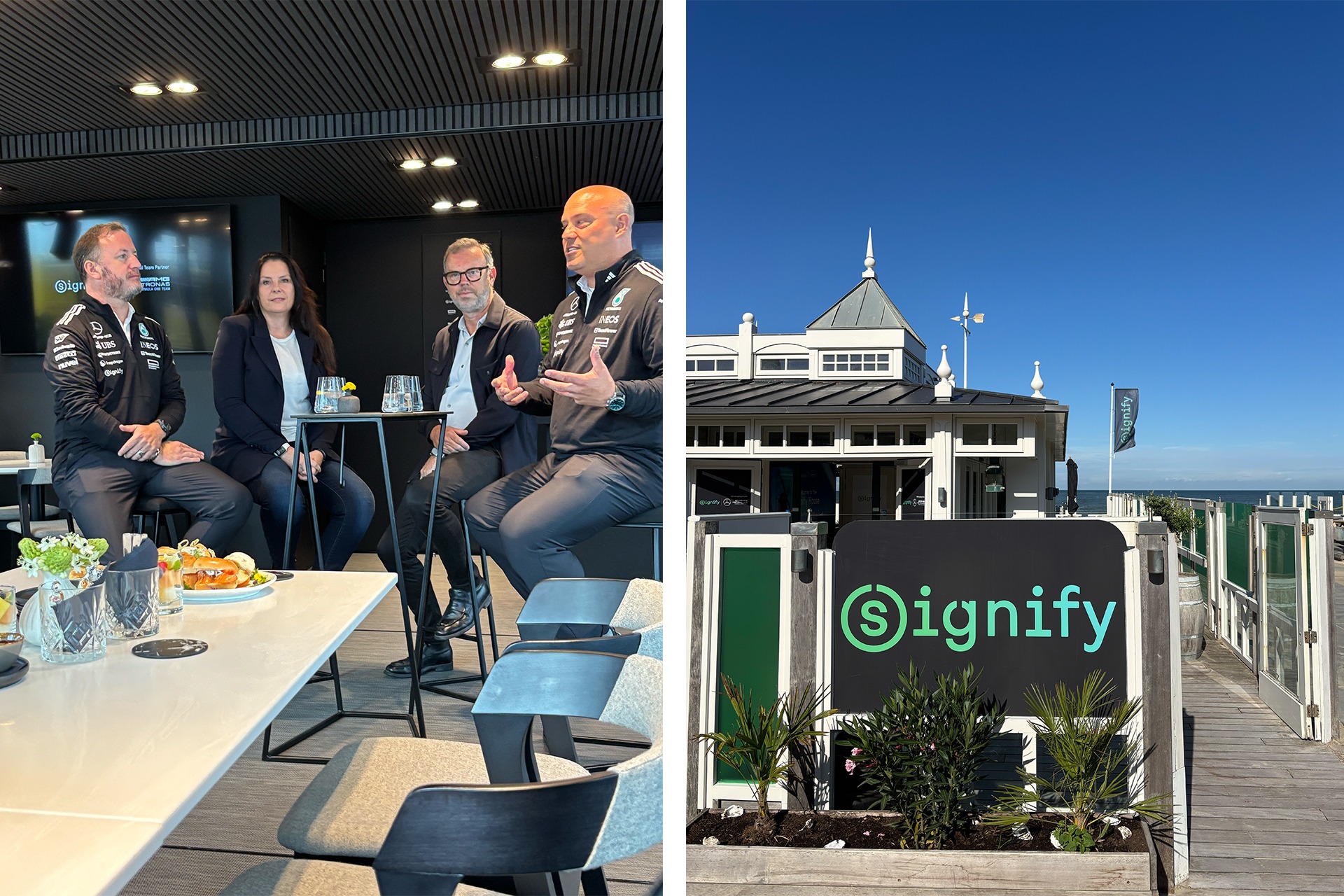
And so, off to the Netherlands I went. After an evening exploring the beautiful town of Haarlem, our team of distinguished guests was transported trackside to Zandvoort, and the exclusive, “backstage” behind the scenes area of the racing Paddock. Here, each team has its own base of operations in the form of vast, luxury trailers. Over coffee and pastries, the day began with a discussion between Nathalie Quéré, Head of Sponsorship at Signify, Ton Borsboom, Head of Design at Signify, and Mercedes AMG Petronas Team Representative, Bradley Lord.
During this insightful session, the panel shared the intricacies of the partnership between Signify and the Formula 1 team, outlining how its lighting products help to support the team wellbeing and optimise performance, not just of the two lead drivers – George Russell and Kimi Antonelli – but the 150-strong team of engineers and support staff on track for the race, as well as those based at the team’s UK factory, who will all be on-hand and working during each race, regardless of where it is in the world. Signify’s Nature Connect product in particular is being used by the F1 team to help those travelling around the world to combat jetlag, while also being implemented in a new “Human Performance Centre” at the team’s HQ.
The briefing then went on to cover the ways in which the two partners are learning from each other in terms of sustainability. Not typically viewed as the most sustainable of sports, Lord explained how, through measures such as sustainable cars, efficient logistics, and 100% renewable power, F1 as a sport is striving to be Net Zero by 2030; ad Signify is helping the Mercedes AMG Petronas team reach these goals. Indeed, the collaboration between the two was referred to throughout as a “partnership, not a sponsorship”, as both parties discussed their shared values and common interests in sustainability.
The morning session closed with a video presentation from the drivers themselves, each sharing their own understanding as to the power that light can have on their mentality and performance heading into a race. Such is the enthusiasm of Russell and Antonelli that they have specifically asked for certain lighting conditions and products in their pre-race spaces. Following this, we were treated to a surprise visit from Antonelli himself, who managed to steal away a couple of minutes from his heavily regimented, to-the-minute schedule to say hello to everyone.
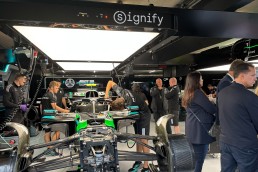
After this, the group was taken on a very special, behind-the-scenes tour of the Mercedes AMG Petronas garage. Even though at this point the race was still two days away, the garage was a hub of activity, as the teams of engineers were hard at work constructing the two race cars. Even as someone with a passing interest in the sport, I could acknowledge the privilege of getting access to this strictly VIP space, and to see the work, precision, and detail that goes into putting together a Formula 1 car ahead of race day.
After a thrilling morning trackside, our group was then taken to the Zandvoort seaside, to Signify House – the company’s main base of operations during the Grand Prix. Here, after a delightful lunch, we had a round-table discussion with Harsh Chitale, CEO Professional Business, and Member of the Board at Signify, to discuss some of the broader developments from Signify as a company. Now firmly established following its rebrand from Philips, Chitale broke down the “brand identity” for Signify and how it seeks to stand out in this “brave new world” of IoT connected devices, “where illumination is just one small part of what the device does”.
Chitale also explained the origins of the partnership between Signify and the Mercedes AMG Petronas Formula 1 team, stating that, as the company looked to establish itself as “the world’s largest lighting company” that is always looking to innovation and the future of design, it sought a global partner with a similar mindset.
He said: “Formula 1 as an industry stands for innovation, but we are looking for responsible innovation; we are redefining sustainability in our industry, F1 is also leading the charge in sustainability in the automotive industry, and redefining the ways in which the automotive industry can be sustainable. They’re committed to Net Zero in 2030, and amongst them, Mercedes AMG Petronas is leading the charge. We realised that our identities match in what we are driving, which is leadership, innovation, and sustainability."
Speaking of the ways in which Signify are aiding in Mercedes AMG Petronas’ sustainability targets, Chitale added that, for an industry that is not known to be sustainable, even the smallest contributions can make a difference. “Lighting used to burn 18% of the world’s energy and carbon emissions. Now, with the innovation that we have done over the years, the industry has brought that down to 8%, and you can take that even further down with connected lighting, and so on,” he said.
“Mercedes as a team, but also Formula 1 as a whole, is moving to more electric power and biofuels, not just for the car, but for their transportation around the world, their facilities. It’s not just what happens in the race behind each team, there are a lot of people working around the clock in the background, analysing hundreds of sensors that are generating data from the car, so there is a lot of energy that is getting consumed in their facilities and offices and so on. We are working with Mercedes AMG Petronas to get all of those facilities fitted with more energy efficient, sustainable lights. We are working with them in developing their sustainability transition plan, because it is not just products that we can bring to the table, but also capability; we are a Platinum EcoVadis Rated company, the only one in our sector to have achieved that, so we are using this capability to help the team.”
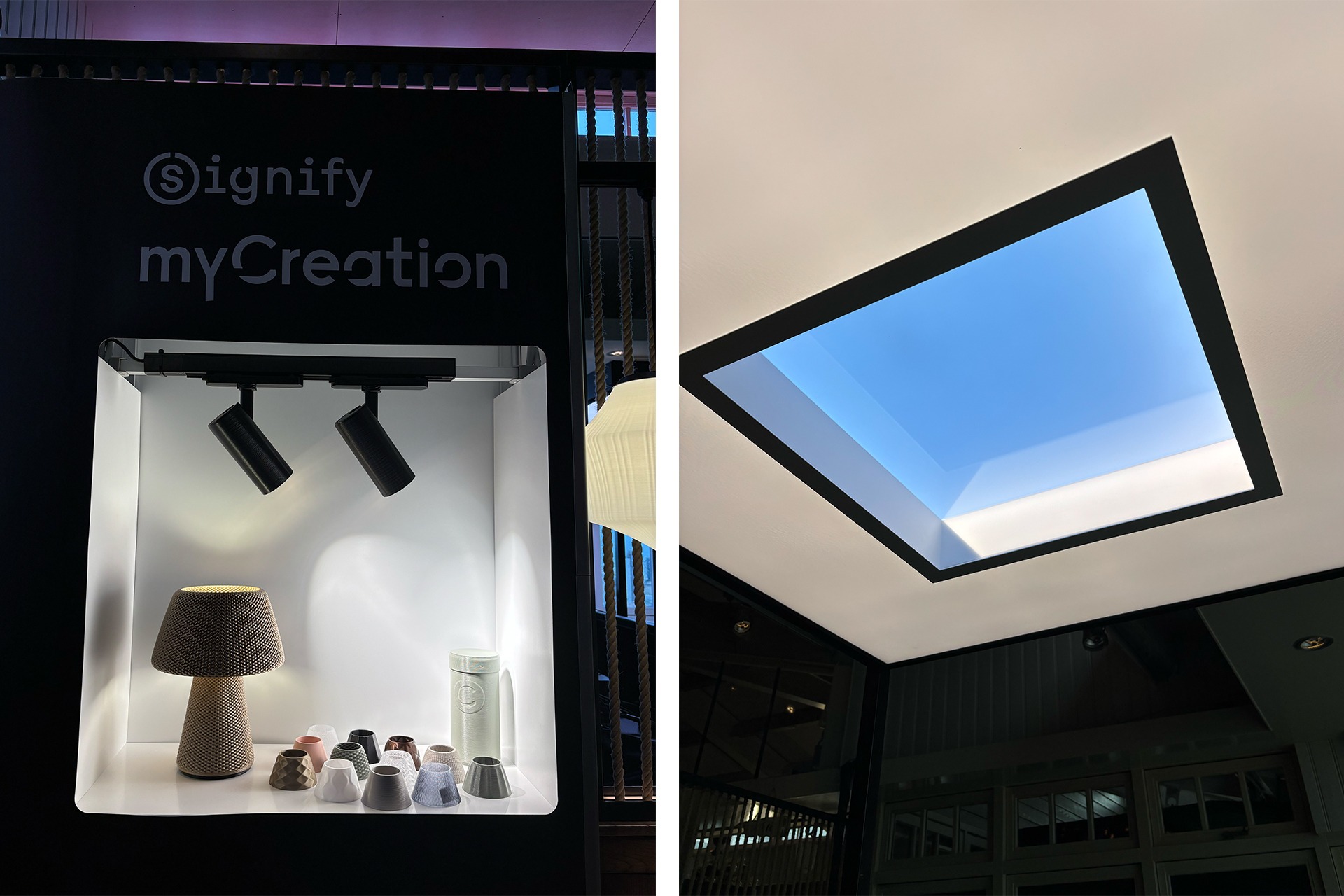
Following the discussion with Chitale, guests were invited to explore the rest of Signify House, where they could learn more about the brand’s emerging lighting innovations – from its 3D-printed MyCreations range, and NatureConnect range of daylight-simulating artificial skylights, to its advancements in performance and entertainment lighting, professional outdoor and sport lighting, and its developments for the commercial sector.
Alongside this, the group also took part in a “time trial” competition of the Zandvoort circuit on a racing simulator game, with prizes on offer for the top three times. I’m pleased to say that I bagged a spot on the podium, finishing second overall. Clearly knowing my penchant for hats, I was rewarded with a Mercedes AMG Petronas / Signify cap for my efforts.
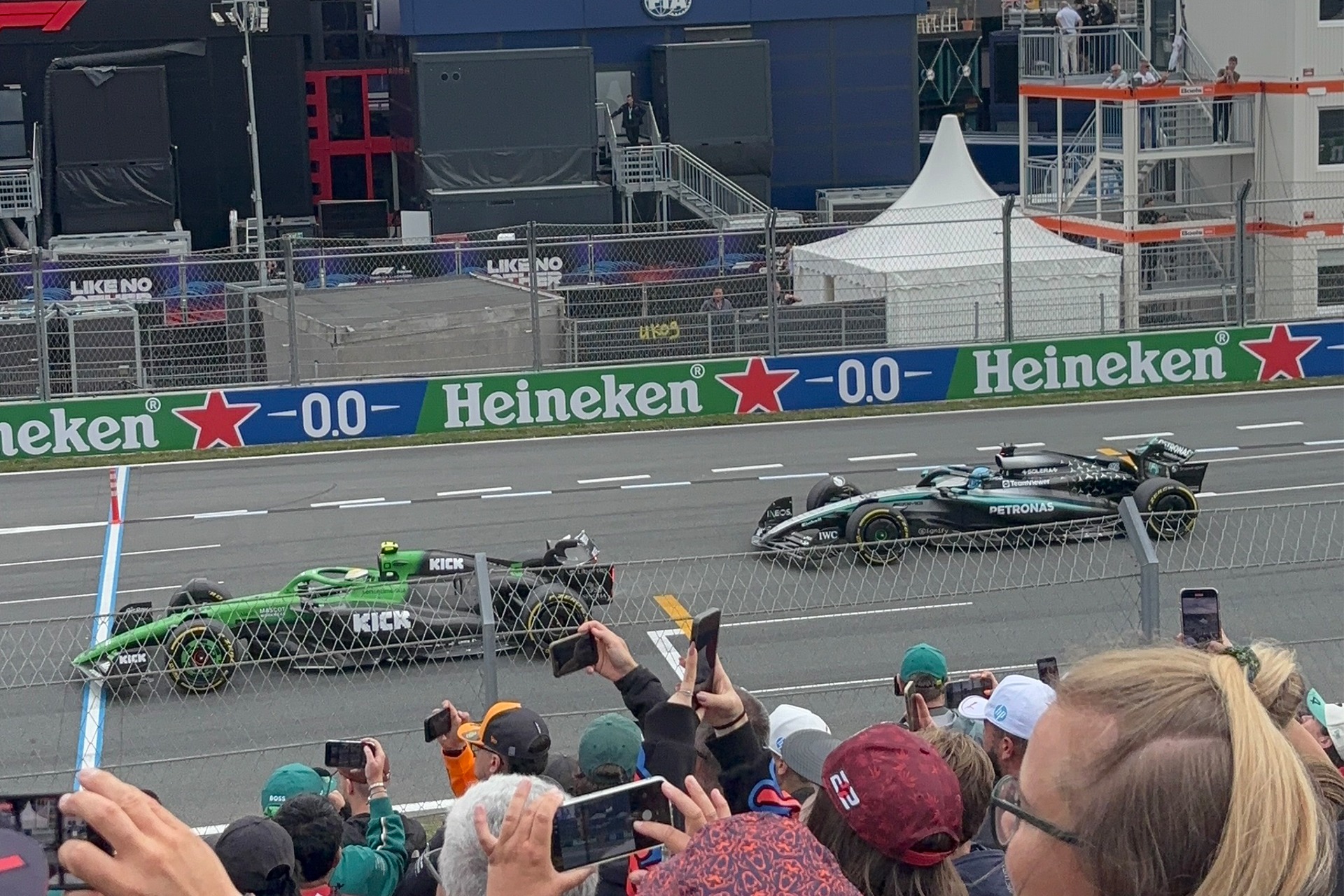
That cap was proudly worn the following day, when those of us in attendance were given an extra, bonus opportunity to attend Day 1 of Practice at the Dutch Grand Prix. A very different atmosphere than the previous day, as we approached the track, it was alive with excitement as the masses of Formula 1 fans, each donning the colours of their favourite teams and drivers, took to the stands to see these incredible feats of engineering in action. The roar of the crowd was nothing compared to the roar of the engines, and even as a self-proclaimed novice to the world of Formula 1, seeing these cars in action, up close and personal, was a unique experience, that I am very grateful to have been given the opportunity to see.
Unfortunately, our new favourite drivers, George Russell and Kimi Antonelli, didn’t place on the podium at the Netherlands Grand Prix, but it was still a tremendous experience to see how Signify and Mercedes AMG Petronas are working together to reach a more sustainable future, with lighting at the forefront.
Nulty Launches Apprenticeship Scheme
(UK) – Global lighting design consultancy Nulty has launched an apprenticeship programme from its London studio, creating a fully supported pathway into the lighting design profession.
The pioneering scheme will offer aspiring creatives the chance to train amongst one of the industry’s largest lighting design practices, through a two-year placement with Nulty’s award-winning London team. Apprentices will gain hands-on experience working on live projects, while studying for an Advanced Diploma in Illumination Engineering.
Structured to provide a comprehensive introduction to architectural lighting design, the programme will see apprentices spend four days a week engaged in practical learning, working under the mentorship of designers at every level. Participants will be immersed in the day-to-day realities of project work, and gain first-hand knowledge of how to develop imaginative lighting design concepts and master technical skills in CAD drawing, 3D modelling, and photometric calculations.
One day a week will be dedicated to academic study, supplementing practical learning with a foundation in lighting design theory and illumination engineering. Delivered by leading academics, the industry-backed qualification offers a comprehensive introduction to the principles of architectural lighting design.
Paul Nulty, Founder, Nulty said: “Nulty’s apprenticeship scheme is part of our ongoing educational movement. Seasoned lighting designers know that theory will only get you so far – especially when it comes to the intangible medium of light. True learning comes from tackling creative challenges on real projects. To help bridge that gap, we’ve developed a holistic learning programme that blends theoretical knowledge with on-the-job expertise.
“This approach feels especially important at a time when entering the job market is more challenging than ever. Graduates face fierce competition for roles, alongside wider industry shifts driven by factors such as Brexit, AI adoption and global economic pressures. We feel strongly that it’s our responsibility to support the next generation of talent by providing an experience-led path into practice.”
Ellie Combs, Managing Partner, Nulty added: “Most designers can point to an inspirational mentor or team who shaped their career. Our apprenticeship initiative is about giving the next wave of designers that same head start, within a nurturing environment with strong opportunities for both professional and personal growth. We look forward to welcoming the first intake of Nulty apprentices to our London team.”
Nulty’s apprenticeship programme is open to school and college leavers, or anyone looking for a new career path in lighting design. Applicants must be eligible to live and work in the UK, and demonstrate a genuine passion for design, creativity and the built environment.