
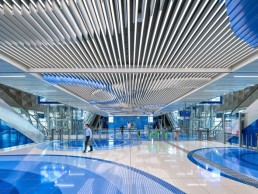
Dubai Route 2020 Metro Link, UAE
To mark the arrival of Expo 2020, the Route 2020 Metro Link project is an extension of Dubai’s metro line that welcomes visitors to the Expo site. Lighting for the station extensions came from dpa lighting consultants.
The Route 2020 Metro Link project from Dubai Roads and Transport Authority sees an extension of the Dubai metro service, connecting the interchange at Jebel Ali with the flagship metro station at the Expo 2020 site. Consisting of a 15km extension – of which approximately 12km is above ground and 3km underground – it features seven stations and branches from the existing Red Line.
dpa lighting consultants was approached by the architect Atkins (as part of the original Metro Bid team) to be involved in the project. Responsible for the design and specification of all architectural lighting to the interiors, façades, and landscape for all six new stations and the one existing interchange, the project presented the team with a number of unique lighting challenges, as Lee Sweetman, Director at dpa lighting consultants, explained to arc: “Several challenges presented themselves at each stage of the process, from the differing design languages of each station through to the integration and ongoing maintenance of appropriate lighting equipment,” he said. “Lighting of the prefabricated Expo station canopy was a particular instance and many design interpretations were developed in order to provide the most appropriate solution. Extensive site visits of all existing stations on the Red Line were undertaken to assess the advantages and disadvantages associated with each station theme and type.
“The lighting approach had to be robust enough to allow for the technical considerations but also flexible enough to accommodate each station’s signature architecture and interior design.
“We didn’t attempt to mimic natural daylight in the underground stations either. Each station varied in design and approach and was its own unique element within the overall journey. The interchange station at Jebel Ali was a particular challenge, as an extension building was added to an existing station, thereby putting the existing and contemporary interpretations into close context.”
Earth, Fire, Water and Air were the guiding principles that informed not only the lighting design of the new line stations, but also dictated the architectural language of the new development. Lighting design for the stations was developed alongside the architectural, interior design and engineering teams to enhance the key principles inherent in the original Metro concept, while also maintaining and developing a unique night-time identity for the newly commissioned line. Subtle and contextual lighting interventions were to sit alongside more dynamic and characterful areas in order to balance and contrast the approach to illumination.
“The challenge was in dovetailing the existing concept schematics with the newer interpretations of the design,” continued Sweetman. “Certain technical guidelines also needed to be incorporated in order to provide safe and navigable levels of illumination to each individual space. Over illumination was always a concern given the conflicting criteria of the technical requirement versus the aesthetic requirement.
“Several design-led features such as the ceiling features and large-scale pendants needed to be balanced in such a way that they maintained their impact without being overbearing. Likewise the architectural lighting needed to ensure that these elements were still visible in the overall scheme.”
The Expo station and its canopy were key considerations throughout the project and represented the primary focus of the lighting design. The canopy in particular, presented a unique opportunity to announce the station and its arrival plazas within an often congested illuminated environment. A subtle, yet sophisticated approach to the illumination of the canopy celebrates the unique colour, contrast, form and texture of this iconic architectural intervention.
Sweetman added: “The site is densely packed and the lighting design had to take into consideration this potential architectural/lighting conflict. The lighting of the canopy was developed to enhance the colour, form and texture of this striking element while also providing a more sophisticated approach and one that was not overly theatrical. After many lighting trials, the soft, subtle illumination to the underside of the structure was eventually chosen as the most appropriate solution, given the complexities of installation and ongoing maintenance.”
For Sweetman, there was never the worry that by creating something more subtle, the design would get lost among the wider visual noise of the Expo, telling arc: “I believe the structure itself is the main player in the interaction of architecture and light. Light is used to enhance the structure’s character and night-time identity and I believe that this more refined approach to the illumination helps to raise the hierarchy of the canopy above the surrounding architecture.”
This project also represented a rare opportunity to evolve and enhance the after dark identity of Dubai’s critical public transport network, helping to provide cost effective and efficient transit options to wide sections of the local community, commenting Sweetman said: “Once again the architectural form is the main driver of the identity of the new line. Its differential between the existing system is subtle yet noticeable and it was always our intention that the careful and coordinated arrangement of the internal lighting elements would give form to the stations during the hours of darkness.”
This iconic project was ceremonially inaugurated by H.H Sheikh Mohammed bin Rashid Al Maktoum, Vice President and Prime Minister of the UAE, and Ruler of the Emirate of Dubai in July 2020 and became fully operational in the early part of 2021. Reflecting on the project, Sweetman said: “Overall I believe that the design has achieved the required balance between the heritage of the existing line identity coupled with the more contemporary interpretation of the new line. The external identity of all stations has been enhanced while the interior lighting has endeavoured to emphasise the experiential elements of the journey itself across the whole length of the railway extension. In particular, lighting to the Expo canopy and station are significant additions to the overall night-time visitor experience, helping to reflect the great levels of importance and civic pride which the UAE has invested in all aspects of the Expo infrastructure and design.”

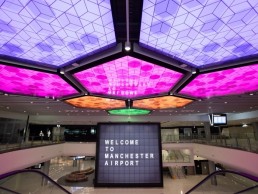
Manchester Airport Terminal 2, UK
As part of an ongoing redevelopment of Manchester Airport, Terminal 2 has been expanded and revamped, more than doubling its capacity for passengers. The new-look terminal features a dynamic and welcoming lighting scheme designed by Hoare Lea.
Pre-pandemic, Manchester Airport was the third largest airport in the UK, with almost 30 million passengers travelling through each year.
Spanning across three terminals, the airport is undergoing a vast, £1bn transformation, first announced in 2015 by Manchester Airports Group (MAG) and spearheaded by architects Pascall + Watson. The huge transformation programme comprises a series of 60 enhancements; key elements among these include new piers, aircraft stands, forecourt and multi-storey car park.
The centrepiece of the transformation though, is the extension of Terminal Two. Completed earlier this year it offers state-of-the-art facilities and provides a first-class experience for passengers, in a modern, bright and spacious environment.
The new terminal features a series of open, double-height spaces and floor-to-ceiling glazed façades, ensuring a bright and airy interior awash with natural light, while more dynamic touches have been introduced to create a vibrant and welcoming space for travellers.
Hoare Lea has designed the lighting strategy for the expansion, working alongside Pascall + Watson, and principal contractor Laing O’Rourke on the development.
David Linville-Boud, Associate at Hoare Lea, explained how the lighting concept first took shape: “The general look and feel had been developed by the architect, and CGIs had been produced by them, which included lighting elements. We took their conceptual designs and investigated how we could achieve the desired intent, what typical products would allow this to be achieved and what their general performance specifications would need to be (beam angles, outputs, optical controls, etc) in order to achieve the design principles required for each space.
“As designs started to become more detailed, if there were opportunities for alternative or additional lighting within the contract, this was detailed, designed out and presented accordingly. A good example of this is the introduction of the giant, colour-change hexagons in the departure lounge, which were introduced to replace the original design of skylights above the space.”
The primary focus for Linville-Boud and Hoare Lea was for the lighting to enhance the experience for users of the space. He continued: “While highlighting the architecture is an important visual element, the experience of the journey of travellers through the airport and their appreciation of each space while being able to undertake the tasks within each is the primary requirement – whether it is a functional task such as security, or a leisure task such as circulating around the departure lounge, or just passing time waiting for departure. Different lighting treatments react to the architecture, the varied ceiling heights, the space usage and assist in defining each space and guiding travellers through the arrivals or departures activities.”
Taking the architectural design intent and the building blocks defined within the basis of the design, Linville-Boud explained that the concepts for each space were fleshed out as individual elements to define the exact performance requirements, product types and installation requirements to fit the architecture and the overall lighting design approach.
“Following on from this, the complete BIM model was utilised to build lighting design models to make it easier to handle the design for each space due to the large size of the scope areas,” he added. “From there, full designs were undertaken for every space to ensure compliance whilst also considering the appearance within 3D space to ensure the best passenger experience.”
Working within a large-scale, £1bn redevelopment programme, the scope of the project is incredibly vast. As such, the design team had to work hard to ensure a level of consistency across the site, while the logistics of working within an airport also presented a number of challenges for Hoare Lea, as Linville-Boud explained: “The main challenges included the sheer scale of the project, covering multiple areas and ensuring a cohesive design that coordinated between each space.
“Due to the nature of being an airport, some very specific requirements exist for certain applications and careful development of the lighting was required in order to achieve the specifics while ensuring the appearance was coordinated and integrated to prevent a solution that may meet the requirement but at a cost of reducing the aesthetic of the overall space.”
Linville-Boud added that, due to the size of each space within the terminal, and their respective, clearly defined architectural designs, lighting the volume of each space, providing visual interest and creating the right ambience were integral factors that were “as important as achieving the lighting on the working plane”.
“With the concepts set out at the earlier stages of the design process, these needed to be rolled out and tailored to suit each space exactly,” he continued. “This resulted in a few adjustments to fit the geometry of each area as the ambition was to ensure consistent details, such as product spacing across each open area to allow the pattern and rhythm to be maintained.
“Each area type had its own design solution; for instance, circulation areas utilised a baffled ceiling with lighting integrated into the baffle layout, whereas the security area was based mainly on suspended downlights in-between rafts. This methodology was consistent throughout, giving the coordinated layouts and identity to each area.”
The idea of a consistent methodology and identity throughout is an integral factor to the wider redevelopment of Manchester Airport, which will eventually see other areas expanded and renovated. However, while working within the context of a wider redevelopment plan may have been a challenge, Linville-Boud didn’t see it that way.
“The large-scale nature of the project doesn’t overly complicate the actual lighting design or solutions, but it does complicate the design delivery due to the sheer size of the spaces and the associated quantity of the lighting products required.
“Each space was designed in full, whether it was a WC, corridor or check-in hall – this ensured the designs were exact for each and not based on a rollout of theoretical design parameters that may not transfer correctly into the actual architecture.
“There are specific requirements for ‘task’ areas in an airport, which must be met alongside the general typical requirements for usability of the spaces. As these were generally known during the design process, providing integrated solutions was possible, rather than needing to add additional lighting as an afterthought,” he said.
“The extension to Terminal Two and the new pier also set the methodology and design approach that will be continued into other spaces as and when they are developed. Due to this, it was important that at the early stages, the design solutions had a certain flexibility to allow them to be tailored to similar yet different spaces – some of which weren’t designed at that time.
“Other areas are being looked at, and the designs will follow the methodology employed already here for a consistent approach throughout the terminal and piers. The designs, as per the architecture, need to be read as one and not seen as a refurbished building and a new build. In addition, the commonality of lighting products and consistency in the lighting design and lighting control will create a seamless integration of the extension to all areas of the terminal, allowing better management of the building services, more efficient operation, and provide visual uniformity, creating a calmer, more pleasant environment.”
For this large-scale operation, a new lighting control system was employed for all the lighting integrated into the existing building management system. DALI was utilised in every luminaire, with the exception of the large colour-change hexagons, which operate from a DMX protocol. Lighting control types were set as part of the basis of design, and this was then rolled out across the various spaces with adjustments to suit individual situations. The DALI system, created by Laing O’Rourke, operates almost 20,000 drivers, more than 3,000 sensors and 500 application controllers – the project won Laing O’Rourke the Large Indoor Project category at the 2020 DALI Awards.
The introduction of a dynamic control system was part of a push to improve the user experience within the terminal, as Linville-Boud explained: “The lighting control system and the way it has been employed increases the quality of the travellers’ experience, while also giving full controllability and the associated benefits for the airport operator – whether it’s dimming, scene setting, colour control or event activation.
“The system is also linked to the flight information to be able to raise and lower light levels around gates depending on their utilisation. The large colour-change hexagons are positioned adjacent to a two-storey media wall, and they have the ability to respond to the content being shown on the wall.
“The ability to group and control sets of luminaires allows the lighting to be used to guide travellers through the spaces – areas not in use can be dimmed, allowing the passengers to follow the lighting through their travels.
“Airports can be alien and confusing environments with many users circulating in all directions with limited knowledge of the layout of the spaces. Every aspect that can reduce this confusion can come together to ease the ability to locate their destination, whether this is through signage, architectural designs and materials or lighting. The separation of lighting treatments and light levels into specific areas enhances this ability to navigate and negotiate through spaces to the desired destination.”
As Linville-Boud mentions, airports can be hectic and stressful places. Therefore, with the addition of a dynamic lighting system, he believes that the lighting design will help to facilitate a more calming and uplifting environment for travellers both arriving and departing from the terminal.
“All lighting has been selected to be low glare to enhance visual comfort,” he said. “In transient circulation spaces, lighting is mainly shorter linear fittings integrated into the layout of the baffled ceilings, giving visual guidance to travelling routes. Larger spaces utilise alternative solutions with the appearance suitably scaled to suit the size of the space and the ceiling height, which can vary substantially.
“All of the lighting is part of the architecture to give a pleasing appearance to make the spaces feel more harmonised. In specific areas, such as the check-in and departures, additional feature elements are included – in the check-in hall to create an impressive welcome mat and in departures to add active features to make enticing spaces where passengers can enjoy their dwell time and be immersed into the environment.”
Following the opening of the revamped Terminal Two in July of this year, Linville-Boud is satisfied that the final lighting scheme sits in keeping with the wider architectural design, creating a welcoming space for travellers.
He concluded: “The final appearance of the lighting meets the design intent in both performance and appearance, and creates people focused spaces that enhance the user experience from the moment they arrive right through to boarding a plane.
The lighting is successful and integrates very well with the architecture, which itself creates amazing spaces that flow from one area to the next, forming a fully coordinated and effective transition that gives a quality and relaxing experience in such a busy and active environment.”
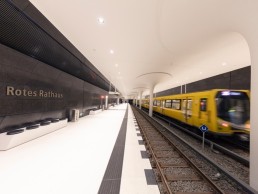
Rotes Rathaus, Germany
The bright, monochrome finish within Berlin’s new Rotes Rathaus subway station is a bold contrast to its historic setting, with a complementary lighting scheme from Licht Kunst Licht.
The Rotes Rathaus (Red City Hall) in Berlin is a new subway station that connects the main station of the government district to the Berlin subway station. Designed by Berlin-based Collingnon Architektur und Design, the station opened in December 2020 after more than 10 years of construction. With lighting design from Licht Kunst Licht, the station was transformed into a public space that aids flexibility in movement and safety.
Back in 2010, underground remains of the gothic styled town hall were discovered. In a bid to conserve the historic structure, it was decided to preserve and incorporate it into the new architectural design. After numerous revisions, the final agreed upon design led to the development of a mushroom-shaped column structure that mimicked the original vaulted ceiling.
The new design for the station revolves around a simple yet dramatic black and white colour scheme. Boasting gleaming white floors and ceilings, dark and subtly sparkling walls made of polished concrete, the anthracite-toned staircases remain in dark colours to add drama, which results in a radiant reception flooded with light when entering the 140-metre-long station hall.
arc caught up with Edwin Smida, project leader from Licht Kunst Licht, to discover more about the studio’s approach to lighting the space. Continuing the lighting studio’s established relationship with the architect, Licht Kunst Licht worked closely with the architectural project team to create three proposals to fit in with the ever-changing concept.
Deciding to not use additional, complex lighting structures, the lighting design simply consists of integrated downlights in the concrete ceiling. The calculated interplay with the reflection from the white floors and ceilings produced the desired, pure lighting effect along with a high level of visual comfort for passengers and station staff. Luminaire wattages and beam angles were adjusted by Licht Kunst Licht to ensure each fixture was correctly fitted across the varied ceiling heights in the hall and on the side wall of the connecting bridge. Platform ends, where ceiling protrusions prevented the use of downlights, were fitted with pairs of inground luminaires.
“Initially, the architect wanted a light ceiling appearance, and asked whether the light should come from the cove at the edge of the mushroom columns. We rejected this idea because it would have focused too much attention on the columns. As an alternative, we put forward the idea of using downlights for the general lighting on the platform and using the indirect reflection of a brightly painted floor for the ceilings,” said Smida. “At first, the Collignon office was a little sceptical about whether this could work, but we were able to show some images of other projects in which this effect was easily demonstrated. But, the radical reduction of the concept to simple downlights was convincing in the end, because we could foresee that the room itself would benefit from this effect.
“The project was not built from the bottom up as usual, but the other way around. This means that the ceiling was poured first with the mushroom columns attached, and then the soil from underneath was removed and the rest of the room was added,” continued Smida. “For the lighting, this meant that the concrete recessed housings had to be installed in the ceiling years before the luminaries. At the time of planning, we were still calculating with metal halide lamps, but in the end, contemporary LED luminaires were installed. The manufacturer, We-ef, mastered the balancing act between the early system coherence of the downlights and the concrete cast-in housings and the later contemporary lighting technology excellently. This was only made possible with close contact to the client and constant monitoring of the progress of the construction site. For this we must explicitly thank We-ef employee Detlef Herfter for his endless commitment.”
In the beginning, side diaphragm walls were built, followed by a waterproof concrete floor to form the bottom of the pit. A “cover” was then concreted over the pit to form what would later be the ceiling of the station. The flared support heads were completed early on, but the supporting columns grew in a later construction phase. This had consequences for the ceiling-integrated lighting concept. The first installation step was the mounting of concrete installation housings, which was carried out early on. We-ef delivered the customised modified housings in 2013. In addition to a formwork element for the recessed installation detail, they also featured additional entries for the redundant wiring. Later, operator Berliner Verkehrsbetriebe (BVG) decided not to take any risks as reliability was a top priority.
In 2010, it became apparent that LEDs would replace the HIT discharge lamps commonly used at the time. We-ef, the architects and lighting designers all worked together to select the future-proof LED technology. This also accounted for the emergency lighting to be seamlessly incorporated into the scheme. The lamps were finally delivered and installed in 2017 during the fit-out of the hall. A total of 70 We-ef DOC240 lamps were installed above the platforms. With 24 LEDs in warm white (3000K) and a connected wattage of a maximum 48W, they produced a symmetrical medium-beam light distribution. Additionally, there were more than 100 DOC220 recessed luminaires with 12 LEDs and symmetrical medium-beam optics in the areas with lower ceiling heights. ETC140 inground luminaires with 24 LEDs in 3000K were installed at the ends of the platforms and feature a non-slip ASC coating in accordance with DIN 51130.
Taking cues from the architecture, the lighting matches the modern aesthetic created by Oliver Collignon (head of the architecture firm), which was designed as a purposeful contrast to the history of the station’s location.
The monochrome colour contrasts continue to emphasise this modern look, and paired with the lighting, create an open, bright and comfortable atmosphere. “It’s charming to end up in a bright and friendly-looking room on the way underground,” said Smida. “Ours almost looks like a hall, the likes of which are usually only found above ground. But the way to the hall could still have a bit of drama, so it made sense to design the stairway slopes as connecting pieces in contrasting black. We never saw a problem here in terms of adaptation; the contrasts would have had to be much stronger. It was all purely intentional.”
Overall, the new station is not only a place of significance for Berlin commuters, but also as an iconic piece of design in the city centre.
“In virtually all of its projects, Licht Kunst Licht tries to focus on the lighting atmosphere rather than on the luminaires themselves. We always put our knowledge at the service of the architecture, i.e., we try to find a concept that works in harmony with the architecture. This principle usually produces strong and expressive results in which cooperation of the various trades is perceived as a unity,” added Smida.
It is safe to say that Smida and his team were able to achieve these studio-driven principles at the Rotes Rathaus station and create a stunningly simple lighting scheme under challenging circumstances.

Sally Storey
Following the release of her new book, Inspired by Light: A design guide to transforming the home, Sally Storey sits down with arc to look back on her career to date and what led to the release of the book.
Over the past 30 years, Sally Storey has worked on a series of high-profile projects as both Founding Director of Lighting Design International and Creative Director of John Cullen Lighting.
Establishing LDI in the mid-80s, at the dawn of the lighting design movement in the UK, Storey is one of the pioneers of the UK lighting design community, but her appreciation for the power of light only began in earnest during her studies.
“I read architecture at Bristol University, and what really fascinated me about architecture was the way that natural light modulated a building, not only from the outside but also how it penetrated inside,” she said. “Then I realised that we weren’t being taught anything about how to light a building inside, so that ended up being the focus of my dissertation.”
It was during her second year at university, as her passion for lighting was burgeoning, that she met the late John Cullen, himself just branching out as a sole trader having come from working as a light technician for the BBC before moving into the world of residential lighting.
“He said that I could work for him during my holidays and learn about light,” Storey continued. “The first thing that I did for him was to design his showroom on Smith Street – I had to say yes and then worry about it later. I designed it as an interactive lighting pod where you could transform the space to give different impressions of wallwashing, uplighting, downlighting, spotlighting, cold light, warm light. For my thesis, I then used this space to analyse people’s perception of the light and what the mood was.”
From there, Storey was hooked, shifting her focus from architecture to lighting design and joining John Cullen Lighting permanently. It’s an obsession that remains today. “I had the option to go back into architecture, but I was obsessed by then, and I still am. I still love every bit of it. I love design, I love historical design and contemporary design, and working with light, you become a master of a tool, the fourth dimension of architecture, and you can apply that mastery in a number of different ways to solve different problems.
“The solutions that you have for a classical project are very different to a contemporary project, but you still find a solution, whether its ambient, task or feature lighting, but the solution was different.”
Working alongside John Cullen in the advent of the “Halogen Revolution” (what Storey refers to as the first lighting revolution of her career), the company was primarily focused on residential lighting and creating architectural lighting products for the home. “It was interesting at the time, because very little was available,” Storey explained. “There was either very glary halogen downlights, or rather large dark light fixtures, but there wasn’t anything in between, so that’s how the John Cullen downlight range and the first Polespring developed.
“It was very much concentrating on residential design, so we ended up finding or developing a product to support the design for a house, which would be something that I’d want in my own house, rather than the big, industrial things that you’d find in a hotel. It was almost like trying to bring the museum quality light to the home, on a miniature scale.”
As John Cullen Lighting began to grow, so too did the understanding and acknowledgement of lighting design as a profession. It was this growing understanding that led Storey to establish Lighting Design International in the mid-80s. She explained: “At the time, there weren’t that many lighting consultancies, and that’s why John Cullen Lighting, particularly for residential projects, was making lights and providing a simple service.
“But then in 1986, Chase Manhattan Bank came, and they were willing to pay for design. I then realised that there was an opportunity to have an independent lighting consultancy and charge a proper fee for the work that we were doing.”
From working with Chase Manhattan Bank and later Goldman Sachs’ offices on Fleet Street, the newly-formed design practice expanded its reach into hotels, shopping centres and building exteriors, growing organically to the position it is in today as one of the UK’s leading design studios.
“We come from an architectural background where we think that light should be seen if it’s decorative, and if it isn’t decorative, it should be concealed, yet reveal the architecture,” Storey said of LDI’s design approach.
“As we expanded, the team came from product design, interior design, theatre design – in the early days there wasn’t a degree or an MA in lighting. Nowadays though, a lot of the people you employ will have a degree in lighting, and it’s exciting to know that there is diversity in the team because we come from different backgrounds. The passion that brings us together is light, but what we bring to the team is very different, so our inspiration comes from different points.
“I would say that I’m an intuitive designer, I go into a space and have a gut feeling about how it should be lit, whereas other people will design in different ways.”
The lack of any real education or understanding about the importance of light in the wider design world was a particular driver for Storey in the early days of LDI, alongside her ambition to make the world “a better lit place”. “What I was so appalled by at the time was that people didn’t understand light,” she said.
“You weren’t taught it at university, one of the things that displays the building so much. The one thing I was taught was potentially doing a lux grid with fluorescents for the office, and that was it.
“I think because it’s technical, people didn’t know how to use it. The evolution of light was practical, rather than aesthetic. If you go back in time, when you had lots of candles and oil lamps, you had a lot more atmospheric environments. You then went to fluorescent tubes and the space was lit but ambience and layering were gone. So, we were then trying to bring back the magic of layers of light. I’m passionate about educating people to understand how important light is in every aspect.
“How do we make an environment better to be in? How do we create a level of contrast that adds to the interest of the space? I think one of the things that we’ve really pioneered and kept on doing is creating that in all the work that we do. I think the best projects are those that people go to, and they just enjoy being there; the lighting is integrated with the architecture, and the environment feels so wonderfully welcoming and good, but you don’t know why. That’s the hidden magic that the lighting designer brings – it doesn’t have to be the hero. The architect and interior designer can remain the hero, because what we’ve done is made the space nicer to be in.”
Over the past 35 years, LDI has a number of landmark, high-profile projects and clients to its name, from the aforementioned Chase Manhattan Bank and Goldman Sachs offices, to hospitality projects such as One Aldwych, the Savoy, Claridge’s, the Corinthia, the Connaught, and many Four Seasons hotels worldwide, to name but a few. More recently, the studio has worked on a series of projects within Harrods.
“We’ve got a track record of really big names, which is a fabulous testament to what we were doing, but they were willing to invest – particularly the hotels,” Storey continued. “They were trying to change the way that people went on holiday, and part of it was all about the experience, and people were beginning to understand that lighting helped the experience.”
Amongst the big names that LDI has worked with, the scope of work has been incredibly diverse, meaning that the studio hasn’t developed a signature style as such, but rather a signature way of approaching projects.
Storey continued: “We’ve been lucky to work recently on lots of projects in Harrods, but what’s been interesting about them is each one is an entirely different retail experience – the technology side is really high tech, but then Harrods Dining Hall is all about historic restoration, and the shoe departments were about dynamic retail lighting.
“Similarly with the hotels, we worked with the Firmdale Group on Ham Yard and the bowling alley there, and then George V in Paris; they’re both in the luxury space but with different interpretations.
“I think we have a signature style, in that I like to feel that the lighting solutions we come up with, we will go on and on to get the perfect results. We believe in detail, we believe in time spent to set it up and make it happen, but we also believe that a lot of the projects that we work on are timeless. An old halogen scheme, for example, might need to be updated to LED now, but you would probably end up doing a similar thing.”
Alongside her role as Founding Director of LDI, Storey is also Creative Director of John Cullen Lighting, taking over the company after John Cullen sadly passed away in 1986. While balancing her time between the two companies may sound like a challenge to some, Storey feels that there is a clear distinction between the two companies – particularly with John Cullen Lighting’s residential focus.
“With LDI, I’m at the forefront of creativity and what is happening in the lighting industry. It means that I’m aware of trends, or creating trends, and I’m aware of what’s available. That experience also gives us inspiration for the product range at John Cullen Lighting,” she said.
“The reason we ended up doing a product range with John Cullen is because nothing existed, and I’d say that it probably inspired lots of other products in the marketplace.
“I’m inspired by what I see, and I see if there’s a little gap. For example, I wanted a small, no-glare downlight to go in a shelf that was only 18mm thick, but most miniature fixtures are glary, so the Minim was developed. There is a design service there, but it’s linked mainly to residential; it’s not designed to fulfil every role in every project.”
Despite her involvement in both companies, LDI and John Cullen Lighting are very much separate entities, with Storey adding “the designers at LDI are passionate about their independence”, but she finds great benefit in being active in both design and manufacture.
“It would be interesting to know where I would be if I started 10 years ago – it might just be design. But what is interesting is being able to be involved in both. I feel it’s a privilege.
“Within design, so often we will look at a product and want to have something slightly adapted. So, somebody might adapt a John Cullen product, and it will become a new product. Likewise, we’ll be working with other people’s products, and they’ll have a new range based on our adaptations.
“What I’ve always believed is that you should use the product that’s best suited for the project. There may be projects that come in that I feel are well suited to John Cullen, but there are other more commercial projects out there that would need the full consultancy advice and other products.
“I think in a way I’m lucky, but it was just being in the industry at the right time that has led to my history of being involved in design and product development resulting this way.”
In amongst Storey’s varied portfolio of projects, the core focus on residential lighting has always remained. “Commercial gives you that excitement, and I think part of that excitement is knowing how to dilute it and bring the right elements into the home,” she said.
This fascination has led to her recently publishing a new book alongside RIBA, titled Inspired by Light: A design guide to transforming the home. The book, which is filled with beautiful examples of residential lighting projects, was conceived as an entry point for interior designers and architects to better understand the impact that good lighting can have on the home.
“I felt that too many people that I was talking to – mainly architects and interior designers – didn’t understand LEDs. There wasn’t enough in a technical but layman’s way to explain why it was important that the cheap LED in your home has one effect, and the more expensive product with proper quality has another, and how much had become possible because of LEDs in lighting.”
The book is broken down into three sections; the first covers the more technical aspects, demystifying LEDs and covering the basics of any lighting scheme and how various effects would work before explaining layers of light. “The idea is, just as an architect or interior designer plays with a palette of textures and colours, the lighting designer plays with a vocabulary of layers of light and beam widths and different aspects. And it’s by layering those that you get the richness of the scheme,” Storey explained.
The second section detailed how those techniques could be applied to different rooms, with examples from both classical and contemporary design to show how the solutions could vary. The final section took six case studies from very different projects such as a chalet, a barn conversion, a villa in Dubai and a duplex apartment, to showcase the different results that could be achieved from the various lighting techniques. “You don’t use every idea on every project, it’s about deciding which ideas you use,” Storey said.
“I’d love to think of it as an aspirational book, but also a very usable book, so that an architect who couldn’t afford a lighting designer would be able to learn and get ideas.”
Throughout the book, Storey called on an extensive back catalogue of impressive retail projects, with work from both John Cullen Lighting and LDI featuring. She recalled that collecting the various images was a challenge, but an enjoyable one nonetheless. “A lot of the projects did have my touch on them, but there were others that didn’t, but I loved the image and I thought it needs to be celebrated – particularly when I was trying to get a balance between different styles of projects.
“A lot of books hold together because there’s one photographer, because there is either a continuous photographic style or a continuous design style, but I think by looking at the projects, because the hand of so many designers were involved in terms of architects and interior designers, there’s so much variety that I hope it adds to the richness of it.”
Published in October, Storey said that she has received lots of positive comments about the book since its release. “I can’t say how it has been received, we have to look and find out what other people think, but so far I’ve had lots of lovely comments. The proof will be in the pudding, but so far people say it’s really useful. And I hope, because technology changes all the time, I’ve tried to make it open, so people get the guidelines on things like the technology of LEDs, but it’s also loose enough that as technology changes, some of what I’ve said won’t change.”
While working on the book, there were a number of other areas that Storey was keen to explore, from shelf and art lighting to garden illumination, but was limited by page constraints. As such, she said that she has already started thinking about further books down the line.
“At one time, I was interested in the connection between the home and the hotel, because I’ve found that over the years, homes were influencing hotels, then hotels were very much influencing the home.
“But the good thing about the home is that it’s a good toolbox for those that do hotels and everything else as well because it explains the rationale. Even if you’re designing other things, the rules are the same. It’s just how you apply them.”
With more book ideas in the pipeline, Storey is hoping that she can continue her passion of “spreading the word in lighting,” and raising awareness on the transformative power of light, regardless of the budget. “What I find fascinating is working out how we’re going to light things with less energy, but more effectively,” she said.
“You tend to use light in really amazing, rich spaces, but in places with low budgets, lighting can transform. Think of what you can do in spaces with a low budget to make the mood different. It’s about trying to persuade people that actually, where budgets are tight, you can create very simple environments, but make them very important.”
Alongside this, Storey believes a continued push towards more sustainable, environmentally-conscious lighting solutions is the way forward for the industry. “We’re at an interesting turning point in lighting and the world of sustainability, so what is important for us is looking at how to make all of our schemes more sustainable so that you can still create the layers, but be more conscious. That’s the direction that we’re going in,” she said.
“What I want to do is, at the beginning of the scheme, think of the key elements. What are the key elements that make the project what it is? What do we need and what don’t we need? Could we do it with recycled equipment? One needs to be bringing that to the table earlier on in the project.
“The ultimate aim should always be beauty, but one should also think ‘did we save in creating that beauty?’ You shouldn’t put things in for the sake of it. What is it adding? Do we need it? Is this enough? I think just having those questions is quite interesting.”
Having been involved in the lighting industry for nearly 40 years, Storey has seen a lot of changes in her time, but her love and passion for light still burns as bright as ever.
She concluded: “I still get so excited when you take a space and, out of the darkness, create visual focus. You can change the way people perceive the space, or control a person’s mood by the way it’s lit. I find that really fascinating.”
www.lightingdesigninternational.com
www.johncullenlighting.com
Inspired by Light is available now on the RIBA Books website.
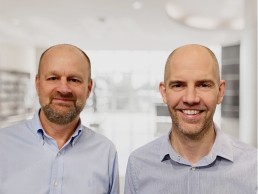
Paul Crisp & Alex Ruston
Following the acquisition of Precision Lighting and Remote Controlled Lighting (RCL) by Luminii in October, Managing Directors Paul Crisp and Alex Ruston tell us how the opportunity came about.
How did you both get into lighting?
Paul Crisp (PC): I first encountered the lighting industry when I ran an injection moulding business specialising in clear plastic moulding. The business was built around expertise in optical engineering, and we utilised this to develop a range of standard optics as LED technology first began to enter the lighting market. I soon realised the introduction of LEDs would change the shape of the lighting industry. I was hooked and have been working in the lighting industry ever since.
Alex Ruston (AR): In 1996 my father asked if I would help him out as he set up the UK office of a US lighting company called Translite. What was supposed to be a few weeks’ work, however, turned into 25 years.
Can you explain your lighting journey so far?
PC: My experience with the optical business was a great place to learn and understand the technology platforms and development roadmaps that were driving the move to LED technology and enabled me to engage with lighting businesses across the UK, Europe and North America. This proved a perfect grounding to move up the value chain and work with traditional lighting manufacturers managing the transition of their businesses to LED technology. In recent years, I have used this experience to work with several organisations looking to expand or develop their businesses, which is how I became involved with Luminii. I was immediately impressed with the company’s vision and ambition to develop a great architectural lighting business, and I am delighted that RCL and Precision Lighting have become part of this vision.
AR: We founded Precision Lighting in 2000, and then RCL followed in 2001. I was running Precision Lighting and my father was running RCL, and then in 2013 he stepped back from the day-to-day operations of RCL and I took over running both companies.
How did the acquisition come about?
AR: Precision Lighting and RCL have been pioneering lighting innovation on the international stage for decades. As we’ve continued to grow and establish our credibility, we have come to believe we should trust our light to lead the way. When Luminii approached us about these acquisitions, we saw significant and immediate opportunities to grow our story in highly interesting and new ways, with a shared vision related to product development. Luminii’s keen interest in expanding industry leadership internationally beyond the US and Canada merged well with our interest to introduce our distinctive advantages in new markets.
What was it about RCL and Precision Lighting that stood out?
PC: Luminii understands the ever-rising demand for constant innovation in lighting and is committed to a business posture that is ambitious enough to meet its customers’ expectations. RCL and Precision Lighting are highly strategic pieces to that puzzle. Among the many distinctions Precision Lighting has established over the years, the company has made impressive advancements in Micro-LED products and technology, complementing Luminii’s robust efforts to build upon its existing STENOS Micro-Linear platform. RCL, as well, offers highly complementary capabilities to Luminii’s portfolio-wide capacity to equip lighting professionals with highly flexible solutions.
Alex, what benefits do you believe this move will have for both Precision Lighting and RCL?
AR: We believe our strengths in product innovation and sales in categories and markets Luminii had yet to tap into will deliver major early wins for Luminii. We also can flex our abilities to serve as expert ambassadors of Luminii’s products in the European and Middle Eastern markets where we’re already well established. Conversely, availing our products to the broader Luminii portfolio through these acquisitions means our influence multiplies in new markets – and within Luminii’s existing customer base.
How will Precision Lighting and RCL fit into Luminii’s portfolio?
PC: In my role as the new Managing Director for Precision Lighting and RCL and in close collaboration with Alex, we are not focused on subtracting from or adding to the companies’ strengths – but in multiplying them within Luminii’s ecosystem and sphere of influence. For example, the acquisitions promise new avenues for both Precision Lighting and RCL to enhance our own engineering, operations, and manufacturing capabilities with those of Luminii.
In particular, the acquisitions represent a leap ahead for Luminii’s portfolio in areas of product miniaturisation and remote-controlled lighting. Likewise, the acquisition of RCL creates an entirely new product category for Luminii, and complements Luminii’s highly flexible solutions in ways that will also bring RCL products to life in new ways. While there are various pathways still being forged between all of Luminii’s brands, the bottom line for all brands is win-win across the board.
What can we expect to see from the brands post-acquisition?
AR: Both RCL and Precision Lighting have many new and exciting products in development. We continue to be incredibly focused on R&D and advancements that will result in industry-leading luminaires and control technologies.
What do you think the future holds for the lighting industry?
PC: The recent pandemic has brought into sharp focus the importance of wellbeing and great user experiences in all that we do. Public spaces will have to pay much more attention to the quality of the experience they provide, and lighting will have an even more significant role to play in helping to create the public spaces of the future. LED adoption has gone past the necessary obsession with lumens/watt and efficiency and is increasingly focusing on light and beam quality and the effect of light on wellbeing and creating beautiful spaces.
AR: I think that control technologies will continue to be at the forefront of the lighting industry. Our clients and specifiers are looking for complete control over all aspects of their lighting installations, and that’s something we will continue to tighten our focus on.
www.luminii.com
www.precisionlighting.co.uk
www.rclighting.com
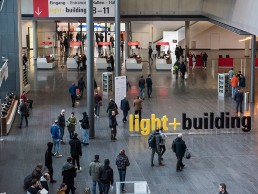
Messe Frankfurt issues update on Light + Building 2022
(Germany) – Messe Frankfurt, organisers of Light + Building, have issued an updated regarding the trade show, scheduled to take place on 13-18 March 2022.
Posted on the Light + Building website, the statement reads: “Until recently, we were looking forward with great confidence to Light + Building in March 2022 with customers at home and abroad. Due to the unforeseeable enormous dynamics in the development of the pandemic, decisions have to be reviewed again and again.
“Close exchange is a well-established instrument for us to take account of the broadest range of views as possible and to capture many voices.
“However, our discussions have clearly shown that a Light + Building will definitely take place in 2022, as essential parts of the industry and sectors involved need it.
“The concrete date 2022 will, thus, be decided depending on further developments. Please be assured that we will act responsibly and find a solution as quickly as possible.
“We will make a timely decision in January in the interest of a successful international Light + Building. Together with our partners and exhibitors’ representatives, we are intensively examining all possible options.
“We will, of course, keep you posted about any further developments.”
The announcement comes after the 2020 edition of the event was cancelled due to the Covid-19 pandemic.
www.light-building.messefrankfurt.com

Stoane Lighting becomes member of LightingEurope
(UK) – Stoane Lighting has announced that it has become a member of LightingEurope, and will be supporting its work to shape a healthy regulatory framework for the lighting industry in Europe.
Dave Hollingsbee, Managing Director of Stoane Lighting, said: “Stoane Lighting has always been a practical and pragmatic company. Other than lamps and control gear, we make our luminaires entirely in our machine shop and assembly space in Scotland. The prospect of pooling our experiences with other manufacturers’ as we explore new territory for our industry, particularly within an environmentalism context, is something we very much look forward to.”
Ourania Georgoutsakou, Secretary General of LightingEurope, added: “We are very pleased to be joined by Stoane Lighting at a time when Europe’s lighting industry is at a turning point. Sustainability and the circular economy are at the heart of Europe’s growth strategy and LightingEurope is the forum for Europe’s lighting manufacturers to forge a common vision of what sustainability means for lighting and to shape rules that allow companies to innovate and deliver on our green ambitions.
“Having Stoane Lighting’s ethos and experience at our table will make a significant contribution to our work.”
www.stoanelighting.com
www.lightingeurope.org

Artistic Licence DMXtoDALI quad
DMXtoDALI quad converts DMX512 to four circuits of DALI, allowing control of up to 256 DALI fixtures. The product offers conventional DT0 (intensity) control and also DT8 colour support for colour temperature and RGBWAF. Broadcast, Group, Device and Scene addressing modes are supported. Nine pre-configured personalities can be selected via RDM; these handle the mapping between DMX channels and DALI addresses required in common scenarios, greatly simplifying the user experience.
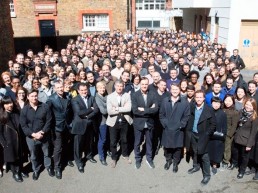
Zaha Hadid Architects transitions to employee ownership
(UK) - Through its recently established Employee Benefit Trust, Zaha Hadid Architects has transitioned to employee ownership.
Building on the vision of Zaha Hadid to entrust the practice to the friends and colleagues with whom she collaborated for several decades, the switch to employee ownership is a move that the studio feels will be beneficial long term.
A statement from ZHA said: “As the Trust has no external shareholders, we can now reinvest all profits back into the business, into our people, equipment and facilities to the benefit of all our employees; allowing us to prioritise our work with visionary clients, communities and industry experts around the world to advance the quality of the built environment.
“Building upon the experimentation and pursuit of discovery that Zaha so championed, we embrace new ideas and technologies to deliver a repertoire of projects that become more spatially inventive, more structurally efficient, more technologically advanced and more sustainable with each new design.
“Younger generations of architects are demanding our profession become more accessible and egalitarian. Supported by independent and transparent organisational systems and structures, employee ownership of ZHA will cultivate the skills and diversity that drives our decision-making and give every member of our team a voice in shaping our future.”

Lucent Lighting becomes carbon neutral
(UK) - After dedicating the past year to reducing its carbon emissions, Lucent Lighting has announced that it has achieved its target of becoming a carbon neutral business.
With businesses accounting for more than 85% of the total emissions in the UK, the company felt that now was the time to act, and as such put forward its aim to reduce plastics in its packaging, analyse its waste and recycling opportunities and assess materials within its products, while also achieving ISO14001:2015 Environmental Management Certification.
Lucent has also teamed up with Carbon Neutral Britain - the UK’s leading carbon offsetting initiative. Founded in 2020, its projects have already offset more than 500,000 tonnes of CO2 and planted more than 3 million trees, providing essential habitats for wildlife.
Alongside this, the company has chosen to support the Carbon Neutral Britain Climate Fund, which supports wind, solar, hydro and cook store projects focused on developing countries around the world; and the Carbon Neutral Britain Woodland Fund - this supports reforestations, deforestation prevention and woodland management projects focusing on the positive impact of local wildlife, ecology and biodiversity.
Michael Dunk, Managing Director of Lucent Lighting, said: “We are delighted that we have been able to be awarded Carbon Neutral status as a business and see this as a continuation of our commitment over the past few years to be as sustainable as possible across the business process.”

Entries open for 2022 Casambi Awards
Submissions are now being accepted for the 2022 Casambi Awards. Winners will be announced at the Casambi stand during Light+Building in Frankfurt, Germany, in March 2022.
Casambi has created two separate award categories this time around – best Casambi project and best Casambi Ready product.
Participants are invited to fill in either form for the best Casambi project or Casambi Ready product to enter the awards. All entries should include 4-10 high-quality photographs. Nominations can be submitted as a group, and there is no limit to how many entries you can submit.
Casambi project types that can be nominated
Any type of architectural lighting project that includes Casambi technology. If not completed, the project has to be at least in the final installation phase, and there are no restrictions on the project’s location.
https://casambi.com/casambi-awards-project-submission/
Casambi Ready Product types that can be nominated
Any product that includes Casambi technology, whether it be a switch, driver, sensor, luminaire, or anything else.
https://casambi.com/casambi-awards-product-submission/
Casambi says: “It doesn’t matter if you are a manufacturer, electrical consultant, architect, lighting designer, commissioning engineer, or influencer - the number one entry criterion is that entrants are passionate about lighting.”
The jury for the 2022 Casambi Awards is:
Till Armbruester, Head of Product Design, Licht Kunst Licht AG
Aristide Stucchi, President, A.A.G. Stucchi
Helen Ankers, Managing Editor, [d]arc media
Anton Biersack, CTO, Occhio GmbH
Rafael Urculo, Founder, Urculo Ingenieros
Zoe Faulkner, Associate, Troup Bywaters + Anders
The awards are free to enter, and entries will be open until the 1st of February 2022.
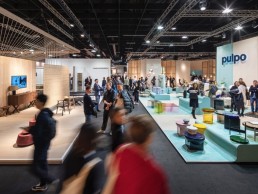
imm cologne 2022 cancelled
(Germany) - Originally scheduled for January 2022, imm cologne has been cancelled, event organisers have announced.
The executive board of Koelnmesse reached this decision in close consultation with the Association of the German Furniture Industry (VDM) and in agreement with other industry representatives at the international level.
“This step is restricted exclusively to imm cologne and its specific requirements for trade fair operations,” said COO Oliver Frese. “We are principally planning, as before, to carry out our Spring events in 2022. The political guidelines allow for this and, following the excellent and safe course of the past Autumn trade fairs, this must remain our mission in the interests of the participating industries.”
Jan Kurth, CEO of the VDM, added: “Following consultation with numerous exhibitors, industry representatives and trading partners, there is either no question of participation on the part of German exhibitors or exhibitors from the German-speaking region, or this is very much in doubt.”
Frese continued: “We didn’t make this very bitter decision easy for ourselves, but consider it to be our obligation to take this step now in close consultation with the industry. We are currently working actively on options for also still being able to offer exhibitors of imm cologne an attractive trade fair presence at the international level.”
Koelnmesse, together with the VDM and the exhibiting industry, are now looking ahead to 2023, when imm cologne will return.