
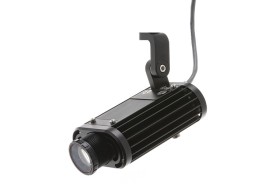
Rosco Image Spot Mini
The newest member of the Rosco Image Spot family of LED gobo projectors, Image Spot Mini, is lightweight (2.2 lbs /1.0 kg) and has an ultra-compact form factor measuring 131.2mm x 89mm x 108.55mm, making it an ideal fixture for discreet spot lighting and vivid gobo projection. Image Spot Mini will be available to ship this autumn in three IP65 rated models: 3,000K, 5,500K and UV.

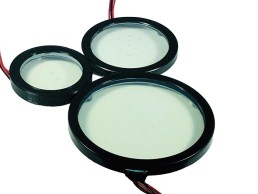
LensVector S2F Series
The LensVector S2F Series enables dynamic beam shaping between a 15° spot and a 35° flood. The new series complements LensVector’s first offering - the M2M Series. LensVector now offers all lenses in a smaller 35mm option that complements the current 48mm and 65mm lenses. With LensVector’s liquid crystal lens, luminaires can smoothly broaden beam size via wireless or wired control.
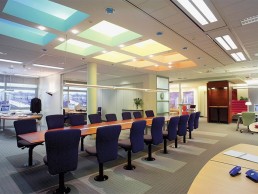
Lumileds Luxeon Fusion
Combining the needs of many tuning technologies, including dim to warm and dynamic tuning for human centric lighting, Luxeon Fusion addresses colour temperatures from 1,800-10,000K with high CRI (>90 over 95% of range) and high colour fidelity. Customers can now leverage the Luxeon Fusion platform technology, which unites white colour selection, dim to warm capability, SKU reduction and dynamically tunable white lighting - all designed for mass adoption, in one single solution.
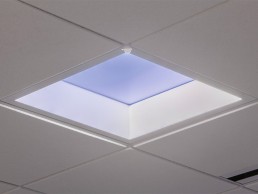
Cree Cadiant
The Cadiant dynamic skylight recreates the experience of being under a natural sky with remarkable realism, creating the sensation of natural sunlight and a blue sky in interior spaces via a virtual skylight experience. Cadiant uses advanced lighting controls in combination with multi-dimensional LED panels and colour-changing technology to simulate the natural dawn to dusk, east to west arc of the sun, providing a valuable sensory connection to the outdoors for people working in spaces without access to natural daylight.
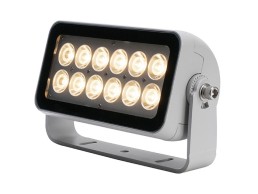
Acclaim Lighting Flood One EO
The Flood One EO is a high output, IP66 rated white LED floodlight in a very low-profile design, intended to fit into small spaces for façade lighting applications. Available in multiple colour temperatures (2,700K, 3,000K, 3,500K and 4,000K), it features a standard 10° beam angle with optional spread lenses of 20°, 40°, 60° and 10x60° for custom lighting applications. The Flood One EO performs at temperatures between -40°F to 125°F, and maintains 70% of its lumens for 150,000 hours.
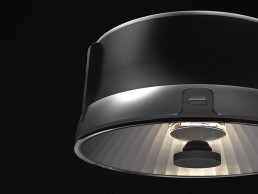
Ecosense Lore
Lore from Ecosense won ‘Most Innovative Product of the Year’ at Lightfair International. With Lore, Ecosense debuts its latest technology, including auto sensing protocol, 0.1% standard dimming, low glare/high control optics, and Lingo, a plug and play digital bus. All developed to simplify specification and save time. Lore is a full array downlight family with two aperture sizes. Ecosense offers recessed housings, trims, and the Lore cylinders include wall, ceiling, and suspended luminaires.

lightsphere
arc caught up with Julia Hartmann and lightsphere to see how these women are dominating Switzerland.
Headed by Julia Hartmann, alongside Project Director Melanie Heilgeist and Lighting Designer Carla Sigillo, lightsphere is an all female run lighting design practice based in Zurich, Switzerland.
Hartmann established the young team five years ago, after a successful eighteen years in the industry.
Reflecting on her desire to pursue a career that allowed her to be creative and inventive, she said: “Working as an independent lighting designer is a dream come true. As a child, I was interested in the relationships between nature, design and technology and was fascinated by the influence of light on humans.
“After completing my college degree in design, the path led me to interior design studies. There, I took part in a light workshop in the first semester, which inspired my professional future. The fascination for light and the use of light in the built environment soon became my passion,” reflected Hartmann.
“I wanted to be an inventor and explorer when I was younger. At a later stage in life, this changed to product design with a focus on bionic structures. As life is not a straightforward path, things and situations change along the way. But, looking back and reflecting on my career, I am actually where I wanted to be. In lighting design, we have to be inventors and explorers and at some stage we also have to develop or modify products. As well as that, as lighting designers, we are very close to nature and need to understand the influence of light on us as humans.”
Hartmann completed a degree in Interior Design at the University of Applied Sciences in Coburg, Germany. She became a student assistant for the Department of Lighting Technology during her time studying, which involved being partly responsible for establishing the university’s own light laboratory and organising multiple light workshops in Coburg and the surrounding areas.
This interest in light led her to become a student member of the ELDA and later the PLDA, which gave her access to valuable contacts in the industry early on. She then went on to complete a scholarship earned internship at the prestigious Lighting Planners Associates (LPA) in Singapore. After graduating with honours, Hartmann followed work to one of Switzerland’s largest lighting design offices, reflexion, where she stayed for six years.
“During this time, as a project and team leader, I was able to pass on my passion for light to colleagues and customers and worked on exciting major national and international projects,” she explained.
“At the age of 32, I decided to establish my own office in 2014 called lightsphere. Promoting young professionals has always been close to my heart, therefore I allowed students from the University of Wismar and Aalborg internship positions.”
Heilgeist began her light journey whilst studying interior design at the University of Applied Sciences and Art in Hildesheim. “During my Bachelor degree thesis, where I designed the interior of a Kindergarden in a big industry hall, questions like How do you bring interiors alive? How do you get light in the space when there is no daylight or it is a cloudy day? How do you create ambience, atmosphere or serve the use of a space with light? came up and there I realised the importance of light, artificial light and daylight,” she explained.
During her time at Hildesheim, she also took part in an exhibition, together with the lighting design students, that revealed the practicality of lighting a space and sparked her interest in the profession. Heilgeist then went on to complete a masters in Architectural Lighting Design in the UK and was later offered a job as a lighting designer in the London office of dpa lighting consultants and later in its UAE Dubai office, where she gained the experience she took with her to lightsphere.
Sigillo adds a construction element to the team at lightsphere with her experience as an architectural building engineer. At the age of 30, after working as an engineer for three years, Sigillo realised she was missing an element of creativity in her daily routine. “I began to reflect deeply on my passions - architecture, photography, light and design - and how to combine these creatively without moving too far from the building engineering and the skills I had gained during my education. This is how I came across the magical world of lighting design,” she explained.
After completing her engineering masters, Sigillo went on to finish a masters in Lighting Design at Aalborg University in Denmark, and then a Daylighting intensive course at the Parsons School of Design.
Designing “for the people” is one of the main focuses lightsphere maintains through its lighting practice.
“We approach lighting design from a multidisciplinary standpoint. The effects on users and the biological effect of lighting means we now conduct more research within our workflow. We also follow other industries to see how innovations can cross over. We are always searching for new inventions from all over design, research and science, so we can create the best possible results. Therefore, our clients’ needs are the key factor for our concept approach.”
Heilgeist added: “I personally believe that great and harmonious lighting design can only be achieved in a team within the company and in cooperation with the project team. Designing a lighting scheme requires you to understand the user and requires experience and knowledge of special fields in lighting. lightsphere is a team of exactly that variety in personalities, experiences and knowledge.
“On a daily basis, we strive to provide the best customised lighting solutions for each client technically, economically, but more importantly, in harmony with the look and feel of the space.”
Hartmann became the Swiss Women in Lighting ambassador after a close working relationship with Light Collective formed during The Perfect Light project.
“The key goal for me is that at some point in the future, we no longer talk about gender issues, and instead we talk about individuals and their achievements. It is all about sharing ideas and experiences within the profession,” described Hartmann about her role as a Women in Lighting ambassador.
“My experience as a female in the industry is that sometimes a situation occurs where some project partners tend to have preconceptions about your understanding of technical matters in a project, which leads to an assumption where they won’t take you seriously when dealing with technical questions. But, it’s always a great moment when they realise that you do know your job well, including the technical and control aspects. For me, it is more important to treat each individual respectfully to be able to collaborate in the best way possible,” she added.
“Another great thing about the Women in Lighting project is to encourage more, especially younger females, in the lighting industry to speak up and improve their self-confidence.”
With technology and scientific advancements happening at a rapid rate in the lighting industry, Hartmann maintains it is important to hold onto the foundations of the importance of good lighting.
“With all the technical possibilities we have nowadays, lighting design has become more and more diverse and the freedom of creation seems endless. But, the core intention for lighting design is to play with emotions and let magic happen.
“Knowing your tools is one thing. More importantly, empathy and the sense of creating beautiful spaces with light for the people using the space is key. I believe we have to work towards the direction to keep regulations in mind but not to blindly trust those guidelines, instead to use our aesthetical common sense and demand in creating beautiful spaces with light and shadow to enable people to have a better life.”
The importance of lighting and biological life is one area of research the team has dedicated a lot of time and effort into. Whilst working on the Zurich Innovation Centre for Givaudan, a world leader in producing flavours and fragrances, the team were required to create multiple lighting schemes for humans and plant life.
The space was divided into laboratory workspaces and a main atrium, used for recreation and communication. “The architects, from Bauart Architects and Planners, wanted to set a comparison between the laboratories where people need to work with high precision and high quality standards. In contrast, the atrium space is used for communication, recreation and exhibitions,” explained Hartmann.
“In addition to this remarkable building’s shape and use, the landscape architects from Schrämmli Landschaftsarchitektur wanted to integrate seven columns, twelve metres high, with living ornamental plants to enhance the atrium space and incorporate nature into the building.”
To solve the challenge of finding a light source that would enable the plants to not only survive, but thrive indoors, the team carried out numerous in-house experiments to find the ideal luminaire solution. At the time, Sigillo was completing her internship in the office and used this project as her Masters’ thesis research paper.
“After the successful integration of the bespoke luminaire, we - myself and Carla – joined forces with Dr. Karolina Zielinska Dabkovska to complete a research paper that was published in the online research magazine Sustainability. We wanted to share the results and experiences we gained over the years with the lighting design community to create better awareness and understanding on the complexity and processes necessary for using indoor plants, as it’s a highly complex setup,” elaborated Hartmann.
“Humans relate to light on an emotional and biological level. This happens individually in different ways; therefore it is important to understand the person or people using the space, building or environment. We, as humans react to light, it is important to carefully design the right light for the right time of day and task. We need to fulfil these requirements and demands but we also need to keep the magic and create a little sense of wonder.”
Over the short amount of time lightsphere has been practicing, the trio has achieved a lot of recognition in the industry and won numerous awards for their contribution to lighting design, including an IES Award of Merit for Energy and Environmental Lighting Design in 2017, the Lighting Design Studio of the Year 2019 Switzerland and Award for Excellence in Customised Luminaire Development 2019 by Lux Designer Awards , to name a few.
Championing a sentiment many aspire to achieve in the lighting industry today, Sigillo added: “I hope that my genuine passion for light, coupled with my technical skills, will contribute to push the world towards new visions and new sustainable lighting solutions, where natural and artificial lighting can work together seamlessly, guided by environmentally friendly principles.”
Furthering its journey, Hartmann described how she sees lightsphere moving forward and growing further: “We will keep going with our curiosity and love for light, and try to keep up to date with technology and design as well as science. We conduct our own research about various topics like biophilic design and LED light for indoor ornamental plants, which we want to foster and improve. With this mix and the magnificence of my team, which we will hopefully increase in the future, it motivates me and keeps me going. We will keep on exploring and inventing.”

Sarah Gaventa
As phase one of the Illuminated River project is set to be unveiled, we met up with Sarah Gaventa, Director of the Illuminated River Foundation, to chat about the project, and the importance of quality public realm lighting.
After more than two years of planning, the first phase of the Illuminated River project - an initiative that will see up to fifteen bridges along the River Thames adorned with new light installations - will be unveiled this summer.
Featuring artwork by renowned artist Leo Villareal, the project will become the longest public art installation in the world once complete, with the aim to “use light art to reconnect people to the bridges and their histories, and to celebrate their role in London”.
Leading the project is Sarah Gaventa, Director of the Illuminated River Foundation. Before joining Illuminated River, Gaventa was previously the UK government’s advisor on public space at the Commission for Architecture in the Built Environment (CABE), working as Director of CABE Space - the public realm element of the commission - for four years.
Prior to this, she was trained as an art design historian, getting her Masters at London’s Royal College of Art, and has a background curating shows and exhibitions on public art.
Having experience in both the art world and the public realm means that Gaventa is ideally placed for the Illuminated River project, as she says: “This job seemed right for me, in that its about trying to do something that is about bringing that marriage of art and architecture, and it’s something that is for the public benefit as well.”
Despite not coming from a lighting background, Gaventa is readily aware of the importance that light plays in creating a pleasant public space, thanks to her work with CABE. “I’m no expert, but I’ve always had an appreciation for it,” she said.
“CABE gives a lot of advice for how one were to design a public realm, and obviously lighting is a key part of that. We used to produce research and guidance, and light obviously has a massive impact on how people feel about a place.
“So there was always an element about finding the right kind of light that encourages people to use a space. Understanding how light is a psychological aspect in terms of how it makes people feel, understanding the role and significance of light, which is so important, was always an element within the wider scope of what we did when trying to improve our streets and public spaces and making them people-friendly.”
Taking a similar approach for Illuminated River, Gaventa was keen to ensure that the project did more than just illuminate the bridges, but to improve the surrounding areas as well.
“I knew that when we did this project, there was absolutely no point in just concentrating on where the light went on the bridges and not thinking about the quality of the lighting environment along the river,” she said.
“We’ve walked both the south and north bank with the lighting teams of both Southwark and City of London, who have both been very supportive, and just looked at the light levels, the light temperatures - which are quite interestingly much higher than the light levels of our artwork - to try and get some kind of continuity, not in colour terms, but so that there’s a quality environment for the public, and that they’re not going from light to dark to over-bright spaces.”
To back up this approach, Gaventa and the Illuminated River team conducted the first illuminance study of Central London along the river, analysing and looking at where all the light is coming from that is not needed. “I suppose in a way our project is focusing people’s attention,” she said. “Walking with the lighting team of Southwark, we realised that every third lamp was out, or it was a different colour temperature.
“So when you take the time to look, you realise what a patchwork it is and that really, it needs a bit more coordination, which local authorities are now trying to do, and there hasn’t been much coordination for example between the north and south bank. They are separate local authorities all the way along, and they don’t talk to each other about their lighting strategies. If you’re in the middle of a bridge and you look north, then you look south, the environment you’ll see in terms of the way it is lit will be completely uncoordinated and disparate.”
However, while the Illuminated River project will no doubt create a more unified lighting scheme across the Thames, Gaventa says that this was not a direct aim for the project, but instead a happy by-product of it. “It’s one of those things that once you start getting into this project, you realise that if you’re going to do one thing, you need to do the other, and this seemed like the most intelligent, thorough way of doing it,” she said.
“There’s nothing worse than when you go and see one project, and there’s another next to it and you think ‘well they didn’t talk to each other’, so a lot of it is about the dialogue, about discovering what’s possible.
“The only local authority with a public lighting strategy in London is the City of London, nobody else has one. And I do hope that as a result of Illuminated River, there will be more thought about that, and that there is a more coherent lighting strategy along the Thames.”
In her role as Director of the Illuminated River Foundation, Gaventa is responsible for coordinating the team, from the consultants and the support staff to the winning design team - Leo Villareal and architects Lifschutz Davidson Sandilands - as well as putting in place a timeline, budgets, and everything else needed to make the project a reality.
This also included the extensive planning and consultation process - something made all the more difficult because of the number of local authorities involved. “Last year we received 30 planning applications and eighteen listed building consents, delivered a programme of community consultation, which has been an incredibly important part of it, making sure that we’re not doing anything that’s bad for the environment, trying to reduce all the light spill that there currently is, reduce the light levels and energy consumption - it’s been quite a slog!
“And then we’ve been working with seven different local authorities - apparently we did the biggest single planning application outside of Crossrail and Tideway, and they both had acts of parliament. I think I must have had 24 pre-app meetings too. So it’s quite hard to do a pan-London project when there are so many different boroughs because you have to approach each separately.”
A huge boost in this process was the support of the Mayor of London’s office, something Gaventa believed was “crucial” for its acceptance with local authorities.
The idea for the project, Gaventa said, came from the Lord Rothschild, and was supported by the Greater London Authority (GLA) as they sought a cultural legacy project following on from the 2012 Olympics that spread across the city.
“An art-based project that would be seen by a lot of Londoners is quite a big ask, but the idea of lighting the bridges had been floating around for some time,” she said. “Nearly 20 years ago, when Lord Rothschild was Chair at Somerset House, he asked James Turrell to come up with a scheme for Waterloo Bridge. So this idea that had been floating around for a long time suddenly found its moment with the Mayor was looking for something, and it came from that.”
The designs for the project see Villareal and Lifschutz Davidson Sandilands create a unified, consistent scheme across the fifteen bridges, something that Gaventa was very keen on: “They’ve put together a very compelling proposal, which has a continuity between each of the bridges, whereas some of the other entries had completely different schemes with no coherence,” she said.
“We wanted something that felt curated, that there was a synergy between because currently, all of the bridges that are lit have no relationship with each other, in terms of the way that they’re lit, how they’re used or the approach that they’ve taken.”
The winning designs were chosen by a jury after more than 100 entries were submitted. However, while Mark Major was involved in the technical panel, the project came under criticism from some in the lighting community due to a lack of lighting professionals on the jury, something that Gaventa puts down to the fact that “every lighting designer in Britain went in for the competition, so it wouldn’t have worked very well if they were on the jury!”
Following the selection of Villareal and Lifschutz Davidson Sandilands, Illuminated River has been working closely with the ILP, getting young graduates involved with the project, while Atelier Ten are also on board, providing lighting engineering and design expertise.
The project has also collaborated with official connected lighting supplier Signify to create the Illuminated River apprenticeship - an initiative that will invite students to work with both Signify and the Illuminated Rivers team over the course of two years.
Indeed Gaventa was full of praise for the role that Signify has played in the project, stating that it is “more than just a supplier, they’re a partner. They’ve gone above and beyond”.
“They’ve been really good partners for us, and they’ve worked with us from day one. We have fortnightly project team meetings and they’re always at those as well, with whole day planning meetings. They’re more than a supplier, they’re on site with us because it’s their responsibility, and it’s obviously a high profile project for them as well.”
The collaboration with Signify extends beyond the provision of lighting products too. Illuminated Rivers is working with Signify on an app that allows them to look across social media and find out not only what people are saying about the installations, but also to see where viewers are taking photos. “This helps us to see where people are standing, and whether these spaces are appropriate in terms of how well they’re lit and whether they’re accessible,” Gaventa explained.
“Leo [Villareal] did something similar for his Bay Lights scheme in San Francisco. They collected similar data and found that the favourite place to take the best photograph of the artwork was actually a car park, so that eventually got transformed into a piece of public realm with a café.”
Throughout her career, Gaventa has shown a strong passion for public realm regeneration, for improving the quality of our living environment and creating spaces for the public to enjoy, and this passion has been further strengthened with the Illuminated Rivers project.
“For me, public spaces are the only democratic spaces we have left,” she said. “It doesn’t matter what income you have, what background you’re from, we’re all equal in a public space and they’re also vital for our mental wellbeing and health.
“I always think of a Ruskin quote that says ‘The measure of any great civilisation is its cities and a measure of a city’s greatness is to be found in the quality of its public spaces, its parks and squares’, and I think doing a project like this is another way of saying that we’re investing in people and giving something to the many rather than to the few.
“I’m also very keen on public art. The exhibition that I curated at Historic England looked at post-war public art. This was in the days when they’d build social housing estates and put a Henry Moore in it because it was felt that every person deserved to have the best quality experience of art, so for me this is another way of saying so.”
Gaventa added that she is hopeful that the new installations will attract more visitors of all ages to the Thames, while it might make some locals see the beautiful architecture that is already on their doorsteps in a whole new light.
“We have some data that says that younger people don’t see the Thames as an attraction or as a place to go. And we think that by bringing something as interesting as these artworks and light sculptures to the river, that would encourage younger people to use it.
“This is one of the wonderful things about light, if it encourages people to come, and if it encourages people to walk across bridges that they might have otherwise got a taxi or a bus over.
“When you walk across London Bridge, everyone has their heads down. They’re looking at their screens or they’re looking at the ground. If this makes a few people stop on their evening commute and just look at this amazing public space and look at the light sculptures - if it gives people this pause, that’s one of the things that light can do, it can give you a moment out of your busy day.
“I think with light we can reclaim the bridges, and if we can encourage people to enjoy them, then they have some of the best views of the city.
“This was one of the things that attracted me to the project. As soon as I realised it was more than just an art project, that it had some public benefits, I was much more interested in it.
“Because of the project’s longevity, it felt like something that could be worthwile, that could be of benefit to Londoners. It’s about using light to reveal the beauty of what’s already there, but it’s also nice to have something that’s a bit joyful in these times, and that’s the power of light really, it can do that.”
While the first four bridges are scheduled to be illuminated this summer, the work doesn’t stop for Gaventa and her team, with preparations already well underway for the next five bridges, due to be illuminated next year.
And she’s hopeful that the work of the Illuminated River Foundation will inspire other cities to follow suit and create similar installations: “I hope other people will then look at their own lighting plans, and we’re happy to share what we’ve learned,” she said. “I’m hoping that this will be seen as an example of how to do it well, and how you need the best lighting professional expertise to create a project like this.”
The Vessel, Gambia
Lighting designer, artist and Dark Source founder Kerem Asfuroglu tells us about his recent trip to Gambia for a charity venture, in collaboration with The Vessel UK and Daughters of Africa.
Long-time readers of arc will already be well aware of the work of Kerem Asfuroglu, as the lighting designer and artist regularly graces the pages of this magazine with his hard hitting Dark Source stories.
Since the turn of the year, the Hochschule Wismar graduate has founded his own independent lighting design and visual arts studio, Dark Source, following his departure from Speirs + Major - where he worked for almost eight years - in October of last year.
Passionately driven by its “social conscience and creative vision”, Asfuroglu’s aims for Dark Source are to work collaboratively to add value to public, architecture and design projects of various scales, with social-impact and community projects ranking very high on the studio’s agenda.
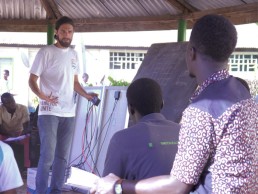
As part of this agenda, Asfuroglu recently teamed up with the Daughters of Africa Foundation and The Vessel UK for a charity project in Gambia, focused on training 30 local electricians about lighting design and solar energy to increase their employment potential, while also providing a new source of light for their local community. More than just another lighting design project, The Vessel is an innovative approach to target projects around the world to promote the universality and importance of lighting design.
The project came out of Asfuroglu’s charity work closer to home, as he explained: “In 2014, I volunteered at KORI, a community centre in North London that was focused on youth development.
“The community centre was founded and managed by a wonderful lady called Odiri Ighamre, who taught me a lot about youth-mentoring. The Vessel was a product of KORI that focused on empowering people to deliver projects in Africa through teamwork and sharing knowledge. They worked in various African countries before, but Gambia proved to be one of their most consistent partners.
“We always talked about doing something, but I never got around to it due to my professional commitments. When I left my job towards the end of 2018, I finally ran out of excuses.”
Electricity is an unreliable and very expensive resource in Gambia; apart from the main highways, the majority of the streets do not have any lighting. On top of this, approximately 600 million people in Africa cannot access or afford electricity, which forces people to consider oil-based lamps or candles for illumination, which can cause issues such as air pollution, fire, smoke poisoning and bad sight. The aim for The Vessel, therefore, was to demonstrate how designed light could improve lives - not only by replacing the incendiary illuminants, but also by offering an alternative to their blatantly utilitarian successors.
Following technical training at St. Peter’s High School in Lamin, the project was finalised with the practical installation of a solar power-based lighting scheme at a 24/7 accessible community library. “Alagie Ndow, the most charitable young man, offered the Inspiring Young Stars Library, which he set up to serve his community in Abuko,” said Asfurloglu.
“Our mission was to deliver a holistic training, which involved design concept, project management, site-work and even preparing portfolios for getting new jobs.”
Due to the lack of electricity and economic circumstances, some children travel up to six kilometres to attend the library, so Asfuroglu and The Vessel wanted to improve their studying experience through lighting design, while eliminating the power cuts and costs indefinitely.
The new design for the library consisted of multiple layers of light, with custom-designed pendant luminaires providing task lighting, spotlights for creating vertical emphasis and bespoke lanterns for flexibility.
A local artist produced the hand-woven pendant shades, as Asfuroglu explained: “All we did was identify that we needed pendants as a functional layer of light. It was important that the design felt local to create a sense of character familiar to the surrounding context and its users.
“We got in touch with a local artist named Tijan and coordinated the process through WhatsApp until we met in person. We only gave him a guideline idea about the scale and transmission, the rest is his magic. We are delighted that we can take no credit on that front.”
The spotlights focused on the walls revealed the colour and texture of the books, while creating a legible and well-lit space. Old-school kerosene lanterns found in second-hand shops were retrofitted with LED lamps. The transportable nature of these lanterns provided flexibility as they could be relocated based on need; for instance, two of these were hung outside the entrance to signal that the library is open, with a warm welcome.
Due to the very tight budget for the project, Asfuroglu said that they had “no funds for fancy equipment”. “It is a real eye opener,” he said. “It makes you appreciate the kit that you normally get to use over in this part of the world.
“We allocated more funds for the lamps to ensure a certain level of quality and longevity. We also brought enough spares to minimise the maintenance costs for the community.”
As well as the quality of light, mounting standards played an important role on the luminaire selection criteria. “Whether it is B22 or GU10, it was important to ensure that the right products can be found in the local market. Therefore all selected luminaires had to utilise interchangeable lamps for future-proofing.”
Asfuroglu also added that, owing to the difficulty in sourcing specific materials in Gambia, as the majority of electrical equipment is outsourced, most of the materials used - such as the solar panels, light fittings and cabling - had to be brought in from abroad.
However, he revealed that the overall equipment cost was less than £1,000 - and was completely financed through fundraising. The new scheme also provides a solar system capable of storing up to 1.2KW per day. “With five hours charge, the system provided more than eight hours of illumination, and enough additional power for other applications.”
The newly illuminated library features a complete 2700K LED scheme, something that is uncommon for Africa. “Due to the efficiency concerns, manufacturers don’t tend to provide LED lights in warmer colours,” Asfuroglu explained. “The popularity of the scheme busts the myth that warmer climates always opt for cool colour temperatures.”
Indeed, Asfuroglu said that he was “over the moon” to see how much the local community embraced and valued the scheme, particularly when considering the lasting social impact that the project will have on the area.
“Our biggest design question was ‘what will be left for the community once the project is over?’” he said. “Its social impact was meant to create sustainability and growth through training, evoking business ideas, connecting communities and improving social circumstances. As much as delivering a design project, it’s also about teaching how to sustain and spread the culture of design.
“True self-sufficiency relies on the knowledge to be sustainable, as well as the energy. Rather than importing a design, the project focused on local culture, issues and experience to generate its own workforce through sharing knowledge.
“I heard that one of our trainees, Pabi, wants to design lighting for his neighbourhood now. He’s trying to get households to join together and contribute. We cannot think of any better outcome than this.”
Having spent a month in Gambia for The Vessel project, Asfuroglu described his time there as “a profound experience”.
“Within the massive African continent, Gambia is a tiny country that is full of life and ambition,” he said. “The growing economy has not yet reached its full potential, therefore it is difficult for people to sustain themselves with a single job. This is why the lighting design course was timely for our 30 young electrician friends, helping them to broaden their approach and seek other opportunities.”
On his return to the UK, Asfuroglu has said that he is already looking for the next venture to get involved with, whether that be in Gambia, or elsewhere in Africa. He said: “Social impact and community projects rank very high in Dark Source’s agenda. We’d be happy to see ourselves going back soon, but it would need to be with the right people, and the right time.
“Charity projects demand considerable amounts of time and resources, therefore the coordinating partners play a very important role on bringing the project to life. With that said, we want to give a big shout out to The Vessel UK and Daughters of Africa. They have done an amazing job with coordinating the project and accommodating us. It would not have been the same without their personal care and involvement.”
And he has encouraged more lighting designers to get involved in initiatives such as these. “The Vessel was a design project that sought success in social impact, not excellence in visual aesthetic. It’s part of a movement that encourages lighting designers to take social responsibility in parts of the world where their skills may not be profitable, but certainly life changing.
“If you want to get involved, you should first scout for like-minded organisations and project managers who operate in the area of interest and consult them. Start a conversation. Think of what you can offer and make sure that it has deeper roots than just a two-dimensional lighting project. We would be happy to share our experience and point people in the right direction if we can, so feel free to give us a shout!”
Looking back on his time in Africa, while he feels that the whole experience was incredibly rewarding, there was one moment that stands out as a highlight.
“On our last working night, seeing the children comfortably study under the new light was our biggest reward,” he said. “Lots of parents showed up asking about the place, because the new lighting got their attention.
“As we stepped outside, we noticed that the power had gone out in town again, but the best part was that the children at the library did not even notice. This is how imminent design enhanced the quality of life.
“This project has been a profound experience for everyone who has taken part in it. As designers, we rarely get opportunities to improve lives in such an essential and straightforward way. We are forever in debt to our donors. This project would not have touched so many lives without their kindness.”
Following his return to the UK, Asfuroglu has received a great deal of recognition for his work in Gambia, notably receiving a special mention at the Lamp Awards. Noted as a “commendable piece of charity and social work...concerned with making a long lasting, sustainable difference within the community” by the judges, Asfuroglu received a donation of €1,000 in lighting material for Dark Source’s next social light project.
Dark Source would like to give special thanks to: Speirs + Major, Ben, Kay & Lisa Fitzsimons, Lionel M. & Margaret F. Harrold, Anne Moldenhauer, Roland Block, Hasan Gozlugol, Jonas Godehardt, Michael Dooney, Resat Bekflavioglu, Emre Gunes, Howard Lawrence, Irmgard, Rainer, Lucie, Satu Streatfield, Helga Iselin Waseth, Nassif Josef Nassig, Johannes Stahl, Carolina Marquezim-Emanuel, Enzo Mercedes, Clementine Fletcher-Smith, Dorit Bagehorn, Yasin Caliskan, Jack Wates, Cem Bektas, Ben Krueger, Frederik Friederichs, Hakan Kose, Katia Kolovea, Melody Culanah, Rosie Morgan & Bojana Nicolic.
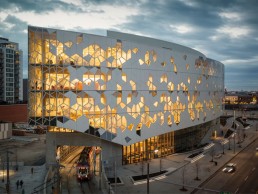
Calgary Central Library, Canada
The new public library in the centre of Calgary, Alberta, is an educational and physical bridge for the community and provides extensive spaces to be utilised by the everyone. The lighting scheme by SMP Engineering merges daylight and LED harmoniously in the nature influenced architecture.
The library covers an expanse of 240,000 sqft in the heart of the cultural district of the city, was completed in November 2018.
Construction commenced in 2013 for the striking modern structure, which was an award winning design derived from collaboration between Snøhetta and Dilaog, and captures the city’s desires for a technologically advanced public space.
The $146 million project is the largest public investment for Calgary since the 1988 Olympics and marked the beginning of a new chapter to develop its creativity, innovation, knowledge and technology in the rapidly growing city.
The lighting scheme was designed and implemented by SMP Engineering. Bradly Trufen, Electrical Designer at SMP Engineering, described to arc how they became involved with the project at the beginning: “SMP is the largest company of its kind in Western Canada and has been around for more than 42 years. I think our services and portfolio of past projects played a key role in us being awarded this job.
“We were approached with an initial concept, which is pretty typical. It’s our job to push the limits and try to get as close to the conceptual idea as possible. But the project lighting design is dynamic, it’s constantly changing until the project is complete – we only get one shot to get it right. You can’t go back to the client and ask for a redo,” he added.
The building is located on the Light Rail Transit Line and acts as a bridge between the previously divided Downtown and East Village areas. Acting as a space for social interaction, studying, learning and community activities, the library is a hub for celebrating inclusivity.
“Doubling as a portal and a bridge, the entry plaza heals the previously split seam between the two neighbourhoods and re-establishes visual and pedestrian connections across the site,” claimed Snøhetta.
The façade of the structure is cladded with hexagonal modular pieces of fritted glass and occasional iridescent aluminium that form an aesthetically pleasing pattern across the curved surface and allow natural light to gently filter through. The entire surface of the building is covered in this geometric pattern, which suggests there is no one particular front entrance, again reinforcing the goal of the architecture to be unifying and all-inclusive.
When approaching the entrance to the library, visitors are welcomed by one of the largest freeform timber shells in the world referencing the Chinook cloud arches that are common to the area, formed from local western red cedar.
Explaining the layout of the building further, Snøhetta described how the wooden archway “spirals upward over 85 feet to a view of the sky through the oculus. Wood slats line the perimeter of the open atrium, shaped in plan like a pointed ellipse, serving as an orientation device for people to quickly grasp the circulation and organisational logic of the library. The rhythm of the beams and columns are reminiscent of a stoa, the public, open-air colonnades of ancient Greek architecture that doubled as spaces of gathering and intellectual exchange”.
The six floors of the library have designated spaces with varying uses, including a 350-seat theatre and performance hall. A programme of lively events, public activities and the children’s library, with play areas, occupy the lower floors, which then gradually transition into quieter study areas moving upwards until reaching the Great Reading Room on the uppermost level. Visitors enter this inspiring workplace through a transitional space of softened light and acoustics. Natural light plays a key role in illuminating this room, peeping through wooden slats that provide glancing sightlines between the atrium and the western façade.
“Emphasising the interplay between daylight and architecture, the design approach was to embrace the ever-changing Southern Alberta sky. Lighting should be discreet: enhancing and supporting daylight, maintaining Calgary’s dynamic natural light as key lighting,” explained SMP Engineering.
“Linear LED luminaires suspended amongst acoustic baffles provide ambient lighting, ensuring illuminance targets are met. Sloping walkways are lit asymmetrically with lines of recessed LED lighting tracing exterior walls. LED spotlights and downlights illuminate public art and areas that are out of reach by the aforementioned techniques. Elsewhere, luminaires are placed directly above areas requiring illumination: shelving-integrated lighting for the stacks; stairways lit by LED-integrated handrails. Feature lighting denotes distinctive spaces – areas requiring lighting as unique as the spaces themselves.”
“Throughout the design, we sat down and discussed integration of lighting into the architecture,” reflected Trufen. “Our role is to always be creative and to provide options for discussion. I don’t think our creativity was ever stifled in any way. It is a bit depressing when you come up with an idea you consider brilliant and they are shot down in a moment! But I am an optimist and I don’t like to dwell; I focus on the ideas that stick. We need to look at the bigger picture and any place that we can help the team in this regard is a win.”
The addition of dimming and daylight harvesting throughout the space helps to maintain the illuminance levels, regardless of the time or weather conditions outside. End-user digital controls allow for control over the entire design, which also ensures the awareness of luminaire usage and energy consumption. The library was built to be one of the most energy efficient structures of its kind, which played a vital factor in the designing and fixture choices made by SMP Engineering. “We needed one of the most adaptable lighting control systems on the market,” explained Trufen.
“That meant no proprietary control hardware; reprogramming with remote access and user interface and a long warranty and support from the manufacturer”.
In terms of designing a scheme for the Calgary Library, the SMP Engineering team stepped out of the box and, in some areas, did the opposite of what many designers would attempt.
“There is a current stigma in the architectural world for having visible fixtures. They want the light to appear out of cracks in the architecture. To make this a reality requires a bit of juggling of the wants of the client and the architect and the needs of the relative codes. We managed by approaching lighting in all the different methods available and narrow them down until we have the best solution. It is a lot of work but it pays off in the end,” explained Trufen.
“The entry vestibule was a new design to me. Typically, we try to hide LED sources, but the limited space in the vestibule didn’t allow enough room for a proper dispersion of light. Having even illumination is a trend. Going with a trend doesn’t give you any attention as you’re just in the pack. So, instead of fighting the design, we embraced it. The end result was like one of those old-time Vegas casino signs. It makes the entrance stand out, inviting and above all else interesting. I’m sure any lighting designer will scoff at it, but I’m not designing this space for them. This is for the public.”
The team also came across other challenges along the way, such as the installation of lighting under the sprinkler lines. “The architect wanted the open ceilings simplified so as to avoid clutter,” Trufen elaborated. “This meant varying lengths in the fixture, which was a nightmare to organise.
“Another challenge was the suspended fixtures in the enclosed public spaces. The doors were full height, so the fixture needed to be stepped back to avoid the door swing. Sounds easy enough, but coordinating the length of each piece was anything but”.
Upon reflection, Trufen comments the challenges and failures are opportunities for learning experiences and claims they are the highlights of the project. “I’m excited about the result. Some areas turned out better than I originally anticipated and others I look back on and consider what I would do different. The stuff that keeps you up at night is the most exciting and rewarding,” he concluded.
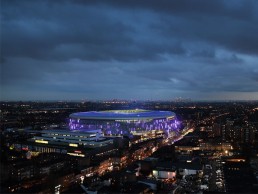
Tottenham Hotspur Stadium, UK
The new Tottenham Hotspur Stadium has been gaining plaudits from sports and architecture aficionados alike. With lighting designed by BuroHappold, in collaboration with Populous, F3 Architects and Zumtobel Group, it is a shining beacon for other teams to aspire to.
Sports fans around the world will already be keenly aware of the newly opened Tottenham Hotspur Stadium, as until its official opening this April, it was one of the most hotly anticipated new sporting venues in the world.
Located on the site of the London club’s former White Hart Lane ground, the 62,062-seater multi-purpose venue will not only be home to Tottenham Hotspur Football Club, but will also host National Football League (NFL) games - it is the first purpose-built NFL stadium to be constructed outside of the United States - concerts, and other major events.
More than just a stadium, the new facility features a vast array of hospitality venues, from the Chairman’s Lounge and VIP Boxes to the Tunnel Club - an exclusive restaurant that looks out onto the tunnel as players enter and leave the pitch, the 65-metre-long Goal Line Bar - the longest continuous bar in Europe, and an in-house microbrewery for local craft brewery Beavertown.
The stadium - the second largest club stadium in the UK behind Manchester United’s Old Trafford - was developed by Populous and F3 Architects, who worked in collaboration with BuroHappold and Lighting Partners Zumtobel Group on the lighting design.
The lighting design was developed as part of a large, collaborative consultation process between Populous, F3 and BuroHappold. Both architecture firms had visual preferences, and the lighting designers would advise on lighting arrangements and specifications that could be incorporated in order to achieve their vision together, while BuroHappold also brought ideas and lighting concepts to the table, which assisted to provide a well co-ordinated and cohesive lighting scheme.
This collaborative effort aimed to provide a comfortable and safe environment for players, employees and visitors alike, while providing perfect illumination for the many different requirements, from the fan experience, to the player’s facilities, media zones and behind-the-scenes areas.
With player wellbeing being of paramount importance, considerable attention was given to circadian rhythms in the changing rooms, physio and relaxation spaces, meaning that the lighting had to be catered for the different times of day when the players used the facilities. With this in mind, the design team used Zumtobel’s Panos Infinity, with a white-light range of 2700-6500K, which offers the user a range of options to adjust the colour temperature to the respective application. The Austrian manufacturer’s Slotlight tunableWhite and RGBW LED tape has also been utilised in this area, while the players’ tunnel has been illuminated using Custom Active Light Wall - two huge stretch ceiling fittings that were personalised in Zumtobel’s Dornbirn factory.
Complementing these approaches, JPR Lighting was commissioned by F3 Architects for the design, development, manufacture and full on-site installation of bespoke signature lighting for a number of specialist areas in the stadium. This included the Players Lounge - a space where players are given a psychological boost before each game.
Subliminal hexagon design details throughout the lounge intend to help the players focus prior to the game. Key to the success of the space, the design themes are echoed by the lighting. The hexagon ceiling system comprises acoustic sections and light boxes for a complete ceiling system. The light boxes include a track and sheet system with LED sources.
For the hospitality areas, BuroHappold worked closely with Populous to develop concepts that would capture the various vibrant interior spaces. A key requirement for the stadium was to create internal spaces where visitors could spend time and indulge for longer periods than normally associated with football stadiums, prolonging the matchday experience and inviting fans to arrive early and leave late.
“Tottenham has such a great and growing industry of local producers of food and drink, and we really wanted to showcase that. So we created this street food meets beer hall environment, and it’s a fantastic place to meet both before and after the game,” said Chris Lee, Managing Director of Populous.
“We wanted to produce an environment where the spectators can choose where they want to go. Some of the stuff we loved about American sports and American stadiums is the idea that you came for the whole day, and you could choose to go to different bars or restaurants and have different experiences during the day or from trip to trip.”
To differentiate the plethora of different areas that fans can experience, each hospitality area has its own distinct individual character and identity, which is reflected in the lighting.
Lighting was developed to ensure that there were distinct layers, creating depth and providing visual emphasis to areas of interest. For the most part, a system of lighting included for the general illumination of each space with horizontal lighting was provided by downlights, track spotlights or surface mounted canister downlights, such as acdc’s Novus and Novus Mini downlights. This was then complemented with emphasis on the illumination of vertical surfaces.
To bring the whole scheme together, decorative lighting was added via suspended pendants and integrated lighting within the furniture and architectural structures. These three components of lighting assist to provide the layering required, while the use of dimming to reduce the background lighting provides further emphasis to the feature lighting, enhancing the character of each individual area or space.
Alongside the Players Lounge, JPR Lighting worked with F3 and BuroHappold on a range of specialist areas, including the Media Café, H-Club Members Suite, and the Sky Lounge Stratus East and West atriums, totalling more than 24,000sqm of floor area.
The Media Café acts as a hub for the press on matchdays, with screens visible at all angles. The multi-functional space includes a café that is also open to the public outside of matchdays, with a back section closed off through a bi-folding wall. The lighting in this space was a real focus to enable a seamless fluidity throughout each of the spaces when open together. JPR’s design team developed a unique housing that was fabricated around the club’s vision. A series of continuous swirl lights around 28-metres in length were designed with one-piece diffusers for a seamless finish. Organically flowing through the Media Café, these solutions bring fluidity to the adjoining environments. Zumtobel’s Vivo spotlights, finished in a custom blue colour to match the team colours, complement JPR’s bespoke fixtures.
The H-Club, a ‘discerning private members club thrust into the world of entertainment’, is steeped in the history of Tottenham Hostpurs’ founding years. JPR’s fully bespoke lighting solution featured around the circumference of the H-Club’s Luminaire Bar and lift lobby. The brass fronted step lantern echoes the luxurious details throughout the suite. Pre-fabricated into individual sections, the lighting installed onsite features more than 230-metres of diffused LED.
The Stratus East and West atrium lounges are modern, contemporary spaces where fans can enjoy stunning panoramic views across London from the highest vantage point available in the stadium, and a birds-eye view of the pitch during game days. For this area, a triangular ceiling design was presented to the JPR team, which was developed into an array of bespoke lightbox and acoustic solutions. The ceiling layout comprises more than 500 bespoke triangle boxes throughout the East and West wings of the Sky Lounge.
In its role as Lighting Partner for the new stadium, Zumtobel Group was heavily involved in the lighting, right down to the design process, as Elliot Evans, lighting designer at Zumtobel Group, explained: “For Tottenham, partnership was key, so we worked closely with BuroHappold, Populous and F3 Architects, and translated the specifications and ideas of the architects and lighting designers into a tangible lighting scheme.
“As a company, we have designed lighting schemes for a wide range of projects, including commercial and retail space, urban landscapes and leisure facilities, and this project allowed us to work from this expertise.”
Farhad Rahim, Associate Director of BuroHappold, added: “With the wide use of products from Zumtobel, acdc, Simes and Thorn, this gave a large palette of luminaires to address the lighting requirements without having to compromise.
“Zumtobel Group played a key part in assisting with the lighting designs, with advice on the choice of luminaires, technical details of the lighting, and assisting with mock-ups on site for client approval.”
More than 77,000 luminaires from Zumtobel Group and its various lighting brands have been installed throughout the stadium, and Evans revealed that Tottenham Hotspur’s hierarchy even played a role in which products were selected: “Each of our clients work in different ways, with some wanting to get more involved than others. However, working on such a high profile, high budget project, we would have expected the hierarchy, including Chairman Daniel Levy, to be involved, and we welcomed the input.”
As the Tottenham Hotspur Stadium is the only venue in the English Premier League that is situated on a high street, with a direct presence in the local community - the stadium is actually part of a wider regeneration project for the area - it was vital that it have a striking visual presence. Lighting played a major factor in this, as from the outset of the project, designers hoped to use light to create an instantly recognisable stadium that would be seen by millions around the world while delivering the ultimate matchday and visitor experience.
Key to this is its impressive ‘halo’ of light. Created using 380 pieces of acdc’s Blade RGB linear luminaires, the halo creates an iconic scene of light visible from a birds eye view, while enhancing the guest experience for those inside the stadium. With their beam angle control and minimalistic design, acdc’s Blade fixtures blend seamlessly into the architecture of the stadium.
Alongside the stadium-topping halo of light, the Blade fixtures are used across the façade of the building, setting the scene for approaching fans and guiding them towards the stadium. However, due to the built-up nature of the stadium’s surroundings, care and consideration had to be given to the local community, ensuring that the façade lighting didn’t spill out into the night. As such, acdc worked closely with the architects and consultants, creating several mock-ups and undergoing a number of intensive tests, before developing a custom louvre for the fixtures, ensuring the right level of glare control.
“We wanted a building that was transparent, that was welcoming, and the veil that wraps the building, with its blue lighting, was about responding to different conditions to create a dynamic building with dynamic architecture,” Lee added.
Alongside the impressive façade lighting, on the ground, the external lighting scheme was orientated around the use of bespoke lighting columns incorporated with multiple spotlights that provide large areas of coverage from a single column, which together with the incorporation of other components - such as CCTV, WiFi and Audio - assists in reducing clutter and cutting down the number of columns for both lighting and other services in the external public areas.
Mesh Lighting specified these columns, manufactured by Technilum, to ringfence the whole of the outside of the stadium, as well as the approach. Ranging in height from four to 20 metres, the poles were specified from the Structure K range, and are paired with projectors courtesy of Simes and acdc.
One of the main challenges that comes when creating a new sporting venue, particularly one with a ‘bowl’ structure such as this, is that, in doing so, it loses some of the charm and character of the team’s former home, instead becoming just another ‘identikit’ stadium.
“This is something that Tottenham was aware of and focused on from the beginning,” said Evans. “In fact, everywhere you look in the new stadium there is a nod to the history of the club.
“White Hart Lane was always known for its fantastic atmosphere and Tottenham has worked tirelessly to find ways to recreate this feeling in the new scheme.
“The whole lighting scheme has been designed to enhance the matchday experience for the supporters, for example, over 360 RGB floodlights have been used to light the underside of the roof, alongside the more than 600 linear RGB luminaires that create the instantly recognisable façade and halo effect, creating the new face of White Hart Lane.”
Indeed the new venue features a number of nods to Spurs’ former home, with some of the original brickwork and flooring taken from the old White Hart Lane and installed in the new stadium. The concourses are also filled with links to the club’s heritage, giving the ground its own sense of character.
“I think one of the important things from an architectural perspective was that we wanted to produce a building that, while upgrading the quality, didn’t lose the authenticity of what football stadiums are all about,” Lee said.
“It’s easy when you upgrade quality to make it too posh or too slick, so we wanted to produce an environment and use materials that were real and genuine, that would wear and that would look better in ten years time.
“As a sports architect, the challenge to design an amazing soccer stadium that’s genuine and authentic, that has a seating bowl that’s incredibly atmospheric, this is what it’s all about. We wanted to create a seating bowl that had identity, that had character, that wasn’t a symmetrical, ubiquitous stadium where you didn’t know where you were.”
Since the stadium’s official opening - a 2-0 victory for Tottenham Hotspur over Crystal Palace - it has gained plaudits from sports fans and architecture aficionados the world over. And for Evans, himself a Spurs fan, it was a special moment to see it finally open.
“It was an honour to be involved in the stadium, as it’s such an iconic project and it has a real history with a community feel - they have built something that people can be proud of for decades.
“The whole team is proud of the collaboration and what we have achieved, and on a personal level, as a long-time Tottenham fan, this has been a dream for me, and I have enjoyed seeing the project develop and the stadium finally open.
“It’s a fantastic scheme that uses the very latest lighting technology, is sustainable and future-proofed for any changes - it brings the club into a different league.”
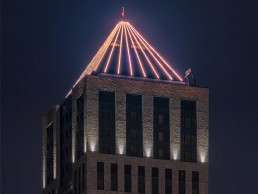
Nurol Life, Turkey
Turkish lighting design studio ZKLD has created a minimalist, elegant lighting scheme to complement the new Nurol Life tower complex, comfortably placing it within the wider Istanbul skyline.
Located in the heart of Istanbul, Turkey, Nurol Life is a new complex housing 501 residences and 50 offices. Completed in 2018, the building stands at 220 metres high, and is nestled in between the city centre and the Belgrad Forest.
Due to its proximity to the luxurious elements, coupled with its sleek look and minimalist design approach, Nurol Life is centred on the concept of ‘Practical Luxury’, with the aim to make life feel easier for its occupants.
Designed by Hakan Kiran Architecture, with interior design from Autoban, the lighting design for the complex was created by ZKLD Light Design Studio. The main idea for the lighting design was to complement the ‘Practical Luxury’ concept, creating a cosy and pleasant ambiance that makes people feel welcome on a human scale, while adding to its eye-catching architectural design, highlighting its iconic look on wider the city scale.
Because of the tower’s height and location, the façade was integral to ZKLD’s lighting design right from the start, as Mustafa Akkaya, lighting designer at the firm, explained: “At the beginning of the project, a mutual exchange of ideas was made with the client and the architectural team.
“During the next phases, we put forward possibilities of light that could emphasise the structure, and new ideas came in from there. The collaboration of ideas put a great emphasis on the lighting scheme during the whole process.”
The façade lighting for Nurol Life was broken down into three separate parts: the first, the base of the tower, related to the common areas and offices on the lower floors, and how the building is perceived from street level. The second part relates to the residential properties in the main body of the tower, while the final part relates to the ‘Pyramid Lounge’, situated at the building’s peak, and the pyramid form that can easily be perceived in the wider city scale.
At the base of the building, the lighting designed by ZKLD illuminates the entrances with mid-power uplights in a move to try and keep the building looking “calm and elegant”.
To accentuate the silhouette of the building, while retaining a minimalist appearance, the main body of the tower is lit from the corners. This illumination was achieved through the use of very narrow, 5-degree Philips Color Kinetics LED projectors at 3000K that were placed at the bottom corners of the tower.
The other application for façade illumination created by ZKLD was to highlight the surfaces of the balcony sidewalls with Assan line Power Plus graze lighting fixtures recessed on the floor of the balconies.
“It was a great challenge to graze the surfaces homogenously whilst preventing light spill going through the windows of other residences,” said Akkaya. “Several mock-ups, where we played with the lenses of 3000K linear power LED fixtures, had to be done to obtain the desired result.”
The graze lighting on the façade helps to showcase the stone cladding materials; with the graze lighting effect, the texture of the stone is highlighted, helping to break the monotonous look of the tower.
The tower-topping Pyramid Lounge is the most attractive part of the project, not just for the building inhabitants, but also in highlighting the building amongst the city’s skyline - and it is particularly notable for its geometric shape. To highlight this geometry, and give the building an iconic status within the city, lines of light, underline the shape of the pyramid. However, while these light lines give a message to the wider city, it was important for the reflected lights and visible fixtures not to disturb inhabitants who spend time inside the pyramid.
To make this a reality, a special profile was designed between two glass panels to conceal linear lighting fixtures. With the Philips Colour Kinetics RGBW, pixel-controlled LED fixtures, the designers are able to create special lighting scenarios for special events and national holidays, while retaining a sleek, minimalist look throughout the majority of the year.
This minimalist approach is something that was very important to ZKLD, as Akkaya explained: “Light is an instrument that brings a dramatic effect to a space, but it has to fit with the natural aesthetic of the building.
“We aimed to keep this drama elegant and minimal, by illuminating the building modestly from the inner side balconies, and the iconic geometric shape on the roof.”
Alongside the façade illumination, ZKLD created a lighting scheme for the surrounding landscape, extending the simple, relaxed aesthetic, while adding to the cosy atmosphere that the designers wished to create for residents.
This landscape lighting is blended with the tower, and constitutes the front of the building, a courtyard in the middle of the office space, a pool terrace and the rooftop. For each of these areas, a colour temperature of 3000K was chosen to complement the façade lighting, while creating a series of cosy and serene ambiances.
As part of this landscape lighting scheme, Heper Vesta S and Norma luminaires were used to highlight the road and pedestrian paths, while Faro Shadow LEDs created effect lighting on the grass.
For the main entrance of the building, the aim of the lighting design was to create a highlighted entrance, without any distortion on the visual perception of the interior. Keeping illuminance below eye level was the essential idea of this area’s lighting concept; therefore short bollards with double-sided light distribution were used.
The courtyard, with its small water feature at the centre, is an important breathing space not only for office employees, but the inhabitants as a whole, due to its location. To create a ground-level illuminance, so as not to disturb the office employees while they are working, floorwashers and spike spotlights were chosen to create the desired level of ambiance.
Another spectacular part of this project is the pool terrace: in this area, repetitive linear forms within the architecture served as a starting point for the lighting concept, while Vibia’s Meridiano Series creates warm, cosy and light-shadow effects on the surfaces, as Akkaya explained: “The rhythmic light beams are constituted to create a dramatic atmosphere. The wall sconces that have 360-degree linear light effects are also used to boost light and shadow, underlining the linear form of the architecture.”
At the rooftop, as with the rest of the project, cosiness and simplicity were the main factors in the lighting concept. The use of both up and downlighting fixtures with different light distributions were used for the pathway lighting; as the wider beam helps to illuminate the canopy, narrow beam fixtures help to create a dramatic atmosphere with rhythmically lit pillars to guide people through the pathway.L&L Luce&Light’s Step 6.2 floor-recessed luminaires were used to create this rhythmic effect across the terrace level.
Apart from these up and downlighting fixtures, all luminaires are kept below eye-level: illumination in other parts of the rooftop includes one-sided floorwashers at the side of the walkways, while a diffuse light emanates from the vegetation lighting. Special bollards, again fitted with 360-degree light effects, are used to continue the light and shadow motif present in the pool terrace, therefore keeping the whole lighting design integrated within the architectural language of the landscape.
Such integration was essential for placing Nurol Life into the fabric of the city as a whole - a key facet of the initial concept. “Lighting elements were mainly chosen in accordance with the conceptual idea,” Akkaya said. “Nurol Life is a structure in the centre of a metropolitan city, therefore we needed to keep in mind that it will be affected by its surroundings all the time.
“For this reason, we were very careful with the surrounding buildings and as such we differentiated lighting levels according to the needs of each space. On the different layers of the building, such as the balconies, indirect lights were chosen to avoid visual discomfort during the design development process.”
Akkaya added that ZKLD’s close relationship with the architects, developed from previous projects, helped to make the whole process as streamlined as possible.
“In every project, the essential point is the conceptual idea: there are different ideas inspired by each project, its people and its surroundings. For Nurol Life, we aimed to enhance the architectural details by using the power of light.
“Lighting design played an important role in reflecting the ideas of the project, and seeing this minimalist and elegant touch in the silhouette of Istanbul is a great feeling. Alongside this, Nurol Life has a unique place as its own reflection in the heart of the city.”
