
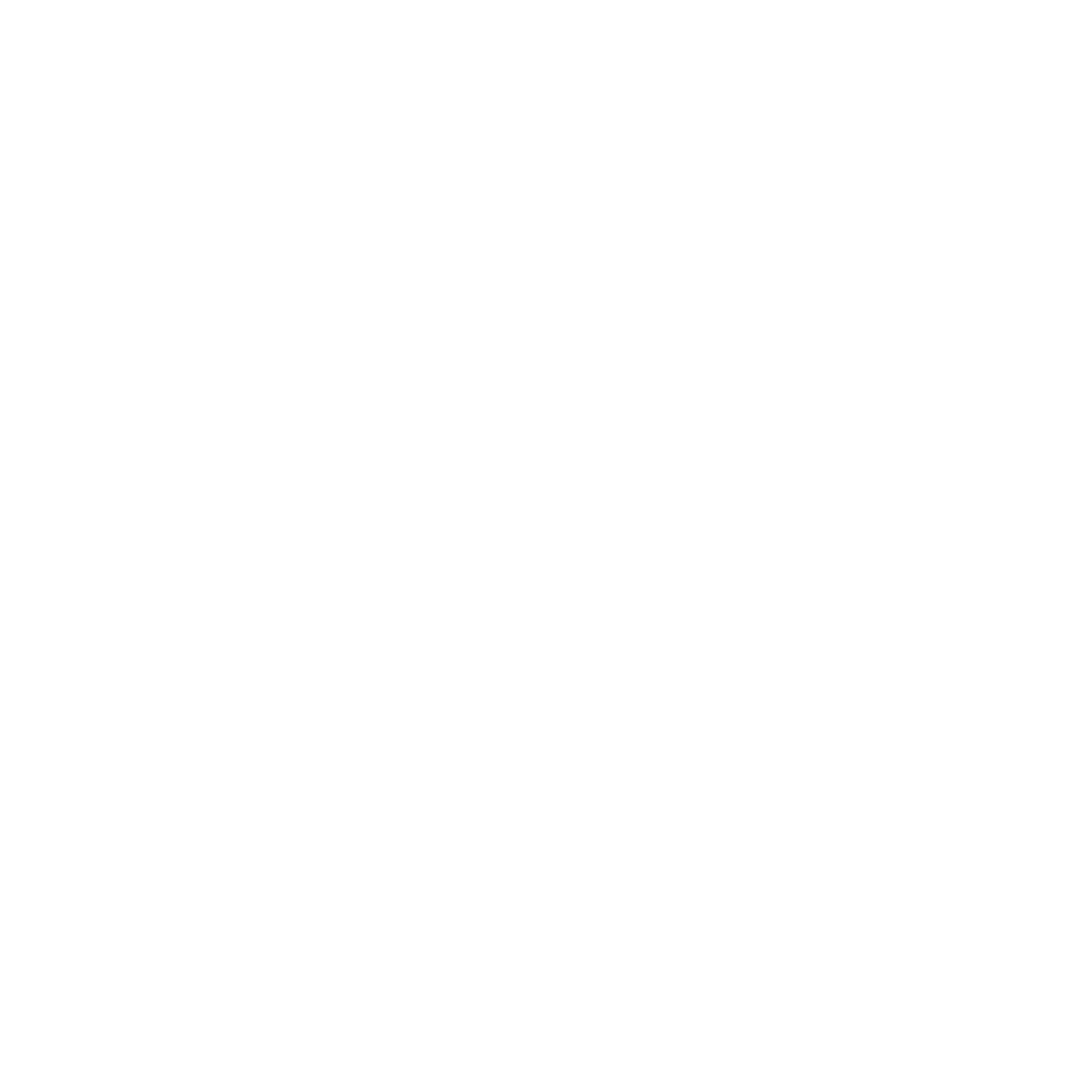
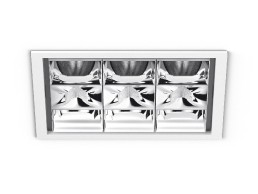
XAL Unico
Unico represents a truly unique level of flexibility. The downlight offers the right solution for every requirement. Architects and lighting designers can choose between two mounting options (trim or trimless), seven design shapes, nine light insets, three colour temperatures and three control options, all of which can be individually combined. The micro-faceted reflector technology combines precise light control with a high level of efficiency and excellent glare reduction.

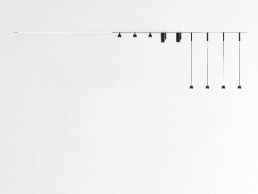
Modular Lighting Systems Pista
Pista is a thin and slim magnetic track rail system that is customisable in both length and configuration. With Pista you can combine linear LED, for general lighting, and spots, for accent lighting. Twin Bracket enables designers to use two parallel rails to create symmetrical or asymmetrical configurations, while Night Light is a light fixture in disguise: when the light is on, the black diffuser creates a soft glow. When off, it looks like an elegant black accent.

DIAL DIALux evo 8.1
With DIALux evo 8.1 DIAL has developed a new version of its lighting design software, which is now available for download free of charge. With this update the software is not only faster but also offers many new features, which make the user’s work easier. Among the new features are a help function, an assistant for importing DWG plans and documentation for zones extending over several floors.
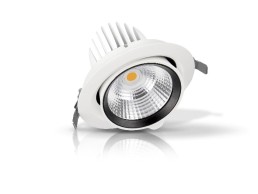
LEDVANCE Spot Vario
The Spot Vario provides the ultimate flexibility in retail lighting installations. This recessed spotlight can be used as a classic downlight or as a wall washer. As a result, retailers can reconfigure their installation according to need, using accent or general lighting to illuminate temporary displays and promotions to best effect. Spot Vario is easy to install because it is connected to an external driver with a bayonet connection. The luminaire and the ECG can therefore be easily separated to allow DALI or DIM devices to be connected.
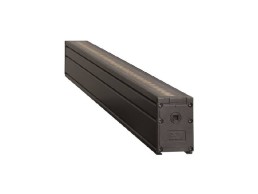
unonovesette Slash
Slash is designed for outdoor in-ground or surface mounted applications. It is available with different optics including wall washing and wall grazing. The internal optical system is tiltable +/- 20° from the outside of the fixture with a dedicated knob to minimise light pollution and optimise the light effect. Glare control is further enhanced by the unique linear anti-glare louvre, which is especially designed for wall washing and grazing applications providing exceptional uniformity.
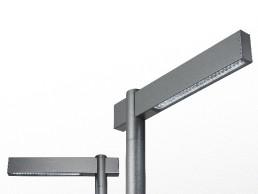
Arcluce Krane
Krane combines unique and innovative design to solidity and elegance. It is available for pole installation in single or double application, both provided with a linear soft optic for high visual comfort without glare and no light pollution. In an elegant and solid extruded aluminium body, Krane finds its natural position in the most modern urban areas, it is the ideal solution for lighting business districts, new town squares and prestigious parks.
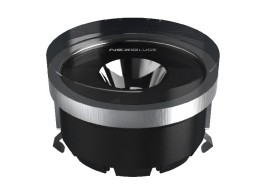
Nexoluce Omnia Series
The Omnia series by Nexoluce features uplights, downlights and projectors that are able to supply up to 24W, with a sleek body starting from 10.8cm in diameter and 7.5cm in depth. The COB version of Omnia hosts a new generation of Bridgelux LED and reaches 160lm/w with a variation of narrow, medium, wide and asymmetric optical systems. The other option of the product hosts CREE Power LEDs PCB with either three or nine units. The light beam angle ranges from 3.5 to 86 degrees.
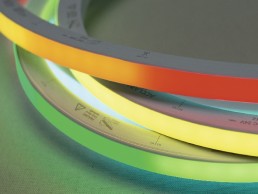
Acclaim Lighting Flex Tube Pixel SE
Flex Tube Pixel SE is a flexible, side-emitting LED strip that features RGB control of every 3.27-inch section for virtually any exterior or interior lighting application. IP68-rated and submersible to three feet, Flex Tube Pixel SE has a highly durable, impact-resistant, PVC body that can be ordered to length to suit project requirements for customised lighting applications. Flex Tube Pixel SE provides a 160-degree beam angle, operates off of 24-volt DC power and produces 90 lumens per foot.
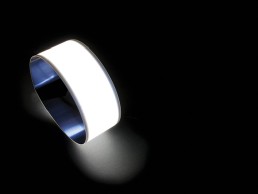
David Morgan Review: Applelec OLED Panels
David Morgan takes a closer look at the expansion of Applelec’s ventures into the world of OLED technology and its various applications in the industry.
It is ironic that OLED, one of the most recently developed light sources, is being marketed in the UK by a company that started life as a traditional metal fabricator. Applelec celebrates 20 years in business this year. Over this period it has developed first into illuminated signage, then into LED lighting panels and now into OLED panels.
Applelec was started by two boyhood friends, Ian Drinkwater and Paul Stothers, who first met at the age of 13. Ian was employed in his father’s metal working company and Paul joined as an apprentice in his early 20s. Ian is now the MD of Applelec, looking after business development and strategy, with a passion for innovation and R&D. Paul is the Production Director.
Applelec were early adopters of LED light sources as a way of replacing fluorescent lamps for illuminated signage. After seeing Korean-made side-illuminated prismatic panels at a lighting show in Hong Kong that had been originally developed for use with LCD TVs, Ian realised this would be an excellent back light source. He recognised it would work for not only signage, but also for general architectural and retail lighting. Marketed in the UK under the LED Light Sheet brand, the material has been enthusiastically adopted by architects, interior designers and lighting designers for use in a wide variety of applications. Applelec has been awarded the UK licence to the three patents covering the construction of LED Light Sheet.
Notable projects that Applelec has supplied LED Light Sheet for include back lighting the windows of the Tardis in Dr Who and integrated into New Dawn, the contemporary light sculpture celebrating Women’s Suffrage by artist Mary Branson, situated at the Houses of Parliament.
The latest venture for Applelec into the world of lighting materials has been to distribute OLED panels from both LG Display and OLEDWorks to complement their existing LED Light Sheet business.
I reviewed the OLED materials from LG Display for arc magazine in 2016 and it seems that full scale production of their range was delayed for a couple of years while a new production facility was built. The LG OLED products are now in production and marketed under the Luflex brand name. The Luflex range now includes nine different OLED panel products, including both rigid and flexible panels with their largest size flexible panel at 300mm x 300mm, the largest available in the market. The company’s main business is producing display components and systems for TVs, mobile phones and other digital devices.
While OLEDs for display use and for lighting applications share the same basic technology and science, it is not clear how much crossover there is in the production details of the two types of material. The most impressive applications for AMOLEDs (Active Matrix Organic LEDs) to date are the flexible displays being proposed for flip phone designs, and in huge screen TVs including the 88-inch LG TV. This size has been shown in prototype form this year at various trade shows. The TV application is a high volume use for OLED materials and presumably helps to provide the commercial support for products to be used in lighting applications.
The second OLED brand being marketed by Applelec in the UK is from the US company OLEDWorks. OLEDWorks purchased the Philips OLED business Lumiblade at the end of 2015 after Royal Philips decided to exit the lighting industry by floating the lighting division as a public company with a new brand name.
OLEDWorks, based in Rochester NY, was formed in 2010 and the management team includes John Hamer, who was responsible for commercialising OLEDs at Kodak in the late 1990s. OLEDs were invented at Kodak in the late 1970s and AMOLED displays were used in early Kodak digital cameras.
The OLEDWorks flexible panels branded LumiCurve Wave (Applelec brand it the Ripple) are based on the super thin Willow glass from Corning. This material is only 0.05mm thick, incredibly flexible and provides a better hermetic seal for the panels than polymer materials leading to a longer working life and lower lumen depreciation. Apparently, this glass is produced in roll-to-roll process, which opens the possibility for a lower cost continuous OLED production at some point the future. One downside to the use of Willow glass is that the Ripple panels are quite fragile and need careful handling during assembly and a protective cover when in use, which will increase the overall thickness of the luminaire.
Applelec presented OLED panels from both brands side by side at the recent darc room exhibition and some differences in output and light quality were evident. The OLEDWorks panels appear to be more powerful than those from LG currently and seem to provide a more attractive lit appearance.
The Lumiblade Brite 2 FL 300 L is the brightest warm white OLED panel available, providing up to 300 lumens from a panel 220mm x 46mm wide and 1.4mm thick, with a surface brightness of up to 7,000 cd/ mtr2 ( Nits ).
With an efficiency of 60 lumens per watt with 3,000K 90 CRI and lifetime of 10,000 hours to L70, these sources are an improvement on previous OLED panels but the overall performance will need to improve to compete with panels based on traditional LEDs.
It is exciting that the long-promised flexible OLED panels are now in production and available for use by luminaire manufacturers and lighting designers.
The LG website features a small number of completed projects in Korea where their OLED panels have been used, including task lighting for university reading rooms, and in the Seoul Palace Museum display cabinets. Applelec has recently supplied OLED panels for use in a duty-free cosmetics display project and also for use in decorative pendants, indicating that there is a potential market for this technology.
OLED panels have a number of inherent benefits over conventional LED side lit or back lit panels. These include a completely dot free and even lit effect, low levels of blue light in the spectrum, broad spectrum and mechanical flexibility. However, at the moment the efficiency, life expectancy and lumen depreciation are worse than conventional LED panels while the cost is higher. If OLED technology and production processes develop to overcome these limitations then larger volume applications could emerge in general lighting. Incorporating flexible LED panels into automotive applications may be one of the higher volume markets to develop in the medium term.
For Applelec the addition of both OLED brands to their existing portfolio of lighting panels is a great opportunity to gain from the marketing activity surrounding the technology and to be in a position to offer the most appropriate lighting solution for any project. Applelec foresees growth in the OLED market and have a long-term commitment to both partners.
Ambience, Australia
Ambience’s new workspace is located in Melbourne, Australia, and is home to its experimental and artistic office lighting installations.
The old chemical supplier factory and office was purchased by Ambience and transformed into their artistic, labyrinth-like playground space.
“Our brief to our interior designers and architects, Studio Y, was to create a workplace where people wanted to work. This had two meanings; one where it created a harmonious and productive workplace, but most importantly an environment where people wanted to come every day,” explained David Justice, Managing Director at Ambience.
Taking a mere seven months from conception to completion, this project was very important for the Ambience team, as it was essential its own workspace reflected the light-hearted branding and creative tone of the firm.
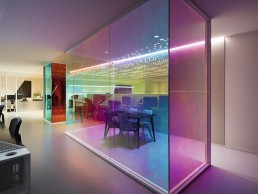
Designed to give varied stimulation at different times of the day, making use of the bright Australian sunshine to the rainbow prism effects and colour gradients, with bolder colours and contrasting shadows, depending on the time of day.
The design process encompassed a varied amount of restrictions and challenges the team had to overcome. As with many projects, budget was of course an influencing factor when it came to renovating the older building. A customised perforated ceiling system was put in place to help control the daylight and heat levels, which in turn created a smooth, calming and futuristic effect.
Stephen Justice, of Ambience, reflected on the team’s journey through production: “We ended up changing some of the creative execution throughout the process, as it became quite experimental. As the space evolved, our lighting approach evolved with it. For example, we created some beautiful custom perforated linear table features, but when we went to install them, we thought they were cluttering the space so we made the tough decision to remove them.
“We added linear LED profiles after we added the dichroic film onto the glass to create a laser effect. The dichroic film on the glass itself is a lighting element where by depending on the time of day and amount of natural daylight that filters into the space, reflects and bounces colour and shadow contrasts throughout the office, walls and ceilings.”
All of the downlights were custom painted to live harmoniously in their allocated colour zone and linear LED extrusions were painstakingly assessed to be placed for the greatest effect and interaction with the dichroic and seating arrangements.
David explained how this project differed to others Ambience had previously worked on: “The creativity of the lighting execution was paramount. With other projects, lighting is usually, at best, a secondary consideration. However, with us being the lighting designers, the entire project was centred around light.
“The pressure was on being able to execute a lighting design concept that provided an overall task lighting with consistency. The concept was tried many times in the past, which resulted in a lack of overall consistency.
“The consistency of light across the entire perforated ceiling added another layer and dimension to the office space; one that is prominent in the aesthetics overall, yet a subtle and calming environment can be felt when working under the light itself. It gives varied visual stimulation at different times of the day, from mesmerising natural sunlight to mind-bending prism effects and arresting backlit colour gradients, with colours becoming denser and shadows more dynamic.”
Working simultaneously to the dichroic film installation is a striking large lighting feature; a custom-designed backlit double layered acoustic panel in the ceiling. It was created to provide mood-calming and gentle lighting for staff in the main office area without cluttering the ceiling with suspended fixtures.
The team used an array of fixtures to create the finished effect, including 3500K LED panels by EMAC, sense adjustable downlights by Neko, custom perforated mesh pendant by Jan Flook Lighting and Symphony ‘Solo’ recessed LED profile.
A number of accent fixtures were added meticulously for greatest impact and interaction with the dichroic film and seating arrangements in the space. Fixtures used for this specific area included Symphony ‘Piccolo’ micro LED profile, Symphony ‘Rhapsody’ LED neon profile and the Mini Roll LED Track Light.
The finished product of Ambience’s new office is a modern and timeless space that has staff and visitors alike pausing to take in the colourful Australian sunshine and creative installations in the workplace.
“When the staff entered the space for the first time, they were gobsmacked by the beauty and mood of the space,” claimed David.
Coralarium, Maldives
The Coralarium is a semi-submerged tidal gallery created by artist Jason DeCaires Taylor, that interlinks the skyline, inter-tidal waterline and seabed.
Situated in the centre of the largest developed coral lagoon in the Maldives, on the island resort of Fairmont Maldives Sirru Fen Fushi, the work aims to create a direct pathway to the ocean.
A long swimming pool transects the island and denotes the starting point. The installation begins by following this line into the clear shallow waters of the sea where an underwater coral pavement begins. Sea-scaped with underwater poplar trees and endemic planted corals, it heads 100-metres through the shallows towards the underwater realm, a symbolic pathway to another world and the starting point of the artistic intervention.
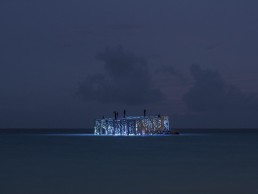
After a 50-metre swim, visitors encounter a submerged staircase, which leads up towards a semi-submerged tidal building. The building is cube shaped, six metres tall, with its front façade submerged up to median tide of three metres. The design of the walls is based on natural coral structures, and is porous to allow the tides, current and marine life to pass through it and the structure to ‘breathe’ within its location. The complex structural formation is designed to dissipate oceanic forces while creating a protective space that encourages nature to colonise and seek refuge. The construction, using high grade, polished, marine stainless steel aims to reflect and mirror the surrounding blues of the coral atoll and the sky above. A mirage on the horizon, that over time will take on the patina of the sea as it becomes colonised by algae and weathers within the environment.
The entrance of the building is situated above water and leads into a dry elevated viewing platform. The roof is perforated with a coral pattern to allow beams of light to illuminate the individual works and a series of submerged lights to illuminate the space during the night. The Coralarium becomes a portal or interface to the wonders of the underwater world.
Mushroom Lighting was approached in December 2017 by the installation electrical company Welford Lamplighters, on behalf of DeCaires Taylor, to design a lighting scheme for The Coralarium.
The budget was very tight and required the lighting of submerged and semi submerged sculptures within the stainless steel structure. The lighting was designed to not only light the sculptures but also to light the enclosure so that it was visible from the shore at night, as the sun set behind it, and also light the water so that night diving would be possible.
Mushroom Lighting chose 24 of the new Gantom Storm DMX RGBW 4.8 watt IP67 floods for above the water and eight Teclumen Mini Sub Color TKX RGBW 15 watt IP68 Spots with 120-degree beam for beneath the waves. The Gantoms were supplied in a custom aluminium finish to blend in with the stainless steel, and the Teclumens were finished in stainless steel.
A total of eight programmes were installed into a Chromateq controller, with a light show on the hour. This includes various themes, such as fire and ice, when the waves take on the appearance of flames, and the structure turns ice blue, as well as highlighting various elements of the structure.
The program runs over approximately twelve minutes, and then settles into a static scene, with the whole cycle repeating every hour. A time switch built into the control system keeps the cycle repeating.
Numerous challenges were overcome that are not the norm, such as monsoon rain and the entire working area frequently being underwater. The underwater element has provided an amazing environment for fish, and the scuba divers are taken on a journey through the Coralarium, experiencing night diving at its finest.
www.mushroomlighting.com
www.underwatersculpture.com
Black Prince Road, UK
In March 2016, the Lambeth London Borough Council decided to regenerate Black Prince Road, an historic landmark in the area.
Located in central London, Lambeth is an area that houses up to 30,000 people as well as being home to the International Maritime Organisation. The street name’s origin is derived from Edward of Woodstock, known as Edward, the Black Prince, who lived in Lambeth during the fourteenth century. As the eldest son of Edward III, his presence in the area resulted in much of the freehold land in Lambeth to remain under Royal ownership to this day.
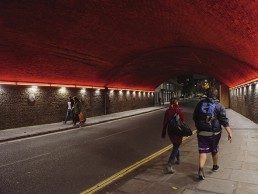
Michael Grubb Studio was selected to help rejuvenate this area, and worked on replacing the lighting for the bridge that overlooks the road. Using inspiration from the Black Prince’s ruby, which is one of the oldest parts of the Crown Jewels of the United Kingdom, the team decided to illuminate the road and underpass in a rich red colour. The Black Prince’s ruby belonged to the Prince during the 1300s and has remained in the Royal Family ever since.
After designing a unique concept around this historically influenced area, Michael Grubb Studio brought in Schréder UK to support the project’s installation. The team experimented with various materials and light source samples to finalise the desired effect. The final outcome resulted in the installation of 52-metre custom made red LED strip fixtures by LED Linear.
Stuart Alexander, Associate at Michael Grubb Studio, explained some of the challenges the team faced: “A challenge for the project was to appreciate the historical significance of the structures as well as gain the approval from a host of interested stakeholder groups.
“For engineers, the bridge presented many difficult challenges. Its tunnel walls were old, uneven and in a state of disrepair. The LED strip mounted onto the walls had to be level and true to achieve the desired effect. Therefore, a levelling mounting channel was used by the specialist installation crew to ensure a fantastic finished result.
“The strip was divided into two-metre modules that were designed to fit together as a jigsaw, with each having custom graphics and a specific place on the tunnel walls. As a result, the process required communication between suppliers, designers, manufacturers and engineers to create the stunning end result and do justice to the original vision for the project,” Alexander added.
Due to the delicate nature of the structure, the team had to be careful to ensure the fixtures were mounted using the same method as the previous fluorescent luminaires. Using a standardised size and making them vandal proof meant any potential future issues could be easily resolved.
The core installation of 52-metre custom red LED Linear strip lights reflected off a hammered aluminium panel onto a polycarbonate protector with vinyl custom graphics applied. 27 Schréder LED handrail modules were built into the base of the strip to provide the desired lighting levels needed on the road, and were chosen for their small size and photometric performance.
Alexander described the key architectural lighting considerations the scheme had to maintain throughout: “To make sure the highway was lit to the correct standards, as well as ensuring no excess light flooded upwards, contributed to the red light giving the maximum impact within the space. Equally, making sure the pedestrian experience didn’t have any high glare made the use of handrail luminaires the perfect solution.
“We recognised no one had used handrail LED luminaires for street lighting before but we found it was the perfect solution and something we are looking to use elsewhere in future projects. Handrail luminaires have a huge range of controlled optics, they come in a very small form factor that can be easily built into many different bespoke shapes and only have 24V in them - and an added bonus is they’re built to be used as part of a handrail, so you can take a baseball bat to it with no problems!”
The overall simple, but powerful effect, transformed this functional street space in London and it’s become an iconic project on the firm’s profile.
“We didn’t realise the red would really ‘ping’ so much and reach the top of the space; the resulting impact was far better than expected! We used a street light reflector within the housing of the red LED to give a crystal effect on the acrylic but no one anticipated the effect would work as well as it did. It really came to life!” reflected Alexander on the final look of the project.
“It was a simple idea very well executed with a stripped down, simple bespoke luminaire. The lighting is key; you really don’t (and shouldn’t) notice the housing apart from during the day, and that’s exactly how it worked out.”
