
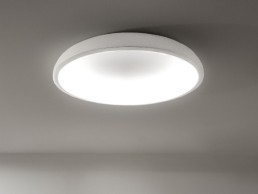
Linea Light Group Reflexio
Reflexio ensures a total absence of direct glare. The light emitted by the special LED round board is reflected by a domed diffuser, defining the fixture and spreading around the space. Looking up isn’t a problem with this technology; the indirect lighting principle guarantees perfect shadow control. Multiple and clear projections vanish, replaced by smooth and diffusive shadows.

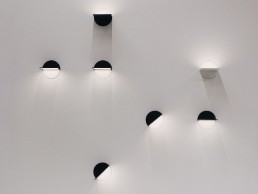
Fluvia Loop
Loop is an elegant and minimalist design by Antoni Arola for Fluvia that applies OLED technology to truly functional lighting. A wall lamp produces a fine sheet of light rotatable through 360-degrees to create an original loop effect. Loop can be installed individually as a reading or support light, or in groups, allowing multiple wall combinations. Its customisable primer finish means it can be integrated into any space.
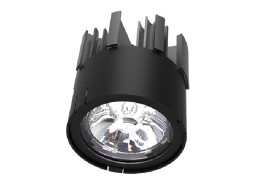
David Morgan Review: Eulum Arcane Module
One of the most intriguing technologies to hit the lighting industry recently has been the LensVector liquid crystal lens system, which produces a zoom lens without any mechanical moving parts. This technology is likely to radically affect both the form factor of spotlights and projectors while also giving lighting designers the chance to add more dynamic lighting effects into their projects.
The LensVector dynamic liquid crystal lens technology was originally developed by Dr Tigran Galstian and his research team at Laval University in Quebec City, Canada. The system works by aligning liquid crystal molecules to a shaped electric field to establish a digital lens. By changing the electric field, the nature of the lens, and therefore the illumination effect, can be manipulated.
LensVector was started in 2006 to commercialise the technology and initial applications that were for use in non-lighting applications. After a decade of development the significant potential in the lighting market has become apparent. Lighting designers are excited by the added level of control provided, and a variety of lighting manufacturers have already shown products incorporating the LensVector modules.
Eulum was one of the first companies to start working with LensVector technology and integrated it into their Arcane LED module, complete with LED light engine, heat sink, driver and Casambi Bluetooth control that was introduced at Light+Building this year.
Eulum was founded in the UK in 2005 by Marcus Worthington, a lighting industry veteran with previous experience at Marlin, Trilux and Zumtobel.
The company started as a lighting design consultancy but then moved into luminaire design, development and production. The US company was formed a few years later in 2008 as a partnership with Brian Gery, an experienced electronics designer who Worthington had met while looking for help developing LED drivers.
The company has grown rapidly by developing innovative technical lighting products for lighting manufacturers and end users, including a wide variety of technically challenging exterior amenity and architectural luminaires, AC driven LED downlights and even a solar-powered, wireless-controlled helicopter landing lighting system for use on oil rigs. In recent years, Eulum has partnered with Xicato and Casambi to develop Bluetooth wireless-controlled LED drivers.
The involvement with LensVector started in 2016 when Eulum was contracted on an exclusive basis by a US lighting company to develop controls for downlights and spotlights incorporating Casambi and LensVector technology. After that project was completed and successfully launched, Eulum was free to develop its own products incorporating these technologies, which resulted in the Arcane modules.
The initial release of Arcane modules includes three versions: white, tuneable white and RGBW. The four LED light engine is integrated with the driver and Casambi module, which is mounted onto an industry standard extruded heat sink.
The light output from the light engine is collimated by a Gaggione ten-degree narrow beam colour-mixing lens. The resulting beam is then controlled by the LensVector liquid crystal beam controller. This combination allows the beam to be adjusted from a ten-degree spotlight distribution up to 50-degree flood.
Eulum had an on-going relationship with Casambi so working with them to add a fifth channel to the existing four channel RGBW module to control the LensVector focusing was not a major problem. The module runs from a remote 48-volt DC power supply and draws around fifteen watts when on full power. The light output of up to 1,500 lumens for the white and tuneable white versions, when on full power, will be sufficient for smaller retail and museum spaces. It is understood that later versions of the modules will run at higher power with the driver components separated from the LED light engine to allow for improved thermal management.
The RGBW version produces a lower light output of around 600 lumens with all four LEDs on full power reflecting the much lower efficiency of the RGB LEDs.
Control of the LensVector focus and LED dimming/colour temperature adjustment or colour changing is all achieved via the Casambi App. It seems likely at this stage that individual focus control of each luminaire will be required so the marriage of Casambi with LensVector is an excellent one.
The lit effect from the module is attractive with a smooth distribution at all beam angles.
It is understood that the range of Arcane modules will be expanded in the future to meet customer requirements for higher power and light output. Since Eulum is also a partner with Xicato there may be versions incorporating a Xicato light engine, Casambi wireless control and LensVector focusing.
The primary reason for luminaire manufacturers to incorporate the Eulum Arcane modules in their products is that it allows them to rapidly test the market for LensVector-based products without needing to invest in the required electronics design and development. The speed at which the market for LensVector develops will to some extent be dependent on the added cost of the technology, so being able to use an off the shelf module for first generation luminaires is likely to be an attractive option. For lighting schemes where fixed focus downlights and projectors will do the job it may be hard to justify the cost.
However the initial enthusiasm shown by lighting designers for this technology indicates that they would like to introduce the kind of dynamic effects generally associated with event lighting luminaires into smaller scale retail and museum applications.
www.eulum.com
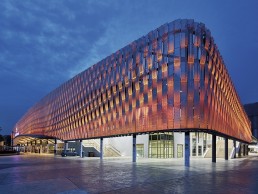
KL Sports City Phase 1, Malaysia
The existing Bukit Jalil National Sports Complex, used for the 1988 Commonwealth Games, has been transformed into the new Kuala Lumpur Sports City, the largest sports complex in Malaysia. The complex includes high-performance sports training facilities, a sports rehabilitation science centre, a youth park, a public sports facilities, a sports museum, a youth hostel, a convention centre and a sports-focused retail mall.
Designed by Populous and developed by the Malaysian Resources Corporation Berhad (MRCB), Limelight atelier from Singapore was appointed for the lighting design of the façades of the Bukit Jalil National Stadium, Axiata Arena, National Aquatic Centre and the new covered link way.
Phase one of the monumental transformation of KL Sports City was completed from design phase in just eighteen months in order to host the 2017 South East Asia (SEA) Games.
At the heart of rejuvenated KL Sports City, is the 87,000-seater Bukit Jalil National Stadium. Its new striking façade is focused on creating a close relationship with the locals and is reminiscent of the stripes of the Malayan tiger. It allows for sun shading, natural ventilation and transparency to the existing iconic structures.
The lighting scheme consists of concealed lines of lights, which are carefully integrated within the 678 parametric twisting blades; using Acclaim
lighting’s LED Flex tape RGBW, with 8-pixel control of the LED nodes at every metre that allows for close and far away visuals of graphical displays and colours. This allow the operators to display a fully bespoke visual for every event.
The second layer of the lighting design was an introduction of a highly ecological intention, by designing and implementing a bespoke six-headed adjustable gimbal luminaire from Acclaim. The solution greatly reduced the amount of light fixtures needed to illuminate multiple aspects of the façade.
Each luminaire is carefully placed in between each blade, blending in as part of the architecture. It allows for the illumination of two blade surfaces, illuminates the roof ring structure and, at the twisting juncture of the blades, reflects some light inwards, adding visual depth to the architecture by paying homage to the existing iconic skeleton structures. This adds not just aesthetics but allows for the reduction of functional lighting to the perimeter of the stadium.
“This is what we termed as functional aesthetics, an important design philosophy of our studio... the objective was to minimise the usage of light fixtures, and to make use of the façade lights, to illuminate multiple elements whilst contributing to the functionality of the perimeter circulation space, greatly minimising energy consumption and cost,” explained Melvyn Law, Director of Limelight atelier.
The building fabric of Axiata Arena, an indoor arena, formerly known as Putra Stadium, was to have illumination radiating through the undulating perforated façade panels, revealing a tremendous visual interest of form, light and colour after dusk. The first challenge was to correctly position the grazing luminaires for an optimised display of the geometry of the façade, especially those at the entrance’s wavy roof. It was resolved with multiple desktop simulations, small scale tests and full size mockups with the support of the contractors and manufacturer. Another challenge faced by Law and his team was to conceal the luminaires and its auxiliaries to minimise electrical and control cables routing disruption to the existing building due to cost and time limitations and site constraints. Working closely with Populous, an architecture tray detail was designed to integrate in to the edifice, concealing fixtures, cables and drivers.
“The visual narrative was elevated with many technical studies and tests, which allows us to not just fulfil, but to amplify the vision of Populous, with the integrated details and techniques,” added Law.
The main entrance to the arena was up-lighted with Meyer Epolux luminaires mounted on columns. Downlighting was designed as a distinct visual marker with a warmer 3000K colour temperature flanked by the cooler colour temperatures of 4000K. The combination of the colour temperature was initially thought to be unusual. However the juxtaposition grows on you and serves its purpose well.
Over at the boulevard, horizontal twisting blade roof elements formed the newly constructed shaded canopies, linking the existing light rail station and various sports venues. Apart from the luminaires that are surface mounted between the horizontal blades for safety and security, colour psychology was introduced in the circulation space. Each structure column is up-lighted in hues of blue by Acclaim’s HP-Midi-RIG thus serving as a guiding light and reflecting the users’ journey that inspires calm and authority, if ever the spectators or visitors are upset with the result of the games.
This leads to the last sporting arena: the National Aquatic Centre with its Olympic standard swimming pool. It was brilliantly illuminated to the imagination of a “glowing lantern from within” expression, with luminaires primarily
from Targetti uniformly uplighting the membrane canopy as well as having suspended pendant lights to serve its functional needs. ELR Vasari 3 recessed narrow beam downlights with selected Rosco colour filters were used to graze the new fritted façade glazing to optimally portray a new colour identity for the international graded swimming arena.
The overall results for phase one has already seen increased usage and social growth to the surrounding precinct. KL Sports City phase one has gathered many accolades internationally and regionally. Besides being a finalist of the World Architecture Festival in 2017, it is also a winner of the exterior lighting category of the Asia Pacific Property Awards 2018 and attained the Singapore Good Design Mark (SG MARK).
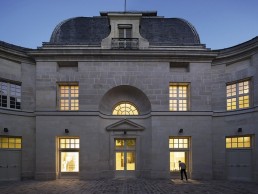
The Paris Mint, France
The Paris Mint, located on the banks of the Seine, is one of the finest examples of neoclassical architecture in the French capital. Built from 1767 to 1775 and designed by Jacques-Denis Antoine, the Hôtel des Monnaies remains one of the most vivid images of the Parisian landscape.
Dominated by a 117-metre façade, the site comprises of a palace, the 11 Conti museum and boutique exhibition areas, workshop space and a gastronomic restaurant presided over by Michelin-starred chef, Guy Savoy.
Since 1976, the activities of the Mint – the oldest French institution, founded in the ninth century by Charles II – have been split between two locations, the historic Hôtel des Monnaies which produces works of art, medals, decorations and coins made of precious metals, and Pessac in the Gironde, where current Euros are produced at a rate of nine million a day.
In 2009, the Hôtel des Monnaies site underwent a redesign, with architect Philippe Prost winning a competition launched by the Paris Mint to find a project manager. The aim of this project was to remove the Paris Mint from its isolation within the Parisian landscape, and to place it in the constantly moving narrative of the 21st Century. As such, the Mint became a hybrid project, halfway between the renovation of a historic landmark, and the restructuring of a block in a working-class district of Paris.
“This project of restoration and reorganisation poses challenges at multiple levels,” said Prost. “Not just the urban, architectural or landscape level, but also industrial, economic and cultural, and beyond that at a symbolic level.”
Despite the many different aspects of the restoration, it was important for Prost to see the site as a whole, rather than a myriad of parts, and to treat the location, steeped in history, with the respect that it deserved.
“Respect and determination is ultimately how Philippe Prost has envisaged his work here,” said Aurélien Rousseau, President and General Director of the Paris Mint. “Respect for the work of Jaques-Denis Antoine whom, like us, he is keen to rediscover, respect for the industrial processes present on the site, respect for the desire of the site’s owner to open up this unique place without losing its essence. In short, respect for the place’s memories.”
In opening up the Mint to the public, the intention was to make it more of a cultural site, giving visitors the opportunity to rediscover the site of the Mint itself, while lending an additional legitimacy to the trades that have been practised there since its origin some 250 years ago.
The idea of making this historic monument more accessible is related to its remarkable architectural quality, to its history and to its strategic location – 1.2 hectares within the heart of the sixth arrondissement.
For this grand ‘restoration and reorganisation’ project, in particular the development of the 11 Conti museum and exhibition areas, Prost selected Virgine Nicolas and Benoît Deseille of French practice Hi Lighting Design, incorporating their lighting design skills into the design team.
This design team, Deseille explained, was comprised of many different skillsets, from multimedia and exhibition design, to graphic and lighting design. “Led by the architects, the design process and the synergy of the team has been very beneficial to the project,” he said.
In the 11 Conti museum, the brief was to provide a sensory experience to visitors, incorporating an architectural exploration through the heart of the Paris Mint. Moving from exhibition spaces to workshops on a “voyage across centuries and continents”, visitors discover the museum’s collections and treasures, such as the technical know-how contained in the workshops where each day artisans and labourers practise the craft of transforming metal.
This journey is punctuated by a succession of sensory experiences: the sight of minerals glistening in the darkness, the sound of coins being struck, and the physical contact with machinery.
Starting from the Benjamin Franklin Court, the visitors’ experience begins on the ground floor of the foundry, where the glow of molten metals invite them up the stone staircase to the second floor. Deseille and Nicolas installed a long custom-made pendant luminaire from Lenoir Service to express this molten glow, while the walls around were dressed in metal panels of steel, copper and brass.
“The initial idea of the project was to offer a sensory experience to visitors and the way the lighting participates to this ambition varies along the journey and in the different spaces,” Deseille said.
“To ensure the continuity of this experience, the transition spaces like stairs were an opportunity to create immersive moments with light.”
Once at the top of the staircase, visitors are plunged into the darkness of the Materials Room where, as if in the gallery of a mine, all the minerals and materials used in the manufacture of coins and medals – gold, silver, bronze, copper, pewter, platinum, nickel and iron – are exposed.
Moving from darkness into light, the visitors’ next encounter with the various metals is in the white room of the laboratory. A walkway that bridges one façade to the other allows visitors to see the workshops and discover the process of chasing and burnishing, before rejoining the manufactory – the walls of which are shaped like a great ship, intended to be a “Noah’s ark of tools and knowledge”.
Old coin making materials feature throughout the museum, creating a blend of modern and traditional textures and aesthetics. Another staircase in the oval of an old cistern winds around a barrel dressed in embossed and perforated boards while in the Functions and Uses room, two monumental right angled display cases mirror the pattern of the ceiling mouldings.
Deseille believes the attention to detail from the architect serves the combination of historic and modern architecture well.
“Heritage is one of the multiple domains of the architect Philippe Prost, and the philosophy he developed offers a sort of guideline on how the contemporary elements can complete the historical architecture.”
The journey through the museum culminates in a room dedicated to the art of the collection, where medal cabinets, paintings and busts are displayed, all illuminated by three huge cones of burnished steel and brass alongside Concord’s Beacon fittings.
Finally, an open door invites guests into the ‘Strong Room’ – a square-shaped room clad in aluminium, where the finest treasures of the museum are displayed in open chests.
Following on from the museum, the new Boutique of the Paris Mint is composed of a suite of rooms all different from each other, ceilinged or vaulted, vertical or horizontal, lit by natural or artificial light, all designed and decorated as though it were an art gallery for showcasing the productions of the Mint, which marry knowledge, creativity and excellence.
“The transformation of the site at 11 Conti has provided an exceptional space for the new boutique, and given these artistic products the backdrop that they deserve,” said Claude Griffin, Director of Marketing and Development at the Paris Mint.
“The goal was to showcase the creativity of our master engravers and the excellence of their creations by literally shining a light on their products in order to show the finesse of the engraving, the creativity of the design and the refinement of the materials used.”
The boutique takes advantage of the natural light on offer, with the first room featuring a seventeen metre high skylight amplified by four white shutters, which form a hood, bathing the room in a soft light. Elsewhere, the last space is illuminated by natural light from the court de la Méridienne, lighting up the room of jewels and casts.
Opened in September of 2017, coinciding with the 250th anniversary of the Hôtel des Monnaies, the new 11 Conti museum and exhibition space pays loving tribute to the history of the Paris Mint.
The lighting design from Deseille and Nicolas complements the building’s beautiful architecture and the intricate artefacts on display without overshadowing either. Instead it adds to the sensory atmosphere that Prost sought to implement, creating a truly memorable experience.
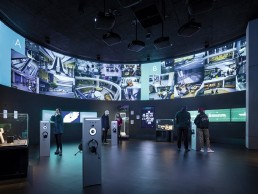
Spyscape, USA
The Spyscape museum in New York City, opened in February 2018, is a new global destination for espionage that marries educational programming with state-of-the-art interactive technology, creating a unique experience for every user.
Designed by Adjaye Associates, with lighting design coming from Brooklyn-based Lighting Workshop, Spyscape was developed in collaboration with expert advisors including hackers and former intelligence agency directors. The inspiration for the museum was to create a ‘premiere spy headquarters’ that allows visitors to deeply engage with the practice of espionage.
Spread across three levels, the 60,000sqft museum includes permanent and temporary exhibition spaces, a black glass bar, flexible event spaces and a rare book store.
The design from Adjaye Associates inverts the traditional relationship between building and town, essentially establishing a small town within a building, as David Adjaye explains: “The exhibition design is set up to be a miniature city in abstraction, with a set of conditions that mirrors the urban experience of discovery, of moving from interior to exterior.”
Drawing from the architectural language of the most prestigious spy organisations, the material palette includes dark fibre cement, grey acoustic panelling and black linoleum. “Many of the materials we used are ones that we typically use for façade systems,” Adjaye continued. “It felt like an interesting way to flip the relationship of the building and city, and to create a counter narrative to the existing glass building, which is all about transparency.
“Because this is a museum about spying, I was interested in obscuring that, and using design to create a dynamic interplay between the obscured and the revealed.”
Throughout, smoked glazed doors, varied lighting strategies, transparencies between floors, and screens and perforations establish spaces that continually shift users’ vantage points, while prioritising the experience of encounter and discovery.
On entering the museum, visitors are guided into a 350sqft multimedia briefing elevator – one of the largest elevators in the world – that orients them to the Spyscape experience as it rises through the building, introducing the world of secret intelligence via an immersive film, developed with the studio that created VFX for films such as Avengers, Blade Runner 2049 and Ex Machina. Visitors are also given a unique Identity Band, which uses RFID technology to personalise their experience.
The elevator brings visitors up to the exhibition level, and opens onto a flexible retail and temporary exhibition space that unfolds beneath a dramatic vaulted LED light canopy. The perimeter curtain walls of the museum feature a playful ‘urban camouflage’ graphic dot and pixel vinyl that obscures views to the surrounding city, partially shrouding the museum interior while also functioning as a solar screen.
Exhibitions throughout are housed in a labyrinthian series of stacked box pavilions, each organised around a unique spy-related theme. The spatial arrangement was designed to play with perceptions, with partially concealed interstitial circulation spaces opening up into immersive, fully interactive multimedia environments.
Each pavilion is distinctive, and crafted around its unique content – one of which being a weathered steel drum detailed with offset panelisation that envelops users in 360 degrees of programmable content.
Throughout the contemporary museum, Spyscape explores spy stories and characters, from code-breakers and spy pilots, to the spycatcher who brought down the FBI’s most damaging traitor, and the teenager who hacked the CIA’s website, with artefacts and multimedia storytelling.
The site also offers immersive experiences to visitors through a series of ‘Spy Challenges’, in which they can test their own spy skills. These range from encryption and deception challenges that allow visitors to test their ability to decode messages “from agents behind enemy lines” and learn the art and science of spotting lies, to surveillance challenges and an exciting ‘Special Ops Challenge’, in which visitors have to negotiate a path through a laser corridor – designed by Atlas AV – against the clock.
The experience concludes with a personal debriefing that analyses each visitor’s unique skill set, where they will learn which of the ten archetypal spy roles they are best suited to, including Hacker, Special Ops Officer, Cryptologist, Intelligence Analyst and Spymaster. This profiling system was developed with the former Head of Training at British Intelligence and top industrial psychologists.
The whole museum was brought to life by a diverse team of curators, designers, educators, programmers and storytellers, with a number of experts recruited to add to its authenticity. “The client brought in a group of expert advisors, including former members of renowned hacking collectives, award-winning investigative journalists and former station chiefs and directors of intelligence agencies to ensure that the content captured the essence of spying today,” Adjaye explained.
Adjaye Associates has an extensive portfolio of museum projects, including most recently the stunning Smithsonian National Museum of African American History and Culture (NMAAHC) in Washington D.C. Yet while Spyscape is smaller in terms of its size and grandeur, it allowed Adjaye to explore different technological aspects.
“My firm has always been interested in exploring the evolution of the museum and educational spaces, and in thinking through how our relationships to these types of spaces are shifting in the 21st century,” Adjaye explained.
“The NMAAHC thought through this shift through the lens of narrative experience and identity, but of course technology is now also integral to our approach to these typologies. So, it was exciting to have this project because it allowed us to engage deeply with the interactive technologies, and to think through its relationship to architecture and more traditional modes of exhibition design.”
Lighting designers Lighting Workshop were brought in to work on the project through their connection with construction consultancy Gardiner & Theobald, and Steven Espinoza of Lighting Workshop was very keen to get involved. “We’ve collaborated on quite a few projects with G&T, so when the RFP landed on our desks, my eyes lit up,” he said. “I dove at the opportunity, and we were thankfully awarded the project.”
Adjaye Associates had already been working on their design for a while by the time that Lighting Workshop came on board, but Espinoza was able to find areas in which he could emphasise or amplify the architect’s vision.
But while the opportunity to work on a museum dedicated to the top secret world of espionage might bring to mind the likes of James Bond or Mission: Impossible, Espinoza instead believes that a more serious tone needed to be taken in Spyscape.
“It’s an interesting time that we’re living in,” he said. “The levity that I used to associate with spying during my youth (James Bond, etc) has faded. Spying is a dark topic, and it’s become woven into the 24-hour news cycle. The public are no longer bystanders. Our private lives and data are under constant attack, and Spyscape doesn’t hold any punches when delivering these messages.
“At the same time, David [Adjaye] was able to create moments of intrigue, and has struck a careful balance where, as a visitor you’re never consumed by anxiety, but it’s always present.
“As a lighting designer, my goal is to help support the vision that David created, and I believe we’ve succeeded. Consequently, there are a variety of lighting experiences that range from jaw dropping to inspiring, to covert and confusing. We’re keeping you on your toes, that’s for sure.”
As with any museum, the lighting design had to be flexible throughout, and Espinoza and his team worked to make it so. “Any museum is a living and breathing experience, so we designed the lighting to be incredibly flexible,” he said.
“There are so many rooms and spaces to get lost in, and each has its own personality and therefore, lighting quality. Should an exhibition change or become modified in the future, we want to be able to address that without tearing the whole thing down. It was important to provide a lighting system that is highly flexible in this regard. A highly sophisticated control system was provided to maximise adaptability, and to give us the ability to acutely define how each space feels on a granular level.”
One of the most impressive lighting features is what Espinoza refers to as “the vault”: a series of nearly four thousand suspended tubes created by Arktura, illuminated with Philips Color Kinetics iColor Flex LED nodes and arranged to create a domical vault. “The entire installation is about 100 feet long and 20 feet wide, and each tube is an addressable, colour changing light source,” he explained. “The result is an installation that can become anything between an enormous low-resolution video screen to a uniformly illuminated cloud.”
However, elsewhere in the museum the lighting remains more discreet, instead “dissolving into the architecture”, as Espinoza puts it. “The experience in Spyscape should be about the narrative and the content. In most cases we chose fixtures that would be discreet and well shielded.”
Track lighting throughout the museum was provided by iGuzzini, while Kreon, USAI and Edison Price provided recessed downlighters. Elsewhere, Nanometer’s T24 provided the RGBW cove lighting, while the RGBW recessed floor lighting came from Aldabra’s GX2. Throughout, the lighting complements the architecture, never overshadowing the museum’s design – instead adding to the atmosphere that Adjaye sought to create.
“We looked to support the architecture, and to amplify the multitude of emotions that it evokes,” Espinoza said. “The subject matter here is unsettling, and I believe the architecture and lighting addresses this profoundly.
“The variety of architectural volumes, how they are organised, and how they are illuminated, was carefully planned. Some spaces create intimacy with artefacts, while others can become almost overwhelming in scale. In many instances, technology, including large scale animated lighting gestures, introduces moments of awe that give meaningful waypoints and bring balance to the experience. It’s all very carefully orchestrated. That took a lot of time, patience and coordination.”
Such time, patience and coordination has led to the creation of a truly unique, exciting visitor experience. Where some would associate the world of espionage with the decadent, glamorous life of 007, Spyscape adds a thrilling sense of realism, throwing visitors into the real life world of spying. The design from Adjaye Associates and Lighting Workshop complements this expertly, helping to ensure that Spyscape will no doubt make it onto the already extensive list of ‘to-do’ tourist destinations in New York.
www.ltgworkshop.com
www.adjaye.com
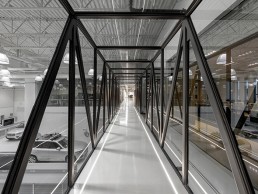
Uber ATG Headquarters, USA
Dubbed the ‘City of Steel’, Pittsburgh has become the new home of the research and development hub for the world-dominating taxi service, Uber. Not only has Uber become a common name in our day-to-day vocabulary but is also now at the forefront of technological developments in self-driving vehicles.
The 80,000sqft warehouse space was renovated to match Uber’s design and engineering vision, with the help of Assembly / CannonDesign, an international architectural firm.
Working in collaboration with a creative and inspiring team, Assembly / CannonDesign teamed up with local firm Strada Architecture, Studio i lighting consultants, Continental Office and Maltbie, (an exhibit and experience designer) to bring together the warehouse space.
Unlike other technology office spaces, the Uber ATG area was specifically designed for builders and engineers as a functioning working environment with a variety of workshop areas and studios. Located amongst the workstations and studios is a fully functional machine shop, where autonomous cars are engineered, built and tested. Liz Guerrero, Principal of Assembly / CannonDesign who led the lighting design, reflected: “At the time of this project, we had completed a handful of projects with Uber, starting with their San Francisco Headquarters in 2014. We worked closely with Travis Kalanick on the design of those projects, so when ATG found the site of their new home, he introduced us to Eric Meyhofer, who leads Uber’s ATG division in Pittsburgh. Our goal was to create a space that focuses on their work first. Uber is building the City of the Future in the City of Steel, which, to us, meant celebrating the past and where Pittsburgh has been, but also celebrating where it’s going. When we design a space for any client, it’s important that every decision ladders up to the big idea – from the initial planning to the materials, furniture, as well as the lighting.”
The project took just over a year from beginning to completion in the former Sam’s Club building, with very little changes in the design concept and the vision remaining consistent throughout. As Guerrero explained: “Budget and design schedule are always constraints and it feels like you could always use more of both, but those constraints are what push you to be better, more creative and more nimble. For us, we never settle, so it’s always about figuring out how to bring the big idea to life within the projects means.”
Functioning as a workshop space as well as an office and showroom, it is important the lighting is tailored accordingly to its prescribed environment. As Guerrero described, there were key areas of lighting and control systems put in place for the individual needs: “In the studio spaces or open office, the lighting needed to be more controlled, more level with plenty of dimming capabilities for the individuals. When you’re tinkering at your desk and working on hardware components, the lighting needs to be brighter, but the software teams typically like it darker. Building in range provided the right balance and flexibility.”
Assembly / CannonDesign attributes the rust toned colour palettes of the project to the industrial nature of the city and the business. The inspiration for the scheme echoed the city’s heritage, from worn Cor-ten steel frames and glass walkways to the natural grain of local hardwoods - providing the perfect contrast to the stark, machine-like white showrooms.
Using a combination of architectural and decorative fixtures, the design firm primarily used fittings from 3G Lighting, Architectural Lighting Works, USAI, Gotham, Luminii, Finelite and Klus to provide the functional yet elegant fixtures that blend seamlessly into the architectural design.
“The design continued to evolve through the construction of the project, but the vision remained consistent. We love that lighting can bring another layer and depth of the design of the space. We wanted to use light in many different ways in hopes of creating a rich and varied environment,” reflected Guerrero. “We love that every client and project are different and they have their own set of objectives and challenges; a different puzzle to solve. What stands out is that we really enjoyed the collaboration with ATG and getting to learn about and experience another part of the country. We fell in love with the city of Pittsburgh on this project, and I think that shows in the end result.”
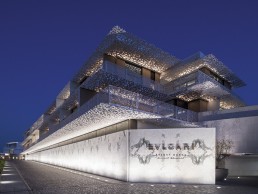
Bvlgari Hotel & Resort Dubai, UAE
Opened in December 2017, the Bvlgari Resort & Residences Dubai is the latest jewel in the designer brand’s luxury hospitality collection.
Situated on Jumeira Bay – a manmade island carved into the shape of a seahorse – the 158,000sqm resort was conceived as an ‘Urban Oasis’ for visitors and residents alike.
Designed by Italian architectural firm Antonio Citterio Patricia Viel (ACPV), the resort is a ‘first-of-its-kind’ development for Bvlgari, both in scale and magnitude. The complex features the hotel building and villas, six residential buildings with 173 sea facing apartments, fifteen private mansions and Bvlgari’s first Marina and Yacht Club, and is intended to resemble a traditional seaside village in southern Italy.
The architects worked alongside Italian lighting design studio Metis Lighting, who have worked on several projects for the brand, to develop the architectural and lighting design concept for the resort, drawing inspiration from traditional design, combined with Italian architecture and accentuated by Middle Eastern touches. Local firm Delta Lighting Solutions carried out the lighting design development and execution, while Huda Lighting supplied the fixtures and luminaires.
Metis Lighting has been working with ACPV and Bvlgari for more than fifteen years, dating back to the Bvlgari Hotel Milan in 2002, and Marinella Patetta, co-founder of Metis Lighting alongside Claudio Valent, explained how collaborative their work with ACPV is. “The lighting project is launched together with the architectural and furniture design,” she said.
“The initial brainstorming involves a two-way exchange of ideas. We often start from sharing initial renderings, so a strong idea for the interior or architecture may guide the lighting proposal, or vice versa: an interesting lighting solution can change details or materials in the project.”
In creating the lighting design, Patetta explained that Bvlgari has certain design standards and guidelines for the main lighting criteria, such as lighting levels and scenario control, but added that these are not very restrictive and are “totally in line” with ACPV design, meaning that they are fairly easy to adhere to.
Once the lighting design concept was created, Metis and Delta Lighting Solutions worked to ensure that it was implemented effectively. Patetta continued: “Most of our work after the concept is focused on maintaining and developing the initial ideas without substantial variations.
“It may seem to be easy, and some clients believe that our work is finished once the concept is completed. In reality, we are aware that the next step is to manage and solve difficulties and clashes that will arise during the coordination between all consultants and equipment.”
The lighting concept for the resort aimed to recreate the warmth and simplicity of a charming Mediterranean village. The approach was very minimalistic and subtle, with all architectural light fittings, provided by the likes of Traxon, Flos, Light Contract, Lucent Lighting, LED Linear, KKDC, Erco, acdc and Radiant Lighting, concealed and kept in warm colour temperatures.
The remarkable design for the resort features a blend of styles, fusing traditional design, contemporary Italian architecture and Middle Eastern touches, and Patetta believes that Italy’s mixed heritage led to the varied design.
“Italy is a bridge that connects northern Europe to the southern shores of the Mediterranean,” she said. “We are a sort of melting pot, and many influences of Islamic architecture are present everywhere, especially in southern Italy.”
“Furthermore, as architects and lighting designers, we really appreciate some typical elements of Islamic architecture, such as geometric decoration, the contrast of light and shadow, lantern projections and light reflections on water. The specific combination of those elements and their interesting development provided by ACPV’s interior design was very inspiring for our work.”
Once the lighting design concept was in place, Delta Lighting Solutions was brought in to handle its development and execution. Although joining the project halfway through its development, Ziad Fattouh, Managing Principal of Delta Lighting Solutions, says that he enjoyed the process.
“It was a fun project to do even though the concept was defined, and we feel we were able to continue to influence the outcome in the subsequent stages,” he said. “The project’s end result depended strongly on getting the details right, which was achieved through the detailed design stages and three years of post-contract work.”
Patricia Lopez-Yanez, Associate at Delta Lighting Solutions, added: “Our aim was mainly to support in the realisation of the vision by providing our input and lighting design expertise.”
Lopez-Yanez added that, despite coming in once the initial designs and concepts had been completed, there was still room for creativity on her part. “While working on this project, we learned that creativity is not only used in the initial conceptual, artistic phase, but that creativity is essential in developing ideas and turning them into a reality.
“Taking the ideas from the architect and executing them takes a lot of imagination, empathy and dedication. A nice render that has been presented to a client is a dream, and sometimes can be very difficult to recreate.”
The sheer scale and complexity of this project meant that transforming the initial vision into a reality required a lot of collaboration and coordination between the architects, engineers, lighting suppliers and lighting designers. Because of this, Lopez-Yanez and her team had a vital role to play.
“The complexity of this project was evident in the design phase, but we got to experience it even more during the site supervision phase, when the design had to be executed by the contractor,” she explained.
“At one point we had daily meetings on site to discuss different details, and if required, come up with solutions on the spot to solve problems, due to time pressure.”
An example of this came in lighting the hotel’s façade. This is defined by a warm glow of coral-like brise soleils or sunscreens made of matt white GRP, which is a reference to traditional shading techniques in the Middle East. As the brise soleils follow an irregular geometry, this made it difficult to integrate the Traxon linear light fittings.
As Lopez-Yanez explained: “With over 30 different variations of the same typical detail, it was one of the most complex exercises, as it required coordination between the architect, engineers, the manufacturer of the brise soleil, and of course the lighting.
“We also faced different challenges in the interior areas where all the architectural fittings were designed to be concealed, so a lot of coordination had to happen between the different contracting teams on site.”
The way in which all parties came together to collaborate on this project is a testament to its success, and Lopez-Yanez feels that this teamwork helped to make what could have been a difficult project a lot easier to complete.
“It was a daunting experience at first, knowing how big and complicated the scale of work was, but we worked with very proactive people who made the design coordination a lot easier,” she said.
“There was a lot of back and forth with the discussions in terms of the design issues we encountered on site and providing optimum solutions for these issues. It was very important though that we met the design expectations of the client while still maintaining the design integrity of the building and its architecture. In this regard, I believe that we were able to achieve that.”
Alongside the integrated architectural lighting from Osram, acdc, LED Linear, Aldabra and Lini LED, among others, the Bvlgari Hotel & Resort features a number of decorative and bespoke fixtures created exclusively for this project, with custom downlights from Lucent in all guest rooms, custom linear cove lighting from Light Contract, and decorative suspended lights from AggioLight.
Metis Lighting and ACPV designed all the custom elements with clear references to Bvlgari’s brand identity, using motifs such as the eight-pointed star, and the geometric sequence of circles and squares. According to Patetta, these were “conceived almost as if they were ‘jewels’ to catch the eye and enrich the visual experience of the clients”.
“In complete harmony with the interior design, lighting is also used to recall the luxurious and unique character of the Bvlgari brand and bring it to the new hotel’s building,” she added.
Although the resort does feature a number of decorative fixtures and focal points, for the most part the lighting remains minimalistic and subtle, with a hidden warmth. It is this concealed beauty that Patetta feels makes the lighting scheme stand out. “We believe that a lighting project is successful when nobody perceives, at first contact with the space, that functional lighting exists,” she said. “If you first notice a technical lighting fixture, then the general location, something is not appropriate.
“We consider it a success when a beautiful chandelier draws attention to itself and also seems to light up the room, creating a sophisticated ambiance. In reality, that special atmosphere is due to the presence of countless technical devices.”
Fattouh agrees that the subtle use of light adds to the sense of luxury that Metis and ACPV worked to create, adding: “The light was meant to be as discrete as possible, integrated and hidden, and used only to help capture the mood of a space.
“The lighting scheme helps accentuate the richness of the finishes, and creates a sense of drama and luxury. Light was used sparingly and carefully, and only where we needed it, while avoiding the flattening effect of too much ambient light.
“When you walk into this hotel, you get the feeling of luxury and elegance, but it is done without being ostentatious. Instead of using high ceilings and large chandeliers in the lobby to create a sense of luxury, you instead notice the highest quality finishes and the amount of thought put into detailing and integrating things such as light fittings, furniture and so forth.
“When entering the lobby and many other public spaces, one thing that you will not notice are any visible light sources, instead you only see the light effects where needed.”
The Bvlgari Hotel & Resort Dubai is the latest in a string of impressive, grand projects completed in the Middle East, and since its opening, it has been labelled as one of the best new luxury hotels in the world, and for Lopez-Yanez, it was exciting to be involved in such a project, particularly in this emerging market.
“The scale of projects in the Middle East never ceases to amaze me,” she enthused. “Coming from South America, there were a few ‘big’ projects like government buildings and airports that I worked on, but in the Middle East the scale of the projects is completely different.
“Architects and designers have come to the UAE to build a new country. The cities are like a blank canvas, where a lot of freedom is given to us to build the biggest and most ambitious architectural pieces.”
With their range of hotels, Bulgari’s aim is to convey the timeless glamour and heritage of its own Roman jewellery, and thanks in part to its beautiful design, this latest jewel is set to shine for generations to come.
www.deltalightingdesign.com
www.metislighting.it
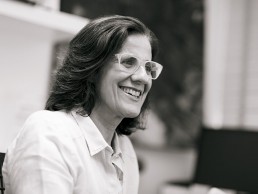
Mônica Luz Lobo
The first certified lighting designer in South America, founding member of AsBAI (Associação Brasileira de Arquitetos de Illuminação), a professional member of the IALD and board member of the IALD from 2017-18, Mônica Luz Lobo is a pioneering female lighting designer and businesswoman in the industry that continues to shake things up for the better in the lighting world.
Setting out to follow a career that would allow her to work with space, people and its interaction, Lobo graduated as an architect in 1987 from Sta. Ursula University, Rio de Janeiro. Lobo then moved to São Paulo to follow her husband as a leap of faith; moving with no friends or professional contacts. This daunting change ended up being one of Lobo’s best career moves. By chance, she found an advert in the local newspaper for a position at one of the most prestigious lighting consultant firms of the time - Esther Stiller & Gilberto Franco Lighting Consultants. Pursuing the start of her career here enabled her to experience a “true revolution and a new way of seeing and understanding architecture”.
“Discovering lighting and its intangible quality full of meaning was a step forward,” she added.
After working in São Paulo for five years, she made the decision to move back to Rio de Janeiro, where the opportunity to achieve her goal of being associated to a lighting manufacturer, working as a lighting designer and developing lighting schemes was ever more attainable. Lobo became a member of the IES, the Illuminating Engineering Society, in 1996, as one of the first steps of moving in the right direction.
Lobo reflected: “I learned a lot, but what has always moved me was the design process. In 1997, I founded LD Studio Lighting Design together with a partner at that time, Ines Benevolo. In our own independent lighting design practice, we were working on a diverse universe of commercial, institutional, educational and residential projects.”
LD Studio Lighting Design has grown into one of the largest and most well-respected design firms today, and continues to maintain a strong work ethic within its tight-knit team, which reinforces its success in the industry. The firm describes its guiding line approach as architectural lighting, but is always seeking to provide “something else that awakens a non-static way of looking and perceiving the architectural space”.
The design firm attributed its company values to: “Dedicating ourselves to building a working environment in which pleasure is part of all processes. Our strong team spirit and the desire to work with light in a transcendent manner are fundamental values for us.
“The constant and continuous search for understanding and learning has put us where we are today, with the capacity to handle very complex projects and – at the same time – to treat small and delicate projects in all their importance and potential.”
Three years after the firm was established, Lobo and Benevolo’s team scooped up their first international award, the Edwin Guth Award of Excellence on Interior Lighting by IES for Igreja da Lapa dos Mercadores, a small church in Rio de Janeiro. An exact example of a smaller project that took just as much time, care and attention as the larger scale installations.
Following on in a similar fashion over the proceeding years, LD Studio has accumulated a number of awards, including the Igreja da Pampulha (the Pampulha Church), the Museu do Amanhã (the Museum of Tomorrow) and the Guindastes do Pier Mauá (the Pier Mauá Cranes), which was the overall winner of the darc awards / architectural 2017 and appeared as the cover story in arc 100.
Changes happened within the studio when Ines Benevolo left the team in 2006, and Daniele Valle was promoted to Associate in 2011, after starting in the firm as an intern in 2000.
Lobo became a founding member of Brazil’s architectural lighting design association AsBAI in 2000. Acting as a volunteer, Lobo and the group of fifteen organisers work to support the Brazilian lighting design community and encourage new members.
In 2016, Lobo decided to take a step back and re-evaluate her settings and role within the firm. During this time, she felt an urge to change the way the firm did things and the approaches they took when undertaking new projects.
“During the latter half of 2016, an urge to rethink and review the way of doing things sparked a process of planning and movement that enriched us during all of 2017, and led to a whole year of workshops, internal exchanges and external collaborations. This movement became such an important internal project that we refer to it as the ‘O Pulo’ [The Jump],” described Lobo. In 2017, the team celebrated their 20th anniversary as a lighting design practice and Lobo reflected: “20 years of practice makes you think back to understand and analyse what you have done and what should you do next.”
A bi-product of this period of reflection led Lobo to adopt a new ethos for the firm, which she continues to pursue to this day. “I have realised that what I really want is to have pleasure in my design process, bring pleasure to my team as part of this process, all while delivering a purpose-driven product to our clients. In a way, this is what I consider to be my mission in life to perform,” claims Lobo.
One of the studio’s most notable projects, that Lobo believes put them on the map in terms of success in the lighting industry, was the Igreja Nossa Senhora da Lapa dos Mercadores in the heart of Rio de Janeiro, completed in 1999.
Built in honour of the Madonna of Merchants in the eighteenth century, Lobo and her team brought the intricate and breath-taking ancient architecture to life and into the 20th century. Reflecting on the project, Lobo commented: “This project was so successful as we achieved a result that revealed the space of the church, as well as highlighted a comprehensive sense of hierarchy in the architectural elements. A subtle interpretation of the Baroque architecture made a great focal point.”
During her time of reflection, Lobo looked back at this project and defined her thoughts of change and the shift in her role in the industry, and has now dubbed herself as the ‘Light Awareness Activist’. “The light has blended on the surfaces and I became invisible. This was a revelation to me, as an architect. Sometimes you need to disappear in order to do things better. In some ways, this has become a kind of signature of LD Studio’s works, where we focus on merging light within the surfaces, producing a lighting skin,” said Lobo.
“This project [The Igreja da Lapa dos Mercadores] worked as a learning experience and recognition through winning an international award, which taught me I was heading in the right direction.”
The technology for fixtures and light sources has developed dramatically over the last 20 years, as Lobo observed: “A lot has changed for technology! The church was lit with fluorescent tubes (T8) and halogen lamps. One specific light, ‘The Fathers’ Light,’ was done with metal halide. It was the launching of ceramic metal halide PAR lamps, which were a revolution at the time! Speaking on the design/creative design side, it seems that all these new tools lead to limitless possibilities, but what I really believe boosts creativity is collaborative work.”
Lobo further added her sentiments towards lighting designers and the role they play in the industry. It is a notion that is shared by many designers in today’s industry and Lobo reiterated: “As lighting designers, we need to raise the awareness that our work is essential, and of course, deliver it. There is an increased awareness of the necessity of lighting designers, but still as a complementary element to a project.”
“Lighting can add meaning to a space. It can materialise an immaterial thinking, a strong concept. I am still in the process of reviewing these considerations. In this re-thinking process, with the help of the whole team at LD Studio, and in particular a great external collaborator in Diana Joels, we are searching to re-define our own methodology. We have an understanding that deep analysis, followed by an immersive idea-generating process is needed to develop a strong concept, which is crucial to develop a rich lighting composition.”
A source of long-term personal inspiration for Lobo comes from lighting designer Richard Kelly, who is well known for his work at the General Motors Design Dome in 1956, which was featured on the cover of arc 98. “He was my first lighting hero, so inspirationally precise and continues to be a source of reference today,” she explained.
Looking ahead, LD Studio has a clear outlook into its future in lighting design. Lobo explained: “I see the future of our internal rethinking movement, O Pulo, and a beautiful future related to our goal, to add pleasure to the design process and everyone involved, deliver a purpose-rich product to our clients and make them happy as well, all while consequently raising the awareness of the importance of lighting design. The growth will come as a natural result of this.”
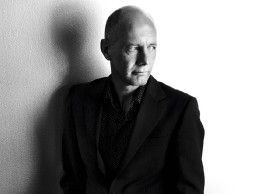
UNStudio
Founded in 1988 by Ben van Berkel and Caroline Bos, United Network Studio – better known as UNStudio – is an international architectural design network with offices in Amsterdam, Hong Kong and Shanghai.
Although mainly operating in architecture, interior design, urban development and infrastructural projects, the firm has also worked in product design, working with Zumtobel on the Nightsight, alongside furniture pieces for Alessi and Walter Knoll, among others.
Since its inception, UNStudio has completed projects in countries around the world, working with a vision of ‘future-proofing the future’, in which it anticipates the future and any possible changes that it may bring.
These projects have always placed a large emphasis on collaboration, something that founder Ben van Berkel is particularly passionate about: “The ambition of UNStudio, and why we are called United Network Studio, is because we believe in collaborative models. We don’t believe in the concept of the architect at the front of the orchestra.
“We believe that, in the early stages of design, you need to consult with specialists and look beyond your own profession in order to make something more fascinating than just design for design’s sake. It needs to be people-oriented, it needs to connect to themes of health, sustainability and so on.”
This people-oriented approach has seen the company work on a diverse array of projects, spanning a wide range of disciplines and areas, over the past 30 years, but is there a particular area of expertise that Van Berkel believes the company specialises in?
“It’s interesting, ten years ago I would have said no, because we were so diverse and I always wanted to learn more about every other part of the profession, from infrastructure to product design, urban design and so on,” he said. “But now I can see that there are trends and common themes that I work within.”
One such theme surrounds infrastructure, a fascination for Van Berkel that comes from his work designing bridges (UNStudio created the Erasmus Bridge in Rotterdam, Netherlands, and has just won a competition to design a new bridge in Budapest). This fascination has led Van Berkel and UNStudio to work on designs for airports in Amsterdam, Brussels, Taiwan and Kutaisi, alongside long-term regeneration projects like the Arnhem Central Station masterplan – a project that Van Berkel has been involved with since 1996. “If you think about infrastructure, you have to think about how people move and who the user groups are that you design for, so it’s a very important topic to be found in our work,” Van Berkel explained.
It’s a topic that can even be found in projects unrelated to infrastructure. “If you look at some of the buildings that we’ve worked on, like the Mercedes-Benz Museum in Stuttgart [completed by UNStudio in 2006], it’s based on infrastructure,” Van Berkel continued. “The idea that you go up eight floors in an elevator, then at the top you have two spirals crossing each other as they go down, it’s quite a rich organisation. But this organisation comes out of a fascination for infrastructure.”
The newest infrastructural project for Van Berkel will see the introduction of cable cars to the Swedish city of Gothenburg. Similar to the Emirates Air Line in London, these cable cars will act as a form of public transport, rather than entertainment. “It’s something that the people of Gothenburg really wanted to have in the city,” explained Van Berkel. “People who live there work in the north of the city, at the Volvo factory and so on, so there’s always congestion.”
Alongside these large, infrastructure-led projects UNStudio’s extensive portfolio includes work ranging from museums, offices and retail centres to hotels and residential properties, yet while some architecture firms have a definite style or aesthetic that carries across their portfolio, Van Berkel instead prefers to mix it up with each new design.
“I’m always careful with style,” he said. “I believe that one should liberate style a bit more, to avoid a very mono-functional image that you can’t sustain for every location. I’m very location-oriented; even when our work is sometimes a bit more simple, less articulated or less curvy, you can still recognise it as our work because I like to bring a surprise into the design, maybe through the interior or another way.
“Our work is very experience-oriented, so although you can’t see it immediately, you can discover the recognisable links between the projects over time.”
The reason for Van Berkel’s visit to Frankfurt for Light+Building, further to seeing the latest advancements in the lighting and building services sectors, was to collect the Zumtobel Group Award for Urban Developments – an architectural award created by the Austrian lighting manufacturer designed to “act as a stimulus for new developments and concepts in the built environment that help meet current and future demands for improved urban living conditions and energy needs”.
UNStudio won this award for the aforementioned Arnhem Central Station in the Netherlands – a complex project that functions not only as a public transport hub, but also seamlessly incorporates office and retail spaces, a new station hall, a platform roof structure, a railway underpass, a road tunnel, storage for bicycles and parking space. Blurring the distinction between the inside and outside, the station helps to create a new identity for its region, while organising the main connections within the city.
Although the complex creates a more coherent, organised hub for the city’s transport links, the main inspiration, Van Berkel explained, was to rekindle the excitement of traveling. “There used to be a time when stations celebrated the idea of traveling, they would uplift you when you would depart or that you would enjoy seeing family again in the arrival hall, where you could really feel the enjoyment and uplifting qualities of traveling,” he said.
“Lately, stations have started to become negative areas or not so safe, so this station was designed to be more positive, a station where you feel comfortable, where a lot of light is to be found, where you almost feel like you’re in a community-like space.”
The station features a long, sweeping walkway around a curved central column, that adds to the more open, community-like aesthetic that Van Berkel was aiming for, while the use of large windows allows for plenty of natural light to complement the artificial lighting, designed by Arup.
“The architecture does the wayfinding and that is, especially today in very busy areas, very necessary because if you have to look for signs, then you don’t know where to find your train or bus. Here there’s more theatre and more to enjoy, with the light coming into the station, that helps connect you to where you are going.”
The mention of the use of light in the Arnhem Central Station moves our conversation on to lighting, and UNStudio’s relationship with light. While light has always played a role in his work, Van Berkel passionately talked about the new advancements in the lighting sphere, moving beyond basic illumination. “I’m very fascinated by light. I see light as data,” he enthused. “I think the lighting world has never been as exciting as it is today.
“I’ve done a lot of research with other parties to find out how important light is for the work environment, for instance, like how unhealthy light can be or how much you can actually steer it towards wellbeing and health.
“Amongst other things, lighting is a way of enriching space, as it is a product that is giving light, but I think that in the future it will also impact on other qualities in work and in the living environment.”
As such, Van Berkel believes that factors such as lighting design are being brought to the table much earlier in the design process now, something that he certainly welcomes: “What used to be so bad was how clients, developers and we as a profession, were maybe looking too much at making object-oriented architecture. But I think it’s important that we know what kind of effect or impact light can generate.
“Similar to infrastructure, and the way one walks through a building and how it defines the organisation of the building, I think the same for other elements of design, like lighting, ventilation, acoustics, these things can work together much more in the future.”
The quest for more research into the impact of lighting and air quality was one of the driving factors for Van Berkel in the formation of a new sister company of UNStudio – UNSense. UNSense is a self-proclaimed “arch tech” company that aims to “humanise architecture”, and explore and develop new sensor-based technologies designed specifically to positively impact people’s physical, mental and social health.
Set up because Van Berkel believes “that the future of design is going to be more tech-oriented”, he hopes that UNSense can help, through the use of new technologies, to make “a better human-centric environment for people who want to live and work in healthier ways in the future”.
“It’s going a bit beyond the smart city and smart home concept, in that we don’t just want to make things more efficient. We want to give them more direction and meaning.”
Light will play a role in this new, sensor-based off-shoot of UNStudio, but Van Berkel believes that it will “become part of a holistic system” surrounding the technological development of buildings.
“I’ll combine lighting design with acoustics and air quality, and maybe material research, and then put it into one system to work on the software,” he continued. “That’s why we set up UNSense – you have the hardware side of the building, and then the software side, and the latter needs a different kind of financial programming and expertise than an architectural office. You can do research in an architectural office but not data-driven organisation and analysis. You need different specialists for that.”
In the meantime, Van Berkel continues to work with external lighting designers on his projects, having completed several projects with Arup, including the Arnhem Central Station, as well collaborating with the likes of German firm AG Licht, and Rogier van der Heide, whom he feels is having a “beautiful career”.
His work with light has extended into the manufacturing sphere too, having worked with the likes of iGuzzini and Philips in the past, as well as teaming up with Zumtobel for the Nightsight: a modular system designed to create environments for social activity, mobility and walkability in a bid to “reclaim the night” within the public realm through variety in lighting scenarios and intensities.
“Nightsight is inspired by the many variations possible in theatre lighting,” Van Berkel said during the launch of the Nightsight at Light+Building 2016. “The system enables spatial choreography through light and is primarily aimed at facilitating activity, enjoyment, engagement and social interaction in the public realm.”
And while Van Berkel is hopeful that lighting will continue to play more of a role in his work going forward, particularly in the new UNSense venture, there are still a whole host of projects in the pipeline for UNStudio to keep him busy.
On the infrastructural side of things, there are projects like the aforementioned Gothenburg cable cars, and a brand new commission, only recently won by UNStudio, which has seen the firm design a new road, tram, cycle and pedestrian bridge across the Danube river in Budapest, Hungary – a competition that saw Van Berkel and his team work alongside Buro Happold, to beat off competition from the likes of Zaha Hadid Architects and Wilkinson Eyre.
Elsewhere, the firm is working on the headquarters for Booking.com in Amsterdam and the EuropaCity Centre Culturel Dédié Au 7è Art – a cultural cinema complex on the outskirts of Paris, to projects as far and wide as Germany, Azerbaijan, UAE and South Korea. “It’s really great, there are so many nice things. It’s the best time ever for us,” Van Berkel enthused. Based on everything I heard in our short time together, it’s hard to disagree.
www.unstudio.com

Ken Douglas
Following the acquisition of Illumination Arts by HLB Lighting Design, arc sat down with Ken Douglas, Principal at HLB Lighting Design to discuss his lighting design journey, the decision to become part of HLB and the benefits that such a move will bring.
What made you decide to become a lighting designer?
I’m one of those people you occasionally hear about who had a teacher set the course of their life at an early age. In middle school, I had a teacher who involved me in the school’s theatre programme doing sets, lights and sound. Those early experiences led to community theatre and a single-minded goal of becoming a lighting designer.
I owe Mr. Genovese a lot.
Give an overview of your career to date.
In my early twenties I decided to move from pursuing theatre work to seeking a job at an architectural lighting design firm. (I found that I wanted to have more stability and security than I found on the theatre side.)
My first architecture job was working for a gentleman named Ed Feldman, who was an early practitioner, and at the time was designing lighting for retail stores. From there my next major job was with David Mintz, Inc., where I would work for the next fifteen years. There I became an Associate Principal, where along with Faith Baum, we managed most of the day-to-day activity of the firm.
In 2003/2004 Faith and I decided that our career path required a change, which led us to found Illumination Arts. We would grow IA for the next fourteen years. Over that time we developed several strong and unique market sectors, including infrastructure and signature bridge projects.
Over the course of this entire period, I have been very involved in the lighting community, particularly IALD, where I served for many years on the board of directors, and where I had the good fortune to make many friends throughout the worldwide industry. That time spent doing that volunteer work has been some of the most satisfying of my career.
You moved to Osram and then back to IA. Can you explain that decision?
This was in the midst of the recession, and we found that the firm was having difficulty supporting the staff and two principals. Not wanting to place myself in the position of competing with the firm I founded, I made inquiries on the manufacturing side of the market. After about fourteen months, the economy improved and we were able to reverse that decision and come back together again at Illumination Arts. It proved to be a good port in a storm.
How did the decision to become part of HLB come about?
This actually goes back to the relationships I’ve formed within IALD over the years. Barbara Horton and I became friends through our time on the IALD Board, and would occasionally meet for lunch to catch up with each other.
In August of 2017, during one of these lunches, we were discussing where our firms were going and what we thought each firm needed to continue to grow to the next level.
We realised that the needs we were describing were things that the two firms could solve for each other.
What are the advantages of becoming part of HLB?
I think we all believe the advantages are manifold for all of us. For IA it provides a depth of resources and infrastructure from which to serve that client base and continue to grow and expand within the multi-office, national footprint that HLB already possess.
From the HLB side, it provides immediate additional growth with the addition of new staff (including two principals) in the New York and San Francisco offices, and access to new market sectors that IA is a strong player in, but that HLB did not have a presence in.
The team is already functioning as one strong unit, rather than two separate teams, and we can already see a synergy of ideas and experiences going back and forth to make the new team stronger and more creative.
Are you still in the IA studio or have you moved in with HLB?
All of the IA staff have moved into existing HLB offices. Most in the New York office, and our one remote Senior Designer, Elizabeth Johnson has joined the team in the San Francisco office as a Senior Associate.
This has help speed along the blending of everyone into one strong, collaborative team.
How do you see the future of lighting design?
From where I sit, the pace of digitisation is continuing at an ever-increasing pace.
The role of the lighting designer will continue to expand, as will the knowledge base required to be successful as a lighting designer.
As creative individuals practicing in this space, we not only need to be visualisers, and creative collaborators, we also need to have the technical skill set and understanding of both the digital and built environment to be able to execute the ever more complicated digital systems our designs require.
Our clients turn to us to produce beautiful and interesting luminous environments, but they also rely on us to have our finger on the pulse of technology, energy codes, LEED, Well Building, IoT, and all the other ever-expanding trends that impact lighting and the built environment.
This evolving marketplace demands that we stay ahead of these trends and be able to see the opportunities and the pain points they present us and our clients and be able to act quickly to take advantage of them in our designs.

The Lighting Practice opens New York office
(USA) – The new location, situated on Broadway, New York City, is the second office for lighting consultants The Lighting Practice.
National lighting consultant The Lighting Practice has opened a new office in the Financial District of New York City. Led by Principal Alfred Borden and Associate Jon Hoyle, the firm’s second location, situated on Broadway, will accommodate its rapid growth and act as a home base for local and national projects.
“The Lighting Practice’s New York office is an important step that supports our plan for growth. We look forward to expanding our relationships and continuing to collaborate with our New York clients and design partners,” said Helen Diemer, Principal and President of The Lighting Practice.
New York City is not uncharted territory for The Lighting Practice. The firm has been part of design teams for major landmarks including the Empire State Building, Madison Square Garden, The Helmsley Building and more.
In addition to opening its New York office location, The Lighting Practice is a certified Women-owned Business Enterprise (WBE) through the NYC Department of Small Business Services.
