
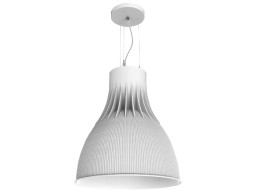
Hacel Aspen
Designed and manufactured in the UK by Hacel, the new stylish and sculpted Aspen range of prismatic LED pendants offers excellent light distribution and performance. The range is available in a choice of lumen outputs delivering up to 8386 lumens with efficacies up to 135lm/W. Hosting a classic design with perfect proportions, the Aspen is a versatile solution for a range of applications.

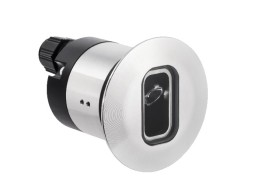
unonovesette Caliber Wall
Caliber Wall is an extremely efficient compact LED wall-light recessed wall or in-ground drive-over, designed with an angled perspective of 30 degrees for optical excellence and engineered for complete resilience. Caliber Wall features the unonovesette Smart Shield system, complete with an integrated constant current driver, which allows the luminaire to be powered in parallel with a 12Vdc up to 24Vdc constant voltage power supply.
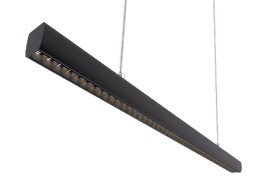
Acolyte Synthesis
The Synthesis LED Linear is a modular based LED fixture that is easy as ABC to configure. Choose your beam angle and tailor this fixture to your space and lighting needs in minutes. Multiple direct and indirect beam angles range from ten to 120 degrees. Symmetrical and asymmetrical lenses make the Synthesis LED Linear extremely versatile. It’s also efficient and delivers up to 116 lumens per watt. Square and rounded profiles are available with a combined power and support cable. The Synthesis LED Linear is available in black, silver, white and gold standard finishes. Custom powder coat and anodised finishes available upon request.
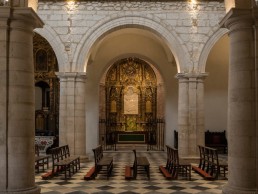
The Inmaculada Concepción Church, Spain
In recent years, the Spanish town of Melilla, situated on the most northern point of Africa, has had a shadow cast over it with struggles of immigration along the Moroccan border. But casting a light on the historic town is the renovation of the Inmaculada Concepción Church. Suffering severe damage from an earthquake of 6.3 in magnitude back in January 2016, it was imperative that restorations went underway as soon as possible to preserve the ancient building.
Headed by Jose Antonio Fernández from Chacel 8 Arquitectura, the rapid restoration project was forced to seamlessly blend the lighting design, by Javier Górriz from Diseño y Consultoría de Iluminación, in with the architectural repairs, in order to stick to the tight deadlines, all with the help of Antonio Bravo, a dedicated recovery historian.
The church of Immaculate Conception is a building of worship and prayer that consists of multiple tiers of history. The earliest layers date back to late Gothic times, with uncertain origins, which archaeologists are still working on in search of further details. Peeling back more across the historic timeline, there is evidence of a Renaissance church that overlaps, and finally turns into a Baroque church that has continuously been added to and evolved into the church we see today.
First and foremost, it is important to identify lighting that will act as a functional balance to the natural light already present throughout the structure. In order to fulfil its main purpose of housing worship, activities and religious functions for the Church community, careful thought was put into designing a lighting scheme suitable for this environment.
Górriz explained the key architectural lighting considerations that were at the forefront of the decisions made for the design: “We need lighting equipment that is as versatile as possible, so that the same luminaire can adapt and change to the different needs, (possibly including different optics, anti-glare louvre, emergency kits, differing colour temperatures, light intensities and system controls). The lighting had to be functional, respectful of the history, emotional, engaging in light and shadow, visually comfortable and able to capture the whole look of the building. During the actual renovation process, a series of secrets that were initially concealed, are revealed and emphasised with light.”
Situated in a fortified enclosure in Melilla, it was important for the designers and architects to work carefully in the delicate setting. With continuous documentation from beginning to end, this project was careful to analyse the historical evolution in order to intelligently integrate the new lighting.
When working with Górriz to formulate a lighting scheme for the project, Fernández describes the thought process: “We are so used to treating light as the element that covers the basic needs of displacement as something that allows us to complete a task, but we should also look at it as the resource that lets us tell a story that transports the visitor to another era that attracts attention to the elements we want them to focus on.”
This impressive turnaround from earthquake destruction to dramatic reconstruction happened in record time. When discussing the project with Górriz, he enlightened us to the fact that the lighting design was realised in a breathtaking three months and overall completion of the renovation was after a staggering six months. With this tight timeframe naturally came some challenges and obstacles to overcome. Notably, one of the hardest hurdles the design team encountered on numerous occasions was the ever-changing canvas to work upon. Górriz reflected: “The principal problem was working alongside the architectural restoration and having to integrate a new system of lighting in a space that isn’t prepared for it, (we had issues with grooving and wiring). Every time that you stripped the plaster, you discovered a new door, or a new space that was sleeping for a long time that wasn’t exposed, so we had to emphasise that with light. In summary, we had to ensure full respect for the skin of the building.”
Structurally, the team had to work around issues of channelling pipes for new points of light, working in tune with the architects in order to make the most of utilising new fixtures to their full potential to justify their existence. Thus, designing a metallic channel that had a triple function; containing electrical wiring for luminaires and drivers without damaging the structure of the church in a longitudinal setting leading to the nave whilst at the same time dividing two stages of construction and highlighting the two different eras of architecture in the building. Differing to previous projects he has worked on, Górriz reflected on the comparisons: “The main differences are working with the unknown in the church and the tremendous speed of the project and the execution of the work that required a very detailed follow-up and rapid correction at the same time. An outstanding feature was the collaboration of a large multidisciplinary team, headed by the architect, director of the lighting work and even down to the smallest contributor of the team.”
Using fittings primarily from Reggiani, the team were able to create this emotive response to the historic building with great effect. Warm colour temperatures reaching 3000K, the LED Yori Surface adjustable projector in different power versions (10W, 22W and 30W) were used with anti-glare along with recessed fixtures along with the Yori Channel Arm. The flexibility of the fittings ensured a user-friendly experience and an overall modern design. It was important to the overall impact to not use indiscriminate flood lighting, but create an atmosphere of peace and welbeing throughout, making it a comfortable and welcoming space for worshippers.
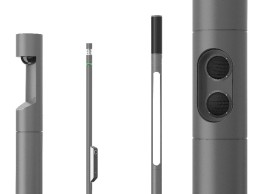
David Morgan Review: Selux Lif system
David Morgan casts his eye over the Lif system from Selux: a comprehensive urban lighting system based on a minimal pole design.
Selux Lighting, originally known as Semperlux, Latin for ‘always light’, was started by Hermann Bansbach in Berlin in 1948, when the city still lay in ruins with hardly any electricity – or light.
Hermann Bansbach brought light into this dark time by brightening the Berliners’ buildings with his simple, affordable battery charger. The Selux brand name replaced Semperlux in the 1980s and a craftman’s shop in Berlin turned into a global company with 553 employees in Europe, North America, and Australia. Today the company generates more than 80% of its revenues outside Germany.
Selux has produced exterior amenity and street lighting since the 1960s and has lit major cities around the world. The Lif system is one of the latest amenity lighting ranges to be added to the Selux range and was launched at Light+Building in 2016. Lif is a comprehensive urban lighting system based on a minimal 180mm diameter pole design. As many elements of the system as possible are designed to fit within this diameter. These include a variety of LED luminaires, CCTV cameras, Wi-Fi hotspot and loudspeaker modules, and this provides an integrated and elegant appearance that could reduce the visual clutter of many city centres. The only elements that extend beyond the pole diameter are signage, phone charging points, emergency phones and information points.
The LED lighting elements of the Lif system include pole top luminaires for general lighting, façade lighting arrays, directional projectors and diffuse rings of light available in various colours. The luminaires and other system elements can be stacked on top of each other to provide the precise combination of outputs and distributions required for the particular location in an urban space.
The lighting and other modules are mounted in cylindrical housings available in four different heights, which can be independently rotated to aim the light output from the projectors and façade lighting in the correct direction. The smallest housing is 250mm high and large enough for the twin projector module with the largest housing being 1.5 metres to accommodate up to three façade lighting arrays.
Within each LED luminaire type there are multiple options. The façade lighting luminaires are available in horizontal or vertical beam types with ten distributions and two colour temperature options of 3,000k and 4,000k. The design detail and construction of the 500mm long façade lighting luminaires is particularly well executed. Twelve high power LEDs with TIR optics are aimed sideways towards individual scoop shaped faceted reflectors that direct the light into the correct beam pattern and direction for the various distributions. For each distribution type the reflectors are positioned and aimed in different configurations. The front glass is bonded to the die-cast enclosure with an attractive screen-printed pattern to hide the bond line.
The post top lighting element is also beautifully detailed with individual sub-assemblies including an LED ring, heat sink, moulded prismatic lens and highly engineered facetted, vacuum metalised, moulded reflector. Two or four sub-assemblies comprise each post top element with either symmetrical or asymmetric distributions.
The twin spot projectors incorporate hybrid optics that combine a facetted-moulded lens with a metalised reflector coating to produce a narrow beam distribution from a shallow component. Two beam angles are available and can be combined in the same twin projector module. The front glasses are again bonded to the die-cast heat sink housing.
The final luminaire type is the diffuser ring. This can be provided in any fixed colour for zoning or as part of a wayfinding scheme. These can be located either at the top of the pole under the top cap or between any of the other elements in the stack. Dimming for all luminaires is via DALI.
The Lif system is a very well engineered and elegant system that can be configured in multiple ways to meet almost any city centre amenity lighting task.
It is understood that the design and development was all undertaken in house over an eighteen-month period by the Selux design and engineering team.
The visual logic of the system’s design is minimal and the detailing is clean and very well executed with high-quality components. My only concern about the design is that the projectors and façade lighting luminaire are all sealed for life and would not be able to be maintained on site at the end of their life or in case of any LED failures. However, bonding the glass directly to the casting does give a very effective seal and it may be that these luminaires can be reworked in the Selux factories if necessary.
This new system is an interesting, elegant and practical addition to the Selux amenity lighting range.
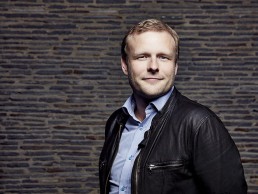
Tapio Rosenius
Renowned Finnish designer, innovator, artist and entrepreneur, Tapio Rosenius is on a quest to explore and question major topics within the lighting industry.
Growing up close to the Arctic Circle, Tapio Rosenius has experienced and learned a very alternative perspective and interpretation of light compared to many of us. With extreme variations in hours of daylight during the year and near enough none during the winter, Rosenius developed a strong fascination with how natural light is a constant, malleable force, which would in turn heavily influence his creative work as a lighting designer.
With multiple aspirations as a youngster, Rosenius swayed between wanting to dominate the world as the biggest rock star to becoming a diving instructor or arthouse filmmaker. Heavily influenced by French cinematographer Sacha Vierny for his narrative driven and beautifully abstract lighting interventions, as a student, Rosenius pursued Photography and Film, and then moved on to study light as an expressive medium at art school in Tampere, Finland, before he eventually settled into the architectural lighting industry. Whilst living in London in early 2000’s, he completed a Master of Science in Light and Lighting at the UCL Bartlett.
His first role in the industry came about through an interesting venture whilst still at school: “I started moonlighting for a Finnish architectural lighting designer around 1996. We used lighting design as a social integration tool for unemployed middle aged people in Lapland. We tried to re-train them as ‘nighttime gardeners’ with skills in ice sculpting and lighting design. Then in 1997, the art school offered to pay me to go and do an internship somewhere outside Finland. The condition was that I had to find a job in the next 24 hours. After a night spent searching for ‘Lightning Design’ companies in AltaVista I found dozens of weather stations, and amongst them Kevan Shaw Lighting Design from Edinburgh. I think Kevan might have misspelled the word ‘lighting’ on his front page, lucky for me! After a rather hilarious job interview over the phone, I joined Kevan’s team and ended up working for him until 2001.”
Progressing on from this, Rosenius then moved to London to join Maurice Brill Lighting Design until he left the role as Director in 2009 to bravely pursue his own lighting firm in Madrid. Not only was setting up independently a daunting prospect, Rosenius had also reached a pinnacle life changing point with his wife, who had just found out she was pregnant. London had become an increasingly busy and intense urban environment, so together they returned to his wife’s home country, Spain, to begin family life and establish the now well-known firm Lighting Design Collective (LDC).
As Director of LDC, he works with light as a medium for architectural collaborations, digital interventions, product innovation and art, and seeks to create tangible connections between artificial light, digital futures, biomimetic and the human experience. Specialising in an imaginative and innovative approach to architectural lighting, the team really focus on state-of-the-art lighting schemes for architecture and the built environment, utilising high tech applications, digital content and artistic assets.
A few years into the venture, Rosenius partnered with Jari Vuorinen to establish LDC Helsinki and then a little later with Kristian Krogh to establish LDC London.
Spread across these three studios, the team now includes leading designers, software coders and digital artists who have built a portfolio of world-class projects for numerous international clients, and covers a wide span of applications from cultural, hospitality, retail, office, residential, landscape and infrastructure.
Rosenius’ intrigue and admiration of natural light is evidently at the root of the work LDC produces. The way natural light moves in infinitely different ways and how it relates to time, space and context is key to the design works produced, and research led, into lighting practices used, both as an art form and for its functionality. In addition to working on lighting schemes with LDC, Rosenius is also a product designer. He created the Light over Time (LoT) luminaire with Artemide in 2017, a series of lighting tools that allows designers to re-imagine, reveal, reinterpret and modulate spaces with precision optics.
One of the most notable projects to come out of LDC is the SILO468, located in the Kruunuvuorenranta district in Helsinki. During darc room 2017 in London, Rosenius presented this remarkable project that brings together all of his recurring influences of natural light and the natural environment together onto one industrial canvas. The abandoned 1960’s oil silo, sixteen metres high and 35 metres in diameter, was transformed into a captivating light installation. 2,012 holes were perforated in the structure, where existing rust stains already existed, and represent the year 2012, the Helsinki World Design Capital year. During the day, the sunlight shines through these holes to create moving patterns that mimic the sun reflections on the surface of the nearby sea. 1,250 LEDs were placed inside the structure that reflect against a red light background at night. Custom made software, controlling the lights, is used to monitor the outside environment and determine the white LEDs internally to match the movement of the prevailing winds like a flock of birds, live, ensuring the light sequence will never repeat.
The installation’s aim was to become a signifier for the start of a major urban redevelopment for the City of Helsinki, and to become a landmark and a marketing draw on the landscape of the lesser-known district it is situated in. In turn, the area, with its 11,00 inhabitants, quickly became referred to as the ‘District of Light’.
Rosenius describes himself as a “cross-over” designer that is constantly aiming to bridge the world of architectural lighting with other creative fields and new technological research.
“The architectural lighting industry drags behind all of the other lighting fraternities (live, show, film, arts) in everything from creative software to innovative hardware to progressive design processes. I believe that our built environments could be made more inclusive, fascinating, practical, meaningful and beautiful for all inhabitants if better systems, better processes, more creative software and more quirky lighting hardware was available. So, I try to put my money where my mouth is and invest into achieving this goal,” Rosenius explained.
“I try to encourage the studios to operate with an anti-disciplinary design philosophy where the knowledge, research, aesthetic and design is constantly mixed and the outcome is highly contextual.”
‘The Future is for Antidisciplinary Design’ is an exploration into the future of the lighting industry and the role and value of the lighting designer within that world today. Taking this theory as an approach to the way he runs LDC, Rosenius cares deeply about the lighting design profession, perceives problems within it and opens it for discussion to provoke healthy debate within a professional audience.
During PLDC2017 in Paris last year, he opened up this topic for discussion, beginning with the question, “What if Lighting Design was an ‘open ended’ profession existing at the creative edge of the built environment services? What if the current consultancy model is leading the profession towards irrelevance?”
Providing an interesting look at our lighting industry, it is important to keep relevant and educated on the position you hold and what you are working towards in order to effectively manoeuvre your way through the constantly evolving industry.
Throughout Rosenius’ lecture, he uses his own experiences with LDC as a case study, tracking the development of the Madrid based studio and how it has adapted and developed into a Dynamic Environments Group consisting of architectural lighting design company spin-offs for digital content and software development, virtual reality services, strategic design services and a new technology start-up. Rosenius clearly states that he is working on the basis of his own opinions and experiences from the industry, including research on programs such as ‘Think in a Tank’ and the EU funded ‘Towards Digital Paradise’. He also draws upon research taken from MIT Media Lab’s work with a particular focus on that from Joi Ito. Rosenius clearly encourages the exploration into the architectural lighting design industry and critically debates its insular practices. He comments during the PLDC lecture: “We don’t lead the innovation within our own field nor do we inspire related fields to follow us. We shy away from criticising our peer’s work or the state of our profession presumably for the fear of ‘spoiling the party’. So what? We all get along nicely, we are highly inspired by our craft and there’s a nice community spirit. But this hides an important and worrying trend. For the rest of the built environment industry, we, the independent lighting designers, are becoming less relevant, less interesting, and less necessary by the day.”
A bold claim to make, Rosenius passionately pulls this theory apart, discussing it with fellow designers alike and poses interesting resolutions to the problems.
Is it merely an increase in competition in the industry or a lack of compelling value proposition towards the clients and the architects, which is a likely influencer?
One of the concerns Rosenius has adopted is through the client process. The combination of services and design output produced by Lighting Designers proves consistently identical as well as the inclusion of the services that aren’t design packages but instead a basic set of consultancy tasks. Rosenius explains further: “When a client compares any given lighting design companies, many are like identical twins where only the close family can tell the difference between the two. The clients have plenty of choice for these seemingly identical ‘lighting design’ services since they are offered simultaneously by numerous lighting designers, engineering consultancies, luminaire manufacturers, agents and suppliers, other design professions and even contractors. We need to ask ourselves what is our value proposition and what is it that truly differentiates us as a profession? And most importantly, do we innovate enough? The current model appears to be bringing the prices down, sometimes to zero, and begs the question: Is architectural lighting design already a commodity?”
To explore this idea further, Rosenius performed an experiment with LinkedIn searches to see if different search results filtered by industry based titles gave a clear indication for the amount of pure lighting designers. The results proved intriguing, as the addition or subtraction of certain industry based titles whittled down to an estimated 10,000 ‘Lighting Designers’ as apposed to the somewhat 700,053 Lighting Design professionals. Whilst this does not highlight the Lighting Designers as an insignificant proportion, it does suggest the services are being commoditised as a result of an easily learned skillset for popular design solutions and trends.
Rosenius moves along to then question the limbo like position Lighting Designers have found themselves in. “It is clear that architectural Lighting Designers exist as a minority group within the much larger lighting design activity. It seems to have adopted a role as educated (or in some cases simply enthusiastic) consultants rather than innovators. The technical innovation is driven by the manufacturing industry and their consultants; the conceptual innovation is driven by the ‘outliers’, the artists, VJ’s, architects, academic research organisations and the new technology companies,” he explains.
In order to combat these issues, Rosenius recommends the industry encourage investment into the research and development sectors to avoid this commoditisation and continue to be relevant professionals. He also observes that Lighting Designers are continuing to ride along in their bubble of contentedness whilst manufacturers throw ample amounts of budget into their own research and development and support education for Lighting Designers in order to mould them into their preferred format to suit themselves. Rosenius clarifies: “Whilst there is arguably nothing particularly wrong with this model of knowledge transfer, it does, however, weaken the position of the Lighting Designer, when it comes to innovation. I would even venture further to say it potentially suffocates creativity and allows complacency to creep in. If the Lighting Designer doesn’t need to innovate, they can simply apply ready-made solutions in a creative way to suit the project. A process that goes a little bit like this: Discover – Copy – Paste – Tweak – Shop for new solutions at a trade fair – Repeat. Should we as a profession change focus to remain relevant for years to come?”
The majority of his theory for this can be drawn from previous lighting projects over the last twenty years and the trending creative results produced by these and the consistent amount of repetitive and predictable processes used.
The future? According to Rosenius, one of the best resolutions for these issues is an interdisciplinary approach to running a lighting design practice. To achieve this ideal working environment, it is essential to have collaborators from various working backgrounds contributing to the lighting design team beyond their own discipline. As an avid promoter of new and exciting projects that challenge ‘the norm’, he believes the intersection of different disciplines creates interesting results and brings new values to a project. “This approach begins to push the company from a standard consultancy model, where each skillset is active within its own silo, towards a creative design company model. There are fantastically successful design practices that work with the interdisciplinary model such as IDEO, Fjord, Frog and many others. They offer great inspiration on how lighting design profession could develop and what the business models could be,” he states.
When Rosenius originally established Lighting Design Collective, it was being run as a typical lighting design firm, following as he puts it, “the Anglo-Saxon model of services and deliverables”. With the ever growing demand for more complex concepts, broader skillsets from practitioners and content packages for media surfaces, LDC evolved into a multi-disciplinary firm. After six years, UNSTATIC developed as a spin off digital content team headed by Gorka Cortazar. Think-in-a-Tank was then developed as part of LDC in collaboration with sociologist Dr Marco Bevolo and has run annually since 2014. ReVR Studio was the next spin off to come out of LDC, when the demand for quality lighting visualisations and Virtual Reality became higher. In early 2016, ReVR developed into their own team to continue to collaborate with leading architectural firms and Lighting Designers creating integrated design processes.
Moving towards the Digital Paradise that Rosenius refers to in his research, he explains the movements LDC went through.
“In late 2013, LDC were invited to join a research consortium bidding for EU Horizon2020 funding under a topic of Connected Light and Sensing for Smart Spaces. We lost the bid but learnt a lot and got introduced to the futuristic world of new technology research run by VTT Technical Research Centre of Finland. Since then, we have been part of three winning consortiums, Delphi4LED, DecoChrom and Towards Digital Paradise, most receiving funding from the Horizon2020 program. The latter one led us to partner up with a group of professionals to create a new technology start up, Skandal Technologies, developing systems for Ambient Communications.” Skandal Technologies also uses new biomimetic and responsive technologies in lighting control in built environments.
The idea that humans have a substantial ability to process ambient and peripheral information that directly affects emotions and subconscious contextual understanding without the need to activate cognitive thought processes is the bases of innovation for Skandal Technologies, which is currently developing its Generation 2.0 system.
Rosenius states: “The future of the Lighting Design profession is precarious. A shift from a consultancy based business model to an anti-disciplinary design company model could foster more innovation and gain a new position closer to the edge of the larger lighting profession. Investment into research and strong promotion of critical debate should be a central goal of practice leaders. Our profession should own the process of visual narrative for our built environment and lead the conceptual innovation. We should provide application research and inspire related fields such as new technology companies to follow our lead. We should design our own tools and set the trends for the manufacturing industry.
“The figure of the Lighting Designer has become more known and the field has grown, which is great. I haven’t seen a big shift in terms of design and creativity, however. Most companies operating in architectural lighting design appear to be very confortable with figuring out ‘creative solutions’ rather than behaving as actual design companies. I make a big distinction between design and consultancy activities. The latter dominates the lighting fields and you can see it in the project outcome very clearly”.
As a starting point, Rosenius believes it is important to understand and define what value lighting can bring to the client. However, this in itself comes with difficulties, as Rosenius noted, many clients struggle to distinguish between the various specialists in the field, and thus a multitude of services are provided with a staggering variation in quality. “The value proposition is often vague, which has led to the drop in fees. In many markets, Lighting Design is still a cottage industry trying to find its way,” he observes. “Yet, there is still hope for young designers about to break into the industry, with countless opportunities to bring new approaches and desire for differentiation from the client’s side.”
So, what potential does the future hold?
Rosenius promotes: “Integration of new design tools in software and hardware will permit designers to develop more complex and integrated schemes into their designs”. As for LDC, their offices are growing across their three sites, and they are working hard to bring their creative message to the forefront of clientele business with great success. As an independent entity, ReVR is delivering virtual reality packages for multiple platforms in design and architecture, and London based UNSTATIC provides independent digital content services with designers in mind. Currently also working as the CEO of Skandal Technologies and as a pioneer in using biomimetic lighting control in built environments, Rosenius continues to develop systems, visions and technologies related to this field whilst coaching new generations of lighting designers through his own design practice mantra.
www.ldcol.com
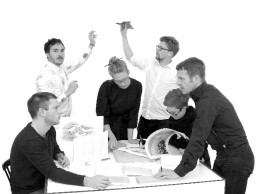
JAC Studios
Following their impressive work on the Wadden Sea Centre, arc’s Matt Waring caught up with Danish architects JAC Studios to discuss its design philosophy, and the role that light plays in its work.
Scandinavia is a region well regarded for its approach to design, and not just in the world of flat-packed furniture; with its sparse, minimalist aesthetic complementing the vastness of the landscape. In the architectural sphere, JAC Studios has brought this approach to its work, designing exhibition spaces and residential projects that exist in harmony with their surroundings.
Founded by Johan Carlsson in 2009, JAC Studios was established, in his words, “as a response to find a balance between, or a framework from where to explore spatial interventions and storytelling from both a practical and propositional perspective”.
After opening an art space, working with performance and exhibitions in the international art scene and working within the field of ‘temporary interventions’ for eight years, Carlsson was invited to design an exhibition about the Danish situationist artist Asger Jorn, something that he believes was a ‘generator’ for him setting up his own studio.
Now, JAC Studios is an architecture and design practice that explores “both the practical and the theoretical, aiming for results that are innovative, high quality and socially relevant.”
This is realised by utilising a philosophy that looks at the wider contextual setting surrounding each project, regardless of scale. This was evident in their work on the darc awards / architectural shortlisted Wadden Sea Centre, and can be seen across the studio’s portfolio too.
“JAC Studios believe in contextual interventions, where the narrative or the thematic story is communicated through a one-off design, composed of investigations in movement, the specific room, the scenic setting, light, sound and furniture,” Carlsson explained.
“Projects should address the social, spatial and sustainable issues and are developed physically and conceptually in parallel. This approach focuses on a deep understanding of how things are made with emphasis on hand-craft and production.”
Because each project must interact with their wider contextual setting, it’s hard for Carlsson to define what JAC Studios’ ‘signature style’ is. Instead, he said, they “always aim to focus on spatial experiences, an approach where the performative aspect of body and space creates the dynamics”.
Since its inception, JAC Studios, comprised of a team of architects, designers and artists, has developed a more specific focus on interior architecture, and predominantly exhibition design, working on internationally renowned projects such as the Yumin Art Nouveau Collection in South Korea, and House of Sweden in Washington D.C., as well as UNESCO world heritage sites such as the Icefjord Centre in Greenland, and the aforementioned Wadden Sea Centre in Denmark.
Alongside this, the studio has developed a focus on private sector work, completing a series of small-scale residential projects, such as the widely published Sturlasgade apartment in Copenhagen.
The core aspect to developing each project, Carlsson explained, is rooted in context, relationship to the site, history, user preferences and ambitions. “This is coupled with respect and sensitivity for the existing, valued ethics and aesthetics,” he said.
However, the studio is selective when it comes to what projects they take on and bid for, as Carlsson elaborated: “Our preference always begins with context and content: in the case of exhibitions, this is often the artefact or object linked to a specific theme. We favour a no-nonsense exhibition, where the artefact is the main actor.
“We believe that the combination of scenography and architecture provide a base for alternative thinking, which results in communicative spaces evaluated by storytelling, aesthetics, materiality, sustainability and user participation.”
Throughout the design and implementation process, JAC Studios place a great deal of care and attention on maintaining good relations with the client. Stating that the client is always “an integral aspect on the work”, Carlsson explained that they always focus on “developing a good working relationship through hands-on workshops that help to establish a collaborative approach within the team”.
Alongside its work in the practice of architecture, design and realisation, JAC Studios believe in the importance of sharing knowledge and information, and they achieve this through their Residency and Salon programmes. “We believe that architecture plays a major role in contributing to debates and dialogue, and that architecture should work as a social and communicative stage,” said Carlsson.
As such, the studio is comprised of two key aspects: one, as Carlsson explained, is “rooted in the practice of architecture, design and realisation”, while the second is “focused in sharing knowledge through the staging of events, ‘salons’ and gatherings that address a critical approach to the wider field of architecture”. JAC also, through its Residency programme, invite other practitioners from diverse practices into the studio.
This quest for a constant dialogue, and the studio’s self-proclaimed ambition to ‘embrace the sphere between architecture and art’, has seen JAC bring in collaborators “in the form of writers, scientists, filmmakers and artists that help add a depth and integrity” to each project. By working with these collaborators, JAC believe that they can find the “balance between the rational and the poetic” in their work.
Such collaboration was none more evident than in the Wadden Sea Centre project. As JAC Studios acted as a general contractor on the project, as well as the lead designers, they were able to gather a team with unique specialties and skills that formed the design approach and exhibition aesthetic.
As such, they teamed up with fellow Danes and lighting designers fortheloveoflight, while also working with Jason Bruges Studio and No Parking to create a serene exhibition space that matches JAC’s primary ambition and sits in perfect harmony with the surrounding landscape.
“Good design should relate but not necessarily mimic, copy or respond seamlessly with landscape,” said Carlsson. “There should be a critical response that is formed through analysis and perception of each unique landscape and architectural setting.
“The landscape in the Wadden Sea is truly exceptional and was a core inspiration throughout the project. The site is in constant motion in the area, tides and migratory birds follow their own rhythms and we felt the exhibition should respond to this.”
It wasn’t the first time that JAC worked with fortheloveoflight – the two practices share a studio space, and as such, Carlsson revealed that he and Nikolaj Birkelund, founder of fortheloveoflight, work closely together on the majority of projects that they have in the studio.
JAC and fortheloveoflight also created a bespoke light fixture together for the Wadden Sea Centre. Working alongside Mike Stoane Lighting, they designed and developed the BBx.70 ‘Birdbeamer’ fittings.
“We developed the BBx.70 from concept and design to realisation through a series of physical 1:1 mock-ups and testing both in the studio and on-site,” said Carlsson. “With the excellent help of Mike Stoane, we were able to produce bespoke fittings that offered a uniqueness and high quality to the lighting units and interfaces.”
Further to this, JAC has developed modular furniture for the House of Sweden, crafting a thin wooden structure with integrated lights but no cords. “To reach this, a low voltage system was developed and implemented into the magnetics that keep the modules together,” explained Carlsson.
This all ties into Carlsson’s belief that, in order to create an effective exhibition space, teaming up with lighting designers should be a top priority. “When developing design aspects such as display cases it is essential to work closely with a lighting designer to form the project approach, materiality and principal dimensioning,” he said.
“We often work with priceless and rare objects, so a skilled command of lux levels and illumination is fundamental to our projects as well as creating a suitable environment for the selected objects.”
This need for skilled expertise in lighting means that Carlsson understands the importance of working with lighting designers, as he believes that “lighting design is one of the most essential aspects in our projects, particularly within exhibitions”.
“Clever manipulation of light can create moods that form the essential experience when visiting a gallery,” he said. “As such, natural and artificial light should complement each other and work together to form an overall theme and aesthetic.
“When we generate a project, we set up a team from the very beginning, which includes a lighting designer. Since many of our designs are developed and custom-made, it is a must that all aspects that would affect the design or the way the design is seen are with us through the full process.”
Carlsson’s close working relationship with Birkelund at fortheloveoflight has given him a strong understanding of just how light can impact on a space: “Lighting is and will always be one of the core instruments in spatial design, the rapid pace of innovations within lighting opens up for new ways of how to integrate the light, but also what functions the light can perform in a space,” he said. “Functions that sometimes go beyond providing light, but also control the environment and the performance of the space.”
Because of this, and Carlsson’s experience of developing lighting fixtures, he explained that lighting “will take an even more prominent role in the practice”.
“It is exciting to develop bespoke systems that utilise the latest technology with mock-ups and rigorous tests in-house, further challenging the meeting between technology, craft and innovative solutions. That said, we strongly believe in specialists and we will continue to collaborate with lighting designers.”
All of this means that for JAC Studios, the future looks bright, and Carlsson agrees, adding that he hopes to use the studio’s experiences to continue developing, and push on to new frontiers.
“We hope that the future will allow us to continue exploring and to create designs and experiences that make us reflect, question the ordinary and create new conditions.”

Giovanni Bonazzi
Following the announcement that 3F Filippi had acquired Targetti, arc caught up with Giovanni Bonazzi, CEO of 3F Filippi to talk about the acquisition, and what it will mean for the two brands going forward.
What is the history of 3F Filippi?
3F Filippi (Fluorescent Fixtures Filippi) was founded in 1952, by my father, Romano Bonazzi, and his partner Martino Filippi, who died a few years later due to a traffic accident. The company aimed to design, produce and sell lighting fixtures equipped with fluorescent technology. The decision to enter this sector was based on the growing demand for high efficiency systems, able to illuminate the ever-increasing number of industrial plants that opened their doors every day in post-war Italy. My father understood the great potential of the lighting market development in our country and abroad, and continued to run the company along with my mother Mirella until five years ago, when he left 3F Filippi to me and my sister Cristina.
What is your role at 3F Filippi and how did you get there?
I hold the position of Chief Executive Officer, but I have been working in the family business for many years. After completing my studies, in fact, I joined 3F Filippi, dedicating myself to commercial activity and marketing. Over the years, I gradually joined my father in the choice of strategies to be undertaken.
Why did 3F Filippi acquire Targetti?
In our 66-year history, we have achieved high-level performance in our reference markets, such as industry, commerce and the tertiary sector, and have a consolidated experience in the design and production of efficient technical lighting systems. Our will to constantly test ourselves led us to take over a historic brand such as Targetti, aiming to expand our product range and develop industrial synergies with a move into the field of architectural lighting for indoor and outdoor environments.
Furthermore, the wide range of products allows us to proudly bring ‘Made in Italy’ to more than 50 countries, and grow further in markets with great prospects, such as the USA, United Kingdom and China, thanks to the dense sales network and to foreign branches.
Was it a straightforward process or was there a lot of negotiation?
It was not a long negotiation (just consider that the IDEA Fund had acquired Targetti less than a year ago). Once we established that there was no lack of opportunities to grow together on international markets, we did not find it difficult to close the deal.
What are your plans going forward with the Targetti brand?
Our aim is to bring the Targetti brand back to the growth levels of a few years ago. It is a difficult challenge, the one we are facing, but we are convinced that, thanks to adequate synergies with 3F Filippi, the Florentine company has what it takes to regain the prestige it deserves.
How will the 3F Filippi and Targetti brands sit together?
Even if this acquisition has created one of the most important Italian lighting groups, it is important to remember that we never thought about merging the two companies. They will continue to move autonomously, in order to keep valuing the approximately 600 employees who every day contribute to the growth in their concerned sectors. We are extremely satisfied with how the company has been managed up to now, and we have found an excellent management team and a close-knit and motivated team of collaborators.
That said, we will do everything to ensure that the pluses of one can become, from now on, a competitive advantage for the other. For example, I am convinced that the considerable commercial know-how gained over the years by Targetti in markets such as China, USA, United Kingdom, Russia and the United Arab Emirates will also be useful to 3F Filippi to develop its business in these countries, where it has had little presence until today.
Will there be any more acquisitions in the future?
Even if we never say never, I believe that in the next few years we will be purely concentrated in the growth of current brands, including that of Duralamp (a subsidiary of Targetti).
What will you be showing at Light+Building?
Of course Light + Building will see the participation of both brands, each with its own stand. In the case of 3F Filippi, some new versions of our appliances for industry and retail, much better performance than the previous ones, will be shown to the visitors. Moreover, the company will present a world premiere of some new lighting fixtures dedicated to work spaces, and in particular to the office. These are products that we are planning and developing together with some important Italian architectural firms.
How do you see the architectural lighting industry developing in the future?
I believe that a future full of challenges awaits us. The progressive affirmation of LED in every sector, for example, will “push” companies to complete the adaptation of their devices by equipping them with this type of light source. But the challenge will also be commercial. The most successful companies in the coming years will be the ones able to offer the best on the market, with a wider range of offers. Leaving aside, at least in part, the world of design-oriented lighting, I think that the greatest successes will be achieved by those companies, or groups, which will provide any type of lighting solution, setting themselves not as a simple products supplier, but as a a real partner that offers high added value solutions for the customer.
Tianjin Binhai Library, China
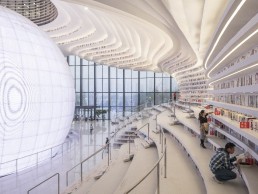
It’s not often that a newly opened building normally associated with dusty, quiet rooms and bland architecture attracts so much interest in the international press. Both architectural and popular media have drooled over the extraordinary design of the Tianjin Binhai Library in China by Dutch architects MVRDV and local designers Tianjin Urban Planning and Design Institute (TUPDI). The 33,700sqm cultural hub, part of a larger masterplan to provide a cultural district for the city, features a luminous spherical auditorium and floor-to-ceiling cascading bookcases not only as an education centre, but also social space and connector from the park into the cultural district.
An oval opening punctured through the building is propped open by the Eye, a luminous sphere with an auditorium, which takes the main stage within the atrium and enlarges the perceived space within. The building is lifted upwards creating cascading floor to ceiling bookshelves that also act as seating and walkways leading to more private reading rooms. Terraced bookshelves echo the form of the sphere to create an interior, topographical, landscape whose contours reach out and wrap around the façade. In this way, the stepped bookshelves within are represented on the outside, with each level doubling up as a louvre. The library’s open glass façade opens to the park outside so it is a light, airy and welcoming space.
“The Tianjin Binhai Library interior is almost cave-like, a continuous bookshelf,” says Winy Maas, co-founder of MVRDV. “Not being able to touch the building’s volume we ‘rolled’ the ball shaped auditorium demanded by the brief into the building and the building simply made space for it, as a ‘hug’ between media and knowledge.”
Maria Lopez, MVRDV’s project leader, commented,“The library building can be understood as a zipper that transitions gradually from a normal building to its eye (spherical) core.”
MVRDV made proposals for the lighting design during the design phase but eventually this task fell to TUPDI who designed the lighting for the atrium and then assigned Tianjin Architecture Design Institute (TADI) for all other areas with lighting designer Huayi Jianyuan leading the project for TADI.
The terraced bookshelves and ceiling relief are highlighted by natural white flexible cove lighting (provided by Osram 4000k Value Flex G2) that echoes the form of the sphere creating a luminous topographical landscape whose contours reach out and wrap around the façade. In this way, the stepped bookshelves within are represented on the outside, with each level doubling up as a louvre.
By contrast, the Eye is illuminated in cool white emphasising this remarkable structure within the building.
Maas said: “The Eye is the centre of the library. It ‘hollows out’ the building and creates, out of bookshelves, an environment to sit, to read, to hang out, to climb and to access, to create an organic social space. In its heart is the auditorium which mirrors the environment, giving a 360-degree panorama of the space inside; a truly reflective and pensive environment.”
The futuristic library sits within a sheltered gallery, topped with cathedral-like vaulted arches, which winds its way throughout the scheme. MVRDV’s project is surrounded by four other cultural buildings designed by an international team of architects including Bernard Tschumi Architects and Bing Thom Architects.
The five-level building also contains extensive educational facilities, arrayed along the edges of the interior and accessible through the main atrium space.
“We opened the building by creating a beautiful public space inside; a new urban living room is its centre,” added Maas. “The bookshelves are great spaces to sit and at the same time allow for access to the upper floors. The angles and curves are meant to stimulate different uses of the space, such as reading, walking, meeting and discussing. Together they form the ‘eye’ of the building: to see and be seen.”
The public program is supported by subterranean service spaces, book storage, and a large archive. From the ground floor, visitors can easily access reading areas for children and the elderly, the auditorium, the main entrance, terraced access to the floors above and connected to the cultural complex. The first and second floors consist primarily of reading rooms, books and lounge areas whilst the upper floors also include meeting rooms, offices, computer and audio rooms and two rooftop patios.
Tianjin Library is part of German architects GMP’s 120,000sqm masterplan which aims to accentuate the characteristics of the surrounding districts. Through its design, the complex will become a junction point for the Central Business District, old town, residential districts, commercial areas and the government quarter; hoping to compensate for any missing programme in each. The library’s outer volume was given in the masterplan so the Eye and its surrounding semi-public area are an internal space, like an inverted icon, acting as a central point and folly in the building.
The library is MVRDV’s most rapid fast-track project to date. It took just three years from the first sketch to the opening. Due to the given completion date site excavation immediately followed the design phase. The tight construction schedule forced one essential part of the concept to be dropped: access to the upper bookshelves from rooms placed behind the atrium. This change was made locally and against MVRDV’s advice and rendered access to the upper shelves currently impossible. The full vision for the library may be realised in the future, but until then perforated aluminium plates printed to represent books on the upper shelves.
In the Kindle era, the difficulty of getting people to visit libraries to interact with books is obvious. However, since its opening in October 2017, visitor figures have gone through (or should that be, undulating through) the roof. MVRDV has created an iconic piece of architecture that will live long in the memory for as long as books are still enjoyed.
The Word, UK
In the UK, the impact of austerity measures over the past few years has hit certain sectors hard – particularly public libraries. Cut backs on expenditure have led to a raft of library closures across the country, and for all intents and purposes, it appeared that the local library was fading from British society.
So much so that figures recently published by the Chartered Institute of Library and Information Professionals, there has been a 14-percent decline in library visitors over the past five years.
That is not the case in South Shields though, as thanks to FaulknerBrowns Architects, Muse Developments and Desco, a stunning new library building has been constructed.
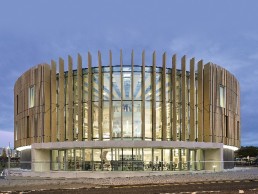
Dubbed The Word, the new building is not just intended to be another run-of-the-mill library, but an outstanding social hub for the community, with it’s unique circular structure designed by FaulknerBrowns to mimic the fanning pages of an open book.
Located on a prominent gateway site linking South Shields’ riverside area with the town centre, The Word is one of the first projects for the redevelopment of the area, and as such the scheme needed to be successful to provide a striking new focal point in the North East town’s marketplace, in which its community can take great pride, and from which the wider regeneration will develop.
Because of this, the design and construction team created a shining example of an attractive, efficient civic building, encompassing design features that reflect the town’s industrial and manufacturing heritage, enhanced by a complementary, bespoke lighting scheme, developed by Desco, to attract and engage visitors.
Desco had previously developed a good relationship with FaulknerBrowns, having worked on numerous projects together over the years. Through this existing relationship, Desco were recommended by the architects to Muse Developments to join the team.
From this initial recommendation, Desco was involved from the project concept through coordination, installation, commissioning and all the technical aspects of the lighting scheme, including prototype design and approval. Alongside this, they worked with manufacturers Hacel and Atelje Lyktan to develop some bespoke lighting solutions.
James Davison, Senior Design Engineer at Desco, explained how he worked with the architects to develop the lighting concept: “FaulknerBrowns’ initial concept of an open book with the pages fanned out was also the main inspiration for the lighting design.
“The concept matured as the client’s ambitious vision for a more wide-ranging, exciting visitor attraction emerged. As the brief and client expectations gradually evolved, so too did the lighting design, retaining a flexible approach to the design being the key element.
“Faulkners had a very keen sense of how they wanted the building to look and the lighting needed to tie into this vision whilst maintaining the element of flexibility throughout the building.”
However, while the lighting design needed to be flexible, there also had to be a sense of uniformity. As the highly sophisticated building includes library and exhibition spaces, alongside a number of key areas allowing interactive exhibitions, storytelling and social spaces, all co-existing alongside contemplative and study zones, Desco sought to utilise a singular concept to illuminate all these areas, creating a sense of commonality in the space.
Davison explained: “We developed the notion of a linear extrusion with multiple uses, which could be interchangeable to reflect the fluid nature of the architecture. These linear ‘spokes’ tied in with FaulknerBrowns’ concept and the overall ‘language’ of the building.”
The multiple uses of this bespoke linear extrusion meant that Desco was able to adapt to the changes throughout the building as the areas and room boundaries ebbed and flowed by modifying the luminaire components to suit the spaces.
“Within the main luminaire housing there are three main sections,” Davison elaborated. “High output linear sections to illuminate larger areas and displays, track mounted spotlights to emphasise exhibitions and key artwork pieces, and lesser output linear sections with a more controlled and diffused light for areas where glare control was paramount – offices and reading areas.
“By interchanging these elements within the confines of the original ‘spoke’ design, we were able to be extremely agile to the client’s changes.”
This bespoke linear lighting design serves to complement the structure’s circular, ‘fanning pages’ effect, extending from the building’s centre outwards, to align with the architecture. The fluid solution of multiple linear sections within a single extrusion brings a sense of continuity to the design aesthetic while maintaining the desired element of flexibility.
Desco collaborated with local manufacturers Hacel to create this linear system, as Davison explained: “Hacel were in the midst of developing a linear lighting system and we were able to exploit this process and tailor the luminaire to our needs.
“We started with the continuous extrusion – this needed to come in different lengths to tie in with the architecture. Once this ‘carcass’ was established, the individual components could be inserted almost like piecing together a jigsaw.”
The main feature, Davison explained, that differentiates this system – which later became Hacel’s Infinitas – with other linear installations is the inclusion of the track section. This means that the spotlights incorporated within the ‘carcass’ allow a single extrusion to run for, in some cases, more than 10-metres, illuminating several areas differently while maintaining a sense of commonality.
On entering the building, a halo of LEDs integrated into the soffit of the overhanging upper floors illuminates the building’s perimeter at ground level, encouraging the public to engage with the building, while the glazed triple height atrium floods the space with natural light, while providing stunning views of the River Tyne and the neighbouring Grade I listed Old Town Hall – two enchanting aspects of the building’s historic context.
Due to its circular shape, the whole building appears to emanate from a central point, the large, three-storey atrium. The whole building seems to channel visitors into this fabulous space, and the lighting revolves around this concept. The linear lighting emphasises this, while providing an optical illusion that the entire building is sloping inwards.
At the heart of the development is a bespoke, 6.5-metre wide LED luminaire, designed by Desco and FaulknerBrowns in collaboration with Atelje Lyktan. The chandelier – the largest single fitting ever manufactured by Atelje Lyktan, was custom-made to fit an architectural ceiling recess with the depth of the fitting dictated by the architect’s vision. The installation is comprised of 84 ‘drums’ mounted to a bespoke frame. As the chandelier is literally bolted to the soffit, all cables were hidden within the bespoke mounting frame of the luminaire installation, with the cabling cast within the concrete before the installation design had been completed.
The chandelier was incorporated with tuneable white LEDs, allowing for the atmosphere and mood of the building to be altered depending on the time of day, as Davison explained: “The colour temperature of the fitting is designed to simulate daylight; a warm 2700k light in the morning gradually changes to a colour temperature of 6500k as the sun peaks, then turning back to 2700k tones at sunset.
“As the colour of the light changes so gradually, most people don’t realise the subtlety of the effect directly. This gradual change results in the mood of the building changing over the course of the day, with the building awakening with the sun in rich golden tones, achieving its peak effect at midday with a very clean natural light, and gradually returning to the early colours, changing and evolving the atmosphere of the building throughout the day.”
Desco was also responsible for the external lighting design, in which they aimed to enhance and enliven The Word’s context within the public market square, creating a new meeting place and community event space. Peripheral lighting with a mixture of Concord uplighters and integrated LEDs clearly defines routes and complements the architectural form of the building, helping to draw visitors in. The Word defines its landscape, and the external lighting scheme helps to transform and emphasise the structure at nighttime.
FaulknerBrowns worked hard to ensure that the building, while remarkable in its shape and design, still held true to its surroundings, paying homage to South Shields’ industrial heritage with a palette of materials chosen by the architect including coal, salt, glass, stone and metal.
“As such, the colour temperature of the luminaires needed to be correctly chosen to bring out the rich tones in each of these materials,” said Davison. “All of this occurs within the confines of dark sky initiatives to reduce light pollution, which is something we were very keen to achieve.
“It would have been very easy to bathe the building in light but we have picked out key components to the external façade instead, allowing the building to be highly engaging.
“The external lighting was also selected and placed to highlight the circular nature of the building, where traditional façade lighting would have made the building appear flat and lifeless, the shape is highly accentuated by the scheme without ever overpowering it.”
Despite The Word being an incredibly unique building, particularly for a library in the UK, Davison asserted that Desco has, through its experience in the leisure sector, worked on projects of a similar nature in the past, although he did concede that the approach towards this building was quite different to other projects.
“Sometimes a client or architect gives an open brief to the lighting design – they’re not sure exactly what they want but normally have a strong idea of what they don’t! With The Word though, the concept was well established and the challenge became one of ensuring the brief was met and maintained,” he said.
“The other major factor in how this differed from other buildings is the shape – there aren’t too many spherical buildings built these days! I enjoyed the challenge of creating a lighting design that responds to and complements the architectural concept.”
However, Davison revealed that, while he enjoyed creating the lighting design for The Word, trying to maintain the aesthetic while having an eye on lighting requirements of such a firm, restrictive geometric pattern was a ‘real issue at times’.
“Avoiding over illuminating at ‘peak’ areas, i.e. where the linear extrusions meet, meant a lot of work was done on the DALI lighting control system,” he said. “We dimmed the lines of light as they became closer together, but not too much so as it would be instantly noticeable – we wanted to maintain a sleek, uniform light.
“It’s a detail that isn’t immediately obvious and possibly passes most by, but it’s something that for me, although relatively simple, really captures the extremely detailed thought pattern that has been applied to the lighting design.”
This detailed thought process has led to the creation of a very effective lighting design throughout the new centre, serving both on a functional basis to emphasise the architectural form of the building, blending into the overall concept of the design, and also as a statement piece, with the bespoke Atelje Lyktan chandelier dominating the three-storey space without ever looking out of place.
“Both major applications achieve their goal and demonstrate the technical capabilities and expertise available,” said Davison. “Sometimes it is difficult to imagine how a building will look, especially from 2D plans and even 3D models as the light interaction within a space may differ in reality.
“With The Word however, the vision we wanted to achieve was clear and the similarities between our initial concept sketches and calculations and the finished building is striking.”
Since its completion, the impact that The Word has had on the South Shields community has been reflected in its success. Figures revealed that in its first two months of operation, this new cultural venue has attracted 88,000 visitors, and as further evidence of its success to date, 867 new readers have joined the library – an increase of nearly 400-percent compared to the same period at the old Central Library. Alongside this, there has been a staggering 750-percent increase in library users in the teenage demographic, which Davison puts down to the “sleek, modern and welcoming design of the building” being a major contributing factor in creating appeal for new and future generations of readers to come.
“Against the backdrop of gloomy figures recently published by the Chartered Institute of Library and Information Professionals, The Word’s statistics are very welcome news,” added Davison.
One of the most impressive feats of The Word though, Davison believes, is that it was completed not under the big budget that privately-funded developments are, but the slender means of a local authority deep in the midst of austerity measures, making the success of the project all the more remarkable.
“All aspects of the design needed to reflect this, including the lighting package,” he explained. “Our cloth needed to be cut accordingly whilst maintaining a high level of design. This was achieved by good design, collaboration and innovative thinking; all leading to the development of an iconic and flagship structure.”
Overall though Davison is delighted that The Word can serve as a social hub for the local community, providing a beautiful new location for residents to take pride in and taking that all important first step in the regeneration of the town centre.
“South Tyneside Council’s aspiration for the scheme was for it to be an icon for South Shields, promoting footfall and tourism back into the town centre. The impressive visitor figures and positive feedback serve to demonstrate how The Word and its intelligent and eye-catching design is already achieving that aspiration and helping to shine a national spotlight on culture and design excellence in the North West of England.”
Canadian Museum of History, Canada
The Canadian Museum of History, located in Gatineau, Quebec, is the most visited museum in Canada, welcoming more than 1.2 million visitors each year.
With roots dating back to 1856, it’s one of the country’s oldest public institutions and a respected centre of museological excellence, sharing its expertise in history, archaeology, ethnology and cultural studies both within Canada and abroad.
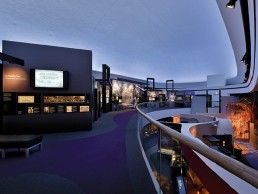
With roughly 25,000sqm of exhibition space spread across four floors, the lighting design needed to be just right, in order to showcase the more than 200,000 artefacts on display.
To create a new lighting scheme for the museum, Montreal-based GSM Project – a group that specialises in the design and production of thematic installations and exhibitions – brought in Lightemotion, who through a combination of museum and architectural lighting, highlighted the work of architect Douglas Cardinal, while showcasing the museum’s history.
François Roupinian, President of Lightemotion, said that the goal for the new lighting design was: “to create a visual narrative with the lighting that would take the visitors throughout the different galleries that tells the story of Canada. The light should act as a magic wand, directing the viewer’s attention to key areas.”
To accomplish such a feat with a maximum spectrum of effects, the team at Lightemotion used more than 40 kinds of light fixtures. From theatrical floodlights to gobo projectors from ETC and miniature LED heads from the likes of iGuzzini and Sistemalux for subtly illuminating even the smallest details of the displays, all equipment used throughout the museum was carefully studied and adjusted in order to create a unique path of light.
Roupinian continued: “Flexibility is important for creating the right lighting.” As such, nothing was left to chance, with features including interchangeable lenses, zoom, anti-glare accessories, an integrated potentiometer to adjust the lighting level for conservation needs and ambience, and the option to add colour filters. Because of this, the lighting manufacturers for the project were chosen with particular care so that a wide range of choices would be available to ensure colour consistency.
Beyond the myriad of fixtures required, a project such as this comes with its own set of challenges; the first being the use of LED technology to recreate the warmth and subtlety of halogen, as LEDs are often too bright for the more subtle needs of a museum, as Roupinian explained: “The use of LED in a museum with thematic environments is not easy. Manufacturers want to produce very high lumen output luminaires but the choice and quality of optics is not always available.
“Also, in a museum we need control of the light and spills, and a good quality beam. We do not necessarily need a lot of light output, especially when you illuminate objects at 50 or 100 lux.
“The problem then comes though, that even when you have fixture equipment with integral dimmers, when the light is dimmed on an artefact, the LED lights become greyer.”
Roupinian and his team countered this though by working closely with different manufacturers, such as ETC, iGuzzini and Sistemalux, that could produce fixtures with good quality optics that would give less spill and residual lighting.
“Also, to counter the greyish colour that certain luminaires would produce through dimming, because of the lux level requirements, we used filters to correct the tonality of the light,” he explained.
Another important element to take into account was that certain fragile artefacts are sensitive to heat. When fine-tuning the lighting, Lightemotion worked closely with the museum’s conservation team to provide consistent and suitable lighting, carrying out tests that include thermal models to ensure optimal conservation conditions for the artefacts.
But one of the biggest challenges, Roupinian explained, was ensuring a consistent feel throughout the museum: “The one great challenge was keeping the same design aesthetic, quality and control of the light in a situation where we had different ceiling heights, different mounting possibilities and in some areas, we didn’t actually have any ceiling or lighting positions to hang the fixtures.”
This was evident in the case of the museum’s main, emblematic dome. Acting as a visual reference point throughout most of the museum pathway, the dome is an immense structure, but it’s shape made it impossible to install lighting. However, the team at Lightemotion employed a special approach: “We wanted to use this constraint as an advantage,” said Roupinian.
“That’s where we got the idea to use the dome to create light with indirect lighting. We wanted to make it the centrepiece of the museum’s ecosystem.”
“So we carefully tested many tonalities to illuminate the dome to create a great ambience, while using indirect lighting within the space,” he continued. “We also designed, with GSM, a mounting system for the exhibit installations where we could have lighting positioned within a minimal track system.”
Following these colour tests, the team was able to create their desired effect: a timeless tone for a comfortable atmosphere, where visitors feel as if they have stepped into the museum’s very own world. “Our goal was to illuminate this beautiful space architecturally, but at the same time design a lighting system that would serve the artistic and narrative purposes of the exhibit,” explained Roupinian.
“The light ultimately needs to tell a story. The visitors shouldn’t have to be aware of the technical feats behind the scenes, the lighting should create a complete sensory experience.”
The Canadian Museum of History isn’t the first project of this sort that Lightemotion has worked on, having built up an extensive portfolio of museum projects over its 16-year history from as far afield as China, Italy, New Zealand, Singapore, and its home nation of Canada. However, Roupinian believes that this time around, it offered up a different challenge than usual.
“It is quite a different museum project compared to the others that we have done in the past,” he explained. “We normally design lighting for exhibits that are very immersive, and where the architecture is not very present, or at least is not placed in the forefront.
“But in this project, we were able to apply our sensibilities in lighting design both in the exhibit lighting and in the architectural lighting. Both have to be in symbiosis, without upstaging each other. This was a great challenge for us, and we feel very fortunate to have had the opportunity to work with such a great client and talented exhibit designers and architects.”
As such, Roupinian is very pleased with the end result, and he believes that their work in the lighting design could lead to new avenues for LED in the world of museum lighting. “This is a new benchmark for uses of LED systems in museums, where it is possible to have good control and a high quality of lighting, like we were able to have in the past with halogen technology,” he said.
“I am currently working with different manufacturers in designing fixtures that would be more suited for museum lighting. We often use the same type of fixtures for retail and museum lighting, which I don’t think is a long-term solution. The industry has to adapt to the needs of lighting in museums, that is mostly driven by the control of lux levels on artefacts.”
This work, Roupinian feels, serves to add to the success of the project: “I honestly feel that we were able to bring the lighting to its maximum potential with the technologies available when we designed the project,” he exclaimed.
“We are very happy with the result, and so are our clients. The lighting tells a story and guides the spectator throughout the different galleries.
“I think the lighting helps to make a connection, keeping the visitors connected to the space and the artefacts that tell the story of Canada.”
First Direct Access, Heathrow Airport, UK
When traveling first class, it is reasonable for one to expect a certain element of luxury – a high-end level of sophistication that sets the experience apart from standard class.
Such an experience is exemplified in the new First Wing at Heathrow’s Terminal 5. Now open for business, it enables esteemed passengers to proceed from landside to the First Class Lounges in under five minutes.
Lighting designer practice StudioFractal was invited to join the design team, working alongside architects Pascall & Watson and contractor MACE to create an atmospheric, luxury security portal, befitting a first class experience.
It’s not the first time that StudioFractal has worked at Heathrow Airport; indeed, Ian Payne, Design Director at StudioFractal and lead designer on the project, boasts of a “long and industrious affiliation” with Heathrow Airports Limited, having brought many of their major undertakings to fruition, including the multi-award winning T2 terminal.
“It has been a real delight collaborating with numerous innovative partners, from architects to artists,” he said. “It’s that long-standing relationship that led us to the appointment by MACE and collaborations with Pascall & Watson.”
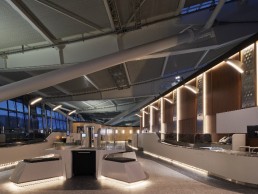
Alongside MACE and Pascall & Watson, StudioFractal worked meticulously to develop designs within the challenging project deadlines, with a brief to create a security portal that fit seamlessly within the high quality framework of the existing Terminal 5 concourse, while also creating a high-class, premium experience for the First Class British Airways passengers. The scope for this design included all lighting components, along with the development of a feature wall.
The definitive solution for the feature wall includes sections of slanting perforated metal, with back and front lighting, in this case LED Linear’s VarioLED Flex. Rhythms of timber sit between each panel, illuminated from the edges with warm white light, emphasising the rich tones of the wood. A specification of warm lighting was implemented in pursuance of enhancing the rich and luxuriant materials palette.
StudioFractal took Heathrow’s initial client aspirations and explored materials, texture, pattern, movement, tone and integrated lighting solutions to give the space levels of quality and tone more akin to a luxury hotel lobby than that of an airport.
This aesthetic wasn’t easy to achieve, according to Payne. “Airport security zones are inherently functional spaces where lighting must fulfil security objectives and facilitate the observation of passengers and luggage.
“To move away from a clinical environment and into a sophisticated ambience we developed a strong ‘material and texture palette’ alongside Pascall & Watson, to ensure materials would respond well to a variety of lighting techniques.
“To maintain a premium feel it was important to integrate the lighting within the architectural framework, we developed a number of simple lighting details to allow key materials to be illuminated from concealed lighting sources.”
Elsewhere, low-level illumination achieves a more intimate ambiance, in direct contrast to the high level treatments utilised throughout the rest of the terminal. This was perfected by clever integration of the lighting into the furniture and cladding details, and by developing sculptural wall-mounted elements that express the same material palette used throughout the space. This was partly due to the constraints of working within the terminal building’s existing framework as lighting needed to be coordinated amongst existing structural beams and proposed perimeter balustrades.
However, StudioFractal was able to develop a curved LED luminaire head with lighting from Kemps Architectural Lighting, mounted to the feature wall and to custom-made poles on the perimeter of the security zone. This served to provide the ambient lighting levels that they were looking for.
All luminaires and feature wall components required stringent DFT Aviation Security in Airport Development (ASIAD) compliance, and were specified through the airport’s second tier lighting suppliers. However, as Payne explained: “StudioFractal worked with Heathrow to ensure the challenges of designing within an aviation environment did not encroach on the sophistication of the finished first class portal.”
As such, the lighting designers explored a number of solutions in order to ensure that they achieved the right balance of form over function, safety over client experience – a constant challenge in an environment like this.
However, throughout its portfolio, StudioFractal has an extensive aviation experience, having worked on airports both in the UK and abroad, developing projects for the likes of Gatwick, Stansted, Dublin, Abu Dhabi, Vienna, Gabon, Riyadh and Indira Ghandi International Airport. The firm’s work on Heathrow’s Terminal 2A even saw them claim Public Project of the Year at the Lighting Design Awards in 2015.
This experience and prior knowledge no doubt served StudioFractal well throughout the new project at Heathrow. “Aviation projects naturally lean heavily towards highly engineered solutions, safety, sustainability and longevity, focusing on defining character and wayfinding,” said Payne.
“Whilst those things factored heavily in the First Direct Access, we had the added complexities of designing a luxury environment displaying warmth and elegance amongst the bright, expansive Terminal 5.”
Despite these complexities though, StudioFractal, alongside Pascall & Watson, have created a warm, relaxing, luxurious space for first class passengers.
And Payne believes that the collaboration between the client, Pascall & Watson, and StudioFractal, immensely helped in reaching such a successful outcome. “It’s of upmost importance to develop a clearly defined concept and strategy from the offset, with the client and the design team,” he said. “Though we’re obviously very proud of the project, we always measure our success in terms of feedback and we’ve had exceptional responses from users of the new area, the Heathrow client and the design team.”
Some such feedback came from Nitesh Naidoo, Project Director at Pascall & Watson, who said: “StudioFractal has been a valued, skilful and effective collaborator on the T5 BA First Wing project. Their input during the design phases has helped us realise a groundbreaking addition to the luxury facilities provided at Heathrow Airport.
“The StudioFractal team has been instrumental in the design and realisation of the feature lighting concept for the premium search facility.”
But while there has been plenty of praise for the design of the new facility, Payne believes that for a project to be a true success, it needs to stir emotions in its visitors.
“A successful design is not just about how an environment presents itself but how you feel amongst it,” he said. “The union of light and materials sets a sophisticated tone for the first class route, your focus is drawn to the human level, not to the vast space in which it sits.
“The contrast between cool and warm lighting adds to the experience of moving from a busy light terminal into the serene luxury zone. Through connecting small visual details to the main terminal the First Wing sits comfortably within it, yet it offers its own superlative experience.”
