
Cocody Project
The latest fine dining restaurant to hit Texas that combines European experience with culinary tapestry from the West Coast of Africa. Renowned interior designer Nina Magon reveals how she masterfully wove two culturally contrasting concepts together to create a design that was elegant and sophisticated.
Houston, Texas is often described as the foodie capital of the American South, boasting an array of cuisines and food joints from hole in the walls to fine high-end restaurants. Houston has it all, or at least we thought it did until now, a new fine dining restaurant has landed and is offering a fresh perspective in Houston’s hospitality landscape. Cocody is a restaurant that offers a unique gastronomic journey that fuses its owners’ love of high-end Parisian hospitality with their native Ivory Westcoast cuisine. Established by Edwin and Edith Basso, the restaurant brings together renowned chefs David Denis, Lionel Debon, and Sylvian Denis, who came from a successful career at Le Mistrel where they caught the Basso’s attention. The final piece to the project, and challenge to conquer, was to seamlessly blend the West African culinary identity of the restaurant with a world-class establishment akin to those in Europe therefore, creating a distinct and immersive experience that will become a landmark in Houston’s fine dining scene.
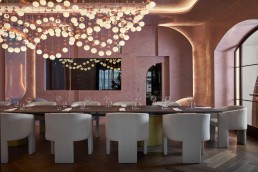
Leading the design project was Austin Architect Winn Whitman who introduced frequent collaborator and Houston-based interior designer, Nina Magon. The Basso’s took Magon on to bring their creative vision to life and encouraged her to draw inspiration from far-flung places from around the world. One of the key influences came from one of Edith Basso’s favourite restaurants, Plaza Atheénéé in Paris, which influenced the colour palette of gold and pink hues, Venetian plaster, backlit marble, curved furnishings, and brass elements. Stand out features of the main restaurant include champagne brass-coloured arches and a golden horseshoe-shaped bar, crystal-lit dining room, and a whimsical lounge featuring playful details like a Mona Lisa with a lollipop. The project took approximately two years from concept to completion, with every detail meticulously crafted to ensure an unforgettable dining experience.
“The balance was delicate, creating a space that celebrated global influences without veering into something garish, but rather, achieving an environment of refinement and timeless elegance reminiscent of Europe’s finest dining destinations” says Magon.
“We overcame this by meticulously curating materials, textures, and design elements that spoke to a sophisticated European aesthetic, while integrating subtle cultural nuances that honoured the culinary identity of the restaurant. By focusing on craftsmanship and restraint, we ensured every detail contributed to a cohesive and elevated ambiance that complemented the world-class dining experience the client sought to provide.”
Pivotal to Magon’s approach in realising Basso’s vision was to infuse opulence and sophistication through the use of light, to ultimately craft an enchanting immersive experience. Lights played a central role and were added generously to the spaces, including 5,000 individual lights concealed within walls, stairs, and wine racks, with the help of lighting designer Andre Medena, of AM Light Studio, who dealt with all the technical lighting aspects. The decorative lighting was essential in creating Cocody’s enchanting ambiance, using custom sculptural pieces that added to that sense of luxury while aiming to still be functional and personable. The main dining room showcased a sparkling canopy of crystal lights that bathes the space with a soft ethereal glow. Created by VISO Lighting, the purpose of the installation is to provide a wow-factor centrepiece that refracts and reflects light in a subtle dramatic visual that doesn’t impede on the atmosphere or the patron’s experience.
In the private dining room, above the chef’s table the lighting takes a more bespoke role with Preciosa’s ‘Pearl Curtain’, which is suspended at alternating heights to form a waving curtain. However, the light offers to be more than a piece sculptural art, blurring the line between functional and decorative. The chandelier’s programmable lighting systems enables for a variety dynamic sequences tailored to complement the cuisine being served. Originally intended to react to touch, the chandelier can now be programmed to create dynamic lighting sequences tailored to the patrons, adding an element of exclusivity and therefore sophistication to the space.
“Each of these elements were selected to serve a dual purpose: enhancing the functionality of the space while becoming a defining feature of its design,” comments Mogan. “The interplay of light, form, and material was carefully considered to ensure a cohesive yet dynamic experience, allowing the lighting to tell its own story within the larger narrative of Cocody.”
In the grand room, light again takes the design focus in the shape of a breathtaking, multifunctional chandelier above the bar that serves as both a striking centrepiece and a structural marvel, supporting 5,000 pounds of liquor bottles. Expertly crafted in Colorado, this captivating feature is made from translucent materials, allowing for a seamless diffusion of light and the result is a dual-purpose masterpiece that combines opulent design with functional bottle storage, elevating the space’s aesthetic while reinforcing the bar’s role as a centrepiece for the restaurant.
The synergy between the design team and lighting consultants ensured that the lighting not only enhanced the ambiance but also became a defining feature of the space, with architectural and decorative working in harmony. The architectural lighting provided structure and direction, setting the mood and defining the spatial character, while also highlighting key features such as the backlit onyx, the stairs, and other specific architectural details. This then allowed the decorative pieces such as the Wink lamp by Masquespacio and Houtique, to add a layer of drama, and a “whimsical” atmosphere that Magon repeats throughout her design.
However, not all developments of the project worked so cohesively to begin with, including significant structural constraints that required careful consideration during the installation of the liquor chandelier and the crystal canopy. Both elements necessitated precise engineering to support its weight and ensure long-term stability without compromising the design’s integrity. For the liquor chandelier, the team collaborated closely with fabricators and structural engineers to address the challenge of supporting its substantial weight while seamlessly integrating it into the space. They also worked to ensure that lighting connections remained hidden within the translucent material and carefully diffused the light to avoid harsh spotlights, creating a soft, inviting glow that enhanced the ambiance. The crystal canopy presented its own unique challenges to managing weight considerations, the team strategically positioned HVAC vents to prevent airflow from causing the crystals to move excessively or collide, ensuring the installation retained its elegance and harmony.
Magon says: “the collaboration with our manufacturers and fabricators, such as 3Form, Preciosa, and VISO Lighting, was instrumental in bringing the vision to life. Each partner brought a unique level of craftsmanship and innovation to the project. Their ability to translate complex designs into tangible, bespoke pieces was exceptional. For example, the crystal canopy and the liquor chandelier required precision engineering and an understanding of both the structural and artistic demands, which they executed flawlessly.”
The original brief also envisioned two full height restaurant levels for the main space however, this was made unfeasible due the HVAC ducts that were to be accounted for. To resolve the issue the design team collaborated closely to incorporate a mezzanine area, this was made possible by installaing a state-of-the-art HVAC system and relocating on of the main pipes. By introducing a quasi-double-height area this allowed the stunning crystal canopy to dramatically span the area and creating an ethereal backdrop. When asked if there were any aspects Maron would reconsider, in hindsight she says she would explore ways to optimise the ceiling height in the space, despite successfully incorporating a mezzanine and addressing structural constraints. She suggests greater vertical clearance could have allowed for even more dramatic design elements, particularly in the main dining area. However, the evolution of the brief ultimately resulted in a more dynamic and multi-dimensional design, one that exceeded the initial expectations while remaining true to the client’s vision.
Cocody as an establishment already set itself apart since the inception of its unique concept. However, as a design, it stands out for its seamless integration of light as a storytelling element. From the ethereal crystal canopy to the grand custom liquor chandelier, every fixture provided functionality in the form of a piece of art. By using custom pieces alongside dynamic lighting it enhances the customer’s experience making it evident it is a one-of-a-kind establishment.
When asked about what makes Coody stand out in comparison to her other projects Maron says:
“What truly sets Cocody apart is its ability to transcend traditional restaurant design by blending architectural precision with artistic expression. It is a space that celebrates the fusion of form and function, creating an experience that is as visually captivating as it is immersive. This project stands as a testament to the possibilities of thoughtful design, making it a highlight in our portfolio.”
The realisation of Cocody’s vision was a collaborative triumph, seamlessly blending the expertise of the design and project teams, structural engineers, and skilled artisans. Innovative solutions overcame challenges such as structural constraints and airflow considerations, preserving both the aesthetic and integrity of the design. Timeless yet dynamic, every detail harmonises to captivate and inspire, leaving a lasting impression on all who enter.


Axel Meise
In 2024, Occhio celebrated its 25th anniversary. darc’s editor Sarah Cullen caught up with Axel Meise, Founder and Chief Designer, to find out more about the brand’s creation.
With the opening of its latest showroom in London in 2023, the German lighting brand, Occhio is firmly establishing its position in the world of lighting. With its distinctive sleek aesthetic and high spec technological developments in lighting quality and control, the brand has a bright future as a leader in the premium lighting field. What other brand could pull off the suave Mads Mikkelsen as the face of a large advertising campaign?
Light and product design seems to be an innate part of Axel Meise, who began designing during his studies in the 1970s. “I have been working with light my whole life,” he explains. “First it was a hobby – when I was a teenager I began creating lighting in my family’s home, in Düsseldorf. Then, in the early 1980s, I moved to Munich for my mechanical engineering studies, which I financed by selling my first lighting designs. During my studies, the technological change from incandescent to halogen happened. I saw the great potential of this new light source and decided to start my first venture to put my ideas into practice.
“At the time I was young and inexperienced, I made some mistakes and had to sell the company. I started all over again with my own lighting store and provided lighting consultancy for end-users and professionals. This was when I better understood what the customers wanted, what the market had to offer – and what was missing. I couldn’t find a system that covered all the needs of a lighting designer in one concept, in one quality, in one consistent design. So, I had to invent it myself.
“In 1999 I started Occhio. It was - and is – a disruptive, holistic concept, and was an instant success.”
When asked what fascinated him about light, Meise believes that it is the “source of life”.
“We’re often not aware of this, but light has a crucial influence on our mood and emotions. In the end, you could say, artificial light is a human cultural achievement.
Without light, even the most beautiful interior design wouldn’t be visible.”
He continues, describing the importance of lighting and its role within interior design: “Furthermore, we consider light to be the fourth dimension in space; with light, we can design rooms, set accents, stage highlights, create islands of light and lead the user through a room or space. And, by the way; with good light, the perception of the finest materials, structures and shapes chosen for the interior design can be enhanced. In other words, light sets the tone, without the right lighting design/scheme, every interior concept falls apart, every design piece would not come into its own.
“Our light should not illuminate a room but get a living space to shine. Light should create atmosphere that is tailored to the individual needs of the people, the rooms, the architecture and their surroundings.
“Moreover, controlling the light in the room or the whole building is extremely important. Why? As mentioned, light creates atmosphere, light affects our feelings and mood. Light should therefore be adaptable depending on the time of day, activity, and personal mood. That’s why the light in all our luminaires and ranges can be adjusted easily, intuitively and individually, especially when you opt for our Bluetooth based Occhio air App. We call it ‘joy of use’. But of course, you can connect Occhio products to the different home automation systems based on KNX or Dali as well.”
Meise has witnessed two of the largest developmental changes in lighting during his career. Notable, the introduction of halogen lamps in the 1980s and later the banning of incandescent lamps and phasing out of halogen. Meise reflects on the latter technological development as one of the best and worst things to happen to the industry. “At the beginning [of banning incandescent], our business model along with the entire industry was turned upside down. But it soon became the start of a rapid technological shift towards the new LED technology – and therefore to entirely new possibilities in design and control. We decided to develop the electronics for this new technology in our own: a very ambitious approach, but it paid off. With highly innovative, user oriented operating functions such as touchless control, up-down fading, and the Bluetooth-based Occhio air control system, we have also created distinctive features that make our products unique in the market. In the end: LED became a game changer for us.”
Adapting with the evolving technology over the years, Occhio has managed to establish a clear aesthetic for the brand that blends inspirations from classic Italian lighting design with the well-versed attributes of German engineering – a concept that supports the origin of the brand’s name.
Meise has fostered Occhio’s distinguishable aesthetic by taking a “holistic approach” to his designs. “At Occhio, uniqueness is one of our core values” he explains. “Uniqueness in design, lighting quality and joy of use. Every series follows this path and are carefully curated by me. Generally, we take a holistic approach to design and our luminaire series is evidence of this: individually or as part of a connected system, Occhio luminaires unlock the power of light in every living situation. All our products can be combined seamlessly due to their consistent design and choice of surfaces, which blend puristic elegance with attention to detail.
“Occhio’s design philosophy has always been characterised by purism. With the new Luna luminaire series, we opened a new chapter – towards a significantly more stylish, emotional design language, yet without compromising on the unique quality of light and magical operation.
“The two new highlights of the series include: Lunanova, which shows what is possible in this area and interprets the opulent theme of chandeliers in a completely new way. The spherical appearance of the light object is an expressive statement and, together with the incredible lighting quality and unprecedented lighting effects, an absolute eye-catcher.
“Luna pura is Occhio’s first wireless luminaire, allowing the magical power of Luna anywhere, anytime. With infinitely variable dimming and a ‘colour tune’ gradient, the lighting atmosphere can be adjusted - from cool moonlight to the warm glow of a lamp, to romantic candlelight. A pura is rarely alone: one Luna pura is fascinating – multiple Luna pura are a new dimension of luxury and ease of use. Also, several of the luminaires can be controlled together via air sync – as if by magic.”
Part of remaining relevant in a fast-paced world is creating a product that is timeless and built to last. When it comes to trends, Meise promotes a long-term and sustainable approach to product design. “Trends come and go. The best lighting quality will always be key for the best possible perception of your ambience. And with a growing choice of surfaces, we adapt our style options to the long-term trends in interior design.
“As mentioned above, people want to experience light in different ways, depending on their needs, their wishes, their moods. For us, this means that people want to be even more active, intuitive, and playful with light, and experience completely new ways of using light to shape their environment and enhance their well-being. With our holistic approach, our innovations and the comprehensive possibilities for control and interaction, Occhio already offers incredible possibilities. And we are already working flat-out on new concepts that you will be hearing about in the coming year.
“Let’s also talk about expectations; customers are paying more and more attention to sustainability. Occhio stands for high quality and timeless design and therefore long-lasting, sustainable products. Of course, people are expecting cutting edge technology and innovations, which Occhio can offer on a totally new level. But it goes far beyond the products, because at the end of the day our customers buy the light from Occhio, an experience, an added value to their life. This is our mission, to bring the new culture of light to the people because good light means quality of life.”
Reflecting on his work in Occhio’s portfolio, Meise is most pleased with his most recent collections. “Every single Occhio luminaire series, every one of its characteristic designs, fills me with great pride. But our latest models have a special status. The Gioia series (2022) really is our redefinition of table and reading lights. A truly incredible series - technically, creatively and functionally.
“Also, with the new Luna luminaire series, we have created a completely new icon. At the last Milan Design Week, we also presented our first chandelier – Lunanova. The spherical appearance of the light object is an expressive statement and, together with the incredible lighting quality and unprecedented lighting effects, it is an absolute eye-catcher of which I am very proud. And now – brand new, our fist wireless luminaire Luna pura. It allows you to experience the magical power of Luna anywhere - at any time.”
What are the next steps for the brand, what can we expect to see from Occhio moving forward? “If you decide to go for Occhio products, you will experience the future of light today in terms of design, lighting quality and especially regarding joy of use. Up-down fading, colour tune, gesture control, or the Occhio air app… this is a totally new way to interact with light.
“But, more generally, we see the future as not only in selling unique, highly innovative luminaires to our customers, we also see it in the idea of ‘Light by Occhio’. Our customers will increasingly opt for a holistic lighting experience that only we can offer. They buy into atmosphere, mood, and wellbeing. They will live the culture of light by Occhio by having their living spaces designed holistically with our light so they can fully enjoy its huge value and enrich their quality of life. Instead of saying ‘I have Occhio luminaires’, in future our customers will say: ‘My light is from Occhio’.
“As a European leader, we are one of the most innovative companies, which has developed from a German design icon into an international brand in the luxury segment. I am very proud of what we have achieved so far. But of course, our ambition is to become a global player and bring Occhio’s culture of light to more and more people in the world. Mission-wise, it has always been our goal to raise awareness of the role that good lighting plays in our lives and the important influence it has on our wellbeing. When customers tell me about their Occhio luminaires with shining eyes, it fills me with great pride.
“Light is passion, joy, and quality of life!”
Materials: The Monumental Collection by Luminaire Authentik
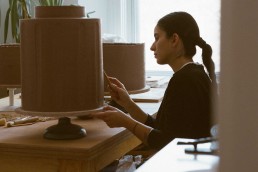
Luminaire Authentik envisions blending sculptural art with functional lighting. In collaboration with artist Zeynap Boyan, they created The Monumental Collection, stoneclay sculptures inspired by ancient Turkish architecture.
Luminaire Authentik, based in Toronto, Canada emphasises customisation as a core principle, offering a hands-on approach that allows customers, architects, and designers to create bespoke lighting fixtures. Since 2021, this collaborative ethos has extended to the local artistic community through an artist residency programme. The initiative invites artists to explore how their mediums, such as ceramics and metal, can interact with light, blending their creativity with the company’s expertise in functional design. By fostering experimentation and innovation, the residency highlights the shared artistry of customisable lighting and traditional art, celebrating the connection between technical skill, creative freedom, and storytelling.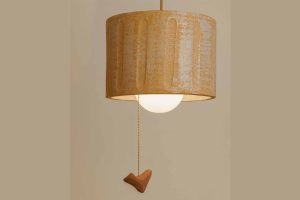
Now in its third residency the Canadian lighting brand has partnered with artist Zeynap Boyan to create ‘The Monumental Collection’. This series of clay fixtures draws inspiration from the legacy of ancient civilisations and the rich cultural heritage of pre-modern Turkey, paying homage to the grandeur of classical architectural while blending elements from Hellenistic, Roman, Byzantine, and Anatolian artifacts into a reimagined, modern lighting design.
When asked about what it was about Boyan’s work and vision that made her fit for this term’s residency, founder of Luminaire Authentik, Maude Rondeau says: “Through this collaboration, Boyan brings her deep understanding of materiality and her poetic approach to form, enriching our creative process. Her hand-sculpted ceramic pieces not only highlight the tactile beauty of clay but also introduce a fresh narrative dimension to our customisable lighting, further pushing the boundaries of what’s possible when art and design come together.”
At the core of every piece by Luminaire Authentik is the harmony between tradition and modernity. Their handmade production process prioritises quality and precision, using a combination of time-honoured craftmanship and innovative designs, where lighting is both sophisticated and functional.
Boyan’s hand-sculpted ceramics presented a unique challenge: integrating delicate, irregular forms with precise lighting systems. The process involved iterative prototyping, testing, and refining to ensure the ceramic components retained their artistic integrity while meeting functional and structural requirements.
Central to each design is a hand-sculpted knob, a defining feature of Boyan’s work that enhances the organic quality of the collection’s forms. Sculpted entirely from stoneware clay, each piece undergoes an oxidation firing process, is finished with hand-brushed glaze strokes, and is completed with Luminaire Authentik’s custom products, showcasing their artisanal approach. Boyan’s choice of stoneware clay and fire oxidation techniques allowed earthy tones and textures to be produced, grounding the collection in naturistic aesthetic while also dedicated to Luminaire Authentik’s sustainable minimum waste practices.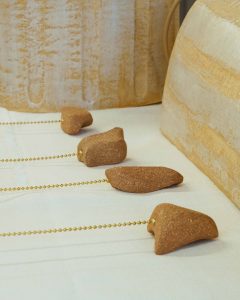
One of the most crucial aspects to get right in the process was addressing the unpredictability of ceramics because factors such as shrinkage can occur during the fire process. Achieving consistent integration with lighting components required balancing the organic imperfections of ceramics with the clean lines of lighting design, this was both a challenge and rewarding creative endeavour.
“Every residency challenges us to think differently about design and innovation,” says Rondeau. “Jeremy Le Chatelier’s [first artist in residency] use of construction waste redefined our approach to materials, while Édith Sévigny-Martel’s [second artist in residency] ceramics introduced new forms and textures to our collections. With Zeynep, the collaboration has pushed us to explore the fusion of tactile, sculptural ceramics with sleek, modern lighting systems, resulting in pieces that are both functional and deeply emotive.”
Boyan’s designs and artistic perspective is profoundly influenced by her time growing up in Istanbul and how remarkable artifacts are seamlessly embedded into everyday surroundings. She recalls how walking through neighbourhoods like Beyoğlu and Sultanahme – where churches, bazaars, mosques, and ancient ruins coexist – felt like stepping into different eras. These experiences offered a tangible sense of existing within a complex, multi-layered environment shaped by countless civilisations.
Boyan adds: “Being surrounded by such a unique blend of history, art, and architecture in daily life can feel both overwhelming and, at times, unnoticed. However, living abroad in recent years has given me a new perspective on how deeply the past informs the present. I now have a deeper appreciation for the complex cultural roots of the places I’ve lived and their ability to hold so many histories at once. The Monumental Collection reflects this personal journey, blending classical forms with contemporary craftsmanship to honour the beauty and strength of this layered heritage, while reinterpreting it in a way that feels fresh and modern.”
The Monumental Collection was released in January with an opening vernissage, followed by a two-day exhibition in Montreal. Luminaire Authentik says they hope the collection will conjure discussions on technical processes and artistic breakthrough among the industry, while evoking the public’s curiosity and wonder to see light as a medium for storytelling and artistic expression.
Ekho Studio on collaborating with Arup
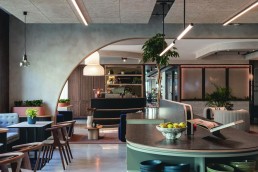
Ekho Studio collaborated with Arup to create a new, dynamic London-based office for Alexion, which was recently acquired by AstraZeneca.
Pharmaceutical company Alexion, recently acquired by AstraZeneca, has a newly completed 7,000sqft workspace located within AstraZeneca’s existing offices at St Pancras Square, London, UK.
During trade show LiGHT 24 in November last year, [d]arc media’s managing editor Helen Ankers hosted an exclusive Q&A with Sarah Dodsworth, Founding Partner at Ekho Studio, who worked on the project. Dodsworth discussed the project’s journey along with her studio’s collaboration with design and engineering firm, Arup.
Ekho was brought on as lead consultant/lead designer on behalf of the client for RIBA Stages 1 to ascertain and fix the project brief and vision. Following on, it was brought into Arup’s team as the “specialist design services” to join its multi-disciplinary team covering mechanical, electrical, acoustics, environmental and general design management.
“It was of paramount importance to the client that the design solutions were as coordinated as possible, so this model of team structure was adopted,” explains Dodsworth.
The brief for the new design was to enable greater collaboration to drive an innovation agenda, as well as ensuring the new space harmonised with AstraZeneca’s existing offices. These include the 21,000sqft, award-winning commercial head office for AstraZeneca UK, located on the building’s 8th and 9th floors and designed by Ekho Studio in 2021/22, becoming the agency’s first completed project.
Over the next few pages you will find an edited recount of the discussion that took place at LiGHT 24, followed by Dodsworth’s reflections on the completed project, shared exclusively with darc.
Helen Ankers: How did Ekho get involved in the project and what was the initial brief?
Sarah Dodsworth: We’ve been working with this client for a number of years, and this project is an evolution from a scheme that we delivered in 2022 in the same building, which was a relocation of their commercial marketing team from a huge building on the outskirts of Luton into Central London. You can probably imagine, without focusing too much on it, was a huge cultural shift for all manner of reasons - the ways of working, the approach to collaboration with partners being in central London, etc.
This project is on the sixth floor of their new London HQ building, and as mentioned it’s an evolution of where we were with the other scheme. What differs with this design is that it combines workplace for a team that call it home, every day. With a reception concierge, but also significantly, a big conference meeting tech suite. What it offers is a touchdown for the senior execs - who are part of this global company - who travel all over the world, a place to drop in when they land into the UK before moving on again. So, it provides a space with the ability to arrive at any time of the day into an environment that’s appropriate for that, which feels beyond a typical office.
It has the business lounge facilities, the hospitality lay down, catering facilities, and top-notch tech spaces to hold conferences, etc. All of this is combined with what you would call a workplace, with desks, quiet pods, that kind of thing.
Ankers: What struck me when I initially saw the images was how much it felt like a hotel.
Dodsworth: Given the nature of their business, it was important the design wasn’t about frivolity and making things look nice for the sake of it, the absolute fundamentals of it were productivity, ensuring this is a place where wellbeing thrives, and ensuring it’s a functional workplace. And then what ensued around the aesthetics and the look and feel followed. There was no one in that business that would’ve taken us seriously if would’ve honed straight in on textures, colours - which we love doing by the way - but we had to ensure we gained their trust, and they understood what we were doing. For example, the investment into AV and these meeting spaces is so reliant on the lighting: the scene setting, the control element, the glare, the uniformity of light. We had to ensure that we nailed all of that before we started explaining how we can still make this really soft, warm, welcoming. It’s a much softer approach to what an office feels like. Given this is a space where people land in at any given time of the day, it’s not just a nine-to-five workspace, the layering of the lighting, the warmth, but the ability to manipulate and control those spaces from a daytime into an evening use was really important.
Ankers: What challenges did you come across and what were the key focuses?
Dodsworth: I’d say we had opportunities and challenges with this one. I’m sure anyone else involved in interiors, architecture and lighting knows what I mean when I say when you inherit a Cat A spec building - an office building - and there’s already ceilings and lighting in place, the challenges around justifying why we want to remove what’s there, which is new, which is an unsustainable approach, but it’s actually really unconducive for us to be able to create this layered, softer, more nuanced scheme. In some ways it presented an opportunity for us here because this was a previous fit out of a previous occupier that just needed stripping out.
What we were able to do within the office space significantly is define and design something quite tailored and unique that then made the lighting design intrinsic to that rather than, for example, a grid, with a format, with a uniform of light that then no matter how many lovely pendants, layers, and integrated LED fixtures you input, can get lost and not often read because the standard of light is already quite overwhelming.
So, that was an opportunity that we took, there was flexibility. But, conversely to that around the challenges, in the workplace it is all about uniformity of lighting. As much as I’d love to do a little bit more around the contrast between light and shadows, we’re working with engineers and lighting designers, which require uniformity of light in these boardroom spaces and workplaces to ensure that it’s a productive environment. We don’t want people complaining of fatigue or headaches, and the lighting is very much working with that. There’s a beautiful curved blue bespoke bulkhead in the ceiling of the large meeting space, and that caused us real challenges to get the right approach of uniform lighting without a huge proliferation of fittings that just ruined the whole installation’s curved nature. That got the engineers and the technical side ticked but also allowed us to bring in the softer elements as well.
Often, when something looks simple I think you can appreciate that it was hard to achieve to get elements looking beautiful and considered and curated.
Ankers: How was the client to work with - welcoming of new ideas or rigid with the brief?
Dodsworth: I think that is the benefit of working with a client before, isn’t it? You’ve bought some trust, and we delivered quite a groundbreaking scheme for them a few years ago, which was a game changer for them. I think we had the opportunity there because the marketing team were a slight subsidiary of the global team, and they wanted to purposefully mix things up and do things differently. They wanted spaces that felt more hospitality focussed.
So, when we latterly do these spaces, which are very much for a corporate audience, we’ve at least got some great benchmarks, we’ve already brought them on that journey. Needless to say, there are the standards that are written within the corporate literature around the CIBSE guidance and the lux levels being 500, etc. So, we very much have to work collaboratively with the entire design team to ensure that we’re illustrating that this works functionally, fundamentally, but equally we’re not just there to nod along and tick the boxes, but to push the agenda as well and explain how the workplace has changed, as we all know, believe us there’s another way. We can get these spaces to be functional but also make them beautiful so that people genuinely want to come to work as well.
It’s about dialogue and it’s about throwing yourself into those technical workshops as well as it is then relaying that back to the client where some of the technicalities are lost but ensuring them that you’re ticking every box as it were.
Ankers: You mentioned working collaboratively with other designers on the project; do you have a lighting design team, or did you work with another studio on any lighting design for this project?
Dodsworth: At Ekho Studio, we’re all interior designers. We are massively passionate about lighting design because if you haven’t got good lighting, no matter what we do, you will only achieve so much. Even though we like to think we’re fairly well-educated, we would always collaborate. On some projects it’s a given that the design team doesn’t just have an electrical consultant, it involves lighting specialism. It isn’t always a given, so we are massive advocates - I sometimes think I should be on commission with the number of times I try to get feature lighting consultancy in on a project! As much as we have the vision and we know what we want to achieve, we fundamentally could not do that solo; we very much work as a team and rely on coming together to discuss how we achieve things and how we can do it across all the different parameters that we need to do.
Ankers: Where do you think an interior designer’s job ends and a lighting designer’s starts?
Dodsworth: I can only speak from our experiences. Our studio sees a project through to completion following the RIBA stages all the way through to RIBA six. So, to me it doesn’t end, but obviously you have different involvements at different stages depending on how technical the stage is. You’re selling the dream, interpreting the brief at RIBA one and two, and then bringing in lighting design hopefully never later than RIBA stage three; now we need the help. We’ve sold the concept and everyone’s on board, but we really need [the lighting designers] to help us work this out.
Ankers: What were the standout features for you in terms of the lighting?
Dodsworth: They probably look very simple but I am incredibly proud of the timber rafts that we created for the office space, because when you walk in, the tone is just set. Generally, we are used to a more gridded version of ceilings, unless you have some cool warehouse or ex-industrial building. This is an a-typical office building. The fact that we could get the client on board to invest, because it is quite a bespoke, tailored solution, we wanted the natural materials and tones to create the whole story of sustainability around the choice of materiality and that connection to nature. But I think what’s really important to how we approach the lighting within the workspace, and again, this comes back to this layered lighting, was that it wasn’t just strips of LEDs throughout. Yes, we had to ensure for the uniformity, but there’s lots of downlights that provide softer pooling of light in conjunction with something more functional. And then where we’ve got some of the suspended pendants within the collaboration zones, for me it’s really important to ensure that lighting’s not just coming down, it’s actually indirect as well.
I can’t help but feel that sometimes when you go to Scandinavia particularly, they’re really good at getting the light to be indirect as well as direct and bounce off the surfaces, which creates for a softer environment. I am a migraine sufferer and too much of bright lighting really triggers me. So, I think it’s just about how people feel comfortable in the space, but then ensuring that it is productive throughout all these hours of operation.
I’m also really proud of the bespoke curved blue ceiling installation that we developed, which comes off some of the original concepts around form that we wanted to do. Curves have this sort of subliminal, relaxing and softening feel to them. How do we take a very corporate client and create a sophisticated and calm space that can’t be too homely, because that would have been frowned upon - it’s sophisticated and grown up and professional. That particular ceiling was a real challenge. So, we formed this bespoke bulkhead, and the blue colour, which has a mottled texture, is formed from a natural clay product. This gives a real striking effect within the space and allows the light to bounce off something with some aggregate and texture to it. Set within that is acoustic panelling, which had to be bespoke formed to fit in our shapes and finished with beautiful handblown glass pendants dropping down. Lots of design workshops went into this feature, and it was very much about bringing everybody on board collaboratively.
Overall, there are loads of lovely details throughout, lots of nice pendants, table lamps and integrated LEDs, which are all fabulous, but were a little more straightforward to deliver. It’s always the things that are a challenge that particularly stand out in your head.”
Reflecting on the project as a whole, Dodsworth elaborates to darc the working relationship Ekho Studio had with Arup. “This was our first time working with Arup. We learned an appreciation of the technical aspect of a fitting, so much more than what it looks like. For example, the output of a light per unit being a determining factor, which influences quantity and spacing, not least linked to the energy efficiencies too.
“The client team’s priority was always function over form and to generate spaces for high productivity. Our challenge as a project team was to find solutions that meant we delivered on functionality with a considered design approach.
“The architectural lighting elements were intrinsic to ensuring spaces are appropriately lit to suit the usage of each environment, while the decorative elements created warmth and softness, which resulted in a layered approach. This gave the scheme it’s unique edge and aesthetic and also meant that the work settings are very adaptable.”
The Value of Light - An AI Take Away
https://vimeo.com/1034345238
Juan Ferrari, Project Director at Hoare Lea explores how light is more than just illumination — it is a language that shapes emotions, influences well-being, and transforms environments. Its value transcends mere functionality, enriching both tangible and intangible experiences. Light carries time within it.
It’s about envisaging the future because every light you see is already in the past, connecting us to both what has been and what is yet to come.
WAC Lighting Launches WAC Group
(USA) - WAC Lighting has announced the launch of the WAC Group, a new collective for its distinctive lighting and smart fans brands. The group combines cutting-edge technology, exceptional design, and a commitment to customer success under the tagline "Technology Illuminated."
The new parent brand brings together WAC Lighting, Modern Forms, Schonbek, AiSPIRE, WAC Limited, and WAC Landscape Lighting under one umbrella, creating a one-stop destination for lighting and fan solutions in residential and commercial spaces.
The unified portfolio provides lighting showrooms, homeowners, architects, interior designers, lighting designers, landscapers, integrators, and other professionals with a range of products spanning various styles, price points, and advanced lighting and fan technologies.
"WAC Group combines our heritage of design with the latest technology," says Becki Li, President of WAC Lighting. "By bringing our brands together, we're enhancing our ability to provide innovative solutions that not only illuminate spaces but improve how people use light – making environments smarter and more energy-efficient."
Jenifer Walsh, Chief Marketing Officer, adds: "We're creating a future where lighting is more than just lighting. It's lighting technology that is more intuitive, efficient, and inspiring than ever before. By unifying our portfolio of brands, we're setting new industry standards in function and design and delivering this broad range of innovative solutions to our customers.”
The WAC Group will maintain its individual brands' names, websites, and teams while offering a streamlined approach to servicing lighting professionals and end users.
www.waclighting.com

Deadline for [d]arc awards entries extends
(Worldwide) – Designers, you now have until 4 February to enter your project lighting schemes and lighting products to be in with a chance of winning the prestigious [d]arc award accolade.
Organised in collaboration with Light Collective, the [d]arc awards utilise the worldwide reputation of arc and darc magazines and offers a unique opportunity to showcase your work to the global design community.
Anyone can enter, including lighting designers, architects, interior designers, or manufacturers. Once the shortlist has been chosen by an international jury, independent lighting designers, architects, interior designers, and product designers can vote on their favourite projects and products, making this the only peer-to-peer lighting design awards in the world.
The categories include:
- Spaces High / Low
- Place High / Low
- Structures High / Low
- Art High / Low / Bespoke
- Kit Exterior / Interior / Technology
- Event
Those who make it through the voting stage (and you must vote in each category) will be invited to attend the exclusive [d]arc night party in London on the 25th of April – an event that has created a reputation as one of the must-attend events of the year for lighting, where the winners shall be announced. Now that the [d]arc awards is reaching its 10 year milestone the night promises to be one with more prestige and glamour than ever before, with repuation for putting on a good night out this won't be one you'd want to miss.
Finally, all submissions are published on the website and entrants also benefit from a free [d]arc awards directory company profile – a comprehensive online lighting design resource that can be used by designers and clients for inspiration.
Submissions must be entered on or before the 4 February. Please head to www. darcawards.com/enter-the-awards to find out more.
Signify launches Pioneers of Light portal
(Online) – Signify has announced the launch of Pioneers of Light, an online portal offering access to the latest light innovations, suite tools, and a wealth of resources.
Pioneers of Light is designed specifically to the needs, challenges and workflows for the lighting design community.
Commenting on the launch, Darren Smith, Specification Lead at Signify UK&I, says: “Lighting designs are rapidly becoming more creative and ambitious than ever, driven by client requirements having increased focus on all pillars of sustainability. As a result, lighting projects are becoming more complex. With the launch of the Pioneers of Light portal, at Signify, we aim to partner with the design community to empower them to bring their clients’ projects and vision to life with a lighting solution that makes a difference.”
Key features include:
- One-stop product configurator – lets users browse, configure, and specify lighting products, whether it’s a quick selection based on photometric parameters or create detailed configuration. When finished, download all relevant information with a single click and even generate a configuration ID to share with clients or use for price inquiries.
- DIAlux or Relux – Drag and drop photometric files directly into your DIALux or Relux lighting projects and create a bill of materials including a configuration ID for easy ordering.
- Quick Light Plan Calculator – intuitive light calculator saves time by creating a light plan for simple indoor office and industrial applications. Simply fill out the dimensions, properties and performance requirements of the space and Signify set you up with a light plan that meets your project’s standards.
Additionally, the design community can also benefit from, and have easy access to case studies, all Signify brands, webinars, training and educational resources about smart lighting, system features and capabilities, to help them stay updated.

HLB Lighting Design welcomes Kevin Frary as Director in Seattle
(USA) – HLB Lighting Design has announced the appointment of Kevin Frary as Director in a strategic move to expand its presence in Seattle and the Pacific Northwest.
Frary brings more than two decades of experience of architectural lighting design to the firm, contributing to award-winning projects that combine technical and artist style.
Frary shares: “Joining HLB marks the exciting next phase of my career – an opportunity to collaborate with a team whose work I have long respected and admired. I am eager to contribute to the growth, helping expand its presence and portfolio in Seattle, the Pacific Northwest, and beyond. With deep appreciation to HLB’s legacy, I look forward to helping shape the future of lighting design with such a visionary firm.”
Principal and CEO of HLB, Carrie Hawley, says: “We are thrilled to have Frary join our team as a director in Seattle. His remarkable expertise and proven ability to drive innovation align perfectly with our vision for growth and excellence in the Pacific Northwest. We are confident Kevin will help us deliver transformative design experiences and look forward to this exciting new step establishing better care to our clients in a region we have developing for 20 years.”
www.hlblighting.com

Jack Neill Joins Pharos Leadership Team as Product Director
(UK) – Pharos Architectural Controls has promoted Jack Neill, former Senior product Manager, to Product Director.
With more than 13 years of hands-on experience with Pharos technology – both in-house and as a systems specifier – Neill steps into the role from his former position, which he has held since 2022.
Neill’s journey with Pharos began in 2011 after earning a degree in Lighting Design and Technology. Starting in technical support, he rose to manage the team before transitioning to client-side roles and a stint at SixEye, before returning to Pharos in 2020.
“For me, it’s all about developing incredible products and technology that drive the best outcomes for our customers and partners,” says Neill. “I’m excited to build on our successes and continue delivering across the Pharos ranges.”
Pharos CEO, Simon Hicks, adds: “Jack’s promotion reflects his outstanding leadership in product management. With his experience and vision, he’ll play a critical role in shaping our strategy and driving innovation.”
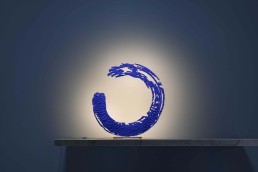
Catellani & Smith - Ensō lamp
(Italy) – Italian decorative lighting brand wins accolade for its Ensō lamp from the China Athenaeum: Museum of Architecture and Design.
The lamp, inspired by Japanese calligraphy, blends art and innovation and showcases the brand’s signature mix of craftsmanship and cutting-edge design.
The Ensō lamp features a hand-painted blue structure that mimics the fading ink of an unfinished circle, resting on a brass base. Standing at 66cm tall, it uses a patented wireless LED system to create a soft glow on walls, combining functionality with sculptural art.
This win highlights Catellani & Smith’s commitment to creating timeless, artistic lighting pieces that redefine spaces.
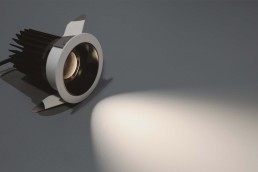
Neko Lighting - Sense 55
With a compact 55mm size and 8W power output, the Sense 55 downlight delivers high performance despite its small form. Its shield angle greater than 45° ensures glare-free illumination, while the soft and seamless gradient of light provides precise, uniform lighting. Available in various finishes, it seamlessly integrates into any ceiling for a clean, modern look.