


Recolight welcomes new code of practice
UK) - Recolight has welcomed the publication of the new code of practice for the remanufacture of lighting equipment, published by BSI last month.
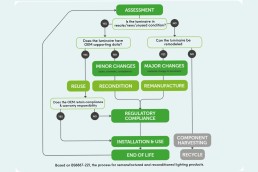
The new publication is numbered BS8887:221 2024 and is now available from BSI. The document provides a structured approach to the assessment of used luminaires and components, defining a scope of works, electrical and mechanical remanufacture, component selection, markings and instructions, and testing/validation.
Commenting on the news, Recolight CEO Nigel Harvey says: “The specification is a major step forward, helping to normalise the remanufacture of lighting equipment. First and foremost, it should give confidence to specifiers, end users, and producers that luminaires remanufactured in accordance with the requirements are compliant and fit for purpose.”
He adds: “This code of practice has been developed thanks to the hard work and dedication of the drafting committee. Particular thanks go to the Committee Chairman Tom Ruddle, formerly Remanufacturing Engineer at Egg Lighting. He was instrumental in keeping the team, and the project, firmly on track.”
The specification was developed over some two years, including representatives from lighting manufacturers, luminaire designers, lighting designers, the Lighting Industry Association, and Recolight.
Remanufacture is a vital way in which producers and end users can better embrace a circular economy, by keeping products (or parts of products) in service for longer. It is the logical application of the “Reduce – Reuse – Recycle” hierarchy to the lighting industry. Typical embodied carbon savings from remanufactured products are 50-80% compared to new products, with similar levels of waste avoidance.
More of UK lighting companies are now engaging in remanufacture. One of the most common approaches is to retrofit fluorescent luminaires with LED light sources, thus retaining the body of the luminaire. Such remanufacturing operations can either take place in a producer’s factory or can also take place at a customer site.
InSpotlight returns to Light + Intelligent Building Middle East
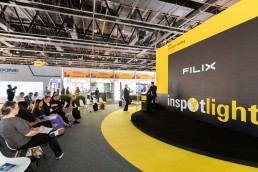
(UAE) – InSpotlight, a platform for light innovations, is set to return on 14 – 16 of January, at Light + Intelligent Building Middle East.
Now in its third year, InSpotlight provides a platform for industry leaders, enthusiasts, and innovators to come together to discuss the future of lighting, design, and technology.
With more than 40 international speakers, InSpotlight will showcase the latest breakthroughs in lighting technology, sustainability, and design trends. From energy-efficient smart lighting solutions to revolutionary advancements in global lighting standards, the stage is set for three days of unparalleled inspiration and collaboration.
The event kicks off with the Specifier’s Arena, where brands will compete for "Product of the Year". The award covers four subcategories which include 'Indoor Lighting', 'Outdoor Lighting', 'Decorative Lighting', and 'Intelligent Lighting Solution of the Year.' Representatives from various companies, including LEDFlex Group, iGuzzini, Bega, Targetti, Media Façade, Catellani & Smith, Intra Lighting, Arkoslight, Erco, ateljé Lyktan, ewo, Inventronics, Flashnet, Madrix, and Linea Light, will take the stage to present their shortlisted products to an independent panel of judges.
The second day will feature a series of presentations and panel discussions, which highlight the latest industry innovations, while Tac Lion, General Manager, Media Façade will host a session on the ways in which smart lighting systems are changing the way we interact with our surroundings.
Matteo Toscan, Head of Application, Street and Area at Inventronics will conduct a presentation on ‘Outdoor Smart Lighting and IoT integration’, exploring how connectivity technology and smart LED systems improve outdoor lighting, helping end-users to reduce energy and maintenance costs.
The final day focuses on fostering alignment in global lighting practices. The Illuminating Engineering Society (IES) and Society of Light and Lighting (SLL) will host a joint workshop on core principles, from energy efficiency to human-centric design and dark-sky initiatives. Attendees will also get hands-on experience with an IES tool designed to simplify illuminance standards worldwide. Following this, arc Editor Matt Waring will moderate a panel on Building Commonality on Global Lighting Best Practices. Speakers on this panel include Dan Lister, SLL President; Brienne Willcock, Director of Education and Standards, IES; Mark Lien, Consultant, IES; Riad Saraiji, Professor and Dean of the College of Architecture, Art, and Design, Ajman University; Regina Santos, Founder, Light Fusion; and Jelena Lazarevic, Associate, Foundry.
Light + Intelligent Building Middle East is held in Za’abeel Hall 1 – 4, Dubai World Trade Centre, with InSpotLight housed in Za’abeel Hall 1 across all three days of the show.
www.light-middle-east.ae.messefrankfurt.com
Dark Frontier - A Dark Skies Presentation
https://vimeo.com/1034342720
At no point in our history, have we produced and consumed light more than now. This has led light pollution to increase at an alarming rate impacting on the wellbeing of all earthlings while changing our perception of the night. Speakers Kerem Asfuroglu, Dark Source hosted a presentation consisting of dark sky friendly lighting design precedents and exploring the trends in tackling light pollution.
DALI, TALQ, and Zhaga join forces
(Worldwide) - DALI Alliance (DALI), TALQ Consortium (TALQ), and Zhaga Consortium (Zhaga) have signed a landmark liaison agreement to streamline data and control systems for outdoor lighting.
This collaboration promises to simplify investment choices for cities and private operators, enabling seamless communication between interoperable components across outdoor lighting systems.
DALI’s specialty lies in developing digital lighting control specs, with widely recognised certification programmes like DALI-2, D4i, and DALI+, all geared toward ensuring smooth integration of lighting components. TALQ brings a globally accepted protocol that standardises data exchange across diverse smart city applications, from lighting to environmental sensors. Zhaga’s expertise in LED interface specifications has been instrumental in compatibility across LED modules from different manufacturers.
"The D4i certification program plays a crucial role in enabling the seamless integration of streetlights into smart city applications, enabling interoperability and sustainability, while gathering critical data for asset management, diagnostics and energy monitoring," says Paul Drosihn, General Manager of the DALI Alliance. "By working closely with Zhaga and TALQ, we’re fostering a future-proof ecosystem that enhances supply chain longevity, security, and the right to repair – building resilient infrastructure that supports smart cities for the long term."
“For us, it is a logical step to work together with DALI and Zhaga. Not only do we share the same goals, but the composition of the member companies also has a large overlap. The better the standards in the street lighting environment become, the more sustainable and future-proof the investment decisions of cities and operators will be,” explains Simon Dunkley, Secretary General of the TALQ Consortium.
“We are thrilled to take this step forward together with DALI and TALQ. By combining our efforts and expertise, we are working towards a more interconnected and efficient future for smart lighting. This partnership ensures that we are all moving in the same direction, uniting our ambitions and promoting real-world interoperability," says Heinrich Thye, Secretary General of Zhaga.
www.zhagastandard.org.
www.talq-consortium.org.
www.dali-alliance.org.

Further Expansion for Studio Lumen
(UAE) – Lighting design studio, Studio Lumen has recently expanded its team to include new lighting designers.
The new members include Priyanka Viegas as an Intermediate Lighting Designer; Poonam Mehta as Senior Lighting Designer; and Danish Sayed as an Associate at the Studio Lumen Kochi office, in India.
The expansion of the team has allowed the lighting design studio to increase its capacity, enabling more client projects to be worked on simultaneously. The new members of the team have also brought their own skills and knowledge, which broadens the capabilities of the studio and supports a more holistic approach to lighting design.
Viegas’ background is in interior design and visualisation, and after moving to Dubai she became involved in the lighting industry. Viegas became aware of Studio Lumen having seen the team’s work at various lighting events and connected with Studio Lumen Partner Siddharth Mathur, who offered her the role of Intermediate Lighting Designer.
Viegas says: “What I find more rewarding is the level of detail and attention each project receives, along with the coordination with other disciplines. This collaborative effort ensures that our concepts are progressing in the right direction.”
Mehta joined Studio Lumen last month as a graduate in Product Design, she developed a keen interest in luminaire design, which led to her pursuing a career in lighting design. After working in Australia for nearly a decade, she moved to Studio Lumen in Dubai.
Mehta says: “Having admired Studio Lumen throughout my career, securing a role with the team felt like a natural next step in my career,” she said. “The studio’s commitment to pushing creative boundaries through its independent, concept-driven approach really sets them apart in the industry.”
Associate Sayed joined the industry when he recognised the effort and creativity required for a landscape lighting project, which led him to explore architectural lighting and pursue a career in this field. Sayed has already made an impact on Studio Lumen’s clients, including his work on a Polo equestrian lighting project.
“It was interesting to understand how horses perceive lighting, and gain more insight into equestrian lighting,” says Sayed. “The project was multifaceted, bringing together lighting for stables, polo fields, escarpments, and public realm, which gave me exposure to a number of new areas.”
Sayed adds: “The projects show such a personal touch and careful curation,” he explained. “We really go with a new approach to a new project. There is no recycling, but rather a bit of upcycling in design. We treat each project very personally right from ideation till the final coordination and handover. This sets us apart from the industry as we offer more of a handcrafted experience and less of an assembly line situation.”
Siddharth Mathur, Partner at Studio Lumen says: “It is wonderful to have three new members of the Studio Lumen family, each bringing their own expertise and experience to create a richer understanding of lighting design for our studio. This in turn will benefit our clients, allowing us to work on more projects, but also draw in the skills from across our talented team.”

An Overview of the Environmental Assessment Landscape in the Lighting Industry
https://vimeo.com/1034341766
Irene Mazzei, of Stoane Lighting, discusses the progress and current barriers that still prevent the application of these approaches in a consistent way across the industry, accompanied by the illustration of some practical examples of lighting Life Cycle Assessment.
Time to Step Up - The Role of a Lighting Designer
https://vimeo.com/1034345635
Marcus Steffen Founder of Akarui discusses the place a lighting designer currently has in the industry, and how this will need to evolve to ensure that we survive a fast-changing industry.
Celebrating 25 years of Lights in Alingsås
Lights in Alingsås returned for another spectacular year, marking the 25th edition of the show. arc’s Ellie Walton visited Sweden for the first time this year, to join in the landmark celebrations, uncovering why this festival is held so dearly to the lighting community.
The weather in Alingsås this October was blissful, the leaves were turning amber and brown, the sun lit up the canal with a twinkling glimmer, and there was a crispness to the air – it felt like the most autumnal town in Europe. While the town seemed peaceful and quiet on the surface, there was lots happening behind the scenes as Alingsås geared up for its annual light festival, and this year’s event was quite the extravaganza.
Lights in Alingsås returns every Autumn to the small Swedish town just outside of Gothenburg, where 40 students are selected from around the world to create a lighting trail consisting of six light art installations all designed around one chosen theme. Students work with workshop heads, who are already world-class established lighting designers, as well as both seasoned and training electricians, to build each installation from concept to construction. The teams have exactly one week to create the installation before the grand opening, as well as presenting their creations to each other and a number of invited guests from the lighting community. The event provides many opportunities for not only the students, but for the locals, attracting visitors to the town, allowing residents to get involved in the project and taking on trainee electricians to expand their knowledge.
This year’s event held special significance as it also marks 25 years since Lights in Alingsås’ inception. It began in 1998, when a group of students from Ljuscentrum at the University of Gothenburg arrived in Alingsås to experiment with architectural lighting in public spaces. The project was so well received that they returned the following year, this time joined by students from Jönköping University, with ambitions to turn the project into a large-scale event. The initiative became a celebrated success, benefiting both the local community and the students.
Recognising its potential, Alingsås formed a partnership with the Professional Lighting Designers Association (PLDA) in 2000 to further develop the project internationally. Since 2018, the project has been led and organised by Alingsås Energi, which collaborates with the International Association of Lighting Designers (IALD), connecting Alingsås to a global network of lighting design professionals.
Now Lights in Alingsås has evolved into a prestigious event, and a once in a lifetime opportunity to budding lighting designers that is sought out internationally. Notably the event isn’t just sought out by students, but established designers themselves have seized the opportunity to take mentor positions, guiding teams with rare hands-on experience – an opportunity that is hard to come by in the educational field of lighting.
arc arrived in Alingsås a few days before the launch, while the teams were in the middle of constructing their designs. In an impressively short amount of time the students are thrown into a whirlwind of activity, engaging with lectures and presentations. Ideas have to transform quickly into sketches and prototypes, which are then rigorously tested, discussed and refined in detailed reports. Idle hands were not to be seen when observing the sites and workshops, as students have to work day and night to complete the project.
With this year marking its 25th birthday, the event expanded to get the whole town involved, from its locals, small businesses and volunteers. Lights in Alingsås was always a programme with the students’ education in mind, however, in the last 25 years it has cemented itself as part of the community and something for everyone to look forward to.
Frida Almqvist is the Lighting Designer at Alingsås Energi and is responsible for Alingsås’ streetlights; and part of her job description is also Workshop Head of Lights in Alingsås. She has seen the magnitude of what Lights in Alingsås means to the community.
“For the students, it’s all about the learning experience, but the public’s expectations are a different story,” explains Almqvist. “They often expect something flashy, like video mapping displays that you’ll find at other light festivals, which isn’t what we aim for. Ironically, they are our biggest supporters and biggest critics, but we want to appreciate their support for the show. This is why we are making it extra special by involving the community into creating their own installations, such as holding a competition for best shop window design, and this year we had our very first video mapping in the town, which could be seen projected onto the museum.”
On the night of the grand opening, locals turn out in their hundreds in the town square anticipating their town’s make over. After performances from the local children’s choir and proud speeches from the organisers the unveiling could finally begin.
This year’s theme was about the mythological and the magical. Emma Cogswell, lighting designer and one of six workshop heads, came up with the idea after being inspired by a gift she got for her daughter from an airport.
Cogswell recalls: “I was looking for a gift for my daughter when I came across one of those troll dolls from the 80s with the long colourful hair, and I thought mythologies could make a great theme. Since this is an international programme there are students and workshop heads from all over the world and each country tends to have their own mythologies and tales that often teach people about their culture, along with its values or morals. I thought it would be perfect for a lighting theme and for them to learn about each other.”
The trail begins in the town centre at the canal, visitors are greeted at the bridge in its rainbow colours and illuminated arch with the number “25”. Here is site one’s installation, led by workshop head Johan Röklander, lighting designer and teacher at Jönköping University in Sweden. The site for this project offered a picturesque stretch of the river running through Alingsås nestled between two of the town’s bridges. The installation begins at one of the bridge’s arches to frame the design, with an illuminated “25” serving as a gateway to the enchanted realm ahead. The second bridge acts as a backdrop, complementing the vegetation that added a natural touch. The water is at the heart of the concept, to which the design team wanted to depict entities like Kinn and Bäckahästen from Norse folklore, which share traits with mermaids and sirens. These beings are captivating and beautiful but also mysterious, even dangerous, known for luring people into the water, embodying both allure and peril. In their installation, luminaires are installed underneath the water to mimic footsteps as though something unseen is moving below the surface. Spotlights and gobos project intricate patterns onto the vegetation, weaving shadows and light into a serene yet otherworldly ambiance, while a moon attached to the second bridge reflects its figure onto the water, tying everything together in a dreamlike glow.
Site two is located further down the canal by the Pump House, where the site begins, and finishes at the lower bridge. Led by American designer, Valerie Insardi, her team created their concept around the Greek mythological tale of Orpheus and Eurydice, a tale of love and loss. The installation is split into six beats to tell the story. The lighting transitions through a range of tones, each representing an emotional state. The warm reds symbolise love when Orpheus and the nymph Eurydice fall in love and marry; the atmosphere gradually darkens along with the music until a sudden hiss of a snake, at that moment the snake bites and the lighting turn cold. The rest of the sequence follows Orpheus’ journey through the underworld and ultimately failing. The entire sequence runs in a two-to-three-minute loop, and its theatrical professionalism was evidently influenced by their workshop head’s expertise in theatre lighting.
Insardi comments: “I have a theatrical lighting background. So, I’ve been really excited to be here. I know that a lot of students in architectural lighting don’t get as much hands-on experience and it’s hard for them to understand how the work in the classroom translates onsite, so it’s been really amazing to see those students get their hands on fixtures and understand how it works and what we can do with light.”
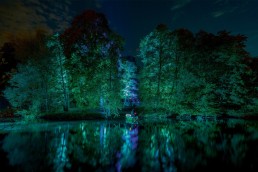
Following the river to site three, continues the themes of Greek mythology. Together recreating a symbolic passage through the River Acheron, guided by Charon, the ferryman who transports souls to the realm of Hades, and the three-headed guardian who ensures no soul escapes. The team incorporated layered lighting techniques, using a variety of colours and effects to evoke the mood and symbolism of the underworld. Unlike common interpretations that equate the underworld with hell, the Greek underworld is not a place of punishment, but a realm of quiet inevitability, therefore the team avoided typical red tones and instead focused on cool tones and subtle accents. The site is designed to reflect three distinct zones from the visitor’s perspective: the living world, the river that separates realms, and the underworld itself. The first scene begins with the arrival of Charon, a warm beam of light illuminates his boat as he carries souls into the underworld, while a subtle white light glows from the boat, giving the impression of faintly breathing souls. This visual effect repeats in a continuous loop, reinforcing the idea that this journey is perpetual. Scene two marks the souls’ entrance into the underworld, layered lighting across the riverbank and into the depths of the site to create a soft fade-in, fade-out effect to add depth. Hades is subtly introduced by the surrounding lights, which begin to dim and flicker. A strong, focused beam of blue light emerges from behind a central tree, symbolising his power and presence.
In Greek mythology, Hades’ name means “the unseen,” and to reflect this, the team hung a subtle yellow lamp from a tree branch. In the darkness, only the glow of the lamp is visible, representing the intangible nature of Hades’ form – the students described it as something you sense but cannot fully perceive. The lantern has also been incorporated as a safety measure for boats passing through the river to enter the lake.
“We were fortunate to have this forest as the perfect canvas to work with,” says George Fatseas, Greek lighting designer and workshop head for site three. “The big conversation among the studios was about restraint. With RGBW lights, robotic fixtures, and all the technology at our disposal, it’s tempting to go all out and do a million things. But what you really need to keep in mind is sticking to your core concept and supporting your story. Otherwise, it turns into a chaotic circus of colours and movements, which ends up distracting from the narrative we’re trying to tell.”
The trail continues through the park across from site three. Here, an interactive installation for children is introduced by a red curtain. Through the curtain the world of story books and imagination resides in the form of a light installation where children can interact with moving lights and sound effects activated by movement. On the left-hand side of the park is an installation in which the tour guides created the concept, a special addition for the 25th anniversary that gets the whole team involved. This piece is rooted in Swedish mythology, weaving themes of life’s threads and perhaps even hinting at goblins peeking out from the bushes.
Birgitta Krook takes part in the event every year as a tour guide for the installations, and also participated in creating the concept for the design. “In Nordic mythology, the three Norns weave the threads of life, maintaining the balance of the world,” she says. “That’s the inspiration behind this story. We created the weave ourselves, but all the technical elements like the wiring and lighting were done by professionals.”
Krook also lives locally after settling here with her husband to raise her children. After seeing the impact the programme has on her community, Krook was eager to get involved in something important to her neighbours.
“I think the festival is fantastic for the community. October is usually a quiet month, with a lull between summer and the holiday season. But during the festival, the cafés and restaurants in Alingsås are bustling – probably busier than any other time of year,” says Krook. “Residents living near the festival sites really embrace it. Some even decorate their own buildings to join in the spirit. Once, a resident set up a car with a mannequin in overalls, making it look like someone was fixing the car for the whole month – it was so charming. The festival brings so much life and energy to the area, and people are genuinely happy to be part of it. The residents truly love this event.”
After leaving the park and crossing to the cemetery, visitors entered site four, ran by workshop head Emma Cogswell. The team discovered their theme together by exploring themes around myths, legends, monsters, and their dualities, which resonate across cultures. This sparked the idea to create an installation that not only highlights the monsters we face but also reflects the safe havens we rely on to cope with them – whether those monsters are real or metaphorical. The installation is divided into three main areas: the wall symbolises the duality, bright autumn colours are projected onto the wall that pulse in a gentle rhythm at the speed visitors are expected to move at and loosely alongside the music. The forest and river on the left displays the creepier side of the story, where googly eyes stare from the bushes and darkness by carefully placing lights on string. The students also made sculptures of creatures from foliage, chicken wire and sticks. The third layer was a reflector field using heart shaped reflectors into the ground to create an interactive light experience without using electricity, but the expectation of visitors using their own light sources while wayfinding the trail can discover the glimmering field of hearts, which ultimately created a dynamic and playful light display.
Cogswell adds: “Our first idea was to make something creepy and scary, given the location by the cemetery it was fitting however, as it developed, we just wanted to have fun with it and started to add new ideas such as the field of reflectors, which visitors can engage with.”
To enrich the cultural tapestry of mythologies of the trail, site five draws inspiration from an Asian legend of a mythical half-human, half-bird figure known as the Kinnari. This enchanting creature is trapped in the human world, marries a prince, but is later forced to flee due to rumours spread by the evil king. She returns to her realm, leaving clues for the prince to find her. Under the wing of workshop head and lighting designer, Chayot Kiranantawat, site five begins by telling the story through colours transitioning from warm and bright to darker hues in amber and red, reflecting the bird’s entrapment and the twists of fate throughout the story. Gobo projectors add intricate patterns and shadows, subtly symbolising her magical transformation. At the heart of the installation, the Kannari’s illuminated wings stand as a striking visual focal point, merging storytelling with aesthetic allure. Two rows of “mushroom ball” lights create a magical path – not to be followed but observed from the sidelines. The designers of the installation encouraged visitors to walk around the installation rather than walk through it and act as observers, adding a reflective and participatory dimension to the tale.
The sixth, and final site, is located in what was the town square, which was burned down 275 years ago. The site was constructed under the guidance and help of lighting designers Jasmina Memic and Srdja Hrisafovic. The concept of the installation takes inspiration from a Bosnian folktale, taken from the workshop heads’ cultural heritage, who both originate from the region. In the tale, the village of Ku is terrorised by an evil dragon, spreading fear and destruction. In a heroic act of defiance, a woman from the village transforms herself into a dragon to confront the beast. The two dragons engage in an epic duel, circling around the sun in a climactic battle, until the woman-turned-dragon finally triumphs.
The installation captures the final act of this dramatic battle, set along a 100-metre stretch between two rows of majestic oak trees. Two dragon sculptures are suspended high in the branches, allowing visitors to observe from below. When entering the installation, we are immersed in a natural soundscape of footsteps, wind, and rustling leaves. The tension builds as the atmosphere intensifies – dynamic lights illuminate the dragons and emphasise its shape, shifting in vibrant, moving colours. The climax is marked by the dragons’ collision, as the sun sculpture blazes brilliantly, and the surrounding trees flicker rhythmically in unison with the dramatic moment. Following the collision, the lights gradually soften, and the music transitions to a serene, harmonious tone. The two dragons retreat along their separation, leaving visitors in a state of calm and reflection. Site six concludes the trail with an awe-inspiring finale – a testament to the incredible collaboration of a team of seven nationalities, coming together in such a short amount of time to create this spectacle.
This year’s event was seminal not only in its quarter century landmark, but also in the display these budding designers and electricians have achieved in as little time as one week. However, despite the particularly special anniversary, every year the event is marked as something special and exciting for the lighting community as one of the most beloved programmes in the industry.
“I’ve been working with Lights in Alingsås and this programme for 10 years now,” says Cogswell. “And along the way, I’ve made some amazing friends. I’m a huge supporter of all the efforts – whether it’s from the energy company, manufacturers donating fittings, or the students, both current and past. Honestly, I always tell people, ‘If you’ve got a Lights in Alingsås jacket, wear it to any lighting event!’ Someone’s bound to tap you on the shoulder and say, ‘I’ve been there – it’s incredible.’ It’s a community, and everyone loves it.”
Cogswell adds: “For me, Lights… is all about that sense of connection and collaboration. I truly believe light is one of the essential elements of our environment. It fits right in with everything else – music, smell, furniture, fashion – it’s all part of the same beautiful mix.”
The impact Lights… has is ever lasting and has seen many of its alumni now become established lighting designers themselves. Some of those successful alumni have even returned to work as workshop heads, including Nick Dankers, lighting designer at Living Projects, who participated for 20th anniversary event in 2019 as a student. Dankers is so passionate about the event he even postponed his wedding last year for the opportunity to work as a workshop head for Lights in Alingsås and has a dedicated tattoo of the Lights logo.
“Did taking part in the final showcase open doors for me as a lighting designer? Definitely. More than anything, it’s about the people you meet and the connections you make,” says Dankers.
“I come from a programming background, so the work itself wasn’t a challenge. It was more about the experience of working with people. It’s not just about technical skills but also about learning to collaborate, especially with such a diverse group. We had students from India, Mexico, Argentina – a real mix of cultures and honestly, that was the hardest part, trying to bring everyone together as a team. Cultural differences can really show up in how people approach tasks. For example, some cultures are very task-oriented and focused on schedules, while others are more relaxed and go-with-the-flow. It’s fascinating to see how that affects the creative process, but it’s also challenging.”
Those bridges built between cultural difference, which Dankers mentions, also blossom into special friendships in a short period of time. It was evident when observing the groups that the students had formed a close bond with each other, in spite of the tremendous amount of pressure and little time they had together. The day before the opening, the students gathered in the canteen, in which I saw on my table a group of students surprise their peer with a cake and candle and sang ‘happy birthday’, ensuring their new friend felt celebrated and cherished on their special day despite only meeting a week ago. Considering that many of these young adults had travelled thousands of miles to be there, it was touching to see how quickly they found solace and connection in one another.
It’s also evident the importance to the whole community of Alingsås too. On the opening night, locals came out in their hundreds, with children, grandparents and furry companions joining for a first look at this year’s event. A total of 90,000 people were reported to have visited the trail over its 31-day duration, reaching a new visitor record. For a small town like Alingsås, the winter periods can be tough to attract outsiders, Lights provides an extra boost both economically and in spirit.
Lights in Alingsås has transcended its origins from a student experiment to being the beating heart of its community’s spirit. Over its remarkable 25-year journey, the festival has not only provided a platform for aspiring lighting designers but also deepened its roots in the cultural fabric of Alingsås. As the lights dim on this year’s anniversary edition, what lingers is not just the incredible designs by these talented students and mentors but, also the connections forged between the community, designers and students. Lights in Alingsås is more than just a festival; it’s an example of how light can unite people across borders, generations and professions.
Northport - Landscape Forms
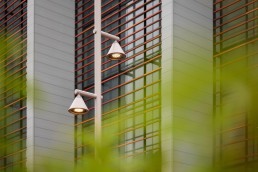
With its range of performance options including multiple outputs, distributions and clear and diffused lenses, Northport lighting casts pleasing, low-glare illumination that enhances everyday evening life and community interaction. Invoking the form of the iconic acorn streetlamp, Northport area and path lights combine modern lighting technology with an elegant homage to the traditional-style lights so deeply rooted in American landscape design heritage.
Winter light installations 2024
It’s rather cold and very dark outside however, it’s the unspoken rule in the UK that we don’t talk about that. So, arc decided to brighten up the winter evenings with some of the best art installations that London had to offer. Here’s what we discovered…
- Liz West – Fluorescence
British artist, Liz West is known for her work exploring the use of light and blurring the boundaries between sculpture, design and painting to create works that are playful in colour and immersive.
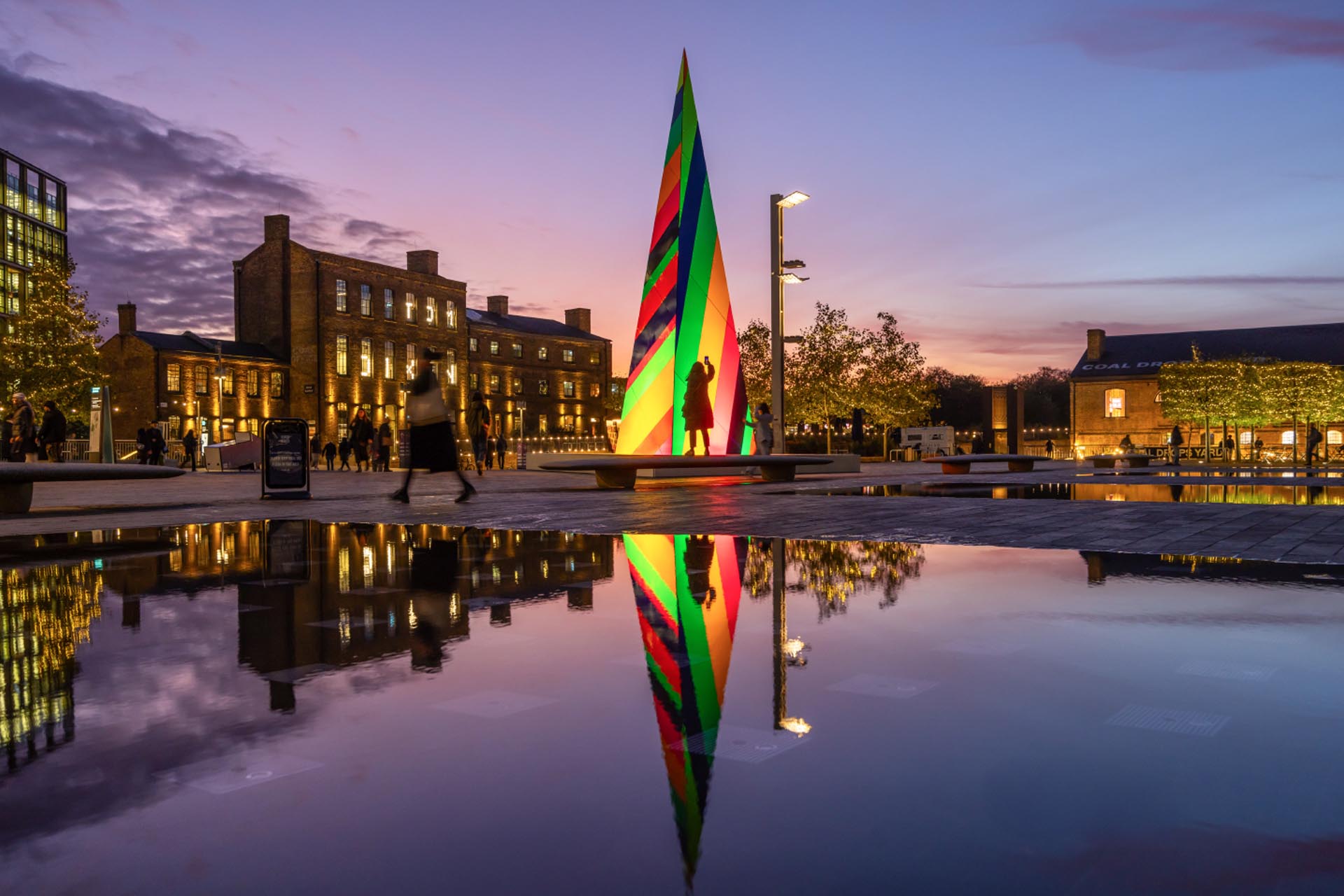
West has created an installation to spread the Christmas joy this winter in a contemporary interpretation of Christmas lights. Standing 10.7m tall in Granary Square, just seven minutes from Kings Cross Station, in elongated tetrahedron resembling a Christmas tree it is covered in her trademark rainbow of chromatic colours. The colours travel in a horizontal diagonal pattern to encourage visitors to move around the sculpture to see the intersecting colours that are powered by UV lights at the base of the structure.
The installation is free for the public to enjoy, so if you're passing through King's Cross Station, it's worth taking a detour to Granary Square. Along the way, you'll encounter other vibrant Christmas lights to admire, perfect for injecting some festive cheer to your day.
- Lumen Studios x Nonotak – Eclipse
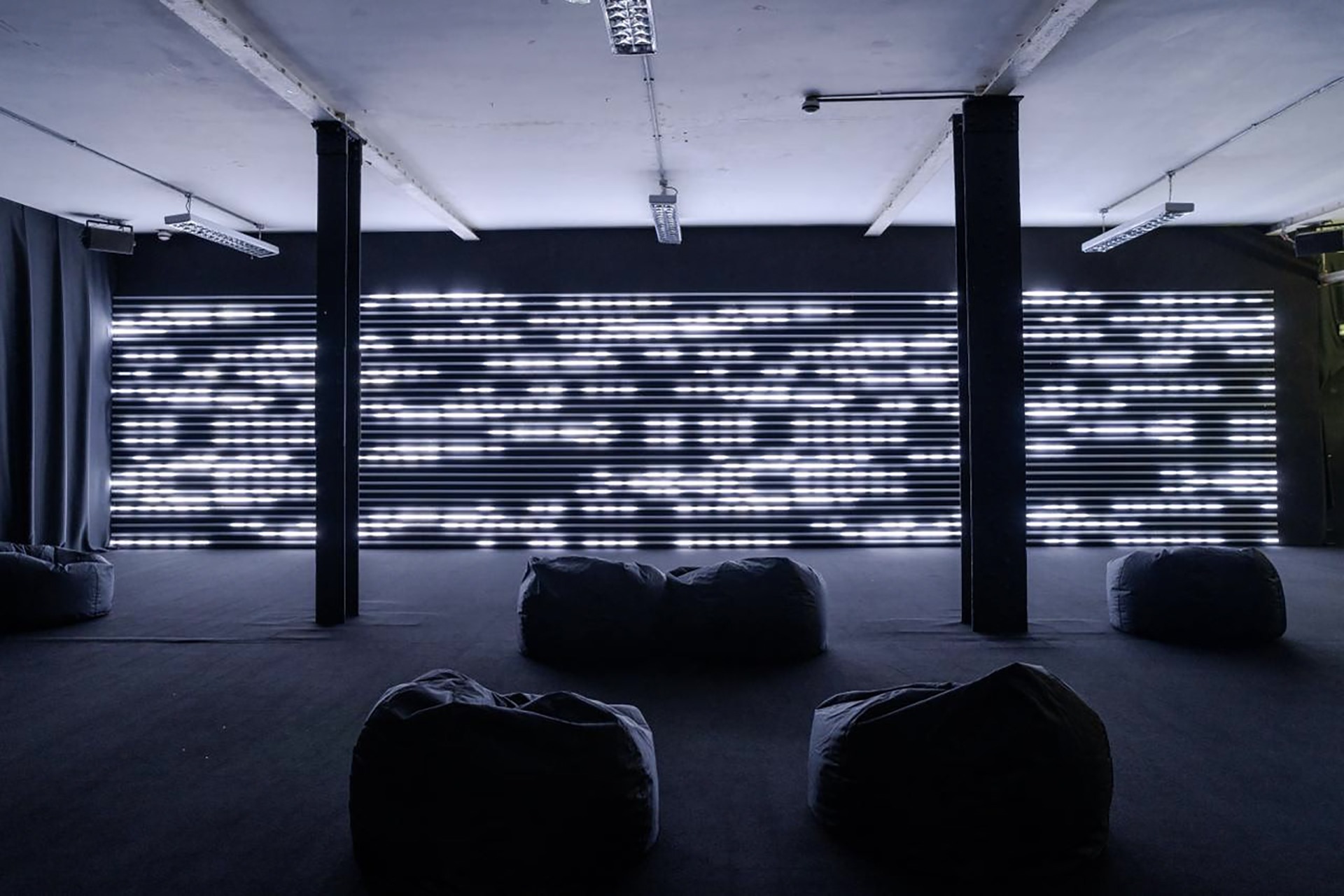
Tucked inside an industrial warehouse near London Bridge lies an extraordinary audio-visual experience created by Nonotak and presented by Lumen Studios. Making its London debut, the exhibition features three stunning installations: Highway, Dual, and Hidden Shadows. Nonotak is an artistic duo consisting of illustrator Noemi Schipfer and architect/musician Takami Nakamoto, based in Paris. They are renowned for transforming light and sound into immersive, dreamlike artistic experiences that blur the boundaries between the senses.
The three installations are separated into rooms within the warehouse and begins with Highway. Here visitors sit comfortably on beanbags, watching waves of light ripple horizontally across an LED screen. The light patterns move at varying speeds, breaking into meticulously arranged fragments accompanied by soothing ambient sounds; this tranquil introduction sets the stage for the sensory progression that follows. The next room intensifies the experience with Dual, where beams of light swing aggressively to pounding, gunshot-like beats, creating a visceral environment reminiscent of Berlin's techno clubs—minus the hedonism. While visitors are encouraged to explore the space, the initial step off the bench can be intimidating as lights bombard the senses and watching other visitors that cross disappear into the darkness on the other side. Once visitors cross to the other side, they find another bench and a directional arrow guiding them to the final installation. Beyond the curtain lies Hidden Shadows, a cinematic experience akin to Highway. Here, visitors sit and marvel at the interplay of soundscapes and mesmerising visuals. The installation takes viewers on a journey through hypnotic geometric patterns, pulsating strobe lights, and a serene, meditative cosmic experience.
By seamlessly integrating light, sound, and space, Eclipse transcends traditional boundaries, offering audiences a unique opportunity to explore the sensory and conceptual dimensions of modern digital art.
- Anthtony McCall – Solid Light
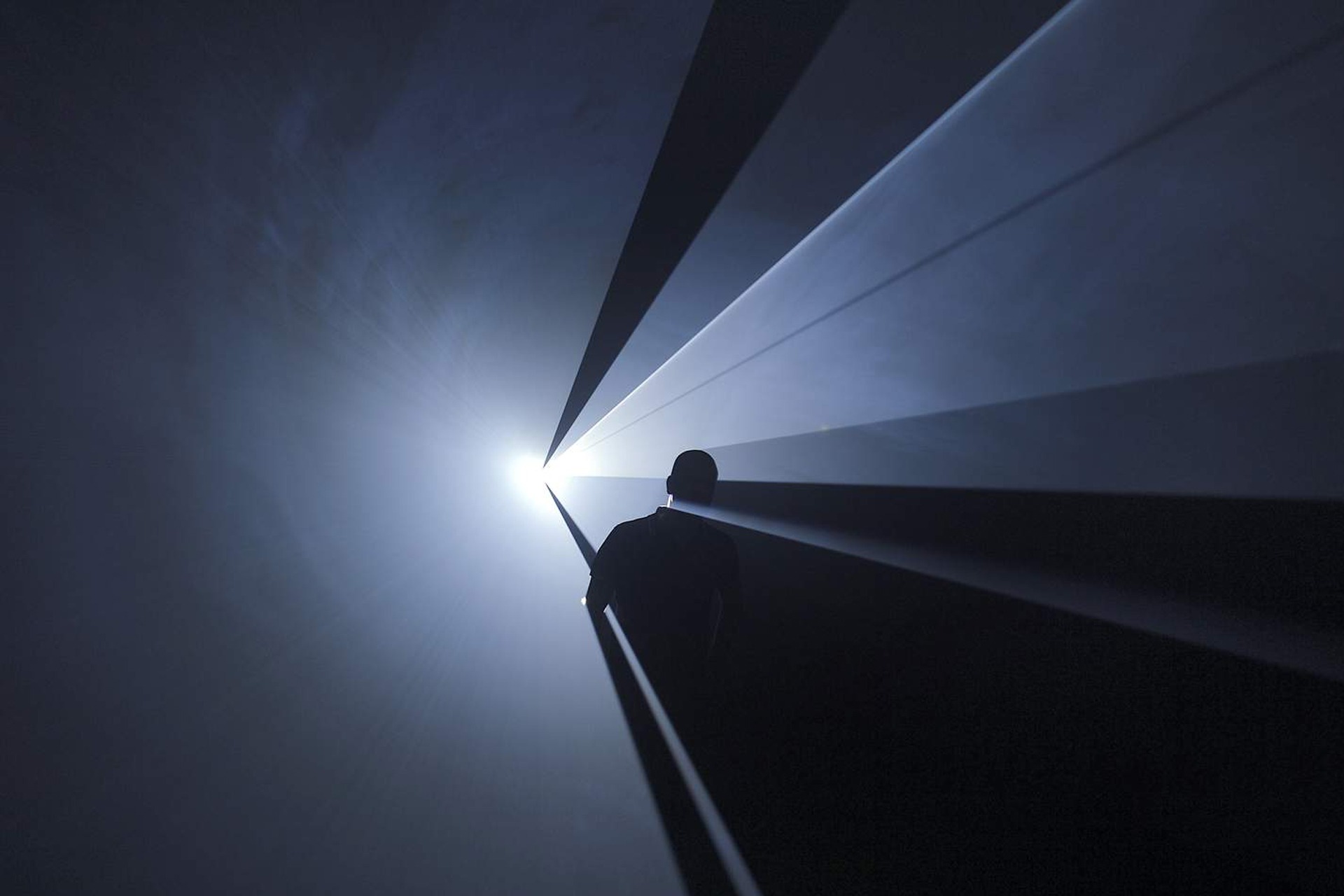
Tate Modern in London is showcasing Anthony McCall’s immersive art, where the viewer’s movements bring the work to life. Curated by Gregor Muir and Andrew de Brún, beams of light projected through mist from shifting, three-dimensional shapes that the viewer can walk through and explore, creating a unique perspective. Blending sculpture, cinema, drawing, and performance, McCall is known for redefining light art since his Line Describing a Cone in 1973 – which is exhibiting at the show.
Light art wasn’t really a thing until the 1970s with McCall being one of the first to adopt the medium. Initially overlooked, McCall's early experiments relied on environmental factors like smoke and dust to reveal the solidity of light beams. A failed exhibition in Sweden in 1977 led him to leave the art world for decades, only returning in the 1990s with the advent of haze machines and digital projection, which allowed his sculptures to evolve and flourish.
McCall's installations, in stark contrast to the flashy selfie-friendly works of Yayoi Kusama, who was recently housed at Tate, or commercialised light shows, are more minimalist and meditative. Visitors are given the freedom to walk around for as long as they like to explore McCall’s four light sculptures. Using beams of light and fog, his art creates illusions of solid forms that feel physical and tangible. Stripped of context, his work celebrates the essence of art itself — light, line, and geometry that offer quiet, introspective experiences amidst the current contemporary immersive trends.
www.tate.org.uk/anthony-mccall
- Lost in Light - Squidsoup
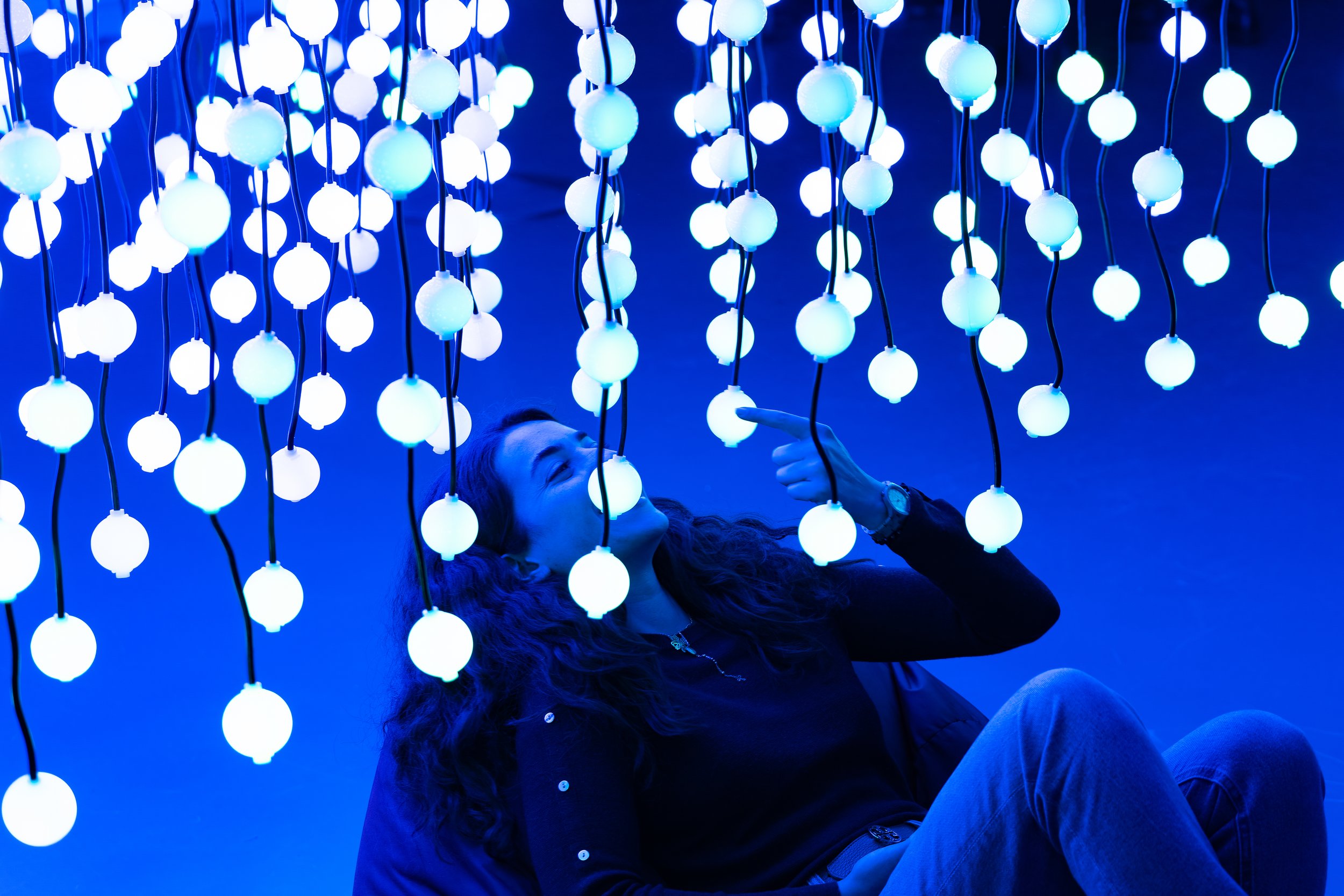
Known as the pioneers of light, sounds and technology, Squidsoup is renowned for its dynamic lights and sound environments. Known for acclaimed projects including collaborations with international artist Four Tet and appearances at Burning Man and Vivid Sydney, the art collective has now created an immersive installation suitable for all the family in Shoreditch, East London. Spanning three stories and 30,000sqft, the exhibition features five distinct installations, including works from sub-brands like Circular Echoes, Infinite, Three Volumes, Sola, and Submergence. The pieces blend immersive lighting and electronic soundscapes to create art that bridges the physical and digital realms. Lost in Light offers a more accessible introduction to light installations where people of all ages can immerse into and offers a great back drop for Instagram photos.
Neurodiversity & Lighting
https://vimeo.com/showcase/11485671/video/1034345183
Speaker: Seraphine Gogate, GDM Building Consultants
In this session, we will explore the latest research on how various light and lighting parameters affect neurodiverse populations. We will highlight the emotional side of lighting design, discussing how inappropriate lighting can increase anxiety, stress, and discomfort, whereas well-designed lighting can promote calmness, safety, and emotional stability.