
BlackSwan Studio
Montreal-based interior design firm Espace 313 has created a monochromatic and graphic studio, enhanced with elegant lighting, for tattooists at BlackSwan.
Situated in the heart of Montreal, Canada BlackSwan tattoo studio is a hub for inked artists to congregate in the unassuming destination that presents a unique character.
BlackSwan is designed by Espace 313 as a bespoke environment imbued with unapologetic elegance. “In an era of increasing tattoo democratisation since the beginning of the century, as well as a desire for personal affirmation and ownership of one’s own body, the tattoo salon offering has continued to grow, with a desire to differentiate itself from the sometimes-intimidating appearance typically associated with these places,” says Gatline Artis, owner and lead designer at Espace 313. “It is in this perspective that the client approached us with the ambition to reinvent the traditional image of the tattoo salon, favouring a soft and refined aesthetic.”
Utilising the existing space, the team added contrasting conceptual interventions merged with a contemporary artistic spirit. Espace 313 wanted to showcase raw and distinctive materiality throughout.
Upon entering, the blend of materials and textures sets the tone for the studio. A plaster covered reception desks draws your attention before revealing an enigmatic metal sculpture that rises in front of a delicate white veil that filters soft light. Hanging above the reception desk is Michael Anastassiades’ Mobile Chandelier 9 fixture. The delicate pieces hang beautifully balanced in an arrangement of linear tubes, geometric lighting sources, reflective surfaces, and counterbalancing weights. They rotate freely, creating an ever-changing lighting configuration.
Taking inspiration from a tattoo on pale skin, the team aspired to integrate distinctive dark elements onto a bright canvas, and ultimately using the element of contrast as a pillar of the design concept.
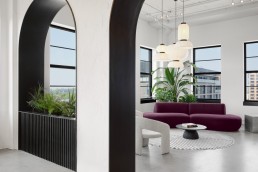
At the heart of the project is the welcoming lounge. Furniture takes on curved forms and a splash of plum colour is woven into the space, which adds a touch of “vivacity and contrasts with the vegetation already present”. &Tradition’s Formakami pendants, by Jaime Hayon, cluster above the seating area, reinforcing the curvature forms of the furniture. The pendants are a contemporary expression of the traditional Asian lanterns, hand crafted with ivory white rice paper and black stained oak accents.
The lounge area is bathed in an abundance of natural light, but the centrepiece of the tattooing space is a large sculptural light installation, which is “subtly evoking the unfolding of a swan’s wings and echoing the studio’s graphic identity”. The black Vega Minor fixtures used to create this installation, by Kuzco, are a diminutive square linear profile that envelops and radiates a soft uniform light, and again adds to the monochromatic scheme of the space.
Taking this minimalist approach in design goes against the typical aesthetic of tattoo studios. The clean lines and tones give an impression of sterility and cleanliness, and a lack of decoration on the walls and non-customisation of workstations was a deliberate choice by the owner. Instead of imposing an artist’s identity on the space, an emphasis is solely placed on the artwork created in the tattoo designs.

Marcus Steffen - The Reluctant Businessman
When people ask me what I do, I usually say I am a lighting designer. That has been my profession for approximately 20 years, and it is a core part of my identity. But now I don’t think I can keep saying that. As I have built my own consultancy business over the last 10 years, I have had to focus on running the business. I have hired staff, I do training, I do marketing and sales; everything that comes with a business. It has slowly become apparent that I am a businessman first, and a lighting designer second. This was something I fought against for a long time, since my passion for light is still there, but I have come to realise that they complement each other in wonderful ways.
arc has been kind enough to give me the opportunity to write about the business of lighting design. With my series of articles, I hope to share what I have learned and why, even as I focus on the business side, I still feel the essence of a lighting designer inside me.
In the design world I often feel that we believe business, money, organisation, profit; these are all dirty words. As if thinking about these somehow sullies the creative process in which we work and that if we don’t focus on purely the design element, we are somehow not producing our best work. But over my journey from starting my own consultancy to growing with staff, number of projects and their size, I feel that the opposite is actually true. Every step I have taken to building my business and focusing on that side has resulted in better quality work, happier clients and allowed us to incorporate good lighting into many more projects. I believe that the two go hand in hand.
But why start your own business? I think most designers dream of the freedom of being their own boss. They really want to focus on producing the best designs they can for clients, and having control over their time, all the while supporting them with income. I know this is what motivated me to start my own business. I dreamt of a few well-paid projects, time to travel, and a comfortable place to live. Unfortunately, when you start out, it is hard work, and a lot of it is not related to design. There are accounts, endless admin, dealing with clients, trying to win projects, building processes and endless other tasks, pulling you away from your design work. This can take its toll, and generally leads to frustration, exhaustion and even burnout. You fall out of love with your dream and normally the business fails soon after. Many numbers fly around but generally half of businesses fail in the first five years, and 70% after 10 years. These are tough numbers to face.
The harsh reality is that if you want to spend your days creating the most amazing, beautiful lighting designs then your best option is to work as hard as possible to get a job that allows you to do this. Working in a company will give you the freedom to focus purely on design and being creative, while the company takes care of getting the projects and looking after all the admin.
Actually running a business is an entire other job from what the business actually does. I run a lighting design business, so we produce lighting designs for clients. I have lighting designers who work for me and produce the majority of that design work, and most of my time is spent on what happens around the lighting design. I am focused on ensuring the designs are delivered on time, where the new projects will be coming from when we finish those designs, looking to the future, and how we can improve the services that we offer. Almost none of that is doing actual lighting design. To run a business, you really need to have more than one person because there is just too much to do. If you start on your own, then it is almost a race to grow, expand and fill those roles before you burn out from exhaustion of doing 3-4 jobs by yourself.
Over the years I have had many lightbulb moments, but one of the key ones was thinking about what would happen if I got ill. If I was unable to do the lighting designs then clients would be upset, bills wouldn’t be paid, and I would be in a very tough position. This became even more relevant once I had employees since I wanted to ensure that they felt secure in their jobs. This fear (and fear can be an excellent motivator) led to me building a business that will not need me to function day to day. I want it to be able to produce incredible lighting designs that blow clients away, and can be easily delivered by contractors, but doesn’t rely on me to do this. My knowledge and experience isn’t used for dealing with projects day to day, but rather it is embedded in the training of designers and in the design processes and systems we have put in place to ensure good designs are produced. I balance the need to create and design (which is still a huge part of me as a lighting designer) with building a business that does what I love when I am not there.
I don’t want to put you off starting your own business, or if you are running one already, make out that it is hopeless. On the contrary, I think creatives can actually make amazing business owners. That problem solving, innovation and ability to create are all essential skills. The key is to remember to apply them to the business, as well as what it produces. For me, the ability to do many more designs as a team has inspired me, because that means there are less projects out there that are poorly lit, to the detriment to everyone who uses those spaces.
Hoare Lea
During our time as a publication, we have run interviews with practices from across the full spectrum of the lighting design world – from solo ventures to international studios, each coming to us to speak of their inspirations, design approaches, and overall appreciation of the power and beauty of light. Given the diversity of lighting design as a profession, it is always fascinating to see the differences, and similarities, in the way that these firms operate – from ateliers and independent studios, to lighting design divisions of larger multi-disciplinary and engineering companies.
One such example of a lighting design studio within a multi-disciplinary operation is Hoare Lea. Formed in 2000 by Dominic Meyrick, the lighting design department has since grown from a small start-up to a major contender in its own right, with offices across the UK and beyond, and a number of award-winning projects to its name.
Now led by Directors Jonathan Rush, Juan Ferrari, and Ruth Kelly Waskett, alongside Meyrick, the company is leading the charge in sustainable practices, with its North Star initiative putting people and planet at the heart of everything it does.
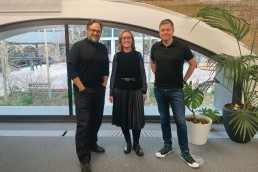
Keen to learn more about how a lighting design studio operates as part of a wider, multidisciplinary offering, arc travelled down to Hoare Lea’s London office – just a stone’s throw from the trendy Coal Drops Yard – to sit down with Rush, Ferrari, and Kelly Waskett to talk people, planet, and more.
While Meyrick established the lighting design wing in 2000, Rush and Ferrari both came on board in 2005, having worked together previously at another lighting design practice. Kelly Waskett, by comparison, joined the team initially as Principal Daylight Designer in 2017.
As is the way with lighting design as a profession, each of the Directors arrived at the company through their own, unique route. Kelly Waskett recalls the journey that led her to Hoare Lea: “My path is like most people’s: it’s got lots of twists and turns, but broadly my background is mixed between engineering, architecture, and lighting. I started with a degree in engineering, and I worked as a building services engineering consultant for about five years. During that time, I felt a bit restless because what I was doing wasn’t satisfying me creatively, so then I did the MSc in Light & Lighting at UCL – that was around 2005.
“I continued to work for multi-disciplinary practices, and later did a PhD in Daylighting – and after that I started doing some work at UCL, because it was setting up a new degree in Architecture & Engineering Design. I wrote some of the material for the new module on lighting, and then Hoare Lea reached out.
“So, I came here, and I was absolutely delighted because at that point I’d realised that I didn’t want to go down the academic route. I’d done a bit of time in academia, and I’m really happy that I did – I’m still a visiting lecturer at UCL – as it brings something different to what we do here.”
Ferrari shares an equally convoluted route to Hoare Lea, although his took him down a much more theatrical path, as he recalls: “I started as an actor, then moved into directing theatre and teaching in schools. In doing that, I fell into musicals, and through them into lighting.
“Not being very good at playing any instruments but loving musicals, I could “play” a lighting desk – I thought that it was the way that I could express myself.”
“Long story short, I then trained in theatre lighting. I came to the UK and studied at the Royal Central School of Speech and Drama, and then decided I wanted to explore architectural lighting – I was fascinated that everything was lighting, but it was approached in very different ways. So, I started studying it, and through that I fell more and more into architectural lighting, and that’s how I’m doing architectural lighting now; by being curious, you fall into something, and you end up doing it.”
By comparison, Rush believes his story is “much more boring than all that”. He adds: “I did a furniture design degree, I needed a job and I needed to learn CAD, because my university all those years ago didn’t have CAD, and so I found a job, and it was at a lighting company that did sports shops. I did that and I thought it was quite interesting; I’d quite liked architecture before, and it seemed like a route to architecture without having to do any of the hard work, if truth be told. I worked for a series of practices, and then came here in 2005.”
These varying routes between Rush, Ferrari and Kelly Waskett are also reflected in the wider lighting design team, with members coming from paths as diverse as interior design, product design, theatre, engineering, and even psychology. It’s something that the team feels is only a good thing.
“It’s beneficial, because you end up with a very diverse way of thinking, not just one fixed route, but they always tend to be more human-centric and put people at the heart of things – even product design, everything about that is the user experience of that product. I think that’s probably where there’s a common thread between us all,” Rush says.
“We like to think that we can do everything related to lighting, and that comes from the fact that we have a team that has multiple backgrounds, and therefore can plug in different ways to whatever the requirements of the project are,” Ferrari adds. “I’m very proud of that fact, and that we have always balanced perfectly well the technical side and the aesthetical side of lighting, and we put that forward to all of our projects.”
While Ferrari leads the architectural lighting design element of the team, Waskett oversees the daylighting team – again demonstrating the diversity and scope of the practice. She explains: “When I joined Hoare Lea, it was mainly to develop the daylight offering that we have as part of the lighting team. It was recognised as a huge part of lighting, and that it deserves to have a place within the lighting service offering. Over the years, I’ve built up that team, and I’ve got a number of people whose sole focus is daylight, and integrating that with not only the lighting design service, but also with the other things that we do at Hoare Lea – it’s a huge part of sustainable building design.
“I’m really proud of the fact that we have daylight as part of our offering, because there are a lot of firms out there that do some beautiful work, but they don’t address daylight – they shy away from it and treat buildings as if it was just night-time all the time. You can have a lot of fun with that and do beautiful things, but there isn’t a recognition of the 24-hour life of a building, of people in that space, and the fact that most of us, in reality, experience light coming from multiple sources, natural and artificial. I love to embrace that, and that’s part of the reason why I’m here.”
Elsewhere, Meyrick looks after the environmental impact side of things, with Rush serving as Group Leader. However, he feels that despite the moniker, it is a much more democratic process.
“Everyone is massively autonomous, and there’s no dictation – it’s not hierarchical. We try and communicate most things, and most things that we do are discussed as part of the team; we try not to be authoritarian.”
This collective approach to leadership is something that ties into the overarching culture that Rush, Ferrari and Kelly Waskett are trying to instil within their team. “We want to provide good jobs for nice people,” Rush adds. “Work is work – we’d all rather be on a beach somewhere, relaxing and drinking mojitos, but we have to work, and therefore we prioritise staff wellbeing in what we do. We want to provide good jobs, challenging jobs, while giving people the root space to grow.
“Our design philosophy follows that because we want it to be relevant; there’s no point in doing something that the world doesn’t need just to hit the zeitgeist of the time.”
“And the new generation know that too,” Kelly Waskett continues. “From what I see, the people coming into the industry are looking for something that has a purpose and a meaning. Designing beautiful things without that purpose isn’t enough anymore, there’s a vacuousness to it. The world that we’re in today means that we cannot just get by designing beautiful things. We’re always looking for a greater meaning in what we do, a greater social and environmental impact.”
Taking a more socially and environmentally responsible stance is something that ties in with the wider Hoare Lea philosophy of people and planet. However, while there are a lot of companies operating under a similar “ethos”, Hoare Lea is striving to do more than just talk, taking tangible steps to improve their environmental impact. These steps vary from encouraging staff to commute via public transport, to an electric car scheme, to meat-free catering in the office, and measuring the carbon impact of everything it does.
And Ferrari adds that the firm is still eager to do more. He explains: “We have always been very conscious of the sustainable side of things, and this is continuing as we are learning. We know that we don’t know everything; we don’t have all of the answers, but we love the learning, both on the human-centric side and the planet side of things.
“With regards to sustainability, being a multidisciplinary company and having a sustainability team within our company that we can relate to and learn from is one of the very basic benefits of being part of Hoare Lea. That’s why you won’t hear us say ‘engineering company’. We talk about a multi-disciplinary consultancy as we’re constantly sharing with a wider range of professionals. It’s amazing the wealth of knowledge that you get to progress your own specialism from working in a firm like this.”
Kelly Waskett adds: “We’ve got people that are trained at doing embodied carbon assessments for the entire building, from start to finish. We have a huge amount to add to that in terms of the knowledge that we have about our bit – when I say “our bit”, it is significant, because we specify a lot of equipment, but that’s one of the benefits of being part of a wider firm.”
Having been with the company for nearly 20 years, Rush continues that the collaboration with the wider team is something that has grown stronger over time, particularly in recent years. “Historically, we considered ourselves as a studio that happened to be part of a bigger thing, although in the last five years or so, we’ve made real efforts to not be that, because we’ve seen the benefits of being part of a more collaborative unit,” he says.
“If you’re looking for influence and collaboration and innovation, what better way than just getting up from your desk and talking to someone from the Sustainability, Acoustics, or our Intelligent Buildings team. So many times, you can have a conversation and you’ll hear about one of your colleagues in one of the other teams that are doing something, and you’ll think ‘we’re not doing that, what do we need to do?’ And it drives you. You can talk to them, ask them how they approached it, and learn from that. It’s so easy to collaborate to drive innovation and thinking internally.
“We don’t really have a thing called ‘business as usual’; I believe that there are lighting design firms that are probably still doing exactly the same thing now that they were doing 10 years ago – except they now do it with LED. Whereas we now say, ‘what are we going to do?’ And we get so much more freedom to think about it because a lot more conversations are not just about what’s happening now, but what is coming, what is happening in five years’ time, where do we need to be then? We do what Ruth calls ‘Horizon Scanning’ – looking ahead. That comes back to employing good people, keeping good careers, because we want to be relevant in five years’ time, in 10 years’ time. We need to keep moving with the massive changes that are coming.”
Ferrari adds: “If you ask me, the future of Hoare Lea, of our practice lies not in the three of us, but in the younger members of the team; and they’re already actively involved in shaping our progress and moving us forward. There is one thing that you get in a multidisciplinary practice, or in a larger firm, time. You have time to think together about the future, you have time to help people develop.”
“As part of a bigger firm, we can afford to not be egotistical. If I was running my own practice, it might serve me better to keep my brand as me. Whereas our brand is not us, it’s a bigger thing. It’s bigger than me, it’s bigger than everybody. It’s quite a liberating thing,” Kelly Waskett explains. “On a slightly more banal note, we benefit from the fact that we’re part of a bigger organisation with infrastructure behind it. We don’t have to worry about accounts or HR or certain things that we’re not trained to do.”
Being part of the wider multidisciplinary network also means that opportunities can arise for the lighting design team to work on projects that they otherwise might not have been presented with. It gives the lighting design team an interesting mixture of projects to work on.
“It does open up our call to bigger projects, and projects that we might not get as an independent,” Rush says. “In addition to that, we work on projects just because they are fun, creative or engaging – for example, we do a lot of heritage buildings, which to some extent doesn’t quite fit within the mould of the bigger multidisciplinary practice. We have the ability to do our own small, unique pieces of artwork at the same time as larger infrastructure projects.”
As Kelly Waskett puts it: “One of the things that we’ve always tried to do is balance out the fun and unusual with more day-to-day projects. There will always be a flow of new-build projects, but then there’s also a recognition of the fact that we need to deal with existing buildings and retrofitting, and that has influenced the type of work that we do as well. There’s nothing that we would definitively say no to without evaluating it on its merits. We’re thinking about the fulfilment of our work as well, and the fact that we enjoy some smaller things, because we just want to have a bit of fun with it.”
Rush adds: “You have small studios, or you have engineering practices, and then you have the rest the lighting that goes on in the world, which is done by electricians and manufacturers. And it’s really rewarding when you can do something where you can say ‘we probably wouldn’t have been employed as a small studio to do this, but we’re actually using the skills that we have to make a space that’s better for people’.
“Healthcare is a good example of that. Typically, they wouldn’t employ a lighting designer or a small practice lighting designer, but we know that light has a huge power to make people’s lives better. There’s a lot that you can do within the healthcare sector to effect better outcomes for people. That’s one of the benefits of being part of a multidisciplinary company, you get to experience and influence a lot more buildings and spaces.”
Ferrari continues: “That’s one of the reasons that we tend not to say no to something, because there is always something to contribute. Whether that’s looking at the human side of data centres, or helping hotel clients to understand the sustainability side and be more efficient, while still being gorgeous, it’s fascinating. There’s always something to learn in every project.”
To that end, with the lighting design department forming just a small part of the overall offering at Hoare Lea, there are occasions where they won’t be directly involved in projects, but will instead guide and support the electrical engineering team to ensure that the highest standards of lighting are maintained.
“There is a lot of knowledge sharing with our electrical colleagues on that front,” Ferrari explains. “There are a lot of electrical engineers, not only in our company, but in every single company that does lighting, and they have a reason to do lighting, so we need them to do it in the most appropriate manner from a company perspective, because we have the same signature, and so it is always important that their level of lighting knowledge is paired to ours.
“This extends to the planet perspective as well – as an industry, we cannot judge ourselves for being energy efficient on a museum project or art installation, but then build schools, offices, hospitals, that are not efficient and doing everything wrong for the people that use them. It is important that we bring other people with us on our journey, and we start by bringing our own firm colleagues with us.”
Kelly Waskett continues: “We want everyone to start from a good level of quality as a minimum, and it’s about making sure that we’re not just designing sustainable lighting that’s horrible, and people don’t want to be in the space, and vice versa.
“Last year, Juan and I went on a roadshow around our offices, which was really fun, and it was about sharing knowledge. It wasn’t us talking at people and lecturing them, we had games, workshop activities, and we got lots of great engagement with electrical engineers and sustainability professionals around how we can do this better together.”
“It brings everybody to a higher level of lighting understanding, and therefore there is a better output for everything and everyone,” Ferrari adds. “Something I am very passionate about is the fact that the places we spend more time have the worst possible lighting, not only in the human sense, but in sustainability terms – schools, offices, even homes, have often been neglected of lighting design, and those are the things that we want to influence. And one of the ways of doing that is sharing knowledge, pushing together, upping our game.
This approach means that the team has a broad portfolio of projects to look back on, spanning across multiple sectors and specialisms – to the point that it is hard for the team to pick out landmark favourites.
“We’ve got a lot of great projects, but I always find it really difficult to separate them,” Rush says. “To some extent, the ones that you feel more fondly about are those that were smaller, where it was a really nice team, it was fun and you felt you were doing something that had a bit more value, or a bit more like you were having a cup of tea rather than a meeting.”
“It’s not always the glamourous, big, shouty projects,” Kelly Waskett explains. “When you say landmark projects, some of the things that come to mind are not the obvious blockbuster buildings.”
Ferrari, however, is a lot more romantic in his view: “I have a poetic vision, in that I see cities as our landmarks,” he says. “I think that’s what happens when you walk around a city like London, and you see your input on the landscape, it is quite telling.
“Using London as an example, when you arrive in London, if you travel by plane you might land in Heathrow Terminal Two, the Queen’s Building as it is called – that is one of our projects. You move into central London, you walk around, and you will see the Middle Eight hotel, Greenwich Market, Apollo Victoria Theatre, Kings Cross, NoMad London, the Grain House; The Bailey and so many others, it’s incredible when you start walking a city and you realise the volume of work that you have done. Picking up those landmark projects within our portfolio is quite difficult, but to look particularly in the cities that we have a lot of presence, is good because you can feel that you are working in your own house. We have done it internationally too – we have left an indelible mark in many cities and countries.”
Encapsulite joins LR Spektd
(UK) – Lighting Reality has announced Encapsulite has joined its lighting specification platform, LR Spektd.
The manufacturer joins the platform with 18 product families and 4,500 variants of its products listed, giving lighting designers the chance to discover and specify Encapsulite equipment via the use of LR Spektd’s in-depth search engine.
With more than 50 years of experience, Encapsulite, provide interior and exterior lighting products that are popular with architects and lighting designers.
The addition of Encapsulite to LR Spektd demonstrates growth to the platform, since its acquisition of Spektd in October 2023, when it was relaunched with a number of enhanced features, helping lighting designers and manufacturers achieve more, in less time, with fewer resources.
Richard Hall, of Lighting Reality, says: “Adding Encapsulite’s suite of products to LR Spektd provides users with an incredible opportunity to option the highest quality products for lighting projects, in just a few clicks. Designers have been coming to the LR Spektd platform to enjoy its ease of identifying products, which is helping to save them valuable time on projects.”
Jordan Waumsley, Managing Director of Encapsulite, adds: “LR Spektd is changing the game for both lighting designers and manufacturers, and we are excited to be a part of this productivity revolution. The depth and scope of information that designers can access is incredible and we are looking forward to seeing our products in action on the platform.”
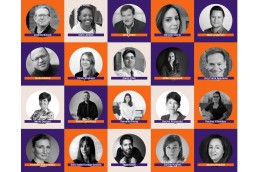
Silhouette Awards winners to be announced on 28 February
(UK) - The winners of the 2023/24 Silhouette Awards will be announced in an online presentation at 3pm GMT on 28 February.
Entering its third year, the Silhouette Awards aims to shine a light on emerging talent within the lighting industry. Each winner will be paired with a supporting mentor for six months.
The 22-23 Mentors are an esteemed panel of senior influential lighting designers:
- Andrew Bissell
- Carla Jardim
- Chip Israel
- Daniela Viloria
- Dave Anderson
- Fanny Englund
- Faraz Izhar
- Giulio Pedota
- Jorg Frank Seemann
- Maria Dautant
- Neha Sivaprasad
- Pamella Phang
- Panos Ferentinos
- Paulina Villalobos
- Rachel Fitzgerald
- Sandra Brookes
- Sara Isabel Ortega Donoso
- Tejas Doshi
- Veronika Mayerboeck
- Zerlina Hughes
With the support of the Silhouette Awards’ sponsors, the winners will be rewarded with the opportunity to enhance their skillset and pursue their career ambitions. This year’s sponsors include Monarca, ADO Lights, GVA Lighting, LUG Light Factory, Atea Lighting, Intra Lighting, Ledluks, Lucent, Luce&Light and we-ef.
Eve Gaut, Silhouette Awards Co-Founder, Parrot PR & Marketing commented: “We are overjoyed that we have been able to continue the success of the Silhouette Awards for a third year. We could not be more grateful to our supporters and sponsors for their continued support in nurturing young talent through our mentorship programme. As the awards grow each year, it is a wonderful collective achievement to see another 20 young designers’ benefit, progressing their careers and developing the future of the industry. We have seen a lasting impact from the past two years at how the mentorship journey has made a huge difference to our mentees. Congratulations to this year’s winners.”
Katia Kolovea, Silhouette Awards Co-Founder, Archifos, added: “As the Silhouette Awards programme has progressed into its third year, we are thrilled to see how the community has grown. As the pool of past mentors and mentees gets larger and reaches further around the world, we are proud to see how everyone is connecting and supporting each other. It is inspiring to see how our supporters, sponsors and mentors want to continue to benefit the industry. This year’s winners will equal 60 young talents which have been nurtured, making a massive impact on the future of the industry. We can’t wait to celebrate this year’s winners with the community.”
To find out the winners of this year’s Awards, tune in to a virtual event on the 28 February at 3pm GMT on the Silhouette Awards Youtube Channel. https://www.youtube.com/@silhouetteawards
Pharos joins Q-SYS Technology Partner Program
(UK) – Specialist lighting controls manufacturer, Pharos Architectural Controls has joined the Q-SYS Technology Partner Program Q-SYS, which allows software and hardware partners to create market solutions integrated with Q-SYS.
As part of the programme, key products from the Pharos range have been verified and endorsed by Q-SYS, a cloud-manageable audio, video, and control platform, following plugin integration with a Q-SYS Ready badge. Pharos Designer and Pharos Expert will integrate with Q-SYS to provide integration with Architainment showing control system for advanced installation through Q-SYS and Expert’s DMX control.
Pharos Designer now has a wide range of controllers to suit any DMX, eDMX and DALI lighting project, show control capabilities and free software for users to design and build installations as they wish. Pharos Expert enables dynamic architectural lighting with its straightforward control solution, centred around a single, reliable controller.
Bas Hoksbergen, Commercial Director at Pharos, said: “Our inclusion in the Q-SYS Ecosystem is the next stage in the development of our products to ensure customers have the best possible experience in their integration capabilities. We are excited to announce this partnership and look forward to seeing our customers make amazing projects.”
Geno Zaharie, Principal, Alliances & Ecosystem, Q-SYS added: “We are proud to have Pharos join our program and work collaboratively with us on a plugin integration that will enable elevated experiences across our shared customers.”
How to be brilliant by the ILP
Watch Paul Traynor as he delves into the delicate balance of lighting and architecture at LiGHT23's darc thoughts. Through insightful case studies featuring Maggie’s Centre in Leeds, Balenciaga’s London flagship store, and the Optic Cloak in Greenwich, discover the art of strategic illumination. Learn how lighting can elevate user experience, subtly express form, and breathe life into vibrant spaces.
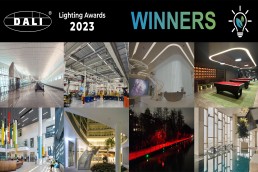
Winners of the Dali Lighting Awards 2023 announced
(USA) - On January, the winners of the DALI Lighting Awards 2023 were announced.
Each of the eight categories recognises the best use of DALI lighting control in projects from around the world, with the winners chosen by an expert panel of judges of lighting designers, media specialists and global lighting experts.
Winners of the eight categories include:
Healthcare & Education: Zencontrol for its work on The Louisa Martindale Building in Brighton, UK, a new state-of-the-art clinical facility. The DALI-based lighting system uses more than 20,000 assets, and DALI was selected as it fulfilled two essential design briefs, namely access to enhanced diagnostics, and future sustainability.
Industrial: Group Volvo Trucks won for the Battery Pack Factory in Gent, Belgium. This project used DALI technologies to improve worker wellbeing, by implementing tuneable white lighting across its manufacturing areas.
Infrastructure: Delmatic won or its work on Zayed International Airport in Abu Dhabi, UAE. The project is claimed to be the largest DALI control system in the world, with a single site-wide DALI network that manages and monitors 180,000 DALI lamps, 35,000 DALI emergency lamps and10,000 DALI sensors and switches, all coordinated by 3400 single and multi-universe DALI control modules.
Outdoor: esave AG won with its Waterfront Lighting project in Fürth, Germany. This small-scale project leverages DALI features including precise dimming, colour control and scheduling to deliver optimal lighting for human eyes, enhanced safety, and insect protection.
Residential: Morlights’ won for their work at the Ko’ula at Ward Village, Honolulu, USA. Morlights relied on DALI technology to ensure light levels and colour temperature suit the varied needs of different spaces, creating a human-centric lighting scheme, with cohesion across the entire venue.
Retail & Hospitality: bluebottle’s project at Ritz Carlton Hotel in Melbourne, Australia won for its multi-faceted project, which utilised intelligent DALI technology across each area of the hotel, including guest suites, to create a sophisticated environment, while also emphasising ease of use and flexibility.
Workspaces: Shanghai LONTRI for the Estée Lauder R&D Center project in Shanghai, China won the award for its 11,500sqm site. Designed according to the LEED Platinum and WELL Platinum standards, it utilises DALI in a variety of ways to reduce energy consumption and improve the employee experience.
Paul Drosihn, DALI Alliance General Manager, said: “Huge congratulations go to all our winners and highly commended projects that were successful against stiff competition. These projects demonstrate the outstanding results that can be achieved across the globe using DALI in lighting design and control, spanning a breadth of applications and sectors.
Drosihn continues: “It’s a fantastic testament to how the lighting industry has embraced DALI and is leveraging this technology to gain significant benefits.”
Details of the DALI Lighting Awards 2024 will be announced later this year. More information on the awards and the DALI Alliance, as well as the full list of this year’s winners can be found on the DALI Alliance website.
IES Forms New IES Middle East Section
(USA) - The Illuminating Engineering Society’s Board of Directors announced during Light + Intelligent Building Middle East, the approval of Society’s newest section, IES Middle East.
The IES Middle East Section represents IES’ growing representation in the international lighting community, and a demand for lighting resources and standards on a global scale.
This will be overseen by its local Board of Managers and committees, including: Majeed Uz Zafer, Section President, Section Liason; Courtney Mark, Section Vice President; Regina Santos, Section Treasurer; Selma Benmakhoulf, Section Secretary.
With more than 6,200 members internationally from over 60 countries, the Illuminating Engineering Society has a growing international membership. The IES ANSI-accredited standards are used in many countries by lighting specifiers and manufacturers who require the best source of lighting knowledge and recommended practices available in the field of lighting design and engineering.
IES Sections are the local subdivisions or chapters of the IES that help create and maintain a community of local lighting professionals. Sections host educational, networking and awards events as a way to bring together those with lighting knowledge to improve the lighting industry.
Majeed Uz Zafer, President of Middle East section said: “The Illuminating Engineering Society is the largest resource for lighting standards in the world based on lighting applications.
“With the rapid evolvement of the lighting industry in the Middle East, it is important that IES has a Middle East section. I am excited to have this chapter launched in the Middle East to work with the vibrant lighting community in the region in enhancing the quality of lighting.”

Lords disappointed by Government’s response to light and noise pollution on the UK
(UK)- House of Lords Science and technology committee has written to the Nature Minister, Rebeca Pow MP, on 31 January, to raise concerns with the Government’s “disappointing response” to its report on the effect of artificial light and noise on human health.
The report, “The neglected pollutants: the effects of light and noise on human health”, was conducted by the committee believing that valuable public health interventions could improve quality of life and NHS pressures in the UK. The committee urges the Government to reconsider its policy on light and noise pollution.
In a statement, the Committee states that it is concerned that the Government has rejected its recommendations on light pollution and the creation of a light policy statement, which would set out the expected roles of different departments in tackling light and noise pollution.
It says: “The Government acknowledges the need of more research to address the significant gaps in understanding of the effects of artificial light, however the recommendation for a research programme was rejected. The committee asks again if the Government will commit to fund further research into the effects of light pollution on human health, with a view to establishing metrics that can measure the extent and severity of light pollution in the UK.
“There’s a concern that the Government response contains no clear commitment to ensure that local authorities are sufficiently resourced or incentivised to address these issues on noise and light pollution, or to set out any standards to local authorities to help them manage light or noise pollution.
“There is a sense that the Government is not concerned about this policy area, despite the 25 Year Environment Plan’s promise to “ensure that noise and light pollution are managed effectively” – hence the report “the neglected pollutants”.”
The full letter to the Minister is available via the link https://committees.parliament.uk/publications/43158/documents/214669/default/
Young Lighter Final from the SLL
Each year, the Young Lighter competition provides a high-profile opportunity to help younger lighting professionals in the early stages of their careers. This year, LiGHT 23 will host the final presentations, which include:
Anna Freiesleben | Michael Grubb Studio
Light Beyond Earth: Illuminating life on exoplanets
Irene Mazzei | Edinburgh Napier University / Stoane Lighting
Improving sustainability in the lighting industry
Teresa Aguilar Carrasco | Architect
CircaLight, a new circadian light assessment tool for Grasshopper environment
Tom Ruddle | EGG Lighting
Lighting Remanufacture
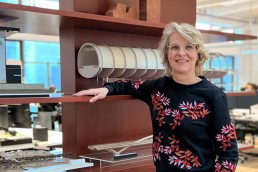
Danish Mette Lyng Hansen appointed as new Head of Light Bureau
As of 1 January, Mette Lyng Hansen has been appointed as the new Head of Light Buerau, part of AFRY. Currently CEO of Gottlieb Paludan Architects, Hansen will continue to work across both practices.
“I am very pleased to be able to present the important and broadened responsibility for Mette. Her proven skills and competence will ensure the future business of AFRY Architecture & Design, both within Gottlieb Paludan Architects, as well as Light Bureau,” said Helena Paulsson, VP and Head of Business Area Architecture & Design at AFRY.
Light Bureau, established in the UK more than 25 years ago, is an independent full-service lighting design agency consisting of multi-disciplinary lighting experts. With numerous, global awards and award-winning projects, Light Bureau has received international recognition, with offices in the UK, Denmark, Sweden, and Norway.
Mette Lyng Hansen added: “To shine the light on society has always been a big part of my life, even privately. Family members have worked professionally in the industry for multiple years, which has provided me with both understanding, insight and dynamics of light. And after many years in the architectural industry, I can vouch for the fact that the design of daylight and architectural lighting plays an integrated role in creating coherent spatial experiences."
www.lightbureau.com