
Architectural Area Lighting LED KicK
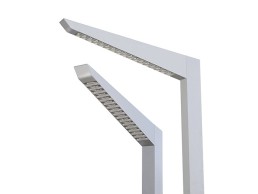
The LED KicK represents a new class of LED luminaire and is the industry’s first product to angle upwards and yet provide full light cutoff. Fusing a contemporary urban design with advanced LED technology, the KicK combines form and function where it matters most - on the pedestrian scale. The pole and luminaire are stylishly integrated into one bold angular design that delivers a truly elegant low glare solution for walkways, paths and building entrances. The KicK’s unique optical system delivers 12,88lm at up 99lm/W with 0% uplight and 0% backlight.

Soraa Gable & Barrel fixtures
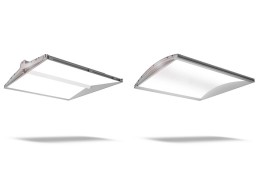
Soraa has redefined human centric lighting with its two new specification grade fixtures - the Gable and Barrel - that have outstanding lens uniformity, colour rendering (CRI > 90) capabilities, DLC compliant efficacies, and will be available in 3,000K, 3,500K and 4,000K CCT. At only three-inches in depth, the perfectly luminous Soraa Barrel series has a curved arch form and is available in 2 x 2-inches and 1 x 4-inches geometries. Redefining traditional ambient luminaire design, the Soraa Gable series appears frameless, giving it an incredibly clean, contemporary aesthetic in 2 x 2-inches and 1 x 4-inches geometries.
Eaton Invue Arbor LED family
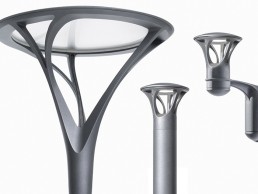
The family features an architectural organic luminaire design for area and pedestrian applications, while delivering precise optical control and an attractive pixilation-free performance with multiple control options including integral 0-10 volt (V) dimming drivers, integrated occupancy sensors and wireless monitoring and communication. Designed around Eaton’s patented WaveStream LED optical platform, the products offer improved efficiency and performance compared to typical HID options.
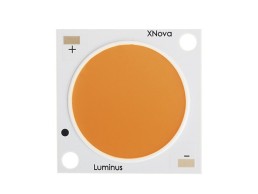
Luminus 3rd Gen LED COB arrays
Delivering up to 150 lm/W typical efficacy in 3,000K, 80 CRI, Tj = 85°C and over 170 lumen/Watt at 5,000K, the Gen 3 COBs deliver up to 25% higher efficacy than previous Generation 2 products leveraging the company’s high performance packaging technology and premium chips manufactured by Luminus’ parent company, San’an. These new products will continue to be offered in the widest range of CCT/CRI combinations, including 95+ CRI Accuwhite and Sensus below black body products.
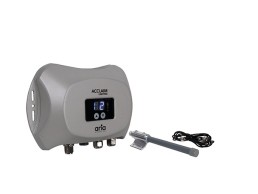
Acclaim Aria
The Aria Wireless DMX system is a compact, local, outdoor rated wireless DMX system. The Aria transceiver can act as both the sending and receiving point, and provides up to fourteen channels on the 2.4 GHz band. It has an internal wireless radio that features both mesh networking and signal routing optimisation to ensure the best possible reception of DMX data. It comes with a 5dB, omni-directional antenna, which provides transmission up to 2,600ft line of sight, and 300ft between obstructions and walls.
WSP Finland
WSP Finland is utilising the Unity game engine, photo-scanned materials and LuxRender software to achieve a realistic, immersive, virtual environment to aid the lighting design of their latest ongoing project. We take a look at how they do it.
USING THE UNITY GAME ENGINE FOR LIGHTING DESIGN
Lighting that adapts to the user is a new technology with operability that can be tested using a game engine. “Writing the model for the game engine began in the form of cooperation with students at the Aalto University and was inspired by the Aalto Light Energy research project,” explained Pia Salmi at WSP Finland. “The aim of the project is to develop the energy efficiency of outdoor lighting without compromising on traffic safety.”
The Unity game engine was used to study what the adaptive lighting looks like in the landscape and on the Kruunuvuorensilta Bridge, their most recent project, and how the adaptive lighting affects pedestrians’ experiences of the safety and congeniality of the environment.
At the preliminary design stage a model was made of Kruunuvuorensilta Bridge, while at the next stage, the entire design area will be simulated. The design of Kruunuvuorensilta Bridge and the road layout will be carried out using a Building Information Model (BIM). In fact, data models will be prepared of all the designs and details, in which the compatibility of the various technical sub-areas can be checked and any overlaps can be identified. The data model will not, however, work as an illustrative presentation model as the place of the bridge will be taken by technical design documents. The material in the data model will be used as a basis for the Unity model, but it will have to be edited and slimmed down before it can be loaded into the Unity program.
The illustrative Unity model can be used both for design in general and for public relations concerning the specific plan. The model can be used to examine both the adaptive lighting related to users and the special lighting of the pylons. The lighting will be examined on the bridge, further away out to sea and on the shoreline. While the design is being drawn up, examination of different lighting arrangements and intensities using the 3D model will give all those involved the same understanding of the design. The Unity model provides a more illustrative and a more empirical result than traditional 3D images, when different lighting-control situations can be simulated interactively. The game engine produces scans of the materials in the structure and in the landscape, which reinforce the reality of the cyber environment. The sound of the tram and other ambient nature sounds will also be present in the model to enhance the reality of the experience. And here’s the really exciting bit.
“The completed model will be used for decision-making and public relations for the project,” says Salmi. “Individuals will be able to move about inside the model using Occulus Rift 3D spectacles in conjunction with the game engine, and observe the lighting and the bridge design from the same perspective as if they were moving around on the completed bridge.”
The model will also operate as a presentation model via the Internet without using the 3D spectacles. In addition, WSP Finland will also be preparing videos of the model in which the viewer will be able to ride on the tram and move around the streets and the square. The model has been on show at the Tram Exhibition at the Laituri Gallery in Helsinki since January 13th 2016.
THE BRIDGES
The new tramway bridges (Kruunuvuorensilta and Finkensilta) paint a new skyline for observers offshore and provide a new viewpoint towards the city. The bridges are situated in the fragile Helsinkipuisto nature area that requires a special emphasis on the safety and ecological aspects of the lighting design so that obtrusive light emitted to the environment (light pollution) can be minimised and a degree of darkness maintained. The views, both towards and from the bridges, will be preserved as far as possible. Light will be controlled by increasing light according to trams, pedestrian and cyclists. The light is limited to areas where needed by using non-glare light fittings and further controlled by dimming-down light sources when these areas are not in use.
The lighting plan complies with the principles and guidelines of the 2015 Helsinki outdoor lighting feasibility study, the development plan guidelines and the principles of the Light District report. Bridges will become prominent landmarks and thus require special consideration when their illumination is designed. Architectural aspects and lighting designs are based on the winning proposal in the bridge competition in co-operation with Knight Architects (UK). The main visual elements of the lighting plan are the Kruunuvuorensilta Bridge pylon and the design of combined tramway power and lighting columns. The illumination of the bridge pylon by spotlights is dynamic and can be modified if and when required.
Lighting on the bridges will be implemented using LED light sources. The result will be an energy-efficient, long-term lighting solution that enhances the aesthetics of the bridge architecture. The systems for controlling the LED lighting will provide an opportunity to adjust the lighting according to the particular needs of any specific area.
The Kruunuvuorensilta Bridge will accommodate a high-speed tramway with carriage speeds of up to 70kph. The tramway will be illuminated to prevent accidents. The lighting classification for the footpaths and cycleways on the bridge is P2. The colour temperature of the white light in the overall lighting will be 3,000K and the minimum requirement for the colour rendering index Ra will be 80. The serviceability of all light fittings will be taken in to account when finalising the locations of the fixtures.
The lighting of the Kruunuvuorensilta Bridge footpaths will be fixed to the bridge’s south-facing balustrade. The tramway and cycleway will be lit by LED modules fixed to the combination columns.
Overall plan for the special lighting of Kruunuvuorensilta Bridge
The pylon of the new Kruununvuorensilta Bridge will be illuminated to form the highpoint of the design, as a landmark. In daylight, views of the bridge will highlight the pylon and its supporting cables plus the combination columns. At night-time, the lighting will bring out the lines of the bridge deck and emphasise the pylon as the climax of the design.
The diamond-shaped edges of the bridge pylon will be highlighted by narrow cones of light from the RGBW spots. The illumination of the pylon will be programmed to provide varying special lighting according to the calendar year and to mark major City of Helsinki festival days. One special feature of the pylon lighting will be that it can be controlled by a mobile device. It will be possible to give organisers of and participants in City of Helsinki events the right to control the lighting for the duration of the event.
When there is no-one present on the bridge, the lighting will be dimmed to a level of 10% of the normal. The lighting level will be increased automatically to the recommended level approximately 100 metres in front of any bridge user and then reduced again approximately 100 metres behind any bridge user. As far as the tramway is concerned, the brightening of the light is designed to take into account tram stopping-distances and the requirements set for traffic safety. Sensor technology can be implemented using smart long-range sensors which can identify the speed and direction of movement of different user groups on the bridge (trams, cyclists, pedestrians, motor vehicles). The sensors will be integrated into the bridge balustrades or the supporting columns. The technology used in long-range sensors is under continual development so that the way these are used will be refined as the design proceeds.
The building of the Kruunuvuorenranta bridge is estimated to start 2020-21 and to be completed in 2023.
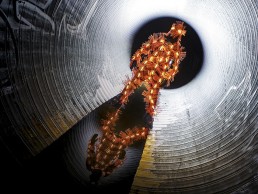
OUTSIDERS, Canada
With the hunt for renewable energy being an ongoing issue, Canada-based lighting designer NARGIZA has created a performance piece that uses light, aliens and the power of colour to stress the importance of energy.
Designed by Canada-based NARGIZA, lighting performance OUTSIDERS: ENERGY IS INSIDE was staged in Oakville, Ontario, Canada in May 2016 at three locations: Lake Ontario, Lions Valley Park and a tunnel under a highway.
As we all know, one of the most urgent issues of the present day is the search for alternative energy sources that are capable of sustaining safe life on Earth. Humans have discovered, and are currently using, various existing energy sources. On the whole, these are mineral resources from our planet as well as the power of the wind, sun and water.
This performance embodies NARGIZA's imagination of how and what kind of energy inhabitants of other planets and galaxies might use to survive - how could they possibly look? How could they communicate? What powers their movement, growth, lighting, food supply etc.?
NARGIZA chose the colour red to portray the essence and to visualise energy. That is why the 'aliens' in the performance are turned red - maybe suggesting that they came from Mars as red is often associated with the planet.
People often say that red is the most vibrant colour as it symbolises passionate love, power, fire and dynamics. According to the Chinese, red brings good luck, happiness and splendour. For the Native Americans it incarnates life and action.
The two visiting 'aliens' draw a parallel to some sort of abstract generalisation of these beliefs. It’s as if they came to share their knowledge, experience and achievements in using various energy sources. To represent this idea visually, NARGIZA decided to make the aliens full of light. Thus reinforcing the main point that the energy is found inside of us and it is the foundation of our livelihood.
The materials used in the alien's costumes include: 116 LED modules IP-SF, 5,000 red medium size zip-ties and wire (supplied by GVA Lighting).
Pic: Maksim Zinchuk
Llumversació, Spain
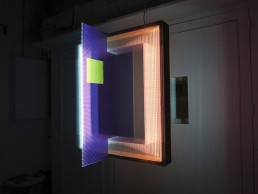
Presented as a collection of light art at Barcelona's dterra gallery, Maurici Ginés and artec3 Studio's 'Llumversació' exhibits how it can break through materials to reveal a magical image, establishing a dialogue with the audience.
During February and March 2016, Maurici Ginés and artec3 Studio presented Llumversació - a collection of light art at dterra gallery in Barcelona, Spain. The collection aimed to create a new perception of an object through the use of light, in its interaction with materials and filters. Ginés´work explores the event taking place when two colours interact together, and when chromatic additive interference is applied. The resulting ambiguity creates a new virtual sensation.
Ginés, creative director of artec3 Studio, has more than 20 years of experience working with light in different areas. He has done projects ranging from ephimeral to permanent, in the urban public space.
In this exhibition, Ginés proposes an analogical experience in an interior space, where light breaks through materials to reveal a magical image and establish a dialogue with the audience.
‘‘We worked with cellular polycarbonate and theatre filters, and by combining these two materials and integrating light, we established a dialogue with the audience,’’ explained Ginés. ‘‘I like the idea of ‘virtuality’, the piece does not exist but only an image of itself and how the depth of colour creates a new appearance. We have three pieces that work with projected light through cellular polycarbonate, and two with light that emanates within themselves.’’
Llumversacio is a collection of artwork that evolved from Ginés´ persistent investigations during his years dedicated to light.
Pic: ©artec3 Studio
FLATLAND, UK
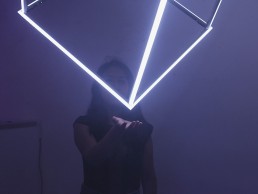
After temporarily hijacking the identity of Wallplay Shop in New York, USA, light art collective Nitemind created FLATLAND - an immersive installation of 2D and 3D LED sculptures coupled with live musical performances.
During April 2016, light art collective Nitemind presented FLATLAND - an evolving light installation and concept shop - at Wallplay 118 Orchard St. New York, USA, exploring the interplay of dimension and light. Showcasing minimal lighting pieces (2D and 3D LED sculptures), an immersive installation was open upstairs for the opening and closing nights only. Coupled with live musical performances, these events were scattered throughout the week it was open.
Along with FLATLAND, Nitemind creates mesmeric visual experiences of motion, light, and colour. It is a group of artists using technology and physical space to create immersive and interactive installations. Its work uses light as a medium, including laser beams, video-mapped LED and software art in combination with ephemeral sculpture and site-specific installations. Nitemind has been instrumental in the development of exhibitions at the Palais de Tokyo, Metropolitan Museum of Art, MOMA, Johannes Vogt Gallery, Red Bull Music Academy, and many others.
With thanks to artist and interactive programer Michael Potvin; artist, designer and lead fabricator Joey Perugini; creative producer and music supervisor Brian Sweeny; Shadrack Lindo for graphic design and Will Rahilly for video animation, FLATLAND was an awe-inspiring display of how dimension and light can interact to create a truly exciting event.
Pic: Erez Avissar
www.nitemind.tumblr.com
www.wallplay.com
Virgin Active, UK
Working with a hands-on approach alongside architects Atelierdb, Hoare Lea Lighting's scheme showcases the transformative power of the lighting designer at Virgin Active's Walbrook Health Club in London.
Hoare Lea Lighting was commissioned by Virgin Active to provide the lighting solution for its new Walbrook Health Club in London. Virgin Active wanted to understand how a lighting designer could transform its spaces. They wished to develop its premium Collection brand and recognised the importance of the lighting working with the architecture to achieve this. “Over a number of meetings we got to know Virgin Active and they got to know us, and our understanding of an integrated, architectural approach and atmospheric appeal,’’ said Chris Fox, Senior Designer, Hoare Lea Lighting. “It was a learning experience for all and we really got into the DNA of the Virgin Active brand. It was refreshing to start from base lighting design principles and build upwards.’’
The club is located on the ground and basement floors of the Walbrook Building, a landmark development in the City of London. The 2,300m2 (24,500ft2) floorplate provides lounge facilities, a large gym floor, studios, and luxurious changing areas with access to a spa centre, incorporating a sauna, steam and salt rooms.
With a brief to adopt a fresh, integrated architectural approach, the scheme forms an important part of the visitor experience. Throughout the club, lighting details complement the high-end interior design.
“The client was keen to move the design integration forward and lighting was high on the agenda,’’ explained Fox. “We approached the design conceptually to begin with, and played up the visual contrast between the spa and main gym floor spaces. I wanted to push the difference between the muted, tranquil atmosphere of the spa and changing rooms, using low-level, low glare and warm colour temperature sources. Then pump up the visual intent of the main gym floor with bold, dynamic lines of light, and cooler colour temperatures.’’
Hoare Lea Lighting worked with architects Atelierdb to create an all-LED design, to reflect the contemporary luxury of Virgin Active’s Collection brand.
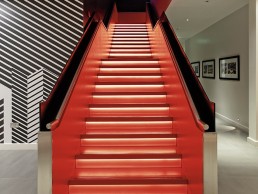
To give it prominence, the reception desk features leather clad front panels, with an integrated line of light, created by Optelma’s Firo, picking out the texture of the material. XAL's Tula Micro narrow, cylindrical feature pendants are suspended above the desk. These provide illumination to the worktop, adding interest and breaking up the space. A feature staircase leads from the reception to the lower-ground floor, with integrated lighting adding a sense of theatre.
The changing rooms and spa are lit to a lower level than other areas of the club. This combines indirect and hidden sources, and a colour temperature of 3,000K, to create a warm, relaxing, luxurious atmosphere, which contrasts with the fresh, more dynamic 4,000K of the main gym.
Indirect sources, such as feature-point Arena Tilt wall washers and sporadic low-glare ProEvo spotlights from acdc create an atmospheric gateway to the spa.
Within the spacious changing rooms, integrated lighting elements enhance the high-end feel. These include Mini Profiles from Optelma incorporated into showers and behind the etched glass vanity units. This profile is also integrated beneath the vanity units, bathing the table tops with light, adding glamour and complementing the clean palette of grey plank tiling, marble and timber finishes.
In the main open-plan cardio and weights studio, a series of Optelma Quad linear LED profiles provide suspended lines of light. Combined with suspended disks of light provided by Optelma’s Laxa, these create a false ceiling beneath the exposed services. Recessed lines of light in the weights zone complement the main cardio area, creating a light, airy and inspiring space.
Continuing on to the walkway through the gym, the weights and mezzanine level is lit by a continuous 40m of Optelma's Quad 55 recessed line-of-light, which turns through 90° to follow the walkway through the studio and into a corridor framed with further profiles. Within the corridor, lines-of-light run up each wall, meeting the line of light that runs across the ceiling - a visual feature that accentuates the ‘shrinking’ height of the corridor.
The lounge/café area is also lit with a warmer 3,000K colour temperature. The relaxing, hospitality feel is accentuated by integrated lighting elements. acdc's Orelle light cove provides soft background lighting, while Deltalight’s twin gimbal spotlights pick out the café zone, and a hidden line of light highlights the coffee point.
Positioned on low tables, task lights by Louis Poulsen give member’s individual control, adding a domestic feel. acdc's Arena small, low-glare light points highlight the picture wall, while a line of pendants provide illumination over the desks. The design of the pendants is echoed in the floor lights located in the soft seating area.
David Bell, Director, Aterlierdb commented: “The lighting design across all areas of the club enriches the functional use of each space dramatically, with darker zones helping to calm, and brighter areas with stronger fittings helping to add energy for members.’’
Tim Carter, Virgin Active Brand Director added: “The solution we developed with Hoare Lea Lighting has helped us create a luxe space that is a true oasis of exercise and wellness. It adds to the stand out experience that members can expect when they visit one of our Collection clubs.’’
Fox concluded: “It’s been exciting to work with the client and architect in such a hands-on way. It was clear that the well-considered lighting solution had made a significant difference.’’
Pic: Redshift
www.atelierdb.com
www.hoarelealighting.com
Train World, Belgium
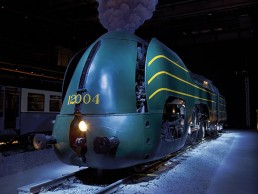
Combining the magic of history with the robustness of industrial design, Lightemotion's lighting scheme at the Train World railway museum in Brussels, Belgium utilises the height of the space and theatrical lighting techniques to tell a story of the locomotive.
Train World, the new Belgian railway museum, opened on 25 September 2015 after ten years of work and an investment of €25m. Montreal-based independent lighting consultancy Lightemotion was tasked with the lighting of this past, present and future railway showcase, which exhibits the most beautiful original pieces of the country’s historical collection.
Scenography, designed by the Belgian artist François Schuiten and architect-designers Expoduo plunges visitors into a true multisensory and theatrical universe. The staging of spaces and objects had to be supported by an exclusive lighting layout. Schuiten and Expoduo brought Lightemotion into the project early on, making the lighting design an integral part of the project from the beginning. This is why the lighting is at one with all the other parts of the museum.
“Our introduction to the client, EuroStation, was made through Francois Schuiten, the artistic director / scenographer behind Trainworld,’’ explained Francois Roupinian, President, Design Director at Lightemotion. “Schuiten had heard about us through our international museum work, particularly our designs for the Turin Automobile Museum and Barolo Wine Museum, both in Italy. I think he saw something in our approach to those projects that he wanted to explore with Trainworld.’’
Lightemotion had to use architectural lighting equipment and integration techniques to create the effects that are typically expected in theatrical or museum settings. In addition, the team faced the challenge and opportunity to merge its experience in thematic environments and museums with its large scale architectural work.
“We began with the idea that we would paint with light – illuminating and revealing the spirit of the massive steel railway cars and engines as well as the details of the smallest, most delicate artefacts – just like you would illuminate an actor on a stage,’’ explained Roupinian.
In the end, all of the museum artefacts are lit like actors, and their stage is the scenography and architectural backdrop of the museum.
Schuiten requested a very theatrical and immersive lighting design approach, to help tell the story throughout all the different galleries, creating a distinct feeling or environment in each, while being coherent as a whole. At the same time, the project needed to be very rigorous, as it had to function as a permanent architectural lighting installation.
To link the galleries and reinforce its understanding as a whole, Lightemotion created a dynamic program that allows the light to evolve along a timeline. The ambiance of each gallery is always subtly moving, slowly changing like time passing. Given that the trains are such strong, industrial objects of steel, the movement of light brings them to life in ways that complement the artistic direction of the exhibit. “From a dramatic beam of light to the play of light and shadow, the lighting environment guides visitors through the story,’’ added Roupinian, “or, as François Schuiten would say, through “un opéra ferroviare”.’’
The first act of this ‘opera of the train’ starts in Schaerbeek Station - a Belgian railway architectural jewel and one of the oldest stations in the country, located in the heart of Europe, constructed on the first rail track of the continent linking Brussels and Mechelen. It is now connected to a new industrial hangar via the railway garden.
This 86,000sqft hangar contains four exhibition halls where guests can admire several locomotives, including the Pays de Waes - the oldest preserved steam locomotive in Europe - as well as a thousand objects related to the railway world, drawings and models.
Diversity and difference in scale of the exhibits brought the creators of Lightemotion to use lighting systems, architectural technology and unusual applications.
“We had to think outside the box. We used, for example, lighting systems designed for outdoor use to obtain the power and durability required for locomotives highlighting,’’ said Roupinian.
The project required more than 2,000 LED lamps and metal halide, known as Metalarc, widely used in film projectors and theatre. Every detail is carefully embraced by the light through a thorough study of exposed volumes. Each light source was custom tailored to the scenography needs and context. Simulations using 3D software has achieved a considerable level of precision in highlighting the project.
With the hangar space's 20-metre high ceilings, the primary challenge was creating and controlling theatrical lighting with very few lighting positions and difficult maintenance access. To address the access issues, Lightemotion used equipment that was low maintenance and controllable, so it could create the immersive environments demanded by the design brief. “But, we also knew from the beginning that we wouldn’t have the budget for a full LED system – this meant we had to use a mix of lighting sources,’’ explained Roupinian.
To address the ceiling height, metal halide ETC profiles were used. However, because they’re not dimmable, Lightemotion had to carry out mockups to find the ideal filters to tint and reduce the light levels on the trains, in order to create the theatricality required. It was also a challenge to produce tight beams of light in order to stage small objects from those high ceilings; again, a lot of research and testing was done, to select the ideal lamps and fixtures for the desired result.
“Using multiple types of lighting sources in one gallery was a tour de force,’’ said Roupinian. “We didn’t want the ambiance or the overall visual environment to be messy, from halogen to LED to arc lamps. Again it was the careful selection of filters that was critical to achieving the effects we wanted, and ensuring the quality of the end result.’’
Aside from not having the budget to use an LED system throughout the museum, having to mix sources and use arc lamps complements the industrial nature of the trains and their materials. Without them, the exhibit ambiance may not have been the same.
The lighting is at times dramatic, vibrant and animated. Each exhibition hall is unique and presents a variety of environments to be experienced by its visitors. “Trainworld differed from our previous museum projects due to the scale of the display space. But it shows that lighting can be theatrical and sensitive in its tonalities and intensity levels, and still tell a story in a large scale setting,’’ concluded Roupinian.
The space, objects, light, image and sound combine to create a multisensory experience to carry visitors into the Belgian railway world.
Pic: Marie-Françoise Plissart
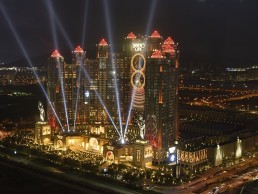
Studio City, China
illumination Physics was chosen as the sole lighting designer and supplier for the façade of the grand Studio City resort in Macau. With nods to Hollywood glamour and the era of Art Deco, the lighting aims to engage with its surroundings while offering dramatic, eye-catching effects.
Studio City Macau is a Hollywood-themed resort offering a cinematic inspired entertainment and leisure experience, never before seen on the Cotai Strip in Macau. It is the second property owned by Melco-Crown Entertainment after City of Dreams and was awarded Casino / Integrated Resort of the Year by the ninth International Gaming Awards (IGA) for 2016.
Studio City carries the strongest entertainment theming of any resort in Macau and the movie theatre vision is carried throughout every part of the building. Therefore the façade lighting is necessarily theatrical in style and reinforces the remarkable elements of the building.
Selected as lighting designer for the entire façade, illumination Physics was responsible for the design, manufacture, supply, install and programming of all the lighting used. There is a strong art deco influence throughout, in particular the eight decorated turrets that sit atop the eight hotel towers - highlighted through the lighting. However, your eye is first drawn to another feature - the two hotel towers curve to form a semi-circle and are connected via a massive figure of eight formed in golden truss, 30 storeys high. At this point the building is transparently open and there is no structure within the eight; it is open from both the east and west. Within the 'eight' sits the 'Golden Reel' ferris wheel, featuring seventeen themed capsules that take riders 130-metres off the ground, illuminated in golden light, made possible by 1,000 pieces of illumination Physics’ CR80 mini wash light. Above and below the Golden Reel there are Starbursts; metal fingers radiating both up and downwards in two giant fans, brought to life with the illumination Physics Wash 36 RGBA. Attention to detail demanded that the fixtures were finished in metallic gold to match the structure of the Golden Reel.
At the very summit of the building, ten shards of steel stretch skyward like the fingers of a hand. These have been illuminated and have become a nightly feature. Wash lighting alone didn't get the separation and contrast illumination Physics wanted and would have resulted in a great deal of light spill into the sky. Instead the team produced just ten pieces of a very special direct view custom fixture – the IP Super Dot, one of which was placed on the very end of each finger of the Starburst. Designed with a lens shaped like a mushroom, the PMMA lens has an internal reflector to direct 100% of the light downwards and in 360º. Visible from any viewpoint without any upward light trespass, the Super Dot is intensely bright and used RGBA to match all of the fixtures on the hotel towers.
It was vital that Studio City's lighting helped the property exert a strong pull, while promoting drama and curiosity along with a grand sense of arrival. In the words of Lawrence Ho, CEO and Chairman of Melco International, the objective was not to be the largest property on the Cotai Strip, but the coolest. Yet it must do all of this in a more sophisticated way than its many competitors in Macau.
The design strikes a balance between grand spectacle and relative restraint in the programming of the dynamic lighting. The ‘show’ is provided by the towers whilst the podium only uses dynamic lighting for six powerful searchlights. The podium façades make use of warm white with the added use of neutral white when contrast is required. For example the two massive 'Hero'ç statues that stand above the gates of the grand entrance make use of the cooler colour temperature, better accentuating their polished metal skin - a mix of IP Wash 36 and IP Wash 48s were used with various beam angles and a total of 72 pieces were used on each of the statues. The towers have two main façades, both east and west appropriately, and the lighting is mirrored on both.
Above the podium every one of the 5,000 illumination Physics LED light fixtures makes use of dynamic colour changing. All of the IP Wash 48, Wash 36 and IP Linear Wash lights used to uplight the tower façades are RGBA. This not only enables the tower to match the mono white colours of the podium at times, but the display of true gold and other hues that would otherwise be impossible to achieve.
Surrounding the Golden Reel is a media façade containing 3,008 IP Media Dots especially designed for this project. Access to the media wall area for maintenance is possible but requires the use of three separate Building Management Units (gondolas lowered from above). To be mindful of this the IP Media Dots were designed with no electronics on board and each has its own dedicated extra low voltage cable. By simplifying the Media Dot it is made robust and the single cable per fixture means that if one IP Media Dot is damaged, the problem only affects that item.
The media wall draws the eye to the centre of the building and provides movement and meaning in the lighting that is synonymous with the early incandescent casino lighting in Las Vegas, Nevada. The media walls add another level of capability in that video graphic content is used to support notional concepts in the lighting shows.
Searchlights are synonymous with a Hollywood movie debut and Studio City would be incomplete without them. Six searchlights rake the sky above the main entrance of Studio City every night. The lighting not only makes a statement about the character and theme of the property but can also be seen from all its competitor’s premises. There are many other searchlights located at other casinos in the area, all of which are installed at rooftop level. At Studio City the searchlights are deliberately positioned at podium level where they have greater visual impact. The towers are clad in a complex metal decorative structure that cleverly camouflages the curtain wall system within. The building’s texture does not resemble the typical assembly of rectangular panels of a modern unitised curtain wall building, instead the eye is drawn to a filigree of art-deco diagonals and cascading buttresses – the language of the 1920’s and 1930’s.
Much has been made of the façades and the lighting is designed to celebrate that. To maintain the grand illusion the façade required wash lights, but this presented several challenges. The towers contain two hotels so light trespass into the guestrooms needed to be avoided. The lights would have to point upwards to provide an effect true to the theme, but this could lead to light pollution unless surgical accuracy could be achieved. The wash lights themselves also had certain practical limits to their dimensions from an aesthetic perspective because they would need to be mounted at two levels on the façade itself as well as the podium roof.
A new fixture design was required and so illumination Physics created the IP Wash 48, a high power narrow focus RGBA wash light. At approximately 100W and equipped with 5º lenses, the Wash 48 has an effective range of approximately 50-metres when used as a shallow angle grazing wash light.
There are four cascading buttresses, which extend from the roof level of each of the eight hotel towers, 32 in all. The IP Wash 48 has been mounted in groups of up to six lights at the podium level, four lights at mid-height on the façade, then finally in groups of as few as two fixtures at the highest level. The lighting follows the architecture and with the accuracy of the 5º focus, light trespass has been avoided. Light pollution has also been minimised by aiming the beams of light in such a way that they are terminated into the building surface, which itself is not specular.
Because access to the 280 Wash 48s on the façade requires a gondola, it was decided that the drivers would not be integrated into the fixtures. Like the Media Dots, the IP Wash 48 is distilled to its simplest form, metal and LEDs. The electronic drivers are located remotely in easily accessible locations within the building. The same illumination technique has been employed on the eight turrets that sit atop each hotel tower, however in this case a standard illumination Physics Linear Wash light was suitable and because the light fixtures are accessible by pedestrian technicians, the AC version of IP Linear Wash was used to simplify the power and data distribution.
The design of the building may harken to early 20th century themes but it was constructed using modern unitised and non-unitised construction techniques.
At night, the stark textures are exploited to create drama and highlight areas such as the Bussing Grove (where the majority of guests arrive), so that they are consistent with the character of the more deliberately decorative features of the property.
Early in the lighting design it became obvious that the extensive use of back-lit faux alabaster panels would require a large quantity of linear LED wash lights. At Studio City there were very large, internally illuminated panels necessitating the use of a high power edge light, using asymmetric lenses such as IP SHPT.
However there are hundreds of other back-lit panels at Studio City which are of more modest dimensions, typically a little less than two metres in width. The quantity was so significant that the team questioned the use of such a high performing and high cost fixture as they were responsible for managing a budget. Exploring their options made it clear that a low power LED linear product would not produce the light needed and because of the size of the average SMD chips, lensing the beam would be very problematic. This lead to two technical breakthroughs that enabled illumination Physics to create a new product called ‘LPSL’ (‘low power strip linear’).
LPSL takes advantage of a new generation of LEDs that are neither low power nor high power, but something in between. LPSL LEDs can be driven at 0.25 to 0.50 of a watt. Their typical high power linear products use LEDs driven at 1-2W but for the majority of back-lighting at Studio City the amount of lumens generated by the newly coined ‘mid-power’ LEDs is sufficient.
illumination Physics had to figure out how to focus the light given the larger size of the LED dies. The solution came in the form of a unique optical design that concentrates the native 120º symmetrical beam of the SMD LED into a highly functional 15 x 60º focus. The net result for the client was that illumination Physics halved the cost of 1,500 pieces of linear back-lighting without sacrificing functionality or quality. More than half the potential energy was also saved.
The illumination Physics team also faced many challenges with the control system for Studio City. Not only did it need to be robust yet flexible, it had to control both the media wall and the façade lighting, ensuring both were perfectly synchronised. This required that a media server and a lighting ‘PC based console’ be married together.
The control system had to be self-sufficient in terms of scheduling but able to be easily adjusted when the need arises. Macau, like Hong Kong and much of Asia has many festivals that require special seasonal or one-off lighting treatments. Although the lighting rig is large and complex, the operation of the system had to be straightforward enough that modifications to the lighting programs and schedules would be user friendly to the owner’s technical staff.
The system wiring was an optical fibre backbone that went to the majority of the 22 dedicated lighting control rooms in which the equipment was installed in dedicated racks. The lighting protocol that was chosen was sACN (streaming Architecture for Control Networks). The LSC ‘Clarity PC’ was chosen for overall control.
All of the lighting fixtures and media servers (in console mode) were distributed over seventeen Universes of sACN. Clarity was chosen for its proven reliability as much as for its advanced functions. For this project, the time/date scheduling functionality was extremely important. All of the cues originate from Clarity to control both the lighting and media systems.
Coolux's Pandora’s Box was chosen as the media server to control the media wall’s 3,008 pixels through its pixel mapping software. Run in console mode to provide parameter control via ‘Clarity PC’.
Having built the lighting system, the success of the project then depended on how it was employed. The creative choices concerning the programming of the lighting and the content that would be created for the media walls needed to be emotionally evocative and create maximum visual impact. Working with Melco-Crown creative director Geoff Benham, illumination Physics created a library of lighting scenes that were synchronised with related content for the media walls. Using remote internet control, live tests and programming sessions were conducted from a variety of viewing points.
Studio City stands tall in Asia’s gaming hub; the lighting is dramatic but represents a step in sophistication and technology in Macau.
The façade lighting of Studio City has been a single all-encompassing project for illumination Physics, from concept to completion.
www.vimeo.com/illuminationphysics/ipmacaustudiocity
www.illuminationphysics.com
