
Glenlivet Visitor Experience, UK
The iconic whisky brand Glenlivet has created an immersive and interactive visitor experience at its Speyside distillery that reflects its rich heritage, high standards, and welcoming nature. A vibrant lighting scheme from Into adds to the warm and welcoming atmosphere of the space.
The Glenlivet, Speyside’s original single malt, is welcoming whisky fans to its newly refurbished home in Speyside, Scotland. After undergoing 18 months of extensive renovations, the home of The Glenlivet has become so much more than a distillery, with a new look and feel.
Following in the footsteps of its founder, George Smith, and his legendary hospitality, the redevelopment reflects his high standards and welcoming nature. Using innovative technology combined with exclusive bottlings, immersive tours, and whisky tastings, The Glenlivet brings visitors an experience like no other. From exploring the art of whisky-making and showcasing rare editions, to reflecting The Glenlivet’s heritage throughout the interiors, the new visitor experience pays homage to being the original mark of quality for Speyside single malt.
Designed by London-based studio Blacksheep, with lighting design from Into, the valley of the smooth flowing River Livet echoes throughout the visitor experience, while the interiors have been inspired by The Glenlivet Estate and the wilderness of the Cairngorms National Park, in which it sits.
Working closely with the interior designers throughout the entire project, Johanna Paice, Associate at Into talks arc through the design process: “When we first met with the interior design team, they ran through their concept for each area – their visuals had a very strong aesthetic and really helped us to get an idea of what the client would like and how the overall space would work. We discussed possible lighting ideas and solutions at this stage; for some areas, they had very strong ideas of what the lighting should be like and the effect they wanted to create, in other areas it was more of a discussion. Our concept was to make the space feel inviting and to ensure there was a balance between showing off the products and experience but still making it feel authentic to the original space and location.”
The visitor centre is spread over the ground and lower floors of the distillery. Visitors enter via the reception where they are greeted by a spectacular custom chandelier by London-based florists, Grandirosa, which is made from local dried wildflowers. From here the visitors embark on a guided explorative journey through a series of spaces that bring the story of The Glenlivet to life. Spaces that follow, include a lounge, which acts as a waiting area ahead of the tour; The Tasting Room - a dramatic circular space featuring a round custom walnut table at its centre as well as a sculptural display that rises from the table displaying a selection of whiskies; then there’s The Sample Room and The Provision Room retail spaces; The Drawing Room - an atmospheric and relaxed onsite bar; The Smugglers Hideout - an elevated private space for tasting the finest bottles of whisky; and then finally The Glenlivet Warehouse, featuring floor to ceiling whisky barrels that are illuminated with hidden linear LEDs washing down. The Warehouse space is split into three, the angel’s share showcasing the aging process of the whisky with a large backlit display, with the two other areas focusing only on the areas of interest making the space feel moody and interesting.
Initially, Into focused on each area of the Experience separately, reviewing the integral details via mock-ups to ensure they worked with the finishes suggested. The team then added layers of light to the space to enhance Blacksheep’s interior design. “Every fitting was reviewed and colour temperatures throughout the space were considered to get the best effect possible,” said Paice. Final fixtures for the project were selected from: KKDC, Engima, UFO, LightGraphix, Stoane Lighting, TM lighting, Hunza, Lightform, Lite-house, and Soraa.
Into used clever lighting design to differentiate the various spaces while ensuring they were seamlessly linked. “We wanted the space to feel harmonious, but the individual areas also needed to stand out in their own right, especially the retail spaces,” Paice explained. “Lighting was used to zone the areas with dimming to each; we also used colour temperature to denote different areas. The retail spaces were slightly cooler with 2700K light fittings, this also helped highlight the true colour of the whisky. Whereas the Experience area was a lot warmer with 2200K fittings.
“Showcasing the products was one of the main focuses of the lighting scheme,” Paice continued. “This was done with integral lighting details mounted within the joinery and I think this helped to get the balance between showcasing the products and staying true to the concept and the homely feel of the ground floor space. It helped that the interior finishes were naturally warm, with lots of rich colours and woods used. The whiskey itself is such a lovely amber colour that highlighting this with warmer light helped to really bring the bottle to life.
“The tasting room was slightly different to the other spaces, while it was still very dramatic as you walk in, the lighting was more visual with large circular suspended profile rings mounted at high level and used as a feature. They were dimmed very low instead of using them to light the space. We also highlighted the bottles within the display using light sheets hidden within each bespoke shelf. As the visitors taste each one, the shelves with the whisky they are tasting illuminates.”
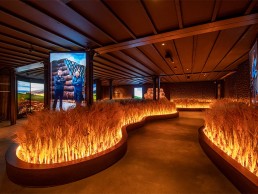
The main theatrical elements throughout the space are within the lower ground floor experience and as guests walk into the Speyside room filled with barley, the architectural lighting is used to create drama within the space. “We wanted to bring the barley to life and make sure it didn’t get lost,” continued Paice. “This was done with fibre optic pavers mounted within the base of the barley shining up and through. The light shimmers and moves to create the effect of barley moving in the wind.
“The rest of the lighting in the space is focused, with dramatic pools of light on the floor and uplighting details to the carved wood walls to add depth and layering the space.”
For Paice, as there are so many beautiful handmade displays and finishes within this project, highlighting them in a sensitive way became even more important. “Lighting also helped to create unusual effects and make the space feel more impactful and dramatic,” she said. “We are really happy with the overall lighting design. It’s very close to what was originally discussed at the concept stage with the only differences occurring because of the various mock-ups, which identified the best execution of each lighting detail. Not only did these demonstrate to the client possible ways to present their product, but they also steered the collaboration between lighting and joinery, which was a great success.”
Darren Orrow, Director at Into, added: “This was such a fantastic project to work on; both the interior designer and client had some great ideas for lighting. We all worked very closely on mock-ups and detailing to make sure our collective creative vision could be realised within budgets and timescales.”
Commenting on the finished product, Miriam Eceolaza, Director of The Glenlivet, said: “After 18 months of renovations, we can’t wait to open the doors to our local communities and bring whisky lovers into our new visitor experience. It’s a true immersion into the iconic Speyside region, walking guests through our stunning indoor field of local barley, tasting from our old and rare archives, experimenting with our famous cocktail capsules and taking a unique piece of Speyside home with our straight from the cask personalised bottling. From the decor and design to ambience and atmosphere, guests will witness something truly original at every turn.”

Yotel Vega, UK
With a dynamic, retro-futuristic lighting scheme, Artin Light has created a vibrant, experiential journey of light at Glasgow’s newly opened Yotel hotel and Vega bar and restaurant.
For those of us that enjoy a city break, the hotel is often seen as a place of respite, somewhere to lay your head after a busy day of exploring. But, for Glasgow’s newly-opened Yotel hotel, and adjoining Vega bar and restaurant, the hotel is a destination in itself.
As a brand, Yotel has become known around the world for its quirky, vibrant aesthetic, and the Glasgow branch is no exception. Designed by Canadian interior designers DesignAgency, with lighting design from Artin Light, the hotel takes visitors on a retro-futuristic adventure from the lobby - dubbed ‘Mission Control’ - up to the Vega bar and restaurant on the seventh floor.
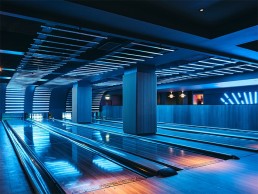
Peppered throughout this journey are a series of dramatic light interventions, more akin to a trail of light art installations than a traditional architectural lighting scheme; from the Purple Pills in Mission Control, to the Reflection Portal in the lift lobby, the lift experience itself, and the dynamic, graphic equaliser-inspired bowling alley inside Vega.
Luke Artingstall, Director of Artin Light, explained the concept behind the lighting: “There was a lot of influence from what other Yotel branches had done, and the experience that you get when you first walk in,” he said. “I wanted the lighting design to tap into that, but with a futuristic twist so that when people walk in, they think that it’s really cool and a little bit different.
“The interior for Mission Control was quite minimal and clean, with lots of curves and strong materials. This worked really well with the lighting design as we could then integrate lighting into details; there’s a lot of indirect lighting, letting light dissipate from the perimeters into the interior space.
“The Purple Pills in the entrance area were such an important part of the visual experience as you approach the building as you see them externally in the double height void, and as you walk underneath them, they are slowly and subtly animated in the purples and blues synonymous with the Yotel brand. The design for the pills was inspired by the interior vibe - there are no sharp corners, everything is smooth and curved, so that was the start of the journey.
“We wanted to create an immersive experience where it’s not just about lighting, it’s like you’re entering an art installation. Interaction was such a big part of what we were trying to achieve.”
With so many bold light elements across the space, Artingstall said that he was encouraged throughout by a very enthusiastic client. “Yotel were really excited about our initial concepts,” he said. “They bought into the theme straight away, and that was really exciting for us because there are some iconic pieces within the building that create this fragmented journey, and then the lighting design flows through it.”
From Mission Control, guests are guided to the lift lobby - a beautiful, arched space that has been highlighted with concentric channels of indirect light. Here, Artin Light created a “surprise” element: the Reflection Portal at the end of the archway. Inspired by reflection and movement, as well as the concentric geometry of the space, the Reflection Portal features a backlit, digital mirror that was designed to play on illusion and perception of the 3D space, drawing visitors into a ‘portal’ and absorbing them into the artwork. The digital mirror features bespoke artwork content developed by Artin Light, alongside Studiotech, which creates a “digital portal” that reacts to the movement detected within the lift lobby.
From here, guests step into the feature lift, which takes them up to Vega on the seventh floor. A far cry from the typical lift experience, Artingstall wanted to create a “complete inversion” of the lobby experience.
“The lift lobby where we have the mirrored arch is a beautifully bright, light space, and the concept was to flip it on its head and play with your perception of space and darkness,” he said. “Inside the lift, we wanted to create a black void, where you walk into this cube and everything is blacked out, with no light whatsoever. The idea was that as you go up to the seventh floor, it’s like going through space, so from the black void we created an animated experience with light and sound that would take you on a journey up the building, immersing you into a digital artwork that is inspired by the different elements of the interior design.
“It was a really challenging part of the project, because of the confinements of the lift and what we had to work with, but it’s such a massive element of the scheme and was one of the starting points where we developed the whole concept from there. One of the first things that the client said to us was ‘we’ve got this lift and we want you to do something with it’, and that then inspired what we did in Mission Control, the Purple Pills, the Reflection Portal, and it had an influence on the bowling alley in Vega too. It was as if once the client had a taste for it, they wanted to see how far we could push it, and that’s ultimately what you want to hear as a designer.”
Moving up the building, the Vega restaurant and bar continues with the overarching “futuristic, sci-fi, cyber city crossed with Miami Vice” feel that was established in Mission Control, with neon lighting details punctuating the dark and moody atmosphere of the space. This also served as a direction influence on what Artingstall did with the final artistic element of the project, the bowling alley.
“The bowling alley was a space that the interior designers wanted to take in one direction, using projection to create interaction, but because of the architecture of the space it was a little bit problematic. That was the opportunity to take the neon influence from the bar area and bring it to the bowling alley by creating a retro sci-fi, synth wave mashup of an installation, that would have a visual interaction as you bowled as well.”
The vast ceiling installation, for which Artin Light again collaborated with Studiotech, serves as a digital canvas, with bars of light that interact with users as they bowl, tracking the ball down the alley and creating a vibrant play of light. “I don’t believe anyone has ever gone down that route in terms of what we achieved with the final installation,” Artingstall continued. “The space had a massive ceiling expanse that needed us to do something cool with it. When I first saw it, I thought that we could do something so much better.”
With the various dynamic, artistic lighting elements throughout the project, the lighting for the Vega bar and restaurant was kept deliberately minimal, with low levels adding to the intense, moody atmosphere of the space. Alongside pops of colour from decorative pendants and neon-esque wall lights, the lighting for the bar is characterised by an expansive mirrored ceiling, interspersed sporadically with “night sky” panels.
Artingstall explained: “Within the mirrored ceiling panels, we saw an opportunity to create miniature infinity panels as well. We used fibre optics to create a night sky effect, which was a big part of the concept. We also had mirrors in the walls of the restaurant and bar that had fibre optics behind them too, so while it was dark and moody, the colour pops and the twinkling lights in the mirrors help to amplify the whole visual experience.”
The night sky effect comes into play after dark, mixing with the coloured lights within the space to add to the vibrant ambience of the space. “During the day, the lights are switched off and everything is quite bright and light, and not about the colour, but at nighttime it would transition - all of the RGBW elements of the scheme go into pinks and blues, while the fibre optics in the mirrored panels completely flip the space,” Artingstall added.
“But the contrast of the lighting was so important; it wasn’t about trying to over-light the space, but using really tight, narrow beams where we could, pin spotting tables and letting the colour and reflectiveness in the space do the talking.”
Looking back on the project after completion, Artingstall believes that there were a number of unique challenges to overcome, but the end result proves that the work was worth it in the long run.
“Naturally with any type of project like this, it was not just about the visual effect but the detailing as well - this was such a big part of the process, and coordinating all of the elements into one build-up was very difficult. It was one of those projects where you step a bit out of your comfort zone, but you don’t progress unless you do that.
“I believe that the lighting design really complements the interior design - the two go hand in hand. The artistic moments where we did the Purple Pills, the Reflection Portal, the lift and the bowling alley make a massive part of the hotel. People want to go there and experience that, they want something different and a bit more, and I think that we’ve done that with this project.
“I love art, I love light art and playing with perception and space. I wanted the project to be a visual experience that is like going to a mini light art festival.”
Artingstall concluded that it was through the encouragement of an engaged and supportive client that he was able to create such an experiential journey of light throughout. “Yotel is a worldwide brand and it has got some amazing sites and hotels. It’s a really exciting brand to work with, and they really pushed it on this project. They let go, and I think that’s what’s really nice about it.
“Naturally, it’s got an excitement about it that draws you in, and hopefully the general public who go there will really enjoy it as well, as it’s such a visual treat for the eye.”
The Londoner, UK
Blending an art gallery and a theatre within a luxurious boutique hotel, The Londoner offers guests a relaxing yet mysterious environment to unwind. Inverse Lighting Design sought to use light as a means of complementing and enhancing the decadent interiors of the hotel.
Described as ‘the world’s first super boutique hotel’, The Londoner is nestled in London’s world-famous Leicester Square, offering guests a luxurious stay with a vast array of amenities and experiences, as well as the highest levels of comfort and decadence across its 350 rooms, 35 suits, seven meeting rooms, six bars and restaurants, ballroom and Wellness Retreat.
The hotel is the latest project from the UK’s largest family-owned hotel group, Edwardian Hotels London, and was designed by architect Woods Bagot, interior designers Yabu Pushelberg and lighting designers Inverse Lighting Design to play into the roots of Leicester Square as London’s historic theatre district, with a ‘West Side Story’ narrative underpinning the guest experience.
The hotel is spread across 16 floors, but due to strict planning, restrictions limited any upwards build. This means that eight of the 16 storeys form the capital’s deepest habitable basement - the hotel was even, at one point, the largest excavation project in Europe. The bedrooms and suites remain above street level, while public areas, guest attractions and services are housed in the lower floors, with no natural light - a significant challenge from a lighting design perspective.
Edwardian Group Founder and Chairman Jasminder Singh hoped that The Londoner would be “a centrepiece and anchor of the West End; a celebration of London, its history, aesthetic and people. Stylistically, the public areas have been designed with a minimal and cohesive neutral palette, a modern British sensibility, continuous reminders to theatricality, and a sense of mystery, with nods to British humour, especially in the vast and multifaceted art collection.
“The lighting scheme reflects all of this with hints of theatrical lighting, surprising moments and a focus on the artwork,” said Nicola Agresta, Senior Lighting Designer at Inverse Lighting Design. “This has also been infused into the guest rooms, but in a more subtle way so that they are still spaces for comfort and relaxation.”
The lighting concept is based on the main themes present in Yabu Pushelberg’s interior design: theatre, mystery, and the art collection. One of the best examples of this can be found in the ground floor bar, The Stage, which references a living theatre orchestrated around a box-shaped, veiled piling with mirrored surfaces for added spectacle.
The use of surface and track mounted spotlights and framing projectors reinforces the idea of being ‘under the spotlights’, like on a real stage; the corrugated velvet walls mimic the curtains of London’s West End theatres, and the light strikes them exactly as they would theatre curtains.
Agresta continued: “The sense of mystery is achieved by balancing focus and accents, playing with reflections and shadows, or creating moments of surprise: on the mezzanine level of The Residence, a floor dedicated exclusively to hotel guests featuring three distinctive spaces to enjoy a drink, relax and engage, the Y Bar wood panelling is neutral by day but in the evening guests are surprised every 60 minutes with vivid, illuminating illusions of artist Andrew Rae’s comic illustrations. The light is focused on the tables, leaving the rest of the bar in darkness, allowing the illuminated walls to become as visible as possible.”
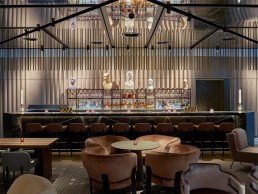
Elsewhere on the mezzanine level, the Drawing Room offers guests a plush, soft environment to relax, characterised by cove and diffuse lighting that is offset with decorative floor and table lamps. Meanwhile the Whisky Room is one of The Londoner’s hidden secrets, featuring just six tables, sumptuous velvet seating and a collection of the world’s finest whiskys. The glass cabinet housing the spirits illuminates each individual bottle and is the main feature of the space, while the rest of the room is kept very dim.
On entering the hotel, visitors are greeted by a large, open space. An unobtrusive reception to the side allows for free passage through to the lounge. Lighting here keeps the atmosphere inviting with soft and integrated fixtures.
Opposite check-in and beyond the lounge is Whitcomb’s, The Londoner’s all-day restaurant. The space transforms throughout the day with two harvest tables changing for breakfast and dinner, each highlighted by the lighting. Illumination for the rest of the space is more general, owing to the flexibility of the tables.
Heading down to the basement levels, the sense of mystery is further highlighted within the Green Room - the hotel’s private club and lounge space. Fixtures hidden behind the mirrored ceiling create accents and shadow that accentuate the soft waves of curved wood panels and rich velvet seating within the space.
On level B2, the ballroom is one of the largest in a hotel in central London. A glowing halo encircles the ceiling, concealed behind a suspended metal mesh curtain - again giving the impression of theatre curtains. The ballroom comprises three layers of lighting: general, from suspended black floodlights; functional, courtesy of remote controlled spotlights; and decorative accents through RGBW glass globes, which interact with the other coloured lights in the space to create different settings.
Completing the basement levels is the Retreat, which houses a pool, treatment centre, gym and juice bar. The pool is beautifully lit from Barrisol panels in the criss-crossed ceiling for a bright yet soft atmosphere. RGBW LED strips create different settings, from warm to dim throughout the day to colourful and playful scenes for special occasions.
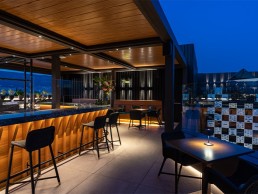
Above ground, The Londoner is capped off by its rooftop izakaya lounge. Upon arrival here, thick, dark wood slats stand floor-to-ceiling, revealing glimpses of the dining space. Spanning the ceiling and partitioning the dining space is a network of intricate ropes, reminiscent of the ancient Japanese art of shibari. To create a soft dining atmosphere and highlight the shibari ropes, surface-mounted spotlights graze the wood ceiling surface to diffuse the light and highlight the ropes by contrast.
Among the various bars and restaurants, the hotel also hosts a large art collection, which the lighting design team studied in great detail. From flexible spotlight solutions to dedicated picture lights in both the public spaces and guest rooms, lighting focuses on the artwork to create highlights. One of the key areas that shows this is The Gallery on level B3, where artworks rotate and alternate with empty frames: plug in spotlights have been used here to give maximum flexibility while still reducing the number of fixtures needed, accenting the artwork and playing with shadows from the empty frames to connect with the hotel’s overriding sense of mystery.
Agresta explained how throughout the project, Inverse worked closely with Yabu Pushelberg to create a lighting scheme that would enhance and complement the interior design. “We’ve always worked very closely with Yabu Pushelberg in our projects. They have a great sense of how they want the spaces to look, but they also always left us enough freedom to design our own scheme and create different moods, as long as it was coherent with the overall concept.”
With a brief that desired the contrasting feelings of theatricality and mystery with a balance of drama and functionality, Agresta highlighted some of the main challenges that the lighting design team faced in bringing the concept to life: “As the two main themes of the interior design were the connection to the West End and the sense of mystery, the main challenge in turning the brief into a reality has been trying to balance these two almost opposite directions.
“With the theatre theme, we had to show the luminaires, the spotlights and the projectors to have a direct, visual reminder. For the sense of mystery, we had to conceal the lighting fixtures, create interesting and magical moments. And obviously all of this had to fit into the guest experience of a luxurious hotel.”
With half of the hotel being situated underground, Agresta added that the lack of natural light in the front of house areas was another cause for concern. “It was a real challenge from the very beginning,” he said.
“We had to make sure that these spaces would have looked bright enough during the day to avoid a contrast too big when entering or exiting the hotel, while still looking interesting and sexy. We achieved this by creating accents, washing the corrugated velvet walls to mimic the curtains of London’s West End theatres, in connection with the theme.
“Uniform peripheral lighting on walls usually creates subjective impressions of relaxation - we used a combination of both to highlight interior design features, make the rooms feel bigger, and play with day and night scene settings.”
Control also played an integral role in achieving the required ambience throughout the hotel. As such, Inverse sought to implement a lighting control system that enabled automatic adjustments throughout the day to set the right mood for guests, but also provided the necessary reporting to ensure that any faults were reported promptly to minimise disruption to guests and operations.
As such, the use of DALI-controlled luminaires in combination with Lutron’s lighting control system allowed the lighting designers to meet the challenging requirements of the project. The attention to detail in specifying a fully-controllable scheme led to Inverse winning the Hospitality category at the 2021 DALI Awards.
Agresta said: “The Londoner is a showcase for what the use of the latest technologies can achieve to deliver unforgettable experiences. DALI enabled us to meet the customer’s expectations, and to be able to improve on them in the future without having to change the infrastructure.”
Throughout the hotel, Inverse opted primarily for fixtures from Lucent and TM Lighting, while products from LEDFlex, iGuzzini, LightGraphix, Targetti, RCL, Cooledge and Applelec also helped achieve the required ambience of the space. Lucent in particular worked closely with Inverse to provide architectural lighting for all rooms and penthouses, including downlights, LED strips and profiles, and low level wall lights. The corridors are also lit with Lucent LED strips and downlights, with the manufacturer specifically designing a Line 1 Cell unit for this project. The façade and public areas, which rely on the mixture of dramatic and intimate light, are also lit with Lucent’s downlights.
Speaking of the specification process, Agresta added: “The lighting plays a double role in enhancing the luxurious feel of the hotel - it highlights the interior design features and the art collection, and helps to create a great atmosphere.
“All products have been specified knowing that they would ensure a great result, being good quality products. Specifically for the exposed spotlights and all the picture lights, the main reasons these have been specified were the great light quality and glare control - absolutely necessary for the guest experience - and the beautiful finishes the light fixtures can be made of, to match the rich materials specified by the interior designer.”
Looking back on the project following its completion, Agresta is satisfied that the lighting design meets the brief and the intention of the interior design, adding to the luxurious feel of the space.
He concluded: “There’s an incredible mix of feelings when you walk through the hotel: a visible connection between the exposed light fixtures, the theatrical theme and the art collection; a sense of mystery and discovery that creates interest, and an overall sense of comfort and relaxation. All of this couldn’t be possible without a methodical study of the space, and a meticulous control of the light scene settings.”
Athens Capital Center Hotel, Greece
Completed in late 2020, Lighting Design International has brought a fresh, yet homely feel to the luxurious Athens Capital Center Hotel, highlighting the beautiful artwork and striking interior design of the space.
Completed towards the end of 2020, the Capital Center Hotel – M Gallery in Athens, Greece received a complete interior renovation and upgrade. The hotel is located near Syntagma Square in the heart of Athens, across from the Parliament buildings on one side and the bohemian district of Kolonaki.
With a unique identity, the hotel’s interiors are heavily inspired by its Greek surroundings. Lighting Design International (LDI) was commissioned to provide a fresh yet homely approach to highlight the elegant interiors created by MKV Designs.
arc hears from Sandra Brookes, Senior Lighting Designer at LDI, to find out more about their involvement in the project: “LDI has been working on many successful projects in Greece for several years now. We have developed excellent relationships with our clients in the area. As a result, one of our clients recommended us to MKV Designs.”
Brookes explained how the initial design brief shaped the approach for the lighting, ensuring it was balanced throughout: “This was created was created through layers of light, while the unique and distinctive atmosphere in each space added drama, which is highlighted through accent lighting.
“We worked in tandem with the interior designers creating harmonious integral lighting that highlighted the interior in places and was the protagonist in others.
“One of the project’s strengths was that once the lighting brief was defined, it was thoroughly maintained. The final design result was an elegant, sophisticated ambience with a residential feel focused on art, which represented the initial vision agreed with the client.
“LDI was commissioned to provide a fresh yet homely approach, highlighting the elegant interiors by MKV Designs. The concept was brought to life via the art and the successful relationship with lighting throughout the hotel. Art plays a very important role within the interiors of the hotel. The different pieces dotted around the hotel were emphasised with light, reinforcing the significance of great artistry to the M-Gallery brand.”
The hotel presents a luxurious arrival experience starting at the porte-cochere, where a valet service receives the guests. You are welcomed by a warm and vibrantly uplit façade and an arcade containing the Gallerie Café. The arcade café incorporates an abstract marble relief on the inner perimeter wall. This element is enhanced by accent lights that emphasise the form and texture by using light and shade. The marble wall also provides an introduction to the excellent blend of art and architecture that is experienced throughout the hotel.
In the reception lobby, vibrant colours and bold patterns are highlighted with soft lighting to give the space a residential feel. The light wrapping around the grand staircase, the subtle vertical washes and the lighting concealed within the furniture make this a unique space.
“The ground floor public areas are a labyrinth of areas interwoven with each other tied up by a central atrium flowing from the main entrance to the Galerie Café,” continued Brookes. “Art is dotted around with lighting providing an interest and focus in every corner.”
“The reception is at the far end, away from the entrance, offering a sense of intimacy and exclusivity, which is highlighted by the subtle lighting atmosphere. This area is perfected with two paintings by Yannis Adamakos that were highlighted with recessed spotlights, enhancing, and lifting the blue hues that are a symbol of Greece.
“LDI designed the lighting layouts with the existing structure in mind, but with the advantage that most of the equipment was concealed from view successfully by the new interiors. Bespoke tailored details were developed in conjunction with the interior designers and incorporated within furniture and the building envelope.”
Central to the building is a large atrium that houses a Mappemonde art piece mounted on the entirety of the façade viewable from the staircase, guest rooms and roof terraces. The original Mappemonde was sculpted by Greek artist George Lappas for the Venice Biennale of 1988. This piece consists of parts of metal cut out of a house-shaped form at roof level and mounted horizontally on square white boards in a checkerboard formation. Composed of 3,000 metal pieces, it is carefully lit with colour changing floodlights, producing textures and patterns with movement enhanced by individually controlled white and colour changing lighting.
As daylight moves throughout the space, different shadows form through the silhouetted sculpture. At night, the piece comes alive with concealed colour changing spotlights that cast shadows across the boards in various directions. At night, the lights, which are located at different levels, are programmed to cross fade with changing colours to create an animated focal point to the centre of the building.
Telling arc about some of the challenges the team faced during this renovation project, Brookes explained that bringing the historical building into the 21st century in a careful and considered manner was a main consideration, with the focal point art piece in the central lobby being another.
“The project was a refurbishment of an existing site. The outer shell and structure were maintained while the building was completely renovated. The original layout was maintained throughout, but the building services and interiors were totally upgraded. Therefore, we had the opportunity of having a new and more current lighting scheme and control system incorporated within the building, leaving a minimal lighting aesthetic visible so that guests could enjoy the warm inviting lighting ambience without knowing where the equipment is located.
“The pièce de résistance of this project is in the central atrium and is viewed from the terrace above; The Mappemonde art piece. During the night, the metal pieces of the work were carefully lit with colour changing floodlights producing movement and creating an explosion of shadows, textures and patterns through individually controlled white and colour changing lighting horizontally positioned throughout the length of the piece. A special effort was made for the sources to be carefully concealed from view within the building envelope, focusing on the art piece.
“Designing and programming this piece was one of our greatest challenges as the lighting effect needed to be the focus and the equipment totally concealed from view, and for the lighting to transition seamlessly not only from day to night but to subtly crossfade between the colours, performing a spectacle of light at night.”
Art played a major role in the design scheme throughout the hotel, so it was integral to the overall success of the project for Brookes and the team to integrate lighting to suit the individual artworks cohesively into the grander design. Brookes explained further: “Art and light is a relationship that has always existed from the beginning of time: from the humble picture light to more immersive installations. Art and lighting are used throughout hotels to help accentuate the identity of their location, so the guest gets a local feel. Nowadays, art is taking centre stage in hotels more and more, attracting the interest of potential guests and passers-by and with lighting adding a new dimension to the experience.
“There are several ways of using light to accent art, and these have all been used throughout the Athens Capital Centre Hotel – M Gallery. The hotel’s art was inspired by Greek culture. The hotel is at the heart of Athens in a prominent position looking towards one of Athens’ most popular tourist destination, the Parthenon, on one side and on the other side looks towards the bohemian quarter of Kolonaki with its numerous art galleries setting the scene.”
Moving further into the hotel to the contemporary and cosy guest bedrooms and suites, luxurious materials, flexible lighting, and the addition of original artwork were chosen to add to the experience of luxury and intimacy. “The interiors and art represented the Greek heritage and the resulting fresh approach helped to enhance the art within the rooms. Spotlights and traditional picture-lights were used to add accent to all artwork exhibited,” explained Brookes.
“Intimacy and art were connected via the creation of lighting scenes. At the touch of a button the atmosphere of the room changes, and different objects were highlighted in each different scene. These scenes are governed by a control system, which is essential to realise the subtlety required to create the perfect balance of lighting effects within a space.”
The layered lighting used throughout the project came to life with various scenes created. “Like an artist, the lighting designer uses different combinations of light levels across the space to create the desired ambience throughout day and night. During the daytime the ambience was welcoming and lively but with levels balanced enough to provide a homely feel. During the night scene the levels were subtle, and the art was emphasised by increased brightness,” said Brookes.
When asked about the mix of classical and contemporary architecture throughout and whether it was challenging to create a scheme that would effectively complement the varied architecture, Brookes commented: “The success of the scheme was in the creation of the right ambience for each style in a cohesive way where the classical and contemporary architecture felt unified in its approach to lighting. In both, there were commonalities that made the transitions seamless. The lighting worked as a silent backdrop creating that all-important consistency throughout.
“The lighting complemented the distinctive look of the interiors through the careful control of accent lighting. Each space focuses on that special ‘je ne sais quoi’ created solely for that space with lighting in a subtle way.”
The blend of architectural and decorative lighting allowed the decorative pieces and the artworks to take centre stage. “Oversized bespoke decorative luminaires help to retain a cleaner soffit and introduce a sense of scale. Their special design adds uniqueness to the style of the Gallerie Café, the lobby lounge, and the lift lobbies,” explained Brookes.
“The warm, welcoming atmosphere at the reception area is provided mainly through a decorative loop of lighting that flows, interweaving the labyrinthic spaces. These are curved coves with integral linear lighting, which are shaped around the columns, providing soft lighting. Accent lighting was positioned only as required and highlighted the intricate lattice behind the reception.”
Reflecting on the project and the lighting’s success, Brookes concluded that the “overall impression is a fresh yet homely space brought to life via the focus on the art and its successful relationship with lighting throughout the hotel”.
She added: “Art played a key role within the hotel’s interiors, which was part of the initial brief and was developed as the main feature during the whole process. The different pieces of art dotted around the hotel were emphasised with light providing a cohesive approach where traditional and contemporary architecture were combined successfully by the power of light.”
www.lightingdesigninternational.com
The Nobu, UK
The Nobu Portman Square is the third Nobu Hotel to open in London. Well known for its contemporary décor, the client brought in lighting designers at Isometrix to create a complementary scheme for the new branch.
Founded by renowned Japanese chef Nobuyuki “Nobu” Matsuhisa and his partners in the 90s, the Nobu brand is well-known for its contemporary décor, with high-end Japanese restaurants and luxury hotels all over the world.
When Nobu London Old Park Lane opened, it was the first international outpost and was an immediate success; this was closely followed by Nobu Hotel London Shoreditch. Portman Square is the latest addition to join the London-based hotels; located in the heart of central London’s chic Marylebone area, the hotel features 249 guest rooms and suites, and world class dining options including Nobu Restaurant, Nobu Bar and Nobu Terrace, plus the relaxed restaurant and bar, The Lounge. The hotel also features a ballroom and meeting spaces, as well as the world’s first Nobu Pilates Reformer studio, which is situated in Nobu Wellness & Fitness.
With an existing relationship in place with the Nobu Group - having collaborated on several projects in the past - lighting designers from Isometrix were called upon to enrich the atmospheric and visual expression of the architecture, both internally and externally. The aim being to provide a guest experience in keeping with such a luxury lifestyle hotel – embellished with lighting accents that express the contemporary Japanese décor.
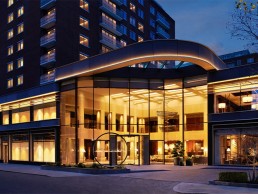
One of the key lighting considerations on this project was the façade, which was completely revamped from the previously dreary Radisson Blu hotel aesthetic. The design team evolved the architectural lighting design and focussed the external façade with some strategically positioned lighting elements. This subtle lighting scheme delivers an enriched atmospheric and visual effect, expressing the building fabric and contours of the architecture.
As soon as you walk through the door everything about the space radiates a sense of calm. In the lobby for example, a cast-shining silver piece by kinetic sculptor Ivan Black is suspended from the ceiling, rotating hypnotically. Working with two separate interior design teams – Make Architects for the guest rooms and David Collins Studio for the public areas – the Isometrix team had full freedom to design their own lighting scheme. They discussed decorative lighting pieces with the teams to ensure the spaces were visually appealing and aligned with the concept and for the architectural lighting, specified the right products for application from brands including: Lucent, Precision Lighting, LightGraphix, Trkya, Kreon, Prolicht, iGuzzini, Soraa, and L&L Luce & Light - ensuring they were also aesthetically pleasing to create a clean finish, in-line with the Nobu brand.
With its close relationship with the Nobu Group, Isometrix understands the brand identity when it comes to lighting and approached the Portman Square location as an extension of the brand – wanting to create a sense of timeless elegance and sophistication that guests will adore. Having visited a previous Nobu hotel project they had worked on in Willow St, the lighting team used this as their foundation to then apply their own flair and set this unique hotel apart, all the while keeping its identity.
The building’s unique architecture and bespoke interior design provided the Isometrix team with the opportunity to design a beautifully lit environment – bringing a serene, calm and effervescent ambience through light for guests. Working with all disciplines to bring the scheme to life, the lighting design team built various mock-ups to review and personally visited the factories where the decorative light fittings were being produced. Working closely with the manufacturers, the team ensured the colour temperatures for all the fixtures were consistent with the overall lighting within the hotel.
As with all projects, Nobu Portman Square did have its challenges – some of which specifically relate to the fact the site was once a Radisson Blu hotel. As the space underwent a complete transformation, the design team found depths and voids were not as per originally designed and so had to specify particular luminaires to work within the set site conditions, while providing great illumination. As well as this, having to work with multiple main contractors and design teams across the project meant working with various approaches. Isometrix assisted by unifying the project as a whole, from guest rooms to the signature bar, ensuring all the while an attractive experience; the main objective being to create a coherent lighting design language and produce an alluring ambience throughout.
The lighting throughout, helps to facilitate a sense of calm by softly accenting the materials and furnishings without being noticed. The low-level lighting provides a soft glow as you navigate the public areas. The warmth from the colour temperature allows guests to feel comfortable. This is enriched by the lighting system, which gently alters the levels throughout the day, creating the finest of atmospheres. The décor then adds to this sense of calm, which flows throughout with the fine detailing and integrated lighting fittings that subtly draw guests’ attention.
“Our specification of high CRI LED light sources, the consistent warmth emitted, our input on bespoke lighting elements and the refinement of beam angles, all work to enhance the feeling of grandeur and luxury at Portman Square,” Ryan Jones, Senior Lighting Designer and Design Lead at Isometrix told arc. “We wanted to illuminate the spaces without the sources being visible - preserving the sense of calm and tranquillity known from the brand.
“As designers, we are very detail oriented and we paid close attention to finishes and materials – testing various lighting products, colour temperatures and CRI’s to make sure the light emitted enriched the surfaces they touched. We worked closely with manufacturers to create and tweak lighting products solely for the project to maintain the reduced visibility of the source, as this was a key factor.”
Reflecting on the project, fellow Design Lead and Intermediate Lighting Designer at Isometrix, Daniela Cordova, added: “Our lighting design on this project gives us a great sense of accomplishment. It’s incredible to look back at the initial concept visuals and compare them to the finished product. To see our ideas brought to life by the collaborative efforts of the various teams highlights the value our design carries.”
Designers Mind: Protect Your Energy
In the first of a new series of articles from Designers Mind, Founder Kaye Preston discusses the links between our energy levels and our productivity, and how by prioritising our wellbeing we can improve our focus and motivation.
Like many things in life the design industry has two sides: on one it’s an incredible industry filled with passionate, creative minds; on the other it can be a stressful environment with long hours to meet tight deadlines. Often the simplest of wellbeing practices get overlooked, putting a strain on our mental and physical health.
This got me thinking: we know how important our health is yet we still struggle to prioritise it, to make the time.
I admit that through my own journey and experience with burnout I had to change my mindset around wellbeing. It wasn’t until I started learning more about health through my own healing and coaching and I experienced first-hand how connected our physical and mental health are that I understood the importance of prioritising my wellbeing.
Time is often cited as a top reason why many people don’t prioritise their health. But if by putting our wellbeing first we could be more productive, have improved focus and motivation, wouldn’t this actually save us time at work?
Too often health gets slotted in around a long work day, family commitments, our partners, even life admin. What if we flip this around and start with our health instead? Our healthy habits creating the energy we need to show up every day the way we truly want and achieve our goals.
Our energy level really does determine how we show up every day
Prioritising our mental and physical health by incorporating more sleep, eating well, moving more and taking breaks may feel counterintuitive. Surely taking time to spend on ourselves takes away from work? Not in this case. Imagine what we could accomplish if we woke up feeling energised, motivated and ready to take on the day instead of feeling tired, overwhelmed and exhausted from the long day before?
And this brings me to a little secret that I’ve learnt about time.
Time Management = Energy Management
Our energy is actually an excellent measure of our current level of wellbeing and linked to motivation, productivity, focus and creativity.
Let’s start measuring time by quality instead of by quantity. We’ve been conditioned to measure our time by blocks of hours and minutes. And of course, this is useful to a certain extent. But a thought I’ve been pondering lately is if we show up energised our time could be spent very differently than if we’re tired, overwhelmed and stressed out.
An energised hour could mean more quality time for our work in the moment and more quality time for loved ones or other areas of our lives later on. We may think we don’t have time for our wellbeing and sometimes prioritising our health can even feel counterproductive. But taking 15 minutes out to have a break, go for a walk, get some water may mean the next 45 minutes are spent in deep focus, ultimately achieving more than a distracted or tired full 60 minutes.
Our energy levels are affected by our healthy habits, stress, work and relationships.
So, what are some things we can do to protect our energy so we can wake up energised, motivated and ready to take on the day?
Meditation, yoga, sleep, relaxation, exercise, eating whole foods, keeping hydrated, getting outside, connecting with loved ones and setting healthy boundaries are all practices that can help improve our energy levels.
What may be depleting our energy?
Lack of sleep, not taking enough breaks, eating a diet full of processed and sugary foods, not drinking enough water, lack of exercise, toxic relationships, too much time in front of our screens, not enough time in nature, poor time management, lack of boundaries and procrastination.
It’s important to try things out and see what works for you. To discover what gives you energy and what doesn’t.
Steps to protect your energy
Here are some steps to help get you started:
1. Get back to basics with your health by prioritising sleep, food, hydration, exercise, movement and rest.
2. Learn ways to manage your stress by prioritising your health, practicing meditation or getting more time out in nature. Identify your stress triggers and make any possible changes.
3. Think of small steps you could take rather than trying to change everything at once. You’re more likely to be successful creating new healthy habits making small changes consistently over time.
4. Recognise that you may feel differently throughout the day, throughout the month, seasons, or different chapters of your life. As you get better at listening to your body you’ll be better able to identify your needs.
5. Practice compassion and kindness towards yourself. Wellness is a journey. One that needs to adapt and change with you.
6. Acknowledge your accomplishments. When making any changes it’s really important to recognise what went well for you during the day.
7. Be mindful of any self-sabotaging behaviours that may be depleting your energy and derailing you from what you want to achieve. For example, scrolling on your phone first thing, eating that food you know disagrees with you when you have a big deadline, or avoiding starting a big project.
8. Reach out and get support from your friends and family, colleagues or a professional. Set healthy boundaries, learn how to communicate your needs.
Imagine starting your day from a place full of energy? What could you achieve?
By prioritising our physical and mental health we protect and build up our energy. Having more energy optimises our time, allowing for better focus and creativity. We have more energy to design, getting more done in less time, which in turn allows more time for our wellbeing and all areas of our lives (I do love when something goes full circle!).
GreenLight Alliance: A Dive into Remanufacturing
As the lighting industry begins to understand the importance of the circular economy, Tom Ruddell of EGG Lighting and Simon Fisher of The Regen Initiative break down the role of remanufacturing in reaching circular goals.
The circular economy is, bit by bit, coming to lighting. But what will it look like? Will it cost more? Will it be compliant? What about lighting quality? Will there be trade-offs?
There is a growing consensus in the lighting industry that remanufacturing needs to play a part in the solution. Aligned with circular economy principles, remanufacturing seeks to return used products to an as-new condition. In many cases this costs less than equivalent new products and delivers significant carbon and waste reductions.
Around 40,000 tonnes of commercial lighting equipment is sold per year in the UK, according to figures published by gov.uk (https://www.gov.uk/government/statistical-data-sets/waste-electrical-and-electronic-equipment-weee-in-the-uk), but unfortunately only about 7% of the displaced WEEE equipment is properly collected and processed. It’s a wake-up call and an opportunity to do much better.
• We want to see an industry where used luminaires can be collected and treated as assets with residual value, encouraging clients to specify high-quality luminaires that can be remanufactured.
• We want to see new luminaires being designed to be remanufactured.
• We want to help clients upgrade to modern LED technology for less cost and with less waste than buying new luminaires.
What is remanufacture?
Currently, most non-experts see “remanufacture”, “refurbishment”, “reconditioning”, “rebuilding” and to some extent “reuse” as more or less the same thing. Taking inspiration from established remanufacturing operations across the globe, a group of pioneering organisations have looked to standardisation to help build consensus on these terms and processes. Both authors are involved in a BSI (British Standards Institute) committee established in 2020 whose task is to build on the “process of remanufacture” standard (BS 8887-220) to develop an agreed process for the remanufacture of lighting equipment. We want to ensure that remanufacture is a circular economy process that provides the compliance and commercial guarantees that clients require.
“Remanufacture: return a used product to at least its original performance with a warranty that is equivalent or better than that of the newly manufactured product” – BS 8887-2:2009
In contrast, reconditioned or refurbished products may feature small aesthetic defects and/or come with a partial warranty.
Building Trust
When you buy a new product, you have an expectation and guarantee that the product will be safe, of good and consistent quality and compliant with relevant legislation and standards. Remanufacture must meet the same expectations and it has been for years in other industries.
You can buy certified remanufactured laptops which have gone through hundreds of tests and inspections before being approved and issued with a warranty. Printers, machinery, phones, brake callipers – the list goes on.
What does this mean for lighting? A customer should expect a remanufactured luminaire to be in as-new (or better) condition and performance - with a full warranty. Remanufactured luminaires should be thoroughly tested and documented to support a declaration of safety and compliance with relevant standards and legislation.
Embodied and operational carbon emissions
Embodied emissions are those that took place in the supply chain to manufacture, transport and install a product and all its components, as well as to dispose of it at the end of life. As businesses are now setting zero carbon targets, quantifying and publishing embodied carbon emissions will become an increasingly important practice. Operational emissions concern the energy used during a luminaire’s service life. These outweigh embodied emissions by an order of 90% to 10%. That means we should always strive for efficiency but it doesn’t mean embodied emissions aren’t hugely significant. In fact, by offering cost reductions compared to new luminaires, remanufacture can be a force for accelerating the deployment of latest-efficiency lighting without wasting complete luminaires.
There are different approaches to measuring embodied carbon. It is a major element within complete Life-Cycle Analyses (LCAs), but also simplified methods and tools can be used just focusing on this area.
Why change?
It’s simple. We must curb our consumption of our natural resources. Carbon reduction and carbon avoidance will become a critical yardstick in the coming years. One of the headline outcomes from 2021’s COP26 was major companies publishing their commitment to decarbonisation. Carbon taxation will almost certainly increase.
The lighting industry is making several positive steps to reduce consumption and e-waste. This includes mandating that new product development embraces Ecodesign principles, whereby light sources and drivers can be easily replaced.
In response to this, Egg Lighting and The Regen Initiative are amongst a growing group of companies who are embracing a structured approach to remanufacturing.
Tom Ruddell, Lead Remanufacture Engineer at EGG Lighting, outlines their approach:
I’ve always felt that designing sustainably should be exciting rather than a burden or a ‘nice to have’. I think designing for a zero-emissions society should and will produce imaginative, innovative, and poignant designs. I think reused materials have a special quality; they have a history and story. This is why I think the approach we’re taking at EGG is so exciting. We’re remanufacturing ‘waste’ aligned to this society-wide challenge, meeting or exceeding the needs of our clients at the same time.
There’s meaning in adding to material history rather than erasing it and remanufacture can help connect that to skills development and job creation in the green sector in local communities. Circularity is all about collaboration and we are already seeing remanufacturers working closely with compliance schemes, installers, suppliers, and clients. At EGG we have a dedicated installations team that reduces the number of contractors and means all our team is aligned on sustainability.
Measuring the environmental impact of what we do is essential and at EGG we calculate embodied carbon using a methodology developed by CIBSE called TM65, which we think strikes a sensible balance between detail and effort. We do two calculations using TM65 – the embodied carbon incurred during remanufacture (1); and the embodied carbon of an equivalent but 100% new
product (2). This means we can report the added embodied emissions (1) and also the comparative embodied emissions (2) – (1). The second indicator of interest is simply waste reductions by weight.
When we remanufactured decorative bulkheads for Aberdeenshire council, we measured significant environmental benefits: 2.2kg (77%) of each luminaire was reused and comparative embodied emissions showed a 20.4 kg CO2e saving compared to a new product. At the same time, using the latest LED technology boosted efficiency by 40% and the clunky on/off sensor relay mode was upgraded to a smooth fade.
The remanufactured option was 25% cheaper than new and provided with a full warranty.
Looking at our remanufacture projects, each one has offered the client a 25-30% cost reduction per product as well as clear embodied carbon reductions compared to new. We always UKCA mark products and provide a full warranty. In each case there has been performance upgrades: new functions, efficiency improvements or better light control. That’s why we think remanufacture is so promising – it makes the circular economy work for clients.
Simon Fisher, Design Collaborator at The Regen Initiative, outlines their approach:
The lighting industry has always contained a niche market for remanufacturing products. Taking existing products and refurbishing them or creating retrofit solutions whereby more efficient lighting components are inserted where once traditional lamp technologies were fitted.
My first full time job in lighting was in a ‘specials’ department and that is pretty much all we did. From emergency conversions to outright bespoke fixture manufacture, to inserting the latest technologies of the day, like 1-10V dimming drivers into new compact fluorescent lamp fixtures.
Remanufacturing could change the lighting industry altogether in a subtle, yet powerful, way. Retaining and reusing existing materials are key to a successful circular economy strategy and this is how The Regen Initiative was conceived.
Delivering solutions with confidence
In partnership with COCO Lighting and Net Zero International, F Mark provides the design and engineering capability for this initiative.
COCO Lighting is an obvious choice to approach with The Regen Initiative, as it has a vision to make spaces safer, healthier and more sustainable with lighting solutions and already delivers remanufacturing projects. They are used to handling and working with OEM products. In-house testing and photometric services capability mean that the validation of remanufactured products and ensuring that they are always fit for purpose.
Both COCO and F Mark are members of the LIA and are proud to be conducting our processes to the highest standards, so it’s a great partnership.
Measuring the impact
Using Net Zero International, we can be sure just how much of a positive impact we’re making. Net Zero International delivers accredited Net-Zero solutions for businesses and will help quantify the capital value and environmental benefit for businesses who employ The Regen Initiative. Net-Zero International is an approved UN Partner and was formed to help businesses get on the road to Net-Zero, in order to achieve the UN targets of carbon-neutrality by 2050 and halving carbon emissions by 2030.
Why is this important?
The value changes on a project-by-project basis, but we consider it a fair assumption that we can avoid up to 40% carbon emissions but deploying a scheme using remanufactured lighting fixtures over purchasing new.
The ability to offer credible, reliable, and sustainable remanufactured solutions will play a key role in minimising consumption and maintaining circular stability.
www.greenlight-alliance.com
www.egglighting.com
www.theregeninitiative.com
This series is curated by Roger Sexton of Stoane Lighting, roger@mikestoanelighting.com
David Morgan Review: Kingfisher Navar
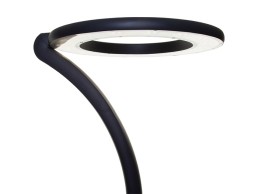
Kingfisher’s new Navar range of modular ring luminaires offer a striking new option for exterior lighting applications. David Morgan takes a closer look at the new range.
There are many possible starting points for a new lighting company that can define the culture and structure as the company grows. In the case of Kingfisher, the starting point in the late 1980s for founders John and Barbara Harding was the supply of lighting columns and associated brackets. From here, the company has grown and developed into a leading UK manufacturer of exterior lighting equipment for a wide range of technical and amenity lighting applications, including street lighting, high mast, sports, transport, and amenity lighting applications.
Kingfisher provides a full lighting design service in addition to the production and supply of luminaires. The company is also the UK distributor for Italian manufacturers Arcluce and AEC, whose products supplement the Kingfisher product range.
Kingfisher joined the Luceco Group of companies in 2017 and this has accelerated the new product development process and widened its market reach. It now employs 85 colleagues at its headquarters in Nottinghamshire, and a total of 1,650 people are employed worldwide in the Luceco Group.
Early products, in addition to the columns, included the Quarto bulkhead, which was the first dark-sky friendly bulkhead on the market and was introduced in 2010. Originally designed as a CFL luminaire it has been developed into an LED luminaire and is still one of the bestselling Kingfisher products.
The latest product introduction from Kingfisher is the Navar range – a modular exterior ring luminaire. Unfortunately, I was not able to physically test this product for the review but James Miles, Kingfisher’s technical manager, presented the various product features during a video meeting with me.
The in-house Kingfisher development team has added some innovative design features to what can be considered to be a rather generic industry standard luminaire type, and these should allow it to be used in a wide range of projects.
The range includes two rings of different diameters, the 600mm Urban with an output of up to 18,000lm and the 900mm Pro with an output of up to 56,000lm. Typical mounting heights for the Urban are 4-6 metres and 6-8 metres for the Pro. The rings can be mounted individually or combined as a single high output Urban Pro luminaire with a mounting height of 8-12 metres.
The Navar ring luminaires incorporate a plug together system concealed under removable covers on the top of the luminaire, one on each side, for through wiring. This simplifies installation on site and also allows the two rings to be easily joined together during factory assembly. The design team made efforts to use hidden fasteners wherever possible so that the Navar has a clean, uncluttered and minimal appearance.
Pole options for the Navar range include a central pole, side entry and swan neck cantilever. When the Pro version is supported with the cantilevered arm the control gear is housed within the arm, which allows the luminaire to be a slim and minimal as possible.
It is envisaged that in addition to the pole mounted options the smaller size ring can be used on a catenary support for town centre urban lighting schemes where the trend is to remove as much street furniture as possible. The support and through wiring details built into the luminaire will be particularly useful for this type of application.
The larger diameter Pro luminaire contains 16x4 LED light engines while the smaller Urban product contains 8x4 LED light engines. The Navar optical system can be customised at the Kingfisher factory to meet detail project requirements in a number of ways. The individual light engines can be rotated to optimise the distribution offering asymmetric, one sided or radial distributions. For standard distributions Ledil optics are used, which are available in five distributions. In addition, an in-house designed, custom optic has been developed within the Luceo group that produces a square distribution with peak intensity at 70-degrees allowing public realm spaces to be lit uniformly with the widest possible luminaire spacing while still producing very good uniformity.
Light control is an important part of the Navar design and variety of anti-glare shields can be incorporated to reduce spill light and light trespass. These shields are mounted close to the light source to produce the best cut off and visual comfort.
Kingfisher has ensured that the Navar design is dark-sky friendly with little or no upward light output. The light engines are available with standard 4000K LEDs but also in warm white 2700K LEDs to meet the increasing requirement for bat-friendly and other environmentally sensitive lighting applications.
The Navar range is a useful addition to the Kingfisher range and it will be interesting to see the range of projects that use these luminaires.

Lauren Dandridge
Lauren Dandridge, Co-Founder of Chromatic, sits down with arc for a frank discussion on intersectionality, diversity and inclusivity in lighting, and how the industry can become more equitable.
Over the past two years, the world has been a tumultuous place. As we stayed inside to avoid the ongoing pandemic, we watched in shock and horror as societal injustices and inequalities were brought to the forefront.
The murder of George Floyd and the Black Lives Matter protests that followed in May 2020, and Sarah Everard’s murder in March 2021 were particular flashpoints, shining a harsh spotlight on the inequities that still exist surrounding race and gender. These moments forced many of us to look inwards, to question our own subconscious biases and privileges, and ask ourselves what we can do, what we need to do better. It led to a lot of difficult, in some cases uncomfortable conversations, but they are conversations that need to be had, nonetheless.
These conversations are what led to the formation of Chromatic – a new lighting design studio led by Lauren Dandridge, alongside co-founder Nick Albert, that is focused on addressing issues of inequity and accessibility in the lighting industry.
“The skeleton of Chromatic is the conversations that Nick and I have that come from a place of extreme discomfort for both of us as a Black woman and a white man – or at least it was at some point,” Dandridge explained. “Now the hard initial phase is over, and we’ve reached a point of comfort in terms of talking about these things.
“When we started the firm, we said from the outset ‘we don’t want to be just another lighting design firm’. There are truly outstanding lighting design firms that do really beautiful and artistic work. I think we can be capable of that and make the biggest, best work out there, but so what? Art without purpose goes in the hotels by the freeway that people only see when they’re in transition.
“I want something that is meaningful not just for me personally, but to my community and to the lighting industry as a whole, and at the time when we were talking about it, I didn’t see it. I found people outside of lighting talking about it, but I didn’t see my industry, that I’ve been in for a really long time, taking a firm stance and then doing something. That became an important part of what we do; we do lighting, but with the human condition always at the forefront.
“The human condition is so much larger than the parts that we as an industry have traditionally thought about. What we are here to do is have lighting talk about the whole human experience in a greater way than it has been so far. I think of Chromatic as a perspective: there’s a view that we take on how lighting informs and is used by humanity, but also the process through which you can execute those designs.”
For Dandridge, the journey that led to the formation of Chromatic was a long one, that saw her travel through theatrical lighting design, architectural lighting design, education, sales, and then back to architectural lighting design again. But through it all has been a love and fascination for light that has endured from an early age.
She recalled: “I went to a private school in Maryland. It had a theatre programme, and I remember in one of the theatre group’s plays there was a lighting effect that I saw, and I thought it was so cool. I talked to the teacher and asked them how they did that, and they showed me a lighting console. That was in middle school, so I ended up making a bit of a thing out of it and kept helping on the plays and the performances.
“Eventually, like most people, someone influential came into my life – her name is Susan Tannery, she was the theatre director at my high school. She told me she went to school for technical theatre, and it seemed like something that I would be interested in.”
As such, Dandridge went on to study Theatrical Lighting at Northwestern University in Evanston, Illinois. Here, she said that she took to heart the classic mantra of ‘do what you love, and it won’t be work’. She explained: “I thought I love theatre, so I’m going to do theatre. But it turns out it isn’t work, because it doesn’t pay well enough to be considered work.
“I decided to take a couple of chances on other things, where I first learned what it really meant to pivot and use all these skills that I had, but in a different avenue. I got an internship on a movie that was shooting in Chicago and worked in the art department. I learned a whole set of different things – we’re still creating environments and trying to create moods, but it’s much more based in reality.”
This experience led to another internship in Los Angeles the Spring before she graduated from college, which in turn led to a job. “But then another influential person came into my life, and they were not a nice person,” Dandridge continued. “I thought ‘you’re still working in this industry, even though it’s common knowledge that you’re not a great human being’. I realised that this is an industry that will continue to promote people who are not their best selves, and I had a really hard time with that. So, I thought ‘if I’m going to be in this industry, I need to have more skills and I need to be able to pursue a different position so that I know how to get there, so that I don’t have to work for that kind of person’.”
As such, Dandridge enrolled in some extra classes at UCLA. It was here that she met another influential person, Kathy Pryzgoda, who taught the lighting classes in UCLA’s Architecture and Interior Design programme. Like Dandridge, Pryzgoda had a degree in theatrical lighting, but was teaching the architectural lighting class – something that piqued Dandridge’s interest.
“I cold-called her and said, ‘I see you’re teaching architectural lighting; I have the same degree as you and I’m curious to see what you’re doing with it’. We went out to lunch and had a great connection, and she hired me to be an assistant. She was running an amazing, single-designer firm, making it work and still doing work at the Hollywood Bowl. I thought ‘this is the best life ever’, she was doing architectural work, which kept the finances consistent, as well as the theatrical work, which was the passion.
“But then, the economy tanked at the end of 2008, so I needed to find another job.”
Luckily for Dandridge, she had done some freelance work for another firm, Konsortum 1, where she met the next influential person in her life, Eileen Thomas. “She was working as a singular lighting designer in a massive electrical engineering firm. She was amazing – incredibly humble, and incredibly giving in terms of knowledge. When you meet someone who genuinely wants you to succeed, all you want to do is succeed for them, and that’s how I feel about Eileen. She saw potential in me as a junior designer, she was incredibly patient with me, and I embarked upon a very steep learning curve.”
And then, as Dandridge puts it, “life happened”. “As simple and terrible as it boils down to, I needed to make more money. I have an ambitious husband who has his own business, and we were looking at the kind of life we wanted to live – it wasn’t that I wasn’t making good money, but as hard as I was working for the money I was making, he said ‘you might as well be working for yourself’.
“David Komonosky, a salesperson at Performance Lighting Systems, had previously said to me ‘if you’re ever thinking about making a change, just give me a call’. So, I made this choice, which at the time seemed like an end of the world decision to leave design and become a sales agent. I thought that I had sold out and given up on life, but then what I realised once I started doing it was that being a sales agent is amazing. I could be the kind of sales agent that I would have wanted to call on me – I always kept a designer’s mentality while keeping a very clear line between what a salesperson does and what a designer should do. I felt that it was my opportunity to learn how the sausage is getting made.”
Dandridge worked in Specification Sales at Performance Lighting Systems for nine years before, in May 2021, making the decision to return to architectural lighting design to establish Chromatic alongside Nick Albert.
“I had been feeling for a few years that this career is checking so many of my boxes except for my personal passion – I work for great people, I make good money, I’m able to take care of my kids, Performance helped me be the kind of mum I wanted to be for a really long time. Now it just so happens that I need to show them something different,” she said.
“Nick and I met around 2015, when I started to call on the design studio he was running. We started talking about future plans in late 2020. We had already become good friends and spent a lot of time talking about the industry, things we liked and things we wished were better. Shortly after, he was speaking with his wife, Susan, and she mentioned that he and I should work together. So technically the beginning of Chromatic was neither of our idea, but instead Susan’s.
“We spent 6-7 months thinking and marinating on the kind of firm we would want to have and the kind of work that we wanted to do. Finally, after what felt like an eternity, we launched in August of 2021.
“Chromatic is something that I had always wanted to do – not necessarily having my own firm but being a designer and having your work be viewed and done in a way that is reputable and good for the environment and good for humanity and all these things.
“Chromatic is our love song to how we want lighting to be effective in the world. It’s about process and perspective. We’re saying, ‘here’s this diverse firm with different perspectives in terms of race, gender, our personal histories’ – we value all of that and it informs how we approach projects.”
Since forming Chromatic last year, and indeed since the tragic events of 2020, Dandridge has been looking at what she can do as a designer and an educator within her role as Adjunct Assistant Professor at the University of South California (USC), to address issues surrounding equity, or the lack thereof, within lighting. In a particularly stirring piece for Architect Magazine, published in October 2021, she talked with Editor Wanda Lau about the “legacy of inequity in architectural lighting”.
“Most of my words start from a place of personal perspective,” she said. “I think about the entry into lighting design that I had as incredibly accidental. If you think about all the things that interested you as a kid, how many of those stuck? Why was it lighting? I don’t know, other than that’s the seed that got the most nurture and attention.
“Is there equity in lighting? No. If you look at the people who are practicing lighting design, the people who are practicing in lighting as a whole, if you walk the Lightfair show floor, you will see that there’s not equity there. Is there equal access to the industry? Sure, from a paper standpoint; anybody can go to a university that has a programme and enter that. But just like most things, if you don’t know it’s there, you don’t know how to ask for it.
“I listen to a podcast by Malcolm Gladwell called Revisionist History, and in one episode he talks about the nurturing of students and how Ivy League schools were having a really hard time getting students of colour, Black students to come to these STEM (Science, Technology, Engineering and Mathematics) majors; but on the flipside there are these historically Black colleges and universities (HBCU) that are pumping out STEM-educated kids of colour. Yet when the predominantly white institutions are asked why they don’t have more students of colour, they say they can’t find them.
“The parallel that I’m drawing with lighting is that it feels very much the same way. If we can increase the access point from at least one mechanism that we can control – we know that trade schools have entry points, we know that if we start early, we can get kids more interested in STEM and artistic endeavours – we can let them know that this is an opportunity that they can ask for.
“I teach at USC, and I have very few Black or Latinx students, and so much so are we singular in our existence that when we launched Chromatic, all the students that I heard from were students of colour who specifically remembered seeing me in that class and thought ‘oh my gosh, I have a Black teacher’.
“The industry isn’t equitable because it started off as an industry that wasn’t equitable, and it can’t change until the people in that inequitable industry decide to reach out and pull other people into it.”
As for her own personal experience as a Black woman in the lighting industry, Dandridge said that she hasn’t received any “incredibly outward or noticeable experiences of discrimination”, but rather micro-aggressions and unintentional biases.
“I have consistently been the only Black person in a space for years. But most of the spaces that I have been in have leaned much more towards the ‘I don’t see race’ part of the conversation; and when you don’t see race, it’s impossible to have tokens, because everyone is exactly the same – ironically until you have a baby, then all of a sudden, you’re a woman.
“But what’s interesting is that people are very willing to acknowledge gender, because it feels like a natural organisation of humanity. People talk about marriage, about having kids, all these things that have gender implications built into them, and that may change based on the level of equity we’re seeing in terms of non-binary gender issues. But when it comes to race people are incredibly uncomfortable because there’s no sophisticated language for dealing with all the layers that racism has. When you say racism people immediately feel like you’re talking about them, and it’s so hard to have conversations in workplaces surrounding race where the immediate defensiveness isn’t projected onto you.
“The idea of ‘colour-blindness’ has put white people essentially on defence, where if they even say the word Black or acknowledge Blackness, then they are somehow opening the door to someone questioning them. And until that dynamic, where the immediate defensiveness of acknowledgement of race goes away, the equity part of lighting is going to be very hard to counteract.”
The contrast between gender and racial equity in the lighting industry leads the conversation to the notion of allyship and privilege – something that arc has been particularly focused on over the last few issues. Where the lighting design community has been very keen to support gender equality and highlight male privilege, is Dandridge concerned that racial equity and white privilege is being overlooked?
“The constituency of women has grown over the years, and any time you have more voices, a singular message can be heard more loudly,” Dandridge said. “It’s interesting because the intersection of race and gender and religion and all of these other things happen, and we don’t always know how to acknowledge them simultaneously.
“If we look at the mindset that being a white man is the ‘norm’, or the standard that we’re trying to get to, then white women are right there. But then you have the complexity of, depending on your perspective, I would argue that men of colour have more privilege than white women because of their position as men. You could do-si-do the different human points a million different ways to make it seem like none of them are achievable and yet all of them are achievable.
“The hard thing about privilege is that it’s something that you don’t realise that you have. Trying to convince somebody who worked really hard to get where they are, who sacrificed, made less money, put their head down, that even in all of that work and in that success, they were privileged is going to go down like a lead balloon. Until we can all acknowledge a level of privilege it’s going to be hard to make substantial progress.
“I have it as an educated person, as a lighter skinned Black person, as an American. The level of privilege that I have, I have to acknowledge when I’m in conversations.”
Alongside Dandridge’s views on equity in the lighting industry as a profession, she’s also heavily invested in achieving wider, societal equity through light. In a previous interview inside arc, Dr. Shelly James referred to light as a ‘social differentiator’, and while Dandridge agreed to an extent, she feels that it is “a symptom of a larger problem in how it is applied”.
“Lighting does not care what it does, it is an inanimate object that is taken as a tool by which people in power can wield it against those not. Much like being able to own a home is indicative of a larger financial and economic system, lighting falls into the same category of something that can be weaponised against a group of people, because it is a necessary item that we need for nightlife, for existing in buildings, and anything that is of need, once it is withheld, it puts you in a place of discomfort.
“I think lighting is a social signifier, not in the same way that having a fancy car is, but that you become part of a group that is being transgressed upon, or surveilled, or undervalued by a system that is supposed to look at everybody equally.
“The second issue is that lighting design as a service industry, for better or worse, largely exists in a place of privilege, in that we are an additional service fee on top of an already expensive process. It’s considered extra fancy if you have a lighting designer in the same way that if you had an interior designer or a landscape designer – it’s hard to say that we aren’t specialised to the point of exclusion.
“This is also something that Nick and I talk about; how can lighting design be more equitable? How can we get on the projects that affect more people, that make the quality of light a necessary item to consider?”
This is one of the primary considerations for Light Privilege – a design framework established by Chromatic, through which Dandridge and Albert are trying to address inequities at night by understanding the ways in which light intersects life, talking about privilege and its role in our illuminated experiences, and confronting the ways that light has been used in systems of racism and oppression.
“Accepting that privilege exists becomes the imperative for identifying, understanding and working to counteract the systemic mechanism of inequity,” Dandridge said. “Light Privilege seeks to ensure that all communities have access to the beauty and possibilities of light. We want to take this information and present it to stakeholders and say that lighting has to be a part of this conversation – not lighting from a financial/economic standpoint, but as the creation of an environment, because we know that doing lighting for the least amount possible, by people who don’t understand the greater implications, doesn’t work.
“It will forever be a work in progress, there are always new mountains to climb, but for right now I’m happy for every opportunity to be able to talk about it.”
Looking ahead, Dandridge is keen to continue spreading the word about Light Privilege and building up Chromatic’s portfolio of work. The studio has several projects nearing completion, and Dandridge explained that they are already looking at expanding.
“We have this firm that has this perspective, we created this process, but we’ll need to hire soon,” she said. “I don’t want to have just any firm, because then it wouldn’t be my firm, and I want to have a place where people can truly bring their whole selves. You shouldn’t have to put away 40% of who you are to have peace at your job, and that’s the goal of Chromatic, to be able to have people who believe in our mission and us, and who we believe in and work together to support this way of life, of being your whole selves: the uncomfortable, sticky parts and the parts that are shiny and polished. They exist in the same place, so that’s a big goal of mine for Chromatic – I want to be even better than the people who were great to me.”
Until then, Dandridge will continue to have the difficult, uncomfortable conversations. Although she feels that over time, they are becoming easier.
“In some ways, it’s liberating. Part of working for somebody else is that you’re not sure you’re supported in all the ways that you can be your whole self, and part of entrepreneurship is that I can be my whole self and the consequences only rest on me, and specifically for Chromatic, Nick. But our partnership allows us that freedom because we both 100% believe in the things that we’re saying,” she said. “It’s terrifying at times, because there’s a certain level of success that you can have when you can be invisible and small, and when you step out and become visible and make statements, you’re inviting judgement and opinion, and there are days when those opinions can be a lot sharper than others.
“Dr. Manuel Pastor, a distinguished professor of Sociology and American Studies & Ethnicity at USC, said to me once that having these conversations is like going to the gym: the first time you go it’s really hard – but then you go a second time, and it still hurts, but it’s not like the first time. And you go again and again and eventually you can do the workout more effectively; you have been trained. And that’s what these conversations have to be like – I know that if I choose to do the work, I will get better, and I think that there is a universal truth in that, and that can be reflected here as well.
“If we continue to have these incredibly uncomfortable conversations with a level of honesty and protection, but not defensiveness, then we can make changes. The conversations beget the change, they are the door through which we walk, but we have to do the work and we can’t be scared of doing it, even though it hurts.”
Michael Grubb
With a big year on the horizon for Michael Grubb Studio, arc sits down with its founder to talk about how he became one of the hottest names in the UK lighting design community, and what the future has in store for the Bournemouth-based firm.
When the Covid-19 pandemic and ensuing lockdowns first hit back in 2020, many of us were understandably quite panicked, taking to social media to remind the world that yes, we are still here.
However, for Michael Grubb and his self-titled studio, he went in the opposite direction, using the enforced pause to look inward and reflect on his position in the lighting design world.
“I got a bit bored with throwback projects,” he told arc. “I get why people did it, but we went the opposite way and instead took a step back to reflect on who we are, who we want to be, what we represent, what our ethos should be moving forward.”
During this period of reflection, Michael Grubb Studio has undergone a rebrand and, as we start to cautiously move into a post-pandemic world, Grubb is looking ahead to what he called “Michael Grubb Studio Part 2”.
The rebrand comes just nine years after the formation of the Bournemouth-based practice, during which it has become one of the most sought-after lighting design firms in the country.
Grubb formed his eponymous studio in January 2013, shortly after working as Learning Legacy Ambassador for Lighting at London 2012 and winning the Lighting Designer of the Year award. His journey into lighting though, began back in the mid 1990s where, like many designers in his generation, he “fell into lighting design”.
“I studied Industrial Design and Product Design at Arts University Bournemouth and Three-Dimensional Design at the University of Plymouth, and I liked lighting as a thing, and I appreciated the mood and ambience that came with it,” he said. “It wasn’t alien to me, but my understanding was very surface level as a graduate. But through work experience I found it interesting and exciting.”
Graduating in 1998, Grubb considers himself “very lucky” that he entered the working world just as the country was gearing towards the new Millennium. Moving from the South Coast to London, he joined Sutton Vane Associates, where he gained access to a number of exciting projects. “There were all of these Millennium projects - the famous ones like the Dome and the London Eye, but there were also museums and national theatres, popping up everywhere. Over a very short period, I got access to a lot of them at a very junior level, and I loved it; I realised then just how important lighting design was, and how varied it was.
“It was like falling in love with someone; it wasn’t love at first sight, even though it’s more romantic to say that. I fell in love with it deeply over a period of months. When I was training, I never really knew where I would fit. I never felt that I wanted to be an architect or an interior designer, even product design even though that’s what I trained in. What lighting design does is it covers everything.”
Grubb worked at Sutton Vane Associates for 14 years, rising through the ranks to the position of Director, before leaving at the end of 2012 and returning to his hometown of Bournemouth. “When I left, I didn’t really know what I was going to do,” he said. “I got some extremely well-paid offers to work with some manufacturers, but by having these offers, it made it clear to me that I didn’t want to do that, and what was left was ‘you’re going to have to do it on your own’.
“I took six weeks over Christmas to think things through, but once I knew I was going to do it, I got really excited, and my brain was working in overdrive. I was also very nervous - I had one kid back then, a mortgage, a family, and people kept saying to me ‘you’ll never do it in Bournemouth, you’ll never succeed outside of London or a major city’.
“But it was an extremely liberating thing. It’s like having a blank canvas - you don’t know what the name of your business is going to be, what your logo is going to look like, your website, you haven’t even thought about projects yet - it was a very exciting period.”
To that end, Grubb explained that he never intended to name the new studio after himself, as the goal was never for it to be a solo project. “I didn’t want the company to be Michael Grubb anything,” he said. “I was adamant that it would be called something else. I spent two weeks getting hardly any sleep, thinking of every possible name I could come up with which had either already gone; was unbelievably cheesy and clichéd; or so vague and pointless that it was pretentious.
“But then someone in the industry said to me ‘you’d be an idiot if you don’t use your name, because you’ve just won Lighting Designer of the Year, and everyone knows who you are. Start with your name and by all means change it in the future if that’s what you want to do’.
“In a weird way, I didn’t feel the pressure at the beginning because I never necessarily saw it as being me. I had no intention of being a one-man band. I started from day one with a collective team mentality not as an individual - my mindset was quite blinkered on being a team from the outset.
“And that happened very quickly as well: within six weeks to three months, it was quite surprising what contracts and what clients we had. That’s when I realised more than anything, people work with people, rather than companies or names or logos, and I hadn’t really appreciated that until I started up - I thought much more that I was starting again, but I wasn’t.”
With such a keen focus on the studio being a collective, he has always sought to surround himself with a strong team of designers, something that he feels is “absolutely critical”. “I’m at peace with this now, but my name is a brand, and the problem we have is that sometimes people do assume that it’s just me, so it’s really important that I have a strong team around me to be able to say it’s not about me,” he said.
“A few times people have said to me ‘what you need is another you’, and I always say that’s the last thing I need. What I need is people that challenge me, are happy to disagree with me, there’s no point in getting ‘yes’ men or women who just nod. Diversity in thinking and skillsets and talent is really important. It’s like a football team – there’s no point in having the best 11 goalkeepers, you need to have diversity and balance.”
Grubb’s mindset of the wider collective is something that isn’t limited to his own company either, as he added that from the offset Michael Grubb Studio always recognised the community feel of the lighting design industry. “One of the things that I definitely bought into was the idea of being positive and embracing other people’s work. I don’t allow anyone in the office to say ‘competitors’, they’re ‘friends of the industry’.
“Generally, I get on really well with all of the other consultants, so at events like
[d]arc night, we’ll chat to everyone; at awards parties, I’ll congratulate the winners afterwards, and it’s all genuine. That genuine community spirit is something that I want to embrace, and then that creates positivity internally as well.”
On a stylistic level though, Grubb hoped from the beginning that he could tap into what he identified as a gap in the lighting design market to create something more unique and standalone. “At the time, everyone was quite rigid in terms of how they worked, on the one hand you had the engineering-minded designers, and then the architectural lighting designers; and on the other hand, you had the light artists. I wanted to position ourselves between architectural lighting and light artists; we’re not saying we’re light artists, we are architectural - but there’s a creative, theatrical, bold, statement area that I didn’t think was being exploited but more importantly, fell where I thought I was as a designer at the time.
“We wanted to create technically sound, but really subjective lighting design. Our approach was ‘as long as we think it looks cool, it’s done’. That was enough of a starting point to know where we were going. Even when we did the logo, everyone else’s was black and white and we had a big, colourful logo, so it was a statement of intent - we’re going to be different and we’re confident in being different.”
That being said, Grubb doesn’t feel that he has a particular ‘signature style’, at least, not intentionally. “Two or three times when I’ve done talks and we’ve had a Q&A at the end, people have asked ‘you do a lot of bold, wow, impact projects and you don’t mind using colour, is that deliberate?’ I always said no, but the fact that I keep getting asked about it, maybe it subconsciously is.
“People say that lighting design should be effortless, that you walk into a space and feel the warmth, and while I buy into that, to some extent I do want people to walk into a room and think ‘look at this restaurant, it’s really warm, really cosy, and wow the lighting is cool’. I want that end bit where people notice the lighting.
“When we get hired, clients are looking for a bit of bang, something that is not too subtle. The bigger you get, you can’t always be like that, but you’ve only got to go on our portfolio page to know that there’s quite a lot of intensity there at times – that’s what people wanted, they wanted a creative statement with light.”
This approach has seen Grubb and his studio work across a wide range of projects, from public realm and exterior lighting to retail, museums, and visitor experiences. “I would say that we’re quite diverse,” Grubb said. “I quite like new challenges. For example, when we got involved with Lush it wasn’t retail that appealed to me, it was their brief, approach, what they were trying to do and untangling problems for them, creating our own creative brief that they then bought into, and then pushing them in the right direction.”
With a diverse portfolio of work, Grubb feels that there isn’t one particular “landmark” project that helped put the studio on the map, but rather a consistent collection of projects “that all happened at the right time”.
“You’re only as good as your last project,” he said. “If you look back six or seven years ago, I’m still very proud of what we did, but if you’re still openly promoting them, I feel like you’re living off past glories.
“We’ve won a lot of awards for Bath Abbey recently and I’m really proud of that. We’ve had moments when we worked on the Olympic Park, the project with Lush, developing the design language for the Guinness Storehouse – these are all quite different, but the key thing for us is that we’re staying relevant across different sectors and different disciplines; we’re always thinking differently and moving forward.”
One area in particular where Grubb has been relatively forward-thinking has been his longstanding push towards sustainability and the circular economy – something that the lighting industry at large is now much more committed to. Not long after the formation of Michael Grubb Studio, Grubb established Re-Lit, an initiative that works with manufacturers to take superseded, damaged, or ex-demo lighting products, recycle and reuse them.
Grubb explained that the formation of Re-Lit wasn’t a preconceived, conscious idea from the start, but something that evolved over time. “A lot of ideas come to us through conversations,” he said. “If you have conversations, over days, months, years, things will bubble to the surface.
“Re-Lit started as a conversation in the pub between Stuart [Alexander, Associate at Michael Grubb Studio] and I. The whole idea came from the number of samples that we had knocking around, and in the LED world, just how much waste there was when we only had them on for 20 seconds and they last for 20 years, but when we tried to return them, the companies had already made better, newer products. We thought that was a big waste, but maybe we could turn it into a charity.
“These things evolve naturally, and when we worked with Lush, they came to us with a completely different set of problems; they were telling us about their green credentials, and we happened to be doing Re-Lit at the same time, so we merged some of that together. It wasn’t called the circular economy at the time, but that’s what we were doing. We looked at how we could get products maintained through multiple stores over 20 years, even to the point of designing the packaging and how it would be stored. We went through the whole process before this idea of the circular economy was widely discussed.”
Although Michael Grubb Studio was relatively ahead of the curve when it came to thinking about the circular economy in the lighting industry, Grubb said that he feels “slightly awkward” when people tell him that he was at the forefront of the movement. “We weren’t pioneering anything; we were just naturally doing it on commercial projects. There were better, more impressive people than us doing it, but people realised that we were doing it and brought us into the conversation. We were more than happy to contribute, and still are, but to say that we drove the industry with it would be very misleading, and makes me feel like we would be getting more credit than we probably deserve.”
Looking ahead, Grubb believes that the circular economy and “second-hand lighting industry” will continue to gain steam, although he doesn’t believe it’ll be the next big revolution.
“It’s a bit like Back to the Future 2, isn’t it? You can predict the future and you’ll get some things right but most things wrong. It depends how far into the future you’re trying to predict,” he said.
“I think what is going to happen now though, where we used to have massive moments like the advent of LED, now there’s going to be lots of little things that shift the way we think. I think education and training needs to change, and it will. The lighting design community is becoming more diverse, there’s more studios and practices than ever before, and everyone is going to find their way of carving themselves into the market.”
As for his own studio, Grubb revealed that he has big plans for 2022. “I’m never a believer in standing still, because eventually you’re going to get caught out,” he said. “There’s an energy in doing new things and being positive and exciting.
“The biggest thing we’re going to do in 2022 is start a London studio. This isn’t a reaction to being in Bournemouth, but a positive step as we’re looking to expand the Michael Grubb Studio brand long-term, globally.”
Alongside a rebrand for the studio, Grubb also added that in 2022 he is looking “to push the team as individuals in the collective to give them the recognition and acknowledgement and support that they deserve”, while also offering more in the way of education and training.
“I’m creating an entire training matrix that then creates a roadmap for each individual designer in the team,” he added. “The roadmap is about career progression, but also based on skills, knowledge, creativity and being clear in terms of what the stages are and how you get there.
“I’ve also registered Michael Grubb Academy, as I believe that there should be some kind of apprentice scheme in place for lighting designers. I’m trying to create a system internally to then be able to open it up externally. I’ve also been in discussions with the ILP among others, as it doesn’t have to be a Michael Grubb thing – I don’t see it as a commercial idea, but a gap in the industry.”
Continuing with the recurring theme of spotting gaps in the market, Grubb also revealed that he plans to publish a book this year, entitled Stories with Light. “There are a lot of technical books on the science of light, and a massive range of books in terms of inspiration, but what I realised was that there are all these stories about light that sit in the middle, and that’s what I wanted to explore.
“There are musings, stories, some that are quite bizarre, touching, random, there are sorts of weird characters – it’s a bit like being around a campfire and swapping tales of lighting.”
With all of this going on, Grubb sees 2022 as the beginning of a new phase for Michael Grubb Studio, and hopes that he can continue to build a brand, and a culture, that people will want to work with.
“We talk about the Great Resignation – I think as human beings, not just lighting designers, everyone has now got strong ideas of who they want to work for, why they want to work for them. I want to create an ethos where we appeal not just to clients, but lighting designers, to be part of something. That’s what people want now – people want a purpose and to feel like they’re part of a movement that they believe in.”

Lauren Lever
After more than 14 years’ experience in lighting design, last year Lauren Lever established her own practice - Minoux. arc sits down with Lever to discuss the move, and her aspirations for Minoux.
How did you get into lighting design?
I am one of the ‘old school designers’ in our industry, when lighting design wasn’t a subject that you could take at university. We came from different backgrounds, whether that’s architecture, product design or engineering. This is part of the reason why I love our industry, as we have such a rich mix of backgrounds and knowledge. I always had a passion for design at school, even though I was one of only two girls in the class and was told that it was normally categorised as a boy’s subject; this still didn’t stop me as I loved the subject and wanted to learn more. This led me to study Product and Furniture Design at De Montfort University in Leicester. During my time there I decided that one of my work pieces would be to design and build a light fixture. When it was time to see which career path I wanted to go down, I found out that lighting design was an actual job and I jumped at the opportunity. I have now been in the industry for more than 15 years and continue to love what I do.
What led you to setting up your own studio?
It was something that I always wanted to do and knew that it would happen when the time was right. I decided to take the leap and start my own lighting design studio last year and I haven’t looked back. Some people thought I was mad doing it in the middle of the pandemic, but I believe there is never a right time to start a new business; you just need to jump right in.
Do you have a ‘Mission Statement’ for Minoux?
I feel my ethos is all about creativity, innovation and being customer focused with an appetite for great lighting design. No project is too small, and I relish the opportunity to share my passion with others.
Will you specialise in a particular area?
I have worked on a number of diverse areas during my career as a lighting designer, but found my focus is prominently in the Hospitality, Residential and Commercial sectors. I do not have a ‘house-style’ and believe that each project deserves to be designed and tailored to suit the client’s needs. I particularly enjoy working on hotel projects, where varied atmospheres and ambiences can be created for each space; ranging from dark and moody bars, to sensual spa experiences or bright and welcoming receptions.
How have your past experiences shaped your approach for Minoux?
I believe that my past experiences have shaped me into the designer that I am today. Each lighting consultancy had their own particular specialism, which has helped me learn all aspects of lighting design and improve my skillset. I have had the pleasure of working for some of the top women in the industry and I am grateful to have been given the opportunity to learn from each of them.
What are your aspirations for Minoux? What do you hope to bring to the lighting world?
Lighting design is still unfortunately one element of a project that gets left to the last minute or forgotten about. I believe that lighting can make or break a project. I have been lucky enough to talk at many events in front of architects and interior designers, which has allowed me to fly the flag for getting a lighting designer in at the earlier stages of a project, showing the end client that good lighting design doesn’t need to cost the earth.
Can you tell us a bit more about your collaboration with Prolicht and Tom Dixon for the Workspace Design Show?
I had the pleasure of working with the Workspace Design Show and they asked Minoux to provide a lighting installation at their main entrance. I was excited to see what could be achieved within the iconic space of the Business Design Centre. Lighting installations should be fun, engaging and draw people in. Prolicht had recently collaborated with Tom Dixon to design a range of light fixtures which shows a rawness and industrial feel to LED technology. Looking at the range, I thought it was perfect for the show, combining the use of smooth lighting controls and programming which was provided by Casambi; this allowed the product to come to life using animation.
What sort of reaction have you had so far? Do you have a lot of work already in the pipeline?
The reaction has been really positive and supportive, especially during the pandemic and I have been fortunate to hit the ground running. It is scary and daunting at times, but looking back I wish I took the plunge sooner. 2022 is looking promising to say the least.
What does the future hold, both for Minoux and for the lighting industry as a whole?
The lighting industry has come on leaps and bounds with the growth of new technology. The new focus at the moment is all about sustainability of fittings and circularity, which has been a long time coming in my opinion. We need to work with manufacturers and future proof our designs to develop much more sustainable projects. As for Minoux, watch this space.

New CEO named for Biennale Interieur
(Belgium) – Caroline Fiers takes over at the helm of the Biennale Interieur, the largest design event in Belgium.
The new CEO succeeds Jo Libeer, who is winding down his professional activities after a full and rewarding career. After a few turbulent years for the entire sector, and with the next Biennale in the offing this autumn, Fiers is excited about the opportunity to drive change.
Fiers joined the Interieur team in 2019 as Commercial Director. In 2021, she already took on a lead role managing the event Please, Have a Seat. “After the cancellation of the Biennale in 2020, we were not just looking for a way to maintain our existing relationships. We were looking for opportunities, exploring new avenues. The event was a great success despite the uncertainty of the pandemic, and I am confident that our team is well positioned for the period ahead.
“Please, Have a Seat was a first step in the search for something new and refreshing while remaining true to the core values of the Biennale. We work together with many different partners, stakeholders and target groups, and collaboration is key. That means we have to listen and understand the changing needs among the various players in the design world. I expect to be supplementing my team with people who can help me come up with new ideas and insights, think outside the box. There will be many exiting things to look forward to for our partners and visitors!
“The crisis put many efforts in our sector in jeopardy, but it also has forced us to be more innovative. We want to continue on that path now, looking for ways to continue to inspire and bring people together. I am more convinced than ever that being together in person, creating conversation on design topics that matter, and driving a sense of community around shared goals must be core parts of our added value.”
Interieur 22 takes place from 20 to 24 October 2022.